O R I G I N A L A R T I C L E
Open Access
“
Special needs
”
is an ineffective
euphemism
Morton Ann Gernsbacher
1*, Adam R. Raimond
2, M. Theresa Balinghasay
1and Jilana S. Boston
1Abstract
Although euphemisms are intended to put a more positive spin on the words they replace, some euphemisms are ineffective. Our study examined the effectiveness of a popular euphemism for persons with disabilities,special needs. Most style guides prescribe against using the euphemismspecial needsand recommend instead using the non-euphemized termdisability; disability advocates argue adamantly against the euphemismspecial needs, which they find offensive. In contrast, many parents of children with disabilities prefer to usespecial needsrather thandisability. But no empirical study has examined whetherspecial needsis more or less positive than the term it replaces. Therefore, we gathered a sample of adult participants from the general population (N= 530) and created a set of vignettes that allowed us to measure how positively children, college students, and middle-age adults are viewed when they are described as havingspecial needs, havinga disability, having a certain disability (e.g.,is blind,has Down syndrome), or with no label at all. We predicted and observed that persons are viewed more negatively when described as havingspecial needsthan when described as havinga disabilityor having a certain disability, indicating thatspecial needsis an ineffective euphemism. Even for members of the general population who have a personal connection to disability (e.g., as parents of children with disabilities), the euphemismspecial needsis no more effective than the non-euphemized termdisability. We also collected free associations to the termsspecial needsanddisabilityand found thatspecial needsis associated with more negativity;special needsconjures up more associations with developmental disabilities (such as intellectual disability) whereasdisabilityis associated with a more inclusive set of disabilities; andspecial needsevokes more unanswered questions. These findings recommend against using the euphemismspecial needs.
Significance
Our research question grew directly from a real-world problem. As the examples quoted in this study demon-strate, the euphemism special needs occurs in everyday vernacular as well as in the scholarly literature. Thus, empirically examining the effectiveness of the euphemism
special needsis use-inspired basic research.
Background
Euphemisms are“expressions used in place of words or phrases that otherwise might be considered harsh or unpleasant” (Annan-Prah, 2015). Employees are not fired; they are let go. Animals are not euthanized; they
are put to sleep. Humans don’t die; they pass away
(Crespo-Fernández, 2006). In years past, pregnant women were referred to as being in a family way, and
children entering puberty were referred to as going
around the corner (Riggs, 2013). Euphemisms occlude
uncomfortable topics.
The word euphemism derives from the Greek word
eupheme, which is the act of using language to effect a good omen (in contrast to blaspheme; Burkhardt, 2010). When Portuguese sailors were forced to navigate The Cape of Storms, they renamed the rocky headland The
Cape of Good Hope; when ancient Romans conquered
the city of Maleventum (which means bad result), they changed the city’s name to Beneventum (now called Benevento; Griffin, 1985). Euphemisms, words used to effect good omens, have been popular for millennia.
In modern day, euphemisms are often used intentionally to deceive or manipulate others. Rather than speaking of economic recessions, politicians speak of minus growth; rather than speaking of military attacks, they speak of
missions(Burkhardt, 2010); rather than bribes, they speak of soft commissions (Rittenberg, Gladney, & Stephenson, 2016). Such Orwellian double-speak lives not only in the * Correspondence:[email protected]
1University of Wisconsin-Madison, Madison, WI, USA
Full list of author information is available at the end of the article
lexicons of politicians, but also the everyman. If we cannot afford to buy a new car, we buy a pre-owned car rather than a used car; if we cannot afford to fly first class, we fly
coachrather than second class (Burkhardt, 2010).
Euphemisms are believed to serve both those who pro-duce them (speakers and writers) and those who receive them (listeners and readers). Linfoot-Ham (2005, p. 228) believes that euphemisms “protect the speaker/writer, hearer/reader, or all of the above.” Bowers and Pleydell-Pearce (2011, p. 2) believe that euphemisms“allow speakers (and listeners) to think about issues that might otherwise be avoided.” Allan and Burridge (1991, p. 11) believe that euphemisms “avoid possible loss of face: either one’s own face or…that of the audience.”However, laboratory studies demonstrate that euphemisms are more likely to be pro-duced in service of saving the producer’s face rather than the recipient’s face (McGlone & Batchelor, 2003).
Although the explicit purpose of euphemisms is to avoid offense, some euphemisms cause offense. Doctors can be offended when they are called providers (Sergel, 2015). Church members can be offended when they are called
customers (La Cour & Kromann, 2011). Patients can be offended when their experience with cancer is euphe-mized as ajourney(Appleton & Flynn, 2014), and workers can be offended when their employment termination is conveyed as downsizing (Vickers, 2002). The very words intended to sugar coat can be more distasteful than the words the euphemisms displace.
Euphemisms can also be ineffective. The doctor-preferred euphemismyou have fluid on your lungs because your heart is not pumping hard enoughis no more effective to patients at risk of heart failure than the non-euphemized term heart failure (Tayler & Ogden, 2005). The nurse-preferred euphemismyour weight may be dam-aging your healthis demonstrably less effective to patients who are obese than the non-euphemized termobese(Swift, Choi, Puhl, & Glazebrook, 2013; Tailor & Ogden, 2009). The goal of our study was to examine the effectiveness of a popular euphemism for persons who have disabilities.
Special needsas a euphemism for disability Euphemisms for disability are popular—so popular that style guides prescribe against using euphemisms for per-sons who have disabilities. For example, the American Psychological Association (2010, p. 76) tells writers to
“avoid euphemisms” for disability, such as“special, physic-ally challenged,handi-capable”because those euphemisms
“are condescending.” Similarly,“bypass condescending eu-phemisms” is a primary recommendation of the Re-search and Training Center on Independent Living (2013), who note that “terms such as special, handi-capable,differently abledandchallengedreinforce the idea that people cannot deal honestly with their disabilities.” The American Speech-Language-Hearing Association also
prescribes against using euphemisms for disability because euphemisms cannot“hide disability, but they can produce confusion”(Folkins, 1992).
Over the past few decades, the term special needs has become a popular euphemism for disability (Berger, 2013). Rather than identifying a person ashaving a disabilityor having a certain disability (e.g., Anika is blind, Bruce has ADHD), the person is euphemized ashaving special needs. Figure 1 demonstrates the steeply rising popularity of the
term special needs, based on Google’s NGram count in
published books dating back to 1900. Currently, Google Scholar indexes over a million scholarly articles with the
term special needs, and Amazon.com sells nearly 5000
books with the euphemism special needs in their title.
Special needsis an increasingly popular euphemism. The origin ofspecial needs as a disability euphemism is unclear. Guralnick (1994) reports in the 1990s changing the wording of a 1980s questionnaire for parents from handi-capped children to children with special needs, suggesting that the euphemism had taken hold by the end of the 20th century. Figure 2 demonstrates the declining popularity of the termhandicappedbased on Google’s NGram. Shapiro-Lacks (2013) proposes that the euphemism special needs
morphed from the term Special Olympics, established in the late 1960s, and the concept of special education, also established in the 1960s.“At some point, people with dis-abilities began to be referred to as special, our needs as
special needs, and our demographic as the special needs population,”writes Shapiro-Lacks (2013).
However, special needs is not a legal term. In nearly a thousand pages of US law, including the Elementary and Secondary Education Act of 1965, the Rehabilitation Act of 1973, the Individuals with Disabilities Education Act of 1990, and the Americans with Disabilities Act of 1990 and 2014, the term special needs occurs only a dozen or so times. And never once are children with disabilities or adults with disabilities referred to aschildren with special needsoradults with special needs. Rather, individuals with
disabilities are always referred to in US law asindividuals with disabilities.
Federal laws use the termspecial needsonly to refer to the distinctive requirements of various groups. For ex-ample, the 2004 Individuals with Disabilities Education Act tasks a federal research center to “examine the special needs of limited English proficient children with disabil-ities.” The 1984 amendment to the Vocational Education Act tasks a state board to “assess the special needs of groups of individuals,” and those groups include “ viduals who are single parents or homemakers and indi-viduals who participate in programs designed to eliminate sex bias and stereotyping in vocational education.” The 1974 amendment to the Elementary and Secondary Education Act tasks a state agency to assess the special needsof the Commissioner of Education (a federal position now called the Secretary of Education). Thus, federal laws do not usespecial needsas a euphemism for disability.
Most style guides also prescribe against using the eu-phemismspecial needs. For example, the National Center for Disability Journalism (2015, p. 23) warns that“the word
special in relationship to those with disabilities is now widely considered offensive because it euphemistically stig-matizes”persons with disabilities. Therefore, the National Center for Disability Journalism (2015, p. 23) advises to
“avoid using these terms [special and special needs]” and instead “cite the specific disability or disabilities in ques-tion.”Similarly, the Research and Training Center on Inde-pendent Living (2013) advises that“the use ofspecial needs
is offensive…Just sayindividuals with disabilities.” Disability advocates argue adamantly against using the euphemism special needs. Kailes (2010) deems special
needs “an offensive euphemism” that is “patronizing,
inappropriate, and distancing.” Woodward (1991) and Linton (1998, p. 14) deemspecial needsa condescending euphemism, promoted by paternalistic “do-gooders.” Rucker (2014) deemsspecial needsakin to other“socially unacceptable words”and“ethnic/social slurs no longer tolerated.” Indeed, in an international survey of
English-speaking persons with disabilities conducted by the BBC,specialranks fourth in a list of terms con-sidered offensive;special was barely beaten out by the slursspasticandretard(Ouch!, 2003).
Several campaigns have lobbied to remove the euphem-ism special needs. Using social media, Lawrence Carter-Long (Carter-Carter-Long, 2016) advanced the Twitter hashtag #NotSpecial alongside the hashtags #SayTheWord and #Disabled and UK television star Josh Reeves (Reeves, 2015) launched the #Don’tCallMeSpecial campaign. In the Disability Studies literature, UK scholar Colin Barnes campaigned to replacespecial educationwithinclusive edu-cation, replacespecial educational needswithunmet
educa-tional needs, and replace the euphemism children with
special education needs (SEN) with the non-euphemized
termdisabled children(Barnes & Sheldon, 2007).
However, parents of children with disabilities and profes-sionals who work with children and adults with disabilities are not nearly so comfortable with the non-euphemized terms disabled and disability (Foundation for Jewish Summer Camps, 2015; Steinberg, 2013). As one mother re-lates,“I don’t like the termspecial needs, but…I don’t like the word disabled or disability any better” (I Am The Giraffe, 2010). Another mother relates,“Every single time I use that term [special needs], I flinch inside; it just sounds so…stiff. Still, it’s less harsh than the reality of disabled”
(Love That Max: Special Needs Blog, 2008). One father re-lates,“I prefer the termspecial needs[because] I feel like it is a little bit less derogatory,” and another father relates,
“special needs maybe sounds more positive, you know,
thandisability”(Sams, 2012, p. 147).
The goal of our study was to examine empirically whether the euphemism special needs is indeed more positive than the non-euphemized termdisabilityamong the general population, as well as among parents of chil-dren with disabilities, people who provide services to persons with disabilities, and other people with a per-sonal connection to disability. We constructed a set of vignettes, which we manipulated to allow us to answer empirically the question of whether special needs is an effective euphemism fordisability.
Vignettes as a tool for studying attitudes
Vignettes, “short stories about hypothetical characters in specified circumstances” (Finch, 1987, p. 105), were pioneered in the 1960s as a tool to study attitudes (Goldberg, 1968; Nosanchuk, 1972). Since then, vignettes have been used to study a range of attitudes, most notably prejudicial attitudes, including sexism (Baron, Burgess, & Kao, 1991), racism (Gilbert, 1998; Haider et al., 2011), ethnic prejudice (Hudley & Graham, 2001; Mills & Gaia, 2012), religious prejudice (Pitner, Astor, Benbenishty, Haj-Yahia, & Zeira, 2003), homophobia (St. Lawrence, Husfeldt, Kelly, Hood, & Smith, 1990), xenophobia Fig. 2Percentage (10−5) of published books (from 1900 to 2000) in
(Caprariello, Cuddy, & Fiske, 2009), and ableism (prejudice against disabled people; Butler & Gillis, 2011; Grewal, Joy, Lewis, Swales, & Woodfield, 2002; Matthews, Ly, & Goldberg, 2015; Nevill & White, 2011; Werner, 2015).
Vignettes are ideal for answering our research question because they allow subtle manipulation; in fact, the manipulation can be limited to only one or two words. For example, to examine whether racism affects hiring decisions, employers can be given identical descriptions of job applicants that differ only by the applicant’s name (e.g., Jamal Jones versus Greg Jones; Bertrand & Mullainathan, 2004). To examine whether sexism affects teaching evaluations, university students can be given identical descriptions of instructors that differ only by the instructor’s gender (Kierstead, D’Agostino, & Dill, 1988).
Via manipulation of only one or two words, vignettes have been used to examine a range of use-inspired re-search questions, including driving accident responsibility (Davies & Patel, 2005) and sexual assault culpability (Neal, 2015). Most relevant to our study, vignettes have been used to examine the effectiveness of euphemisms (e.g., referencing used cars aspre-owned or bribes assoft commissions; Gladney & Rittenberg, 2005; Rittenberg et al., 2016). However, to our knowledge, no study has ex-amined the effectiveness of the euphemismspecial needs, which was our study’s goal.
Overview of the current study
To examine empirically the effectiveness of the euphemism
special needs, we constructed several vignettes. An example appears in Table 1. Each vignette described an envisioned situation in which participants were tasked with choosing a character. For example, in the vignette presented in Table 1, participants envisioned being a university freshman who has decided to live in the dormitories; therefore, the partici-pants were tasked with choosing a roommate. For another vignette, participants envisioned being a second-grade teacher whose principal needed to place one more child in their already full-to-capacity class; therefore, participants were tasked with choosing a new second-grade student. As another example, participants envisioned being a middle-age employee who is told to complete an important project in collaboration with a co-worker; therefore, participants were tasked with choosing a workplace collaborator.
For each vignette, participants chose among four char-acters (e.g., roommate A, B, C, and D). Participants ranked their choices first to last. Using a within-subjects design, we manipulated the following three experimental conditions:
Has a disability: The to-be-chosen character was described as having a disability, for instance,
“Roommate B is an 18-year-old business major and has a disability.”
Has a certain disability: The to-be-chosen character was described as having a certain disability, for instance,
“Roommate B is an 18-year-old business major and is blind.”
Has special needs: The to-be-chosen character was described as having special needs, for instance,
“Roommate B is an 18-year-old business major and has special needs.”
We also manipulated a fourth, no-label control condition:
No label (control): The to-be-chosen character was not described with any label, for instance,“Roommate B is an 18-year-old business major.”
With these found conditions we were able to test the effectiveness of the euphemismspecial needsagainst the non-euphemized term disability. We were also able to test the effectiveness of the euphemism special needs
against the label of a specific disability (e.g., is blind). And we were able to test the effectiveness of the euphem-ismspecial needsagainst no label at all in our control con-dition. If special needsis an ineffective euphemism, then
Table 1Example vignette
You are a freshman about to enter your first year of college at a large state university. You decide to live in the dormitories and need to select a roommate. Based on the following descriptions, select your first, second, third, and fourth choice for the person you would like to have as a roommate.
Roommate A is a 19-year-old history major. Roommate A is from a small town, 40 minutes away. Roommate A likes to play soccer, and watch movies, with an extensive DVD collection that they are planning to bring to your dorm room. Roommate A prefers to study at the library. Roommate A is in a serious romantic relationship that started in high school and might have their significant other visiting in your room, even overnight.
Roommate B is an 18-year-old business major and has special needs (material set 1).
Roommate B is an 18-year-old business major and has a disability (material set 2).
Roommate B is an 18-year-old business major and is blind (material set 3).
Roommate B is an 18-year-old business major (material sets 4, 5, and 6). Roommate B is from a small town, four hours away. Roommate B enjoys hiking, camping and going on long runs, and is a vegan. Roommate B studies mainly at the library. When in your room, Roommate B will be very social and keep your dorm room door open to everyone on your floor.
Roommate C is a 19-year-old Spanish major. Roommate C is from out of state. Roommate C likes being active, hanging out with friends, and practicing the guitar in your room. Roommate C is a morning person, going to sleep around 9:30 p.m. and waking up around 6:00 a.m. every day. Roommate C will use those early mornings to study. Roommate C is personable and loves to talk but can also be a bit intense.
characters described as having special needs should be more likely to be chosen last, which is what we predicted. Indeed, we predicted that characters described as having
special needs would be chosen last even more often than
characters described as havinga disabilityand characters described as having a certain disability (e.g.,is blind).
The to-be-chosen character was a child in a third of our vignettes, was a college student in a third of our vignettes, and was a middle-age adult in a third of our vignettes. Therefore, we could investigate whetherspecial needsis an ineffective euphemism regardless of the age of the person being described.
After reading all the vignettes and ranking all the to-be-chosen characters, participants provided free associ-ations to the terms special needs and disability. We predicted that participants would have more negative associations to the euphemism special needs than to the non-euphemized term disability. Although our sample of research participants was drawn from the general population of US adults, we collected demo-graphic information that allowed us to examine our re-search questions with participants who have a close relationship to disability (e.g., as parent of a child with a disability or as a professional who works with persons with disabilities) compared with participants who do not have a close relationship to disability.
Methods Materials
Six vignettes were written and are available at http:// www.gernsbacherlab.org/, as well as http://dx.doi.org/ 10.17605/osf.io/nyv4s. For two of the six vignettes, the to-be-chosen character was a college student, either a dorm roommate for freshman year or a week-long cabin-mate for an alternative spring break. For another two of the six vignettes, the to-be-chosen character was a child, either a new student in a second-grade classroom or a new player for a youth-basketball team. For the remaining two vi-gnettes, the to-be-chosen character was a middle-age adult, either a workplace collaborator or a cooking class partner.
For each of the six vignettes, descriptions of four characters were written. As Table 1 illustrates, the four descriptions stated several facts about each character. For example, for the freshman dorm roommate vi-gnette, each description stated the roommate’s major (e.g., business; history; Spanish); the roommate’s home-town (e.g., from a small home-town, 40 minutes away; from out of state; from the largest city in the state); the roommate’s hobbies (e.g., likes to watch movies; enjoys hiking; likes hanging out with friends); where the roommate prefers to study (e.g., library; dorm room); and a one-sentence des-cription of the roommate’s personality and behavior (e.g., is personable and loves to talk but can be a bit intense).
To avoid gender bias, none of the descriptions identi-fied the to-be-chosen character’s gender. A series of pilot studies ensured that the four character descriptions for each of the six vignettes were roughly equivalent in preference prior to our adding information about the character’s special needs or disability.
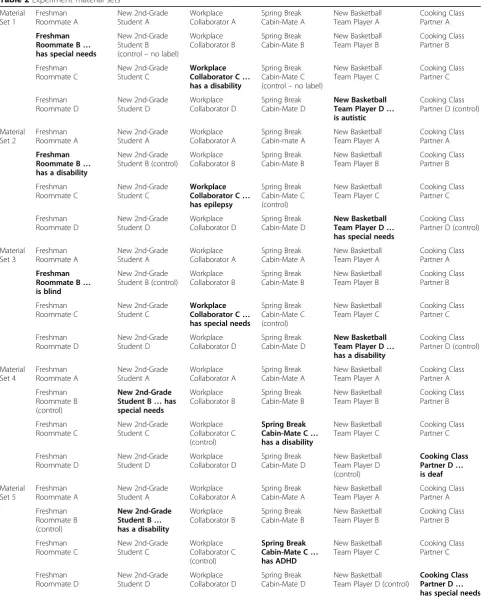
Six material sets were formed, as illustrated in Appendix Table 2. Each of the six material sets contained each of the six vignettes, in the same order (e.g., the freshman room-mate vignette preceded the new second-grade student vignette, which preceded the middle-age adult workplace collaborator vignette, and so forth in all six material sets). To occlude the purpose of the study, only three of the six vignettes in each material set were assigned to the three experimental conditions; the other three vignettes in each material set were assigned to the fourth, no-label control condition.
Six different disabilities were used for the certain dis-abilities. Each of those six disabilities was assigned to only one to-be-chosen character and only one vignette:
is blind(freshman roommate B),has epilepsy(workplace
collaborator C); is autistic (new basketball team player
D); has Down syndrome (new second-grade student B);
has ADHD (spring break cabin-mate C), and is deaf
(cooking class partner D).
Therefore, in each of the six material sets, only one of the 24 to-be-chosen characters was described as having a cer-tain disability (e.g.,is blind). Similarly, in each of the six ma-terial sets, only one of the 24 to-be-chosen characters was described as havinga disability, and only one was described as havingspecial needs. By applying our experimental ma-nipulation to only three of the 24 to-be-chosen characters, we could better occlude the purpose of the study.
Procedure
Participants were recruited to the study naïve to the study’s purpose. The study was titled,“Person Judgment Study,” and participants were told that they would par-ticipate in“a study in which you will read scenarios and rank preferences for people.”
with a disability, parents of a child with a disability, rela-tives of a person with a disability, co-workers of a person with a disability, or good friends with a person with a dis-ability (demographic information that allowed us to distin-guish between participants with versus without a personal connection to disability).
It is important to stress that participants’demographic information was not collected until after the participants completed reading all the vignettes and ranking all the to-be-chosen characters from first to last. Thus, the par-ticipants had no reason to believe that the purpose of the vignette task was related to disability.
Finally, the participants responded to two open-ended statements: “When I hear the term ‘special needs,’ the first few thoughts that come to my mind are ____” and then “When I hear the term ‘has a disability’ or ‘has disabilities,’the first few thoughts that come to my mind are ____.” Participants were provided with five places to provide up to five free associations for each of the two statements. Again, it is important to stress that the par-ticipants’free associations were not collected until after the participants completed reading all the vignettes and ranking all the to-be-chosen characters.
Participants
The participants were 530 adults recruited through Amazon Mechanical Turk and compensated $2 for their participation in the 20-minute study. All participants were required to have a 93% or greater approval rating from their previous work on Mechanical Turk.
Participants were randomly assigned to one of the six material sets. Data from three participants were ex-cluded because the participants responded too methodi-cally (i.e., ranking the character presented first as their first choice, the character presented second as their second choice, the character presented third as their third choice, and so forth). Each of the remaining 527 participants had resided in the USA for the majority of the past five years and were native speakers of English.
The participants’ mean age was 30.2 years (standard deviation (SD) = 8.9 years; range = 18–69 years). The participants randomly assigned to the six material sets did not differ in age (F(5,521) = 0.52, p= 0.761). Of the 527 participants, 66% identified as male gender, 33% identified as female gender, and 1% identified outside the gender binary. The participants assigned to the six material sets did not differ in identifying as male versus female gender (χ2(5) = 0.828,p= 0.975).
Twenty-nine percent of the participants identified as col-lege students; 25% identified as middle-age adults; 10% identified as parents of elementary-school children; 9% identified as middle-age adults whose work responsibilities include supervising subordinates; 2% identified as teachers of elementary school children; and 38% identified as having
none of these life roles. These percentages sum to greater than 100% because some participants identified as having more than one of these life roles. Participants randomly assigned to the six material sets did not differ in having these life roles (χ2(5) = 8.828, p= 0.116; χ2(5) = 2.720,
p= 0.743; χ2(5) = 1.904, p= 0.862; χ2(5) = 4.598, p= 0.467; χ2(5) = 6.758,p= 0.239, respectively) or as having none of these life roles (χ2(5) = 4.561,p= 0.472).
Thirty-seven percent of the participants identified as having one or more personal connections to disability: 18% identified as a relative of a person with a disability; 16% identified as a good friend of a person with a dis-ability; 6% identified as a person with a disdis-ability; 5% identified as a co-worker of a person with a disability; 4% identified as working with children who have dis-abilities; 4% identified as working with adults who have disabilities; and 3% identified as a parent of a child with a disability. These percentages sum to greater than 37% because some participants identified as having more than one personal connection to disability.
The majority of the participants, 61%, identified as not having any personal connection to disability, and 2% did not wish to identify whether they had a personal connec-tion to disability. Participants randomly assigned to the six material sets did not differ in their personal connec-tion to disability (χ2(5) = 5.430,p= 0.365).
Results
Characters’frequency of being chosen last
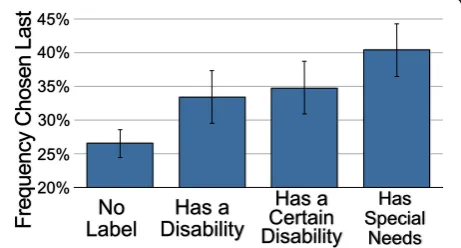
Figure 3 presents the frequencies with which characters were chosen last as a function of the four experimental manipulations: “No Label”, the characters were serving as a control and therefore no disability label was in-cluded in the characters’ description (26.6 ± 2.2%, 95% confidence interval); “Has a Disability”, the characters
were described as havinga disability (33.4 ± 4.0%);“Has a Certain Disability”, the characters were described as having a specific disability (e.g., “is blind,” 34.7 ± 4.0%); and “Has Special Needs”, the characters were described as havingspecial needs(40.4 ± 4.2%).
As Fig. 3 illustrates, a one-dimensional chi-square goodness-of-fit test for mutually exclusive categories indicated that the frequencies with which characters were chosen last in the four experimental conditions (No Label, Has a Disability, Has a Certain Disability, Has Special Needs) differed significantly from chance (χ2(3) = 15.16,p= 0.002).
As predicted, characters were significantly more likely to be chosen last when they were described as having special needs than when they were described as having a disability (z= 2.362, p= 0.009, one-tailed). Similarly, and as predicted, characters were significantly more likely to be chosen last when they were described as having spe-cial needs than when they were described as having a certain disability (z= 1.908,p= 0.028, one-tailed).
Characters were also significantly more likely to be chosen last when they were described as having special needs than when no (disability) label was included (z= 6.008, p< 0.001, one-tailed). In contrast, characters were equally likely to be chosen last when they were described as having a disability as when they were described as having a certain disability (z=−0.455,p= 0.653, two-tailed).
Thus, characters described as having special needs were most frequently chosen last, indicating thatspecial needs
is an ineffective euphemism. Characters described as hav-ing special needs were chosen last even more frequently than characters described as having a disability or a cer-tain disability, suggesting that the euphemism special
needs conveys more negativity than the non-euphemized
term disability or the names of specific disabilities
(e.g., blind). Ifspecial needswas an effective euphemism, then we would have observed that characters described as having special needs were chosen last less often than char-acters described as having a disability or a certain disability. But, as predicted, we observed just the opposite.
The pattern of results illustrated in Fig. 3 was obtained regardless of whether the to-be-selected character was a child, college student, or middle-age adult (χ2
(6) = 6.22,
p= 0.399). Thus,special needsis an ineffective euphemism regardless of the age of the person to whom it is applied.
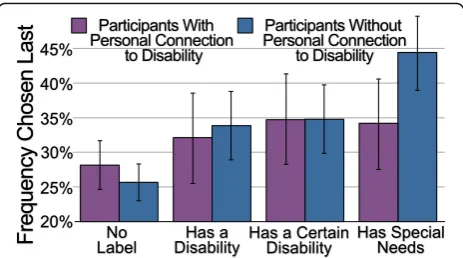
However, as illustrated in Fig. 4, one aspect of the pat-tern of results was affected by whether the participants had a personal connection to disability. Participants with a personal connection to disability (37% of the sample) were less likely than participants without a personal con-nection to disability (61% of the sample) to choose char-acters last when the charchar-acters were described as having special needs (z=−2.284, p= 0.023, two-tailed). For the other three conditions, participants with a personal
connection to disability resembled participants without a personal connection to disability (z=−0.014, p= 0.992, two-tailed, for“Has a Certain Disability”;z=−0.403,p= 0.689, two-tailed, for “Has a Disability”; and z=−0.616,
p= 0.535, two-tailed, for“No Label”).
As Fig. 4 illustrates, participants with a personal con-nection to disability were equally likely to choose char-acters last when the charchar-acters were described as having special needs as when the characters were described as having a disability (z= 0.433, p= 0.667, two-tailed) or a certain disability (z=−0.108,p= 0.912, two-tailed). Thus, even for participants with a personal connection to dis-ability, the euphemism special needs conveys as much negativity as the non-euphemized term disability or the names of specific disabilities (e.g., blind), again indicating thatspecial needsis an ineffective euphemism.
Participants’associations to the termsdisabilityand special needs
Participants’associations to the prompts,“When I hear the termspecial needs, the first few thoughts that come to my mind are ____”and “When I hear the termhas a disability or has disabilities, the first few thoughts that come to my mind are ____,” were coded by two of the co-authors, naïve to the participants’demographics. The coders agreed on 96.83% of the codes and the disagree-ments were resolved by consensus.
Participants had been given five slots into which to write their associations to each of the two prompts (the term special needs and the term has a disability
or has disabilities, which hereafter will be referred to asdisability). On average, participants provided the same number of associations to special needs (M= 4.918; SD = 0.522) as to disability (M= 4.934; SD = 0.442,
t(526) = 1.571,p= 0.117).
Participants’associations were classified into ten mu-tually exclusive coding categories. Three of the ten coding categories captured affective associations: posi-tive (e.g.,“strong,” “capable,”or “acceptance”), negative (e.g., “annoying,” “helpless,” or “needy”), and neutral (e.g.,“different,” “lifelong,” or “born that way”). Approxi-mately 40% of participants’ associations were coded as belonging to one these three affective categories.
Four of the ten coding categories captured four types of disability: physical disabilities (e.g., “paraplegic,” “ wheel-chair user,” or “amputee”); developmental disabilities (“intellectual disability,” “autism,” or “Down syndrome”); sensory disabilities (e.g., “blind,” “deaf,” or “can’t talk”), and psychiatric disabilities (e.g.,“mental illness,” “bipolar,” or “depression”). Approximately 30% of the participants’ associations were coded as belonging to one of these four types of disabilities.
The remaining three of the ten coding categories were empathy (e.g., “I want to help”), accommodations (“wheelchair,” “special education”), and requests for more information (e.g., “what’s wrong?”). Approximately 25% of the participants’associations were coded as be-longing to one of these three categories. The remaining associations, which composed less than 5% of the associ-ations, were considered un-categorizable.
Figure 5 presents the relative proportion of partici-pants’ associations that expressed affective sentiments (positive, neutral, and negative) as a function of whether the participants were providing associations to the eu-phemism special needs or the term disability. As Fig. 5 illustrates, participants’ affective associations to special needs differed significantly from their affective associa-tions todisability(χ2(2) = 17.1,p< 0.001).
Participants produced significantly more negative asso-ciations to the euphemism special needs than to the term disability (χ2(1) = 16.6,p< 0.001). Participants also produced significantly fewer positive associations and significantly fewer neutral associations to special needs
than todisability(χ2(1) = 6.12,p= 0.013 andχ2(1) = 4.70,
p= 0.030, respectively).
Participants produced significantly more negative and fewer positive associations to the euphemism special needs than to the termdisability, regardless of whether they had a personal association to disability. Across the board, participants with a personal connection to dis-ability provided fewer negative associations and more positive associations than did participants without a per-sonal connection to disability (χ2(2) = 55.8, p< 0.001). Nonetheless, both participants with and without a per-sonal connection to disability produced more negative associations tospecial needs(41 and 54% of the partici-pants’affective associations, respectively) than todisability
(33 and 45%, respectively). Thus, participants’ personal connection to disability did not diminish their negativity to the euphemismspecial needs(χ2(1) = 0.012,p= 0.912).
Similarly, both participants with and without a per-sonal connection to disability produced fewer positive associations tospecial needs(25 and 14% of the partici-pants’affective associations, respectively) than todisability
(32 and 17%, respectively). Thus, participants’ personal connection to disability did not increase their positivity to the euphemismspecial needs(χ2(1) = 0.059,p= 0.808).
Figure 6 presents the relative proportion of partici-pants’ associations that conveyed a type of disability (developmental disabilities, physical disabilities, sensory disabilities, and psychiatric disabilities) as a function of whether the participants were providing associations to the euphemism special needsor the term disability. As Fig. 6 illustrates, participants associated significantly different disabilities with special needs than with dis-ability(χ2(3) = 233,p< 0.001).
Participants were significantly more likely to associate developmental disabilities with the euphemism special needsthan with the termdisability(χ2(1) = 202,p< 0.001). Participants were significantly less likely to associate
Fig. 5Relative proportion of participants’associations that expressed affective sentiments that werePositive,Neutral, andNegativeas a function of whether the participants were providing associations to the euphemismspecial needsor the termdisability
physical disabilities and sensory disabilities withspecial needs than with disability (χ2(1) = 150, p< 0.001 and
χ2
(1) = 29.6, p< 0.001, respectively). Participants were equally likely to associate psychiatric disabilities with
special needsas withdisability(χ2(1) = 0.079,p= 0.779). Lastly, participants were less likely to associate
“Requests for more information” with the special needs
(11%) than disability (18%; χ2(1) = 12.1, p< 0.001). Participants were equally likely to associate “Empathy” withspecial needs(25%) anddisability(28%;χ2(1) = 1.11,
p= 0.291). Participants were more likely to associate
“Accommodations” with special needs (64%) than
disability(55%;χ2(1) = 11.8,p= 0.001). Many of the par-ticipants’accommodations-related associations tospecial needs were related to special education or to “special” organizations and activities (e.g., Special Olympics).
Discussion
The goal of our study was to examine empirically the effectiveness of the euphemismspecial needs.
We constructed a set of vignettes which allowed us to gauge how people who are described as havingspecial needs
are viewed in relation to people who are described as having
a disability. Ifspecial needsis an ineffective euphemism, as we predicted, then people described as havingspecial needs
should be viewed more negatively than people described as havinga disability, which is what we observed. Indeed, as we predicted, when people were described as havingspecial
needs, they were viewed more negatively than when they
were described as having a specific disability (e.g.,is blind,
has Down syndrome,is autistic,has ADHD).
We found thatspecial needsis an ineffective euphem-ism regardless of whether the persons being described by the euphemism are children, college students, or middle-age adults. Special needs is an ineffective eu-phemism even in the eyes of people who have a personal connection to disability, such as parents of children with a disability or professionals who work with disabled chil-dren or adults. Even for people with a personal connec-tion to disability, the euphemism special needs is no more effective than the non-euphemized termdisability.
In our study, we also collected free associations to the terms special needsand disability. We found that special needs is associated with more negativity than disability;
special needs conjures up more associations to
develop-mental disabilities (such as intellectual disability, autism, or Down syndrome) whereas disability is associated with a broader, more inclusive set of disabilities; andspecial needs
evokes more unanswered questions than disability. These associations again demonstrate thatspecial needsis an in-effective euphemism. We propose that special needsis an ineffective euphemism because it is imprecise, it connotes segregation, and it implies special rights;special needshas become a dysphemism.
Special needsis imprecise
Euphemisms are, by definition, vague expressions (Ramsay, 2002). But the euphemism special needsis so vague that it can be applied to a wide swath of individuals in various contexts. In the realm of child adoption, indi-viduals withspecial needscan be children with a“range of conditions” that pose “a barrier to permanent adoption placement” (Tan, Marfo, & Dedrick, 2007, p. 1270), including being “minority and biracial” (Rosenthal & Groze, 1990, p. 476). In disaster preparation, individuals withspecial needs can be adults aged 50 years or older, adults who receive home health care, or adults who do not have access to a personal vehicle (Parsons & Fulmer, 2007).
In housing, individuals with special needs can be per-sons experiencing“homelessness, psychiatric illness, drug and alcohol rehabilitation, the elderly, HIV/AIDS, and women escaping domestic abuse” (Wilton, 2002, p. 318). In airline travel, they can be passengers with disabilities, passengers traveling with infants or animals, passengers traveling while pregnant, passengers requiring extra seating, passengers with peanut allergies, children traveling alone, and older adults (https://www.united.com/web/en-US/content/travel/specialneeds/default.aspx).
As Clapham and Smith (1990, p. 194) lament,“the pre-cise groups considered to havespecial needsvaries consid-erably and can include almost everyone.” For this reason, Kailes (2005, p. 3) argues that“continuing to use special
needs does a disservice to every group included.” And
“repeated pleas, over the years, from disability advocates to replacespecial needs, with more respectful, precise, seg-mented, and discrete groupings”should not“be ignored.”
Special needsconnotes segregation
We observed in our association data that the
euphem-ism special needs evokes associations to special
educa-tion, Special Olympics, and other special programs. Because these special programs mostly segregate persons with disabilities from persons without disabilities,special
needs often connotes segregation (Woodward, 1991).
Disability Studies scholars argue thatspecial needsisolates persons with disabilities from the general population (Rucker, 2014) and creates distance between persons with versus without disabilities (Finkelstein & Stuart, 1996).
his motivation with the statement, “special needs kids should be kept in special places”(Broderick, 2013). Special places, special programs, special schools, andspecial needs
connote segregation; in contrast, accessible places (rather than special places) and inclusive programs (rather than special programs) connote integration (Kailes, 2010).
Special needsimplies special rights
Construing disability as special needs enables miscon-struing asspecial rights what are actually human rights, civil rights, or disability rights (Ballard, 1995). For example, a recent article in The Chronicle of Higher Education
misconstrues legally mandated disability rights as special rights. The article erroneously describes Section 504 of the US Rehabilitation Act of 1973, which prohibits discrimin-ation on the basis of disability in federally funded pro-grams, as legislating“special rightsand remedies for people with disabilities” (Rothstein, 2013). Section 504 does not legislate special rights; it legislates civil rights and federal protection from discrimination.
A more egregious misconstrual of basic rights as
special rightswas demonstrated in a viral complaint that a Canadian mother wrote to her neighbor (Daubs, 2013). The complaint centered around the neighbor’s disabled teenage grandson who plays joyously (and loudly) in his grandmother’s front yard. Among other offensive com-ments, the complaining mother wrote to her neighbor,“I hate people like you who believe, just because you have a special needs child, you are entitled to special treat-ment.” The “special treatment” was simply the disabled teenager’s basic right to play in his grandmother’s front yard. But referring to disabilities as special needs could have led to this teenager’s basic rights being misconstrued asspecial rights(see also Finkelstein & Stuart, 1996).
Like disability rights advocates, gay rights advocates have long argued that their rights should not be con-strued as special rights. The GLAAD (Gay & Lesbian Alliance Against Defamation 2016) Media Reference Guide identifies special rights as offensive and equal
rights as preferred. As the Media Reference Guide
ex-plains,“Anti-gay extremists frequently characterize equal protection of the law for lesbian, gay, bisexual and trans-gender people as special rights to incite opposition” to basic, human, and civil rights. The negative implication of misconstruing human rights as special rights is un-appreciated by many minority groups (Goldberg-Hiller & Milner, 2003; Marcosson, 2012; Rubin, 1998).
Special needshas become a dysphemism
The data reported in this article suggest thatspecial needs
is so ineffective as a euphemism that it has become a dys-phemism, particularly for members of the general popula-tion who do not have a personal connecpopula-tion to disability.
Dysphemisms are terms that begin as euphemisms but become even more negative than the terms they were ini-tially intended to euphemize (Gómez, 2009; Holder, 2002). Many contemporary slurs for members of racial, ethnic, or sexual minority groups began as euphemisms and be-came dysphemisms. Pinker (1994) deems such linguistic transition the euphemism treadmill.
Adams (1985, p. 44) explains that because euphe-misms are“an effort to make something sound especially nice … a euphemistic formation can easily turn into its opposite.”The extreme effort to “prettify” a concept dra-matizes not only the perceived negativity of the concept but also the perceived negativity of its euphemism.
It is unsurprising that special needs has become a phemism. Other disability terms have become not only dys-phemisms but also dysphemistic metaphors (Pfaff, Gibbs, & Johnson, 1997). For example, among the definitions the
MacMillan Dictionary
(http://www.macmillandictionary.-com/us) provides for the termdeaf is the denotation“not willing to listen to something” (e.g., deaf to reason); for
blind, one denotation is “unable to realize or admit the truth about something”; for crippled, one denotation is
“damage[d] severely”or“prevent[ed] from working proper-ly”; and forlame,“done without much effort in a way that seems as though you are not trying very hard.” Although
deaf,blind,crippled, andlameoriginated as disability terms, they are now commonly used as dysphemistic metaphors.
The word dumb is now completely a dysphemistic metaphor. Dumb initially bore only a disability-specific denotation. It meant“permanently unable to speak.”But as the MacMillan Dictionary reports, the disability-related denotation of dumb is “now usually considered offensive,” and the preferred terminology for someone unable to speak is “speech impaired.” After dumb shed its disability-specific denotation of “permanently unable to speak,” it took on the disability-unrelated but still speech-related denotation of “temporarily unable or unwilling to speak, especially because you are very shocked”(e.g., Some of the passengers were struck dumb with terrororI was struck dumb by the clerk’s rudeness). The current and most popular denotation of dumb as
“stupid” (e.g.,She’s so dumb she can’t even figure out her
answering machine) refers not at all to speech but
re-flects the (erroneous) connotation that persons with speech disabilities are intellectually inferior.
Our data suggest that special needs has already be-come a dysphemism (a euphemism more negative than the word it replaces). Special needswill likely become a slur, if it is not already, and it might eventually become a dysphemistic metaphor, akin to dumb, lame, crippled,
Appendix
Table 2Experiment material sets
Material Set 1 Freshman Roommate A New 2nd-Grade Student A Workplace Collaborator A Spring Break Cabin-Mate A New Basketball Team Player A
Cooking Class Partner A
Freshman Roommate B… has special needs
New 2nd-Grade Student B (control–no label)
Workplace Collaborator B
Spring Break Cabin-Mate B
New Basketball Team Player B
Cooking Class Partner B Freshman Roommate C New 2nd-Grade Student C Workplace Collaborator C… has a disability
Spring Break Cabin-Mate C (control–no label)
New Basketball Team Player C
Cooking Class Partner C Freshman Roommate D New 2nd-Grade Student D Workplace Collaborator D Spring Break Cabin-Mate D New Basketball Team Player D… is autistic
Cooking Class Partner D (control)
Material Set 2 Freshman Roommate A New 2nd-Grade Student A Workplace Collaborator A Spring Break Cabin-mate A New Basketball Team Player A
Cooking Class Partner A
Freshman Roommate B… has a disability
New 2nd-Grade Student B (control)
Workplace Collaborator B
Spring Break Cabin-Mate B
New Basketball Team Player B
Cooking Class Partner B Freshman Roommate C New 2nd-Grade Student C Workplace Collaborator C… has epilepsy
Spring Break Cabin-Mate C (control)
New Basketball Team Player C
Cooking Class Partner C Freshman Roommate D New 2nd-Grade Student D Workplace Collaborator D Spring Break Cabin-Mate D New Basketball Team Player D… has special needs
Cooking Class Partner D (control)
Material Set 3 Freshman Roommate A New 2nd-Grade Student A Workplace Collaborator A Spring Break Cabin-Mate A New Basketball Team Player A
Cooking Class Partner A
Freshman Roommate B… is blind
New 2nd-Grade Student B (control)
Workplace Collaborator B
Spring Break Cabin-Mate B
New Basketball Team Player B
Cooking Class Partner B Freshman Roommate C New 2nd-Grade Student C Workplace Collaborator C… has special needs
Spring Break Cabin-Mate C (control)
New Basketball Team Player C
Cooking Class Partner C Freshman Roommate D New 2nd-Grade Student D Workplace Collaborator D Spring Break Cabin-Mate D New Basketball Team Player D… has a disability
Cooking Class Partner D (control)
Material Set 4 Freshman Roommate A New 2nd-Grade Student A Workplace Collaborator A Spring Break Cabin-Mate A New Basketball Team Player A
Cooking Class Partner A Freshman Roommate B (control) New 2nd-Grade Student B…has special needs Workplace Collaborator B Spring Break Cabin-Mate B New Basketball Team Player B
Cooking Class Partner B Freshman Roommate C New 2nd-Grade Student C Workplace Collaborator C (control) Spring Break Cabin-Mate C… has a disability
New Basketball Team Player C
Cooking Class Partner C Freshman Roommate D New 2nd-Grade Student D Workplace Collaborator D Spring Break Cabin-Mate D New Basketball Team Player D (control)
Cooking Class Partner D… is deaf Material Set 5 Freshman Roommate A New 2nd-Grade Student A Workplace Collaborator A Spring Break Cabin-Mate A New Basketball Team Player A
Cooking Class Partner A Freshman Roommate B (control) New 2nd-Grade Student B… has a disability
Workplace Collaborator B
Spring Break Cabin-Mate B
New Basketball Team Player B
Cooking Class Partner B Freshman Roommate C New 2nd-Grade Student C Workplace Collaborator C (control) Spring Break Cabin-Mate C… has ADHD
New Basketball Team Player C
Cooking Class Partner C Freshman Roommate D New 2nd-Grade Student D Workplace Collaborator D Spring Break Cabin-Mate D New Basketball Team Player D (control)
Authors’contributions
MAG conceived and designed the study; MTB and MAG created the stimuli; ARR and MTB collected the data; ARR, JSB, and MAG analyzed the data; MAG, ARR, and JSB interpreted the data analyses; MAG wrote the manuscript; ARR, MTB, and JSB gave final approval of the manuscript. All authors read and approved the final manuscript.
Competing interests
The authors declare that they have no competing interests.
Ethics approval and consent to participate
All participants provided informed consent, and the experiment was approved by the Institutional Review Board at the University of Wisconsin–Madison (protocol #2013-1545).
Author details
1University of Wisconsin-Madison, Madison, WI, USA.2University of Kansas,
Lawrence, KS, USA.
Received: 20 July 2016 Accepted: 1 November 2016
References
Adams, R. M. (1985). Soft soap and the nitty-gritty. In D. J. Enright (Ed.),Fair of speech (pp. 44–55). Oxford: Oxford University Press.
Allan, K., & Burridge, K. (1991).Euphemism and dysphemism. New York: Oxford University Press.
American Psychological Association. (2010).Publication manual of the American Psychological Association(6th ed.). Washington, DC: American Psychological Association.
Annan-Prah, E. C. (2015).Basic business and administrative communication. Bloomington: XLibris.
Appleton, L., & Flynn, M. (2014). Searching for the new normal: Exploring the role of language and metaphors in becoming a cancer survivor.European Journal of Oncology Nursing, 18, 378–384.
Australian Broadcasting Company (2007). New Senator speaks out for disabled. ABC News Online.Retrieved from http://www.abc.net.au/news/2007-06-12/ new-senator-speaks-out-for-disabled/66572
Ballard, K. (1995). Inclusion, paradigms, power and participation. In C. Clark, A. Dyson, & A. Millward (Eds.),Towards inclusive schools?(pp. 1–14). London: David Fulton.
Barnes, C., & Sheldon, A. (2007).‘Emancipatory’disability research and special educational needs. In L. Florian (Ed.),The Sage handbook of special education (pp. 233–246). London: Sage.
Baron, R. S., Burgess, M. L., & Kao, C. F. (1991). Detecting and labeling prejudice: Do female perpetrators go undetected?Personality and Social Psychology Bulletin, 17, 115–123.
Berger, R. J. (2013).Introducing disability studies. Boulder: Lynne Reiner Publishers. Bertrand, M., & Mullainathan, S. (2004). Are Emily and Greg more employable
than Lakisha and Jamal? A field experiment on labor market discrimination. The American Economic Review, 94, 991–1013.
Bowers, J. S., & Pleydell-Pearce, C. W. (2011). Swearing, euphemisms, and linguistic relativity.PLoS One, 6(7), e22341.
Broderick, R. (2013). Houston waiter stands up for little boy with Down syndrome.BuzzFeed. Retrieved from https://www.buzzfeed.com/ ryanhatesthis/houston-waiter-stands-up-for-little-boy-with-down Burkhardt, A. (2010). Euphemism and truth. In A. Burkhardt & B. Nerlich (Eds.),
Tropical truth(s): The epistemology of metaphor and other tropes(pp. 355–372). Berlin, DEU: Walter de Gruyter.
Butler, R. C., & Gillis, J. M. (2011). The impact of labels and behaviors on the stigmatization of adults with Asperger’s disorder.Journal of Autism and Developmental Disorders, 41, 741–749.
Caprariello, P. A., Cuddy, A. J. C., & Fiske, S. T. (2009). Social structure shapes cultural stereotypes and emotions: A causal test of the stereotype content model.Group Processes & Intergroup Relations, 12, 147–155.
Carter-Long, L. (2016).“Disabled.”#SayTheWord. On purpose. Often. Until & unless we do,they won’t. #NotSpecial. Retrieved from https://twitter.com/lcarterlong/ status/687314340144394241
Clapham, D., & Smith, S. J. (1990). Housing policy and‘special needs.’.Policy and Politics, 18, 193–205.
Crespo-Fernández, E. (2006). The language of death: Euphemism and conceptual metaphorization in Victorian obituaries.SKY Journal of Linguistics, 19, 101–130. Daubs, K. (2013). Hateful letter stirs local support for autistic boy.The Toronto Star. Retrieved from http://www.thestar.com/news/gta/2013/08/19/hateful_letter_ about_autistic_boy_sent_to_newcastle_grandmother.html
Davies, G. M., & Patel, D. (2005). The influence of car and driver stereotypes on attributions of vehicle speed, position on the road and culpability in a road accident scenario.Legal and Criminological Psychology, 10, 45–62.
Finch, J. (1987). The vignette technique in survey research.Sociology, 21, 105–114. Finkelstein, V., & Stuart, O. (1996). Developing new services. In G. Hales (Ed.),
Beyond disability: Toward an enabling society(pp. 170–187). London: Sage. Folkins, J. (1992).The language used to describe individuals with disabilities. ASHA,
Retrieved from https://web.archive.org/web/20150511071056/http://www. asha.org/publications/journals/submissions/person_first.htm.
Foundation for Jewish Summer Camps (2015). Suggestions for effectively communicating with families of campers with disabilities during an intake. Inclusion Training Guide for Jewish Summer Camps.Retrieved from http:// www.jewishcamp.org/inclusionresources
Gay & Lesbian Alliance Against Defamation (2016).GLAAD media reference guide—10th Edition.Retrieved from http://www.glaad.org/reference Gilbert, D. J. (1998). The Prejudice Perception Assessment Scale: Measuring
stigma vulnerability among African American students at predominantly Euro-American universities.Journal of Black Psychology, 24, 305–321. Gladney, G. A., & Rittenberg, T. L. (2005). Euphemistic text affects attitudes,
behavior.Newspaper Research Journal, 26, 28–41.
Goldberg, P. (1968). Are women prejudiced against women?Society, 5, 28–30. Goldberg-Hiller, J., & Milner, N. (2003). Rights as excess: Understanding the
politics of special rights.Law & Social Inquiry, 28, 1075–1118. Gómez, M. C. (2009). Towards a new approach to the linguistic definition of
euphemism.Language Sciences, 31, 725–739.
Grewal, I., Joy, S., Lewis, J., Swales, K., & Woodfield, K. (2002). Disabled for life? Attitudes towards, and experiences of, disability in Britain. InNational Centre for Social Research: Research Report No. 173. Leeds: Her Majesty’s Stationery Office. Griffin, J. (1985). Euphemisms in Greece and Rome. In D. J. Enright (Ed.),Fair of
speech(pp. 32–43). Oxford: Oxford University Press.
Guralnick, M. J. (1994). Mothers’perceptions of the benefits and drawbacks of early childhood mainstreaming.Journal of Early Intervention, 18, 168–183.
Table 2Experiment material sets(Continued)
Material Set 6
Freshman Roommate A
New 2nd-Grade Student A
Workplace Collaborator A
Spring Break Cabin-Mate A
New Basketball Team Player A
Cooking Class Partner A
Freshman
Roommate B (control)
New 2nd-Grade Student B…has Down syndrome
Workplace Collaborator B
Spring Break Cabin-Mate B
New Basketball Team Player B
Cooking Class Partner B
Freshman Roommate C
New 2nd-Grade Student C
Workplace Collaborator C (control)
Spring Break Cabin-Mate C… has special needs
New Basketball Team Player C
Cooking Class Partner C
Freshman Roommate D
New 2nd-Grade Student D
Workplace Collaborator D
Spring Break Cabin-Mate D
New Basketball Team Player D (control)
Haider, A. H., Sexton, J., Sriram, N., Cooper, L. A., Efron, D. T., Swoboda, S.,… Cornewll, E. E. (2011). Association of unconscious race and social class bias with vignette-based clinical assessments by medical students.Journal of the American Medical Association,306, 942–951
Holder, R. W. (2002).How not to say what you mean: A dictionary of euphemisms (3rd ed.). Oxford: Oxford University Press.
Hudley, C., & Graham, S. (2001). Stereotypes of achievement striving among early adolescents.Social Psychology of Education, 5, 201–224.
I Am The Giraffe (2010). I hate the term“special needs.”Retrieved from https:// madhousewife.wordpress.com/2010/02/09/i-hate-the-term-special-needs/ Kailes, J. I. (2005). Disaster services and“Special Needs”: Term of art or
meaningless term? Nobody Left Behind. Retrieved from http://www. preventionweb.net/files/9653_SpecialNeeds.pdf.
Kailes, J. I. (2010).Language is more than a trivial concern. Retrieved from http:// www.jik.com/language%20FINAL-L-12.27.10.pdf
Kierstead, D., D’Agostino, P., & Dill, H. (1988). Sex role stereotyping of college professors: Bias in students’ratings of instructors.Journal of Educational Psychology, 80, 342–344.
La Cour, A., & Kromann, J. (2011). Euphemisms and hypocrisy in corporate philanthropy.Business Ethics: A European Review, 20, 267–291. Linfoot-Ham, K. (2005). The linguistics of euphemism: A diachronic study of
euphemism formation.Journal of Language and Linguistics, 4, 227–263. Linton, S. (1998).Claiming disability: Knowledge and identity. New York: New York
University Press.
Love That Max: Special Needs Blog (2008).Labels:“Special needs”vs.“disabled”vs. …what???Retrieved from http://www.lovethatmax.com/2008/12/labels-special-needs-vs-disabled-vs.html
Marcosson, S. A. (2012). The special rights canard in the debate over lesbian and gay civil rights.Notre Dame Journal of Law, Ethics & Public Policy, 9, 137–183. Matthews, N. L., Ly, A. R., & Goldberg, W. A. (2015). College students’perceptions of peers with autism spectrum disorder.Journal of Autism and Developmental Disorders, 45, 90–99.
McGlone, M. S., & Batchelor, J. A. (2003). Looking out for number one: Euphemism and face.Journal of Communication, 53, 251–264. Mills, D., & Gaia, A. C. (2012). Prototype use in perceptions of prejudice in
interactions between Whites and Latinos.Psi Chi Journal of Psychological Research, 17, 10–18.
National Center on Disability and Journalism (2015).Disability style guide. Retrieved from http://ncdj.org/wp-content/uploads/2012/08/ NCDJStyleGuide2015.pdf
Neal, A. A. (2015). The role of euphemisms in language comprehension: The taboo topic of rape.Ohio State University Research Thesis.Retrieved from http://kb.osu. edu/dspace/bitstream/handle/1811/71198/ashley_neal_thesis2015.pdf Nevill, R. E. A., & White, S. W. (2011). College students’openness toward autism
spectrum disorders: Improving peer acceptance.Journal of Autism and Developmental Disorders, 41, 1619–1628.
Nosanchuk, T. A. (1972). The vignette as an experimental approach to the study of social status: An exploratory study.Social Science Research, 1, 107–120. Ouch! Team (2003). Worst words vote.BBC. Retrieved from http://www.bbc.co.uk/
ouch/play/worst-words-vote.shtml
Parsons, B. S., & Fulmer, D. (2007). The paradigm shift in planning for special-needs populations. In J. A. Hubbard (Ed.),Emergency management in higher education: Current practices and conversations(pp. 183–196). Fairfax: Public Entity Risk Association.
Pfaff, K. L., Gibbs, R. W., Jr., & Johnson, M. D. (1997). Metaphor in using and understanding euphemism and dysphemism.Applied Psycholinguistics, 18, 59–83. Pinker, S. (1994). The game of the name.The Baltimore Sun. Retrieved from http://
articles.baltimoresun.com/1994-04-06/news/1994096202_1_dutch-words-language Pitner, R. O., Astor, R. A., Benbenishty, R., Haj-Yahia, M. M., & Zeira, A. (2003). The
effects of group stereotypes on adolescents’reasoning about peer retribution.Child Development, 74, 413–425.
Ramsay, R. D. (2002).How to say the right thing every time: Communicating well with students, staff, parents, and the public. Thousand Oaks: Corwin Press. Reeves, J. (2015). I’m a student with a disability—that doesn’t make me‘special’.
The Guardian.Retrieved from https://www.theguardian.com/education/2015/ jul/30/im-a-student-with-a-disability-that-doesnt-make-me-special
Research and Training Center on Independent Living (2013). Portrayal issues.RTCIL.org. Retrieved from http://rtcil.org/products/media/guidelines/portayalissues. Riggs, J. (2013). Puberty: It’s just around the corner.Minnesota Parent.Retrieved
from http://www.minnesotaparent.com/tween-scene/puberty-it%E2%80%99s-just-around-the-corner
Rittenberg, T. L., Gladney, G. A., & Stephenson, T. (2016). The effects of euphemism usage in business contexts.Journal of Business Ethics, 137, 315–320 Rosenthal, J. A., & Groze, V. (1990). Special-needs adoption: A study of intact
families.Social Service Review, 64, 475–505.
Rothstein, L. (2013). New legal questions about disability demand colleges’ attention.The Chronicle of Higher Education. Retrieved from http://chronicle. com/article/New-Legal-Questions-About/140787/
Rubin, P. J. (1998). Equal rights, special rights, and the nature of antidiscrimination law.Michigan Law Review, 97, 564–598.
Rucker, A. (2014).The s-word. Christopher and Dana Reeve Foundation, Retrieved from http://www.spinalcordinjury-paralysis.org/blogs/20/2120
Sams, J. M. (2012). Expanded parenting: Fathers’and mothers’experiences of parenting young children with disabilities. (Doctoral dissertation). Retrieved from http://trace.tennessee.edu/utk_graddiss/1417
Sergel, R. (2015).‘Provider’label fuels physician ire.MedPage Today. Retrieved from http://www.medpagetoday.com/PublicHealthPolicy/
GeneralProfessionalIssues/54120
Shapiro-Lacks, S. (2013).“Disability”vs“Special Needs.”The Jewish Week. Retrieved from http://www.thejewishweek.com/blogs/new-normal/disability-vs-special-needs
St. Lawrence, J. S., Husfeldt, B. A., Kelly, J. A., Hood, H. V., & Smith, S. (1990). The stigma of AIDS: Fear of disease and prejudice toward gay men.Journal of Homosexuality, 19, 85–101.
Steinberg, B. (2013). Let’s not make people afraid to open their mouths.The Jewish Week.Retrieved from http://www.thejewishweek.com/blogs/new-normal/lets-not-make-people-afraid-open-their-mouths
Swift, J. A., Choi, E., Puhl, R. M., & Glazebrook, C. (2013). Talking about obesity with clients: Preferred terms and communication styles of UK pre-registration dieticians, doctors, and nurses.Patient Education and Counseling, 91, 186–191. Tailor, A., & Ogden, J. (2009). Avoiding the term‘obesity’: An experimental study
of the impact of doctors’language on patients’beliefs.Patient Education and Counseling, 76, 260–264.
Tan, T. X., Marfo, K., & Dedrick, R. F. (2007). Special needs adoption from China: Exploring child-level indicators, adoptive family characteristics, and correlates of behavioral adjustment.Children and Youth Services Review, 29, 1269–1285. Tayler, M., & Ogden, J. (2005). Doctors’use of euphemisms and their impact on
patients’beliefs about health: An experimental study of heart failure.Patient Education and Counseling, 57, 321–326.
Vickers, M. H. (2002).“People First—Always”: Euphemism and rhetoric as troublesome influences on organizational sense-making: A downsizing case study.Employee Responsibilities and Rights Journal, 14, 105–118.
Werner, S. (2015). Public stigma in intellectual disability: Do direct versus indirect questions make a difference?Journal of Intellectual Disability Research, 59, 958–969. Wilton, R. D. (2002). Colouring special needs: Locating whiteness in NIMBY
conflicts.Social & Cultural Geography, 3, 303–321.
Woodward, J. R. (1991).Time to get rid of“special”?Disability Rag, Retrieved from http://www.jik.com/ilclang.html
Submit your manuscript to a
journal and benefi t from:
7Convenient online submission
7Rigorous peer review
7Immediate publication on acceptance
7Open access: articles freely available online
7High visibility within the fi eld
7Retaining the copyright to your article