The Thirty-Third AAAI Conference on Artificial Intelligence (AAAI-19)
MPD-AL: An Efficient Membrane Potential Driven
Aggregate-Label Learning Algorithm for Spiking Neurons
Malu Zhang,
1,2Jibin Wu,
2∗Yansong Chua,
3∗Xiaoling Luo,
1Zihan Pan,
2Dan Liu,
4Haizhou Li
2,31School of Computer Science and Engineering, University of Electronic Science and Technology of China, China 2Department of Electrical and Computer Engineering, National University of Singapore, Singapore
3Institute for Infocomm Research, A*STAR, Singapore 4JD AI Research
{maluzhang, jibin.wu, panzihan}@u.nus.edu, [email protected], [email protected], [email protected]
Abstract
One of the long-standing questions in biology and machine learning is how neural networks may learn important fea-tures from the input activities with a delayed feedback, commonly known as the temporal credit-assignment prob-lem. The aggregate-label learning is proposed to resolve this problem by matching the spike count of a neuron with the magnitude of a feedback signal. However, the exist-ing threshold-driven aggregate-label learnexist-ing algorithms are computationally intensive, resulting in relatively low learn-ing efficiency hence limitlearn-ing their usability in practical ap-plications. In order to address these limitations, we propose a novel membrane-potential driven aggregate-label learning algorithm, namely MPD-AL. With this algorithm, the easi-est modifiable time instant is identified from membrane po-tential traces of the neuron, and guild the synaptic adapta-tion based on the presynaptic neurons’ contribuadapta-tion at this time instant. The experimental results demonstrate that the proposed algorithm enables the neurons to generate the de-sired number of spikes, and to detect useful clues embedded within unrelated spiking activities and background noise with a better learning efficiency over the state-of-the-art TDP1 and Multi-Spike Tempotron algorithms. Furthermore, we propose a data-driven dynamic decoding scheme for practical classifi-cation tasks, of which the aggregate labels are hard to define. This scheme effectively improves the classification accuracy of the aggregate-label learning algorithms as demonstrated on a speech recognition task.
Introduction
Traditional artificial neural networks have made remarkable achievements in recent years as demonstrated in a wide range of applications (LeCun, Bengio, and Hinton 2015). These rate-based computational models despite brain in-spired, are lacking in several other aspects of biological re-alism, one being the presence of spiking activities (Ben-gio et al. 2015). Although it is widely accepted that the graded activation of these analog neurons is equivalent to the firing rate of spiking neurons inside the biological neu-ral network (Rueckauer et al. 2017), the view that precise
∗
Jibin Wu and Yansong Chua are the corresponding authors Copyright c⃝2019, Association for the Advancement of Artificial Intelligence (www.aaai.org). All rights reserved.
spike timing encodes information in the temporal domain that is important for neural computation is just as prominent in the neuroscience community (Gerstner and Kistler 2002; G¨utig and Sompolinsky 2006). Consequently, the spiking neuron models are proposed to describe the dynamic of spike generation process, such that the additional temporal information including precise spike timing and phase could be better captured (Kasabov et al. 2013).
Although spiking neural networks (SNNs) offer a com-puting paradigm with the promise of emulating the human brain, its potential in terms of computing powers and ap-plications are yet to be exploited. Despite the exact learn-ing mechanisms in the brain remain unknown, many spike-based learning algorithms have been proposed for pattern recognition tasks. Depending on the number of target spikes, these algorithms can be broadly categorized into single- or multi-spike based.
One well-known single-spike learning algorithm is the Tempotron (G¨utig and Sompolinsky 2006), whereby the out-put neuron is trained to fire a single spike in response to the correct input patterns and remain silent otherwise. The Rank-Order learning algorithms (Kasabov et al. 2013) up-date synaptic weights based on the rank order of the arrival time of incoming spikes. Additionally, the time-to-first spike decoding scheme is employed at the output layer. The Spike-Prop and its improved variants (Bohte, Kok, and La Poutre 2002) are other prominent single-spike based learning algo-rithms, extending the traditional gradient descent algorithm to SNNs. The objective function is constructed from the dis-tance between the actual and the desired firing time of the output neuron, such that the output neuron is trained to gen-erate a spike at the desired time.
The Remote Supervised Method (ReSuMe) (Ponulak and Kasi´nski 2010) is one such example of multi-spike learn-ing algorithms, in which synaptic weight updates are based on a combination of spike time-dependent plasticity (STDP) and anti-STDP rules; whereas, the Chronotron E-learning (Florian 2012) and the Spike Pattern Association Neuron (SPAN) (Mohemmed et al. 2012) learning rules transform the desired and the actual output spike trains into analog sig-nals, and then apply standard learning methods to reduce the discrepancy between the desired and the actual spike trains. Recently, the membrane-potential driven algorithms are emerging with instances include the PBSNLR (Xu, Zeng, and Zhong 2013), HTP (Memmesheimer et al. 2014), EMPD (Zhang et al. 2018b) and MemPo-Learn (Zhang et al. 2018a), whereby the loss is computed based on the post-synaptic membrane potential rather than the spike timing. In general, the membrane-potential driven algorithms are more efficient in learning a precise spike train than the other algorithms. However, they require that the neurons reset their membrane potential at the desired output spike times, which run contrary to the neuronal dynamics during learning (Memmesheimer et al. 2014).
To forecast opportunities or dangers, a neural clue (fea-ture) detector should fire whenever the clue occurs and re-main quiescent otherwise (G¨utig 2016). If the timing of the clues is known, the aforementioned multi-spike learning al-gorithms may be used to learn these desired responses. Typi-cally, however, the timing of the clues is commonly unavail-able; setting the desired output spike times hence becomes challenging. To resolve this problem, G¨utig (G¨utig 2016) has proposed an aggregate-label learning algorithm, namely Multi-Spike Tempotron (MST). This algorithm trains a neu-ron to output a desired number of spikes that is propor-tional to the number of available clues, without considering the precise timing of spikes. The MST employs the gradi-ent descgradi-ent strategy, which uses a threshold-driven method for each iteration of the synaptic update. Within each iter-ation, the difference between the actual and desired num-ber of spikes is instead replaced with the distance between the fixed biological firing thresholdϑand the closest hypo-thetical thresholdϑ∗ (at which the neuron would fire a de-sired number of spikes). However, this transformation makes the learning process indirect and increases the computa-tional complexity significantly. Despite Yu et. al. have sim-plified the recursive gradient computation of the MST (Yu, Li, and Tan 2018) (we refer to to this algorithm as TDP1 henceforth), the necessary computation ofϑ∗ is still time-consuming.
In this paper, to improve the learning efficiency of the aggregate-label learning, we proposed a membrane-potential driven aggregate-label learning algorithm, namely MPD-AL. In contrast to the existing threshold-driven learn-ing algorithms, the proposed MPD-AL algorithm constructs an error function based on the membrane potential trace and the fixed firing thresholdϑof the neuron. The experimen-tal results demonstrate that the learning speed of the pro-posed MPD-AL algorithm is faster than the TDP1 and the MST algorithms. In addition, we propose a dynamic de-coding scheme for aggregate-label learning. Instead of
en-forcing a fixed number of desired output spikes across all classes, we propose to dynamically determine the number of desired output spikes for each class in a data-driven manner. Hence, it makes better use of the available input information to identify the underlying clues and improves the classifica-tion accuracy as demonstrated on a speech recogniclassifica-tion task.
Neuron Model and Learning Algorithm
In this section, we begin by presenting the neuron model used in this work. Then, we describe the proposed MPD-AL learning algorithm. Finally, we compare the proposed MPD-AL algorithm with other existing aggregate-label learning algorithms and highlight their differences.Neuron Model
In this work, we employ the current-based leaky integrate-and-fire neuron model (G¨utig 2016). This model is biolog-ical realistic and yet mathematbiolog-ically tractable compared to other more detailed neuron models.
We consider a neuron connected with N spiking input afferents, whose postsynaptic membrane potential is rep-resented by V(t). The membrane potentialV(t)is initial-ized at the resting potential Vrest = 0 when there is no
spike received from the presynaptic neurons. Each incom-ing spike from the presynaptic neurons will induce a post-synaptic potential (PSP) at the postpost-synaptic neuron, which are integrated over time. The postsynaptic neuron will fire a spike once its membrane potentialV(t)reaches the firing thresholdϑfrom below. The post-synaptic membrane poten-tialV(t)of the neuron can be expressed as
V(t) =Vrest+ N
∑
i ωi
∑
tji<t
K(t−tji)−ϑ∑
tjs<t
exp(
−t−t
j s τm
)
(1) wheretji denotes the spike time of thejth spike from the afferenti, andωiis the corresponding synaptic weight. Here, K denotes the normalized PSP kernel, which is defined as follows
K(t−tji)=V0 (
exp(−(t−t
j i) τm
)−exp(−(t−t
j i) τs
)) (2)
the shape of the PSP is jointly governed by the mem-brane and synaptic time constantsτmandτs, respectively. K(t−tji)is a causal filter that only considers spikes arriv-ing attji ≤t. The coefficientV0normalizes PSP so that the
maximum value of the PSP kernel is 1. The last term in Eq. 1 is the refractory kernel which occurs at each post-synaptic spike. tj
s denotes the time of the jth spike emitted by the
postsynaptic neuron.
MPD-AL Learning Algorithm
The goal of the proposed learning algorithm is to modify the synaptic weights of the neuron so that the trained neu-ron fires the desired number of output spikes in response to a given input spike pattern. This goal is violated either when the actual output spike countNois less than the desired
the desired number (i.e.,No > Nd). To address these two
distinct scenarios, we propose two different learning mech-anisms, which we describe as follows.
Firing less spikes than desired (Nd> No) When the
de-sired output spike count is more than the actual output spike count, the synaptic weights should be strengthened to in-crease the current spike count iteratively tillNd =No. To
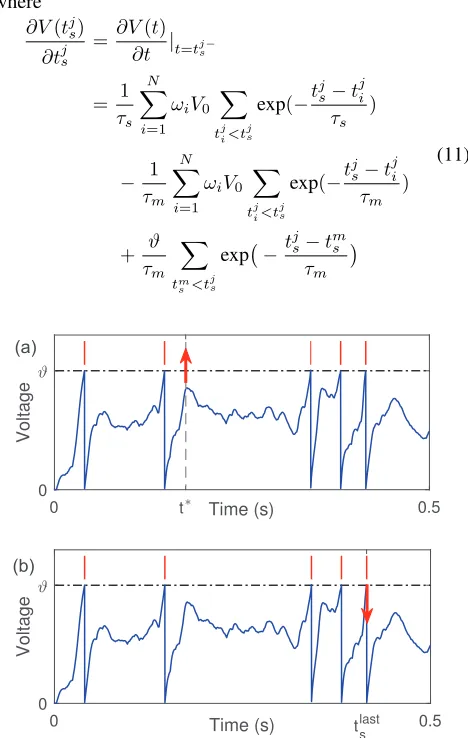
achieve this goal, as shown in Fig. 1a, we identify the easi-est modifiable time instantt∗, at which the membrane poten-tialV(t∗)is the maximum among all peaks of subthreshold membrane potential. Then, as shown in Eq. 3 and 4, the gra-dient descent method is applied to increase the membrane potentialV(t∗)towards the firing thresholdϑwith the aim of generating one more spike,
E=1 2(V(t
∗)−ϑ)2 (3)
∆ωi =−λ1
dE dωi
=−λ1(V(t∗)−ϑ)
dV(t∗)
dωi
(4)
wherebyλ1is the learning rate which defines the magnitude
of synaptic updates. SinceV(t∗) depends on the synaptic weight also through previous output spike timestjs< t∗, j∈ {1,2, ..., m}. Therefore,dV(t∗)/dωiis given by
dV(t∗)
dωi
=∂V(t
∗) ∂ωi + m ∑ j=1
∂V(t∗)
∂tjs ∂tjs ∂ωi
+∂V(t
∗)
∂t∗
∂t∗ ∂ωi
(5)
The last term in Eq.5 has no contribution to the synap-tic update since V(t∗) is either a local maximum with
∂V(t∗)/∂t∗ = 0 or t∗ is the time of an inhibitory input spikes whose arrival time does not depend onωi. From Eq.
1, the first term of Eq. 5 can be expressed as
∂V(t∗)
∂ωi
= ∑
tji<t∗
K(t∗−tji) (6)
For the second term of Eq. 5, applying the chain rule, we get
∂V(t∗)
∂tjs ∂tj
s ∂ωi
=∂V(t
∗)
∂tjs ∂tj
s
∂V(tjs) ∂V(tj
s) ∂ωi
(7)
where∂V(t∗)/∂tjsand∂V(tjs)/∂ωiare evaluated as below
∂V(t∗)
∂tjs
=− ϑ
τm
exp(−t ∗−tj
s τm
) (8)
∂V(tj s) ∂ωi
= ∑
tji<tjs
K(tjs−t j
i) (9)
According to the linear assumption of threshold crossing (Bohte, Kok, and La Poutre 2002; Yu, Li, and Tan 2018), we get
∂tjs
∂V(tjs)
=−(∂V(t
j s) ∂(tjs)
)−1
(10)
where
∂V(tjs)
∂tjs
= ∂V(t)
∂t |t=tjs−
= 1
τs N
∑
i=1
ωiV0 ∑
tji<tjs
exp(−t
j s−t
j i τs ) − 1 τm N ∑ i=1
ωiV0 ∑
tji<tjs
exp(−t
j s−t
j i τm ) + ϑ τm ∑ tm s<t j s
exp(−t
j s−tms
τm
)
(11)
0 t Time (s) 0.5 0 Voltage 0 t s last 0.5 Time (s) 0 Voltage (a) (b)
Figure 1: Demonstration of learning processes. (a) ForNd> No, the modification is performed at timet∗with the aim to
generate one more spike. The subthreshold membrane po-tentialV(t∗)is the local maximum that closest to the firing thresholdϑ. (b) ForNd< No, the modification is performed
at the last output spike timetlast
s with the aim to remove it.
Firing more spikes than desired (No > Nd) When the
learning neuron fires more spikes than the desired spike count, the synaptic weights are weakened to reduce the out-put spike count. To minimize the changes to the membrane potential trace, as shown in Fig. 1b, the modification is per-formed at the last output spike time with the aim of removing it. This choice is desirable as a modification to intermediate spikes could cause catastrophic effects to the spikes emitted immediately after it. Assuming that the last output spike is emitted attlasts , the error function is constructed as
E=V(tlasts )−ϑ (12)
Likewise, applying the gradient descent leads to the fol-lowing update rule
∆ωi=−λ2
dE dωi
=−λ2
dV(tlast s ) dωi
whereλ2is the learning rate. SinceV(tlasts )depends on the
synaptic weight also through the previous spike timestj s ≤ tlast
s , j∈ {1,2, ..., m}; its derivative can be expressed as
dV(tlasts )
dωi
= ∂V(t
last s ) ∂ωi
+
m
∑
j=1
∂V(tlasts )
∂tjs ∂tjs ∂ωi
(14)
The Eq. 14 is then solved using the same treatments as that for Eq. 5.
Comparison between the MPD-AL and other
Aggregate-Label Learning Algorithms
0 tTime(s) 0.5 0
Voltage
MPD-AL
0 Time(s) 0.5
0
Voltage
TDP1
0 Time(s) t 0.5 0
Voltage
0 Time(s) 0.5
0 1
dV(t
)/d
0 Time(s) 0.5
0 1
dV(t
)/d
0 Time(s) 0.5
0
Voltage
0 Time(s) 0.5
0
Voltage
0 Input 500
0 0.01
0 Input 500
0 0.01
(a)
(b)
(c)
(d)
(e)
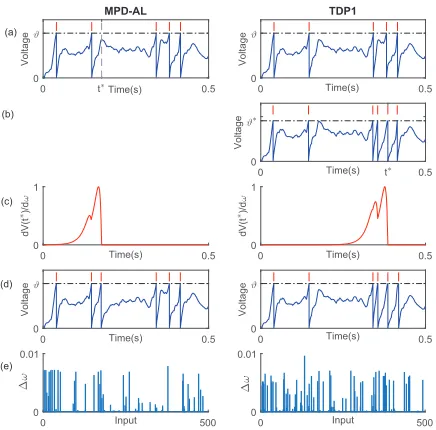
Figure 2: The comparison between MPD-AL and TDP1. (a) Membrane potential traces before learning.t∗ denotes the time instant at which the subthreshold membrane potential is closest to the firing threshold. (b) The membrane potential trace of the neuron with spikes generated at the hypothetical thresholdϑ∗. Here, thet∗corresponds to the time instant at which the membrane potential reachesϑ∗. (c) The shape of the learning curves, depicting the spike-timing dependence of a synapse’s contribution to thedV(t∗)/dω. (d) Membrane potential traces after learning. (e) The accumulated weight modifications during the learning process.
The existing aggregate-label learning algorithms (MST and TDP1) are all threshold-driven. These algorithms mod-ify the synaptic weights based on the error between the fixed firing thresholdϑand the hypothetical thresholdϑ∗. There-fore, it is necessary to determine theϑ∗ for each iteration of the synaptic update. For example, as shown in Fig. 2a (right), the neuron fires five spikes before learning while the desired spike count is six. The threshold-driven algorithms will first numerically determine the critical threshold ϑ∗6, with which the neuron fires exactly six spikes as shown in Fig. 2b (right). However, theϑ∗can not be analytically ob-tained; therefore,ϑ∗is numerically obtained using interval
halving, which is very time-consuming. In contrast, the pro-posed MPD-AL adopts a more direct approach in which the membrane potential (instead of threshold) is considered as the relevant signal for synaptic updates. As shown in Fig. 2b (left), MPD-AL need not numerically determineϑ∗. In-stead, the learning is directly driven by the error between the firing thresholdϑand the membrane potential, whose value is easily accessible.
In Fig. 2c, the learning curves depict the spike-timing dependence of a synapse’s contribution to thedV(t∗)/dω, which highlights the differences between the MPD-AL and the TDP1. In both sub-figures, the weight updates are gov-erned by these learning curves with the aim to increase the membrane potential att∗. According to the definition oft∗
in the MPD-AL,V(t∗)is the subthreshold membrane poten-tial closest to the firing threshold, which makes the synaptic update a straight-forward process. In contrast, the TDP1 rule attempts to potentiate the synaptic weights at a differentt∗
that is typically further away from the threshold, hence re-quiring more changes. This is shown in Fig. 2e, where MPD-AL requires fewer modifications to allow the neuron to gen-erate a desired number of spikes.
Experimental Results
Learning to fire a desired number of spikes
In this section, we first introduce a learning task to demon-strate the ability of the proposed MPD-AL algorithm to teach a neuron to fire a desired number of spikes. Next, we compare the learning efficiency of the MPD-AL against other competitive aggregate-label learning algorithms.
In the first experiment, a single output neuron withN = 500afferents is trained to fire 10 spikes under different input firing rates. The input spike patterns are generated over a time window ofT = 500ms and each presynaptic neuron fires at a Poisson firing raterin = 5Hz (Fig. 3a, 3b) and
20Hz (Fig. 3c, 3d). The initial synaptic weights are drawn randomly from a Gaussian distribution with a mean of 0.01 and a standard deviation of 0.01.
0 Time (s) 0.5
0
Voltage
0 Time (s) 0.5
0
0 Time (s) 0.5
0
Voltage
0 Time (s) 0.5
0 (a)
(F)
(E)
(G)
Figure 3: Neuron’s membrane potential traces before (a, c) and after learning (b, d). The neuron is trained to emit 10 desired spikes under different initial firing rates, i.e., (a, b)
rin= 5Hz and (c, d)rin= 20Hz.
training, the neuron successfully emits the desired number of spikes, distributing throughout the simulation as shown in Fig. 3b. In contrast, Fig. 3c depicts responses of the neu-ron with an input firing rate of20 Hz, in which the neu-ron exhibits bursting behavior at the beginning. Likewise, as shown in Fig. 3d, the MPD-AL algorithm adjusts the synap-tic weights so that the trained neuron emits the desired num-ber of spikes, much less than the initial bursting activities.
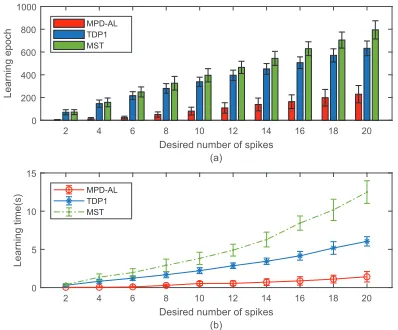
Furthermore, we compare the learning efficiency of differ-ent algorithms with the desired spike counts varying from 2 to 20 at an interval of 2. The input firing rate for presynap-tic neurons is set to 5Hz. For each setup, 20 experiments are carried out with randomly generated input spike patterns and initial synaptic weights. The average number of learning epoch and CPU time used for each setup are calculated and reported in Fig. 4.
2 4 6 8 10 12 14 16 18 20
Desired number of spikes (a)
0 200 400 600 800 1000
Learning epoch
MPD-AL
TDP1 MST
2 4 6 8 10 12 14 16 18 20
Desired number of spikes (b)
0 5 10 15
Learning time(s)
MPD-AL
TDP1 MST
Figure 4: The comparison among MPD-AL, TDP1 and MST algorithms in terms of learning efficiency, i.e., (a) the re-quired number of learning epochs and (b) the rere-quired CPU time.
As shown in Fig. 4a, due to the nature of the iterative op-timization scheme employed, the required number of train-ing epochs grow for all the algorithms with increastrain-ing spike count. The proposed MPD-AL algorithm consistently out-performs other algorithms and requires the lowest amount of training epochs as well as CPU time. Specifically, when the desired spike count is 20, the proposed MPD-AL algorithm requires about 250 learning epochs, while the TDP1 and the MST require more than 600 and 800 learning epochs, spectively. As shown in Fig. 4b, the average CPU time re-quired for the MPD-AL algorithm is about 2s for the de-sired spike count of 20, while the TDP1 and the MST algo-rithms require 6s and 13s, respectively. These results could be explained as below: firstly, as illustrated in Fig. 4a, the MPD-AL algorithm requires fewer learning epochs to reach the desired spike count due to the more direct adaptation strategy taken. On the other hand, both the TDP1 and MST need to numerically determine theϑ∗, which requires more computation times at each learning epoch. Consequently, the MPD-AL offers a better learning efficiency.
Learning Predictive Clues
To learn predictive sensory clues, an organism must bridge the gap between the time when a clue occurs and when the feedback arrives (G¨utig 2016). The temporal credit-assignment problem is a core challenge in both cognition and machine learning. In this section, we will demonstrate that the temporal credit-assignment problem can be solved using the proposed MPD-AL algorithm.
Input
0
Voltage
0
Voltage
0
Voltage
0 0.5 1 1.5 2
Time (s) 0
Voltage
(a)
(b)
(c)
(d)
(e)
Figure 5: Learning predictive clues. (a) Input spike pattern, of which only 10% of the 500 synaptic afferents are shown. Colored rectangles represent 10 different sensory features (50 ms each) that are embedded within a stream of spon-taneous background activities. (b) and (c) show the mem-brane potential traces after being trained to fire one or a burst of five spikes in response to a single clue (blue rectangle). (d) and (e) show the membrane potential traces after being trained to selectively respond to only five clues out of the total ten feature patterns. The neuron is expected to fire only a single spike (d) or distinct number of spikes{1, 2, 3, 4, 5} (e) in response to each clue.
Similar to the tasks proposed in (G¨utig 2016), ten brief (50ms) spiking patterns are constructed from 500 afferents with a firing rate ofrf = 4Hz, which may represent spiking
activities in response to perceived features from the envi-ronment. A certain number of these ten spike patterns will be designated as useful clues, while the rest as distractors. The single neuron connected to these sensory afferents is expected to signal all the useful features by firing a spe-cific number of spikes. In contrast, the neuron should re-main silent in the event of background activities or distrac-tors. In each experimental trial, these ten spike patterns are sparsely embedded in background spike activity with dura-tion Tb. The number of occurrence of each such pattern is
drawn from a Poisson distribution with mean Pm. In
or-der to better simulate non-stationarity of the environment, the background spike activities are generated according to a spontaneous firing rate varying from 0 to 4 Hz (with mean rate 2 Hz). During the training phase, we set the value ofPm
andTbto 0.1 and 500 ms, respectively. In the testing phase,
We first train the neuron to detect a single clueiamong 9 distractors and background activities. In each trial, the desired spike countNd is set to the number of clue event i (Nd = ci). Whenever the neuron fires greater or fewer
spikes than the desired count Nd, the proposed MPD-AL
learning algorithm will weaken or potentiate the synaptic connections, respectively, so as to reach the desired spike countNd. Fig. 5b illustrates the testing result, in which the
neuron fires exactly one spike whenever the correspond-ing clue activity pattern (blue rectangle) occurs and remains silent otherwise. TheNdis not necessarily equal to the
num-ber of clue events since each clue may trigger more than one spike. To simulate this scenario, we design a task where the neuron is required to fire a burst of 5 spikes to the clue i
(Nd = 5ci) and remain silent otherwise as demonstrated
in Fig. 5c. Intriguingly, the proposed learning algorithm en-ables the trained neuron to decompose the feedback signal and associate each clue with a distinct desired spike count, such thatNd = ∑icidi, wherebyciis the number of clue
eventsi within a trial anddi is the corresponding desired
spike count belonging to that cluei. Fig. 5d and 5e show the testing results of these challenging scenarios, where thedi
values for the five clues are set as{1, 1, 1, 1, 1}and{1, 2, 3, 4, 5}, respectively. The experimental results highlight the capabilities of the proposed MPD-AL learning algorithm to decompose the delayed feedback signal.
Application to Speech Recognition
SNNs transform spatiotemporal spike patterns into desired output patterns, and are hence well suited for processing temporally rich signals, for instance, motion and speech recognition. However, the lack of efficient learning algo-rithms limits application of SNN to mostly small toy prob-lems that do not fundamentally involve spatiotemporal spike time computations (Zenke and Ganguli 2018). Although some promising learning algorithms (Lee, Delbruck, and Pfeiffer 2016; Neftci et al. 2017) have been proposed re-cently, they are applied to datasets of static images. There-fore, the temporal pattern classification tasks remain a chal-lenging topic warranting further investigation.
To demonstrate the capability of the MPD-AL learning algorithm in a temporal pattern classification task, we ap-ply it to solve a speaker-independent spoken digit classifica-tion task. The TIDIGITS corpus (Leonard and Doddington 1993) is investigated in this work, which is one of the most common datasets for benchmarking speech recognition al-gorithms (Wu, Chua, and Li 2018; Wu et al. 2018). This dataset consists of isolated spoken digit strings from a vo-cabulary of 11 words (i.e., ‘zero’ to ‘ nine” and ‘oh’) and speakers from 22 different dialectical regions. In this exper-iment, we use the standard training and testing sets, consist-ing of 2464 and 2486 speech utterances, respectively.
Firstly, the raw speech waveform is filtered by a Constant-Q Transform (CConstant-QT) cochlear filter bank (Pan et al. 2018) to extract the spectral information. Here, we use 20 cochlear filters ranging from 200 Hz to 8 KHz. Next, as shown in Fig. 6, the threshold-coding mechanism (G¨utig and Sompolinsky 2009) has been applied to convert incoming speech signals into spike patterns.
The encoded spike patterns are transmitted to the next layer for classification; there are eleven groups of output neurons in this layer with each group corresponding to one class. Each group consists of ten neurons. In order to discriminate between different spoken digits, neurons are trained to generate the desired number of spikes (Nd) only
when a spike pattern from their assigned class is presented, and remain silent otherwise. However, how the value ofNd
is set remains an open question. On the one hand, each spo-ken digit is formed by different number of sub-patterns and hence one commonNdfor all classes is undesirable. On the
other hand, a small value of Ndlimits the use of available
local temporal features, while a largeNd value is prone to
the overfitting problem. To resolve this problem, we propose a data-driven dynamic decoding scheme.
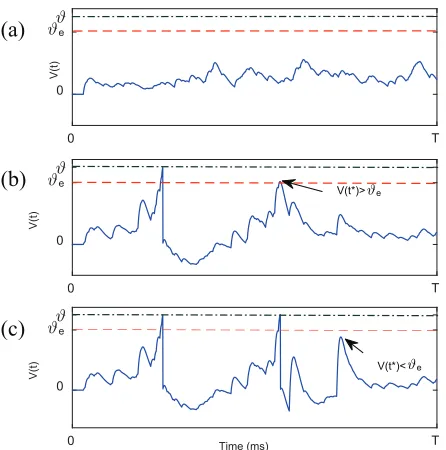
When a training spike pattern is presented, we observe the membrane potential trace of the corresponding output neu-ron. TheNdis decided based on the following three cases:
• If the membrane potentialV(t)remains lower than the firing thresholdϑand no spike is generated (as shown in Fig. 7(a)), thenNd←1.
• If the neuron generatesNospikes andV(t∗)is above the
pre-defined encoding thresholdϑe(as shown in Fig. 7(b)),
thenNd←No+ 1.
• If the neuron generatesNospikes andV(t∗)is below the
pre-defined encoding thresholdϑe(as shown in Fig. 7(c)),
thenNd←No.
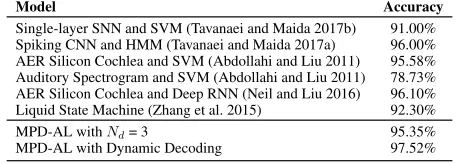
As shown in Table.1, it is encouraging to note that the pro-posed MPD-AL algorithm with dynamic decoding achieves an accuracy of 97.52%, outperforming all other bio-inspired baseline systems. Moreover, to investigate the effectiveness of the proposed dynamic decoding strategy, we perform ex-periments with fixedNd ∈ {1,2,3,4,5,6,7,8,9,10}and
the best accuracy of 95.35% is achieved whenNd= 3. This
result highlights the effectiveness of the dynamic decoding strategy, which could be applied for all temporal classifica-tion tasks. In this work, the classificaclassifica-tion performance is im-proved by training with margins and spike time noise (G¨utig 2016). It is worth mentioning that the accuracy of this work can still be improved when the model is scaled up with hid-den layers using techniques proposed in (Lee, Delbruck, and Pfeiffer 2016; Neftci et al. 2017).
Table 1: Comparison of the proposed framework against other baseline frameworks.
Model Accuracy
Single-layer SNN and SVM (Tavanaei and Maida 2017b) 91.00% Spiking CNN and HMM (Tavanaei and Maida 2017a) 96.00% AER Silicon Cochlea and SVM (Abdollahi and Liu 2011) 95.58% Auditory Spectrogram and SVM (Abdollahi and Liu 2011) 78.73% AER Silicon Cochlea and Deep RNN (Neil and Liu 2016) 96.10% Liquid State Machine (Zhang et al. 2015) 92.30%
MPD-AL withNd= 3 95.35%
(a) (b) (c) (d)
Frequency bins
Figure 6: Illustration of the threshold coding mechanism. (a) The raw speech waveform and the spectrogram generated from the CQT cochlear filter bank. (b) The spectrogram is further encoded into spikes using the threshold coding. The top and bottom sub-figures depict the upward (red dots) and downward (blue dots) crossing events, respectively. For better visualization, only the output from the 1st cochlear filter is displayed. (c) The upward and downward events from (b) are merged to visualize the neuronal activation trajectory. The upward and downward crossing events for the 1st cochlear filter are represented by afferents 1-15 and 16-30, respectively. The threshold coding preserves temporal dynamics of the filtered spectral information. (d) The entire threshold-encoded spike pattern by concatenating the spike events from (c) vertically. The spike events that corresponds to the first filter in (c) is shaded in grey.
(a)
(b)
(c)
0 T
0
e
V(t)
0 T
0
e
V(t)
e
0 Time (ms) T
0
e
V(t) e
V(t*)>
V(t*)<
Figure 7: Illustration of the dynamic output decoding strat-egy.
Discussion and Conclusion
In this paper, we propose a novel aggregate-label learn-ing algorithm MPD-AL to tackle the challenglearn-ing temporal credit assignment problem efficiently. In contrast to exist-ing aggregate-label learnexist-ing algorithms includexist-ing MST and TDP1, we adopt a membrane-potential driven approach in-stead of the threshold-driven one, where the easiest mod-ifiable time instants are identified from the membrane
po-tential traces and used to update the synaptic weights. This more direct training scheme has significantly improved the learning efficiency. The ability of the proposed learning al-gorithm to detect useful clues embedded among distractors and background spiking activities as well as to decompose an aggregate delayed feedback signal to its individual clues are demonstrated in our experiments. We further propose a data-driven dynamic decoding scheme and integrate it with our MPD-AL learning algorithm.
Although the proposed MPD-AL learning algorithm is simple and more efficient, there are areas to improve on. Firstly, MPD-AL increases the output spike count usingt∗
at which V(t∗)is the maximum peak of the subthreshold membrane potential. However, when there is no such sub-threshold peak between any two adjacent output spikes, then the learning mechanism of MPD-AL fails. Secondly, in the experiments of learning predictive clues, clues and distrac-tors are embedded sparsely in training trials to reduce the difficulty of learning. We find that if clues and distractors are dense, the learning performance of MPD-AL decreases. Thirdly, we expect better learning performance and classifi-cation results when the proposed MPD-AL is scaled up to include multiple hidden layers. We will address these areas of improvement in future work.
Acknowledgments
References
Abdollahi, M., and Liu, S.-C. 2011. Speaker-independent isolated digit recognition using an aer silicon cochlea. In
Biomedical circuits and systems conference (biocas), 2011 ieee, 269–272. IEEE.
Bengio, Y.; Lee, D.-H.; Bornschein, J.; Mesnard, T.; and Lin, Z. 2015. Towards biologically plausible deep learn-ing.arXiv preprint arXiv:1502.04156.
Bohte, S. M.; Kok, J. N.; and La Poutre, H. 2002. Error-backpropagation in temporally encoded networks of spiking neurons.Neurocomputing48(1-4):17–37.
Florian, R. V. 2012. The chronotron: a neuron that learns to fire temporally precise spike patterns.PloS one7(8):e40233. Gerstner, W., and Kistler, W. M. 2002.Spiking neuron mod-els: Single neurons, populations, plasticity. Cambridge Uni-versity Press.
G¨utig, R., and Sompolinsky, H. 2006. The tempotron: a neu-ron that learns spike timing–based decisions.Nature Neuro-science9(3):420.
G¨utig, R., and Sompolinsky, H. 2009. Time-warp–invariant neuronal processing.PLoS Biology7(7):e1000141.
G¨utig, R. 2016. Spiking neurons can discover pre-dictive features by aggregate-label learning. Science
351(6277):aab4113.
Kasabov, N.; Dhoble, K.; Nuntalid, N.; and Indiveri, G. 2013. Dynamic evolving spiking neural networks for on-line spatio-and spectro-temporal pattern recognition.Neural Networks41:188–201.
LeCun, Y.; Bengio, Y.; and Hinton, G. 2015. Deep learning.
Nature521(7553):436.
Lee, J. H.; Delbruck, T.; and Pfeiffer, M. 2016. Training deep spiking neural networks using backpropagation. Fron-tiers in Neuroscience10:508.
Leonard, R. G., and Doddington, G. 1993. Tidigits speech corpus.Texas Instruments, Inc.
Memmesheimer, R.-M.; Rubin, R.; ¨Olveczky, B. P.; and Sompolinsky, H. 2014. Learning precisely timed spikes.
Neuron82(4):925–938.
Mohemmed, A.; Schliebs, S.; Matsuda, S.; and Kasabov, N. 2012. Span: Spike pattern association neuron for learn-ing spatio-temporal spike patterns. International Journal of Neural Systems22(04):1250012.
Neftci, E. O.; Augustine, C.; Paul, S.; and Detorakis, G. 2017. Event-driven random back-propagation: Enabling neuromorphic deep learning machines. Frontiers in Neu-roscience11:324.
Neil, D., and Liu, S.-C. 2016. Effective sensor fusion with event-based sensors and deep network architectures. In Cir-cuits and Systems (ISCAS), 2016 IEEE International Sym-posium on, 2282–2285. IEEE.
Pan, Z.; Li, H.; Wu, J.; and Chua, Y. 2018. An event-based cochlear filter temporal encoding scheme for speech signals. In2018 International Joint Conference on Neural Networks (IJCNN), 1–8. IEEE.
Ponulak, F., and Kasi´nski, A. 2010. Supervised learning in spiking neural networks with resume: sequence learn-ing, classification, and spike shifting. Neural Computation
22(2):467–510.
Rueckauer, B.; Lungu, I.-A.; Hu, Y.; Pfeiffer, M.; and Liu, S.-C. 2017. Conversion of continuous-valued deep networks to efficient event-driven networks for image classification.
Frontiers in Neuroscience11:682.
Tavanaei, A., and Maida, A. 2017a. Bio-inspired multi-layer spiking neural network extracts discriminative features from speech signals. InInternational Conference on Neural Information Processing, 899–908. Springer.
Tavanaei, A., and Maida, A. S. 2017b. A spiking network that learns to extract spike signatures from speech signals.
Neurocomputing240:191–199.
Thorpe, S.; Delorme, A.; and Van Rullen, R. 2001. Spike-based strategies for rapid processing.Neural Networks 14(6-7):715–725.
Wu, J.; Chua, Y.; Zhang, M.; and Li, H. 2018. A spiking neural network framework for robust sound classification.
Frontiers in Neuroscience12:836.
Wu, J.; Chua, Y.; and Li, H. 2018. A biologically plausible speech recognition framework based on spiking neural net-works. In 2018 International Joint Conference on Neural Networks (IJCNN), 1–8. IEEE.
Xu, Y.; Zeng, X.; and Zhong, S. 2013. A new supervised learning algorithm for spiking neurons.Neural Computation
25(6):1472–1511.
Yu, Q.; Li, H.; and Tan, K. C. 2018. Spike timing or rate? neurons learn to make decisions for both through threshold-driven plasticity. IEEE Transactions on Cybernetics. Zenke, F., and Ganguli, S. 2018. Superspike: Supervised learning in multilayer spiking neural networks.Neural com-putation30(6):1514–1541.
Zhang, Y.; Li, P.; Jin, Y.; and Choe, Y. 2015. A digital liquid state machine with biologically inspired learning and its application to speech recognition. IEEE Transactions on Neural Networks and Learning Systems26(11):2635–2649. Zhang, M.; Qu, H.; Belatreche, A.; Chen, Y.; and Yi, Z. 2018a. A highly effective and robust membrane potential-driven supervised learning method for spiking neurons.
IEEE Transactions on Neural Networks and Learning Sys-tems.