DEVELOPING A PERFORMANCE APPRAISAL FRAMEWORK FOR STUDENTS’ UNION SABBATICAL OFFICERS
PHIL BENTON
Project submitted in part fulfilment of the Master of Business Administration
i
PROJECT SUMMARY
The aim of the project was to conduct research into performance appraisal processes for
Sabbatical Officers in Students’ Unions. Sabbatical Officers are students elected to serve
as the political leaders of the Students’ Union, and who take a year out of their studies or
post-graduation to do so. Since the passing of the Charity Act 2006, Students’ Unions
have had to register as charities, so Sabbatical Officers have also had to undertake the
role of a charity trustee, accepting the accompanying legal and regulatory responsibilities.
The project’s research objectives first sought to identify the optimum elements for
inclusion in an appraisal process outside of the democratic committee structures which
govern the political processes of a Students’ Union. Secondly, the objectives sought to
identify if the legal requirements of the trustee responsibilities held by Sabbatical Officers
placed any constraints on their performance management needs. Essentially, given their
role as the governors of the organisation who also play a day to day role in the provision
of services, what sort of appraisal or performance management process is appropriate to
put in place?
A literature review was conducted to identify prevailing academic theories in the field of
performance management and performance appraisal. The theories divided between two
schools of thought: appraisal for personal development purposes and appraisal for
ii
management of charities and the wider voluntary sector. From this range of information a
conceptual model was developed through which research could be undertaken.
The research was conducted within a realist philosophy using a case study approach.
Three research methods were used: data line analysis, internet based self completion
questionnaires and semi structured interviews. The research sample frame was the Chief
Executives and Sabbatical Officers of Students’ Unions in the North West and North East
regions of England.
The research found that in practice, PA/PM systems for Sabbatical Officers had
developed according to organisational context and for the most part were informal in
nature. Key to the adoption of a successful PA/PM process was to develop a culture of
feedback throughout the organisation, built on providing clear objectives for the Officers at
the start of the term of office and providing regular opportunities for feedback on
performance throughout the year. The research showed a preference for this feedback to
be given in one to one meetings between a senior staff member of the Union and
individual officers, and that it should focus more on personal development than evaluative
assessment of performance. In some instances, 360 degree review processes had been
introduced to assist with the feedback culture though the effectiveness of these was not
clear. From the perspective of the trustee responsibilities, the research found that there
was an acceptance of the need to appraise performance against the statutory roles and
responsibilities, but that this did not necessarily hinder any other form of performance
iii
Recommendations from the research included clearly establishing the feedback cycle for
Sabbatical Officers; undertaking an objective setting exercise at the start of the year;
identifying a schedule for review meetings; investigating a 360 degree review mechanism;
and reconsidering the process for the Trustee Board to collectively review its
iv
ACKNOWLEDGEMENTS
I would like to thank Wes Haydock for his supervision of this project, particularly his rapid
response to email queries and questions.
I am grateful to colleagues from the North West and North East regions of the National
Union of Students for their contributions to my research. Particular mention should go to
Matt Robinson, Jane Whalen and Peter Shilton-Godwin for giving up their time for the
interviews, and to Martyn Williams for acting as my research champion in the North East
region.
Finally, a big thank you goes to my wife and family for putting up with the last three years
of Wednesday night absences and regular periods of stress as I coped with the demands
v
TABLE OF CONTENTS
Page
PROJECT SUMMARY i
ACKNOWLEDGEMENTS ii
TABLE OF CONTENTS v
LIST OF FIGURES & TABLES viii
CHAPTER ONE - INTRODUCTION 1
CHAPTER TWO – LITERATURE REVIEW 7
2.1 Performance Appraisal Defined 8
2.2 Developmental Appraisal 12
2.3 Evaluative Appraisal 17
2.4 Trustee Dimension 22
2.5 Conceptualising a Framework for Analysis 25
CHAPTER THREE – RESEARCH METHODS 29
3.1 Research Philosophy 30
3.1.1 Positivism 31
3.1.2 Social Constructivism 32
3.1.3 Realism 33
3.2 Philosophical Position 34
3.3 Research Strategy 36
3.4 Research Methodology 37
3.4.1 Sample Size 38
3.4.2 Data Line Analysis 38
vi
3.4.4 Semi-Structured Interviews 45
3.5 Triangulation, Validity and Reliability 47
3.6 Cross Mapping Matrix 49
CHAPTER FOUR – RESEARCH FINDINGS 51
4.1 Procedural Justice 52
4.1.1 Data Line Analysis Results 52
4.1.2 Self Completion Questionnaire Results 53
4.1.3 Semi Structured Interview Results 55
4.1.4 Commentary 56
4.2 Clarity of Objectives 59
4.2.1 Data Line Analysis Results 59
4.2.2 Self Completion Questionnaire Results 59
4.2.3 Semi Structured Interview Results 61
4.2.4 Commentary 63
4.3 Objective Data 65
4.3.1 Data Line Analysis Results 66
4.3.2 Self Completion Questionnaire Results 66
4.3.3 Semi Structured Interview Results 68
4.3.4 Commentary 70
4.4 Feedback Culture 72
4.4.1 Data Line Analysis Results 72
4.4.2 Self Completion Questionnaire Results 73
4.4.3 Semi Structured Interview Results 74
vii
4.5 Motivation and Development 78
4.5.1 Data Line Analysis Results 78
4.5.2 Self Completion Questionnaire Results 78
4.5.3 Semi Structured Interview Results 81
4.5.4 Commentary 82
4.6 Trustee Role 85
4.6.1 Data Line Analysis Results 85
4.6.2 Self Completion Questionnaire Results 85
4.6.3 Semi Structured Interview Results 87
4.6.4 Commentary 89
CHAPTER FIVE – CONCLUSIONS 92
CHAPTER SIX – RECOMMENDATIONS 98
APPENDIX ONE - Data Line Analysis Results 104
APPENDIX TWO - Self Completion Questionnaires 106
APPENDIX THREE - Semi Structured Interview Questions 123
viii LIST OF FIGURES AND TABLES
Page Figure 2.1 Features of an effective appraisal system 9 Figure 2.2 Boselie (2010) Performance management cycle 11 Figure 2.3 Developmental Appraisal system summary 12 Figure 2.4 Armstrong (2001) Performance management cycle 13 Figure 2.5 Performance Appraisal process model 16
Figure 2.6 Evaluative Appraisal process 18
Figure 2.7 Civil Service Management Board Performance
Measurement Model 20
Figure 2.8 Performance review process for volunteer board members 24
Figure 2.9 Conceptual Framework 27
Figure 3.1 Ontological Continuum 31
Figure 3.2 Research Objectives mapped onto the
ontological continuum 35
Page Table 2.1 Competency framework for volunteer board members 22
Table 2.2 Performance standards for Trustees 25
Table 2.3 Sources of the Conceptual Framework 26 Table 3.1 Comparison of generic and contextual strengths and
weaknesses of a data line analysis exercise 40
Table 3.2 Comparison of generic and contextual strengths and
weaknesses of web based self completion questionnaires 43
Table 3.3 Comparison of generic and contextual strengths and
weaknesses semi-structured interviews 46
Table 3.4 Comparison of research methods employed to demonstrate
ix
Table 3.5 Cross mapping matrix 50
1
CHAPTER ONE
2 About the author
The author is currently employed as the Chief Executive of the University of Salford
Students’ Union (USSU), an unincorporated association and registered charity. USSU is a
student-led, student-focussed organisation dedicated to enhancing the lives of students
through representation, campaigning, lobbying, extracurricular activities and the provision
of commercial services. USSU employs fifty five people across a variety of managerial,
administrative and commercial functions. The author is accountable to the USSU Trustee
Board and the role is predominantly responsible for the implementation and delivery of
organisational strategy through effective management and leadership of USSU’s human,
physical and financial resources.
The area under investigation
The issue under investigation is how to provide appropriate performance management
and appraisal for specific members of the Trustee Board. Within a Students’ Union, a
pivotal leadership role for the organisation is played by a group of elected students known
as the Sabbatical Officers. The Sabbatical Officers are elected by the student body to act
as their political representatives, and to shape and lead the Students’ Union for a period of
one year. During that period, the Officers are full time employees of the Union. Primarily,
the Officers are expected to represent the student body to the University, to the local
community, and nationally within the National Union of Students. They also work to
engage students in the activities and services the Union provides on campus, whilst
ensuring that the Union is responsive to and shaped by the needs of those students.
3
structures of the Union, where they would report on their work, whilst seeking membership
support and approval for future courses of action, particularly in their political role. The
democratic structures can vary from Union to Union, but usually include some form of
student council or assembly which is responsible for debating and approving the
representation policies and activities undertaken by the Officers.
The democratic process does not allow for, nor is it intended to provide, any form of
formal performance management or appraisal of the Officers’ work. The democratic
structures are more suited to political appraisal of Officer performance, akin to a
parliamentary select committee, rather than identifying personal development needs and
objectives that are aligned to the strategic direction of the organisation. The Officers are
legally regarded as employees of the Union (NUS, 2007 and 2011) and are expected to
contribute to the strategic development and performance of the Union. However unlike
other employees, the Officers are also Trustees of the Union and thus have to play a
strategic and governance role within the organisation too.
The Charity Act 2006 created a requirement for Students’ Unions to become fully
registered charities with the Charity Commission. As a consequence, many Unions
formally reviewed their governance structures creating Trustee Boards to sit above the
democratic structures. As the elected student leaders of the Union, most Sabbatical
Officers are automatically members of the Trustee Board. The role of a Trustee places a
set of legal obligations on the Officers with regard to their stewardship of USSU as a
charity which, if poorly managed, could lead to significant conflicts of interest arising. As a
4
best interests of USSU at all times (Charity Commission, 2009). Key within that role is the
need to act as the employer of the permanent staff team. Consequently, the Officers do
not have a line manager and as they only work for the Union for a year, do not have to
demonstrate continuous improvement in their performance against objectives year on
year through the Union’s performance appraisal process. However, they do set
themselves objectives for their year in office, and are expected to work as a team to
deliver those objectives.
Strategic Significance
Human resource management (HRM) literature debates at some length the benefits to an
organisation of providing performance management and/or performance appraisal where
an organisation seeks a strategic integrated approach to personnel practice (Bach, 2005).
USSU implements performance appraisal throughout the permanent staffing structure on
an annual basis, and links individual objectives to the achievement of the strategic plan
from the Chief Executive down through the management team and beyond to front line
employees. Within USSU, although a formal appraisal takes place on an annual basis
there is an ongoing process of performance management for all employees
encompassing reviews not only of outputs and outcomes but also of individuals’
performance in terms of upholding and living the values of the USSU in achieving those
outcomes. Bach (2005) views such a process as shifting performance appraisal from
being an annual process to becoming a key driver in enhancing overall organisation
5
This being the case, the lack of a formal performance appraisal and management
structure for the Sabbatical Officers could risk those four individuals, and the organisation,
being unable to identify how they contribute to organisational performance. If the
Sabbatical Officers perceive that the organisation is not moving in the same direction as
they are, then there is a risk of the officers feeling a sense of alienation from the rest of
the organisation. Given the key leadership role the Officers play both as Trustees and
political representatives, it is vital that their objectives and performance are aligned with
the overall direction of the organisation and, indeed, contribute to setting that direction.
Furthermore, although USSU has no specific competition and therefore is not necessarily
concerned with aiming to achieve a sustained competitive advantage over other
organisations, the Charity Commission expects well governed charities to be focussed on
impact and outcomes (Charity Commission, 2008). USSU uses a series of performance
indicators to measure its impact and outcomes, but the nearest comparison it makes to
achieving sustainable competitive advantage is to measure whether it has made a positive
impact on the lives of its members. At the very least, the Sabbatical Officers deserve to
have their contribution to USSU appraised to ensure such a positive impact is being
achieved.
In addition, many of the individuals who take on the role of a Sabbatical Officer are often
aged in their early twenties and have little previous workplace experience, particularly in
high profile leadership roles. Aside from the organisational responsibilities outlined above,
the role offers an incredible personal development opportunity compared to individuals
6
competitive graduate employment market place. As these individuals are often only in
office for one twelve month period (with an absolute maximum of twenty four months
permissible by law), then arguably they need to be able to understand and articulate to
future employers the personal development opportunity they have been through when
seeking further employment. Without a constructive and objective review and appraisal of
their performance and personal development, the competitive advantage the role may
provide for those individuals in the graduate job market could be lost.
Research Question and Objectives
How can a performance appraisal model be developed for Sabbatical Officers that
enables them to contribute effectively to organisational performance whilst respecting their
role as Trustees and elected political representatives?
1. To investigate the optimum elements required in structuring performance
appraisal of Sabbatical Officer roles outside of the democratic process.
2. To critically evaluate how the requirements of the trustee role affect the
performance management needs of Sabbatical Officers.
3. To propose a performance appraisal model for Sabbatical Officers and make
7
CHAPTER TWO
8
This chapter will review the academic literature around the use and style of performance
appraisal, relating it to the wider issue of performance management. The chapter will
close with a synthesis of the issues into a conceptual framework.
2.1 Performance Appraisal Defined
Morris et al (2007) note that performance appraisal (PA) was once a basic system of
producing an annual assessment of a subordinate’s performance, yet has come to be
seen as a encompassing a variety of processes to assess employees, encourage their
development and distribute rewards. Boxall and Purcell (2011) reinforce this view by
describing PA as “among the most complex kinds of HR practice” given that it is a “nexus”
of a variety of HR practices. Further, Boxall and Purcell (2011) caution that treating PA as
a single practice risks making a fundamental error in understanding and locating it within
an organisation.
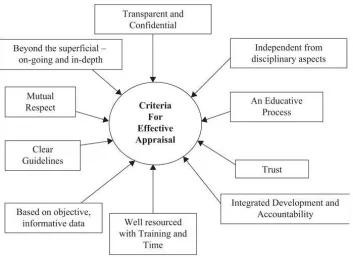
Through a series of empirical studies, Piggot-Irvine (2003) mapped all the elements of an
essential appraisal process (figure 2.1). This model clearly establishes what the cultural
tenets of a PA process should look like. It appears predicated on an assumption that it
could be applied to any organisational context, whereas Boice and Kleiner (1997) assert
the need for a contingency based approach. Respect, openness and trust are highlighted
as the most important elements from the model (Appelbaum et al, 2011), suggesting that
they should be present at all times between managers and employees, going on to state
that to facilitate these elements, feedback should be given regularly - a view corroborated
9
Figure 2.1, Features of an effective appraisal system (Piggot-Irvine 2003, cited in Appelbaum et al, 2011)
The literature has developed over time so that it discusses PA as located within the wider
process of performance management (PM) (Millmore et al, 2007; Piggot-Irvine, 2003).
Marchington and Wilkinson (2008) identify PM as a process that links individual goals,
departmental purposes and organisational objectives with wider human resources
management (HRM) activities in order to ensure work is arranged in a manner that
achieves the best results, with PA being a component of the wider PM process. Millmore
et al (2007) reinforce this view through stating that PA is now viewed as a component of
PM, whilst noting that it is a narrow viewpoint that sees PM simply as a process of
defining performance indicators and setting them as targets to be reviewed and
appraised. They argue that it is impossible for PM to achieve its full potential without it
aligning with organisational strategy. However, they temper their own assertion by
identifying that embedding a PM system is no guarantee that it will deliver the
10
thought about the organisational context, and the method of introduction and execution
(Millmore et al, 2007).
Boselie (2010) expands this notion by discussing PM as a system offering a sophisticated
evaluation of employee contributions to an organisation, bringing together a range of
activities aimed at a convergence of employee and organisational performance. An annual
PA is viewed as one such activity alongside goal setting, goal evaluation and personal
development planning (Boselie 2010). This view is complemented by a CIPD (2005)
survey identifying around 87% of respondents using PA as an element of PM. Boselie’s
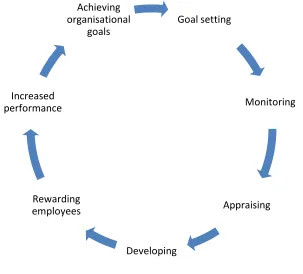
(2010) PM model can be represented as a continual cycle (figure 2.2). It would be fair to
expect that Piggot-Irvine’s (2003) PA features would be present in such a cycle if the
process is to be a success. Whilst the model is mono-causal in nature, assuming that
following the cycle will ultimately increase performance and achieve goals, it clearly
11 Figure 2.2, Boselie (2010) Performance Management Cycle
Conversely, Pointon (2010) argues that universally aligning PA with PM obscures the
important differences between the two notions: PA assesses the individual employee
effort and achievements that contribute to a wider PM approach (Pointon, 2010) and
acquires the information to enable that assessment to take place (Hannay, 2010). Taking
these definitions into account, PA literature begins to divide in two: developmental
appraisal of behaviour compared to evaluative appraisal of performance, with both views
considering if PA becomes then a means of exercising organisational control (Chen et al,
2011; Taylor, 2008; Bratton & Gold, 2007; Millmore et al, 2007; Morris et al 2007).
Goal setting
Monitoring
Appraising
Developing Rewarding
employees Increased performance
Achieving organisational
12 2.2 Developmental Appraisal
Developmental appraisal is focussed on the notion that organisational performance
improves as employees’ own performance improves, and that this is achieved through
regular reviews of the way in which people work rather than an evaluation of outputs
(Chen et al, 2009, Armstrong, 2001). This view regards the PA process as being
something that happens more than once a year (Armstrong, 2001; Marchington and
Wilkinson, 2008), possibly blurring the line between PA and PM. There exists a focus on
the need for clear expectations of behaviours and the job role itself to be articulated at the
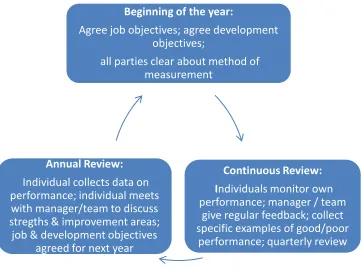
beginning of the cycle, backed up by continuous review and punctuated by an annual PA
process. Bell (1994) identifies a developmental PA cycle, though it possesses some
evaluative characteristics.
Figure 2.3, Developmental Appraisal system summary, adapted from Bell (1994) Beginning of the year:
Agree job objectives; agree development objectives;
all parties clear about method of measurement
Continuous Review: Individuals monitor own performance; manager / team
give regular feedback; collect specific examples of good/poor
performance; quarterly review Annual Review:
Individual collects data on performance; individual meets with manager/team to discuss stregths & improvement areas;
13
The model provides a simple cycle of PA within a PM context, focussed on developing the
individual’s ability to perform. However it relies on an assumption that all parties are
always in agreement on the direction of travel, and on an assumption that a clear
organisational vision and strategy exists against which the annual development plan can
be produced. In addition, the notion of developmental PA becomes more one of a
developmental PM system with a strong PA at its core. This view was later corroborated
by Armstrong (2001) who proposed a similar PM cycle (figure 2.4).
Figure 2.4, Armstrong’s (2001) Performance Management Cycle
Armstrong’s cycle is essentially reductionist in nature, based on an assumption that the
process can be conducted as shown without much more specification, particularly when
compared to Bell’s (1994) model. Equally, it shares the same assumption over the
prevailing ability within the organisation to clearly define roles and performance standards
at the beginning of the process. What both models do offer however is an indication that
Role definition
Performance Agreement
Personal Development
Plan Performance
14
for developmental PA to have impact and be successful, requires a wider organisational
commitment to PM. Both models could be seen as antecedents of Boselie’s (2010) PM
cycle.
Heathfield (2007:6) justifies “PA within developmental PM” by arguing that an evaluative
PA process
“reflects and underpins an old fashioned, paternalistic, top down, autocratic mode of management”
Further, she develops the simple PM cycles above in line with Kuvaas (2010) and
Piggot-Irvine (2003)’s definitions by indicating the importance of regular feedback: discussing
personal development in addition to organisational goals, derived from multiple sources
(Heathfield, 2007; Schraeder et al 2007; Boice & Kleiner, 1997). This multi-source
approach is discussed as 360 degree PA, the term describing the all around collation of
feedback from peers, subordinates, managers and external contacts (Redman and
Wilkinson, 2009). 360 feedback is often identified as key to developmental PA, but not
when used outside a broader PM structure (Morgan et al, 2005) or without a high
feedback culture being present (Kuvaas, 2011; Garavan et al 1997). If successful, the
capture of varying views and perspectives on someone’s performance increases the
likelihood that the evaluative outcome is rounded and correct, and of more productive
benefit to the individual and the organisation (Boselie, 2010; McKenna and Beech, 2008).
An alternative view of developmental PA is that it is as controlling in tone as the evaluative
15
extension of organisational control. Townley’s view is that those PA processes that
purport to a developmental focus are linked to the Focauldian principles of individual
control through unobserved surveillance (Redman and Wilkinson, 2009), arguing that a
360 appraisal is similar in notion to the Panopticon method of observing prisoners
(Marchington and Wilkinson, 2008; Bach, 2005). Kuvaas (2007) corroborates this opinion
by demonstrating through research that some individuals experienced developmental PA
as controlling, particularly where those individuals are used to a high degree of autonomy
in other areas of their work. In turn, this could have a negative effect on work performance
as those individuals developed a perception of a lack of trust in their work (Kuvaas, 2007).
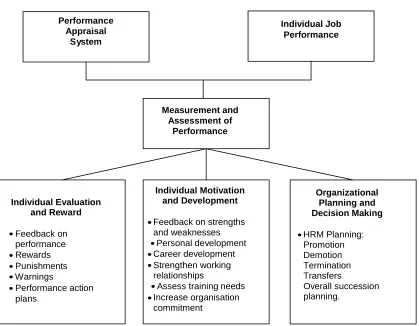
Hannay (2010) proposes a model of PA that appears evaluative but centres on being
developmental, linked to a wider PM cycle. Here, PM is borne out of three elements:
performance planning and goal setting regular coaching and feedback; and an annual
evaluation (Hannay, 2010). Formal evaluation is based on Noe’s (2010, cited in Hannay,
2010) three purposes of PA: collecting information for personnel decisions, identifying
16 Performance Appraisal System Individual Job Performance Measurement and Assessment of Performance Individual Evaluation and Reward Feedback on performance Rewards Punishments Warnings Performance action plans Individual Motivation and Development
Feedback on strengths and weaknesses
Personal development Career development Strengthen working
relationships
Assess training needs Increase organisation commitment Organizational Planning and Decision Making HRM Planning: Promotion Demotion Termination Transfers Overall succession planning.
17
The model’s strength is that, subject to the method used to measure and assess
performance it bridges developmental and evaluative dimensions of PA, yet clearly sits
as part of a wider, organisational PM approach. However, it suffers from a lack of
definition for the method of assessment. Within the focus of this research, the elements
of evaluation / reward and planning / decision making could be deemed superfluous as
the Sabbatical Officers’ role is that of office bearer for a period fixed in time and
remuneration. In contrast, the motivation / development aspect offers a useful
dimension of analysis for developmental PA.
2.3 Evaluative Appraisal.
Redman and Wilkinson (2009) suggest that harder evaluative appraisal processes are
on the increase at the expense of the development approach. However, many
traditional appraisal schemes are underpinned by an evaluative methodology in that,
“management of employee performance is limited to aspects that supervisors can influence”
(Schraeder and Jordan, 2011:7).
Randall (1994, cited in Bratton and Gold, 2007) noted a basic process behind most
evaluative schemes based on defining work, setting targets, performance, and
assessment against targets. Other authors had expanded this reductionist process and
18
Redman and Wilkinson, 2009) expand it into five steps that link to Boseline’s (2010) PM
cycle. The additional steps recognise the developmental dimension to PA.
Figure 2.6, Evaluative appraisal process, adapted from Bach (2005)
The difficulty with the Bevan and Thompson (1992) model is that it is at heart an
“N-Step process” (Collins, 1998), based on an assumption that PA can be conceptualised
into a number of sequential phases that occur in an orderly manner. The issue with that
assumption is that it takes no account of what happens when human interaction is
introduced to the process leaving it relatively under-socialised. The model relies on the
process of PA being predictable and therefore easily broken down into component
steps. The reality is that the model offers little more than guidance to a PA process. It is
arguable that participants would find this a mechanistic experience moving from one
phase to another without deriving personal or organisational value from the experience.
Millmore et al (2007) present a model of performance measurement applied through the
Civil Service Management board, noting that the election of the Labour government in
1997 prefigured an increased focus on PM in the public sector. The model is an
Communicate clear objectives to employees
Establish departmental & individual objectives linked
to organisational goals
Conduct formal reviews of progress against targets
Use reviews to establish training needs
19
archetypal presentation of PA through evaluation of performance (figure 2.7), though
arguably it is overly focussed on inputs rather than outcomes through a focus on
20
ASPIRATIONS
To stretch & motivate the organisation
COHERENT SET OF MEASURES & TARGETS
To translate the aspirations into a set of specific metrics against which performance and progress
can be measured
OWNERSHIP & ACCOUNTABILITY
To ensure that individuals who are best placed to ensure delivery of targets have ownership of doing so.
RIGOUROUS
PERFORMANCE REVIEW
To ensure that continuously improving performance is
delivered in line with expectations.
REINFORCEMENT
To motivate individuals to deliver targeted performance
21
In addition, the Civil Service model (Millmore et al, 2007) has other shortcomings. As
with the Bevan and Thompson (1992) model above, it is under-socialised, through an
assumption that everyone working under the model is in agreement with the procedures
it seeks to impose. The key weakness is that it relies on those individuals who are
supposed to deliver the targets feeling a sense of ownership towards the outcomes.
However, as Radnor and McGuire (2004, cited in Millmore et al 2007) noted, invariably
those delivering the targets had no role to play in creating or setting the targets and thus
took no ownership at all towards their achievement. Thus the lower half of the model
would appear to have no value or impact on the PM process.
Brown et al (2010) accept that evaluative PA has value, viewing the process being
designed to positively impact on employee behaviours leading to improved
organisational performance. It is arguable that this process is not enough in itself, it
must also possess sufficient quality in execution (Brown et al, 2010; Schraeder and
Jordan, 2011). When employees believe the PA process has been procedurally fair,
they are more accepting of the judgements and outcomes the process bestows upon
them (Chen et al, 2011; Thurston and McNall, 2010). The negative experience and
critique of the Civil Service Management Board model above (Millmore et al, 2007) adds
weight to this argument. It would seem then that fairness is as key to an evaluative
driven PA as it is within Piggot-Irvine’s (2003) initial definition.
Criticism of evaluative PA is that it can result in a quantitative process relying on a
checklist approach (Pointon, 2010), resulting in PA that seeks to test conformity with
proscribed behaviours and objectives (Torrington et al, 2011), and providing
22
2009), thus in turn acting as a means of organisational control (Bach, 2005). As in
developmental PA, there is an increasing focus on the use of multi-rater approaches to
collecting data on employee performance (Newbold, 2008) to deliver procedural justice
(Thurston and McNall, 2010). Criticism of multi-rater approaches notes that as many
drawbacks and biases exist as within top down evaluation processes, particularly when
subordinates are required to rate a manager (Torrington et al, 2011; Millward et al,
2010; Drew, 2009; Taylor, 2008).
2.4 The Trustee Dimension
Criticism of both evaluative and developmental PA comes through the view that the
process is ethically inappropriate (Bach 2005, Prowse and Prowse 2009), requires
managers to supervise rather than lead thus producing a subordinated working
relationship (Taylor, 2008; Bach, 2005) and diminishes organisational flexibility (Nickols,
2007). Within the focus of this research is the need to recognise that the individuals to
be appraised are not only employees: through their trustee role they are office-bearers,
employers and political leaders of the organisation. In this context the ethical critique of
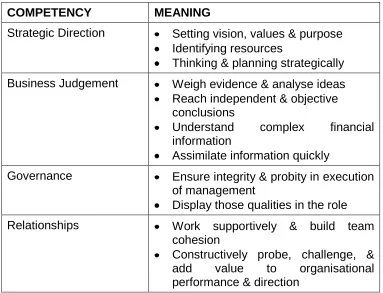
PA holds some weight. The trustee role offers a different dimension to PA. Pointon
(2010) identifies a framework called a “conversation with purpose” used by the CIPD for
appraising the contribution of board level volunteers to organisational performance
23
COMPETENCY MEANING
Strategic Direction Setting vision, values & purpose
Identifying resources
Thinking & planning strategically
Business Judgement Weigh evidence & analyse ideas
Reach independent & objective conclusions
Understand complex financial
information
Assimilate information quickly
Governance Ensure integrity & probity in execution
of management
Display those qualities in the role
Relationships Work supportively & build team
cohesion
Constructively probe, challenge, &
add value to organisational
performance & direction
24
Figure 2.8, Performance review process for volunteer board members, adapted from Pointon (2010)
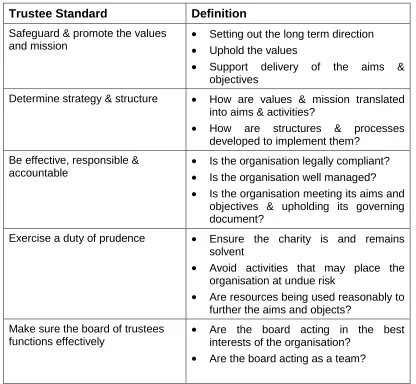
This process is complemented by the best practice guidelines of the National Council
for Voluntary Organisations (NCVO) (2010) and the Charity Commission (2008) creating
standards by which trustee performance can be measured. Pointon (2010) and the
NCVO / Charity Commission (2010/2008) standards can be seen as supporting
developmental PA. The informality of the process risks bias and subjectivity, though the
non-managerial nature of the conversation’s inter-relationships would provide some
mitigation against those factors. This process complements and adds value to Hannay’s
(2010) individual motivation / development aspect of PA. It would be difficult within the
context under review for anything other than a developmental PA approach to be
utilised given the subjects’ role as leaders of the organisation. Equally, the question
Conversation
with a
purpose
2 way review with
Chair
Constructive feedback on competencies
Discuss aspirations
for other roles Identify
appropriate development
25
would exist as to who should hold the conversation as everyone else in the organisation
is technically subordinate to those roles.
Trustee Standard Definition
Safeguard & promote the values and mission
Setting out the long term direction Uphold the values
Support delivery of the aims & objectives
Determine strategy & structure How are values & mission translated into aims & activities?
How are structures & processes developed to implement them?
Be effective, responsible & accountable
Is the organisation legally compliant? Is the organisation well managed? Is the organisation meeting its aims and
objectives & upholding its governing document?
Exercise a duty of prudence Ensure the charity is and remains solvent
Avoid activities that may place the organisation at undue risk
Are resources being used reasonably to further the aims and objects?
Make sure the board of trustees functions effectively
Are the board acting in the best interests of the organisation?
Are the board acting as a team?
Table 2.2, Performance standards for Trustees, adapted from NCVO (2010) and Charity Commission (2008)b
2.5 Conceptualising a Framework for Analysis
As the focus of this study is to identify a performance appraisal process that respects
the Trustee role of the individuals whilst enabling them to identify how they are
26
applicable. Developing a conceptual framework requires a combination of specific
elements from the literature. The conceptualisation is based on providing a
developmental focus to the PA, with reference to the obligations of Trustees, set against
enabling factors. Table 2.3 identifies the elements selected divided between enabling
criteria and functional criteria.
Element Detail Source
Enabling Criteria 1 Procedural Justice
Transparency of process Fairness
Confidentiality
Piggot-Irvine (2003); Chen et al (2011), Thurston and McNall (2010)
Enabling Criteria 2 Clarity of objectives
Focussed goal setting Clarity of job role Development needs
Piggot-Irvine (2003); Boseline, (2010); Bell (1994); Bevan & Thompson (1992, cited in Bach, 2005) Enabling Criteria 3 Objective / Informative Data
Agreed collation process Multi-rater approach
Piggot-Irvine (2003); Heathfield (2007) Enabling Criteria 4 Feedback Culture
Continuous feedback & support
Bell (1994); Heathfield (2007); Kuvaas (2011) Functional Criteria 1 Performance Review:
Motivation and Development
Feedback on strengths and weaknesses
Personal development Strengthen working
relationships
Assess training needs
Hannay (2010); Bell (1994)
Functional Criteria 2 Performance Review: Trustee Competencies Strategic direction Business judgement Governance Relationships Pointon (2010); NCVO / Charity Commission (2010/2008)
27
The conceptual framework itself (figure 2.9) is intended to demonstrate the interaction
between the functional criteria for Sabbatical Officer appraisal, framed by a set of
enabling criteria to guide the style of the appraisal.
The framework enables analysis of the research objectives in a number of ways. The
“Motivation and Development” aspect proposes elements of the Sabbatical role that
could be appraised outside of the democratic processes, taking into account a focus on
Procedural
Justice
Feedback
Culture
Clarity of
Objectives
Objective /
Informative Data
Motivation & Development Feedback on strengths and weaknesses Personal development Strengthen working relationships Assess training needs Trustee Competencies Strategic direction Business judgement Governance RelationshipsFigure 2.9, Conceptual Framework
28
the developmental dimension of PA. Additionally, the “Trustee Competence” dimension
allows a critical evaluation of whether these elements constrain performance
management for the Sabbatical Officers or whether they add value to the role. Finally,
the research phase will test the suitability of the functional criteria, together with whether
29
CHAPTER THREE
30
This chapter will focus on outlining the research philosophy to be followed, and the
research methods to be employed in order to answer the research objectives
successfully.
3.1 RESEARCH PHILOSOPHY
Easterby-Smith et al (2008) identify that understanding the philosophical dimension of
management research can aid the researcher in clarifying their research design,
recognising which designs will or will not work, and may enable the creation of research
designs beyond the researcher’s immediate experience. Saunders et al (2007), note
that the philosophy the researcher adopts will contain certain assumptions about how
that individual views the world which will ultimately underpin the methods chosen to
enact the research itself. The chosen philosophy will be subject to the researcher’s own
view of the relationship between knowledge itself and the process undertaken to create
it (Saunders et al, 2007). The literature identifies three key aspects of thinking about
research philosophy: ontology, epistemology and axiology.
Ontology concerns a set of assumptions about the nature of reality, ranging from
whether it is naturally occurring, or whether reality is a construct of social interaction
between individuals (Easterby-Smith et al, 2008). Epistemology concerns the way in
which enquiries can be made of the world, and whether the same approach should be
used for the natural world as the social world (Saunders et al, 2007). Axiology concerns
the role the researcher’s values play in the research process. Researchers demonstrate
axiological skill by articulating their own values as a basis for making judgments on the
31
design are a representation of their own values (Saunders et al, 2007). Morgan and
Smirnich (1980, cited in Collis and Hussey, 2003) represent the ontological assumptions
as a continuum upon which it is possible to overlay the three main philosophical social
science research philosophies of positivism, realism and social constructionism (figure
3.1).
Reality as a concrete structure
Reality as a concrete
process
Reality as a contextual field
of information
Reality as a social construction
Reality as a projection of
human imagination
Figure 3.1, Ontological continuum, adapted from Collis and Hussey (2003)
3.1.1 Positivism
The positivist approach to research is based on the premise that the truth exists
independent of the researcher who seeks to understand it, and that it can be verified by
the collection of data that will demonstrate unarguable facts (Jankowicz, 2005).
Positivism seeks to establish the facts of the causes of social phenomena with no
regard to subjectivity of the environment, or the influence of the researcher on that
environment – reality will exist regardless of how or when it is investigated (Collis and
Hussey, 2003). A positivistic approach will seek to establish meaningful data through
32
observable phenomena, preferably through a set of experimental exercises that can be
verified and retested by other researchers (Saunders et al, 2007). The key purpose of
this approach is to centre on the data not on opinions, and to attempt to draw
conclusions from the specific context under review that can then be extrapolated to a
wider environment or other organisations (Easterby-Smith et al, 2008). Whilst this
approach has its merits, it relies on absolutes of data and detachment of the researcher.
Saunders et al (2007) argue that complete detachment is all but impossible though the
positivistic approach can be used even if the philosophy is rejected.
3.1.2 Social Constructionism
Criticism of the positivist approach comes from the view that the world is too complex to
be reduced to a series of generalised laws and theories (Saunders et al, 2007).
Consequently, the social constructionism approach argues that the researcher interacts
with the world around them, making sense of it through interpreting the actions of those
under observation. The researcher thus has to adopt an empathetic approach to their
work and understand the social world of their research subjects from their point of view
(Saunders et al, 2007). Social constructionism therefore avoids establishing truths, but
instead seeks to generate a socially agreed reality that is open to revision by others.
The approach is thus based on generating an understanding rather than a truth, but still
requires a rigorous research approach to ensure that these understandings are
complete in themselves so as to enable the production of workable predictions
(Jankowicz, 2005). In a management research context, social constructionism is
33
does not (Saunders et al, 2007), consequently what matters is the meaning of
phenomena uncovered rather than their measurement (Collis and Hussey, 2003).
3.1.3 Realism
Whilst positivism and social constructionism represent extremes of research
philosophies, realism offers a mid-point on the ontological continuum. Realism shares
some of the positivist position, believing that there is an external reality which exists
separate to human description, which can be subject to data collection and
experimentation (Bryman and Bell, 2007), and assumes a scientific approach to
developing knowledge (Saunders et al, 2007). Realism exists in a number of forms
(Easterby-Smith et al, 2008), the common schools of thought being direct and criticial
realism (Saunders et al, 2007). Direct realism argues that what one experiences
through the senses is an accurate portrayal of the world (Saunders et al, 2007) and that
application of appropriate research methods will confirm that experience (Bryman and
Bell, 2007). The direct realist would contend that the world is relatively unchanging and,
similar to positivism, would debate whether the actions of a researcher could lead to a
change in that world or a change of understanding (Saunders et al, 2007). By contrast,
critical realism argues that knowledge of reality requires an acceptance of a bigger
picture than what the senses portray. A researcher can only understand the social world
by understanding the social structures and processes that gave rise to it (Saunders et
al, 2007). The critical realism view is often deemed appropriate in a business research
context as it contends that the social world is complex and fluid, and that the researcher
needs to understand the reasons behind that complexity and fluidity before
34
ontological philosophy behind positivism and weaves a social constructionism thread
through it, asserting that truth comes from a consensus of differing viewpoints
(Easterby-Smith et al, 2007).
3.2 PHILOSOPHICAL POSITION
In establishing a philosophical position for the questions under review in this study, it is
worth returning to analyse the key research objectives.
The first research objective seeks to “investigate the optimum elements required in
structuring performance appraisal of Sabbatical Officer roles outside of the democratic process”. Identifying the elements required to structure an appraisal process would
seem to suggest a positivist approach, as these ought to be measurable and replicable
over a range of occasions. However, it is possible to argue that the role of a Sabbatical
Officer has at least partly developed through social interaction. Sabbatical Officer roles
in the 21st century are arguable different from how they were conceived when first
introduced in the 1950s. At that point, Students’ Unions had not been defined in law as
charitable, so the trustee dimension was not a consideration. A true legal definition of
the role of a Sabbatical Officer was not achieved until the 1994 Education Act, yet the
roles are not consistently defined across the sector: there is an institution by institution
approach to the duties, responsibilities and requirements of the roles that has
developed through human interaction between post holders, students, the Union and
the University. A realist approach which seeks to understand the reason behind the
existence of the roles and whether they are appropriate for performance appraisal
35
The second objective seeks “to critically evaluate how the requirements of the trustee role affect the performance management needs of Sabbatical Officers”. Whilst
“performance management” could be deemed to be a subject for a positivist approach
in that it could be defined and measured, a social constructionist approach would
arguably be appropriate too as “performance” is subject to human interpretation
between rater and ratee. In addition, the literature review has shown the “the trustee
role” to be definable and measurable, but it is arguable that the definition comes from a
social construct rather than pure experimentation and conclusion. The mix of positivism
and social constructionism in this objective suggested the need for a realist philosophy
to be adopted.
Figure 3.2 maps the two objectives onto the ontological continuum.
Reality as a concrete structure
Reality as a concrete
process
Reality as a contextual field
of information
Reality as a social construction
Reality as a projection of
human imagination
Figure 3.2, Research objectives mapped onto the ontological continuum
POSITIVISM REALISM CONSTRUCTIONISM SOCIAL
36
As both objectives merited a realist approach, then realism was identified as the
underpinning philosophy of this research. Consequently a mix of quantitative and
qualitative research methods will be considered for the research methodology.
3.3 RESEARCH STRATEGY
Having settled on a realist research philosophy, there were a number of possible
research strategies which could have been pursued. These included case studies,
longitudinal studies, action research, experimental studies and surveys (Collis and
Hussey, 2003). The actual strategy chosen is dependent on the research objectives,
setting and philosophy. Given the realist philosophy of this research a case study
strategy was utilised as it enabled an in-depth review of one or a small number of
organisations, occurrences or people over a time (Easterby-Smith et al, 2007).
Within a case study, context is all important (Collis and Hussey, 2003) as it invariably
concerns gathering detailed data about an area of analysis leading to the development
of in-depth knowledge. Yin (2003, cited in Saunders et al, 2003:139) reinforces the
issue of context being important by noting that in a case study setting,
“the boundaries between the phenomenon being studied and the context within which it is being studied are not clearly evident”
Some literature points to single case studies suiting social constructionist philosophies
(Collis and Hussey, 2003), but its ability to provide answers to question of “why” as well
as “what” and “how”, plus the use of multiple and combined data collection techniques
37
(1989, cited in Easterby-Smith et al, 2007) noted that case studies within a realist
epistemology should have clear research designs set from the outset, but be capable of
adaptation as the research progresses. In addition, multiple methods of data collection
aimed to provide a triangulated set of responses to ensure that the data received is
valid and reliable.
Saunders et al (2007) further suggest that case studies are an appropriate research
strategy to explore, challenge and test existing theories. As the conceptual framework
proposed in chapter two is driven by existing theories about performance appraisal, the
case study strategy seemed to provide an appropriate process to test the framework’s
assumptions.
3.4 RESEARCH METHODOLOGY
Having identified a realist philosophy and a case study approach for this research, it
was appropriate to use a combination of qualitative and quantitative research methods
to gather the required data. The combination of methods to provide corroborative
evidence for the data or interpretations achieved is known as triangulation (Crowther
and Lancaster, 2009). In a realist approach, the intention is that the qualitative methods
triangulate the findings of the quantitative research particularly as each method has its
own strengths and weaknesses of execution (Saunders et al, 2007). In order to achieve
triangulation of results, three methods will be utilised in this study: data line analysis,
38 3.4.1 Sample Size
Although there are around 120 Students’ Unions across the United Kingdom Higher
Education sector, due to the time constraints of the study, and ease of access to people
and data the research and collection of data was limited to the North West and North
East regions. The two regions contain twenty four Students’ Unions (not including the
author’s employing organisation) all of whom employ at least three Sabbatical Officers.
The author works in the North West region and previously worked in the North East so
had access to the Chief Executives of each organisation. The intention was to use a
sample of both Chief Executives and a Sabbatical Officer from each Union in order to
test the research objectives against the views of both the people who would implement
an appraisal process and the people who would receive it. This created a sample frame
of forty eight individuals. It was recognised that limiting the research to a compact
geographic area would most likely maximise data collection, but risked reducing the
overall representativeness of the sample (Saunders et al, 2007). However, the aim of
the sample was to reduce bias as it contained a broad mix of types and size of
Students’ Union. The established business relationship with and geographical proximity
to the sample enabled the author to interview and distribute questionnaires to the
maximum number of individuals possible, and to employ techniques to attempt a high
rate of return.
3.4.2 Data Line Analysis
Douglas (1995) proposed the method of data line analysis as a quick opening method of
39
researched. The process involves the researcher producing a list of themes or issues
and asking the respondent to rank them in terms of importance. The results of the
exercise can then be collated in spreadsheet form enabling the researcher to assess
the responses very easily. Douglas (1995) used fifty five statements for ranking, but it is
arguable that this could be too many. In addition, some blank spaces can be left for the
respondents to submit their own phrases, preventing the researcher only asking closed
questions.
Table 3.1 highlights some of the generic advantages and disadvantages of a data line
analysis exercise and contrasts those with some contextual observations regarding this
research project.
According to the advantages and disadvantages of using data line analysis, the author
used this method to test the relative importance of the enabling and functional criteria
identified in the conceptual framework. The method was intended to enable an early
identification of whether the criteria were sufficient, or whether the framework was
missing anything. It was also intended to identify which criteria the respondents believed
to be most important: the enablers or the functions.
The research was carried out via an internet based survey using the Survey Monkey
software. The Chief Executive and a Sabbatical Officer from each Union in the two
regions received an explanatory email followed by a web link to the research. The
criteria were listed on a page where the respondent could then rank them in order of
importance. The survey was set to list the criteria in a random order each time the page
40
they appeared. The method was piloted with the senior managers and the Sabbatical
Officers from the author’s employing organisation.
Generic Contextual
Strengths Low cost.
Ease and speed of completion. Enables respondent validation. Enables the researcher’s view to develop quickly.
Ease of completion for busy people.
Quickly identify if conceptual framework is on right track.
Can be conducted quickly at a regional meeting of Unions, or via internet research.
Weaknesses How many statements comprise the right number?
Respondent may not meaningfully engage with the exercise.
Rudimentary method of quantitative research, requires triangulation.
Respondents may offer too many of their own choices.
If own statements end up ranked, may become statistically insignificant & not register as important.
Phrases on cards may possess different significance to researcher and respondent. Unfamiliarity with the method may require time input from researcher to explain the process.
Size of sample may not be sufficient to generate accurate information.
Two quantitative exercises may be asking a lot of the respondents, so design and method of request will be important.
41 Response Rate
The DLA was completed by 32 respondents from a sample frame of 48. The
respondents were split equally between Sabbatical Officers and senior members of
Union staff.
3.4.3 Self-Completion Questionnaires
Questionnaires are regarded as a one of the most widely used data collection
techniques given that they are an efficient method of collecting responses from a large
sample prior to developing a quantitative analysis (Saunders et al, 2007). For this
research, the proposal is to test the objectives by using an internet administered
questionnaire, with each participant being sent a link to the survey website. This method
is rapidly developing into a common source of data collection (Easterby-Smith et al,
2008).
Table 3.2 highlights some of the generic advantages and disadvantages of a web based
self completion questionnaire and contrasts those with some contextual observations
regarding this research project.
According to the advantages and disadvantages of using web based self completion
questionnaires, the author constructed a self completion questionnaire to test the extent
to which respondents believed the democratic process provided effective performance
review for Sabbatical Officers; the effectiveness of the elements which combine to form
42
components of the conceptual framework and addressed the two key research
objectives, seeking to test both the opinions and behaviours of respondents.
The questionnaire used predominantly closed questions on a Likert scale. A mid-point
was not used to avoid respondents exhibiting central bunching tendencies. As a realist
philosophy enables the use of open and closed questions (Collis and Hussey, 2003),
some open text responses were also included to enable respondents to identify their
own opinions on specific criteria In addition, some list questions and some ranking
questions were also utilised.
A web link to the questionnaires was emailed to the Chief Executive and a Sabbatical
Officer from each of the Students’ Unions in the sample. The email contained some
explanatory information about the nature of the survey. The online tool Survey Monkey
was used as the tool to collect the data. The web based nature of the questionnaire
enabled the maintenance of anonymity and there was an opportunity for the user to
validate their responses at the survey’s end. The questionnaire was piloted by the
senior managers and Sabbatical Officers from the author’s employing organisation. This
process resulted in some amendments to the original survey draft, particularly focussing
on ensuring that the language employed was meaningful for both elected officers and
permanent staff members.
Response Rate
The self completion questionnaire was completed by 23 respondents from a sample
43
Generic Contextual
Strengths Low cost.
Appealing design.
Filters can be put in place to move users to correct questions subject to previous responses. Automatic download of answers to database for analysis.
High probability of the right person answering.
Maintains privacy / anonymity of respondent.
Low risk of questionnaire contamination or tampering. Consistency of question asking Ease of completion (subject to design).
Sample population has high incidence of internet / IT usage – unlikely to be put off by technology.
Ease of completion for busy people.
Availability of email contact details ensures right person answers.
Anonymity important.
Some technical language use possible.
Author’s employer has subscription access to
www.surveymonkey.com
Weaknesses Can limit sample to internet competent respondents.
Evidence of poor response rates, particularly as no interviewer present to administer completion. Risk of missed data when people choose not to answer.
Needs to be reasonably short in length to “hook” respondents. Does not support complex questioning.
Must be an interest to the respondent to prompt a reply. Variability in understanding the question without prompts from an interviewer
No opportunity to probe responses
Requires access to an online survey package.
What incentive to complete? – reliant on personal relationship with author rather than employment or financial relationship.
Small sample size may affect validity / reliability if response rate is low.
Sabbatical Officer respondents may not understand the technical nature of the questioning through lack of experience.