Argumentation Theory and Argumentative
Practices: A Vital but Complex Relationship
FRANS H. VAN EEMEREN
ILIAS
Leiden University
University of Amsterdam [email protected]
Abstract: To illustrate the devel-opment of argumentation theory, the paper traces the journey of the pragma-dialectical theory as it wid-ened its scope, step by step, from an abstract model of critical discussion to the complexities of actual argu-mentative discourse. It describes how, having contextualized, empiri-calized and formalized their ap-proach, pragma-dialecticians are now putting the theory’s analytical instruments to good use in identify-ing prototypical argumentative pat-terns in specific communicative activity types in the various commu-nicative domains. This means that they can now start answering the crucial question about the typical characteristics of their discourse asked by interested lawyers, politi-cians, academics and other practi-tioners of argumentation.
Résumé: L'article retrace le par-cours de la théorie pragma-dialect- ique et son champ élargissant d'ap-plication, étape par étape, à partir d'un modèle abstrait de discussion critique jusqu’aux complexités du discours argumentatif actuel. Il dé-crit comment les pragma-dialecti- ciens ont au début employé une approche contextualisée, empirique et formalisée et maintenant ils font bon usage des instruments analyt-iques de la théorie en identifiant des modèles argumentatifs prototypi- ques dans des types d'activités communicatives spécifiques dans les différents domaines de communica-tion. Cela signifie que ils peuvent maintenant commencer à répondre à la question cruciale sur les caracté-ristiques typiques de leur discours posée par les avocats intéressés, les politiciens, les universitaires et par les autres praticiens de l'argumenta-tion
1. Argumentation theory in its current state
At the festive start of the new PhD programme for philosophy and argumentation theory at the University of Windsor I would like to speak about the vital but complex relationship between argumentation theory and argumentative practices. I hope that my speech will succeed in demonstrating the topicality of start-ing this PhD programme.
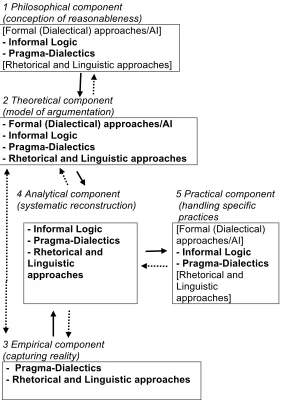
pro-gramme needs to be carried out, consisting of various compo-nents (van Eemeren 2015a).
1 Philosophical component (conception of reasonableness)
[Formal (Dialectical) approaches/AI]
- Informal Logic - Pragma-Dialectics
[Rhetorical and Linguistic approaches]
2 Theoretical component (model of argumentation)
- Formal (Dialectical) approaches/AI - Informal Logic
- Pragma-Dialectics
- Rhetorical and Linguistic approaches
4 Analytical component 5 Practical component (systematic reconstruction) (handling specific practices
- Informal Logic - Pragma-Dialectics - Rhetorical and Linguistic approaches
[Formal (Dialectical) approaches/AI]
- Informal Logic - Pragma-Dialectics
[Rhetorical and Linguistic approaches]
3 Empirical component (capturing reality)
- Pragma-Dialectics
- Rhetorical and Linguistic approaches
To allow for well-founded treatments and improvements of argumentative practices, the practical component of the research programme has to be based on a theoretical model that does justice to all relevant aspects of sound argumentative discourse. The model of argumentation developed in the theoretical com-ponent of the research must therefore be in agreement with a well-considered reasonableness conception, duly accounted for in the philosophical component. Since argumentative discourse is not a theoretical construction but a phenomenon from real life, the research programme also needs to include an empirical component concentrating on the factors and processes playing a part in actual argumentative discourse. In carrying out the re-search programme, its descriptive and normative dimensions get reconciled by reconstructing real-life argumentative discourse as described in the empirical component in the pivotal analytical component from the normative perspective of the model of rea-sonable argumentative discourse articulated in the theoretical and philosophical components.
From the mid-1970s onwards, I have seen it as part of my task to provide, usually in collaboration with others, regular overviews of the state of the art in the study of argumentation, describing the contributions that have been made to it from var-ious disciplinary angles and research traditions.1 For your con-venience, in Figure 1 I have specified which approaches to ar-gumentation theory currently contribute to which components of the research programme. Next to Informal Logic, originating in Windsor, and my own approach called Pragma-Dialectics, also
Formal (Dialectical) approaches (including Artificial Intelli- gence) and Rhetorical and Linguistic approaches are contrib-uting.2
1 See for the most recent overview van Eemeren et al. (2014).
2 See in van Eemeren et al. (2014) Chapter 7 for Informal Logic, Chapter 10
2. From standard to extended theory
The greatest challenge argumentation theorists are faced with is reconciling the normative and the descriptive dimensions of argumentation theory. Let me explain briefly by way of illustra-tion how we have tried to deal with this challenge in giving shape to our pragma-dialectical approach—other approaches have approached the problem in other ways. To create a bench-mark that can serve as a template, we first developed an ideal model of argumentative discourse, named a critical discussion. This model does not describe an existing reality but portrays an optimally reasonable argumentative discourse exclusively aimed at resolving a difference of opinion on the merits.
The model of a critical discussion is “dialectical”, because it provides rules instrumental in resolving a difference of opinion in a reasonable way by means of a regulated exchange of argu-mentative moves. It is also “pragmatic”, because the argumenta-tive moves made in a critical discussion are defined as speech acts (or visual acts) that are functional contributions to the vari-ous stages of the resolution process. Next to a confrontation stage, in which the difference of opinion comes into being, the model of a critical discussion distinguishes an opening stage, which defines the procedural and material starting points, an
argumentation stage, devoted to the exchange of reasons and critical reactions, and a concluding stage, in which the outcome of the discourse is established.
and its follow-up were, we had to admit that we could not pro-vide an adequate answer because we had not the faintest idea about the distinctive features of the various argumentative prac-tices, let alone about how particular deficiencies should be tack-led.
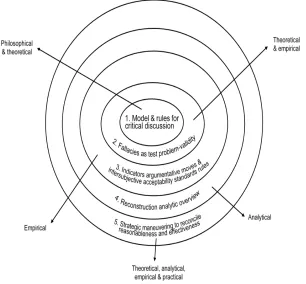
In order to be able to answer the questions relevant to the practitioners of specific argumentative practices in the future, we developed a “masterplan” for the implementation of our re-search programme that involved moving systematically from the abstract model of a critical discussion to the intricacies of argu-mentative reality (van Eemeren 2015c). This step by step coping with complexity is expressed by moving from the centre gradu-ally to the more and more inclusive concentric circles in Figure 2 on page 328.
Since the litmus proof of any normative theory of argumenta-tion is whether it singles out the defective argumentative moves traditionally known as fallacies effectively, its capacity to dis-tinguish between sound and fallacious argumentative moves is decisive for its so-called “problem-validity”: its suitability to serve its purpose. This problem-validity test applies, of course, also to our theory. Our primary step in establishing the connec-tion of pragma-dialectics with argumentative reality therefore consisted in checking whether the theory we proposed can in-deed handle the fallacies.
unrecog-nized other fallacies could be identified (van Eemeren & Grootendorst 1992: 93-220).
Figure 2 From standard to extended pragma-dialectics
rules for critical discussion. Because there proves to be general agreement between ordinary arguers’ acceptability judgments and the theoretical standards, this research makes clear that the pragma-dialectical standards investigated may all be regarded “conventionally valid” (van Eemeren et al. 2009). Follow-up experimental research into factors contributing to hiding the defectiveness of fallacies is still going on (van Eemeren et al 2012).
Our third step in connecting the theory with the intricacies of argumentative reality is the development of a method for recon-structing real-life argumentative discourse (van Eemeren & Grootendorst 1992: 13-89). Since for various reasons argumen-tative reality does not need to correspond with the ideal model of a critical discussion, in the analysis of argumentative dis-course irrelevant elements need to be deleted, implicit elements need to be added, dislocated elements need to be permuted, and equivalent elements need to be substituted. Carrying out these analytic transformations amounts to giving a systematic recon-struction of the argumentative discourse in terms of the model of a critical discussion. In further substantiating the pragma-dialectical approach we have tried to develop all the analytical tools necessary for carrying out such a systematic reconstruc-tion, such as categorizations of standpoints, differences of opin-ion, starting points, argument schemes and argumentation struc-tures. In various respects, these analytical tools are on a par with analytical tools proposed in other approaches, such as Informal Logic and the Rhetorical and Linguistic approaches.3
3 See van Eemeren (Ed. 2001) for an overview of other conceptions of the
analytical tools. In Informal Logic important contributions to the develop-ment of analytical tools have, for instance, been made by Freeman (2011), Govier (1987), Hitchcock (2003), Johnson and Blair (2006), Walton (1996a,b), and Walton, Reed and Macagno (2008).
A fourth and rather fundamental step in taking the intricacies of argumentative discourse into account I initiated together with Peter Houtlosser in the late 1990s by acknowledging in the theo-rizing explicitly that in defending a standpoint argumentatively maintaining reasonableness may always assumed to be com-bined with pursuing effectiveness (van Eemeren & Houtlosser 2002, van Eemeren 2010). In every argumentative move made in argumentative discourse this “argumentative predicament” gives rise to continual strategic manoeuvring aimed at keeping the balance between simultaneously trying to realize these two goals. By including an account of strategic manoeuvring in the theorizing, the unfruitful division between dialectic and rhetoric stemming from the 17th century was aimed to be overcome. This is to be achieved by extending standard pragma-dialectics in such a way that a reconstruction of argumentative discourse can be given that is more refined, more realistic and better account-ed for, so that a more appropriate point of departure is providaccount-ed for a fair evaluation.
3. Three topical developments
Having sketched the evolution of the pragma-dialectical ap-proach, it is important to emphasize that argumentation theory has also been advanced considerably by other approaches. In-formal Logic, for instance, has contributed substantially to al-most all components of the research programme and approaches starting from formal dialectical or rhetorical and linguistic an-gles have also had their share.4 Whereas in formal and informal logical approaches the emphasis is primarily on the normative dimension, the rhetorical and linguistic approaches tend to focus on the descriptive dimension.
4 See van Eemeren et al. (2014) Chapter 7 for Informal Logic, Chapter 6 for
Currently some new trends can be observed in argumentation theory that are not restricted to one particular approach. Next to a broadening of the scope by including "visual argumentation" in the theorizing, three major developments in the way argu-mentation is treated have emerged (van Eemeren 2015b). Each of them is in my view vital for enabling the discipline to realize its practical ambition. For this purpose, the three developments need to be coordinated and brought to bear in combination. The first topical development taking place is “empiricaliza-tion” of the treatment of argumentation. Empiricalization of the treatment of argumentation involves ensuring the connection of argumentation theory with argumentative reality by examining systematically through qualitative and quantitative empirical research the factors and processes influencing the production, interpretation and assessment of actual argumentative discourse. In order to live up to its practical ambition, argumentation theo-ry cannot be limited to normative philosophizing but should be a “positive science” dealing with what goes on in the real world. This means that argumentation theorists should be out to acquire well-founded insights into the factors and processes that actually play a part in the production, interpretation and assessment of argumentative discourse. Although the founders of modern ar-gumentation theory, Arne Næss (1966), Stephen Toulmin (2003) and Chaim Perelman and Lucie Olbrechts-Tyteca (1969), all stressed the need for empirical research, in their own work they concentrated fully on the theorizing. Only more recently empiricalization has been taken up seriously by scholars who are systematically carrying out qualitative or quantitative re-search of argumentative discourse.
ad-vancement of argumentation theory if they go beyond the un-derstanding of a particular case.5 More inclusive types of quali-tative research relying on introspection and observation depict special qualities, traits or conventions of specific specimens of argumentative discourse or describe in an ethnographic vein ordinary arguers’ (so-called “emic”) concepts and norms.6
Quantitative research based on numerical data and statistics is required when claims of the “If X, then Y” type are to be test-ed. Since the 1980s such research has been carried out by prag-ma-dialecticians, but also by some American communication scholars (e.g., Hample & Dallinger 1987) and a few persuasion researchers focusing on argumentation (e.g., O’Keefe 2006). This research has concentrated, for instance, on factors in the presentation of argumentative moves that facilitate or hamper their recognition (e.g., van Eemeren et al. 1989). A recent step towards theoretically relevant empiricalization is the experi-mental testing of the intersubjective acceptability of theoretical (so-called “etic”) norms of reasonableness (van Eemeren et al. 2009).
The second topical development consists of “contextualiza-tion” of the treatment of argumentation. This means that by tak-ing account of the contexts in which the discourse takes place, in particular the more or less institutionalized “macro-context”, a systematic differentiation is made between the various kinds of argumentative practices. In this way justice is done to the fact that, as a rule, the institutional circumstances in which argumen-tative discourse takes place influence to some extent the way in which the discourse manifests itself.
The approaches taken in present-day argumentation theory vary a lot in how they define the institutional macro-context and distinguish between argumentative practices. To allow for a
5 Zarefsky’s (1986) rhetorical analysis of President Johnson’s “war on
pov-erty” is a case in point.
coherent treatment and a methodical comparison of argumenta-tive practices however, their description and differentiation must take place in terms of functional and well-defined theoretical categories.
Contextual considerations have always been an integral part of the rhetorical approaches, starting in Antiquity with the dis-tinction of different “genres” of discourse by Aristotle. In Pe-relman and Olbrechts-Tyteca’s (1969) “new rhetoric” the con-text is in the first place interpreted as “audience”, but still other rhetoricians (e.g., Tindale 1999) take also other contextual ele-ments into account.
American communication scholars adopted in contextualiz-ing argumentation in the 1970s Stephen Toulmin’s (2003) no-tion of “(argument) fields”. Generally they then used the term
argument fields more broadly, viewing them as discourse com-munities or disciplines. Later argument fields seem to have been replaced by argument spheres, each argument sphere coming with specific argumentative practices.7
A new way of contextualizing argumentation was instigated by the dialecticians Douglas Walton and Erik Krabbe (1995), who differentiated between different kinds of dialogue types, each of them characterized by a specific initial situation, method and goal. The contextual dimension of argumentative discourse has also been incorporated in the pragma-dialectical theorizing, but this will be discussed later in this exposé.
The third topical development consists of “formalization” of the treatment of argumentation. Formalization involves achiev-ing precision and rigour by realizachiev-ing systematically an optimally formal shape and regulation for the most crucial parts of the theory. Because it is required for computerization, such formali-zation is of great practical significance.
In line with the idea of “dialogue logic” promoted by the Erlangen School, formal dialecticians proposed formal rules for the verbal resolution of differences of opinion (Barth & Krabbe 1982). Examples of “semi-formal” parts of dialectical argumen-tation theories are Walton and Krabbe’s (1995) profiles of dia-logue, consisting of tree diagrams of possible dialogues, and the pragma-dialectical dialectical profiles (van Eemeren et al. 2007: 17-19), consisting of sequential patterns of the kind of moves that are allowed at a particular point in the resolution process. Formalization is realized most strongly however in formal applications of insights from argumentation theory in Artificial Intelligence (see van Eemeren et al. 2014: Chapter 11). The no-tion of “defeasible reason”, which allows for drawing tentative conclusions while keeping open the possibility that additional information may lead to their retraction, is then of preeminent importance. Connections have been made with the anticipation of defeating circumstances in the Toulmin model and the critical questions associated with the argument schemes as viewed by Douglas Walton.8
Only if all three developments of empiricalization, contextu-alization and formcontextu-alization come to full fruition, is a sound basis created for practical (computerized) intervention in argumenta-tive practices.
4. Prototypical argumentative patterns
The crux of the crucial question we had to leave unanswered in the 1970s are the distinctive features of juridical, political, aca-demic and other kinds of argumentative discourse. Further em-piricalization, contextualization and formalization of our ap-proach to argumentation enable us to show how the analytical
8 Verheij (2005), for instance, discusses how Toulmin’s model of
instruments developed in the extended standard theory can be brought to bear to tackle this question.
Since strategic manoeuvring does not take place in an ideal-ized critical discussion but in the multi-varied practices of real life, after the extension of pragma-dialectics in dealing with argumentative discourse contextualization and increased empir-icalization were mandatory. In all communicative domains spe-cific argumentative practices have established themselves to meet certain institutional exigencies (van Eemeren 2010: 129-162). Parliamentary debates and election speeches in the politi-cal domain and conference presentations, monographs and book reviews in the academic domain are examples of such estab-lished practices. Each of these practices constitutes a communi-cative activity type, which is defined by its “institutional point”. The institutional point is the raison d’être or rationale of the activity—such as scrutinizing the merits and demerits of par-ticular policies in the case of a parliamentary debate.
To realize its institutional point, each communicative activity type is to a greater or lesser extent conventionalized. Some-times, like in a law case, this conventionalization is largely cer-tified in formal rules and regulations. In other communicative activity types, like in a medical consultation, the conventionali-zation is less explicit and formal—or even fully implicit and informal, like in a friendly chat.
in-terpreted facts and concessions; and the concluding stage by a
motivated settlementby a judge.
Depending on the specific institutional requirements, in the various communicative activity types the argumentative dimen-sion is substantiated in different ways. Using in all cases the model of a critical discussion as a template in characterizing communicative activity types argumentatively creates a com-mon point of reference that ensures coherence and consistency in the characterizations of the activity types and unity in the comparisons between them. Because the specific conventionali-zation of a communicative activity type imposes certain con-straints on the argumentative discourse that is allowed to take place, the argumentative characterization is a suitable point of departure for determining the prevailing institutional precondi-tions for strategic manoeuvring.
Due to the different institutional preconditions, in the various communicative activity types the possibilities for strategic manoeuvring may vary to some extent. In some communicative activity types the participants will have more room for defining the difference of opinion in accordance with their own prefer-ences than in others. Unlike in a friendly chat, in a law case, for instance, the definition of the dispute is fixed at the beginning. A similar variety may exist with regard to the choice of starting points, the utilization of argumentative means and criticism, and the sort of outcome aimed for.
legal rule a verdict in a law case, pragmatic argumentation to point out the effectiveness of a policy in a parliamentary debate, and causal argumentation to establish the truth of a claim in a scientific discussion (van Eemeren 2017: 13-22).
Conducting argumentative discourse in agreement with the specific demands of the communicative activity type concerned results in different kinds of argumentative patterns in the vari-ous communicative domains. Each argumentative pattern con-sists of a particular constellation of argumentative moves in which, in order to deal with a particular kind of difference of opinion, in defence of a particular type of standpoint a particular argument scheme or combination of argument schemes is used in a particular kind of argumentation structure. On the “first level of defence”, where the main standpoint (or one of the main standpoints) is defended by the main argumentation, basic ar-gumentative patterns manifest themselves. In basic argumenta-tive patterns it is the type of standpoint at issue that primarily determines which types of argumentation are appropriate for its defence. Because each type of argumentation that is used evokes specific critical questions, more elaborate extended argumenta-tive patterns can come into being which include also the next level and sometimes even further levels of defence.
Argumentative patterns immediately connected with the in-stitutional preconditions for strategic manoeuvring pertaining to a specific communicative activity type or domain are called
prototypical argumentative patterns (van Eemeren 2017: 20-22). Such argumentative patterns represent combinations of modes of strategic manoeuvring that are pre-eminently instru-mental in realizing the institutional point of a communicative activity type in accordance with its institutional preconditions. The occurrence of prototypical argumentative patterns can be explained by the institutional preconditions pertaining to the communicative activity types concerned and they are character-istic of the argumentative discourses in a certain (cluster of) communicative activity type(s).
5. Identifying a prototypical argumentative pattern in Euro-pean parliamentary debate
Having established on theoretical grounds which argumentative patterns are functional and therefore likely to occur in certain communicative activity types, we need to find out by empirical observation whether these prototypical argumentative patterns
do indeed occur in the argumentative discourses concerned. For this reason, during the past seven years, together with Corina Andone, Eveline Feteris, Bart Garssen and Francisca Snoeck Henkemans, I have carried out qualitative empirical research aimed at identifying prototypical argumentative patterns in vari-ous kinds of communicative activity types in the political, the legal and the medical domain.9 By way of illustration, I will report about our identification of an argumentative pattern ensu-ing from the use of pragmatic argumentation in legislative de-bate in the European Parliament.
9 See the ten chapters about the notion of prototypical argumentative patterns
In pragmatic argumentation the prescriptive standpoint that proposal X should be carried out is defended by pointing out that carrying out X leads to desirable result Y—or in its nega-tive variant that X should not be carried out because it leads to
undesirable result Y. The argument scheme underlying this sub-type of causal argumentation is as follows:
1 Standpoint: X should (not) be carried out. 1.1 X leads to positive (negative) result Y.
(1.1’) (If X leads to a positive (negative) result such as Y, it must be carried out).
Pertinent critical questions evoked by the use of pragmatic ar-gumentation are:
(a) Does X indeed lead to Y?
(b) Is Y really desirable (or, in the negative variant, desirable)?
(c) Does X not have any major undesirable side-effects (or, in the negative variant, desirable side-effects)?
This list of critical questions must be expanded if in a certain argumentative practice the circumstances call for it.10
When an arguer responds to critical questions (a), (b) or (c) or any of their sequels, or anticipates these questions being asked, the argumentation loses its “pragmatic” force of instanta-neous problem-solving and turns into complex problem-solving argumentation with a more complex argumentation structure (Garssen 2017: 36). This happens, for instance, when the
10 This could lead to the following sequel of critical questions:
(d) Could Y not be achieved more easily or more economically by other actions?
(e) Would another result (Z) not be even more positive (i.e. more desira ble) than Y?
ence of a problem or the effectiveness of the proposed solution is in doubt. In the political domain using pragmatic problem-solving or complex problem-problem-solving argumentation is generally a functional and therefore likely way of defending the stand-point because in a policy proposal a prescriptive standstand-point re-garding a proposed action is at issue.
In identifying through qualitative empirical research the pro-totypical argumentative patterns that come into being in exploit-ing pragmatic argumentation in a legislative debate in the Euro-pean Parliament, we make use of the analytical instruments de-veloped in pragma-dialectics: the typologies of standpoints (de-scriptive, evaluative, prescriptive), differences of opinion (sin-gle or multiple and mixed or non-mixed), argument schemes (causal, comparison, symptomatic and their sub-schemes), and argumentation structures (single, multiple, coordinative, subor-dinative and their combinations) (van Eemeren & Grootendorst 1992: 13-102).11 In carrying out this research we have
11 Described in a semi-formalized way in terms of these categories and
sub-categories, some of the prototypical argumentative patterns ensuing from the use of pragmatic argumentation in European Parliamentary legislative debate that can be identified based on the analysis of Garssen (2017) are:
Pragmatic argumentation [prag] for prescriptive standpoint [pres] on the 1st level:
1[pres]<1.1[prag]
When statistical information required for demonstrating the existence of a problem is not available, in support of (pragmatic argumentation turned into)
complex problem-solving argumentation [prob], on the 2nd level
argumentation by example [exam]:
1[pres]<((1.1a<1.1a.1[exam])&1.1b)[prob]
When adequacy proposal for solving problem needs to be established, in support of (pragmatic argumentation turned into) complex problem-solving argumentation [prob], on the 2nd level:
argumentation by example [exam]:
1[pres]<((1.1a<1.1a.1[exam])&1.1b)[prob] causal argumentation from cause to effect[caus]:
1[pres]<((1.1a<1.1a.1[caus])&1.1b)[prob]
fied, for instance, a prototypical argumentative pattern that is exemplified in the following contribution by Carl Schlyter, Swedish Member of the European Parliament for the European Greens, to the debate of labelling fruit juices on 13 December 2011:
Mr President, I would like to thank everyone involved in the negotiations. At times, the negotiations were rather amusing. It could be considered strange that we have spent so many hours on such a limited subject as fruit juices, but at the same time, it was a question of rather important principles. Should we maintain the EU’s high standard, where one exists, as opposed to the standard in-corporated into international agreements? If we are to have a properly functioning single market, we must stop deceiving consumers.
During the negotiations, I brought these juice cartons with me and I am still bringing them with me right to the bitter end. Here is one example of juice packaging: high quality, full of lovely cranberries. The problem is that cranberries are not the main ingredient of the juice—it is apple. However, I do not see apple mentioned on the packaging or in the name. This is a product from France. Here I have a product from Sweden/Finland. It is called raspberry/blueberry and there are raspberries and blueberries on the packaging. Hidden behind an enor-mous blueberry there is a very tiny apple. This is mislead-ing, because this juice consists mostly of apple—it con-tains 10 times as much apple as raspberry and blueberry. Here is another fruit drink that is also sold on the Euro-pean market. It has lovely strawberries and passion fruit on the packaging, but what do you think is the dominant fruit? It is apple, of course.
Here is another one that is sold in six other countries in Europe. It states strawberry here, but do you think it contains any strawberries? Yes, it contains a very small amount of strawberries, but as usual it is mostly apple, and the apple on this packaging is hidden behind a symbol so that you can barely see it. This is misleading and fraudulent, and we are at last doing something about it. This is what I have been fighting for, and I am very pleased that this was the end result.
The basic argumentative pattern of the argumentative dis-course in a legislative debate in the European Parliament gener-ally consists of a prescriptive standpoint [pres] supported by pragmatic argumentation [prag]. When the existence of the problem at issue is in doubt and statistical information demon-strating it is not available, in such a debate this argumentative pattern is prototypically extended by adding argumentation by example [exam] on one of the next levels, thus turning the pragmatic argumentation into complex problem-solving argu-mentation [prob]. In the case concerned, Carl Schlyter turns his pragmatic argumentation that the proposed legislation will solve the problem with food labelling in Europe into complex prob-lem-solving argumentation by supporting the premise that there is indeed a problem by indicating that on many labels the ingre-dients are not properly indicated, which is misleading and fraudulent, and supporting this argumentation in its turn by a whole series of arguments by example:
1 The proposed legislation should be adopted.
1.1a There is a problem with food labelling in Europe. 1.1a.1a On many labels the ingredients are not indicated properly on labels.
1.1a.1b This is misleading and fraudulent. 1.1a.1a-b.1a … n [arguments by example].
This means that in Schlyter’s argumentative discourse the following prototypical argumentative pattern is displayed:
1[pres]<(1.1a<((1.1a.1a&1.1a.1b)<1.1a.1a-b.1a… n[exam])&1.1b)[prob]
In a debate in the European Parliament, in defending a pro-posal giving one clear example generally does not suffice. This can be explained by the institutional preconditions applying to such a debate. Members of the European Parliament are sup-posed to speak in the interest of Europe as a whole, not only in the interest of one particular country, let alone only in the inter-est of their own country.12 This means that in their examples they always have to make clear that their intervention applies to most, if not all, European countries. Although Schlyter’s inter-vention does not seem to centre around any specific country’s interests, by choosing a series of examples from a variety of European countries he remains explicitly in line with this estab-lished tradition.
6. Dealing with the variety of argumentative practices
Having widened the scope of our theory, step by step, from an abstract model of critical discussion to the complexities of actu-al argumentative discourse, and having contextuactu-alized, empiri-calized and formalized our approach, we are now putting the analytical instruments developed to good use in identifying pro-totypical argumentative patterns in specific communicative ac-tivity types in the various communicative domains. At long last, in this way justice is done to the vital but complex relationship
12 This relates to the “secondary” institutional precondition, called “the
Euro-pean Predicament”, that although Members of the EuroEuro-pean Parliament can-not ignore the specific interests of their electorate in their home country, they are supposed to speak in the interest of Europe as a whole (van Eemeren & Garssen 2010).
between argumentation theory and argumentative practices. This means that we can now start answering the crucial question about the typical characteristics of their discourse asked by in-terested lawyers, politicians, academics and other practitioners of argumentation in the late 1970s.
In recent research we have paid a great deal of attention to the identification of prototypical argumentative patterns coming about as a consequence of institutional preconditions for strate-gic manoeuvring in various political, legal and medical commu-nicative activity types (see van Eemeren, Ed. 2017). It goes without saying that much more qualitative research of this type, concentrating also on other communicative activity types and other communicative domains, is required.
Another type of research into contextualized argumentative discourse waiting to be carried out is immediately connected with our qualitative explorations of prototypical argumentative patterns. It concerns the detection of “stereotypical” argumenta-tive patterns. The fact that certain argumentaargumenta-tive patterns are prototypical in certain communicative activity types does not necessarily mean that they also occur frequently in actual argu-mentative practices taking place in these activity types. Their frequency of occurrence compared to other prototypical argu-mentative patterns in the same communicative activity type or compared to their occurrence in other communicative activity types or domains needs to be investigated by means of quantita-tive empirical research of representaquantita-tive corpuses of discourse. Only prototypical argumentative patterns which occur relatively frequently in either of these two senses deserve to be considered
stereotypical argumentative patterns.
ac-count will not merely be based on theoretical considerations but also confirmed by meticulous observation in empirical testing. In our account, theoretical considerations and empirical obser-vations are in fact systematically interrelated.
Because of its explanatory role in accounting for the func-tional diversity of argumentative reality, in further examining the argumentative patterns the “strategic dimension” of argu-mentative discourse should also be given its due. Depending on the macro-context and its specific institutional preconditions, different strategic considerations are brought to bear by the ar-guers in their conduct of argumentative discourse. For this rea-son, different argumentative patterns may be supposed to reflect different strategic scenarios. This means that it needs to be in-vestigated which manifestations of argumentative patterns are in specific communicative practices indicative of which strategic scenarios.
In addition, in explaining the differences between argumenta-tive patterns coming about in the same or similar communica-tive activity types in different cultural settings, the arguers’ so-ciological or “ideological” background must be taken into ac-count. In a Chinese cultural setting, for instance, in some com-municative activity types the prototypical argumentative pat-terns may take a somewhat different shape than in a European or American cultural setting. Next to cultural differences, in the end it is also possible and worthwhile to trace individual differ-ences in “argumentative style”. Argumentative styles manifest themselves in argumentative patterns that are characteristic of the strategic manoeuvring of particular individual arguers or groups of arguers.
guid-ance in developingsuitable “formats” or “designs” for perform-ing the verbal activities concerned in an optimal way and appro-priate methods for their production, analysis and evaluation. Taking this time the medical context of health communication as a case in point, by starting from observed prototypical pat-terns, more suitable formats can be designed for conducting argumentative exchanges in doctor-patient consultation, more adequate instructions can be provided for analysing health bro-chures, and more effective tools can be offered for evaluating medical advertisements (accompanied by well-considered ad-vice for their authors). Particularly if the recommended proce-dures can be formalized and computerized, in this way the quality of such argumentative practices can be enhanced consid-erably.
References
Barth, E.M., & Krabbe, E.C.W. (1982). From axiom to dia-logue. A philosophical study of logics and argumentation. Berlin/New York: Walter de Gruyter.
Bex, F.J., Prakken, H., Reed, C., & Walton, D.N. (2003). To-wards a formal account of reasoning about evidence. Argu-mentation schemes and generalisations. Artificial Intelligence and Law, 11, 125–165.
Doury, M. (2009). Argument schemes typologies in practice. The case of comparative arguments. In F.H. van Eemeren & B. Garssen (Eds.), Pondering on problems of argumentation.
Twenty essays on theoretical issues (pp. 141-155). New York: Springer. Argumentation Library 14.
Eemeren, F.H. van (Ed. 2001). Crucial concepts in argumenta-tion theory. Amsterdam: Amsterdam University Press. Eemeren, F.H. van (2010). Strategic maneuvering in
argumentation. Amsterdam/Philadelphia: John Benjamins. Argumentation in Context 2.
Eemeren, F.H. van (2015a). Argumentation studies’ five estates. In F.H. van Eemeren, Reasonableness and effectiveness in argumentative discourse. Fifty contributions to the develop-ment of pragma-dialectics (pp. 81-109). Cham etc.: Springer. Eemeren, F.H. van (2015b). Bingo! Promising developments in
argumentation theory. In F.H. van Eemeren & B. Garssen,
Reflections on theoretical issues in argumentation theory
(pp. 3-25). Heidelberg etc.: Springer. Argumentation Library 28.
Eemeren, F.H. van (2015c). From ideal model of critical discus-sion to situated argumentative discourse: The step-by-step development of the pragma-dialectical theory of argumenta-tion. In F.H. van Eemeren, Reasonableness and effectiveness in argumentative discourse. Fifty contributions to the devel-opment of pragma-dialectics (pp. 127-147). Cham etc.: Springer.
Eemeren, F.H. van (2017). Argumentative patterns viewed from a pragma-dialectical perspective. In F.H. van Eemeren (Ed.),
Prototypical argumentative patterns. Exploring the relation-ship between argumentative discourse and institutional con-text (pp. 7-29). Amsterdam/Philadelphia: John Benjamins. Argumentation in Context 11.
Eemeren, F.H. van (Ed. 2017), Prototypical argumentative pat-terns. Exploring the relationship between argumentative dis-course and institutional context. Amsterdam/Philadelphia: John Benjamins. Argumentation in Context 11.
Eemeren, F.H. van, & Garssen, B. (2010). Constraints on politi-cal deliberation: European parliamentary debate as an argu-mentative activity type. In D. Gouran (Ed.), The functions of argument and social context. Selected papers from the 16th
Eemeren, F.H. van, Garssen, B., Krabbe, E.C.W., Snoeck Hen-kemans, A.F., Verheij, B., & Wagemans, J.H.M. (2014).
Handbook of argumentation theory. Dordrecht etc.: Springer. Eemeren, F.H. van, Garssen, B., & Meuffels, B. (2009). Falla-cies and judgments of reasonableness. Empirical research concerning the pragma-dialectical discussion rules. Dor-drecht: Springer. Argumentation Library 16.
Eemeren, F. H. van, Garssen, B., & Meuffels, B. (2012). The disguised abusive ad hominem empirically investigated: Stra-tegic maneuvering with direct personal attacks. Thinking & Reasoning 18(3), 344-364.
Eemeren, F.H. van, & Grootendorst, R. (1992). Argumentation, communication, and fallacies. A pragma-dialectical perspec-tive. Hillsdale (NJ): Lawrence Erlbaum.
Eemeren, F.H. van, Grootendorst, R., & Meuffels, B. (1989). The skill of identifying argumentation. Journal of the Ameri-can Forensic Association, 25(4), 239-245.
Eemeren, F.H. van, & Houtlosser, P. (2002). Strategic maneu-vering: Maintaining a delicate balance. In F.H. van Eemeren & P. Houtlosser (Eds.), Dialectic and rhetoric: The warp and woof of argumentation analysis (pp. 131-159). Dordrecht: Kluwer Academic. Argumentation Library 6.
Freeman, J.B. (2011). Argument structure. Representation and theory. Dordrecht/New York: Springer. Argumentation Li-brary 18.
Garssen, B. (2017). The role of pragmatic problem-solving ar-gumentation in plenary debate in the European Parliament. In F.H. van Eemeren (Ed.), Prototypical argumentative pat-terns. Exploring the relationship between argumentative dis-course and institutional context (pp. 31-51). Amster-dam/Philadelphia: John Benjamins. Argumentation in Con-text 11.
Govier, T. (1987). Problems in argument analysis and evalua-tion. Dordrecht/Providence: Foris.
Hample, D. & Dallinger, J.M. (1987). Cognitive editing of ar-gument strategies. Human Communication Research, 14, 123-144.
Hitchcock, D.L. (2003). Toulmin’s warrants. In F.H. van Eeme-ren, J.A. Blair, C.A. Willard & A.F. Snoeck Henkemans (Eds.), Anyone who has a view. Theoretical contributions to the study of argument (pp. 69–82). Dordrecht: Kluwer Aca-demic.
Johnson, R.H., & Blair, J.A. (2006). Logical self-defense (U.S. edition). New York: International Debate Education Associa-tion.
Næss, A. (1966). Communication and argument. Elements of applied semantics. London: Allen and Unwin.
O’Keefe, D.J. (2006). Pragma-dialectics and persuasion re-search results. In P. Houtlosser & M.A. van Rees (Eds.),
Considering pragma-dialectics. A festschrift for Frans H. van Eemeren on the occasion of his 60th birthday (pp. 235-243). Mahwah, NJ: Lawrence Erlbaum.
Perelman, C., & Olbrechts-Tyteca, L. (1969). The new rhetoric. A treatise on argumentation. Notre Dame, IN: University of Notre Dame Press.
Tindale, C.W. (1999). Acts of arguing. A rhetorical model of argument. Albany, NY: State University of New York Press. Toulmin, S.E. (1973). The uses of argument. Updated ed.
Cam-bridge, UK: Cambridge University Press.
Verheij, B. (2005). Evaluating arguments based on Toulmin’s scheme. Argumentation, 19, 347-371.
Walton, D.N. (1996a). Argumentation schemes for presumptive reasoning. Mahwah, NJ: Lawrence Erlbaum.
Walton, D.N. (1996b). Argument structure. A pragmatic theory. Toronto: University of Toronto Press.
Walton, D.N., Reed, C., & Macagno, F. (2008) Argumentation schemes. Cambridge: Cambridge University Press.