Rootplowing, Front-end Stacking, and Seed-
ing Effects on Herbaceous Plant Species
Composition
C.L. GONZALEZ AND G.V. LATIGO
Abstract
Effects on herbaceous plant species composition of two mechan- ical brush manipulation treatments (rootplowing and front-end stacking) with and without grass seeding were investigated in the Rio Grande Plain of Texas. Clearing of brushy rangeland by either rootplowing or front-end stacking increased native grass and forb diversity. During the first year after treatment, forbs accounted for about 70% of plant species composition based on density, but by the third and fifth year, they decreased to 2950. Plots seeded to native or introduced grasses established good stands, and by the second year, desirable forage had increased. Buffelgrass (Cenchrus cilia- ris), an introduced seeded species, was the most aggressive species. Five years after mechanical brush manipulation, this species accounted for a major portion of the plant composition in both seeded and nonseeded treatments.
The vegetation of much of the Rio Grande Plain of Texas has changed greatly since domestic livestock were introduced over 100 years ago. Generally, perennial grasses have decreased and shrubs such as mesquite (Prosopisglandulosa), blackbrush acacia (Acacia rigidula) and cacti (Opuntia Spp.) have increased. Although the quality of management has improved greatly on most range within the last two or three decades, most rangeland is still below its forage production capacity (Texas Conservation Needs Commit- tee 1974).
Although some believe that the brush invasion is recent, reports on the early vegetation of the Rio Grande Plain indicated that brush species always have been present although in limited size and density (Johnston 1963; Inglis 1964; Lehmann 1965). In the Rio Grande Plain of Texas, about 85% (5.5 million ha) of the area supports at least a 20% woody canopy cover (Smith and Rechen- thin 1964).
Control of woody species by mechanical treatment is expensive, complex, and difficult, since many species occur on the same range site. Control is complicated because certain species may require different treatments at different times. In addition, some species are desirable wildlife food plants and should not be controlled.
Rootplowing, a mechanical manipulation practice that cuts off woody plants below ground by means of a horizontal blade pulled behind a tractor, generally at a depth of 35 to 40 cm, has been highly effective in combating dense stands of mixed brush. In low rainfall areas, however, the practice could destroy a high percen- tage of existing desirable perennial grasses and result in the inva- sion of annual grasses and weeds (Fisher et al. 1959). Mathis et al. (1971) reported that in Throckmorton County, Texas, rootplow- ing decreased grass production for the next six growing seasons. In west Texas, Hughes (1966) reported more total production after rootplowing, but forbs and annual grasses constituted the major vegetation. In the Coastal Prairie of Texas, Powell and Box (1967)
Authors are range scientist and biological aid, U.S. Department of Agriculture, Science and Education Administration, Agricultural Research, Soil and Water Con- servation Research, Weslaco, Texas 78596.
Manuscript received July 19, 1979.
concluded that controlling brush with minimum soil disturbance was the best method for improving vegetative composition. How- ever, they used natural plant succession; no artificial vegetation or seeding was used.
Fisher et al. (1959) reported that in northwest Texas, seeding grasses after rootplowing produced good stands of native and introduced grass species. On the rolling and Southern High Plains, however, Jaynes et al. (1968) reported that seeding native grasses after rootplowing often resulted in unsatisfactory stands.
Front-end stacking, a recently introduced mechanical practice, has not been thoroughly evaluated. A front-end stacker is a modi- fied dozer blade using a toothed, rake-like “stacker” with teeth 14 to 36 cm apart. The teeth pull the plants out of the soil. In the Coastal Prairie of Texas, Powell and Box (1967) found that scalp- ing, a manipulation similar to front-end stacking, decreased her- bage production.
We conducted this study to investigate further the effects of rootplowing and front-end stacking with and without seeding on changes in species composition of herbaceous plant communities.
Study Area
The study area is on the southern edge of the Rio Grande Plain about 38 km north of Rio Grande City, Starr County, Texas. Long-term average annual precipitation is 43 cm. Potential evapo- ration exceeds precipitation by four fold (USDC 1970). Most precipitation occurs as thunderstorms that are unevenly distrib- uted both geographically and seasonally. Occasionally, tropical disturbances produce heavy fall rains. Thus, September has the highest long-term monthly average. Another rainfall peak occurs in late May or early June from squall-line thunderstorms.
Summer temperatures are high, and daily maximum tempera- tures in July and August are usually 38” C or higher. Fall freezes occur 7 out of 10 years, and spring freezes occur 9 out of 10 years. The average length of the growing season is 305 days (USDC 1970).
The study area is a sandy loam soil range site with level to gently sloping topography (0 to 5%). The associated soil types are McAllen and Brennan sandy loams. These soils have a noncalcare- ous fine sandy loam surface layer and a sandy clay loam subsoil. The Brennan series is a member of the tine-loamy, mixed, hyper- thermic family of Aridic Haplustalfs; the McAllen series belong to the hyperthermic family of Ardic Ustochrepts. The fine sandy loam surface layer ranges from about 25 to 50 cm in depth. Permeability of the subsoil is moderate. The water holding capacity and fertility of these soils are high; thus, this site has a high production potential.
The dominant woody plant species include cenizo(leucophyl- lum frutescens), blackbrush acacia, coyotillo (Karwinskia hum- boldtiana, coma (Bumelia celastrina), mesquite, and capul (Schaefferia cunelfolia.)
Forb cover is sparse; western ragweed (Ambrosia psilostachya), can’s multiple range test was used to test for individual ragweed parthenium (Parthenium hysterophorus), rose palafoxia comparisons.
(Palafoxia rosea), and lazy daisy (Aphanostephus skir>hobasis) -
are most common. Pretreatment Conditions
Before mechanical brush manipulation, the plant community
Methods
Mechanical treatments were established during June, 1972, on native undisturbed brushland in poor range condition due to over- grazing. A randomized split block design had three replications of main plots of two mechanical brush-manipulation treatments (rootplowing and front-end stacking) and an undisturbed control. Each replication or block consisted of three 2.4-ha strips, one strip each for rootplowing, front-end stacking, and the control. Each strip was divided equally into three O.&ha subplots, which were seeding treatments of (1) a single introduced species, buffelgrass (Cenchrus ciliaris), at 2.2 kg/ ha, (2) a mixture of five native grass species (Table I), and (3) nonseeded. Subplots were handseeded between August 31 and September 6, 1972.
Table 1. rates.
Five native grasses seeded as a mixture and corresponding seeding
was dominated by low-growing woody species including some cacti and a few grasses and forbs in the understory. A total of 28 woody species were identified. Total woody plant density was 4,925 plants/ ha (Table 2) with 10 species contributing 3,520 plant- s/ ha. This high woody plant density was associated with low herbaceous plant density and production. Woody plant canopy cover averaged 32%. Cenizo and blackbrush acacia were dominant and accounted for 1,020 plants/ ha. Cenizo and coyotillo had the highest relative frequency, 32 and 3 170, respectively.
The grass flora was composed of 16 species (Table 3). Four species accounted for 63% of the plant composition and 12 miscel- laneous species combined accounted for 25%. Texas bristlegrass, red grama, hooded windmill, and Wright’s threeawn with fre- quency of occurrence values exceeding 25% were well distributed throughout the study area. All forbs accounted for 12% of the plant composition.
Rate’ Table 3. Herbaceous plant species composition and frequency before
Species (kg/ ha) mechanical brush manipulation in 1972.
Pink pappusgrass (Pappophorum bicolor) 0.4
Arizona cottontop (Digitaria cal$omica) 0.7
Species
Plains bristelgrass (Setaria macrostachya) 0.4
composition Frequency
Two-flower trichloris (Trichloris crinita) 0.3
Species (%I (%I
Four-flower trichloris (Trichloris pluriflora) 0.3 Grasses
Red grama (Bouteloua trlfida) 13 31
I Rates based on pure live seed. Hooded windmillgrass (Chloris cucullata) 11 37
Wright’s threeawn (Aristida wrightii) 14 26
All plots were deferred from domestic livestock grazing until Texas bristlegrass (Setaria texana) 25 36
winter, 1974. They were then grazed from late spring to early Gummy lovegrass (Eragrostis
summer and again in late fall each year. The number of animal curtipedicillata) 6 14
units varied each year, but plots were grazed for 90, 140, 135, and Hall’s panicum (Panicum hallii) 6 10
160 days for 1974, 1975, 1976, and 1977, respectively. Utilization of Buffelgrass (Cenchrus ciliaris) 3 3
current growth was about 60% each year. Sand dropseed (Sporobolus cryptandrus) 2 7
Woody plant canopy cover was determined using the line inter- Four-flowered trichloris (Trichloris
cept method (Canfield 1942). Woody species density and relative pluriflora) 1 3
frequency were determined before mechanical treatment by the Fall witchgrass Pink pappus (Pappophorum (Leptoloma cognatum) bicolor) 1 1 1 1
point-centered quarter method (Dix 196 1). Seventy-five points Miscellaneous grasses 5 9
were established on each of the three 2.4-ha strips of brush for the point-centered quarter method and nine line transects 30 m long Forbs
for the line intercept method. Changes in herbaceous composition Western ragweed (Ambrosia psilostachya) 4 4
were evaluated by point quadrat methods (20 quadrats per sub- Wooly tidestromia (Tidestromia plot). Herbaceous species data were collected twice yearly (June
lanuginosa) 2 3
and November).
Ragweed parthenium (Parthenium
hysterophorus) 1 1
Plant nomenclature follows Vines (1960), Gould (1975), and Rose palafoxia (Palafoxia rosea) 1 2
Correll and Johnston (1970). Data were statistically analyzed by analysis of variance procedures (Cochran and Cox 1956). Dun-
Miscellaneous forbs 4 5
Table 2. Woody plant species frequency and density before mechanical brush manipulation treatments in 1972.
Precipitation
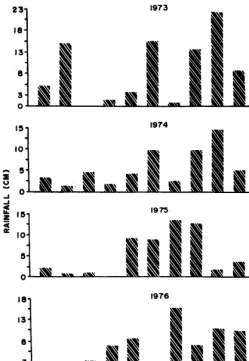
Total annual precipitation amounts recorded were 86,60,55,73,
Species
Cenizo (Leucophyllum frutescens) Black brush (Acacia rigidula) Coyotillo (ffirwinskia humboldtiana) Coma (Bumelia celastrina)
Capul (Schaefferia cuneifolia) Cranjeno (Celtis pallida) Sage (Salvia ballatafolia) Guayacan (Porliera angustifolia) Cactus (Opuntia Spp.) Mesquite (Prosopis glandulosa)
Total major spp. Miscellaneous spp. Total spp.
and 40 cm for 1973 to 1977, respectively (Fig. 1). Precipitation
Frequency Density during this period was above normal (43 cm) in all years except
(%I (plants/ ha) 1977.
32 520 Seasonal distribution of rainfall was irregular during the period
27 500 from 1973 to 1976, a period when mean annual precipitation was
31 400 above the record mean. It was below the mean during the winter
25 480 season of all years, but 1973. In 1977, when mean annual precipita-
21 350 tion was below the mean the winter mean was also below normal.
20 280 The precipitation means in spring of 1973 and 1977 were different
19 280 from the normal; 1973 was extremely dry, while 1977 was
22 260 extremely wet. Annual precipitation for summer was above the
16 250
237 1973
Ia-
8-
‘81 1978
Fig. 1. Monthly precipitation record in study area from 1973 to 1977.
Results Herbaceous Composition
The effect of mechanical treatments on plant species composi- tion (PC) based on density and plant frequency (PF) as compared with an undisturbed control was variable (Tables 4,5, and 6). Both mechanical manipulation treatments showed more forb density
than the control for 3 years following treatment; however, after 5 years forb density was significantly higher only in the rootplowing treatment.
Mechanical Manipulation (main treatments)
In 1973, hooded windmillgrass acounted for the highest PC and plant frequency (PF) of all grass species in both mechanical brush manipulation treatments (Table 4). However, in the control treat- ment, red grama accounted for the highest PC (20.8%) and hooded windmillgrass accounted for the highest frequency (51%). Two- flowered trichloris, a seeded species, did not germinate or establish in any of the plots. The other five seeded species combined accounted for 8.7, 5.2, and 6.8% PC for rootplowed, front-end stacking, and control, respectively. Forb PC was high, 69.3% for rootplowed and 66.8% for front-end stacking, but accounted for only 26.8% PC for the control treatment.
Total number of plants/ha in 1973 was higher in front-end stacking and the control, as compared to rootplowed (Table 4). However, forbs such as western ragweed, ragweed parthenuim, rose palafoxia, and lazy daisy accounted for most plant numbers in both mechanical manipulation treatments. During periods of high rainfall, other species such as espanta vaqueros (Tidestromiu lanu- ginosa), falsemallow (A4alvastrum americanum), common ver- bena (Verbena hipinnatifida), and other annuals were common.
By 1975, plant density had decreased in all main treatments (Table 5); the greatest reduction occurred in front-end stacking. Forb density only contributed to 18% PC in front-end stacking and was significantly lower than rootplowed treatment. The control treatment decreased by 3% PC from 1973 but had higher PF than both mechanical manipulation treatments; this, however, was not significantly different.
Percent PC contributed by seeded species increased in all treat- ments in 1975. Percent PC of all five seeded species combined was 28.6, 19.0, and 19.0 for rootplowed, front-end stacking and the control, respectively. Buffelgrass and Arizona cottontop PC in rootplowed were significantly higher than both front-end stack and the control treatment. Three-flowered trichloris had the high- est PC of all the seeded species in both mechanical manipulation treatments and was significantly different from the control. In the control treatment, three nonseeded grass species, red grama, hooded windmillgrass, and Wright’s threeawn, contributed more than 37% PC and were the most frequent.
Five years following treatment (1977), total plant density aver- aged 519,590 plants/ha for all main treatments (Table 6). The reduction in plant density can be attributed to a great reduction in forbs, especially in the mechanical manipulation treatments. In 1977, forb PC was 32.1% for rootplowed as compared to 23.6 and 25.3% for front-end stacking and the control, respectively.
Table 4. Herbaceous plant species composition (PC) and plant frequency (PF) of major species for rootplowing (RP), front-ending stacking (S), and con- trol (C) in 1973.
RP (%) s (%) C (%) x (%)
Species PC PF PC PF PC PF PC PF
Red grama (Bouteloua trzfida) 1.8 b* 12 b 3.0 b 24 b 20.8 a 47 a 8.5 b 28 d
Hooded windmillgrass (Chloris cucullata) 7.9 b 46 b 9.3 ab 62 a 12.3 a 51 ab 9.8 b 53 c Wright’s threeawn (Aristida wrightii) 1.3 b 12 b 2.0 b 18 b 8.9d a 40 a 4.0 c 23 de Texas bristlegrass (Setaria texana) 3.2 ab 27 a 1.3 b 10 b 5.6 a 27 a 3.4 c 21 def
Plains bristlegrass (Setaria macrostachya) 2.6 a 18 a Ob 4b 0.5 ab 1 b 1.0 c 8g
Buffelgrass (Cenchrus ciliaris) 0.9 b 12 a 1.2 b 11 a 3.9 a 6b 2.0 c 10 fg
Sand dropseed (Sporobolus cryptandrus) 1.3 b 16 a 1.0 b 12 b 3.1 a 16 a 1.8 c 15 efg
Four-flowered trichloris (Trichloris plurzjlora) 0.6 a 6b 1.1 a 10 a 0.3 a lc 0.7 c 6g Arizona cottontop (Trichachne calzyornica) 2.5 a 18 a 1.5 b 13 a 1.3 b 3b 1.8 c 11 efg
Pink pappus (Pappophorum bicolor) 0.8 a 9a 1.4 a 6a 0.8 a 8a 1.0 c 8g
Miscellaneous grasses 7.8 b 58 b 11.4 ab 89 a 15.7 a 82 a 11.7 b 76 b
Forbs 69.3 a 100 a 66.8 a 90 b 26.8 b 78 c 54.3 a 89 a
Total plants/ ha 630,785 1,208.107 946,485 928,459
‘Data are averages of two samplings (June and November).
Table 5. Herbaceous plant species composition (PC) and plant frequency (PF) of major species for rootplowing (RP), front-ending stacking (S), and control (C) in 1975.
Species PC
RI’ (%I
PF PC
s
(%IPF PC PF
oc
(%)PC PF
Red grama (Bouteloua trifida)
Hooded windmillgrass (Chloris cucullata) Wright’s threeawn (Aristida wrightii) Texas bristlegrass (Setaria texana) Plains bristlegrass (Setaria macrostachya) Buffelgrass (Cenchrus ciliaris)
Sand dropseed (Sporobolus cryptandrus) Four-flowered trichloris (Trichloris plurtjlora) Arizona cottontop (Trichachne californica) Pink pappus (Pappophorum bicolor) Miscellaneous grasses
Forbs
Total plants/ha
2.0 b 5c 8.6 c 26 b 9.1 b 26 b 6.5 a 27 a
2.0 a 12 a
5.5 a 19 b
2.4 b 9b 8.2 a 27 a 11.4 a 37 a 1.5 b 9b
9.6 b 26 b
33.2 a 67 a
604,989
4.5 b 14 b
29.6 a 67 a
9.6 b 34 ab
2.1 b 14 b
0.2 b 4b
4.5 b 29 a
5.5 a 27 a
6.4 a 25 a
2.6 b 15 b
5.3 a 20 a
12.1 a 48 a
18.0 b 67 a
12.0 a 24 a
12.4 b 36 b
12.8 a 39 a
8.3 a 26 a 0.1 b 0.3 c
4.5 b 21 b
3.2 ab 14 b
2.4 b 9b
2.4 b 11 b
6.4 a 21 a
11.7 a 40 ab
23.8 ab 75 a
6.2 cde 14 def 16.9 b 43 b 10.5 c 33 bc
5.6 def 22 cd 0.7 f 5f 4.8 def 23 cd 3.7 def 17 def 5.6 def 20 de 5.5 def 21 de 4.4 def 17 def 13.1 cd 38 b 25.0 a 70 a
770,952 669,79 1 681,911
‘Data are averages of two samplings (June and November).
2Values followed by the same sample letter are not significantly different within each main treatment and each species at the 0.5 probability level as determined by Duncan’s multiple range test. Comparisons for main treatments for both PC and PF of each species are made horizontally. Comparisons for means of species are made vertically.
Total PC contributed by four remaining seeded species was
30.2,
18.9,
and18.5%
for rootplowed, front-end stacking, and the con- trol, respectively. Buffelgrass contributed the highest single species PC for both mechanical manipulation treatments, rootplowed being significantly higher than the control. Arizona cottontop and four-flowered trichloris contributed 7.0 and9.2%
PC each in root- plowing treatment and were both significantly higher than front- end stacking and the control. Pink pappus contributed the highest PC of the seeded species in the control and was significantly higher than both mechanical manipulation treatments.Seeding Treatment (sub-treatments)
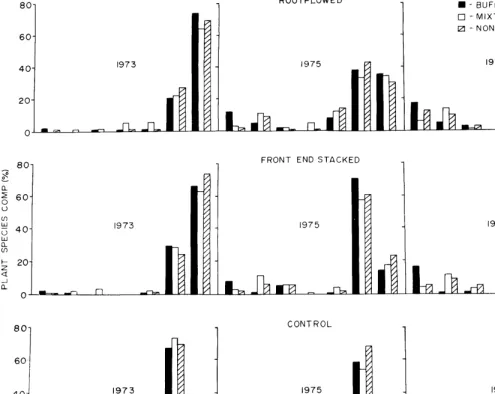
The PC% contributed by seeded and nonseeded grass species and forbs under different seeding treatments following mechanical manipulation treatments and the undisturbed control are shown in Figure 2. Forb PC was high the first year following mechanical treatment regardless of seeding treatment, but decreased with time.
Establishment of seeded buffelgrass was faster than any other seeded species on all treatments. In 1973, buffelgrass made slightly more than 2% of the PC following both manipulation treatments but had increased to about 17% by 1977. Seeded buffelgrass was slower in establishing on the control plots. In 1973, 1 year after seeding, buffelgrass accounted for only 1% of the PC. By 1975 and 1977 buffelgrass increased to 5 and 7%, respectively. It invaded most of the other treatments and in 1977 it was just as common in the nonseeded as in the seeded treatments.
Plains bristlegrass and Arizona cottontop, native seeded species, establish faster than any other species when planted in rootplowed plots. However, by 1977, plains bristlegrass had completely disap- peared and Arizona cottontop decreased in PC from 12% in 1975 to 6.2% in 1977. However, Arizona cottontop invaded other plots and in 1977 it contributed 9.9% PC in the buffelseeded plots and 6.6% in the nonseeded plots that had been rootplowed.
Plain bristlegrass never established itself in any of the seeding treatments following front-end stacking or the control. Pink pap- pusgrass established itself better in all seeding treatments of the control than either of the mechanical manipulation treatments. It invaded the plots where it was not seeded and in 1977 contributed 7.8 and 6.5% of the PC in buffelgrass seeded and nonseeded treatment, respectively.
Four-flower trichloris was slow in establishment, but by 1975 it contributed at least 11% of the PC in both mechanical manipula- tion treatments where it had been seeded. By 1977, four-flower trichloris contributed 13.8% of the PC in the rootplowed treatment where it was seeded, 4.5% in the buffelseeded plots, and 9.3% in the nonseeded plots.
Plant species composition contributed by nonseeded grass spe- cies in the nonseeded treatment of rootplowed plots was 27,43, and 36% in 1973, 1975, and 1977, respectively. Red gramaand Wright’s threeawn were reduced the most in rootplowed plots, while hooded windmill increased and Texas bristlegrass was unaffected. Some important annual and perennial grasses also appeared: southwest-
Table 6. Herbaceous plant species composition (PC) and plant frequency (PF) of major species for rootplowing (RP), front-ending stacking (S), and control (C) in 1977.
Species PC
RP (%I
PF PC
s
(%IPF PC PF PF
Red grama (Bouteloua trifida)
Hooded windmillgrass (Chloris cucullata) Wright’s threeawn (Aristida wrightii) Texas bristlegrass (Setaria texana) Plains bristlegrass (Setaria macrostachya) Buffelgrass (Cenchrus ciliaris)
Sand dropseed (Sporobolus cryptandrus) Four-flowered trichloris (Trichloris plurtjlora) Arizona cottontop (Trichachne californica) Pink pappus (Pappophorum bicolor) Miscellaneous grasses
Forbs
Total plants/ ha
0.8 b 3c 11.6 b 33 b
6.2 b 31 b 7.4 a 33 a
- -
11.8 a 37 ab 2.5 b 18 b 9.2 a 40 a 7.0 a 33 a 2.0 b 13 b 9.4 a 25 b 32.1 a 78 b
429,540
3.0 b 12 b 28.6 a 70 a 8.6 b 39 a 0.8 b 7b
- -
8.9ab 44a 7.6 a 37 a 5.3 b 27 b 1.3 b 10 b 3.4 a 19 ab 8.9 a 34 a 23.6 b 86 a
15.7 a 11.2 b 12.6 a 6.5 a
-
7.3 b 3.1 b 2.1 c 1.6 b 7.5 a 7.1 a 25.3 b
28 a 44 b 43 a 26 a - 34 b
16 b 9c 10 b 27 a 31 ab 87 a
613,390 515,840
6.5 cd 14 ef 17.1 b 49 b 9.1 c 38 c 4.9 de 22 def
-
9.3 c 38 c 4.4 de 24 de 5.5 de 25 de 3.3 de 18 ef 4.3 de 20 def 8.6 c 30 cd 27.0 a 84 a
5 19.590
‘Data are averages of two samplings (June and November).
80
60
1973
80-
60
40 il 1973
20
1
ROOTPLOWED
FRONT END STACKED
1975
CONTROL
_
A 8 C D E F G A B C
Fig. 2. Species composition in 1973, 1975, and 1977 after rootplowing, front-end stacking, and no mechanical treatment. Species listed are: A =
buffegrass; B =four-flower trichloris; C=pinkpappusgrass; D =plains bristlegrass; E = Arizona cottontop; F = nonseeded species; and G =
D E : G ABCDEFG
forbs. Each bar represents plant composition of each seeded species on each of the three seeding treatments. For nonseeded species and forbs, the bar represents totals of all species.
ern bristlegrass (Setaria scheelei), knotgrass (Setaria firmula), natalgmss (Rhychelytrum repens), slim tridens (Tridens muticus), gummy lovegrass (Eragrostis curtipedicillata), and coast sandbur
(Cenchrus incertus). The same nonseeded species occurred in the buffelgrass and native mixture seeded treatments, however, con- tributed less PC than in the nonseeded treatments in 1973 and 1975. By 1977, nonseeded species contributed about the same PC % in all seeding treatments subjected to rootplowing.
Discussion
Before mechanical treatment, very little herbaceous vegetation was growing under the woody plant overstory. Texas bristlegrass was the only grass species consistently occurring directly under the woody plants.
The PC of most nonseeded species of all seeding treatments subjected to front-end stacking was reduced in 1973. However, by 1975, PC contributed by nonseeded species was equal or higher than that of the undisturbed control in all seeded treatments. By 1977, PC of nonseeded species was reduced in all front-end stack- ing seeding plots; however, it was still almost equal to the PC of the undisturbed control. Most major nonseeded species except Texas bristle and red grama were higher in PC in 1977 than before treatment. Hooded windmillgrass and sand dropseed increased the most in all seeding plots subjected to front-end stacking.
In all seeding treatments of the undisturbed control, eleven nonseeded grass species accounted for the major portion of the PC. Wright’s threeawn, red grama, Texas bristlegrass, and hooded windmillgrass were the most common species throughout the study period. By 1977 PC of all nonseeded species was reduced, indicat- ing that seeded species established or invaded the nonseeded con- trol treatments.
Clearing brushy rangeland by either rootplowing or front-end stacking increased the diversity of native grasses and forbs. During the first year, however, forb species accounted for a high percen- tage (68%) of the PC on both mechanical treatments. By the third and fifth year, forbs accounted for only about 25% of the PC, indicating an increase in the percentage of grasses. The higher forb density on areas disturbed by mechanical manipulation treatments as compared with relatively undisturbed areas (control) was asso- ciated with natural secondary succession due to disturbances and higher soil moisture. After disturbances, the soils accumulated more moisture in the profile than did the undisturbed soils (Gon- zalez and Dodd 1979). Thus, more moisture was available for plant growth. Similar results were reported by Powell et al. (1967).
Herbaceous plant composition (grasses and forbs) for the undis- turbed area (control) was relatively stable throughout the study period.
Mechanical treatments destroyed and uprooted some grass spe- cies and increased less desirable species (like some forbs and weedy annual grasses) during the first year after treatment. Similar results have been reported in other areas (Mathis et al. 1971; Powell and
I - BUFFELGRASS 0 - MIXTURE Id - NON-SEEDED
i
Box 1967). In areas cleared and seeded to climax or introduced grass species, however, good stands were established, and by the second year, desirable forage had increased.
Buffelgrass, an introduced seeded species, was the most aggres- sive species. This species accounted for a major portion of forage in the plots where it was seeded. By 1977, it had invaded all treatments and accounted for a high portion of the forage in all treatments. Buffelgrass invasion on all treatments indicated a rapid response to available soil moisture. Indications were that its competitive capa- bility was equal to or greater than that of other perennial grasses in the study. Even though buffelgrass PC was low in all treatments, this species by itself contributed more than 50% of the total forage production by weight in all treatments (Gonzalez and Dodd 1979). This plant is robust, large, and produces much biomass.
The contribution to PC by three seeded native grass species (pink pappus, plains bristlegrass, and Arizona cottontop) was generally high the first three years after treatment and then decreased with time. Plains bristlegrass was completely absent by the fourth year. This probably reflected selective grazing. Four- flower trichloris, like buffelgrass, increased in PC with time on plots subjected to both mechanical treatments. Grazing animals, however, did not utilize this species as much as other species. The order of cattle consumption for the seeded species was observed to be buffelgrass > plains bristlegrass > Arizona cottontop and pink- pappus > four-flower trichloris.
Species composition of volunteer nonseeded grasses was
reduced the first year after mechanical manipulation as compared with the control (23% vs 70%). By the third year, however, 63% of the composition in the front-end stacked treatment and 38% in the rootplowed treatment was made up of nonseeded speices. Little change occurred in PC by nonseeded species from 1975 to 1977, indicating a trend toward a stable plant community.
Conclusions
Clearing and seeding of southern Texas rangeland increases grass species composition. With time and proper management, there should be a shift from annual forbs and annual grasses to desirable perennial grasses. Management considerations are neces- sary, however, in deciding which woody species should be pre- served. More information is needed in southern Texas to determine livestock and wildlife preferences with regard to utiliza- tion of woody plants.
Change in grass composition from native species to buffelgrass will probably occur any time buffelgrass is introduced into the native stand. Observations from this study indicated that cattle prefer buffelgrass and utilized it more than native grasses. More-
over, its rapid growth and recovery after rainfall promotes its capacity to dominate and invade native grass stands. Buffelgrass should not be seeded, however, if diverse rangeland including many native perennial grasses is desired.
Literature Cited
Canfield R.H. 1942. Application of the line intercept method in sampling range vegetation. J. Forestry. 39:338-394.
Cockran, W.G., and G.M. Cox. 1956. Experimental Designs. John Wiley and Sons, Inc., New York. 454 p.
Correll, D.S., and M.C. Johnston. 1970. Manual of the Vascular Plants of Texas. Texas Research Foundation, Renner, Texas. 1881 p.
Dix, R.L. 1961. An application of the point-centered quarter method to the sampling of grassland vegetation. J. Range Manage. 18:190-194.
Fisher, C.E., C.H. Meadors, R. Behrens, E.D. Robinson, P.T. Marion, and H.L. Morton. 1959. Control of mesquite on grazing lands. TAMU. Texas Agr. Exp. Sta., College Station, Texas. Bull. 935.
Gonzalez, C.L., and J.D. Dodd. 1979. Production response of native and introduced grasses to mechanical brush manipulation, seeding, and fer- tilization. J. Range Manage. 32:305-309.
Gould, F.W. 1975. Texas plants: A checklist and ecological summary. TAMU. Texas Agr. Exp. Sta., College Station, Texas. 121 p.
Hughes, E.E. 1966. Effects of rootplowing and aerial spraying on microcli- mate, soil conditions, and vegetation of a mesquite area. Texas Agr. Exp. Sta. Misc. Pub. 812.
Inglis, J.M. 1964. A history of vegetation on the Rio Grande Plains. Texas Parks and Wildlife Dept. Bull. 45. 122 p.
Jaynes, CC., E.D. Robinson, and W.G. McCully. 1968. Rootplowing and revegetation on the Rolling and Southern High Plains. TAMU. Texas Agr. Exp. Sta., College Station, Texas. Prog. Rep. 2584.
Johnston, M.C. 1963. Past and present grasslands of southern Texas and northestern Mexico. Ecology. 44:456-466.
Lehmann, V.W. 1965. Fire in the range of Attwater’s prairie chicken. Proc. Fourth Annual Tall Timbers Fire Ecology Conf. 127-143.
Mathis, G.W., M.M. Kothmann, and W.J. Waldrip. 1971. Influence of rootplowing and seeding on composition and forage production of native grasses. J. Range Manage. 2414347.
Powell, J., and T.W. Box. 1967. Mechanical control and fertilization as brush management practices affect forage production in south Texas. J. Range Manage. 20~227-235.
Smith, H.N., and C.A. Rechenthin. 1964. Grassland restoration: the Texas brush problem. Unnumbered Bull. USDA, Soil Conserv. Serv.,Temple, Texas. p. 139.
Texas Conservation Needs Committee. 1974. Conservation needs inven- tory, Texas. U.S. Dep. Agr. Soil Conserv. Serv., Temple, Texas.
U.S. Dep. Commerce. 1970. Climatological Summary. Brownsville, Texas. 46 p.