A b s t r a c t. Field experiments were conducted on Orthic Luvisol derived from loamy sand in 1999–2002. The tillage sy-stems applied were: conventional tillage (CT) including pre-plough (10 cm) + harrowing, mouldboard pre-ploughing (25 cm) + harrowing; reduced or conservation tillage (RT) using tillage ag-gregate consisting of a grubber (10 cm) + heavy harrow and string roller; and no-tillage (NT) where the only soil disturbance was from the direct sowing machine. Two straw management systems for the winter rye monoculture were applied on each tillage system: removed straw after harvest and retained straw. The straw was furrowed under CT, shallowly incorporated (7 cm) under RT and remained as chaff under NT. The physical behaviour of the soil was characterised by soil wetness, bulk density and penetration re-sistance. Under RT and NT with greater soil bulk density compared to CT, the water content of the soil was greater shortly after rainfall only; later, the reverse was true due to enhanced evaporation. The lower water content in the soil and the higher bulk density resulted in increased mechanical impedance for root growth. Retaining the straw did not counteract the negative response in the soil's physical conditions. The effects of the soil tillage and straw management systems on the yields of winter rye in monoculture were con-siderably affected by rainfall distribution during the growing sea-sons. In growing seasons with dry periods, the crop yield was more reduced under RT and NT than CT and on ‘straw-retained’ than ‘straw-removed’ plots. However, in growing seasons with fa-vourable rainfall distribution, the crop yield was not negatively af-fected by the RT and NT systems.
K e y w o r d s: conventional tillage, reduced tillage, straw ma-nagement, soil, winter rye
INTRODUCTION
In Poland, about 30% of coarse-textured arable soils with inherently low fertility is suitable for rye production. At
present, the profitability of the agricultural use of such soils is very low and therefore they are often abandoned. Nume-rous experiments performed on fine textured soils have revealed that reducing the intensity of tillage by decreasing tillage depth and the number of tillage operations or applying a no-tillage system results in considerably lower crop production costs [7, 24]. The successful application of reduced tillage systems on sandy soils could provide an opportunity to improve the profitability of the agricultural use of such soils, especially in farms without livestock; the same could be said for applying a monoculture practice for winter rye whilst retaining the crop residue on the field. Furthermore, the long-term use of reduced tillage in some regions could provide conditions for environmentally sound production [23]. Retaining or adding crop residue improves several physical, biological and chemical characteristics and thereby increases soil quality [6, 8]. These effects are related to the tillage system used. Soil water and strength characte-ristics are identified as the main properties influencing the physical quality of the soil after cultivation and crop residue management. With time, changes in characteristics provide information on the sustainability of the soil [12].
The aim of this study was to evaluate the effects of simplified tillage systems and different techniques of straw management on the physical properties of sandy soil and the crop yield of winter rye cultivated in monoculture.
MATERIALS AND METHODS
Field experiments (1999–2002) were conducted on Orthic Luvisol of loamy sand texture (7% of particles <0.02 mm), low in organic matter (0.77% Corg.) and acid (pH in
Effect of different tillage systems and straw management on some physical properties
of soil and on the yield of winter rye in monoculture**
J. Pabin
1*, J. Lipiec
2, S. W³odek
1, and A. Biskupski
11
Institute of Soil Science and Plant Cultivation, 55-230 Jelcz-Laskowice, Poland 2
Institute of Agrophysics, Polish Academy of Sciences, Doœwiadczalna 4, P.O. Box 201, 20-290 Lublin 27, Poland
Received March 25, 2003; accepted June 1, 2003
© 2003 Institute of Agrophysics, Polish Academy of Sciences
*Corresponding author’s e-mail: [email protected] **This work was founded in part by the Polish State Committee for Scientific Research under the Grant No. P06 032 2001 C/5741.
A
A
Agggrrroooppphhyhyysssiiicccsss
w w
KCl = 5.5) at the Experimental Station of the Institute of Soil Science and Plant Cultivation in Jelcz-Laskowice (51°03' N; 17°21' E). The soil is relatively high in phosphorus (24.3 mg P2O5/100 g of soil), potassium (17.2 mg K2O/100 g of soil) and magnesium (6.2 mg MgO/100 g of soil).
Two factors, i.e., tillage systems and straw management were investigated under continuous winter rye monoculture. Three tillage systems were applied, conventional tillage (CT): including pre-plough (10 cm) + harrowing, mould-board ploughing (25 cm) + harrowing; reduced or conserva-tion tillage (RT): using tillage aggregate consisted of grub-ber (10 cm) + heavy harrow and string roller; and no-tillage (NT) where the only soil disturbance results from a direct so-wing machine. The use of monoculture was chosen because it is becoming an increasingly used practice in Poland. Under each tillage treatment two straw management sy-stems were applied: retained straw and removed straw. The straw retained under CT was covered by furrows while plo-ughing, shallowly incorporated (7 cm) under RT and under NT it was cut to the chaff and retained as a surface residue. This suggests that the carbon input was considerably greater in the ‘straw-retained’ plots than the ‘straw-removed’ plots. The rye varieties used were: Motto in 1999; Dañkowskie Z³ote in 2000 and 2002 and Amilo in 2001. Mineral ferti-lisation including 96 kg N, 60 kg P2O5and 90 kg K2O per hectare was applied each year. In 2001, 2 Mg ha–1of magne-sium calcium (50% CaO + MgO) was applied on the whole experimental field. The weeds were controlled solely by herbicides under NT and by tillage operations under RT and CT. When tillage operations were not efficient enough more herbicides were applied.
Measurements of the penetration resistance, bulk den-sity and the water content of the soil were taken at the be-ginning of the shooting growth phase and at the bebe-ginning of
the appearance of the grain each year except in 2000 on ac-count of the late appearance of the grain because of drought. Penetration resistance was determined in 5 cm layers to a depth of 30 cm using a drop-cone penetrometer. The plum-met mass, weighing 2170 g, hit the cone with a diaplum-meter of 2.4 cm and at a 30° angle from a height of 25 cm. Bulk density was determined by the core method [3] at depths: 0–5, 10–15 and 20–25 cm using 100 cm3cores (in 10 repli-cates). The same cores were used to determine the gravi-metric water content in the soil.
As can be seen from Table 1 extremely low rainfall oc-curred during late autumn (XI, XII 1998); autumn (IX, X, XI 1999 and IX, X 2000) spring/summer period (V, VII 1999; IV, VI 2000 and VI, VII 2002). The scarcity of rainfall du-ring the spdu-ring and summer months was accompanied by higher temperatures. The interactive effects of both factors on plant growth were exacerbated by these drought condi-tions. Only in 2001 were there no drought symptoms.
A statistical analysis of the results was performed using the Anovan programme.
RESULTS AND DISCUSSION
Soil water
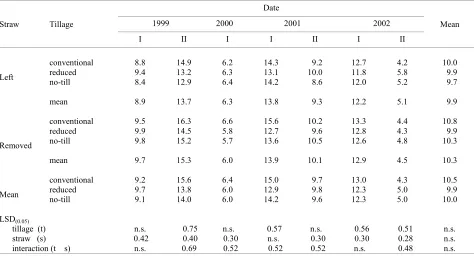
Tillage systems influenced the water content of the soil by altering the bulk density and the associated water move-ment and evaporation. On 3 out of 7 occasions, the highest water content in the soil was observed under CT and the lowest under RT (Table 2). The differences were significant. Similar results have been identified in other experiments [4, 10, 15, 23, 25]. On three occasions (shooting in 1999 and 2000 and at the appearance of the grain in 2001) no significant differences in the tillage systems were observed
Month Year
I II III IV V VI VII VIII IX X XI XII
Year value 1998 R T 41.1 1.3 22.9 4.1 40.8 2.8 46.0 10.4 27.6 14.6 91.6 18.0 117.2 18.2 41.6 17.4 94.7 13.4 82.2 8.6 30.4 0.1 17.5 -0.7 653.6 9.0 1999 R T 21.6 1.1 49.4 -0.5 57.7 5.0 56.4 9.6 35.6 14.0 79.1 16.6 17.4 17.7 183.6 19.9 33.5 16.5 24.3 9.1 36.3 2.2 36.1 1.3 631.0 9.4 2000 R T 34.6 -1.0 33.5 3.3 76.9 4.7 17.8 11.8 76.5 15.6 38.1 18.1 165.8 16.7 45.4 18.5 17.3 12.8 10.9 12.1 47.9 6.5 34.8 2.0 599.5 10.1 2001 R T 20.7 0.0 18.1 0.9 60.3 3.2 40.9 7.7 68.8 14.8 71.0 15.1 140.8 19.2 46.7 19.4 79.2 12.5 22.5 12.1 33.2 3.4 -2.2 31.4 633.6 8.9 2002 R T 24.0 -0.2 58.2 4.3 15.9 5.0 44.5 8.3 78.8 17.2 53.7 18.1 38.2 20.5 85.5 20.4 32.7 13.0 63.3 7.7 47.5 4.8 19.7 -4.2 562.0 9.6 1961- R 2000 T 27.9 -1.5 25.2 -0.3 31.6 3.3 36.9 8.2 63.8 13.4 71.5 16.6 75.4 18.1 70.6 17.6 47.8 13.5 36.9 8.8 41.1 3.7 35.1 0.2 563.7 8.5
and only in one case was the water content of the soil under reduced tillage treatments (RT and NT) greater than in CT (grain setting, 2002). This is in contrast to the results re-ported from other experiments performed mostly on fine-textured soils [1, 2, 5, 14, 18, 19]. In other longterm experi-ments on the same soil [16], however, no significant effects of the various tillage systems on the soil to water relations were observed. This implies that the effects observed in this study might be casual in character.
The effect of different straw management techniques on the soil's water content was not uniform throughout (Table 2). As indicated by the mean values for all tillage treatments, retaining the rye straw after harvest reduced evaporation only in periods of drought (at the shooting stage, 2000 and grain setting, 2002) which could be the result of slower drying compared to bare soils [8]. The positive effect of re-taining straw – which holds water in dry conditions – has been confirmed on other sites where it resulted in a sub-stantial increase of crop yield [20–22]. However, in wetter periods in this study (e.g., grain setting, 1999 and shooting, 2002,) a higher than average water content in the soil was observed mostly on the ‘straw-removed’ plots as opposed to the ‘straw-retained’ plots. The opposite effects of straw ma-nagement systems on respective occasions meant that the 4-year average treatment was very smooth and statistically insignificant.
The effect of straw management on the water content of the soil was related to the tillage system (Table 2). The water content of the soil was greater on the ‘straw-removed’ plots than on the ‘straw-retained’ plots on all occasions under CT and on most occasions under NT. On most occasions, straw management with the addition of tillage interaction was significant. However, the effect of straw was less consistent under RT, which was reflected in the same 4-year average water content (9.9 %, w/w) in the ‘straw-removed’ and the ‘straw-retained’ plots.
It is important to note that occasionally, the effect of the retained straw on the water content of the soil was positive under NT or RT but negative under CT (e.g., at the shooting stage in 2001). These opposite effects were associated with the different functions of the straw in respective tillage systems. Under NT, chaff retained on the soil surface redu-ced evaporation but when rainfall was minimal it absorbed part of the rainwater, thereby limiting water penetration to deeper and rooted soil. However under CT, the straw cove-red by furrows during ploughing increases the organic mat-ter content of the soil and thereby the capacity for storing water. The effects of the straw can be similar under RT where incorporation is shallow. The sporadically inconsi-stent effects of experimental treatments on the water content of the soil are highly influenced by the amount of precipi-tation, the water infiltration rate into the deeper soil profile and the evaporation rate [16]. These interrelations limit the predictability of the effects of the treatment.
Date
1999 2000 2001 2002
Straw Tillage
I II I I II I II
Mean
Left
conventional reduced no-till
8.8 9.4 8.4
14.9 13.2 12.9
6.2 6.3 6.4
14.3 13.1 14.2
9.2 10.0 8.6
12.7 11.8 12.0
4.2 5.8 5.2
10.0 9.9 9.7
mean 8.9 13.7 6.3 13.8 9.3 12.2 5.1 9.9
conventional reduced no-till
9.5 9.9 9.8
16.3 14.5 15.2
6.6 5.8 5.7
15.6 12.7 13.6
10.2 9.6 10.5
13.3 12.8 12.6
4.4 4.3 4.8
10.8 9.9 10.3 Removed
mean 9.7 15.3 6.0 13.9 10.1 12.9 4.5 10.3
Mean
conventional reduced no-till
9.2 9.7 9.1
15.6 13.8 14.0
6.4 6.0 6.0
15.0 12.9 14.2
9.7 9.8 9.6
13.0 12.3 12.3
4.3 5.0 5.0
10.5 9.9 10.0
LSD(0.05)
tillage (t) straw (s) interaction (t´ s)
n.s. 0.42 n.s.
0.75 0.40 0.69
n.s. 0.30 0.52
0.57 n.s. 0.52
n.s. 0.30 0.52
0.56 0.30 n.s.
0.51 0.28 0.48
n.s. n.s. n.s.
I – beginning of shooting, II – beginning of grain setting, n.s. – not significant.
Bulk density
Tillage and straw management systems had an influen-ce on the bulk density of the soil (Table 3). On 4 out of 7 oc-casions the average soil bulk density under NT and RT was significantly (0.05) greater than under CT. The effect of the retained straw was most pronounced on 3 occasions. On one occasion, – in 2000 – the straw led to an increase in bulk den-sity whereas on another two occasions in 2002 – it led to a decrease in bulk density. It is important to note that the de-crease being 0.03–0.07 g cm–3was greater than the increase 0.02 g cm–3. Although the differences were relatively small they were statistically significant indicating the small dis-persion of the results. This decrease was due mostly to a sub-stantial reduction in bulk density on NT plots where straw acting as mulch protected the soil’s structure against the de-structive impact of the rain. This protective effect of the straw mulch has been reported on earlier studies [19].
The interactive effects of the tillage and straw mana-gement systems on soil bulk density increased with the dura-tion of the experiment. This is confirmed by the statistically significant interaction (tillage with the addition of straw ma-nagement) (0.05) during 2001 and 2002 in contrast to 1999 and 2000 (Table 3). This inconsistency could be associated with the uneven distribution of the straw on the surface of the soil. As a consequence, the interaction systems were not significant for the whole 4-year period.
Penetration resistance
Penetration resistance has been influenced by the tillage systems (Table 4). Generally, its values were higher under reduced tillage systems (RT and NT) than under CT. The differences were significant on 3 out of 7 occasions. Re-taining the straw had a significant effect on penetration resistance but only at the beginning of the shoot-growth phase in 1999 and at the appearance of the grain in 2001. In the first case, it was greater on the ‘straw-retained’ (4 MPa) than on the ‘straw-removed’ plots (3 MPa) which could be attributed to the lower water content of the soil of the former (Table 2). This effect was opposite in the second case where penetration resistance was increased in both the ‘straw-retained’ and the ‘straw-removed’ plots.
Winter rye yield
The effects of the tillage system and straw management on the yield of winter rye grain over 4 consecutive years are shown in Table 5. In the growing seasons (1998/99, 1999/00, 2001/02) with their spring and autumn droughts, crop yields under the reduced tillage systems (RT and NT) were significantly lower than under the CT system. On ave-rage, the reduction was approximately 14.4%. The yield re-duction in the dry periods could partly be attributed to the shallow rooting depth and greater stomatal resistance in re-sponse to an insufficient water supply to the plants. This was observed by Lipiec and Gliñski [11] during the growing
Date
1999 2000 2001 2002
Straw Tillage
I II I I II I II
Mean
Left
conventional reduced no-till
1.41 1.44 1.42
1.40 1.50 1.48
1.40 1.40 1.41
1.36 1.46 1.44
1.40 1.43 1.47
1.41 1.43 1.38
1.35 1.41 1.41
1.39 1.43 1.43
mean 1.42 1.46 1.40 1.42 1.43 1.41 1.39 1.42
conventional reduced no-till
1.40 1.36 1.39
1.40 1.47 1.45
1.36 1.39 1.38
1.44 1.44 1.45
1.40 1.48 1.44
1.43 1.41 1.48
1.43 1.45 1.50
1.41 1.39 1.43 Harvested
mean 1.39 1.44 1.38 1.44 1.44 1.44 1.46 1.42
Mean
conventional reduced no-till
1.41 1.40 1.41
1.40 1.49 1.47
1.38 1.40 1.40
1.40 1.45 1.45
1.40 1.46 1.46
1.42 1.42 1.43
1.35 1.41 1.41
1.40 1.44 1.44
LSD(0.05)
tillage (t) straw (s) interaction (t´ s)
n.s. n.s. n.s.
0.03 n.s. n.s.
n.s. 0.02
n.s.
0.03 n.s. 0.03
0.04 n.s. 0.03
n.s. 0.02 0.04
0.04 0.02 0.04
n.s. n.s. n.s.
Explanations as in Table 1.
Date
1999 2000 2001 2002
Straw Tillage
I II I I II I II
Mean
Left
conventional reduced no-till
3.6 4.0 4.4
2.3 3.4 3.1
4.8 5.3 5.3
2.7 3.5 3.5
4.0 4.5 4.7
3.9 6.1 4.3
6.2 5.7 7.3
3.9 4.6 4.7
mean 4.0 2.9 5.1 3.2 4.4 4.8 6.4 4.4
conventional reduced no-till
2.6 3.1 3.4
1.6 3.3 3.3
7.0 5.7 5.2
2.5 3.4 3.4
6.7 4.8 5.1
3.7 5.5 4.0
6.6 7.2 7.1
4.4 4.7 4.5 Removed
mean 3.0 2.7 6.0 3.1 5.5 4.4 7.0 4.5
Mean
conventional reduced no-till
3.1 3.6 3.9
2.0 3.4 3.2
5.9 5.5 5.3
2.6 3.4 3.4
5.4 4.6 4.9
3.8 5.8 4.2
6.4 6.4 7.2
4.2 4.7 4.6
LSD(0.05)
tillage (t) straw (s) interaction (t´ s)
n.s. 0.59 n.s.
0.73 n.s. n.s.
n.s. n.s. n.s.
0.72 n.s. n.s.
n.s. 0.86 n.s.
0.99 n.s. n.s.
n.s. n.s. n.s.
n.s. n.s. n.s.
Explanations as in Table 1.
T a b l e 4.Effect of different tillage and straw management systems on penetration resistance (MPa) in 0–25 cm layer
Straw Tillage 1999 2000 2001 2002 Mean
Left
conventional reduced no-till
3.78 2.98 2.62
3.19 3.11 2.96
4.72 4.55 4.43
3.06 2.94 2.67
3.69 3.40 317
mean 3.12 3.09 4.57 2.89 3.42
conventional reduced no-till
4.02 2.90 3.24
3,60 3.08 2.86
4.76 4.58 4.58
3.08 2.59 3.20
3.87 3.29 3.47 Harvested
mean 3.38 3.18 4.64 2.96 3.54
Mean
conventional reduced no-till
3.90 2.94 2.93
3.40 3.10 2.91
4.74 4.57 4.51
3.07 2.77 2.94
3.78 3.34 3.32
LSD(0.05)
tillage (t) straw (s) years (y) interaction: t x s
t x y s x y
0.62 0.33
n.s. n.s. n.s.
0.31 0.16
0.29 n.s. n.s.
n.s. n.s.
n.s. n.s. n.s.
0.27 n.s.
0.25 n.s. n.s.
0.47 n.s. 0.47 n.s. n.s. n.s.
Explanations as in Table 1.
season of wheat. In dry seasons, crop yield on ‘straw-retained’ plots was less by up to 4.3% than was the case for ‘straw-removed’ plots.
The interactive effect of tillage and straw management systems on crop yields was significant in two dry seasons (1999/00 and 2001/02). This interaction indicates that the effect on winter rye yields from retaining the straw was negative in 2000 under CT and in 2002 under NT. However, retaining the straw under RT had a positive effect on the crop yield in most years. The results indicate that this yield’s in-crease is accidental and can be more associated with its reduction on ‘straw-removed’ plots than with its increase on ‘straw-retained’ plots.
Crop yields in all tillage and straw management sy-stems were highest in 2001 with its relatively high total rainfall and its favourable distribution during the growing season. Compared to yields in other years where there were water shortages, they were greater on average by 31%. In addition this year, the effects of both the tillage and straw management did not have a significant effect on grain yield. This implies that reduced tillage systems can be applied without a negative effect on crop yield even on light soils provided that the weather favours plant growth. This may refer not only to the winter rye monoculture, but also to crop rotation as shown in earlier studies [17]. Since reduced til-lage systems demand low energy compared to conventional tilling systems they can improve the profitability of winter rye cultivation given a sufficient supply of water for the plants. In addition reduced tillage systems are considered more advantageous from the point of view of environmental protection [9,13, 23].
CONCLUSIONS
1. The 4-year application of reduced tillage, including the no-tillage option resulted in the greater bulk density of the soil and its penetration resistance. These increases in growing seasons with spring and autumn dry periods, result in reduced plant growth and crop yield. Leaving the straw – as is the case in the reduced tillage systems – did not coun-teract the negative changes in the parameters of the soil's strength.
2. Changes in the water content of the soil under the til-lage and straw management systems are related to soil bulk density and weather conditions during the growing season. Compared to CT, water storage was greater under reduced tillage systems with greater soil bulk density, but only for short periods after rainfall. However, in periods with rela-tively scarce rainfall, the reverse was true because of increa-sed evaporation from denser soil.
3. The effect of the straw – which was retained – on the conservation of water in the soil is positive in periods with scarce rainfall due to the slow rate of evaporation. However, in periods with greater rainfall, some water is absorbed by
the straw and thereby reduces the quantity of rainwater penetrating the soil.
4. With regard to crop yield, the response of the winter rye monoculture to treatments applied to the sandy soil – which is of low water holding capacity and low inherent fertility – was largely associated with weather conditions during the growing season. In periods of favourable rainfall distribution, the application of reduced tillage systems and retaining straw on the field did not cause any reduction in crop yields. However, in growing seasons afflicted by dro-ught, the application of reduced tillage systems resulted in a significant reduction of yields relative to conventional tillage. In such periods, retaining the straw after the harvest negatively affected crop yield also.
REFERENCES
1.Arshad M.A. and Gill K.S., 1997.Barley, canola and wheat production under different tillage - fal low – green manure combinations on a clay soil in a cold, semiarid climate. Soil Till. Res., 43, 263–275.
2.Ball B.C. and Ritchie R.M., 1999.Soil and residue manage-ment effects on arable cropping conditions and nitrous oxide fluxes under controlled traffic in Scotland. 1. Soil and crop responses. Soil Till. Res., 52, 177–189.
3.Blake G.R. and Hartge K.H., 1986.Bulk density. In: thods of Soil Analysis. Part 1. Physical and Mineralogical Me-thods (Ed. Klute A.). Agronomy Monograph, 9, 2nd ed. SSSA, Madison, WI, 363–375.
4.Dzienia S., Piskier T., and Wereszczaka J., 1995.Effect of cover crops on some soil physical properties following broad bean under no-till system. Scientific Conf. Direct Drilling in Theory and Practice, Szczecin - Barzkowice, Poland, 57–61. 5.Ferreras L.A., Costa J.L., Garcia F.O., and Pecorari C.,
2000. Effect of no-tillage on some soil physical properties of a structural degraded Petrocalcic Paleudoll of the southern Pa-mpa of Argentina. Soil Till. Res., 54, 31–39.
6.Franzluebbers A.J., 2002.Water infiltration and soil structu-re structu-related to organic matter and its stratification with depth. Soil Till. Res., 66, 197–205
7.Hernanz J.L., Giron V.S., and Cerisola C., 1995.Long-term energy use and economic evaluation of three tillage systems for cereal and legume production in central Spain. Soil Till. Res., 35, 183–198.
8.Karlen D.L., Wollenhaupt N.C., Erbach D.C., Berry E.C., Swan J.B., Eash N.S., and Jordahl J.L., 1994.Crop residue effects on soil quality following 10-years of no-till corn. Soil Till. Res., 31, 149–167.
9.Kumar Ajay, Kanwar R.S., Singh P., and Ahuja L.R., 1999.
Evaluation of the root zone water quality model for predicting water and NO3-N movement in an Iowa soil. Soil Till. Res., 50, 223–236.
11.Lipiec J. and Gliñski J., 1997.Field soil compaction: effects on soil physical properties and stomatal resistance of wheat. Proc. Intern. Symp. Soil, human and environment interactions, May 4–11, 1997, China Science and Technology Press, 422– 427.
12.Lipiec J. and Hatano R., 2003.Quantification of compaction effects on soil physical properties and crop growth. Geoderma, 16, 107–136.
13.Lipiec J. and Stêpniewski, W., 1995.Effects of soil com-paction and tillage systems on uptake and losses of nutrients. Soil Till. Res., 35, 37–52.
14.Lyon J.D., Stroup W.W., and Brown R.E., 1998.Crop pro-duction and soil water storage in long-term winter wheat-fallow tillage experiments. Soil Till. Res., 49, 19–27. 15.Mazzoncini M., Lorenzi R., Risaliti R., Sorce C., Ginanni
M., Curadi M., and Pini R., 1998.Diclofop-methyl dissipa-tion in clay soil under different tillage systems in central Italy. Soil Till. Res., 46, 241–250.
16.Pabin J. and W³odek S., 1986. Effect of compaction of a light soil on its physical properties and on yields of field pea and spring barley. I. Dynamics of plant available soil water and crop yields. Pam. Pu³., 88, 71–85.
17.Pabin J., W³odek S., Biskupski A., Runowska-Hryñczuk B., and Kaus A., 2000.Assessment of soil physical properties
and crop yields under conservation tillage systems. In¿ynieria Rolnicza, 6, 213–219.
18.Pranagal J. and Dom¿a³ H., 2001.Physical conditions of rendzina in various cultivation systems. Acta Agrophysica, 56, 247–257.
19.Rasmussen K.J., 1999.Impact of ploughless soil tillage on yield and soil quality: A Scandinavian review. Soil Till. Res., 53, 3–14.
20.Sharratt B.S., 1998. Barley yield and evapotranspiration governed by tillage practices in interior Alaska. Soil Till. Res., 46, 225–229.
21.Singh Baldev, Chanasyk D.S., and McGill W.B., 1998.Soil water regime under barley with long-term tillage-residue sy-stems. Soil Till. Res., 45, 59–74.
22.Sow A.A., Hossner L.R., Unger P.W., and Stewart B.A., 1997. Tillage and residue effects on root growth and yields of grain sorghum following wheat. Soil Till. Res., 44, 121–129. 23.Tebrügge F. and Düring R.A., 1999.Reducing tillage
inten-sity – a review of results from a long-term study in Germany. Soil Till. Res., 53, 15–28.
24.Vilde A., 1999.Energetic and economic estimation of soil tillage systems. Fol. Univ. Agric. Stetin., 195, Agricultura, 74, 213–222.