Iranian Journal of Electrical & Electronic Engineering, Vol. 7, No. 4, Dec. 2011 249
Different Methods of Long-Term Electric Load Demand
Forecasting; A Comprehensive Review
L. Ghods* and M. Kalantar*
Abstract: Long-term demand forecasting presents the first step in planning and developing future generation, transmission and distribution facilities. One of the primary tasks of an electric utility accurately predicts load demand requirements at all times, especially for long-term. Based on the outcome of such forecasts, utilities coordinate their resources to meet the forecasted demand using a least-cost plan. In general, resource planning is performed subject to numerous uncertainties. Expert opinion indicates that a major source of uncertainty in planning for future capacity resource needs and operation of existing generation resources is the forecasted load demand. This paper presents an overview of the past and current practice in long- term demand forecasting. It introduces methods, which consists of some traditional methods, neural networks, genetic algorithms, fuzzy rules, support vector machines, wavelet networks and expert systems.
Keywords: Long-term, Demand Forecasting, Neural Networks, Genetic Algorithms, Fuzzy Rules.
1 Introduction1
A power system serves one function and that is to supply customers, both large and small, with electrical energy as economically and as reliability as possible. Another responsibility of power utilities is to recognize the needs of their customers (Demand) and supply the necessary energies. Limitations of energy resources in addition to environmental factors, requires the electric energy to be used more efficiently and more efficient power plants and transmission lines to be constructed [1]. Long-term demand forecasts span from eight years ahead up to fifteen years. They have an important role in the context of generation, transmission and distribution network planning in a power system. The objective of power system planning is to determine an economical expansion of the equipment and facilities to meet the customers' future electric demand with an acceptable level of reliability and power quality [2].
Accurate long-term demand forecasting plays an essential role foe electric power system planning. It corresponds to load demand forecasting with lead times enough to plan for long-term maintenance, construction scheduling for developing new generation facilities, purchasing of generating units, developing transmission and distribution systems. The accuracy of the long-term
Iranian Journal of Electrical & Electronic Engineering, 2011. Paper first received 18 Jan. 2011 and in revised form 13 Jun. 2011. * The Authors are with the Department of Electrical Engineering, Iran University of science and technology (IUST), Tehran, Iran.
E-mails: [email protected], [email protected].
load forecast has significant effect on developing future generation and distribution planning. An expensive overestimation of load demand will result in substantial investment for the construction of excess power facilities, while underestimation will result in customer discontentment. Unfortunately, it is difficult to forecast load demand accurately over a planning period of several years. This fact is due to the uncertain nature of the forecasting process. There are a large number of influential that characterize and directly or indirectly affect the underlying forecasting process; all of them uncertain and uncontrollable [3]. However, neither the accurate amount of needed power nor the preparation for such amounts of power is as easy as it looks, because: (1) long-term load forecasting is always inaccurate (2) peak demand is very much dependant on temperature (3) some of the necessary data for long-term forecasting including weather condition and economic data are not available, (4) it is very difficult to store electric power with the present technology, (5) it takes several years and requires a great amount of investment to construct new power generation stations and transmission facilities [4]. Therefore, any long-term load demand forecasting, by nature, is inaccurate!
Generally, long-term load demand forecasting methods can be classified in to two broad categories: parametric methods and artificial intelligence based methods. The artificial intelligence methods are further classified in to neural networks [1], [2], [4], [8], [10], support vector machines [15], genetic algorithms [14],
250 Iranian Journal of Electrical & Electronic Engineering, Vol. 7, No. 4, Dec. 2011 wavelet networks [12] [13], fuzzy logics [16] and expert
system [17] methods. The parametric methods are based on relating load demand to its affecting factors by a mathematical model. The model parameters are estimated using statistical techniques on historical data of load and it's affecting factors. Parametric load forecasting methods can be generally categorized under three approaches: regression methods, time series prediction methods [3]. Traditional statistical load demand forecasting techniques or parametric methods have been used in practice for a long time. These traditional methods can be combined using weighted multi-model forecasting techniques, showing adequate results in practical system. However, these methods cannot properly present the complex nonlinear relationships that exist between the load and a series of factors that influence on it [2].
In this paper, we introduce a brief overview in long-term forecasting methods. This paper is organized as follows. Next section briefly describes parametric models. Section III describes different artificial intelligence based methods and section IV is the conclusions of paper.
2 Parametric Methods
The three types of well-known parametric methods are as, trend analysis, end-use modeling and econometric modeling.
2.1 Trend Analysis
Trend analysis extends past rates of electricity demand in to the future, using techniques that range from hand-drawn straight lines to complex computer-produced curves. These extensions constitute the forecast. Trend analysis focuses on past changes or movements in electricity demand and uses them to predict future changes in electricity demand. Usually, there is not much explanation of why demand acts as it does, in the past or in the future. Trending is frequently modified by informed judgment, wherein utility forecasters modify their forecasts based on their knowledge of future developments which might make future electricity demand behave differently than it has in the past [5].
The advantage of trend analysis is that, it is simple, quick and inexpensive to perform [5].
The disadvantage of a trend forecast is that it produces only one result, future electricity demand. It does not help analyze why electricity demand behaves the way it does, and it provides no means to accurately measure how changes in energy prices or government polities influence electricity demand [5].
2.2 End-Use Models
The end-use approach directly estimates energy consumption by using extensive information on end users, such as applications, the customer use, their age, sizes of houses, and so on. Statistical information about
customers along with dynamics of change is the basis for the forecast [5].
End-use models focus on the various uses of electricity in the residential, commercial, and industrial sector. These models are based on the principle that electricity demand is derived from customer's demand for light, cooling, heating, refrigeration, etc. Thus, end-use models explain energy demand as a function of the number of applications in the market [5].
Ideally, this approach is very accurate. However, it is sensitive to the amount and quality of end-use data. For example, in this method the distribution of equipment age is important for particular types of appliances. End-use forecast requires less historical data but more information about customers and their equipments [5].
This method predicts the energy consumptions. If we want to calculate the load, we have to have the load factor in each sections and different types of energy consumptions and then by load factor we can calculate the load in each section.
The system load factor is defined as follows equation:
Average - load demand LoadFactor =
Peak - load demand annual KWh energy =
peak - load demand × 8760 hours/year
(1)
The disadvantage of end-use analysis is that most end-use models assume a constant relationship between electricity and end-use (electricity per appliance). This might hold for over a few years, but over 10 or 20-year period, energy saving technology or energy prices will undoubtedly change, and the relationships will not remain constant [6].
2.3 Econometric Models
The econometric approach combines economic theory and statistical techniques for forecasting electricity demand. The approach estimates the relationship between energy consumption (dependent variables) and factors influencing consumption. The relationships are estimated by the least-square method or time series methods. One of the options in this framework is to aggregate the econometric approach, when consumption in different sectors (residential, commercial, industrial, etc.) is calculated as a function of weather, economic and other variables, and then estimates are assembled using recent historical data. Integration of the econometric approach in to the end-use approach introduces behavioral components in to the end-use equations [5].
The advantage of econometrics are that it provides detailed information on future levels of electricity demand, why future electricity demand increases, and how electricity demand is affected by all the various factors [6], [7], [29].
Ghods & Kalantar: Different Methods of Long-Term Electric Load Demand Forecasting … 251 A disadvantage of econometric forecasting is that in
order for an econometric forecast to be accurate, the changes in electricity remain the same in the forecast period as in the past. This assumption, which is called constant elasticity, may be hard to justify especially where very large electricity prices changes, make customers more sensitive to electricity prices.
2.4 Differences Between These Traditional Mentioned Method
As mentioned in the trend analysis, just past changes or movements in electricity demand and uses them to predict future changes in electricity demand, there isn't any process on why those movements happened. In this method, end users and their behavior aren't important. But in end use method, statistical information about customers along with dynamics of change is the basis for the forecast.
In Economical methods, the results estimate the relationship between dependent variables and factors influencing consumption. The relationships are estimated by the least-square method or time series methods.
In comparison, trend analysis can't be trustworthy; in this method we need a wise and knowing judge to recognize unreal date and omit them from previous information.
Up to this part we describe the old methods for long term load forecasting. They are also useful today. But the new following methods can use for their accuracy and fast possessing system. Special the new methods are used for different economical inputs in forecasting. By these new methods, we can have a model from the past data and correct its inaccurate date. After that we can predict the following peak load.
3 Artificial Intelligence Based Methods 3.1 Artificial Neural Networks
Artificial neural networks (ANNs) have succeeded in several power system problems, such as planning, control, analysis, protection, design, load forecasting, security analysis, and fault diagnosis. The last three are the most popular. The ANNs ability in mapping complex non-linear relationships is responsible for the growing number of its application to load forecasting [8], [9]. Most of the ANNs have been applied to short-time load forecasting. Only a few studies are carries out for long-term load demand forecasting [10], [22], [24], [28].
In developing a long-term load forecast, the following are some of the degrees of freedom which must be iterated upon with the objective to increase the potential for an accurate load forecast: (1) fraction of the database that will be used for training and testing purpose, (2) transformations to be performed on the historical database, (3) ANNs architecture specifications, (4) optimal stopping point during ANNs
training, and, (5) relative weights for use in forecast combination [8].
The design of neural network architecture involves decision making on type, size and number of neural being used [11].
The result of Output ANN is in (2).
n
Yi = ∑ =i 1W Xi i (2) where i 1, 2, ..., n= , Xi is input, and Wi is weight of
network and Yi is one of the ANN's outputs.
The first question to be asked is if an ANN can learn to perform the desire application, and if so what would be the most suitable form of the network. In this section, various aspects of ANNs are analyzed to determine a suitable model. These aspects include the network architecture and method of training. There are three types which can be useful for long-term load demand forecasting: Recurrent neural network (RNN) for forecasting the peak load, feed-forward back propagation (FFBP) for forecasting the annual peak load [10] and radial basis function network.(RBFN) for fasting training and better following the peaks and valleys [4].
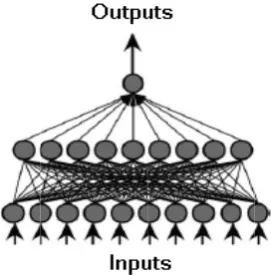
1) Recurrent neural network: Recurrent neural network contains feedback connections, which enable them to encode temporal context internally. This feedback can be external or internal. RNN has be ability to learn patterns from the past records and also to generalize and project the future load patterns for an unseen data [10]. We have different types of RNNs, such as Jordan RNN, Elman RNN and others. Feedback connections in these RNNs are different from network to network. For instance, Jordan RNN has feedback connections from output to input while the Elman RNN has feedback connections from its hidden layer neurons back to its inputs. Additional neurons in input layer, which accept these feedback connections, are called state or context neurons. The role of context neurons in RNN is to get inputs from the upper layer, and after processing send their outputs to the hidden layer together with other plan units. In long-term load demand forecasting, there is strong relationship between the present and next year loads. For this type of problem, Jordan's model of RNN proved to be suitable. However, it should be noted that as the period of target forecast loads becomes longer, the forecast errors might increases relatively [10]. This is why the feed-forward back propagation is used for forecasting loads of longer than 1 year. The Jordan RNN used in most of case study is shown in Fig. 1.
2) Feed-forward back propagation: Feed-forward back propagation is one of is one of the most widely used neural network paradigms, which have been applied successfully in application studies. FFBP can be applied to any problem that requires pattern mapping. Given an input pattern, the network produces an associated output pattern. Its learning and update procedure is intuitively appealing, because it is based on
252 a relatively s both a set of response for wrong answe error is lesse network are m using such a too. Firstly knowledge e they have ha recognize pa Lastly, once patterns, th accomplished advantages f designed to training patte [10]. The FF Fig. 2. 3) Redial function netw network, wh processing e symmetric [ layer, hidden each layer ar shown in Fig For a hid have the follo
• A ce and vecto • A di
input the s • A tr singl of th outpu funct stron other funct vecto
Fig. 1 Jordan R
simple concep f patterns to b r each patter er, then the we ened and as a more likely to
network cent y, they aut enabling them ad seen. Secon atterns, which they have be heir recogniti d very quick for FFBP, B minimize the erns and it has FBP used in m
basis functi work (RBFN) ich has an int lements (patte 4]. It consist n layer and ou
re fully conne g. 3.
dden unit to b owing three c enter, which i which is typ or from the inp istance measu t vector is from
tandard Eucli ansfer functio le variable, an he processing ut of the di tion is a Gau nger value wh r word, the o tion of only t or and the stor
Recurrent Neur
I pt: the network be learned an rn. If the ne eights are corr
result future o be correct. T ter on some of omatically g m to recognize ndly, they are have been ob een trained on
ion of simi kly [10]. Ther BP training is e mean square s supervised tr most of case s
ion network: ) in most gen ternal represen ern units), wh
ts of three l utput layer. T ected to the p
e radically sy onstituents: is a vector in pically stored put layer to th ure, to determ
m the center. dean distance on, which is nd which deter
g elements b istance functi ussian function
en the distanc output of a p the distance b red center.
ral Networks.
Iranian Journ k is supplied w
d desired syst twork gives rected so that responses of The advantage
f their propert generalize th e patterns, wh robust enough bscured by no n the initial se ilar patterns re are two m s mathematica e error across
raining techni study is shown
A redial b eral terms is ntation of hid hich are radic layers; the in The nodes wit previous layer
ymmetric, it m
n the input sp d in the wei he pattern unit mine how far Typically, thi e measure.
a function o rmines the out by mapping ion. A comm n, which outp ce is small. In pattern unit i between an in
nal of Electrica with tem the the f the s of ties, heir hich h to oise. t of is more ally s all ique n in asis any dden ally nput thin r, as must pace ight t r an is is of a tput the mon puts the is a nput Fig net fun pac intr rec for and fre the for ext res wa for net for
al & Electron Fig. 2 Feed-f networks.
g. 3 Redial Basi
The key to tworks is to nction [10].
This section cket in powe roduced to ceived wide a recasting meth
d flexible too equency comp e characterist recasting accu
tension of wav solution [12], Several pap avelet analysi recasting acc twork must recast well: • Select forecasti importan no gene importan nic Engineerin forward back p
is Function Net
a successful find suitable
3.2 Wavelet investigates er load forec power load attention. Com hods, wavelet ol to decompo ponents, maki tics of each uracy. Wavel velet analysis [23].
pers investig is in power curacy was
have the fo
proper wav ing. The selec nt for wavele eral rule till nt thing of po
ng, Vol. 7, No. propagation n twork. l implementat centers for Networks the applicatio asting. Wave forecasting mparing to tra
t theory provi ose load data ing it possibl
component let packet an
and it has bet
gated the ap load forecast improved. T llowing mea
velet functio ction of wavel et application
now .Genera ower load for
4, Dec. 2011 neural
tion of these the Gaussian
on of wavelet elet theory is recently and aditional load ides powerful into different le to analyze and improve nalysis is the tter frequency
pplication of ting, and the The wavelet surements to
on for load let function is , but there is ally, the most recasting is to e n t s d d l t e e e y f e t o d s s t o
Ghods & Ka impr disto recon other Amo biorg and disto recon of b forec • Avoi trans data prob deco excep forec load coeff forec give forec deal simp sever symm Altho for symm biorg The struc Fig. 4. This stru network. The most spanned inpu than multi advantages t resolution an much power accuracy [13
A new m network mo neural call f overcomes th rules. It can and speed [2
Another model for lo function is b the shortcom seen that th forecast accu
Managing task. The mo
lantar: Differ rove forecastin ortion during t
nstruction pro r application ong various ghogonal wav
has linear ph ortion during nstruction pro biorghogonal casting is suita id border sform. Becau
in wavelet a lem arises omposition pro
pt the metho casting applic
data, border ficients of the casting based accurate fore cast without t with the pro ple and effec
ral types of metrical exte ough it is ha
selecting metrical bord ghogonal wav cture of the w
ucture is very
t advantage fa uts although th
layer neura to apply to lo nalysis capabi r in function a
].
method is the f odel for long function is ba
he shortcomin improve effe 6].
new method ong term load basis of nonli ming of single his method uracy and spee
3.3 Genet g electrical e ost important p
rent Methods o ng accuracy, s the wavelet de ocess, which ns such as s wavelet velet function hase, so it wo g the deco ocess. Therefo wavelet fo able [12].
distortion d se of the lim applications, b s during ocess, but use
d proposed in cation with f
distortion me e latest data is
on these coef ecasting result
the help of th oblem, borde ctive solution f border exte
ension and ard to give ge
proper exte der extension velet which is wavelet netw
similar to M
actor of wavel he accuracy o al networks. ong-term fore ility of wavel approximation
fuzzy rules an g term load asis of nonlin ng of single t ectively the f
is the wavele d forecasting. inear wavelet e train set of
can improve ed [30].
tic Algorithm energy suppl part of electri
of Long-Term so it requires ecomposition is different fr
fault detecti functions, n is symmetr
on’t bring sig omposition ore, the select or power l
during wav mited number border distort the wav ers often ignor n [13]. For l finite number eans the wav distorted and fficients could t. It is too bad he latest data. r extension i n, and there ension, such
zero paddi eneral guideli ension meth n is suitable symmetrical. work is shown
Multi layer neu
let network is of model is be . It has m ecast. The mu let functions n to obtain be
nd wavelet neu forecasting. T near wavelets train set of fu forecast accur
et neural netw The neural ts. We overco
ANN. It can effectively
ms
y is a comp ic utility resou
Electric Load less and rom ion. the rical gnal and tion load velet r of tion velet re it load r of velet the dn’t d to To is a are as ing. ines hod, for n in ural not etter more ulti-has etter ural The s. It uzzy racy work call ome n be the plex urce pla reg ach inf dat for em wit mu for the wh ran eva bee flo eco dem for mo non hig gen opi tha inf alg the of tec pro gen stra exc “ch as eng nam rob sum Fig
d Demand For anning is forec gional or na
hieved by formation, suc
ta. Genetic p recast long te mpirical result th a low error
Genetic Alg uch attention r various prob e mechanism o hich combines ndom and y aluation of th en successfull ow problems onomic dispa mand forecast Considering recasting are odel that is ab n-linear or im ghly robustne
neric neural inions of exp at a compreh fluence the po gorithm is able e neural netwo which are cho Genetic algo chnique. More ocedures bas
netics. They combi ategy with a change am hromosomes” This techniq a robust optim gineering, scie GAs accomm mely uncerta bustness. Som mmarized as f
g. 4 Schematic o
recasting … casting of the ational servic constructing ch as climate programming erm electrical ts demonstrat
rate [19]. gorithms (GA
as robust sto blems. This cla of natural sele s the notion yet structure he points in th ly applied in v , fault dete atch, power
ting [14]. the featur complicated, ble to adapt to mprecise rule ss. For avoid
network itsel perts are intro hensive effect
ower load can e to search pre ork is able to f osen together
orithms are e specifically, sed upon th
ine a Darwin a random, y
ong a po .
que has gained mization tool f ence, econom modate all the ainty, imprec me of the a following [14]
of Wavelet Net
e future load d ce area. Thi g models
and previous approach is power consu e successful
As) have rece ochastic searc
ass of method ection and nat
of survival o ed, search he search spac
various areas ection, stabil system contr
res of long a generic ne o and learn fro es, so it is a ding the inflex lf, many exp oduced during t of different n be reflected ecisely at glob fit well at loca
[20].
a numerical they are para he mechanics
nian survival yet structured opulation o
d popularity in for a variety o mics, finance, e e facets of so cision, non-li attractive feat
]:
twork.
253 demand in the is is usually on relative load demand proposed to umption. The load forecast ntly received ch algorithms ds is based on tural genetics, of the fittest, and parallel ce. GAs have such as, load lity analysis, rol and load
term load eural network om amount of a model with xibility of the periences and g the use, so t factors that . The generic bal scope, and al scope, both
optimization ameter search s of natural
l-of-the-fittest d information of artificial
n recent years of problems in
etc.
ft computing, inearity, and tures can be e y e d o e t d s n , , l e d , d d k f h e d o t c d h n h l t n l s n , d e
254 Iranian Journal of Electrical & Electronic Engineering, Vol. 7, No. 4, Dec. 2011 • Learning: GAs are the best known and widely
used global search techniques with an ability to explore and exploit a given operating space using available performance (or learning) measures.
• Generic Code Structure: GA operates on an encoded parameter string and not directly on the parameters. This enables the user to treat any aspect of the problem as an optimizable variable.
• Optimality of the Solutions: In many problems, there is no guarantee of smoothness. Traditional search techniques often fail miserably on such search spaces. GA is known to be capable of finding near optimal solutions in complex search spaces.
• Advanced Operators: This includes techniques such as nicking (for discovering multiple solutions), combinations of Neural, Fuzzy, and chaos theory, and multiple-objective optimization.
The GAs approach presented in this work is employed to find the optimum values of the state vector X that minimizes the absolute summation of the forecasting error r(t). In order to emphasize the “best” string and speed up convergence of the iteration procedure, fitness is normalized into range between 0 and 1. The fitness function (ff) adopted is [14]:
1
ff m
1 k k 1r(t) =
+ ∑ = (3) where k is a scaling constant (for example, k=0.0001) Like other stochastic methods, the GA has a number of parameters that must be selected, size of population, probability of crossover and probability of mutation. r (t) is the error vector associated. GA tries to keep the r (t) in the allowed limitation. If the r (t) is kept in the allowed limitation, the fitness function has the best value for load demand forecasting [14].
Forecasting results using GA were found to be the best. This indicates that the GA approaches is quite promising and deserves serious attention because of its robustness and suitability for parallel implementation [14].
With r (t), we can calculate the load demand forecasting by the following equation:
i n
P(t)=a0+∑ =i 1a ti +r(t) (4)
where P(t) is the peak load demand at time t,a0,
a
i are the regression coefficients relating the load demand P(t) to the time t. r(t) is the residual load at year (t).3.4 Support Vector Machine (SVM)
SVM (Support Vector Machine) is a useful technique for data classification. Even though people consider that it is easier to use than Neural Networks,
however, users who are not familiar with SVM often get unsatisfactory results at first [15].
The support vector machines (SVMs) are based on the principle of structural risk minimization (SRM) rather than the principle of empirical risk minimization, which conducted by most of traditional neural network models. SVMs have been extended to solve nonlinear regression estimation problems [16]. Recurrent neural network (RNN) is one kind of SVM which is based on the main concept in which every unit is considered as an output of the network and the provision of adjusted information as input in a training process. RNNs are extensively applied in long-term load time series forecasting and can be classified in three types, Jordan networks, Elman networks, and Williams and Zipser networks. Both Jordan and Elman networks use mainly past information to capture detailed information. Williams and Zipser networks take much more information from the hidden layer and back into themselves. Therefore, Williams and Zipser networks are sensitive when models are implemented. Jordan and Elman networks are suited to time series forecasting. Traditionally, RNNs are trained by back-propagation algorithms. SVMs with genetic algorithms are used to determine the weights between nodes [16].
The basic concept of the SVM regression is to map nonlinearly the original data x into a higher dimensional feature space. Hence, given a set of data
N
G {(x , a )}= i i i 1= (where xi is the input vector,
a
itheactual value and N is the total number of data patterns), the SVM regression function is:
(x)
f =g(x)=wi iψ +b (5)
where ψi(x)is the feature of inputs, and both
w
iand b are coefficients. The coefficients (w
iand b) are estimated by minimizing the following regularized risk function:( )
N
1 1 2
r(C) C a , fi i || ||
i 1
N 2
= ∑ εΓ + ω
= (6) where,
0 if a f
(a, f )
a f otherwise
− ≤ ε
Γε =
− − ε
⎧⎪
⎨
⎪⎩
(7) and C and ε are prescribed parameters. In (6), Γε (a, f) is called the ε-insensitive loss function. The loss equals zero if the forecasted value is within the ε-tube (7). The second term, 1/2 ||w||², measures the flatness of the function. Therefore, C is considered to specify the trade-off between the empirical risk and the model flatness. Both C and ε are user-determined parameters.The architecture of SVMs with genetic algorithm (SVMG) is shown in Fig. 5.
The superior performance of the RSVMG model has several causes. First, the RSVMG model has nonlinear
Ghods & Kalantar: Different Methods of Long-Term Electric Load Demand Forecasting … 255 Fig. 5 Architecture of SVMG.
mapping capabilities and thus can more easily capture electricity load data patterns than can the ANN and regression models. Second, improper determining of these three parameters will cause either over-fitting or under-fitting of a SVM model. In this section, the Gas can determine suitable parameters to forecast electricity load. Third, the RSVMG model performs structural risk minimization rather than minimizing the training errors. Minimizing the upper bound on the generalization error improves the generalization performance compared to the ANN and regression models.
3.5 Fuzzy Logic Model
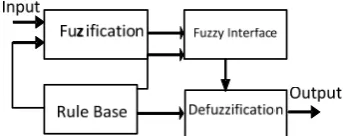
Fuzzy control systems are rule-based systems in which a set of so-called fizzy rules represents a control decision mechanism to adjust the effects of certain stimulus. The aim of fuzzy control systems is normally to replace a skilled human operator with a fuzzy rule-based system. The fuzzy logic model provides an algorithm, which can convert the linguistic strategy based on expert knowledge into an automatic strategy. Fig. 6 represents the basic configuration of a fuzzy logic system, which consists of a fuzzification, knowledge base, fuzzy interface and a defuzzification (IO). The fuzzy logic method is applied for scoring. The application of fuzzy rules will improve the model accuracy by avoiding arbitrariness for the purpose of the stud. The fuzzy rule base is composed of some rules generated from the analysis of the historical load data [16], [21].
One of the applications of the fuzzy rules is to combine them with neural network to train ANN and have a better load demand forecasting. The training patterns for the ANN models were collected from the historical load data. The number of training cycles has been determined through a trial process, to avoid overtraining [16].
The benefit of the proposed hybrid structure was to utilize the advantages of both, i.e., the generalization capability of ANN and the ability of fuzzy inference for handling and formalizing the experience and knowledge of the forecasters. It has been demonstrated that the method give relatively accurate load forecasts for the actual data. The test results showed that this method of
Fig. 6 Block diagram of the fuzzy logic system.
Fig. 7 Structure of ANN and Fuzzy based used.
forecasting could provide a considerable improvement of the forecasting accuracy. This indicates that the fuzzy rules and the training patterns for the ANN is quite promising and deserve serious attention of its robustness and suitability for implementation. It can be concluded that the outcome of the study clearly indicates that the proposed composite model can be used as an attractive and effective means for the industrial load forecasting. The improvement of forecast accuracy and the adaptation to the change of customers would fulfill the forecasting needs [16]. Fig. 7 shows the structure of ANN and Fuzzy based used in forecasting.
We can also combine two different methods to achieve better result. These two methods can be ANN and Fuzzy control. Long term load forecasting of power system is affected by various uncertain factors. Using clustering method numerous relative factors can be synthesized for the forecasting model so that the accuracy of the load forecasting would be improved significantly. A clustering neural network consisting of logic operators is quoted, which can be used in long term load forecasting Applying logic operators and in the fuzzy theory, the algorithm speed of the clustering network will be increased. Although competitive learning algorithm is used here for the network, it solves the dead unit problem and gives more room to select the initial values of the clustering center in the clustering analysis of the history data. The proposed model considers the influences of both history and future uncertain factors [25], [27], [31], [32].
Previous data
Fuzzification
Combination of the results
Forecasted of selected load
Selection of ANN Load data
Fuzzy Interface
Defuzzification
Load forecasted
Forecasted load
256 Iranian Journal of Electrical & Electronic Engineering, Vol. 7, No. 4, Dec. 2011 3.6 Expert System
The confidence levels associated with classical forecasting techniques, when applied to forecasting problem in mature and stable utilities are unlikely to be similar to those of dynamic and fast growing utilities. This is attributed to the differences in the nature of growth, socio-economic conditions, occurrence of special events, extreme climatic conditions, and the competition in generation due to the deregulation of the electricity sector with possible changes in tariff structures. Under such conditions, these forecasting techniques are insufficient to establish demand forecast for long-term load demand. Consequently, this case requires separate consideration either by pursuing the search for more improvement in the existing forecasting techniques or establishing another approach to address the forecasting problem of such systems [17].
In this section, the classical forecasting methods are firstly applied to obtain the long-term load demand forecasts, for a typical fast growing utility as well as normal developing system [17].
A poor performance is observed when such methods are applied to fast developing system, whereas most of these models are valid when used to produce the forecasts of the normal developing system. Consequently, an extended logistic model is developed to reflect the critical forecasting problem in fast growing areas. Although the developed model gives an accurate load demand forecast compared with the classical models, it is hardly difficult to dependent on single method for producing the demand of such fast growing and dynamic system [17]. This is because several important factors related to the cyclic and dynamic events that contribute significantly to the system load are difficult to involve it into the existing forecasting models.
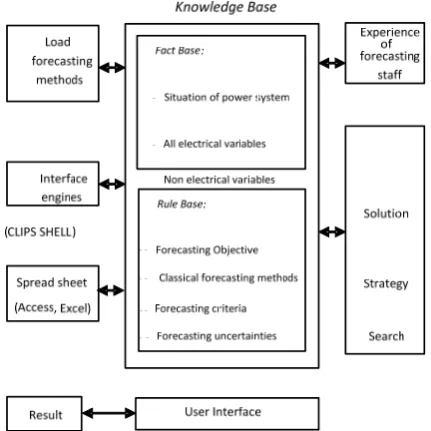
Thus, there is a need to develop a computational tool which allows one to store the knowledge associated with this problem along with the mathematical models to support the choice of the most suitable load forecasting model, for long-term power system planning. Therefore, the implementation of long-term forecasting strategies using a knowledge-based expert system (ES) is then presented in this section. In the expert system, key system variables which have major effects on system load are identified based on past planners experiences. A set of decision rules relating these variables are then established and stored in the knowledge base to select the recommended forecasting [17].
The main components of the proposed expert system are shown in Fig. 8.
With the knowledge base at hand (rules and facts), an inference engine can be used to search through this knowledge base according to the solution strategy. The detailed procedures of the solution strategy to ascertain the accuracy and credibility of selecting forecasting method. In addition to knowledge base, inference
engine, solution strategy, a user interface is also developed in the expert system to facilitate the navigation between the expert system and the user.
The variables of the formulated problem can be grouped into Static and Dynamic Facts as follows:
Static Facts: This kind of knowledge is developed before starting the planning process. A sample of these facts is: system conditions to identify the current situation of the system, i.e., mature, or under developing, isolated or interconnected with other system, etc.
Forecasting horizon to define the load forecasting period, i.e., long-term.
• Load pattern to describe the load behavior (stable, or dynamic pattern, cyclic, or seasonal pattern, or combination of all, time of system peak, load types, etc.)
• Historical peak load to indicate annual and seasonal growth, coincidence factor, area peak, etc.
• Historical energy to describe the information related to number of consumers of each sector, consumption rate, tariff rate, etc.
• Major factors affecting the system peak, i.e., weather variables, economic variables, demographic variables, special event, suppressed demand, bulk loads to be connected into the network, coincidence factor of the system peak, etc.
Dynamic Facts: These facts are developed and automatically updated during the inference process to represent the planning attributes needed for evaluating a decision making process. Samples of these facts include the following:
Fig. 8 Structure of expert system for long-term load forecasting.
Ghods & Kalantar: Different Methods of Long-Term Electric Load Demand Forecasting … 257 • load and energy attribute for the estimated load
and energy forecast;
• System losses attribute for the estimated system losses;
• Error attribute related to the forecasting model. In this section, a long-term load forecasting is developed and classified according to the forecasting problem using a knowledge-based expert system (ES). The proposed methodology is applied successfully to forecast yearly peak load for normal and fast developing power systems. Since the expert system is very flexible in updating the forecasting methods and heuristic rules, it is expected that the expert system can serve as a valuable assistant to system planners in performing their annual load forecasting duties. Finally, it can be expected to serve as a valuable assistant also for training purposes [17].
4 Contrasting New Forecasting Methods
Recurrent neural network (RNN) has be ability to learn patterns from the past records and also to generalize and project the future load patterns for an unseen data. In this type, some additional neurons are available. Additional neurons in input layer, which accept these feedback connections, are called state or context neurons. The role of context neurons in RNN is to get inputs from the upper layer, and after processing send their outputs to the hidden layer together with other plan units.
In the other neural network method, feed-forward back propagation an input pattern is given, the network produces an associated output pattern. Its learning and update procedure is intuitively appealing, because it is based on a relatively simple concept: the network is supplied with both a set of patterns to be learned and desired system response for each pattern. This method is much better than the RNN method. Because if the network gives the wrong answer, then the weights are corrected so that the error is lessened and as a result future responses of the network are more likely to be correct. It can have a trustworthy result.
Another method for long term load forecasting is Wavelet Network. The most advantage factor of wavelet network is not spanned inputs although the accuracy of model is better than multi layer neural networks. This is one reason which can be ended up in this choice. It has more advantages to apply to long-term forecast. The multi-resolution analysis capability of wavelet functions has much power in function approximation to obtain better accuracy. This accuracy can make a better result in future forecasting.
For one method, we can call Genetic Algorithm for long-term load demand forecasting, Genetic algorithms are a numerical optimization technique. More specifically, they are parameter search procedures based upon the mechanics of natural genetics. Forecasting results using GA were found to be the best. This indicates that the GA approaches is quite promising and
deserves serious attention because of its robustness and suitability for parallel implementation.
Other most commonly method is SVM. This method is much more comparable with ANN. First, the RSVMG model has nonlinear mapping capabilities and thus can more easily capture electricity load data patterns than can the ANN and regression models. Second, improper determining of these three parameters will cause either over-fitting or under-fitting of a SVM model. Third, the RSVMG model performs structural risk minimization rather than minimizing the training errors.
Fuzzy system as another method is normally to replace a skilled human operator with a fuzzy rule-based system. One of the applications of the fuzzy rules is to combine them with neural network to train ANN and have a better load demand forecasting.
In expert system, we can use traditional methods to forecast the peak load forecasting. The expert system is very flexible in updating the forecasting methods and heuristic rules, it is expected that the expert system can serve as a valuable assistant to system planners in performing their annual load forecasting duties.
5 Conclusions
Load forecasting plays a dominant part in the economic optimization and secure operation of electric power systems.
Long-term load forecasting represents the first step in developing future generation, transmission, and distribution facilities. Any substantial deviation in the forecast, particularly under the new market structure, will result in either overbuilding of supply facilities, or curtailment of customer demand. The confidence levels associated with classical forecasting techniques, when applied to forecasting problem in mature and stable utilities are unlikely to be similar to those of dynamic and fast growing utilities. This is attributed to the differences in the nature of growth, socio-economic conditions, occurrence of special events, extreme climatic conditions, and the competition in generation due to the deregulation of the electricity sector with possible changes in tariff structures. Under such conditions, these forecasting techniques are insufficient to establish demand forecast for long-term power system planning. Consequently, this case requires separate consideration either by pursuing the search for more improvement in the existing forecasting techniques or establishing another approach to address the forecasting problem of such systems.
Different methods of long-term load demand forecasting are defined in this paper. All of these methods can forecast the load of the power system, but the amount of previous data and such variables which they need to forecast, make them different in accuracy from area to area.
Finally, for long-term load forecasting, we should know the power system in details, and after that we can select the best method for the specified power system.
258 Iranian Journal of Electrical & Electronic Engineering, Vol. 7, No. 4, Dec. 2011 Sometimes we can combine different methods and
compare the accuracy of them together.
Traditional methods, such as time series, regression models and etc. are used in most of the countries, because of their reliable result.
Neural networks can solve nonlinear problems, and because of nonlinear behavior of load, so they can be useful for long-term load forecasting.
Genetic algorithm can forecast long-term load forecasting, when we have a lot amount of different variables and we want to find the best solution to follow the future load. Also it can be useful to estimate the support vector machine parameters.
Wavelet can estimate peak and valley of load behavior better than Furious series. It can combine with ANN have a better forecast.
References
[1] Al Mamun M., and Negasaka K., “Artificial neural networks applied to long-term electricity demand forecasting”, Proceedings of the Fourth International Conference on Hybrid Intelligent Systems (HIS'04), pp. 204-209, Dec. 2004.
[2] Dang Khoa T. Q. and Oanh P. T., “Application of Elman and neural wavelet network to long-term load forecasting”, ISEE Journal, track 3, sec. B, No. 20, pp. 1-6, 2005.
[3] Al-Hamidi H. M. and Soliman S. A., “Long-term/mid-term electric load forecasting based on short-term correlation and annual growth”, Electric Power System Research (Elsevier), Vol. 74, No. 3, pp. 353-361, June 2005.
[4] Negasaka K. and Al Mamun M., “Long-term peak demand prediction of 9 Japanese power utilities using radial basis function networks”, IEEE Power Eengineering Society General Meeting, Vol. 1, pp. 315-322, 6-10 June 2004. [5] Engineering and design hydropower proponent,
“Load forecasting methods,” in EM 110-2-1701, appendix B, Dec 1985.
[6] Genethliou D. and Feinberg E. A., Load forecasting, Applied mathematics for restructured electric power system: optimization, control and computational intelligence (J. H. Chow, F.F. Wu, and J. J. Momoh, eds.), chapter 12, pp. 269-285, 2005.
[7] Fu C. W. and Nguyen T. T., “Models for long-term energy forecasting”, IEEE Power Engineering Society General Meeting, Vol. 1, pp. 235-239, 13-17 July 2003.
[8] Taradar Heque M. and Kashtiban A. M., “Application of neural networks in power systems; A review”, Transaction of Engineering, Computing and Technology, Vol. 6, No. 1, ISSN 1305-5313, pp. 53-57, June 2005.
[9] Atiya A. F., “Development of an intelligent long-term electric load forecasting system”,
Proceedings of the International Conference, ISAP apos, pp. 288-292, 1996.
[10] Kermanshahi B. S., and Iwamiya H., “Up to year 2020 load forecasting using neural nets”, Electric Power System Research (Elsevier), Vol. 24, No. 9, pp. 789-797, 2002.
[11] Phimphachanh S., Chamnongthai K., Kumhom P., and Sangswang A., “Using neural network for long term peak load forecasting in Vientiane municipality”, IEEE Region 10 Conference, TENCON 2004, Vol. 3, pp. 319-322, 2004. [12] Khoa T. Q. D., Phuong L. M., Binh P. T. T. and
Lien N. T. H., “Application of wavelet and neural network to long-term load forecasting”, International Conference on Power System Technology (POWERCON 2004), pp. 840-844, Singapore, 21-24 November 2004.
[13] Khoa T. Q. D., Phuong L. M., Binh P. T. T., Lien N. T. H., “Power load forecasting algorithm based on wavelet packet analysis”, International Conference on Power System Technology (POWERCON 2004), pp. 987-990, Singapore, 21-24 November 2004.
[14] EL_Naggar K. M. and AL-Rumaih K. A., “Electric load forecasting using genetic based algorithm, optimal filter estimator and least error square technique: Comparative study”, Transaction of Engineering, Computing and Technology, Vol. 6, pp. 138-142, ISSN 1305-5313, June 2005.
[15] Pai P.-F., and Hong W.-C., “Forecasting regional electricity load based on recurrent support vector machines with genetic algorithms”, Electric Power System Research (Elsevier), Vol. 74, No. 3, pp. 417-425, 2005.
[16] Faraht M. A., “Long-term industrial load forecasting and planning using neural networks technique and fuzzy interface method”, 39th International Universities Power Engineering Conference, UPEC 2004, Vol. 1, pp. 368-372, 2004.
[17] Kandil M. S., El-Debeiky S. M. and Hasanien N. E., “The implementation of long-term forecasting strategies using a knowledge-based expert system: part-II”, Electric Power System Research (Elsevier), Vol. 58, No. 1, pp. 19-25, 2001. [18] Carmona D., Jaramillo M. A., Gonzalez E. and
Alvarez A. J., “Electric energy demand forecasting with neural networks”, IEEE, 28th Annual Conference of the Industrial Electronics Society, Vol .3, pp. 1860-1865, 2002.
[19] Karabuluta K., Alkanb A. and Yilmaz A. S., “Long term energy consumption forecasting genetic programming”, Association for Scientific Research, Mathematical And Computational Applications, Vol. 13. No. 2, pp. 71-80, 2008. [20] Yingling, Hongsong S., Yawei Y. and Nansheng
D., “Research on long term load forecasting
Ghods & Ka based IEEE, [21] Zhang term e rules”, (ICIME Confer [22] Ghanb Sabagh regress Iran's ENG. [23] Ji Z.,
Wavel to Fo Load” Scienc Works [24] Hobbs Term Neural System ISAP 2 Object [25] Yue L fuzzy for mi 2007. 967, 2 [26] Zhang Wavel term E 2010 S 446, 2 [27] Ghanb Moham Series Neuro POWE [28] Shriva
Appro Based ICPST [29] Yingy Princip power
lantar: Differ on Improved PCAIIA, pp. 8 g Q. and Liu T
electric load , Information ME), 2010 Th
rence, pp. 461 bari A., Nagh
hian M., “Ar sion approach annual elect Conference, p Zhang P. an let Neutral Ne orecast Mid-, Education ce, 2009. ET shop on , Vol. s N. J., Kim B
Load Forec l Network ms Applicatio
2007. Interna t Identifier, pp L., Zhang Y., logic cluster ddle and long
IEEE Interna 007.
g Q. and Liu let Neural Ne Electric Load Second Intern 010.
barian M., K mmadi A. and Regression -Fuzzy Tech ER ENG., pp. astava V. an ach of Input
Load Forec T, pp. 1-5, 200 ing L. and D pal Compone load foreca
rent Methods o d Genetic N 80-84, 2008. T., “ Research
forecasting Management The 2nd IEE 1-463, 2010.
havi A., Gha rtificial Neura hes compariso
tricity load”, pp 675-679, 20
nd Zhao Z., etwork and R -Long-Term
Technology TCS '09. Fir 1, pp 1104-11 B. H. and Lee casting Using Architecture ns to Power ational Confer p. 1-7, 2007.
Xie H. and ring neural ne g term load fo ational Confe u T., “A Fu etwork Metho d Forecasting”
national Conf Kavehnia F.,
d Keivani H., “ to Load Fo hniques”, IE 769-773, 2007 nd Misra R. Variable Sel casting ”, IE 08.
Dongxiao N., ent Regressi asting for me
of Long-Term Neural Networ
h on the mid-l based on fu and Engineer EE Internatio aderi S. F. al Networks on for forecast IEEE POW 009.
“Application Rough Set The Electric Pow
and Compu rst Internatio 108, 2009. e K. Y. , “Lo g System T ”, Intellig r Systems, 20 rence on Dig Zhong Q., “T etwork appro orecasting”, G ference, pp. 9 uzzy Rules od for Mid-lo ”, ICCNT, IE ference, pp 4 Askari M. “Applying Tim orecasting Us EEE Confere
7.
B., “A No lection for A EEE Conferen
“Application on Analysis edium and l
Electric Load rk”, ong uzzy ring onal and and ting WER n of eory wer uter onal ong-ype gent 007. gital The oach GSIS 963-and ong-EEE 442-R., me-sing ence ovel ANN nce, n of in ong [30 [31 [32 [33 inte aro pap inc Gen stab
d Demand For term”, IEE V3-203, 2 0] Zhang Q. Term Loa Network 217-220, 2 1] Maralloo
Kalhor A. via a ne CSICC 20 2] Dalvand
“Long-ter grid using IEEE Con 3] Ghods L. Load Dem Function Electrical Vol. 6, No
erested in powe
ound 30 Journa pers at Interna lude wind an nerations, pow bility and optim
recasting … EEE Conferen
2010. . and Liu T. ad Forecasting
”, IEEE Conf 2010.
M. N., Kous ., “Long term eurofuzzy mo 009, pp 35-40,
M. M., Azam rm load fore g fuzzy and a nference 2008
. and Kalant mand Forecast
Neural Netw l & Electron o. 3, pp. 175-1
Ladan G Iran in 1 degree f Tehran. engineerin university (IUST) in neural n forecast t er installation es
Mohsen K in Iran. H Indian In Delhi, Ind Associate of Elect University Tehran. H Center of Automatio al publications ational Confere nd solar pow wer system dy mization.
ce, ICACTE, ., “Research g Base on W ference, ICCE shki A. R., L m electrical loa
odel”, IEEE , 2009. mi S. and Ta
casting of Ir artificial neur , pp 1-4, 2008 tar M., “Lon
ting by Using works”, Irania nic Engineer 182, 2010.
Ghods was bo 1980. She rece from Azad
She graduate ng in M.S y of science a n 2008. She i network and i the future facto specially in ind
Kalantar, was He received h nstitute of Tec dia in 1991. He Professor in t trical Enginee y of Science an He is also found Excellence for on and Opera
and has presen ences. His fiel wer generation ynamics and c
259 pp.
V3-201-on Mid-lV3-201-ong avelet Neural EA 2010, pp, Lucas C. and ad forecasting Conference, arimoradi H., ranian power al networks”, 8. g-Term Peak g Radial Basis an Journal of ring (IJEEE),
orn in Tehran, eived her B.S. University of ed in power from Iran and technology s interested in ts abilities to ors. She is also dustries.
born on 1961 his Ph.D. from chnology, New is currently an the Department ering at Iran nd Technology, ding member of r Power System ation. He has nted about 100 lds of interest ns, Distributed control, system -g l , d g , r , k s f , , . f r n y n o o m w n t n , f m s 0 t d m