TS 74
Testing the Validity ofDisjuctive Arguments
Using
Physical
Models
RON LEONARD
University of Nevada, Department of Philosophy,
4505 Maryland Parkway, Box 455028, Las Vegas, Nevada, 89154-5028 U.S.A
E-mail: [email protected]
Introduction.
Methods for testing the validity of arguments often require formal techniques Ihat cannot be applied without knowledge of symbolic logic. Simple physical models, such as Venn diagrams, that visually represent logical relationships can help stu-dents to test validity while they are still in the process of learning the formal tools. However. Venn Diagrams are restricted to categorical arguments.This motivated me to develop a similar method for arguments employing propositional logic.
In the previous issue of this journal, I introduced a method for using the physi-cal model of a thermometer to test the validity of conditional arguments.The pro-posal advanced here uses diagrams of a scratch-and-win ticket for arguments based on disjunctions ("or" statements). Its guiding principle is the Counterexample Method, according to which an argument is invalid when it is possible for all of its premises to be true and its conclusion false. Analogously, if it is possible to dia-gram all and only the information expressed in the premises while excluding the information expressed in the conclusion, the diagram visually shows that the argu -ment is invalid.
Scratch-and-win tickets are small rectangular cards containing a number of circles coated with paint. Under each may be written notice of a prize, which may be revealed when the paint is scratched off. For the purpose of our model we must assume that there is a prize somewhere on each ticket. According to the rules, a specific number of circles may contain a prize, but the number of painted circles that the player may scratch is specified. This model provides a relatively straight-forward method for testing the validity of disjunctive arguments.
Before formulating the general method, it will be helpful to apply it to a few examples, including diagrams of each argument. The first thing we must deter-mine is whether the "or" of a disjunction is exclusive or inclusive. A disjunction is exclusive whenever the truth of one disjunct excludes the truth of the other disjunct(s) (such as getting heads when flipping a coin makes it impossible that it is also tails). In such cases a scratch-and-win diagram that tests the validity of a disjunctive argument constructed from an exclusive "or" has only one prize. A
Testing the Validity of Disjunctive Arguments TS 75
disjunction
is
inclusive when more than one disjunct may be true at the
same
time
(such as tomorrow being windy or rainy).
In
such cases a scratch-and-win
dia-gram may have more than one prize. When an argument denies disjuncts, rather than affirming them, the distinction between the inclusive and exclusive "or" is irrelevant. In contrast, as I will illustrate later, the distinction is relevant when an argument affirms the disjunct.Examples
Example 1: Denying a disjunct of an inclusive "or·J
statement:
Either natural disaster or misuse of human technology will calise massive
loss
of life on Earth during
the next
millennium.
No natural catastrophe will occur during the next millennium.
Therefore, misuse of human technology will cause massive
los
s
of
life
on Earth during next millennium.
Figure
1
Massive
loss
of life
Massive
loss of life
on earth
in 3M
due
on earth in
3M
due
to natural di
saster
to human technology
~2
VALID
TS 76 Ron Leollal'd
A premise that either affirms or denies an alternative expressed in a disjunct is
represented by scratching the paint off the corresponding circle. The second premise in Example I denies that the first disjunct is true, which means that there is no
prize there. This is shown by the paint scratched off to reveal the word "NOT" in that circle. Because the ticket must contain a prize somewhere, it is obvious that it must lie under the other circle. (Insofar as no premise affirms or denies that possibility, the circle remains painted in the diagram.) According to the diagram, all and only the information in the premises contains (expresses) the information in the conclusion, so the argument is valid.
Example 2: Denying two disjuncts of an inclusive "or" statement;
The government will fund Medicare
by
borrowing morc money or sig nifi-cantly increasing premiums or drastically reducing benefits.The government will not significantly increase premiums (because sen-iors will never accept higher premiums).
The government will not drastically reduce benefits (because seniors will never accept reduced benefits).
Therefore. the government will fund Medicare by borrowing more money.
U. S. borrows more money to fund Medicare
Figure 2
U. S. raises Medicare premiums
VALID
U. S. cuts
Testing the Validity of Dijjunclive Arguments TS 77
The above example
illustrates how the principle used in the previous
case
may
apply to more than two possibilities (disjuncts), and that their order on the ticket is logically irrelevant. In addition, it shows how practical arguments in ordinary lan-guage often rely on common assumptions concerning attitudes and values. In this case, assuming that the government will conform to the wishes of seniors, the two premises that imply the denial of two of the alternatives reveal no prize under the two corresponding circles in the diagram. So, the prize must be located underthe remaining
circle, which corresponds
to
what the conclusion asserts
.
This
argument too is valid because the diagram that represents all and only theinforma-tion in the premises
cannot
be constructed
without
also representing
the
informa-tion
in the
conclusion.
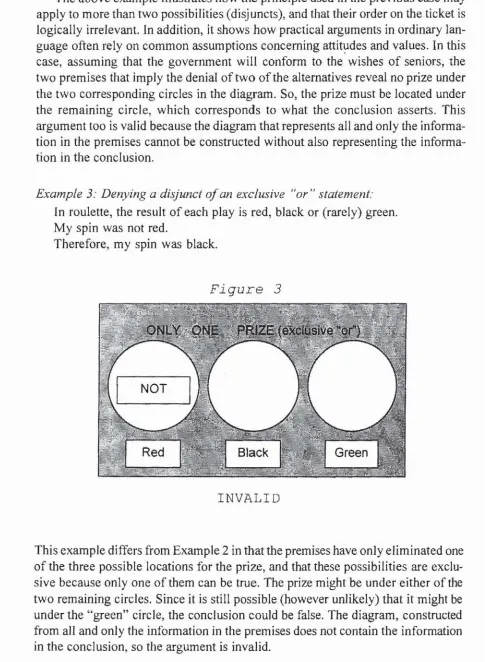
Er:ample 3: Denying a disjunct of an exclusive "or" statement:
In roulette, the result of each play is red, black or (rarely) green. My spin was not red.
Therefore, my spin was black.
Figure 3
INVALI
D
TS 78 Ron Leonard
Example 4: Denying a disjunct of an inclusive "or" statement, with Q disjunctive conclusion:
Criminals sentenced to death should be executed by poison gas, elect
ro-c
uti
on, o
r l
e
th
al
injection.
Criminals should not be electrocuted. Therefore, criminals should be
ex-ecuted either by poison gas or lethal injection.
Figur
e
4
Poison gas Lethal injection
VALI
D
This differs from the other examples in that there is more than one possibility that
would make the conclusion true. Here the "or" is inclusive because there may be
more than one method of execution that should be used, even though it would be
bizarre to use more than one
of t
h
em
for a particular criminal. The possibility thatthe "electrocution" circle contains a prize has been denied, and the diagram illu
s-trates that there must be a prize under at least one of the two remaining, unscratched
circles. Since this is what the conclusion claims, the premises contain the
infor-mation stated in the conclusion. Consequently, the argument is valid.
Example
5:
Affirming a disjunct of an exclusive "or" statement:Either the third millennium begins on January 1,200 I or the third millen-nium begins on January I, 2000.
The third millennium begins on January I 200 I (because exactly 2000
years will have elapsed from 0) the beginning of the Common Era) until
January I, 2001).
Testing the Validity of Disjunctive Argumel1ts TS 79
F
i
gur
e 5
PRIZE
millenium begins 1-1-2001
millenium begins 1-1-2000
V
A
L
ID
The difference from the previous example is that one of the disjuncts is affirmed,
rather than denied. So, there is a prize located in the circle representing the af-firmed disjunct. Hence, the word "PRIZE" appears in that circle. Next, we must determine whether the argument uses an exclusive or inclusive "or," Here,
if
either disjunct is true, the other must be false, so the disjuncts are exclusive. Conse-quently, the ticket is labeled to show that there is one, and only one, prize on the ticket. Since it has been determined that the tirst circle contains the prize, the other circle cannot. Because the conclusion denies that the unscratched circle contains a prize, all and only the information in the premises also contains the information in the conclusion. Thus, the argument is valid.Example 6: Affirming a disjunct o/an inclusive "or" statement:
Either we ban CFC's or the ozone layer will become dangerously de-pleted.
We have banned CFC's.
Therefore, the ozone layer will not become dangerously depleted.
Example 6 differs from the previous one in that both possibilities could be true, for we could ban CFC's and the ozone layer could still become dangerously depleted (from the effect of some other chemical, for instance). Hence, we are dealing with an inclusive "or" statement, so we label the ticket to show that it contains at least one prize. The second premise asserts that we have banned CFC's, which means that there is a prize under the corresponding circle, so we show the word
TS 80 ROil Leonard
PRIZE
Fi gure 6
Ozone layer will be
dangerously depleted
INVALID
other circle, but because the argument uses an inclusive "or," it is possible that
another prize could be found under the other circle. Hence, all and only the
infor-mation in the premises does
not
contain the information
in t
he
conc
lu
sio
n
:
it
is
possible for the premises to be true and the conclusion false. Thus the argument is invalid.Example 7. Affirming a dlsjunct of an exclusive "or" statement:
Presently, the largest country in the world is Russia or China or the U.S.
or Australia or Brazil or Canada,
Canada has been shown to have the greatest land mass.
Therefore, Russia is not the largest country in the world.
Example 7 (see Figure 7 on page TS 80) is a complex example where several
possibilities are mutually exclusive, and where one of them is asserted in order to
conclude that one of the others is false. When a scratch-and-win ticket must
represent these many possibilities,
i
t
is more convenient to use two rows of cir-cles, just as do many actual tickets. Again, asserting that Canada has the largest
land mass is equivalent to finding the prize under the corresponding circle. The
word "PRlZE" thus appears there. Since these possibilities are exclusive, the ticket contains only one prize. The conclusion denies that Russia is the largest country.
which m·eans that there is no prize under that circle. Since all and only the
informa-tion in the premises inescapably contains the information asserted in the
Testing {he Validity of Disju.nctive Arguments TS 81
F
i
gure
7
PRIZE
VALID
Method of Diagramming
Let us now consider the general rules for using the physical model of a s
cratch-and-win ticket for
conducting validity
tests.
I. Draw a large rectangle (ticket) to include all, and only, the information in the
premises of
the
argument.
It
is crucial
that
we never use
information
from
the
conclusion
to
con
s
truct the
diagram.
The test i
s
to determine
whether the
infor-mation contained
in the premises
includes that
contained
in the conclu
s
ion.
No
doubt, if we have already included information from the conclusion, we will find it in the diagram, but that will make the test worthless. By analogy, when testing a water sample for lead, if we added lead to the sample before doing the test, the results would be useless.
2. Draw and label as many circles as there are possibilities (disjuncts) in the dis-junctive ( .. . or. .. ) premise. Each circle is understood to have either the word
"PRIZE" (for a circle containing a prize) or the word "NOT" (for a circle that
TS 82
Ron
Leona
r
d
3. Determine whether, in reality, the possibilities given are inclusive or exclusive. Whenever Ihe possibililies are exclusive, the trulh of one possibililyexcludes Ihe Irulh oflhe other possibililY, only one of them can be Irue. This means Ihal only one of Ihe circles conlains
a
prize. Whenever Ihey are inclusive, thaI is, where more than one possibility may be true at the same time, then any numberof circles may contain a prize. If exclusive, label Ihe licket "ONL Y ONE PRIZE" al Ihe lOp; if inclusive, label Ihe licket "A T LEAST ONE PRIZE" al Ihe top. 4. Premises that either affirm or deny a given possibility are interpreted as
analo-gous 10 scratching the surface of Ihe corresponding circle to reveal Ihe app ro-priate word. For each premise that affirms a disjunct, write the word "PRIZE" in the corresponding circle; for each premise that denies a disjunct, write the word "NOT" in Ihat circle.
Method of Determining Validity
Given that the possibilities are either exclusive or inclusive, determine whether any of the circles thaI have not been scratched cannot/may/musl contain a prize.
J. For "Only One Prize" tickets (exclusive "or" statements), whenever the word
"PRlZE" has already appeared (because a disjuncI has been affinned), Ihe r e-maining circles cannot conlain a prize. (The single prize already has been won.) 2. For "At Least One Prize" tickets (inclusive "or" statements), whenever the word "PR1ZE" has already appeared (a disjuncI has been affirmed), any of Ihe remaining circles may also contain a prize.
3. For either soJ1 oflickel, wheneverthe word "PRIZE" has nOI appeared (disjuncts have only been denied- nol affirmed): (I) If a single unscralched circle re -mains, it must con lain the prize, but (2) if more Ihan one unscralched circle remains, any of them may contain a prize (for exclusive "or," exactly one circle will).
We tesl for validity by delermining whether the diagram (constructed by using all and only Ihe information from Ihe premises) corresponds 10 what Ihe conclusion claims (contains the information found in the conclusion). If so, Ihen the
argu-m
e
nt
is valid;
o
th
e
rwi
se,
it i
s invalid.
4. If the conclusion affirms that there is a prize within a single circle, the argument is valid whenever Ihe diagram indicates thaI Ihere must be a prize there (I here must be a prize somewhere; it has not yet appeared; there is only one unscralched circle where it could be-Examples 1,2). Olherwise it is invalid (Example 3). 5. If the conclusion affirms that there is a prize under one of two or more
unscratched circles, the argument is valid whenever a prize must be under at least one of Ihem (I here musl be a prize somewhere; il has not yel appeared;
th
e con
cl
usio
n
allows for
itt
o be under any
of ther
e
mainin
g circles-Example
4). Olherwise it is invalid.Testing the Validity of Disjunctive Arguments TS 83
the ticket have already been won; the conclusion denies that there is a prize
under a remaining unscratched circle-Examples 5,7). Otherwise
it
is invalid(Example 6).
Conclusions
The method for testing validity by using physical models has several advantages:
I. It provides a reliable procedure for determining the validity of disjunctive argu-ments.
2. The diagrams are easy to draw.
3. The method's simplicity makes it easy to use. In particular, it applies to an
disjunction, regardless of whether its disjuncts are positive or negative.
4. Students need not comprehend the subject matter of the argument. Lack of
background knowledge sometimes limits the test for validity that uses
counterexamples. Where subject matter is technical or obscure, students may
have little idea what it would mean tor the premises or conclusion to be true or
false.
5. Insofar as these physical models are analogous to logical forms, working with them will especially aid the visual learner to grasp the general logical forms