Progress in Biological Sciences
Vol. 5, Number 1, Winter / Spring 2015/121-131Effect of 1-methylcyclopropane in combination
with Calcium chloride
on postharvest storage
and quality of green olives
Received: 20 September, 2014; Accepted: 10 March, 2015
Fariba Amini1* and Ali Akbar Ramin2
1. Department of Biology, Faculty of Science, Arak, Iran
2. Department of Horticulture, College of Agriculture, Isfahan University of Technology, Isfahan, Iran
Green olive cultivars “Manzanila” and “Mission” were harvested at the mature green stage. They were either treated with 1-methylcyclopropane (1-MCP) at a concentration of 1.8 µL/L for 24 h at 20°C or kept untreated as a control. Both treated and untreated fruits were then immersed in water containing CaCl2 of 0 (control), 50 and 100 mM for 2 h under 1.2 bar pressure. Fruits were then surface dried, put into plastic basket and stored at 6°C with relative humidity of 80% in a refrigerator for 12 weeks. The non-1-MCP treated fruits softened within 6 weeks after harvest. In contrast, the 1-MCP treatment inhibited fruit softening and color changes. Treatment with CaCl2 delayed fruit softening, but had little effect on fruit color. The rate of ethylene production and respiration were also significantly (P<0.05) lower in fruits treated separately by 1-MCP and CaCl2, compared to the control. However, the effect of 1-MCP in combination with CaCl2 was more effective in the case of color change and softening during cold storage. It could be concluded that the fruits treated with a combination of 1-MCP and CaCl2, were superior in preventing fruit softening and green color loss, and suffered minimum damage for 12 weeks at 6°C.
Keywords: calcium chloride, Olea europea, postharvest physiology, 1-Methylcyclopropane.
*Corresponding author:[email protected]
Introduction
Research on olive cultivars indicate that detached olives show no climacteric respiratory rise. Green olives produce only traces of ethylene, while black fruit produce significantly higher quantities but still very low compared to climacteric fruits. Ethylene at 150-250 µL/L only slightly increases the respiration rate of green olives at 20°C, while it considerably increases respiration rates at 25 or 30°C with a climacteric-type rise depending on cultivar (1).
Non-climacteric fruits do not show a dramatic respiration or ethylene burst, nor do they continue to develop after harvest. Instead, they undergo a senescence process which is parallel to some of the same processes occurring in ripening fruit (2). However, slowing the process of ripening and senescence extends the storage and the shelf-life of fresh fruits and vegetables. It has been shown that inhibition of ethylene action delays ripening and senescence in several species of fruits and vegetables (3). Recently a new tool, 1-methylcyclopropene (1-MCP), has been added to the methods used for extending storage life and quality of plant tissue. A previous experiment with four cultivars of olive indicated that 1-MCP treatment effectively reduced loss of color changes and firmness for fruits stored at 5°C for 15 weeks (4). The success of the 1-MCP treatment depends on the method of application, duration and concentration as well as commodity factors such as cultivar.
Pre-and postharvest calcium applications have been used to delay senescence, to reduce postharvest decay, and to control the development of many physiological disorders in fruits and vegetables (5). In fruits, vacuum infiltration of calcium chloride (CaCl2) has
been used commercially to enhance storage
potential (6). However, it is difficult to infiltrate enough calcium into some fruits to eliminate decay, without causing damage (5). In anna apple, using CaCl2 in postharvest dips
combined with heat treatment produced better fruit quality than with either treatment separately (7). In apple fruits, application of CaCl2 coating significantly maintained the
sensory quality of apple fruit by slowing down the metabolic changes. The 6% CaCl2
treated fruit had the most intense color and better texture (8). Karemera and Habimana (9) evaluated the effect of pre-harvest calcium chloride on post harvest behavior of mango fruits and concluded that 1.5% CaCl2
significantly increased the number of days taken for ripening of fruits, the shelf-life of fruits, physico-chemical parameters and organoleptic evaluation of mango fruits compared to the control. Postharvest dips in concentrated solutions of CaCl2 have been
used to improve firmness in fresh-cut strawberries (10). However, it is not clear if 1-MCP in combination with CaCl2 will be of
benefit for mature green olive cultivars. Therefore, in this paper the effects of dipping the two cultivars of olive in CaCl2 solution
and 1-MCP separately or in combination, on their quality and storage life are presented.
Materials and methods
Plant materials
Green olive (Olea europea) cultivars “Manzalina” and “Mission” were hand harvested on the 18th and 21st of September
Effect of 1-MCP and CaCl2 on postharvest of olives
parts of each tree, so as to minimize the effect of watering, sun exposure and differences related to different maturation stage. Olives were sorted to obtain fruit uniform size and color and distributed randomly in 0.5 kg lots placed in 2L glass jars as one replication.
MCP and Ca treatments
Olives were treated with 1- methylcyclopropan (1-MCP) at a concentration of 1.8 µL/L (4) for 24 h at 20°C or kept untreated as a control. Both treated and non-treated fruits were then immersed in water containing CaCl2 of 0 (control), 50 and 100 mM for 2 h
under 1.2 bar pressure. Fruits were then surface dried and put into plastic basket and stored at 6°C with relative humidity of 80% in the refrigerators for 12 weeks. Sample of 20 olives were randomly removed from each treatment: 10 olives were used for firmness and 10 olives were used for color measurement. Observations of decay, firmness, and color value were made over 12 weeks, at an average interval of 2 weeks, during the course of the experiment.
Measurement of firmness
Flesh firmness was measured with a Fruit Hardness Tester (Model 10576, OSK, Japan) equipped with a modified 5 mm conic diameter and 2 mm-long tip plunger. Flesh firmness measurements were taken after careful removal of skin and penetration of the flesh to about 2 mm (flesh width ranged from 3-4 mm). Two firmness measurements were taken from opposite sides of each fruit.
Color measurement
External skin color (opposite sides) was periodically measured with a Minolta Chromameter (Model CR-200, Minolta Camera, Co, Japan), calibrated with a white standard (y=94.3; x=0.3142; z=0.3211).
Values of a and b readings were taken and color was reported as a (green-red) and b (blue-yellow). Change in the H angle (Hº)
was calculated as h=arctan [b/a], which can be used effectively for visualizing the color of fruits (1).
Chlorophyll fluorescence measurement (Fv/Fm)
Chlorophyll fluorescence of olive fruits was measured using a plant efficiency analyzer (PEA, Hansatech, LTd, UK). When using a PEA, the fruit sample is darkened with a light weight plastic leaf clip clipped 6 min before the measurement. During measurement, the PEA sensor unit is held over the clip and the shutter remains open. A single button press activates the high intensity of the LED array of the sensor head which provides a maximum light intensity of 3000 µmol m-2s-1.
Maximal PSII photochemical efficiency (Fv/Fm), the ratio of variable fluorescence (Fv) to maximum fluorescence (Fm), was calculated automatically. Measurement was made from opposite sides of each olive. This technique has recently been used for postharvest horticultural communities for better indication of storage environments (11).
Polyphenols measurement
To understand color changes better, total polyphenols of fruits were analyzed. Measurements were carried out according to a previously published protocol (12), employing the Folin-Ciocalteu methodology. Gallic acid was used as the reference standard, and results were expressed as mg gallic acid equivalents per 100 g of fresh tissue.
Respiration
sealed with a rubber stopper for 1 h at 20ºC, following 6 weeks of storage at 6ºC. CO2
evaluation in samples was made from the exit flow from each jar, using infrared CO2
detection.
Ethylene production
Ethylene production was determined by injecting 1 ml of the head-space gas extracted after 1 h and ethylene was quantified on a gas chromatograph (Varian GC-3400, series ) fitted with FID and a stainless steel Porapak N column. The injector, oven and detector temperatures were 110, 90 and 250ºC, respectively. N2 was used as the carrier gas at
a flow rate of 0.37 ml s-1.
Statistical analysis
The experiment was set up as a completely randomized design with three replications of each treatment. Data were subjected to ANOVA, and least significant (LSD) differences were determined at P<0.05 to compare the means.
Results
Color, a* and Hº value
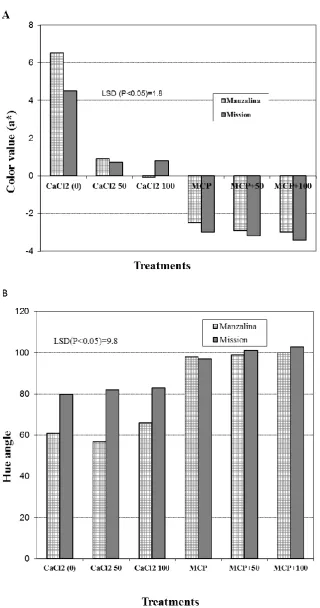
Difference in color changes (a* value) for two cultivars of olives (Manzalina and Mission) appeared after 12 weeks of storage at 6°C (Fig. 1A). Both cultivars showed significant difference in a* value when fruits were treated with 1-MCP and 50 and 100 mM CaCl2 in comparison to the control (0 1-MCP
and CaCl2) treatments. The appearance of
1-MCP treated fruit was better than that of CaCl2 fruit due to the smaller changes in a*
value following storage at 6ºC. However, the quality of fruits (skin color) was improved after treatment with a combination of 1-MCP and CaCl2. Increase in a* value indicated loss of greenness as could be seen in non-treated fruits (Fig. 1A).
Changes in Hº angle are another indication of
ripening in many fruits. Regardless of cultivars, the fruits treated with 1-MCP and CaCl2 from 50 to 100 mM resulted in better
quality after 12 weeks of storage, compared to non-treated (control) fruits (Fig. 1B). The H° values confirmed that MCP alone or 1-MCP in combination with CaCl2 was
chromatically greener than control fruits at the end of the treatment. The appearance of treated fruits was better than the control fruits due to smaller changes in H° (Hue angle) during storage. Hue angle of fruits treated with 1-MCP or 1-MCP in combination with CaCl2 remained significantly (P<0.05) high at
the end of storage, compared to the control fruits. There were no significant differences in Hº angle in fruits treated with CaCl2 in both
cultivars (Fig. 1B). However, there were no significant differences in Hº in fruits treated with 1-MCP alone or 1-MCP in combination with CaCl2.
Fruit firmness
An olive fruit dip in CaCl2 solution prior to
storage significantly (P<0.05) improved fruit firmness in both cultivars following 12 weeks of storage at 6ºC, compared to the control (0 CaCl2) treatment (Fig. 2A). The treatment
with 100 mM CaCl2 was the most effective.
However, the fruits treated with 1-MCP showed significantly higher fruit firmness compared to those treated by CaCl2 alone.
Fruit firmness after 12 weeks of storage ranged from 1.5 to 1.7 kg in controlled fruits, which is lower than the firmness of fruits treated with 1-MCP and CaCl2. Fruits treated
with 1-MCP, especially in combination with 100 mM CaCl2 treatment, became
significantly (P<0.05) harder than those treated with either CaCl2 or 1-MCP alone
Effect of 1-MCP and CaCl2 on postharvest of olives
Figure 1. Effect of 1-MCP (1.8µL/L) and CaCl2 (mM) on color value (a*) (A) and (Hº angle) (B) of olives after 12
Figure 2. Effect of 1-MCP (1.8 µL/L) and CaCl2 (mM) on fruit firmness (A), rate of ethylene production (B) and total
polyphenols (C) of olives after 12 weeks of storage at 6ºC
Ethylene production rate
Olive fruits in the control, 1-MCP, and CaCl2
treatments showed similar ethylene production rates in both cultivars with slightly higher rates in cv. “Manzalina”, but the combination of 1-MCP and CaCl2 dip
slowed down ethylene production (Fig. 2B).
Total Polyphenol
The level of total polyphenol compounds in the olive is shown in Figure 2C. The content
of total polyphenols in olives after 12 weeks of storage at 6ºC following 1 day at 20ºC were ca. 80 and 120 mg/100 g fresh weight in control for cvs “Mission” and “Manzalina”, respectively. During 12 weeks of storage at 6ºC, phenolics increased in control fruit, while less polyphenol accumulation was detected in CaCl2 and 1-MCP treated fruit.
CaCl2, compared to the control. In general,
the total polyphenol content in control fruits was approximately 4 and 3 times higher than that in 1-MCP+CaCl2 treated fruit in cvs
“Mission” and “Manzalina”, respectively.
Chlorophyll fluorescence
Changes in chlorophyll fluorescence (Fv/Fm)
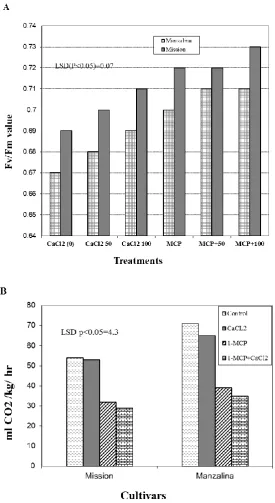
were observed during olive storage in all treatments (Fig. 3A). Both cultivars improved and showed greater value of Fv/Fm compared to the control. Olive fruits treated with 1-MCP and CaCl2 individually or in combination after
12 weeks of storage showed significantly (P<0.05) greater value in Fv/Fm than the control fruits.
Figure 3. Effect of 1-MCP (1.8 µL/L) and CaCl2 (mM) on Fv/Fm value (A) and respiration (B) of olive fruits after 12
weeks of storage at 6ºC
Respiration rate
Both cultivars showed a high initial respiration rate, which declined with either 1-MCP or CaCl2 treatments (Fig. 3B).
However, no significant differences were found in fruits' respiration between control and in calcium-treated fruits alone after 12 weeks of storage at 6ºC but, significant differences (P<0.05) were observed in respiration rate when fruits were treated with 1-MCP, compared to un-treated fruits. The fruits treated with 1-MCP reduced respiration rate to ca. half of the control. Subsequent reductions in respiration rate were observed when 1-MCP was combined with CaCl2, but
the differences were not statistically significant.
Discussion
The results of this study regarding the effect of 1-MCP on quality of olives are in agreement with previous reports by Ramin (4) in four cultivars of olives. Generally, skin color changed from green at the beginning of the treatment to green-red at the end of storage. Red color development is detrimental to these fruits as only green fruits can be processed. The non-treated fruits showed more changes in green color (a* value) in comparison with those in 1-MCP treatment. 1-MCP treated fruits in combination with CaCl2 were more effective in maintaining the
green color of skin than other treatments. Use of 1-MCP was able to maintain fruit color and this behavior seems to be a general effect of 1-MCP in most studied fruits (13, 14). In many fruits and vegetables, color development was accelerated by ethylene. Moreover, ethylene is involved in de-greening of fruits and many horticultural crops. 1-Methylcyclopropene inhibits ethylene action by blocking its receptor for extended periods and delays maturity and ripening (2).
In olives, postharvest treatment, 1-MCP, and calcium applied by dips may act synergistically to maintain or even enhance the initial firmness values of the fruits during storage. The results of this study are in agreement with previous reports by Ramin (4) about olives and Blankenship and Dole (2) concerning other fruits. Wang et al. (15) reported that 1-MCP treatment significantly delayed the decrease of firmness, total soluble solids, titratable acidity, inhibited increase in weight loss, suppressed the increase in respiration rate and ethylene production. Similar effects have been found in apple by different authors (16). The effect of calcium might be direct, by promoting the formation of calcium bridges among pectin molecules, which might increase the rigidity of the wall (17) or indirect by reducing wall porosity and limiting the mobility of cell wall polysaccharide-degrading protein (18, 19). Mackvandi et al. (20) evaluated the effects of postharvest application of 1-MCP and CaCl2
dip or their combination on storage quality of mature-green olives and concluded that the combination of 1-MCP and CaCl2 had
synergistic effect on preventing fruit softening.
The chlorophyll fluorescence technique has been found useful for predicting the quality of a wide range of fruits and vegetables (21). Early measurement showed a sustained decrease in dark-adapted (Fv/Fm) and an increase in (Fv/Fm), indicating the occurrence of environmental stress in fruits and vegetables (22, 11).
Both cultivars (Mission and Manzalina) showed a high initial respiration rate, which declined with either 1-MCP or CaCl2
treatments. Fruit respiration might have increased in response to fruit damage, and the reduced production of CO2 by calcium or
In this study, the control and CaCl2 treated
fruits had higher C2H4 production rates
compared to fruits exposed to 1-MCP, with or without a CaCl2 dip. This may be partly due
to possible microbial growth and general deterioration of the tissue as a result of senescence in these treatments (10). Also, Bower et al. (24) observed that 1-MCP treatment (0.01, 0.1 or 1.0 µL/L) reduced C2H4 production and the increased emission
of CO2 by 1-MCP treated strawberry was
associated with the earlier onset of rot.
During a 12-week storage of Mission and Manzalina cultivars at 6ºC, phenolics increased in control fruit, while less polyphenol accumulation was detected in CaCl2 and 1-MCP treated fruits. It is known
that free phenolics are present mainly in the vacuole of cells. However, they are
synthesized in the cytoplasm and may also be deposited in cell walls.Low-temperature storage treatments induce membrane damage in cell organelles, such as vacuoles, the vacuolar phenolics might possibly make contact with PPO, thus causing browning reaction in plant materials (25).
Conclusion
Olive cultivars’ “Manzalina” and “Mission” can be stored for several weeks when treated with 1-MCP, and this could be extended when fruits are treated with (50-100 mM) CaCl2 before storage.
Acknowledgements
This work was supported by grant No. 84203 from Iran National Science Foundation, and it is gratefully acknowledged.
1. Nanos, G.D., Kiritsakis, A.K. and Sfakiotakis, E.M. (2002) Preprocessing storage conditions for green ‘Conservolea’ and ‘Chondrolia’ table olives. Postharvest Biol. Technol., 25, 109-115. 2. Blankenship, S.M. and Dole, J.M. (2003) 1-methylcyclopropane a review. Postharvest Biol.
Technol.,28, 1-25.
3. Menniti, A.M., Donati, I.R. and Gregori, R. (2006) Response of 1-MCP application on plum stored under air and controlled atmospheres. Postharvest Biol. Technol., 39, 243-246.
4. Ramin, A.A. (2007) Effects of storage temperatures and 1-MCP treatment on postharvest quality of green olives. Fruits, 62, 383-390.
5. Mishra, S. (2002) Calcium chloride treatment of fruits and vegetables, Tetra technologies, The Woodlands, Texas, USA.
6. Trentham, W.R., Sams, C.E. and Conway, W.S. (2008) Histological effects of calcium chloride in stored apples. J. Amer. Soc. Hort. Sci.133(4), 487–491.
7. Lurie, S. and Klein, J.D. (1992) Calcium and heat treatments to improve storability of “Anna” apples. Hort. Sci., 27, 36-39.
8. Ullah, J., Alam, S., Ahmad, T. Mabood-Qazi, I. (2007) Effect of CaCl2 coating on storage disorder of apples CV. Kingstar stored at ambient conditions. Sarhad J. Agric.,33, 775-779.
9. Karemera, N.J.U. and Habimana, S. (2014) Effect of pre-harvest calcium chloride on post harvest behavior of mango fruits (Mangifera Indica L. ) cv. Alphonso. Universal J. Agr. Rec. 2(3), 119-125.
10. Aguayo, E., Jansasithorn, R. and Kader, A.A. (2006) Combined effects of 1-methylcyclopropene, calcium chloride dip, and/or atmospheric on quality changes in fresh-cut strawberries. Postharvest Biol. Technol., 40, 269-278.
11. DeLong, J.M., Prange, R.K., Leyte, J.C. and Harrison, P.A. (2004) A new technology that determines low-oxygen threshold in controlled atmosphere-stored apple. Hort. Technol., 14, 262-266.
12. Maestro, R., Garcia, J.M. and Castellano, J.M. (1993) Changes in polyphenol content of olives stored in modified atmospheres. Hort. Sci., 28, 749.
13. Watkins, C.B., Nock, J.F. and Whitaker, B.D. (2000) Response of early mid and late season apple cultivars to postharvest application of 1-methylcyclopropene (1-MCP) under air and controlled atmosphere storage conditions. Postharvest Biol. Technol., 19,17-32.
14. Jeong, J., Huber, D.J. and Sargent, S.A. (2002) Influence of 1-methylcyclopropene (1-MCP) on ripening and cell wall matrix polysaccharids of avocado (Persea emericana) fruit. Postharvest Biol. Technol., 25, 241-264.
15. Wang, M., Cao, J., Lin, L., Sun, J. and Jiang, W. (2010) Effect of 1-methylcyclopropane on nutritional quality and antioxidant activity of tomato fruits (Solanum lycopersicon) during storage. J. Food Qual.33, 150-164.
1-methylcyclopropene and natureseal on the quality of fresh-cut ‘Empire’ and ‘Crispin’ apples. J. Food Qual.28, 289-308.
17. Wei, J., Fengwang, M., Shi, S., Qi, X., Zhu, Z. and Yuan, J. (2010) Changes and postharvest regulation of activity and gene expression of enzymes related to cell wall degradation in ripening apple fruit. Postharvest Biol. Technol., 56, 147-154.
18. Baron-Epel, O., Gharyal, P.K. and Schindler, M. (1988) Pectins as mediators of wall porosity in soyabean cells. Planta, 175, 389-395.
19. Muroz, P.H., Almenar, E., Ocio, M.J. and Gavara, R. (2006) Effect of calcium dips and chitosan coatings on postharvest life of strawberries (Fragaria x ananassa). Postharvest Biol. Technol., 39, 247-253.
20. Mackvandi, M., Shahpory, S. and Ramin, A.A. (2013) Effect of 1-Mthylecyclopropen (1-MCP) and calcium chloride (CaCl2) on increasing storage longevity in mature-green “Mission” olives. J Hortic. Sci. 27, 488-494.
21. DeEll, J. R., and Toivonen, P.M.A. (2003) Use of chlorophyll fuorescence in postharvest quality assessments of fruits and vegetables. In Dell, J.R. and Toivonen, P.M.A. (eds) Practical application of chlorophyll fuorescence in plant biology. Kluwer Academic Publishers, Dordrecht, The Netherlands, pp. 203-242.
22. Prange, R.K., DeLong, J.M. and Harrison, P.A. (2003) Oxygen concentration affects chlorophyll fluorescence in chlorophyll-containing fruits and vegetables. J. Am. Soc. Hortic. Sci., 128, 603-607.
23. Angeletti, P., Castagnasso, H., Miceli, E., Terminiello, L., Concellon, A., Chaves, A. and Vicente, A.R. (2010) Effect of preharvest calcium applications on postharvest quality, softening and cell wall degradation of two blueberry (Vaccinium corymbosum) varieties. Postharvest Biol. Technol.,58, 98-103.
24. Bower, J.H., Biasi, W.V. and Mitcham, E. J. 2003. Effects of ethylene and 1-MCP on the quality and storage life of strawberries. Postharvest Biol. Technol., 28, 417-423.
25. Massolo, J.F., Concellon, A., Chaves, A.R. and Vicente, A.R. 2011. 1-Methylcyclopropene (1-MCP) delays senescence, maintains quality and reduces browning of non-climacteric eggplant (Solanum melongena L.) fruit. Postharvest Biol. Technol., 59, 10-15