1
Dhvani N Shah
2
Annamma Varghese
CORRESPONDING AUTHOR
1Dr. Dhvani N Shah, MPT (MSK)
Consultant at Naval Dockyard, Mumbai.
Email: [email protected]
Int J Physiother. Vol 1(4), 187-194, October (2014) ISSN: 2348 - 8336
ABSTRACT
Background: Balance is a key component of normal daily activities. Therefore, it is necessary to find various programs to improve balance. The core functions to maintain postural alignment and balance during functional activities. The purpose was to study the effects of the core stability training on dynamic balance in healthy, young adults.
Methods: It was an interventional study, in which 60 healthy young adults were selected. They were randomly divided into two groups of 30 each, one being experimental group and other control group. Measurement of their height, weight, BMI and leg length was taken. Subjects in both the groups were assessed for core stability with pressure biofeedback unit (PBU) and dynamic balance using Star Excursion Balance Test (SEBT) pre and post intervention. Subjects in the experimental group underwent progressive core stability training program for six weeks (3days/week) and control group was refrained from any type of structured training program.
Results: There was statistically significant improvement in core stability and dynamic balance of the experimental group after six weeks of intervention.
Conclusion: It is concluded that core stability training of six weeks duration is effective in improving dynamic balance in healthy, young adults.
Key words: core stability, dynamic balance, star excursion balance test, pressure biofeedback unit.
2 Professor,
K. J. Somaiya College of Physiotherapy, Mumbai.
Email: [email protected]
Received 7th August 2014, revised 20th August 2014, accepted 26th August 2014
DOI: 10.15621/ijphy/2014/v1i4/54563
INTRODUCTION
The human core is important because it is the anatomical location in the body where centre of
gravity is located, thus where movement stems.1
Bergmark2 categorized the trunk muscles into local
and global stabilizers based on their main mechanical principles. Local stabilizing system includes deep muscles or deep portions of some muscles which have their origin or insertion on the lumbar vertebrae. The local muscles are capable of controlling the stiffness and intervertebral relationship of the spinal segments and the posture of the lumbar spine. The global muscles are not only responsible for transferring load between the thoracic cage and the pelvis but also to balance the external loads applied to the trunk so that the residual forces transferred to the lumbar spine can be handled by the local muscles. In this way, the large variations in external loads that occur with normal daily functions are accommodated by the global muscles so that the resulting load on the lumbar spine and its segments is continually minimized.
Balance is a key component of normal daily activities such as walking, running and climbing stairs. It can be defined as the “ability to maintain the body’s center of gravity within the limits of stability as determined by the base of support.”3
Due to the complexity of balance, controlling it
involves interaction of neurologic,
musculoskeletal, proprioceptive, vestibular and visual system. Nasher4 concludes that balance is
achieved through a compilation of sensory, motor and biomechanical process. As balance and joint stability mutually depend on sensory input from peripheral receptors, balance can be interpreted as a function of joint stability. Dynamic balance is a very important aspect of everyday life. Hence, it is imperative to find programs useful for measuring, maintaining and improving balance for injury prevention and rehabilitation.
Logically, strengthening core muscles will improve stability of the lumbar spine. What has been researched in much less detail is the effect that core stability training will have on tasks that encompass whole body movement and dynamic
postural control.5 Therefore, the main purpose of
this study is to verify the effects of the core stability training on dynamic balance in healthy young adults.
recruited from tertiary health care centre after obtaining consent from the hospital and participants. Young non-exercising females of 18-25 years of age with height of 150-170cms and normal BMI were included. Subjects with any
musculoskeletal injuries, neurological and
vestibular conditions, LBP in last 6 months were excluded. Total 60 subjects (n=60) were randomly allocated to two groups i.e. experimental group and control group using the closed chit method. Subjects were divided into both the group of 30 each. All the subjects had to give details regarding demographic data which included name, age, sex, address and occupation. Pre-training session was held for both groups in which body mass index (BMI), limb length, core stability and dynamic balance was assessed.
BMI was calculated using the formula, BMI= WEIGHT IN KG/(HEIGHT IN MTS).In supine, after squaring the pelvis, limb length was measured from the antero-superior iliac spine to the middle of the medial malleolus using a standard tape measure. The limb length measure was used to normalize reach distance data (excursion÷leg length×100). Core stability was assessed using pressure biofeedback unit6 (figure
12) and dynamic balance was assessed by the Star Excursion Balance Test7,8 (figure 13, figure 14). The
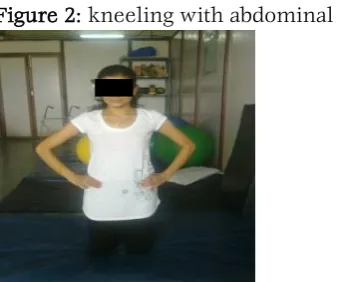
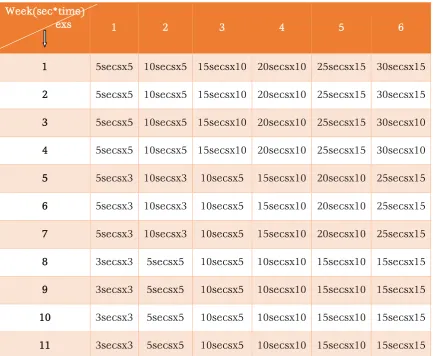
subjects in the experimental group then underwent progressive core stability training program for six weeks (table 1) and the control group refrained from any form of structured core stability training for six weeks but continued with all other daily activities. The core stability program included crook lying with abdominal hollowing (figure 1), kneeling with abdominal hollowing (figure 2), quadruped with one leg raise and abdominal hollowing (figure 3), quadrepud with opposite leg and arm raise and abdominal hollowing (figure 4), kneel sitting to kneeling with abdominal hollowing (figure 5), squatting with abdominal hollowing (figure 6), ball sitting with one leg raise and abdominal hollowing(figure 7), roll ball in and out with abdominal hollowing (figure 8), standing on skates with abdominal hollowing (figure 9), air cycling with abdominal hollowing (figure 10), side plank (figure 11) After six weeks, both groups underwent post-training session where core stability and dynamic balance was assessed again.
Figure 2: kneeling with abdominal hollowing
Figure 3: quadruped with one leg raise and abdominal hollowing
Figure 4: quadripud with opposite leg and arm raise and abdominal hollowing
Figure 5: kneel sitting to kneeling with abdominal hollowing
Figure 6: squatting with abdominal hollowing
Figure 7: ball sitting with one leg raise and abdominal hollowing
Figure 8: roll ball in and out with abdominal hollowing
Figure 9: standing on skates with abdominal hollowing
Figure 11: side plank
Figure 12: pressure biofeedback unit
Figure 13: star excursion balance test
Figure 14: star excursion balance test
TABLE 1: CORE STABILITY TRAINING PROGRAME
Week(sec*time)
exs 1 2 3 4 5 6
1 5secsx5 10secsx5 15secsx10 20secsx10 25secsx15 30secsx15
2 5secsx5 10secsx5 15secsx10 20secsx10 25secsx15 30secsx15
3 5secsx5 10secsx5 15secsx10 20secsx10 25secsx15 30secsx10
4 5secsx5 10secsx5 15secsx10 20secsx10 25secsx15 30secsx10
5 5secsx3 10secsx3 10secsx5 15secsx10 20secsx10 25secsx15
6 5secsx3 10secsx3 10secsx5 15secsx10 20secsx10 25secsx15
7 5secsx3 10secsx3 10secsx5 15secsx10 20secsx10 25secsx15
8 3secsx3 5secsx5 10secsx5 10secsx10 15secsx10 15secsx15
9 3secsx3 5secsx5 10secsx5 10secsx10 15secsx10 15secsx15
10 3secsx3 5secsx5 10secsx5 10secsx10 15secsx10 15secsx15
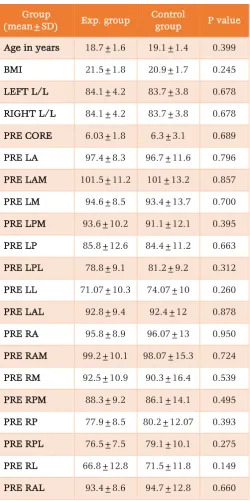
TABLE 2: PRE INTERVENTIONAL COMPARISIONS
Group
(mean±SD) Exp. group
Control
group P value
Age in years 18.7±1.6 19.1±1.4 0.399
BMI 21.5±1.8 20.9±1.7 0.245
LEFT L/L 84.1±4.2 83.7±3.8 0.678
RIGHT L/L 84.1±4.2 83.7±3.8 0.678
PRE CORE 6.03±1.8 6.3±3.1 0.689
PRE LA 97.4±8.3 96.7±11.6 0.796
PRE LAM 101.5±11.2 101±13.2 0.857
PRE LM 94.6±8.5 93.4±13.7 0.700
PRE LPM 93.6±10.2 91.1±12.1 0.395
PRE LP 85.8±12.6 84.4±11.2 0.663
PRE LPL 78.8±9.1 81.2±9.2 0.312
PRE LL 71.07±10.3 74.07±10 0.260
PRE LAL 92.8±9.4 92.4±12 0.878
PRE RA 95.8±8.9 96.07±13 0.950
PRE RAM 99.2±10.1 98.07±15.3 0.724
PRE RM 92.5±10.9 90.3±16.4 0.539
PRE RPM 88.3±9.2 86.1±14.1 0.495
PRE RP 77.9±8.5 80.2±12.07 0.393
PRE RPL 76.5±7.5 79.1±10.1 0.275
PRE RL 66.8±12.8 71.5±11.8 0.149
PRE RAL 93.4±8.6 94.7±12.8 0.660
Table 2 shows that basic characteristics of subject between control and experimental group showed no significant difference. The pre-intervention core stability and excursion distances in between the groups were non-significant.
Graph 1 shows that there is no statistically significant difference (p=0.161) when pre intervention means were compared between experimental group (6.03±1.8) and control group (6.3±3.1). There is statistically significant difference (p<0.001) when post intervention core
stability means were compared between
experimental group (8.7±1.6) and control group (6.03±2.6).
Graph1: Comparison of core stability in two groups
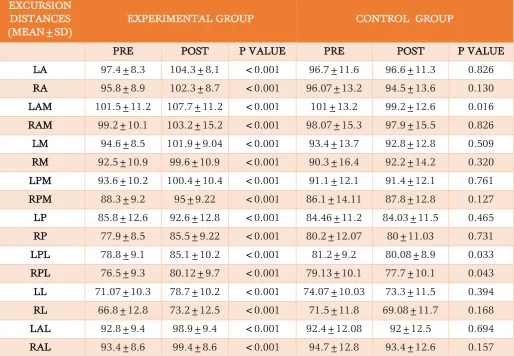
Table 3 shows that there is no statistically significant difference in the control group when pre and post interventional excursion distances of LA (left anterior), RA (right anterior), RAM (right antero-medial), LM (left medial), RM (right medial), LPM (left postero medial), RPM (right postero medial), LP (left posterior), RP (right posterior), LL (left lateral), RL (right lateral), LAL (left antero-lateral), RAL (right antero-lateral) were measured. There is statistically significant difference in the control group when pre and post interventional excursion distances of LAM (left antero-medial), LPL (left postero- lateral) and RPL (right postero-lateral) were measured. There is
statistically significant difference in the
experimental group when pre and post
interventional all excursion distances are
compared. Graph 2, graph 3, graph 4 and graph 5 shows the comparison of excursion distances between the groups.
0 1 2 3 4 5 6 7 8 9 10
PRE POST
CONTROL
TABLE 3: COMPARISON OF EXCURSION DISTANCES IN BOTH GROUPS
EXCURSION DISTANCES (MEAN±SD)
EXPERIMENTAL GROUP CONTROL GROUP
PRE POST P VALUE PRE POST P VALUE
LA 97.4±8.3 104.3±8.1 <0.001 96.7±11.6 96.6±11.3 0.826
RA 95.8±8.9 102.3±8.7 <0.001 96.07±13.2 94.5±13.6 0.130
LAM 101.5±11.2 107.7±11.2 <0.001 101±13.2 99.2±12.6 0.016
RAM 99.2±10.1 103.2±15.2 <0.001 98.07±15.3 97.9±15.5 0.826
LM 94.6±8.5 101.9±9.04 <0.001 93.4±13.7 92.8±12.8 0.509
RM 92.5±10.9 99.6±10.9 <0.001 90.3±16.4 92.2±14.2 0.320
LPM 93.6±10.2 100.4±10.4 <0.001 91.1±12.1 91.4±12.1 0.761
RPM 88.3±9.2 95±9.22 <0.001 86.1±14.11 87.8±12.8 0.127
LP 85.8±12.6 92.6±12.8 <0.001 84.46±11.2 84.03±11.5 0.465
RP 77.9±8.5 85.5±9.22 <0.001 80.2±12.07 80±11.03 0.731
LPL 78.8±9.1 85.1±10.2 <0.001 81.2±9.2 80.08±8.9 0.033
RPL 76.5±9.3 80.12±9.7 <0.001 79.13±10.1 77.7±10.1 0.043
LL 71.07±10.3 78.7±10.2 <0.001 74.07±10.03 73.3±11.5 0.394
RL 66.8±12.8 73.2±12.5 <0.001 71.5±11.8 69.08±11.7 0.168
LAL 92.8±9.4 98.9±9.4 <0.001 92.4±12.08 92±12.5 0.694
RAL 93.4±8.6 99.4±8.6 <0.001 94.7±12.8 93.4±12.6 0.157
GRAPH 2: comparison of excursion distances (LA, RA, LAM, RAM) in both the groups.
GRAPH 3: comparison of excursion distances (LM, RM, LPM, RPM) in both the groups
GRAPH 4: comparison of excursion distances (LP, RP, LPL, RPL) in both the groups
GRAPH5: comparison of excursion distances (LL, RL, LAL, RAL) in both the groups
85 90 95 100 105
110 PRE
POST
75 80 85 90 95 100
105 PRE
POST
0 20 40 60 80 100
PRE POST
0 20 40 60 80 100 120
DISCUSSION
The results of the present study revealed that there was significant improvement in core stability and dynamic balance in experimental group following core stability training program. For all the
directions, normalized maximum excursion
distances increased significantly in the
experimental group. This improvement in reach distance verifies the positive effect of core stability training on dynamic balance.
The core comprises the lumbo-pelvic –hip complex as most of the prime mover muscles for the distal segments (latissimus dorsi, pectoralis major, hamstring, quadriceps and iliopsoas) and major stabilizing muscle for the extremities(upper and lower trapezius, hip rotators and glutei) attach to the core. The abdominal muscles consist of the transversus abdominus, internal and external oblique and rectus abdominis. Abdominal muscle contractions help create a rigid cylinder, enhancing stiffness of the lumbar spine.9 The
transversus abdominis has been shown to be critical in stabilization of the lumbar spine.10,11 The
rectus abdominis and oblique abdominals are activated in direction specific patterns with respect to limb movements, thus providing postural
support before limb movements.12,13
According to Kibler14, the core acts as an
anatomical base for motion of the distal segments
and its governing musculature works
synergistically to produce and reduce force and provide dynamic stabilization throughout the kinetic chain. The body uses core muscle activation to generate the necessary rotational torque around the body and produce extremity motion. So, in the SEBT, as the subject stands on the stance leg and uses the opposite limb to reach, the rectus abdominis and obliques would fire before the movement occurs to perform trunk motion, allowing the subject to maintain balance while the multifidus and transversus abdominus muscles would help to maintain dynamic balance during lower extremity movement by providing support to the lumbar spine.14
Hodges and Richardson identified trunk muscle activity before activity of the lower extremity, which helps the spine to stiffen leading to a foundation for functional movements. They also found that the transversus abdominus is the first muscle to become active prior to actual limb movement and this preprogramed activation of the transversus abdominus was a component of the strategy used by the CNS to control spinal stability. Richardson proposed that a precise co-contraction of the transversus abdominus and multifidus are
independent of the global musculature, neutral spine posture and low-level continuous tonic contractions. This feed forward nature of activation
increases muscle stiffness and segmental
stabilization to provide more efficient use of the
primary muscles.15
Bouisset16 proposed that stability of the pelvis and
trunk is necessary for all movements of the extremities and hence proximal stability is necessary in order to prevent lower extremity injury. The quality of the actions during functional movements require optimum neuromuscular efficiency and control. Mechanoreceptors provide the central nervous system (CNS) with appropriate proprioception feedback to maintain normal length-tension relationships and force-couple relationships through a circling effect of passive(spinal column) to control(neural) to active(muscular)systems in order to maintain this efficient state(inner core activated prior to outer core musculature). This in turn leads to optimal arthrokinematics in the lumbo-pelvic hip complex during functional kinetic chain movements, optimal neuromuscular efficiency in the entire kinetic chain, optimal acceleration,deceleration, dynamic stabilization of entire kinetic chain during functional movements and provides proximal stability for efficient lower extremity movements.
There is no universally accepted standard programme for core stabilization with respect to type, frequency and duration of the prescribed exercises.17 Kimberely18 found a difference on
dynamic balance at five weeks; hence we undertook a six week training programme as was
also followed by Nichole Kahle.The exercises for a
core stability training programme need to concentrate on motor control, emphasizing the neutral spine posture and contraction of the pelvic floor muscles and transversus abdominis with the multifidus.18 The exercises included in this study
progressed from large to small base of support and from stable to unstable surface. It included movements required for dynamic balance and added the core stabilization element to it.
Factors such as height and limb length affect excursion distance and hence in our study we used participants with matched leg length in both groups. Also normalization of leg length for all participants was performed for more accurate
comparison amongst subjects. According to
Gribble’s19 study foot type, hip ROM measurements
LIMITATIONS
Small sample size. The order of trials was not randomized. The core training was not tailor-made to meet individual’s requirement. Long term follow up was not studied.
CLINICAL IMPLICATIONS AND APPLICATIONS
Core stability training can be used in patients with balance deficits, so as to improve balance and reduce risk of fall and injuries, thus leading to a better quality of life. Individuals of all the age groups undergoing fitness regime should include core stability exercises. In athletes and players, core stability training can be incorporated to improve performance and minimize injuries.
ACKNOWLEDGEMENT
I thank all the departmental staff, my colleagues and friends for extending full cooperation during my study and preparation of manuscript.
REFERENCES
1. Clark MA, Fater D, Reuteman P. A core (trunk)
stabilization and its importance for closed kinetic chain rehabilitation. Orthop Phys Ther Clin North Am.2000; 9: 119-135.
2. Bergmark A. stability of the lumbar spine. A study in mechanical engineering. Acta Orthop Scand. 1989; 230:20-24.
3. Yim-Chiplis, P., Talbot, L. Defining and
Measuring Balance in Adults. Bio Rsrch for Nurs.2000; 1(4):321-331.
4. Forssberg, H., & Nasher, L.M. Ontogenetic development of postural control in man: adaptation to altered support and visual
conditions during stance. Journal of
Neuroscience.1982, 2(5): 545-552.
5. Nichole L. Kahle,BS ; and Phillip A. Gribble. Core stability training in dynamic balance testing among young, healthy adults. Athletic Training and Sports Health Care .2009; 1(2):65-73.
6. Richardson C, Hodges P, Hides J. Therapeutic
exercise for lumbopelvic stabilization a motor control approach for the treatment and prevention of low back pain. 2nd Ed; 2004.
7. Gribble P. The Star Excursion Balance Test as a
measurement tool. Athl Ther Today. 2003; 8:46-47.
8. Kinzey SJ, Armstrong CW. The reliability of the Star Excursion Balance Test in assessing dynamic balance. J Orthop Sports Phys Ther. 1998; 27(5):356-360.
9. McGill SM,Norman RW. Reassessment of the
role of intra-abdominal pressure in spinal compression.Ergonomics.1987; 30(11):1565-88.
10.Cresswell AG, Oddson L, Thorstensson A. The
influence in sudden perturbations in trunk muscle activity and intra-abdominal pressure whilst standing. Experimental Brain Research. 1994; 98(2): 336-341.
11.Oddsson LI. Control of voluntary trunk
movements in man: mechanisms for postural equilibrium during standing. Acta Physiol Scand Suppl. 1990; 595:1-60.
12.Aruin AS,Latash ML. Directional specificity of
postural muscles in feed-forward postural reactions during in feed-forward postural reactions during fast voluntary arm movement. Exp Brain Res. 1995; 103(2):323-32.
13.Hodges PW,Richardson CA. Feed forward
contraction of transversus abdominis is not influenced by the direction of the arm movement. Exp Brain Res. 1997; 114:362-70.
14.Kibler W,J,Sciascia A.The role of core stability
in athletic function.Sports Med.2006;36(3):189-198.
15.Johnson P.Training the trunk in the athlete. Strength Cond J.2002; 24:52-59.
16.Zattara M,Bouisset S. Posturo-kinetic
organization during the early phase of voluntary limb movement.J Neurol Neurosurg Psychiatry 1988;51:956-65.
17.Arokoski JP,Volta T,Airaksinen O,Kanakaanpa
M.Back and abdominal muscle function during
stabilization exercises.Arch Phys Med
Rehabil.2001;82:1089-1098.
18.Kimberly M.Samson. The effects of a five week
core stabilization-training programe on
dynamic balance in tennis athletes. Master of science thesis. West Virginia university(2005).
19.Gribble P,Hertel J. Considerations for
normalizing measure of the Star Excursion Balance Test. Measure Phys Educ Exerc Sci.2003;7(2):89-100.