CLINICAL YEAR IN REVIEW
Interstitial lung disease
Vincent Cottin*,#
ABSTRACT: This article reviews the most important articles published in interstitial lung disease, as reviewed during the Clinical Year in Review session at the 2012 annual European Respiratory Society Congress in Vienna, Austria.
Since the recent international guidelines for the management of idiopathic pulmonary fibrosis (IPF), important new evidence is available. The anti-fibrotic drug pirfenidone has been recently approved in Europe. Other pharmacological agents, especially nintedanib, are still being tested. The so-called triple combination therapy, anticoagulation therapy and endothelin receptor antagonists, especially ambrisentan, are either harmful or ineffective in IPF and are not recommended as treatment. Although the clinical course of IPF is highly variable, novel tools have been developed for individual prediction of prognosis. Acute exacerbations of IPF are associated with increased mortality and may occur with higher frequency in IPF patients with associated pulmonary hypertension.
Interstitial lung disease associated with connective tissue disease has been definitely established to have a better long-term survival than IPF. A subset of patients present with symptoms and/or biological autoimmune features, but do not fulfil diagnostic criteria for a given autoimmune disease; this condition is associated with a higher prevalence of nonspecific interstitial pneumonia pattern, female sex and younger age, although survival relevance is unclear.
KEYWORDS:Clinical trial, connective tissue disease, exacerbation, idiopathic pulmonary fibrosis, prognosis, sarcoidosis
T
his article reports relevant progress in the field of interstitial lung disease (ILD) (table 1), as reviewed during the Clinical Year in Review session that was held during the 2012 annual Congress of the European Respiratory Society (ERS) in Vienna, Austria. This session was jointly organised by the scientific Assemblies of the ERS, especially the Clinical Assembly with regard to ILD.All relevant articles were identified viaPubMed using the keywords ‘‘interstitial lung disease’’, ‘‘pulmonary fibrosis’’, ‘‘connective tissue dis-ease’’, ‘‘collagen vascular disdis-ease’’, and ‘‘pulmon-ary sarcoidosis’’. Articles that were published in print before the 2011 ERS Congress in Amsterdam, the Netherlands, were excluded. Articles that were published after the 2012 ERS Congress in Vienna were also excluded. Articles were then selected on the basis of clinical relevance for chest physicians, and likelihood of impacting clinical practice. Although special attention was given to the selection of articles, such a review cannot be exhaustive, and I apologise to authors whose
publications could not be included into this article because of space constraints.
TREATMENT OF IDIOPATHIC PULMONARY FIBROSIS
Treatment of idiopathic pulmonary fibrosis (IPF) is definitely a challenge, and numerous clinical trials have been conducted during the past decade [1], following progress in pathophysiology [2–4], better definition and diagnosis of the disease [5, 6], dedication of physicians in the field, and massive investment by pharmaceutical companies.
The potential efficacy of the triple tyrosine kinase inhibitor BIBF1120 (nintedanib) was evaluated in a 12-month, phase II, double-blind, placebo-controlled randomised trial (ClinicalTrials.gov NCT00514683) [7]. Nintedanib, also developed in oncology, is an oral potent intracellular inhibitor of tyrosine kinases targeting platelet-derived growth factor-a and -b, vascular endothelial growth factor receptors 1, 2, and 3, and fibroblast growth factor receptors 1, 2, and 3. These signalling pathways are involved in the patho-genesis of lung fibrosis in humans and animal models.
AFFILIATIONS
*Hospices Civils de Lyon, Hoˆpital Louis Pradel, Service de pneumologie – Centre de re´fe´rence national des maladies pulmonaires rares et Centre de compe´tences de l’hypertension arte´rielle pulmonaire, and
#Universite´ de Lyon, Universite´
Claude Bernard Lyon 1, INRA, UMR754 INRA-Vetagrosup EPHE IFR 128, Lyon, France.
CORRESPONDENCE V. Cottin Hoˆpital Louis Pradel Service de Pneumologie 28 Avenue Doyen Lepine 69677 Lyon Cedex France
E-mail: [email protected]
Received: Nov 20 2012 Accepted after revision: Nov 27 2012
PROVENANCE
Submitted article, peer reviewed.
The trial included 432 patients who were randomised into five groups to receive placebo or one of four doses of nintedanib (50 mg once a day, 50 mg twice a day, 100 mg twice a day or 150 mg twice a day). The primary end-point was the annual rate of decline in forced vital capacity (FVC), and secondary end-points included acute exacerbations, quality of life measured by the St George’s respiratory questionnaire and total lung capacity. The diagnosis of IPF was consistent with international criteria [5], considered definite in 33% of patients and probable in 62% of patients, with a surgical lung biopsy performed in 28% of cases. A total of 85% of the patients completed the study. FVC declined by a mean of 0.06 L per yr in the group receiving 150 mg of nintedanib twice daily, as compared to 0.19 L per yr in the group receiving placebo, representing a 68.4% reduction in the rate of decline in FVC (p50.06 with the closed testing procedure for multiplicity correction; p50.01 with the hierarchical testing procedure) [7]. Encouraging results were also observed for secondary end-points, especially a lower incidence of acute exacerbations of IPF (2.4 versus15.7 per 100 patient-yrs, p50.02) and a significant difference in the St George’s questionnaire score between groups, a lesser decline in total lung capacity, and fewer patients whose FVC decreased byo10% in the treated group. The main adverse events that were considered to be related to the study drug were gastrointestinal symptoms (diarrhoea, nausea and gastro-intestinal pain) and increase in levels of liver aminotransferases, most with mild or moderate intensity. Given the positive signal for a slower rate of decline in FVC and consistent secondary end-points, two large pivotal phase III trials are currently ongoing worldwide (ClinicalTrials.gov NCT01335464 and NCT01335477, INPULSIS 1 and 2, respectively), testing 150 mg of nintedanib twice daily. The enrolment of 1,066 patients was completed on September 17, 2012, and results are expected by the first quarter of 2014.
Another randomised, placebo-controlled trial conducted by the US IPFnet consortium evaluated the safety and efficacy of a
three-drug regimen combining prednisone, azathioprine and N-acetylcysteine (PANTHER-IPF) [8]. This regimen has been widely used after a previous trial demonstrated better preservation of FVC and diffusing capacity of the lung for carbon monoxide (DLCO) in patients receiving the triple therapy compared to those who received a combination of prednisone and azathioprine [9]. In this trial, sponsored by the National Heart Lung and Blood Institute (ClinicalTrials.gov NCT00650091), patients with IPF and mild-to-moderate lung function impairment were assigned in a 1:1:1 ratio to receive one of three groups of treatment for 60 weeks: combination therapy (prednisone, azathioprine and N-acetylcysteine), N-acetylcysteine alone, or placebo. The primary end-point was the change in longitudinal measurements of FVC. After approximately 50% of the data had been collected (77 patients receiving combination therapy and 78 receiving placebo), a planned interim analysis revealed an increased rate of all-cause mortality (eight deathsversus one death, p50.01) and hospitalisation (23%versus7%, p,0.001) in the group receiving the triple combination therapy as compared to the placebo group, prompting the independent data safety and monitoring board to recommend termination of the study [8]. Patients (78 in the combination therapy group and 77 in the placebo group) had been followed for a mean of 32 weeks. No evidence was observed for a clinical or physiological benefit, especially FVC, in patients receiving the triple therapy. Of note, although increased mortality was observed in patients receiving triple therapy, no functional worsening was found in this group. 28% of patients receiving the combination therapy discontinued all three medications, compared to 4% in the placebo group (p,0.05). Thus, this study provides compelling evidence against the initiation of the triple therapy in patients with IPF [8]. In patients already receiving the triple combination therapy, the decision of whether to continue or stop therapy
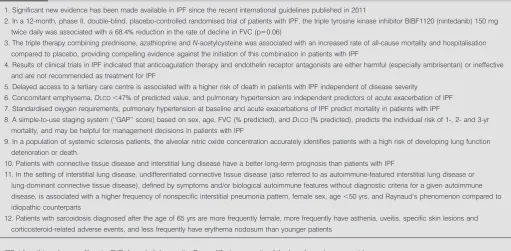
TABLE 1 Twelve key messages
1. Significant new evidence has been made available in IPF since the recent international guidelines published in 2011
2. In a 12-month, phase II, double-blind, placebo-controlled randomised trial of patients with IPF, the triple tyrosine kinase inhibitor BIBF1120 (nintedanib) 150 mg twice daily was associated with a 68.4% reduction in the rate of decline in FVC (p50.06)
3. The triple therapy combining prednisone, azathioprine andN-acetylcysteine was associated with an increased rate of all-cause mortality and hospitalisation
compared to placebo, providing compelling evidence against the initiation of this combination in patients with IPF
4. Results of clinical trials in IPF indicated that anticoagulation therapy and endothelin receptor antagonists are either harmful (especially ambrisentan) or ineffective
and are not recommended as treatment for IPF
5. Delayed access to a tertiary care centre is associated with a higher risk of death in patients with IPF independent of disease severity
6. Concomitant emphysema,DLCO,47% of predicted value, and pulmonary hypertension are independent predictors of acute exacerbation of IPF 7. Standardised oxygen requirements, pulmonary hypertension at baseline and acute exacerbations of IPF predict mortality in patients with IPF
8. A simple-to-use staging system (‘‘GAP’’ score) based on sex, age, FVC (% predicted), andDLCO(% predicted), predicts the individual risk of 1-, 2- and 3-yr mortality, and may be helpful for management decisions in patients with IPF
9. In a population of systemic sclerosis patients, the alveolar nitric oxide concentration accurately identifies patients with a high risk of developing lung function
deterioration or death.
10. Patients with connective tissue disease and interstitial lung disease have a better long-term prognosis than patients with IPF
11. In the setting of interstitial lung disease, undifferentiated connective tissue disease (also referred to as autoimmune-featured interstitial lung disease or lung-dominant connective tissue disease), defined by symptoms and/or biological autoimmune features without diagnostic criteria for a given autoimmune
disease, is associated with a higher frequency of nonspecific interstitial pneumonia pattern, female sex, age,50 yrs, and Raynaud’s phenomenon compared to idiopathic counterparts
12. Patients with sarcoidosis diagnosed after the age of 65 yrs are more frequently female, more frequently have asthenia, uveitis, specific skin lesions and
corticosteroid-related adverse events, and less frequently have erythema nodosum than younger patients
IPF: idiopathic pulmonary fibrosis; FVC: forced vital capacity;DLCO: diffusing capacity of the lung for carbon monoxide.
may be based on a number of factors, including: patient preferences, duration of therapy, tolerance and prior evolution in lung function [10]. Of note, this does not apply to patients presenting with non-IPF ILDs, especially idiopathic nonspe-cific interstitial pneumonia or ILD in the setting of connective tissue disease (CTD), who may in some circumstances benefit from corticosteroids and/or immunosuppressive therapy. The comparison of the N-acetylcysteine alone group and the placebo group in IPF patients is ongoing, and shall decipher whether this drug is beneficial in patients with IPF.
Results from two phase III randomised, double-blind, placebo-controlled, multinational trials evaluating pirfenidone in patients with mild-to-moderate IPF (as defined by FVCo50% predicted and DLCOo35% pred) were published earlier the same year [11]. Although only one of these studies reached the primary end-point of change in FVC at week 72 (p,0.001), the pooled analysis from both studies showed a significant reduction in the decline in FVC compared to placebo (p,0.005), with further beneficial effects of pirfenidone with regard to several secondary end-points [1]. The most common adverse events were gastrointestinal (nausea, dyspepsia, vomit-ing and anorexia), skin rash and photosensitivity, and dizziness, consistent with the known safety profile of the drug and generally of mild-to-moderate severity [11]. A meta-analysis of these studies [12, 13] and another study conducted in Japan [14] further demonstrated a beneficial effect regarding progression-free survival time (HR 0.70, 95% CI 0.56–0.88, p50.002).
In the ACE-IPF trial (ClinicalTrials.gov NCT00957242) [15], investigators from the IPFnet consortium tested the hypothesis that targeting the coagulation cascade at therapeutic doses would reduce the rates of mortality, hospitalisation, and decline in FVC. Rationale for this hypothesis was based on compelling evidence from both animal and human studies that have demonstrated an increased risk of thrombosis in patients with IPF [16], enhanced pro-coagulant activity in alveoli of patients with IPF, stimulation of fibrosis by activated coagulation cascade [17], and a previous unblinded clinical trial suggesting increased survival in patients receiving anticoagulation [18]. In this 48-week, double blind, placebo-controlled trial, patients were randomised to receive warfarinversusplacebo targeting an international normalised ratio (INR) of 2–3 using an encrypted INR home monitoring system. The primary end-point was time to death, hospitalisation (non-elective, non-bleeding), or a decline of o10% in FVC. Termination of the study was recommended by the independent data safety and monitoring board after 145 of the planned 256 subjects had been randomised due to a low probability of benefit and an excess in mortality [15]. The cause of the excess mortality was unknown, with deaths being related to respiratory worsening and not to severe bleeding complications, especially diffuse alveolar haemor-rhage. The results of this trial, although disappointing, have practical consequences. The use of anticoagulant therapy as a treatment for IPF is strongly discouraged, as opposed to international IPF guidelines which listed anticoagulation ther-apy as a possible choice in a minority of patients [5].
Altogether, results made available during the past year have provided new evidence since the recent international evidence-based guidelines for the management of IPF [5]. The triple combination therapy, which has often been considered the
worldwide standard of care for the treatment of IPF although with low-quality evidence, is no longer recommended [10, 19]. Anticoagulation as a treatment of IPF is strongly discouraged. One further study (ASCEND, ClinicalTrials.gov NCT01366209) is being conducted with pirfenidone in the USA. The endothelin receptor antagonist bosentan, macitentan and ambrisentan [19–21] have not proven efficacious in patients with IPF. Further study is needed to evaluate the long-term benefit:safety ratio of sildenafil [22]. Current international guidelines already need to be updated to account for new evidence [19, 23]. The choice of appropriate end-points in IPF trials is controversial [24–29], and priority is now given to clinically relevant end-points in a realistic and ethical setting. Indeed, participation of patients in clinical trials is, more than ever before, a priority to test other pharmacological agents.
PROGNOSIS OF IPF
One study has evaluated the delay in accessing specialised care among patients with IPF, defined as the estimated time from the onset of dyspnoea to the initial visit at a tertiary care centre [30], e.g. a centre specialised in ILD or a transplant centre. Survival time and time to transplantation were evaluated, with covariates accounting for most variables that could affect prognosis, including age, sex, FVC, lead time, potential barriers to accessing healthcare, comorbidities and treatment. The mean delay from onset of dyspnoea to access to a specialised centre was 2.2 yrs (interquartile range 1.0–3.8 yrs) [30]. Delayed access to a tertiary care centre was associated with a higher risk of death in patients with IPF independent of disease severity [30]. A longer delay was not associated with a lower likelihood of undergoing lung transplantation. This important finding is not self-intuitive, as many clinicians used to argue that referral of ILD patients had little implication due to limited therapeutic options in IPF. In fact, once referred, patients may benefit from a correct diagnosis and early appropriate management. This indicates that early referral to an ILD centre should be considered for those with suspected or known ILD. It is anticipated that patients may ultimately benefit from early detection of the disease (so-called subclinical ILD) [31, 32], which may be triggered by velcro crackles at lung auscultation [33], investigation by primary care providers and pulmonologists of patients with mild exercise dyspnoea or chronic cough, systematic screening in individuals with history of familial ILD, innovative biomarkers or imaging methods in the future [32, 33].
The clinical course of IPF is highly variable, with inter-individual variability that impairs our ability to predict prognosis and evaluate the appropriate timing for lung transplantation. In order to optimise the individual prediction of outcome, MURA et al. [34] evaluated the survival and incidence of acute exacerbations in a prospective cohort of 70 patients newly diagnosed with IPF. In this first prospective cohort of IPF patients diagnosed according to current guide-lines, survival predictors were then tested in an independent, retrospective cohort of 68 IPF patients from another centre. The median survival was 30¡21 months, and the 3-yr mortality
risk stratification score was derived. Furthermore, the 3-yr incidence of acute exacerbations was 18.6%, with concomitant emphysema and DLCO f47% pred being independent predictors for acute exacerbations [34]. However, the use of this scoring system is limited by the use of the patient’s perception of dyspnoea, which by essence is subjective.
To improve prognostication, a multidisciplinary staging system was developed for IPF using commonly measured clinical and physiologic variables. LEY et al. [36] evaluated
transplant-free survival in a derivation longitudinal cohort of 228 patients with IPF and, using competitive risk regression, modelled an individual risk calculator which was then validated in an independent cohort of 330 IPF patients. Four variables were included in the final model: sex (G), age (A), and FVC and DLCO as physiology variables (P). The 3-yr prognosis could be estimated by using either a formula (GAP calculator) or a scoring system (GAP index), further identifying three stages of disease. The 1-yr mortality was 5.6%, 16.2% and 39.2% in stages I, II, and III, respectively, and the 3-yr mortality was 16.3%, 42.1% and 76.8%, respectively [36]. One drawback of this staging system is that the change in lung function (e.g. decline in FVC or DLCO) was not included; however, this information may be taken into account using an alternative mortality risk scoring system [37]. Incorporating the imaging data in the scoring system does not improve its predictive value. This validated and simple-to-use staging system may be helpful to inform IPF patients of their prognosis, to help management decisions, especially lung transplantation, and might facilitate research by identifying patient populations at high risk of death and by providing an evidence-based setting to investigate stage-specific management options.
HOOKet al.[38] assessed whether oxygen requirement could be used as a tool for prognostication in patients with IPF. Oxygen requirements were standardised, and titrated oxygen require-ment was defined as the lowest oxygen flow rate required to maintain an oxyhaemoglobin saturation of 96% while stand-ing, immediately prior to 6-min walk testing. Results were derived from a prospective cohort of 104 patients with IPF and validated in a distinct retrospective cohort of 151 IPF patients. The titrated oxygen requirement and 6-min walk test distance were independent predictors of survival. A higher titrated oxygen requirement was associated with a greater mortality rate independent of FVC and 6-min walk test results in IPF (adjusted HR 1.16, 95% CI 1.06–1.27 L?min-1) [38]. The supplemental oxygen flow rate had a prognostic significance comparable to that ofDLCO, oxyhaemoglobin saturation at the end of 6-min walk test and heart rate recovery. This simple measure of gas exchange impairment might be used to help in the referral of patients for lung transplantation.
ACUTE EXACERBATION OF IPF
Several studies significantly improved our understanding of acute exacerbations of IPF. JUDGE et al. [39] retrospectively
analysed a cohort of 55 patients with IPF (mean age 60 yrs, 41 males) who had been evaluated for lung transplantation including right heart catheterisation. As lung transplantation alters the natural course of the disease, transplant events were censored over the follow-up period. This study demonstrated that pulmonary hypertension at baseline and acute exacerba-tions of IPF were associated with increased mortality.
Furthermore, IPF patients with pulmonary hypertension at the time of assessment for transplantation had a greater risk of acute exacerbation of IPF [39]. Neovascularisation evaluated as microvessel density at histopathology was increased in cellular fibrosis and decreased in honeycombing, and inversely correlated with the mean pulmonary arterial pressure. Pulmonary hypertension has not been evaluated as a potential predictor of acute exacerbations in previous studies [40], and this result needs confirmation by further studies. The mechanisms of the observed association between pulmonary hypertension and acute exacerbation of IPF are not well understood, however, the link may be related to endothelial dysfunction. Whether corticosteroid therapy and/or immuno-suppressive therapy are beneficial in acute exacerbations of IPF requires further study [41].
To address the pathophysiology of acute exacerbations of IPF, LEEet al.[42] measured the levels of pepsin, a marker of gastric aspiration, in bronchoalveolar lavage samples from 24 well-characterised patients with acute exacerbation of IPF and 30 stable IPF controls. Acute exacerbations were diagnosed using standard criteria [43], and bronchoalveolar lavage was per-formed using a standardised technique. Pepsin levels were higher, on average, in patients with acute exacerbations as compared with stable controls (a difference driven by a subgroup of eight patients with highly elevated pepsin levels) [42], suggesting that occult aspiration may play a role in some cases of acute exacerbations of IPF. Gastro-oesophageal reflux, which is highly prevalent in patients with IPF [44, 45], may play a role in the induction or progression of the disease and may represent a relevant target for future IPF clinical trials [45], as suggested by retrospective studies [46].
ILD ASSOCIATED WITH CTD
oxide concentration accurately identifies patients with a high risk of developing lung function deterioration or death. Whether this noninvasive biomarker may also help to identify candidates for early initiation of appropriate treatment requires further investigation.
The impact of diagnosing CTD in a patient with ILD (CTD-ILD) has long been debated, with recent findings suggesting that CTD-ILD may have a better prognosis than IPF, with the notable exception of patients with rheumatoid arthritis and a usual interstitial pneumonia (UIP) pattern at imaging [50]. This concept has gained further support from a large study of data derived from The Health Improvement Network, a large primary care database in the UK, involving 446 general physicians from 2000 to 2009 [51]. Mortality rates were compared between the groups using Cox regression, adjusting for age, sex and year of diagnosis. 324 individuals with CTD-ILD had better survival (median survival 6.5 yrs) than 2,209 individuals with pulmonary fibrosis and absence of CTD (median survival 3.1 yrs) (HR 0.76, 95% CI 0.62–0.92), although with significant mortality in both groups (124versus230 deaths per 1,000 person-yrs, respectively) [51]. The median survival was 8.8 yrs in patients with systemic sclerosis-ILD, 6.6 yrs in rheumatoid arthritis-ILD and 5.6 yrs in other CTDs (p50.0217) [51]. One limitation of the study was that IPF was considered a clinical syndrome diagnosed in primary care, with possible confusion with other idiopathic interstitial pneumonia of less severe outcome; histopathological data were not available. However, only incident cases were included, limiting bias. It is likely that the widespread use of high-resolution computed tomography (HRCT), the increased awareness of pulmonary complications of CTD, and the multidisciplinary approach of patients with CTD have contributed to milder cases of ILD being diagnosed.
Significant overlap exists between patients with CTD-ILD and those with idiopathic ILD. Current guidelines recommend evaluation of patients with ILD for underlying CTD using both clinical evaluation and measurement of a variety of auto-antibodies. While a defined and well-characterised CTD is occasionally diagnosed in this setting, a subset of patients present with symptoms and/or autoimmune features sugges-tive of an autoimmune condition, but do not fulfil international diagnostic criteria for a given CTD. These patients are currently considered to have undifferentiated CTD [52], also referred to by other authors as lung-dominant CTD [53]. Undifferentiated CTD is associated with a higher prevalence of nonspecific interstitial pneumonia pattern, female sex and younger age, although with unclear survival relevance [52, 53].
The prevalence and characteristics of autoimmune features were studied prospectively in 200 subjects with ILD [54]. IPF was diagnosed according to the 2002 international criteria [55], and CTD was diagnosed following American College of Rheumatology criteria. Patients received a questionnaire and underwent comprehensive serology testing. They were con-sidered as having ‘‘autoimmune-featured ILD’’ if they had at least one sign or symptom suggestive of a CTD and at least one serologic test reflective of an autoimmune process, yet did not fit criteria for CTD [54]. Of note, autoimmune features included some that are poorly specific for CTD,e.g. gastro-oesophageal reflux and low titre auto-antibody. Autoimmune-featured ILD was identified in 32% of incident patients evaluated for ILD,
62% of them with a UIP pattern at chest computed tomography, indicating that clinical and/or biological features of CTD may be associated with ILD even with a typical UIP pattern at imaging. Furthermore, patients with autoimmune-featured ILD were younger than IPF counterparts, were more likely to be females, and less frequently had a UIP pattern at imaging. However, the 5-yr overall survival was similar in patients with autoimmune-featured ILD and in those with IPF (52% versus 48%, respectively), although it was significantly higher in those with ILD associated to one defined CTD (95%, p,0.01) [54]. In a post hocsubgroup analysis, patients with autoimmune-featured ILD and a high titre of antinuclear antibodies (o1:1,280) had a greater survival than their counterparts. This observation suggests that future refinement of clinical and biological criteria for so-called autoimmune-featured ILD (or undifferentiated ILD) may identify a subset of patients with more clinical, and especially prognostic, relevance.
In a similar approach, CORTEet al.[56] retrospectively studied 101 patients (38% females) with idiopathic interstitial pneu-monia who had a surgical lung biopsy between 1979 and 2005. Two major findings were reported in this study. First, the authors demonstrated that the proportion of patients with idiopathic interstitial pneumonia who were diagnosed with undifferentiated CTD were dependent on the criteria used. When the stringent criteria described by MOSCAet al.[57] was
applied, 21% of patients with nonspecific interstitial pneumo-nia and 13% with IPF were diagnosed with undifferentiated CTD, while the proportion was 71% and 36%, respectively, when the less specific diagnostic criteria of KINDERet al. [52]
was applied. Using the criteria of KINDERet al.[52] did not add value to prognostic evaluation once the histological pattern had been taken into account [56]. This further underlines that a standardised definition of undifferentiated CTD based on prediction of histological pattern and/or prognosis is still lacking. Secondly, this study confirmed the link between a histological pattern of nonspecific interstitial pneumonia and the context of CTD. Although the diagnosis of nonspecific interstitial pneumonia continues to require surgical lung biopsy, a clinical algorithm predictive of a histological diagnosis of nonspecific interstitial pneumonia was suggested based on HRCT appearance (typical or not typical of IPF/UIP), sex and age, and Raynaud’s phenomenon. In patients with HRCT features not typical of IPF, the presence of either a compatible demographic profile (e.g. females aged,50 yrs) or Raynaud’s phenomenon was highly specific for a histolo-pathology of nonspecific interstitial pneumonia and was associated with improved survival [56].
The potential value of cyclic citrullinated peptide anti-bodies has been demonstrated in 74 patients who had respiratory symptoms in the absence of existing rheumatoid arthritis or other CTD, three of whom eventually developed articular manifestations of rheumatoid arthritis during a median follow-up of 449 days [58]. The implication of anti-cyclic citrullinated peptide antibodies in patients with lung disease but no established rheumatoid arthritis requires further investigation.
CTD is associated with a histological pattern of nonspecific interstitial pneumonia, female sex, age,50 yrs and Raynaud’s phenomenon. Refinement of the diagnostic criteria of undiffer-entiated CTD or autoimmune-featured ILD is needed to improve the clinical relevance and prognostic significance of this condition.
SARCOIDOSIS
Although a majority of patients are aged 25–40 yrs at the time of disease presentation [59, 60], sarcoidosis is not uncommon in the elderly. It occurs after the age of 50 yrs in,30% of cases [59, 60], especially in females who display a second and lower peak of incidence between 50 and 65 yrs of age. Specific studies in this population are scarce. The clinical characteristics and outcomes of patients with late-onset sarcoidosis (e.g. diagnosed after the age of 65 yrs) were compared to younger patients with sarcoidosis [61]. Patients with late-onset sarcoi-dosis were more frequently female (5:1versus1:1, respectively; p50.002), and more frequently had asthenia, uveitis, specific skin lesions and corticosteroid-related adverse events than younger patients. Furthermore, they were less likely to have asymptomatic chest radiograph abnormalities and did not have erythema nodosum [61]. The 5-yr survival rate was 93% in patients with late-onset sarcoidosis compared to 100% in those with young-onset sarcoidosis, mostly reflecting the consequences of ageing. The two groups were similar with regard to other organs involved, pulmonary function, radio-graphic stage and severity [61]. Overall, this study demon-strated that sarcoidosis can be diagnosed over the age of 65 yrs, with certain clinical and diagnostic particularities.
Another study retrospectively compared the survival of sarcoi-dosis patients with pulmonary fibrosis (stage IV), which was shown to be worse than that expected in the general population, with 75% of deaths directly attributable to respiratory causes [62].
In a very large epidemiological study, SWIGRIS et al.[63] used data from the National Center for Health Statistics among US decedents from 1988 to 2007 to investigate the possible association between sarcoidosis and pulmonary embolism. Among 46,450,489 deaths, sarcoidosis was mentioned on the death certificate in 23,679 (0.05%) cases. Among these, 2.54% also had pulmonary embolism mentioned on the death certificate versus 1.13% of the background population (p,0.0001) [63]. The association between sarcoidosis and pulmonary embolism was significant regardless of sex or age. The mechanism of increased risk of embolism in sarcoidosis requires further investigation. Pulmonary fibrosis is also associated with an increased risk of pulmonary embolism [16]. These epidemiologic studies suggest that more attention should be given to the risk of pulmonary embolism in the care of patients with ILDs.
STATEMENT OF INTEREST
V. Cottin has received fees for speaking from Intermune, Boehringer Ingelheim and Actelion, and has participated as an investigator to clinical trials sponsored by Intermune, Boehringer Ingelheim and Actelion, and as member of a steering committee for a clinical trial sponsored by Boehringer Ingelheim.
REFERENCES
1 Cottin V. Changing the idiopathic pulmonary fibrosis treatment approach and improving patient outcomes.Eur Respir Rev2012; 21: 161–167.
2 Wuyts WA, Agostini C, Antoniou K,et al.The pathogenesis of pulmonary fibrosis: a moving target. Eur Respir J 2012; [Epub ahead of print DOI: 10.1183/09031936.00073012].
3 Gunther A, Korfei M, Mahavadi P, et al. Unravelling the progressive pathophysiology of idiopathic pulmonary fibrosis.
Eur Respir Rev2012; 21: 152–160.
4 Margaritopoulos GA, Romagnoli M, Poletti V, et al. Recent advances in the pathogenesis and clinical evaluation of pulmonary fibrosis.Eur Respir Rev2012; 21: 48–56.
5 Raghu G, Collard HR, Egan JJ,et al.An official ATS/ERS/JRS/ ALAT statement: idiopathic pulmonary fibrosis: evidence-based guidelines for diagnosis and management.Am J Respir Crit Care Med2011; 183: 788–824.
6 du Bois RM. An earlier and more confident diagnosis of idiopathic pulmonary fibrosis.Eur Respir Rev2012; 21: 141–146.
7 Richeldi L, Costabel U, Selman M, et al. Efficacy of a tyrosine kinase inhibitor in idiopathic pulmonary fibrosis.N Engl J Med
2011; 365: 1079–1087.
8 Raghu G, Anstrom KJ, King TE Jr,et al.Prednisone, azathioprine, andN-acetylcysteine for pulmonary fibrosis.N Engl J Med2012; 366: 1968–1977.
9 Demedts M, Behr J, Buhl R, et al. IFIGENIa: effects of N -acetylcysteine (NAC) on primary end points VC and DLCO.Eur Respir J2004; 24: Suppl. 48, 668s.
10 Wells AU, Behr J, Costabel U,et al.Triple therapy in idiopathic pulmonary fibrosis: an alarming press release.Eur Respir J2012; 39: 805–806.
11 Noble PW, Albera C, Bradford WZ,et al.Pirfenidone in patients with idiopathic pulmonary fibrosis (capacity): two randomised trials.Lancet2011; 377: 1760–1769.
12 Richeldi L. Assessing the treatment effect from multiple trials in idiopathic pulmonary fibrosis.Eur Respir Rev2012; 21: 147–151.
13 Spagnolo P, Del Giovane C, Luppi F,et al.Non-steroid agents for idiopathic pulmonary fibrosis.Cochrane Database Syst Rev2010; 9: CD003134.
14 Taniguchi H, Ebina M, Kondoh Y,et al.Pirfenidone in idiopathic pulmonary fibrosis.Eur Respir J2010; 35: 821–829.
15 Noth I, Anstrom KJ, Calvert SB, et al. A placebo-controlled randomized trial of warfarin in idiopathic pulmonary fibrosis.Am J Respir Crit Care Med2012; 186: 88–95.
16 Sprunger DB, Olson AL, Huie TJ, et al. Pulmonary fibrosis is associated with an elevated risk of thromboembolic disease.Eur Respir J2012; 39: 125–132.
17 Chambers RC. Procoagulant signalling mechanisms in lung inflammation and fibrosis: novel opportunities for pharmacologi-cal intervention?Br J Pharmacol2008; 153: Suppl. 1, S367–S378.
18 Kubo H, Nakayama K, Yanai M,et al.Anticoagulant therapy for idiopathic pulmonary fibrosis.Chest2005; 128: 1475–1482.
19 Raghu G. Idiopathic pulmonary fibrosis: new evidence and an improved standard of care in 2012.Lancet2012; 380: 699–701.
20 King TE Jr, Behr J, Brown KK, et al. Build-1: A randomized placebo-controlled trial of bosentan in idiopathic pulmonary fibrosis.Am J Respir Crit Care Med2008; 177: 75–81.
21 King TE Jr, Brown KK, Raghu G, et al. Build-3: A randomized, controlled trial of bosentan in idiopathic pulmonary fibrosis.Am J Respir Crit Care Med2011; 184: 92–99.
22 Zisman DA, Schwarz M, Anstrom KJ,et al.A controlled trial of sildenafil in advanced idiopathic pulmonary fibrosis.N Engl J Med
2010; 363: 620–628.
23 Muller-Quernheim J, Wells A. Evidence-based recommendations in idiopathic pulmonary fibrosis: a year is a long time in interstitial lung disease.Am J Respir Crit Care Med2012; 186: 5–7.
25 Raghu G, Collard HR, Anstrom KJ,et al.Idiopathic pulmonary fibrosis: clinically meaningful primary endpoints in phase 3 clinical trials.Am J Respir Crit Care Med2012; 185: 1044–1048.
26 Wells AU, Behr J, Costabel U,et al.Hot of the breath: mortality as a primary end-point in IPF treatment trials: the best is the enemy of the good.Thorax2012; 67: 938–940.
27 du Bois RM, Nathan SD, Richeldi L,et al.Idiopathic pulmonary fibrosis: lung function is a clinically meaningful endpoint for phase III trials.Am J Respir Crit Care Med2012; 186: 712–715.
28 Nathan SD, du Bois RM. Idiopathic pulmonary fibrosis trials: recommendations for the jury.Eur Respir J2011; 38: 1002–1004.
29 Albera C. Challenges in idiopathic pulmonary fibrosis trials: the point on end-points.Eur Respir Rev2011; 20: 195–200.
30 Lamas DJ, Kawut SM, Bagiella E,et al.Delayed access and survival in idiopathic pulmonary fibrosis: a cohort study.Am J Respir Crit Care Med2011; 184: 842–847.
31 Lederer DJ. Secondary prevention of idiopathic pulmonary fibrosis: catching the horse still in the barn.Am J Respir Crit Care Med2012; 185: 697–699.
32 Doyle TJ, Hunninghake GM, Rosas IO. Subclinical interstitial lung disease: why you should care.Am J Respir Crit Care Med2012; 185: 1147–1153.
33 Cottin V, Cordier JF. Velcro crackles: the key for early diagnosis of idiopathic pulmonary fibrosis?Eur Respir J2012; 40: 519–521.
34 Mura M, Porretta MA, Bargagli E, et al. Predicting survival in newly diagnosed idiopathic pulmonary fibrosis: a 3-year prospec-tive study.Eur Respir J2012; 40: 101–109.
35 Wells AU, Desai SR, Rubens MB, et al. Idiopathic pulmonary fibrosis: a composite physiologic index derived from disease extent observed by computed tomography.Am J Respir Crit Care Med2003; 167: 962–969.
36 Ley B, Ryerson CJ, Vittinghoff E,et al.A multidimensional index and staging system for idiopathic pulmonary fibrosis.Ann Intern Med2012; 156: 684–691.
37 du Bois RM, Weycker D, Albera C, et al. Ascertainment of individual risk of mortality for patients with idiopathic pulmonary fibrosis.Am J Respir Crit Care Med2011; 184: 459–466.
38 Hook JL, Arcasoy SM, Zemmel D, et al. Titrated oxygen requirement and prognostication in idiopathic pulmonary fibrosis.
Eur Respir J2012; 39: 359–365.
39 Judge EP, Fabre A, Adamali HI, et al.Acute exacerbations and pulmonary hypertension in advanced idiopathic pulmonary fibrosis.Eur Respir J2012; 40: 93–100.
40 Song JW, Hong SB, Lim CM,et al.Acute exacerbation of idiopathic pulmonary fibrosis: incidence, risk factors and outcome.Eur Respir J2011; 37: 356–363.
41 Morawiec E, Tillie-Leblond I, Pansini V, et al. Exacerbations of idiopathic pulmonary fibrosis treated with corticosteroids and cyclophosphamide pulses.Eur Respir J2011; 38: 1487–1489.
42 Lee JS, Song JW, Wolters PJ,et al.Bronchoalveolar lavage pepsin in acute exacerbation of idiopathic pulmonary fibrosis.Eur Respir J
2012; 39: 352–358.
43 Collard HR, Moore BB, Flaherty KR,et al.Acute exacerbations of idiopathic pulmonary fibrosis.Am J Respir Crit Care Med2007; 176: 636–643.
44 Noth I, Zangan SM, Soares RV,et al.Prevalence of hiatal hernia by blinded multidetector ct in patients with idiopathic pulmonary fibrosis.Eur Respir J2012; 39: 344–351.
45 Raghu G, Meyer KC. Silent gastro-oesophageal reflux and microaspiration in IPF: mounting evidence for anti-reflux therapy?
Eur Respir J2012; 39: 242–245.
46 Lee JS, Ryu JH, Elicker BM,et al.Gastroesophageal reflux therapy is associated with longer survival in patients with idiopathic pulmonary fibrosis.Am J Respir Crit Care Med2011; 184: 1390–1394.
47 Girgis RE, Gugnani MK, Abrams J,et al.Partitioning of alveolar and conducting airway nitric oxide in scleroderma lung disease.
Am J Respir Crit Care Med2002; 165: 1587–1591.
48 Tiev KP, Cabane J, Aubourg F,et al.Severity of scleroderma lung disease is related to alveolar concentration of nitric oxide. Eur Respir J2007; 30: 26–30.
49 Tiev KP, Hua-Huy T, Kettaneh A,et al.Alveolar concentration of nitric oxide predicts pulmonary function deterioration in scler-oderma.Thorax2012; 67: 157–163.
50 Kim EJ, Elicker BM, Maldonado F, et al. Usual interstitial pneumonia in rheumatoid arthritis-associated interstitial lung disease.Eur Respir J2010; 35: 1322–1328.
51 Navaratnam V, Ali N, Smith CJ, et al. Does the presence of connective tissue disease modify survival in patients with pulmonary fibrosis?Respir Med2011; 105: 1925–1930.
52 Kinder BW, Collard HR, Koth L, et al. Idiopathic nonspecific interstitial pneumonia: lung manifestation of undifferentiated connective tissue disease?Am J Respir Crit Care Med2007; 176: 691–697.
53 Fischer A, West SG, Swigris JJ,et al.Connective tissue disease-associated interstitial lung disease: a call for clarification.Chest
2010; 138: 251–256.
54 Vij R, Noth I, Strek ME. Autoimmune-featured interstitial lung disease: a distinct entity.Chest2011; 140: 1292–1299.
55 American Thoracic Society, European Respiratory Society. American Thoracic Society/European Respiratory Society inter-national multidisciplinary consensus classification of the idio-pathic interstitial pneumonias.Am J Respir Crit Care Med2002; 165: 277–304.
56 Corte TJ, Copley SJ, Desai SR, et al. Significance of connective tissue disease features in idiopathic interstitial pneumonia. Eur Respir J2012; 39: 661–668.
57 Mosca M, Neri R, Bombardieri S. Undifferentiated connective tissue diseases (UCTD): a review of the literature and a proposal for preliminary classification criteria.Clin Exp Rheumatol1999; 17: 615–620.
58 Fischer A, Solomon JJ, du Bois RM,et al.Lung disease with anti-CCP antibodies but not rheumatoid arthritis or connective tissue disease.Respir Med2012; 106: 1040–1047.
59 Morimoto T, Azuma A, Abe S,et al.Epidemiology of sarcoidosis in Japan.Eur Respir J2008; 31: 372–379.
60 Neville E, Walker AN, James DG. Prognostic factors predicting the outcome of sarcoidosis: an analysis of 818 patients.Q J Med1983; 52: 525–533.
61 Varron L, Cottin V, Schott AM, et al. Late-onset sarcoidosis.
Medicine2012; 91: 137–143.
62 Nardi A, Brillet PY, Letoumelin P, et al. Stage IV sarcoidosis: comparison of survival with the general population and causes of death.Eur Respir J2011; 38: 1368–1373.