CURRENT CHALLENGES TO THE
NON-PROLIFERATION REGIME:
IRAN AND NORTH KOREA. A SUMMARY OF
PROFESSOR HARNISCH’ LECTURE
Dąbrówka SMOLNY, PhD
National Defence University, Warsaw, Poland
Keywords: Non-Proliferation Regime,: Iran, North Korea, weapons of mass destruction
Introduction
The purpose of this article is to examine the main arguments presented by prof. Sebastian Harnisch during his lecture titled Current challenges to the Non-Proliferation Regime: Iran and North Korea on 3 March 2016 at the National Defence University as a part of a series of lectures by prominent political scientists.
his doctorate at the University of Trier with a dissertation on the US -American Korea policy. From 1997 to 2001, he coordinated the Internet project “www. deutsche-aussenpolitik.de”. In 2004, he resided in Trier, where he has had a junior professorship since 2003.
As the starting point of his lecture, the question “What will be the future of NATO and what do I consider the future of NATO and our alliance within the European Union?” was posed. In this context, prof. Harnisch decided that it would be appropriate to talk about current issues and international security fears, because alliance partners have not only to care for their immediate neighbourhood, but NATO, as the strongest military alliance and the world as a whole has to consider the wider field of international security proportions and, therefore, he chose a rather eastern topic, thecurrent stability or instability of the non-proliferation regime and the current state crisis within the regime.
His introduction was related to the conflict regarding the North Korean nuclear weapons programme and putting heavier sanctions on North Korea as well as to the recent so called Iranian deal in which Iran promised that its nuclear programme will be peaceful in the future. He underlined he would not talk about nuclear safety, the question of whether all nuclear reactors in our neighbourhood or in Fukushima or elsewhere will be safe, but would talk about the military use of nuclear technology and the NPT, the non-proliferation treaty, which tries to regulate nuclear weapons capacities.
The lecture consisted of three main parts. In the first part of his speech, prof. Harnisch spoke about the non-proliferation and about nuclear weapons technology. This provided the opportunity to learn about the legal aspects of the non-proliferation treaty and, of course, the political dynamics.
Next, he presented the case of Iran or the Islamic Republic of Iran. Some of you may have noticed that recently we had elections in Iran and some of the people with deeper knowledge of Iran argue that the deal pact with the United States and the other prominent members of the Security Council and Germany had an impact on those elections, coming through to direct another election.
has to stop, limit and then even role-back to the nuclear weapons programme with regard to Iran and appropriate theories.
He introduced the case of North Korea as an example of where the regime didn’t quite work recently. There is regular testing of ballistic missile technology on the Korean Peninsula which has consequences for the security of many nations, including the People’s Republic of China, the ROK Republic of Korea, and Japan.
The non-proliferation regime
First of all, according to prof Harnisch, it is important to understand that the non-proliferation regime is an unequal order. It’s an estimate for order. It creates two classes of states. One class - states that legitimately holds nuclear weapons. We call those states NWS – nuclear weapons states, and there are 5 of them in the world. They are legitimately holding nuclear weapons.
On the other hand, we have a hundred and eighty nations that abstained from holding nuclear weapons that are non-nuclear weapon states. So, we have an unequal order to create two groups of states with different military capacity. And nuclear weapons, as you all know, are the ultimate weapon. So, when it comes to nuclear defence, Poland, Germany and most north NATO allies rely on the United States for extended deterrence.
This asymmetrical order creates stability only if the two groups are satisfied with the order. Professor Harnisch noted: “It appeared that a couple of states such as India and Iran, from time to time, said “Well, that’s not ok”. And we have those 5 nuclear weapon states and a hundred and eighty other states. So let’s change it. And then the system becomes fluid or more fluid. And North Korea and Iran, as well as Iraq, were the 3 most prominent cases to tick the balance of the system. Therefore, it’s important to understand the mechanics of those two crisis worlds.”
the intervention of NATO in Libya, two nations that have tried to get weapons of mass destruction and nuclear weapons sbecame embroiled in war. Those nations who fear that the United States may intervene next on their territory became very concerned about the conventional prominence of the United States. So, for them, weapons of mass destruction, especially nuclear weapons, became more attractive. That was the situation in the mid-2000s.
Sometimes, we think about all our states the same way and the answer to that question is no, it is not because some regime types are more prone and more likely to try to get nuclear weapons than others. They are more attractive to them for several reasons. The research shows that personalised dictatorships, such as the North-Korean dictatorship, is more prone to nuclear proliferation than other regime types. Let’s say one-party systems of the autocratic regime type or democratic systems such as presidential systems in Latin America, or parliamentary systems.
Professor Harnisch thinks that “in a true crisis, the international community, in different ways, effectively addressed the nuclear threat (…) so the response stabilised this asymmetric system of the non-proliferation regime. But, in both cases – in the case of Iran and in the case of North Korea – we can see that nuclear stability does not go hand in hand with conventional stability. In political science terms, we call this the paradox sequel effect, the stability-instability paradox. So we have the signal of deterred situation on nuclear level that grows preventional instability along the way because one of the partners may be attracted to conventional conflict.”
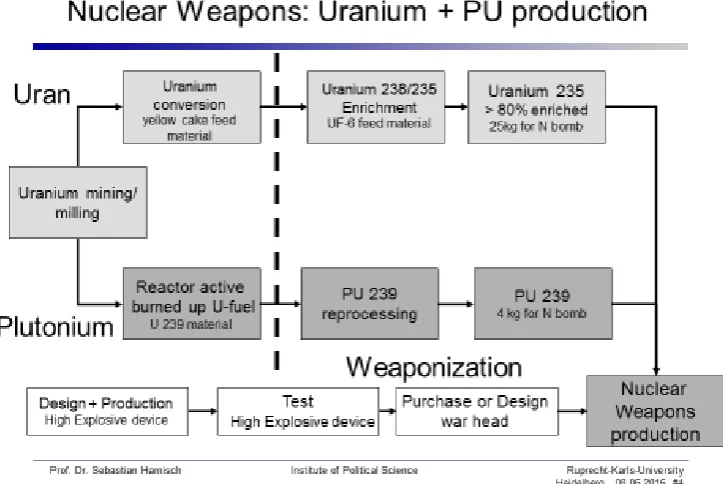
Source: S. Harnisch
Fig. 1. A process of Uranium and Plutonium production
The second way is to use another material – plutonium and to re-process that plutonium, to purify that plutonium. Much lesser amounts of nuclear material are needed to build a device and then it is important in terms of the capacity how heavy that warhead can be or maybe how stable the re-entry that we will call the antiballistic missile is. The plutonium was the road North Korea took first.
non-nuclear weapons states, how can they trust that other nations to not develop nuclear weapons capacity. Why does Poland trust Germany, because technically Germany is capable of building a nuclear weapon probably in six to twelve months. Why does Poland trust that Germany doesn’t do so? Well, the answer to that question is you can trust, but you have to verify. And there is an intricate system of verification so that Poland can trust Germany not to build them, build up those capacities. We have IAEA and European safeguard standards that tell Poland that Germany is not the one. And vice versa, because Poland could, or Turkey could, or Saudi Arabia could, or Japan could, or South Korea could build them if there was no verification that they didn’t do so.”
Now, the security situation is stable, but why should those non-nuclear weapon states trust nuclear weapon states not to detect them? The answer the treaty gives is one side promises non-proliferation - these are the nuclear weapon states - and the other side gets something for it. The treaty requires the nuclear weapon states to disarm, so they have to reduce the threat over time – article 6 of the NPT requires the nuclear weapon states to do so and most nations who are not even capable of building a nuclear industry get nuclear cooperation for peaceful use. There are wealth applications for nuclear technology, for example in medicine. If you want to do a scan of a body often, you use radiation from radiative sources. In order to stabilise this system, this system has an inbuilt interpretation mechanism. It’s called the IAEA safeguard system which tells nations what is legitimate behaviour and what is illegitimate behaviour. It has a sanction mechanism. If one nation thinks it can do things other nations consider illegitimate, they can call upon the UN Security Council to find a resolution to it through sanctions or other means. This is what regularly happens. is is what regularly happens.
Empirically, we make that the system somehow work to reduce the number of states that seek nuclear weapons.
At the same time, more and more nations have joined the treaty. There are up to 185 nations who are part of the non-proliferation treaty. And there are only a few states: Cuba, India, Pakistan and Israel, who never made that promise, and to legitimately haul nuclear weapons outside the non-proliferation treaty.
Many people misunderstand that. Why does Israel have nuclear weapons and Iran have no right to nuclear weapons? Israel never promised to never enter the non-proliferation treaty, but Iran did. Iran promised never to build nuclear weapons and the question is do they want to be out of the treaty and find that everyone would know that they want to go.
The only member missing from the treaty is North Korea. North Korea declared it’s withdrawal under article 10 from the treaty on January 10th 2003, but all other nations, including Poland, never accepted that withdrawal.
The case of Iran
Next, prof. Harnisch presented the case of Iran. To begin with, Iran has a lot of reasons to build nuclear weapons. First, Iran has an old culture, a 5000-year history has an expectation of itself as a regional hegemon. It wants to be a big pioneer in the region and tries to underpin this with nuclear weapons.
Secondly, Iran has a lot of territorial disputes, for example with the United Arab Emirates, therefore not everything seems to be fine when it comes to the immediate security of relations with its neighbours.
Lastly, Iran has no formal diplomatic relations with two of those nations – the US and Israel. For some time, the US called Iran part of the access of evil, so the intention of the United States to intervene, and to withdraw Iran from this access of evil, was pretty unreal. In the mid-2000s, from a rational perspective, it would have been quite understandable that Iran sought nuclear weapons. Iran was using nuclear power so it thought about nuclear weapons but never pursued this under the Shah of Persia until the Iranian revolution in 1979.
But then, at the height of the conflict with the US, the Iranian regime declared abstinence from civilian and military use of nuclear power for about 4 years. After those 4 years, something important happened for Iran, because in the 1980s Iraq invaded Iran and then, in 1982, 1983, and 1984, they started using chemical weapons against the Iranians. After losing tens of thousands of soldiers to chemical weapons, the Iranians reconsidered their decision not to seek nuclear weapons.
In 1985, Iran contacted a Pakistani nuclear bomb maker and tried to seek a warhead, the technology, some material and they really started the programme. It can be taken for granted that after the international community uncovered their secret weapons programme in 2002 and, in the aftermath of 9/11, they stopped and suspended the programme. There were two agreements in Paris and Sierra Leone when the Iranians froze the programme and did not use the sent refuges to enrich the uranium any more.
in order to have a military option. So, in a way, the two positions have a couple of months up to a year in between of nuclear activity and all that adds up to 10 to 12 months difference, all the negotiations from 2006-2007 until 2015 really deal with this.”
The solution is named using the acronym JCPOA, or Joint Comprehensive Plan of Action. From July 14th 2015, it has 6 parties on the Western side, the five standing members of the Security Council and Germany and Iran. These are formal parties of the agreement. A leading representative of the EU was part of the negotiation team. The goal is to ensure the peacefulness of the uranium programme in exchange for uplifting sanctions on Iran. And there are quite a few sanctions with a heavy burden on the Iranian economy.
What is important is that JCPOA is not a legally binding instrument. It is a politically binding instrument because the United States felt that the president will never have the capacity to ratify this in Congress.
The Iranian parliament accepted the agreement and the IAA certified in December that, with regard to the past Iranian behaviour, the IAA, as an institution, is not satisfied with the record of the Iranians.
“There was heavy opposition from Israel and Saudi Arabia” – said prof. Harnisch – “because Saudi Arabia said <<Well, if Iran gests out of the sanction business, they will become the regional rebel to us and we don’t want it>>. And Israel, for understandable reasons, is very sceptical with regard to future Iranian behaviour.”
timeline with regard to when the sanctions will be lifted. The last sanctions will be lifted between now and 15 years into the future. So, it is a very long term commitment.
The case of North Korea
Professor Harnisch continued his lecture describing the case of North Korea: “We right now expect North Korea to have between 6 and up to 16 nuclear warheads of the equivalent of nuclear material. So why did this happen? I think it’s pretty clear form the historical record that North Korea started its civilian nuclear programme after the United States threatened intervention with nuclear weapons in the Korean War and after the Cuba crisis, because the North Koreans thought the Soviet Union would not fulfil its commitment. So, with the help of the Soviet Union, they started with their first reactor. The next push came in the 70s. They started a programme which could be used for military purposes and that pushed the North Koreans into deeper weaponisation.”
By the end of 2003, it was almost certain that North Korea had the amount of weaponisable nuclear material for one or two bombs. In between, an agreement with JCPOA for North Korea was negotiated. It is called the great agreement that traded lifting up sanctions for weaponisation for nuclear strength on North Korea’s part. There was an international organisation called KPEDO that was created to organise this. Actually, in 2003, KPEDO failed and the result was that North Korea steadily built up its nuclear material out of the plutonium programme.
In the meantime, North Korea has had 4 tests and the estimate is that it lost about 1 or 2 warheads equivalent of nuclear material through those tests. But, in 2006, there was also an agreement that North Korea disgarded parts of its plutonium reactor so it never realised the upper – eco looms of these rim bars. They stopped between 8 and 10 nuclear warheads equivalent of material.
Syria, Libya and Iran. They created mostly domestic missile technology and even missiles, of all parts - technology, testing and so forth, but also missiles. Israel put out a nuclear facility in Syria on 6nSeptember 2007 which was built by North Korea and Syria who also engaged in nuclear co-operation.
“When it comes to the security situation of NATO, it is important to know where the ballistic missiles and the nuclear material come from, that potentially threaten your nation or your neighbour,” said prof. Harnisch. He added: “The argument is North Korea, Iran, Syria and Libya were part of that creation. Libya was taken out. Iran is taken out now. Syria is taken out also. There are only parts of the proliferation network which are still around” (fig. 2).
Source: S. Harnisch.
Fig. 2. Proliferation network
any contraband, for anything forbidden. It again black-lists more military entities and institutions in North Korea. It shows you that China, who is the “big brother” and the only whole military ally of North Korea, is getting impatient with its “little brother” when it comes to those military nuclear weapon tests.
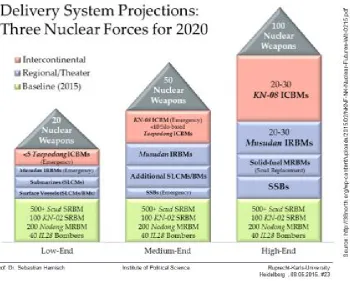
The question of what North Korea can do or what we expect that they can do with reference to the future remains. In that respect, prof. Harnisch presented possible scenarios (fig. 3). Key low-end estimates, with a base line of 2015 to 2020, are that North Korea, if they proceed all the way on their current road, are that they will have 20 nuclear weapons. That doesn’t mean that the 20 nuclear weapons are mounted on intercontinental ballistic missile firing 13,000 kilometres into the continental United States. “That’s very unlikely to happen, they don’t have this capacity. They don’t have attested intercontinental ballistic missiles. What they do have right now is the range of 300 kilometres. The next step is a range of 1,300 kilometres and it will cover Japan, all of South Korea, but will not reach USA forces” he notied.
Source: S. Harnisch.
The mid-scenario is 50 nuclear weapons, depending on how many of their reactors will go round next year. They will create 15 nuclear warheads and the high-end is 100 nuclear weapons. Why is it important? A nation that has 20 nuclear weapons has beyond a second-strike capacity. Militarily that’s the lower end and the nation would not trade warheads to Iran or any other nation willing to pay for them if it has that low a number. But the likelihood that they trade what they have increases the more they have, because then the commercial attractiveness of some of those weapons increases.
Professor Harnisch compared the differences between the true situation and defects for the regime: “North Korea today is a fine state of China. And it is dependent upon trading threats and benefits with China in order to secure itself. If it strays too far ahead of China, China may rule in and put the regime under pressure. And China has the capacity to do so. But the nuclear destabilising effect of North Korea’s behaviour is very limited to north-east Asia. Because the United States can extend deterrence, neither South Korea nor Japan have started to think seriously about nuclear weapons. And, obviously, China has an interest to prevent that from happening. Right? Because then it will face three nuclear weapons states, not only the United States.”
Professor Harnisch argues that, although North Korea became a nuclear weapon state, the system has accommodated North Korea, and Japan and South Korea are now very tipsy when it comes to the North-Korean threat. On the nuclear level, the system is relatively stable and balanced, but on the conventional level, South-Korean and Japanese actions start to have effects on the Chinese culture in the region, and also on the US posture in the region.