Effect Of Instructor-Provided Concept Maps
And Self-Directed Learning Ability On
Students’ Online Hypermedia
Learning Performance
Pao-Nan Chou, National University of Tainan, Taiwan
ABSTRACT
The purpose of this experimental study was to explore the instructional effectiveness of integrating varied instructor-provided concept maps into an online hypertext learning environment, and the effect of learners’ self-directed learning abilities on their learning performance. The research adopted a randomized posttest with two-control-group design. Two major instructional treatments were traditional and interactive concept maps embedded in the online hypertext material. One hundred twenty-six undergraduate students from a public university in the U.S. participated in the study. Student participants were segregated into two levels of self-directed learning groups. Three criterion tests, including identification, terminology, and comprehension tests, were used to measure students’ learning performance. Results indicated that (a) the interactive concept map was superior to the traditional concept map in facilitating students’ knowledge acquisition, (b) students’ self-directed learning abilities did not influence their learning performance, and (c) the concept mapping strategy did not increase students’ self-directed learning abilities.
Keywords: Self-Directed Learning; Web-Based Learning; Concept Mapping; Experimental Study; Online Hypermedia Learning
1. INTRODUCTION
n recent years, the number of higher education institutions in the United States offering distance education programs has been growing (Carr-Chellman, 2005). Although this learning phenomenon builds on the availability and convenience of Web-based advanced technologies, the core of online teaching and learning still relies on hypermedia (Chen & Dwyer, 2003). As Davis (2007) pointed out, online instructors often employ hypertext materials to develop their course reading materials. Therefore, from an instructional effectiveness perspective, the interface design in hypertext materials becomes an important issue in online learning environments (Chen & Dwyer, 2006).
Hypertext materials allow learners to navigate web pages for knowledge exploration (Jonassen, 1993). In the hypertext environment, however, Astleitner and Leutner (1995) suggested that online learners may face a cognitive overload problem when engaging in knowledge acquisition. For this reason, different kinds of instructional strategies should be used to support online students (Chen & Dwyer, 2003) “in more efficiently and effectively processing and internalizing course materials” (Sharma, Oliver, &Hannafin, 2007, p. 265).
Concept mapping is a widely used instructional strategy in classrooms (Plotnick, 1997). It can assist learners’ comprehension of large amounts of information in various learning situations (Dabbagh, 2001; Novak & Canas, 2006). Despite positive perspectives regarding the use of concept mapping produced in previous research (Eppler, 2006; Horton et al., 1993; Novak & Musonda, 1991; Simone, 2007), little is known about the effect of concept mapping on online hypermedia learners (Wang & Dwyer, 2003). Furthermore, some past studies questioned the value of the learner-created concept map as an instructional tool (e.g., Smith & Dwyer, 1995), or suggested a new technique
to supplement the traditional concept map (e.g., Novak & Canas, 2006). Therefore, whether or not an integration of a new type of concept mapping, such as the instructor-provided, multimedia concept map, into online hypertext settings may benefit students’ learning is worthy of exploration.
Since the concept of independent learning is emphasized in online learning environments (Carr-Chellman, 2005), learners’ self-directed learning abilities play an important role in online learning performance (Moore & Kearsley, 2005). Hanna, Dudka, and Runlee (2000) considered a learner’s self-directed learning ability a key factor to successful online learning. Guglielmino and Guglielmino (2003) contended that although students’ technical skills are important for e-learning, their self-directed learning abilities are even more vital in the successful e-learning environment. However, even though a possible link may exist between students’ self-directed learning abilities and online learning performance, past studies do not provide enough empirical evidence on this issue (Chou & Chen, 2008).
Based on the aforementioned information, the current study aimed to explore the instructional effectiveness of concept mapping and the effect of students’ self-directed learning abilities in an online hypertext environment. An experimental study with two control groups was created to fulfill the purpose of the study. Instead of requiring students to provide their own learner-created concept maps, the researchers designed and developed varied instructor-provided concept maps embedded in online hypertext material. Different levels of self-directed learners engaged in such this online hypermedia learning setting. Specifically, the study investigated three main questions:
1. Can the varied instructor-provided concept maps support students’ online hypermedia learning?
2. Do students with different levels of self-directed learning abilities perform differently in an online hypertext environment?
3. Does an instructional strategy (concept mapping) influence students’ self-directed learning abilities in an online hypertext environment?
2. LITERATURE REVIEW
2.1 Concept Mapping
Concept mapping stems from Ausubel’s assimilation theory of learning, which emphasizes the importance of prior knowledge in acquiring new concepts (Cited in Novak, 1990, 1991). A concept map is defined as “a representation of meaning or ideational frameworks specific to a domain of knowledge, for a given context of meaning” (Novak, 1990, p.29). Novak (1990) proposed that when creating a concept map, learners can systematically integrate prior knowledge in memory with new concepts by organizing verbal (word description) and nonverbal representations (graphics).
Novak’s (1990) original idea is based on the learner-created concept map. However, Novak (1991) contended that students must spend a long time learning creational skills and functions of concept mapping. Often, from a learning perspective, the quality of learner-created concept maps is questionable (Wang & Dwyer, 2003). For this reason, several studies questioned the effect of learner-created concept mapping on learning performance. For example, Smith and Dwyer (1995) investigated the difference between the instructor-provided and learner-created concept maps on students’ different levels of cognitive learning. The results showed that these two types of concept maps yielded the same effect.
In order to add to the knowledge base regarding the integration of concept mapping with online hypermedia to educational technology research, the current study designed two types of instructor-provided concept maps, which were embedded in online hypertext material. One instructor-provided concept map was developed by Flash multimedia technology (referred to as an interactive concept map). Another instructor-provided concept map was developed by Inspiration Software without any multimedia elements (referred to as a traditional concept map). The rationale of creating the instructor-provided concept maps in this study is that concept maps generated by the instructor’s professional experiences serve as a tutorial tool that assists learners to comprehend and internalize online hypertext materials.
2.2 Self-Directed Learning
The concept of self-directed learning originates in the field of adult education (Roberson, 2005). From adult education experts’ perspectives, self-directed learning contains three dimensions: motivation, meta-cognition, and self-regulation (Long, 2000). Self-directed learning is often regarded as an individual’s ability to engage in an independent learning activity (Guglielmino & Gugliemino, 1991). Learners with high levels of self-directed learning abilities are active learners who have strong desires for learning, make use of problem-solving skills, have the capacity to engage in independent learning activities, and autonomously manage their own learning (Brockett & Hiemstra, 1991; Candy, 1991; Gibbons, 2002; Knowles, 1975; Merriam & Caffarella, 1991).
In the literature, self-directed learning ability has correlated with students’ academic performance and has even served as a significant indicator for predicting academic success in traditional learning settings (Long, 1991) or non web-based distance learning (Hsu & Shiue, 2005). However, despite several theoretical discussions proposed by scholars, whether or not self-directed learning ability strongly relates to students’ online learning performances remains contentious. By employing a meta-analysis method to review six empirical studies, one past study identified three major issues regarding the relationship between students’ self-directed learning abilities and academic performance in online learning environments (Chou & Chen, 2008):
1. Lack of reliable measurement for learning outcomes: Past studies only explored the relationship between students’ self-directed learning abilities and learning performance. They neither reported the reliability of outcome measures nor conducted an item analysis for outcome measures.
2. Weak methodological design: When empirically inquiring into the relationship between students’ self-directed learning abilities and learning performance in online learning environments, past studies used only a survey methodology to explore the effect of self-directed learning rather than an experimental design. 3. Lack of other independent variables: Past studies only emphasized the role of self-directed learning and ignored other independent variables. Other factors, such as an instructional strategy, may cause an interactive effect with students’ self-directed learning abilities.
In order to solve these potential problems, the current study employed a reliable measurement, which will be described later in this article, to assess students’ online learning performance, adopted an experimental design, and integrated an instructional variable (the varied concept maps) with self-directed learning ability.
Although the characteristics of a high level of self-directed learner is described earlier, a definition assumption in this study is that a learner with a high level of self-directed learning ability may make great use of the designed instructional strategies to engage in online hypermedia learning. Their motivations in instructional treatments may be high.
3. RESEARCH METHODS
3.1 Research Design
instructional effectiveness of concept mapping integrated in an online hypermedia learning setting and the effect of self-directed learning ability. Table 1 depicts the research design of the study.
Table 1: Two by Four Factorial Posttest Design Treatment
Self-Directed Learning T1 T2 T3 T4
H (High) T1H T2H T3H T4H
L (Low) T1L T2L T3L T4L
In selecting a research design, an experimenter needs to minimize the threats to internal validity (Creswell, 2009). Since this study adopts a randomized experimental design and a one-shot recruitment procedure (i.e., recruiting participants at the computer labs one at a time), the findings yielded in this study can greatly decrease the effect of extraneous factors affecting internal validity that Campbell and Stanley (1963) addressed.
3.2 Research Instruments
In this study, Guglielmino’s (1977) Self-Directed Learning Readiness Scale (SDLRS) is utilized to measure students’ self-directed learning ability because the SDLRS is a widely accepted measure to assess self-directed learning ability (Merriam & Caffarella, 1991) when compared to two other available measures. The SDLRS uses a 58-item, 5-point Likert scale. Overall scores range from 58 to 290. A number of empirical studies have supported the reliability and validity of the SDLRS (Guglielmino, 1989). For instance, McCune and Guglielmino (1991) analyzed 3,125 SDLRS test scores and the analysis yielded a reliability coefficient of 0.91. A meta-analysis of 29 studies involving SDLRS also provided evidence of validity (Hsu & Shiue, 2005). This study also conducted a reliability analysis, indicating that the SDLRS measure’s reliability coefficient is 0.82.
Three posttest criterion tests were used to measure students’ learning performance after students completed the instructional treatments. Detailed descriptions of three tests are adapted and summarized as follow (Dwyer, 1978, pp. 45-47):
1. Identification test (measuring factual knowledge in a cognitive learning domain): This test evaluates students’ abilities to identify parts or positions of an object. This multiple-choice test (20 items) requires students to identify the numbered parts on a detailed drawing of a human heart. The objective of this test is to measure the ability of the student to use visual cues to discriminate one structure of the heart from another and to associate specific parts of the heart with their proper names.
2. Terminology test (measuring conceptual knowledge in a cognitive learning domain): This test consists of 20 multiple-choice items designed to measure knowledge of specific facts, terms, and definitions. The objectives measured by this type of test are appropriate to all content areas that have an understanding of basic elements as a prerequisite to the learning of rules and principles.
3. Comprehension test (measuring rule/principle knowledge in a cognitive learning domain): This test consists of 20 multiple-choice items. Given the location of certain parts of the heart at a particular moment of its functioning, the student is asked to determine the position of other specified parts of the heart at the same time. The comprehension test is designed to measure a type of understanding in which the individual can use the information being received to explain some other phenomenon.
The above three criterion tests were analyzed using the Kuder-Richardson 21 (K-R 21) reliability test in this study. The reliability coefficient is 0.84 for the identification test, 0.83 for the terminology test, and 0.78 for the comprehension test.
3.3 Instructional Material and Treatments
of study, thereby avoiding potential threats to internal validity in its experimental design. In each treatment group, the original instructional material is transformed into online hypertext material.
Participants in all treatment groups received the same instructional material, which was a 19-webpage hypertext learning module. Each treatment had its owns dedicated website. A distinct difference among treatment groups was the provision of instructional strategies. The details are:
1. Treatment 1 (Control group A: Text only): In this treatment group, students received only hypertext material. No instructional strategy was provided.
2. Treatment 2 (Control group B: Static image): In this treatment, 19 static heart images, which relate to each webpage’s reading contents, were inserted into the instructional material. The rationale for implementing this treatment was to compare the instructional effectiveness with Treatment 4 since two groups received a presentation of images.
3. Treatment 3 (Traditional concept map): In this treatment, 19 concept maps, which summarize each webpage’s main ideas, were inserted into the instructional material. A traditional concept map is a top-down diagram showing the relationships between concepts. An oval-shaped box with text represents a concept. A labeled arrow shows the relationship between two concepts.
4. Treatment 4 (Interactive concept map): In this treatment, 19 interactive concept maps, which combine static heart images with traditional concept maps, were inserted into the instructional material. The traditional concept maps in this group were the same as for Treatment 3. An interactive concept map was used when participants’ mouse pointers moved over one oval-shaped box (a concept); Flash animation showed a related static heart image (similar to those of Treatment 2) to represent the concept.
3.4 Research Participants
This study involved 126 undergraduate students (67 male; 59 female) at a public university in the U.S. who voluntarily registered to participate. From the aspect of curriculum major in the college, among the participants, 60 students were science majors; 66 students were non-science majors.
3.5 Research Procedure
When students agreed to participate in this study, they were directed to a recruitment website. They were required to read an electronic consent form and click an “agree” button before proceeding to answer the SDLRS and a background information questionnaire. Subsequently, students scheduled a time to complete the study in reserved computer labs.
One week prior to the study, participants were grouped using a median score (203.5) of the SDLRS to segregate student participants into high and low levels of self-directed learning groups. During implementation of the study in the computer labs, each member of a high-level and low-level of self-directed learning group was randomly assigned to one of four instructional treatments. In order to ensure participants’ immersion in each instructional treatment, students were required to spend at least 25 minutes reading online hypertext materials before receiving three criterion tests. Table 2 shows a distribution of participants in treatment groups, which demonstrates that the distribution of participants was almost equally balanced across treatment groups.
Table 2: Distribution of Participants in Treatment Groups
Treatment Group High Level Low Level Total
T1: Control 1 (Text-only) 15 17 32
T2: Control 2 (Static image) 16 15 31
T3: Traditional concept map 16 16 32
T4: Interactive concept map 16 15 31
3.6 Data Analysis
The collected data was analyzed by a statistical technique: Two-Way Multivariate Analysis of Variance (MANOVA), whose purpose is to test for treatment group differences when two or more independent variables are considered simultaneously. If a significant F value is realized, then the Tukey HDS method will be used to perform a multiple comparison test.
3.7 Quality of Concept Maps
In order to ensure the instructional benefit of concept maps developed in this study, a couple of professional instructional designers were hired to review the functionality and usability of concept maps in Treatment 3 and Treatment 4. Revisions to some concept maps were made before the implementation of the current study.
4. RESULTS
According to Tabachnick and Fidell (2007), Wilks’ Lambda value in MANOVA analysis can determine the effect of independent variables on dependent variables and the interaction effect between independent variables. Table 3 reports the overall results of MANOVA.
Table 3: Overall Results of MANOVA
Effect Wilk’s Lambda F p value
Self-directed learning ability 0.97 1.08 0.36
Treatment 0.75 3.96 0.00*
Self-directed learning ability & Treatment 0.87 1.82 0.07
*Significant at the 0.05 level
As shown in Table 3, a statistically significant difference appeared among treatment groups (Lambda = 0.75, F = 3.96, p < 0.05). However, no statistically significant difference exists between the two levels of self-directed learning groups (Lambda = 0.75, F = 3.96, p >0.05), and no significant interaction exists between instructional treatment and self-directed learning ability (Lambda = 0.87, F = 1.82, p > 0.05).
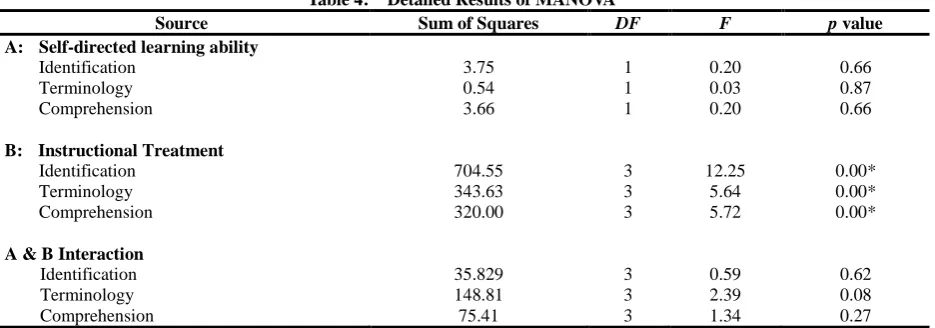
Due to the existence of significant differences for one independent variable, the detailed results of the MANOVA were analyzed and appear in Table 4.
Table 4: Detailed Results of MANOVA
Source Sum of Squares DF F p value
A: Self-directed learning ability
Identification 3.75 1 0.20 0.66
Terminology Comprehension
B: Instructional Treatment Identification
Terminology Comprehension
A & B Interaction Identification Terminology Comprehension 0.54 3.66 704.55 343.63 320.00 35.829 148.81 75.41 1 1 3 3 3 3 3 3 0.03 0.20 12.25 5.64 5.72 0.59 2.39 1.34 0.87 0.66 0.00* 0.00* 0.00* 0.62 0.08 0.27 *Significant at the 0.05 level
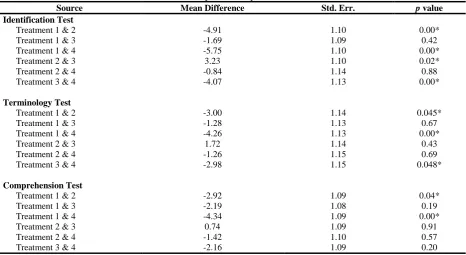
Table 5: Tukey HDS Analysis of MANOVA
Source Mean Difference Std. Err. p value
Identification Test
Treatment 1 & 2 -4.91 1.10 0.00*
Treatment 1 & 3 Treatment 1 & 4 Treatment 2 & 3 Treatment 2 & 4 Treatment 3 & 4
Terminology Test Treatment 1 & 2 Treatment 1 & 3 Treatment 1 & 4 Treatment 2 & 3 Treatment 2 & 4 Treatment 3 & 4
Comprehension Test Treatment 1 & 2 Treatment 1 & 3 Treatment 1 & 4 Treatment 2 & 3 Treatment 2 & 4 Treatment 3 & 4
-1.69 -5.75 3.23 -0.84 -4.07 -3.00 -1.28 -4.26 1.72 -1.26 -2.98 -2.92 -2.19 -4.34 0.74 -1.42 -2.16 1.09 1.10 1.10 1.14 1.13 1.14 1.13 1.13 1.14 1.15 1.15 1.09 1.08 1.09 1.09 1.10 1.09 0.42 0.00* 0.02* 0.88 0.00* 0.045* 0.67 0.00* 0.43 0.69 0.048* 0.04* 0.19 0.00* 0.91 0.57 0.20 * Significant at the 0.05 level
From Table 5, in the identification test, statistically significant differences exist between Treatment 1 and Treatment 2 (p < 0.05), between Treatment 1 and Treatment 4 (p < 0.05), between Treatment 2 and Treatment 3 (p < 0.05), and between Treatment 3 and Treatment 4 (p < 0.05). In the terminology test, statistically significant differences exist between Treatment 1 and Treatment 2 (p < 0.05), between Treatment 1 and Treatment 4 (p < 0.05), and between Treatment 3 and Treatment 4 (p < 0.05). In the comprehension test, statistically significant differences exist between Treatment 1 and Treatment 2 (p < 0.05), and between Treatment 1 and Treatment 4 (p < 0.05).
5. DISCUSSION
From the results of MANOVA, for different criterion tests, no significant difference exists between high and low levels of self-directed learners. In other words, regardless of types of criterion tests, for online hypermedia learning, students identified as high-level self-directed learners did not perform better than their counterparts (i.e., low-level self-directed learners). Learning performance for the groups’ two levels were the same in a hypertext learning environment. However, this result contradicts a theoretical statement saying that a reasonable link exists between self-directed learning and academic success (Long, 1991). Furthermore, this finding is not consistent with several quantitative studies (e.g., Hsu & Shiue, 2005) that emphasized the importance of self-directed learning ability in different learning settings. Therefore, although students’ online activities in this study were completed in computer labs, the results still can support the Chou and Chen (2008) study, in which the findings reported that the effect of self-directed learning on students’ academic success in web-based environments is questionable. Whether or not a replication of this study in a real online course will yield different results is worthy of further investigation.
learning abilities were influenced by an environmental factor (i.e., lab environment) as proposed by Candy (1991) is worthy of exploration.
For the two criterion tests (identification and terminology), significant differences were found between the use of interactive and traditional concept maps. In other words, students in Treatment 4 (interactive concept map) outperformed those in Treatment 3 (traditional concept map) for factual and conceptual knowledge. Two approaches from an information processing perspective can interpret this result. First, since the interactive concept map allows students to click targeted areas in the concept maps, this interaction function indeed increases information processing in students’ minds. The other interpretation point is that students in Treatment 4 received not only verbal (text), but also nonverbal (image) representations, which in turn strengthen cues to process for specific information in learners’ minds. However, in the comprehension test, no significant difference was found between Treatment 3 and Treatment 4. Whether or not the interactive concept map can easily enhance students’ higher order thinking (i.e., rule/principle knowledge) remains unknown.
Even though Treatment 2 (static image) is another control group in the study, students who received this instructional treatment performed well on each criterion test. From the MANOVA analysis, significant differences exist between Treatment 2 and Treatment 1 for all criterion tests. In other words, the static image also can significantly improve students’ learning performance regardless of the level of cognitive learning. Thus, the simple static image in this study, which served as an instructional tool, can allow students to better comprehend the contents in the hypermedia material. This result supports the findings of Rieber and Hannafin (1988) and Lin and Dwyer (2004), which showed that the basic static visual could effectively support student learning. In the identification test, a significant difference was found between Treatment 2 and Treatment 3. This result indicates that the static visual was superior to the traditional concept map when students engaged in factual knowledge acquisition, which is regarded as a lower-order thinking process (Dick, Carey, & Carey, 2005).
Regardless of the level of self-directed learning ability, compared to Treatment 1, students who received instructional presentations in Treatment 2 and Treatment 4 greatly enhanced their learning outcomes. For the three criterion tests, significant differences exist between Treatment 1 and Treatment 2 and between Treatment 1 and Treatment 4, while no significant differences were found between Treatment 2 and Treatment 4. In other words, from lower (factual knowledge) to higher (rule/principle knowledge) levels of cognitive processes, both static and interactive instructions (static image and interactive concept map) can with equal effectiveness support students’ online hypermedia learning. Since instructional design in Treatment 2 and Treatment 4 deal with visual representations, these findings indicate that students tended to favor visual instructions (Lin & Dwyer, 2004; Lin, 2006; Dwyer, 2007).
6. CONCLUSIONS
This study confirmed the instructional effectiveness of the varied instructor-provided concept maps in facilitating different types of knowledge acquisition in an online hypertext environment, and disclaimed the effect of learners’ self-directed learning abilities on hypermedia learning and the interaction effect between the instructional strategy (concept mapping) and students’ self-directed learning abilities.
The statistical analyses answered the first research question, which inquired about the instructional difference between two instructor-provided concept maps. The findings yielded by the study showed that two types of concept maps functioned in different ways. The interactive concept map enhanced students’ lower, medium and higher levels of cognitive learning. The interactive concept map was only superior to the traditional concept map in the lower and medium order thinking processes. However, the traditional concept map did not support students’ three levels of cognitive learning. Through a comparative analysis of overall instructional effectiveness, the interactive concept map might be better than the traditional concept map in the online hypertext environment.
other words, no direct link appeared between students’ self-directed learning abilities and learning outcomes. Students’ self-directed learning abilities did not influence their learning performance in the hypertext environment.
The last research question dealt with the interaction effect between students’ self-directed learning abilities and instructional strategies (the varied instructor-provided concept maps). The statistical analyses confirmed that students’ self-directed learning abilities remained constant under different instructional strategies. In other words, the instructional strategies did not influence students’ self-directed learning abilities. While engaging in online hypermedia learning, students’ self-directed learning abilities were not affected by concept mapping strategies.
The establishment of the second control group in this study produced an additional finding. The statistical analyses showed that the static image improved students’ knowledge acquisition in the three criterion tests. The static image and the interactive concept can equally enhance students’ three levels of cognitive learning. In other words, if not considering the benefits of the multimedia technologies, from a cost-effectiveness perspective, the static image is an alternative learning resource to assist students’ online hypermedia learning.
Three suggestions for follow-up studies are proposed. First, future research may apply the instructional activities designed in this study to real online courses, where students may process the course materials embedded with concept maps in a different way. Second, this study did not record student participants’ reading rates. Future research may analyze the effect of reading rates on students’ online hypermedia learning under varied instructional treatments. Last, future research may assess students’ self-directed learning abilities before and after the experimental study. A potential difference may be found between pre- and posttests.
AUTHOR INFORMATION
Pao-Nan Chou, National University of Tainan, Department of Education, Taiwan. E-mail: [email protected]
REFERENCES
1. Astleitner, H., & Leutner, D. (1995). Learning strategies for unstructured hypermedia: A framework for theory, research, and practice. Journal of Educational Computing Research, 13(4), 387-400.
2. Brockett, R. G., & Hiemstra, R. (1991). Self-direction in adult learning: Perspectives on theory, research, and practice. London, UK: Routledge.
3. Campbell, D. T., & Stanley, J. C. (1963). Experimental and quasi-experimental designs for research. Chicago, IL: Rand McNally.
4. Candy, P. C. (1991). Self-direction for lifelong learning: A comprehensive guide to theory and practice. San Francisco, CA: Jossey-Bass.
5. Carr-Chellman, A. A. (2005). (Ed). Global perspectives on e-learning: Rhetoric and reality. Thousand Oaks, CA: Sage.
6. Chen, W. -F., & Dwyer, F. (2003). Hypermedia research: Present and future. International Journal of Instructional Media, 30(2), 143-148.
7. Chen, W.-F., & Dwyer, F. (2006). Effect of varied elaborated hypertext strategies in facilitating students’ achievement of different learning objectives. International Journal of Instructional Media, 33(2), 165-175. 8. Chou, P. -N., & Chen, W. -F. (2008). Exploratory study of the relationship between self-directed learning and
academic performance in a web-based learning environment. Online Journal of Distance Learning Administration, 11(1), 15-26.
9. Creswell, J. W. (2009). Research design: Qualitative, quantitative, and mixed methods approaches (3rd ed.). Thousand Oaks, CA: Sage.
10. Dabbagh, N. (2001). Concept mapping as a mindtool for critical thinking. Journal of Computing in Teacher Education, 17(2), 16-24.
11. Davis, J. D. (2007). Developing text for web-based instruction. In M. G. Moore (Ed.), Handbook of distance education (2nd ed.; pp. 285-294). Mahwah, NJ: Lawrence Erlbaum Associates.
13. Dwyer, F. M. (1978). Strategies for improving visual learning. State College, PA: Learning Services. 14. Dwyer, F. M. (2007). The program of systematic evaluation (PSE): Evaluating the effects of multimedia
instruction 1965-2007. Educational Technology, 47(5), 41-45.
15. Eppler, M. J. (2006). A comparison between concept maps, mind maps, conceptual diagrams, and visual metaphors as complementary tools for knowledge construction and sharing. Information Visualization, 5, 202-210.
16. Gibbons, M. (2002). The self-directed learning handbook: Challenging adolescent students to excel. San Francisco, CA: Jossey-Bass.
17. Guglielmino, L. M. (1977). Development of the self-directed learning readiness scale. Unpublished doctoral dissertation, The University of Georgia, Atherns, GA.
18. Guglielmino, L. M. (1989). Reactions to field’s investigation into the SDLRS. Adult Education Quarterly, 39(4), 235-245.
19. Guglielmino, L. M., & Guglielmino, P. J. (1991). Expanding your readiness for self-directed learning. Don Mills, Ontario: Organization Design and Development.
20. Guglielmino, L. M., & Guglielmino, P. J. (2003). Are your learners ready for e-learning? In G. M. Piskurich (Ed.), The AMA handbook of e-learning: Effective design, implementation, and technology solutions (pp. 87-95). New York, NY: AMACOM.
21. Hanna, D. E., Dudka, M. G., & Runlee, S. C. (2000). 147 practical tips for teaching online groups: Essentials of web-based education. Madison, WI: Atwood.
22. Horton, P. B., McConney, A. A., Gallo, M., Woods, A. L., Senn, G. J., & Hamelin, D. (1993). An
investigation of the effectiveness of concept mapping as an instructional tool. Science Education, 77, 95–111. 23. Hsu, Y. C., & Shiue, Y. M. (2005). The effect of self-directed learning readiness on achievement comparing face-to-face and two-way distance learning instruction. International Journal of Instructional Media, 32(2), 143-155.
24. Jonassen, D. H. (1993). Effects of semantically structured hypertext knowledge bases on users’ knowledge structures. In C. McKnight, A. Dillon, & J. Richardson (Eds.), Hypertext: A psychological perspective (pp. 153-168). Chichester, England: Horwood.
25. Knowles, M. S. (1975). Self-directed learning: A guide for learners and teachers. Chicago, IL: Association Press.
26. Lin, C., & Dwyer, F. (2004). Effect of varied animated enhancement strategies in facilitating achievement of different educational objectives. International Journal of Instructional Media, 31(2), 185-198.
27. Lin, H. (2006). The effect of questions and feedback used to complement static and animated visualization on tests measuring different educational objectives. Unpublished doctoral dissertation, The Pennsylvania State University, University Park, PA.
28. Long, H. B. (1991). College students’ self-directed learning readiness and educational achievement. In H. B. Long & Associates (Eds.), Self-directed learning: Consensus and conflict (pp. 107-122). Oklahoma City, OK: Oklahoma Research Center for Continuing Professional and Higher Education of The University of Oklahoma.
29. Long, H. B. (2000). Understanding self-direction in learning. In H. B. Long & Associates (Eds.), Practice & theory in self-directed learning (pp.11-24). Schaumburg, IL: Motorola University Press.
30. Long, H. B. (2003). Preparing e-learners for self-directed learning. In G. M. Piskurich (Ed.), Preparing learners for e-learning (pp. 2-18). San Francisco, CA: Jossey-Bass.
31. McCune, S. L., & Guglielmino, L. M. (1991). The validity generalization of Guglielmino’s self-directed learning readiness scale. In H. B. Long & Associates (Eds.), Self-directed learning: Consensus and conflict (pp. 147-155). Oklahoma City, OK: Oklahoma Research Center for Continuing Professional and Higher Education of The University of Oklahoma.
32. Merriam, S. B., & Caffarella, R. S. (1991). Learning in adulthood: A comprehensive guide. San Francisco, CA: Jossey-Bass, Pfeiffer.
33. Moore, M., & Kearsley, G. (2005). Distance education: A systems view (2nd ed.). Belmont, CA: Thomson Wadsworth.
34. Novak, J. D. (1990). Concept maps and vee diagrams: Two metacognitive tools for science and mathematics education. Instructional Science, 19, 29–52.
36. Novak, J. D. (1991). Clarify with concept maps: A tool for students and teacher alike. Science Teacher, 46, 45-49.
37. Novak, J. D., & Canas, A. J. (2006). The origins of the concept mapping tool and the continuing evolution of the tool. Information Visualization, 5, 175-184.
38. Plotnick, E. (1997). Concept mapping: A graphical system for understanding the relationship between concepts. (ERIC Document No. ED407938).
39. Rieber, L. P., & Hannafin, M. J. (1988). The effects of textual and animated orienting activities and practice on learning from computer-based instruction. Computers in the Schools, 5, 77-89.
40. Roberson, D. N. (2005). Self-directed learning--Past and present. (ERIC Document No. ED490435). 41. Simone, C. D. (2007). Applications of concept mapping. College Teaching, 55(1), 33-36.
42. Smith, K. M., & Dwyer, F. M (1995).The effect of concept mapping strategies in facilitating student achievement. International Journal of Instructional Media, 22, 25–31.
43. Sharma, P., Oliver, K. M., & Hannafin, M. J. (2007). Teaching and learning in directed environments. In M. G. Moore (Ed.), Handbook of distance education (2nd ed., pp. 259-270). Mahwah, NJ: Lawrence Erlbaum Associates.
44. Tabachnick, B. G., & Fidell, L. S. (2007). Using multivariate statistics (5th ed.).Boston, MA: Allyn & Bacon. 45. Wang, C. X., & Dwyer, F. (2003). Effects of three concept mapping strategies and prior knowledge in a