© 2016 IJSRST | Volume 2 | Issue 2 | Print ISSN: 2395-6011 | Online ISSN: 2395-602X Themed Section: Science and Technology
Comparative Standardization Study of Two Marketed
Hingvashtak Churna Formulation
Shital. S. Shinde, Ashwini. G. Sonavane, T. D. Dudhgaonkar, A. R. Dhole, C. S. Magdum
Rajarambapu College of Pharmacy, Kasegaon, Walwa, Sangali, Maharashtra, India
ABSTRACT
In the few decades, there has been exponentionally growth in the field of herbal medicines. Most of the traditional systems of medicine are effective but they lack standardization. So there is a need to develop a standardization technique. Standardization of herbal formulation is essential in order to assess the quality, purity, safety and efficacy of the drug. The Hingvashtak churn is excellent remedy for indigestion, stomach pain, loose motions along with indigestion, loss of appetite and also used as carminative. The present research study deals with the comparative standardization of two marketed Hingvashtak Churna formulation from Baidyanath and Zandu. The standardization of this formulation, the organoleptic characters, physical properties, the various physico-chemical properties such as, ash values, extractive values were carried out.
Keywords: Standardization, Hingvashtak churn, Physico-chemical parameters.
I.
INTRODUCTION
Nature always stands as a golden mark to exemplify the outstanding phenomena of symbiosis. Today about 80% of people in developing countries still relay on traditional medicine based largely on the different species of plants for their primary health care. About 500% of plants with medicinal uses are mentioned in ancient literature and 800 plants have been used in indigenous system of medicine. The various indigenous systems such as ayurveda, siddha, unani use several plant species to treat different ailments. Herbal medicines make up an important component of the trend toward alternative medicine1-2.Tyler defines herbal medicines as "crude drugs of vegetable origin utilized for the treatment of disease states, often of a chronic nature, or to attain or maintain a condition of improved health. Current demands for herbal medicines have resulted in an annual market of $1.5 billion and increasingly widespread availability. Churna is one such ayurvedic formulation that is defined as a fine powder of drug or drugs in ayurvedic system of medicine. The churna is free flowing and retains its potency for one year, if preserved in an air tight container. They are similar to powder formulations in Allopathic system of
medicine. Due to lack of modern pharmacopoeial standards laid down and followed for processing of hingvashtak churna using traditional methods, the medicine may not have the desired quality and batch to batch consistency. Thus WHO has emphasized the need to ensure quality control of medicinal plant products by using modern techniques and by applying suitable standards and parameters3.
Advantages of Herbal Medicine
1) They have large amount of use.
2) They have better patient tolerance as well as acceptance.
3) The medicinal plants have renewable source of cheaper medicines.
4) Improvements in the quality, efficacy and safety of herbal medicines with the development of science and technology.
5) Prolong and apparently uneventful use of herbal medicines may offer testimony of their safety and efficacy.
6) They are cheap in cost. 7) They are not harmful.
Throughout the world herbal medicines have provided many of the most potent medicines to the vast arsenal of drugs available to modern medical science, both in crude form as well as a pure chemical upon which modern medicines are constructed.4
Need of Standardization
The quality control of herbal crude drug & formulation is important in justifying their acceptability in modern system of medicines. Standardization of synthetic drugs offers no problem with very well defined parameters of analysis. It is not uncommon to have as many as five or more different herbal ingredients in one single formulation. The batch to batch variation starts from the collections of the raw materials itself in absence of any reference standard for identification. WHO has emphasized the need to ensure quality control of medicinal plants products by using modern techniques and by applying suitable standards and parameters .Standardized products and services are valuable User 'confidence builders' being perceived as
1) Safe 2) Healthy 3) Secure 4) High quality 5) Flexible
Standardization brings important benefits to business including a solid foundation upon which to develop new technologies and an opportunity to share and enhance existing practices. Standardization also plays a pivotal role in assisting Governments, Administrations, Regulators and the legal profession as legislation, regulation and policy initiatives are all supported by standardization.
SAMPLE
Asafoetida –Ferula assfoetida Scientific classification-
Kingdom - plantae (unranked) - angiosperms (unranked) - eudicots (unranked) - asterids Order - apiales Family - apiaceae Genus - ferula
Species - F.assafoetida
Bionomial name -Ferula assafoetida L.
Synonyms
Ferula assafoetida L. Ferula foetida st.-Lag.
Ferula hoosee Lindl.ex Descourt Narthex assafoetida (L.) Falc
Asafoetida is the dried latex (gum oleoresin) exuded from the rhizome or tap root of several species of Ferula, a perennial herb that grows 1 to 1.5 m (3.3 to 4.9 ft) tall. The species is native to the deserts of Iran and mountains of Afghanistan and is mainly cultivated in nearby India. As its name suggests, asafoetida has a fetid smell (see etymology below), but in cooked dishes, it delivers a smooth flavor reminiscent of leeks. It is also known as asant, food of the gods, jowani badian, stinking gum, Devil's dung, hing, hengu, ingu, kayam, and ting.
Chemical constituent-Typical asafoetida contains about 40–64% resin, 25% endogenous gum, 10–17% volatile oil, and 1.5–10% ash. The resin portion is known to contain asaresinotannols 'A' and 'B', ferulic acid, umbelliferone and four unidentified compounds.
Scientific work done - Evaluation of Standardization parameters of Hingvashtak Churna.
PLAN OF WORK5
Comparative standardization of Hingvashtak Churna formulated by Zandu & Baidyanath pharma .The method used for the comparative standardization was planned to be carried out as follows:
1 Study of organoleptic characters
Development of Standardization Parameters for Hingvashtak Churna
1.Colour 2. Odour 3.Taste
2 Determination of physico-chemical parameters
1) Total ash
2) Acid insoluble ash 3) Water soluble ash 4) Water soluble extractive 5) Alcohol soluble extractive
3 Qualitative Estimation of Selected Phyto- Constituents
4 Evaluation of Churna
A) Powder fineness 1) Bulk density 2) Tap density
3) Angle of repose 4) Compressibility 5) Hausner’s ratio
5)Determination of pH
II.
METHODS AND MATERIAL
Developments of standardization parameters for Hingvashtak Churna
1) Study of Organoleptic Characters:
The polyherbal formulation is studied for organoleptic characters like colour, odour and taste using the sensory organs of our body.
2) Physico-Chemical Analysis: Determination of loss and drying
5 g of the sample (without preliminary drying) was weighed and placed in a tarred evaporating dish. It was dried at 105˚ C until the constsnt reading was obtained, and at 10 minutes interval.
Determination of Total ash:
About 2 to 3 g of sample was accurately weighed in a tarred silica dish at a temperature not exceeding 450˚C until it was free from carbon. Then it was cooled and
weighed. The percentage of total ash was calculated with reference to the air dried drug.
Determination of Acid insoluble ash:
The total ash obtained was boiled for 5 minutes with 25 ml of dilute hydrochloric acid; the insoluble matter obtained was collected on an ash less filter paper, washed with hot water and ignited to constant weight. The percentage of acid insoluble ash was calculated with reference to the air dried drug.
Water-soluble Ash:
The ash obtained in the determination of total ash was boiled for 5 minutes with 25 ml of water. The insoluble matter was collected on an ash less paper and washed with hot water. The insoluble ash was transferred into a tarred silica crucible and ignited for 15 minutes at a temperature not exceeding 450 C. The weight of the insoluble matter was subtracted from the weight of the total ash. The difference in weight was considered as the water- soluble ash was calculated with reference to the air dried drug.
Determination of Water-soluble extractive:
5 g of test sample was weighed and macerated with 100 ml of chloroform water in a closed flask for twenty-four hours, shaking frequently during six hours and allowing standing for eighteen hours. it was filtered rapidly, taking precautions against the loss of solvent.25 ml of the filtrate was taken and evaporated to dryness in a tarred flat bottomed shallow dish, to constant weight and weighed the percentage of water soluble extractive was calculated with reference to the air dried sample.
Determination of Alcohol-soluble extractive:
Procedure for water soluble extractive was followed for the determination of alcohol soluble extractive but 90% ethanol was used instead of chloroform water.
3)Qualitative Phytochemical Screening:
Resins: To 2ml of chloroform or ethanol extract 5 to 10ml of acetic anhydrite was added and dissolved by gentle heating. After cooling, 0.5ml of H2SO4 was added.
Bright purple colour was produced. It indicated the presence of resins.
4) Determination of physical characteristics: Bulk density
Bulk density=w/v0 g/ml
Where,
W = mass of the powder V0 = untapped volume
Tapped density
It is measured by transferring a known quantity (15g) of powder into a graduated cylinder and tapping it for a specific number of times. The initial volume was noted. The graduated cylinder was Tapped continuously for a period of 10-15 min. The density can be determined as the ratio of mass of the powder to the tapped volume.
Tapped volume= w/vf g/ml
Where,
W = mass of the powder
Vf = tapped volume. a) Compressibility index
It is the propensity of the powder to be compressed. Based on the apparent bulk density and tapped density the percentage compressibility of the powder can be determined using the following formula.
Compressibility index = [(v0-vf)/v0] x 100,
Or
% compressibility= [(tapped density – bulk density)]/ tapped density] x 100
b) Hausner’s ratio
It indicates the flow properties of the powder. The ratio of tap density to the bulk density of the powder is called Hausner ratio.
Hausner ‘s ratio= Tapped density/bulk density
c) Angle of repose
The internal angle between the surface of the pile of powder and the horizontal surface is known as the angle of repose. The powder is passed through funnel fixed to stand at height of 4 cm. The height and the radius of the pile were measured. Angle of repose of the powder was calculated using the formula
Angle of repose= tan-1(h/r)
Where,
H=height of the pile
r=radius of the pile.
SCALE OF FLOW ABILITY
Table no: 1
5 Determination of pH range:
7The powder sample of Hingvashtak Churna was weighed to about 5g and immersed in 100 ml of water in a beaker. The beaker was closed with aluminum foil and left behind for 24 hour s in room temperature. Later the supernatant solution was decanted into another beaker and the pH of the formulation was determined using a calibrated pH meter.
III.
RESULT AND DISCUSSION
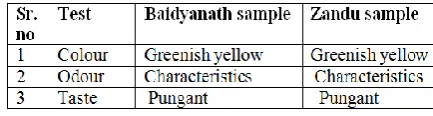
1) Determination of organoleptic Characters:
For the determination of organoleptic characters the colour test, odour test and taste were carried out and results as follows. As shown in table no:1
Table no : 2
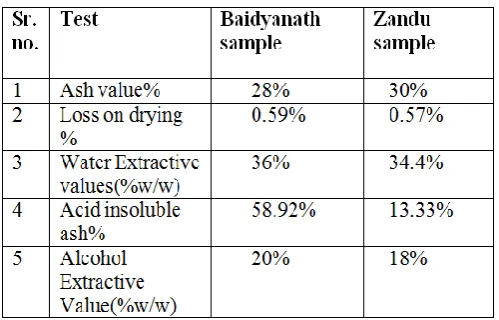
2) Physicochemical Characters:
For the determination of physicochemical characters the ash value, loss on drying, water extractive values, acid insoluble ash, and alcohol extractive values were carried out and results as follows. As shown in Table no: 3
3) Qualitative analysis:
For the determination of qualitative analysis the test for resins, alkaloids, glycosides, tannins, and saponins were carried out and results as follows. As shown in Table no : 4
Table no:4
The results of phytochemical tests were given in the above table. “++” this indicates the presence of more amounts of compounds.
4 ) Physical Characteristics of Powder 8
For the determination of physical characteristics the bulk density tap, tap density, car’s index, hausner’s ratio and angle of repose were carried out and results as follows. As shown in Table no:5
Table no:5
Sr. no.
Test Baidyanath
sample
Zandu sample 1 Bulk density 0.384 0.375
2 Tap density 0.60 0.555
3 Car’s index 35.89 32.5
4 Hausner’s ratio 1.56 1.48
5 Angle of repose
52.35 43.58
5) Determination of pH of sample
pH of both samples is carried out to determination of pH and results as follows. As shown in Table no:6
Table no: 6
Sr. no.
Test Baidyanath
sample
Zandu sample
1 pH 5-6 5-5.6
IV.
CONCLUSION
From the present investigation various standardization parameters such as physicochemical standards like total ash, acid insoluble ash, water and alcohol soluble extractive values, loss on drying, phyto-chemical analysis, flow properties, it can be concluded that the formulation of Hingvashtak churna contain all good characters of an ideal churn and it was found to be harmless ,more effective and economic. The comparison between the two marketed samples has been done on the basis of the above mention parameters which show satisfactory results. The two marketed samples have been evaluated as above mentioned parameters which show satisfactory results, but the efficacy of the products can only be judged by doing the pharmacology of which is suggested as future scope of R & D. The study shows that the contents of formulation presents within the permissible limits as per WHO.
V.
ACKNOWLEDGEMENT
Authors are very much grateful to Principal Dr. C.S Magdum, Vice-principal Dr.S.K. Mohite and Smt. Archana R.Dhole Madam and entire Rajarambapu College of Pharmacy, for providing necessary facilities for completion of the research work.
VI.
REFERENCES
[1] Pharmacopeial Standardization of Mahasudarshan Churna: A Polyherbal Formulation Naresh Chamoli, Kshitij Agarwal* and Prem Saini Dev Bhoomi Institute of Pharmacy and Research, Dehradun, U.K, India-248001. International Journal of Innovative Pharmaceutical Research. 2013,4(1),281-283. [2] Mukharjee Pulok K. Quality control of herbal
[3] Ekka NR, Nmedo KP, Samal PK. Standardization strategies for herbal drugs. Research J.Pharm. and Tech. 2008;1:310-312. Indian Pharmacopeia Part-II Vol. II published by Indian Pharmacopeial Commission, Ghaziabad, 1996;A-50-52.
[4] Pharmacopeial Standardization of Mahasudarshan Churna: A Polyherbal Formulation. Shivani Chauhan*1, Vikrant Pundir2, Ashish Kr Sharma2 Journal of Medicinal Plants Studies Year: 2013, Volume: 1, Issue: 2.
[5] Review On Standardization of Herbal Churna: Nitin V. Kokare, Kiran A.Wadkar, Manish S.Khonawar.Int.J.Res.Ayurveda Pharma 5(3),May –June2014.
[6] Comparative Standardization Study of Two Marketed Ashwagandha Churna Formulation Pallab Dasgupta and Amartya De*International Journal of Research in Pharmaceutical and Biomedical Sciences Vol. 3 (2) Apr – Jun2012. [7] A. Siddiqui, M. A. Hakim, Format for the
pharmacopoeial analytical standards of compound formulation, wokshop on standardization of unani drugs Welfare, New Delhi, 1976. 8.