SECTION 3: CASE STUDIES
Improving Care Through Collaboration
Charles M. Kilo, MD, MPH
ABSTRACT. The opportunity to improve health care using existing scientific knowledge is immense. Much is known that is not being used in routine care, leading to a large gap between knowledge and practice. Collabora-tive improvement models bring health care professionals together to focus on this gap and to accelerate the pace of improvement in their organizations. This article de-scribes one such model, the Institute for Healthcare Im-provement’s Breakthrough Series Collaborative model. Lessons are drawn to help inform future collaborative efforts that focus on the improvement of care. Pediatrics 1999;103:384 –393; collaboration, quality of care, improve-ment, cooperation, outcomes.
ABBREVIATIONS. MI, myocardial infarction; IHI, Institute for Healthcare Improvement; BTS, Breakthrough Series; ICU, inten-sive care unit; LGH, Lawrence General Hospital; CHW, Children’s Hospital of Wisconsin; PICU, pediatric intensive care unit; NNE, Northern New England Cardiovascular Disease Study Group.
“The problem before us is to exchange information. . . that there shall develop a final, cosmopolitan system of medicine which will combine the best elements to be found in all countries.” —Charles H. Mayo, MD,
1930, Mayo Clinic
“Our future as clinicians will depend on our ability to work together and to lead the continuous improvement of health care.” —William
Nugent, MD, 1996, Chief of Cardiothoracic Surgery, Dartmouth-Hitchcock Medical Center
C
ollaboration—it literally means laboringto-gether. The word raises visions of intention— people working together toward some worthy goal. There is a sense of purpose, of collegiality, of sweat, and of joint learning. The word feels like hard yet rewarding work. For most in health care, it feels familiar.
A MEDLINE search on collaboration gives refer-ences on: 1) research collaboratives such as the AIDS Clinical Trial Groups, 2) interpersonal collaboration discussing the need for professionals to work to-gether, and 3) improvement collaboratives where cross-functional teams from different departments or organizations join together to improve the care they provide. In this article, I will discuss the latter— using collaboration to improve health care quality, satisfaction, and finances.
This article is about collaborative improvement
methods that accelerate the rate of diffusion of exist-ing science into clinical practice. It is about improv-ing care based on what is already known usimprov-ing multi-institutional or multi-site work groups. The opportunity to do so is immense.
Given the nature of clinical medicine, one would anticipate that collaboration is a central operating principle in our profession. Instead, health care is a study of contrasts regarding collaboration.
On one hand, health care is steeped in collabora-tive experiences. As individuals, we often work closely together—physician and nurse, nurse and pharmacist, one physician and another consulting physician. Indeed, the very nature of caring implies a collaborative relationship between health profession-als, patients, and their families. The full gamut of patient care is rarely achieved by a single individual acting alone.
On the other hand, our difficulty with collabora-tive relationships is exemplified daily in Harvard’s Center for Medical Simulation and other such simu-lated environments.1The Center is a mock operating
room where anesthesiologists, surgeons, and nurses come together to simulate patient care. Established scenarios are played out using a computerized pa-tient and crises evolve that require intensive team interactions to resolve. Sessions are videotaped and subsequently reviewed by the caregivers. Failure is common—the “patient” frequently expires.
When analyzing tapes of these sessions, it is clear that cooperation and collaborative behaviors are of-ten lacking. Information is not shared; help is not requested (often pride prevents us from asking for help); communication skills are poor; anger is not uncommon. These experiences demonstrate the need for improved knowledge and use of cooperative and collaborative behaviors in health care. The Center also simulates critical care units, emergency depart-ments, and other situations with similar results.
Beyond the level of individual interactions, the necessary knowledge and opportunities for groups or organizations to work effectively together is also rare. To an extent, this construct is embedded in health care’s culture. Physicians are generally trained to be fully independent in thought and action—they often do not view themselves as being dependent on others in the provision of care. Physician culture leads toward independent action, not toward group improvement activities where intensive sharing of information is the norm. They think and act in sin-gular—my patient, my office, my actions. This insu-From the Institute for Healthcare Improvement, Boston, Massachusetts.
Received for publication Sep 9, 1998; accepted Sep 9, 1998.
Address correspondence to Charles M. Kilo, MD, MPH, Institute for Health-care Improvement, 135 Francis St, Boston, MA 02215.
lar nature of clinical medicine is compounded by the lack of detailed information on current clinical prac-tices that challenges existing attempts to improve the provision of clinical care.2
Health care lacks a robust understanding of col-laborative improvement. The content of our interac-tions speaks loudly on this issue. Although we speak about technical aspects of patient care, rarely do we discuss details of the provision of care. For example, it would be common to hear a conversation between physicians on optimal care of patients after a myo-cardial infarction (MI). One of the elements of that conversation would undoubtedly focus on the use of aspirin for secondary prevention. In contrast, it would be distinctly unusual to hear clinicians discuss methods of assuring that all eligible patients receive aspirin post-MI. This is not so much a conversation about decision-making and prescribing care as it is a conversation about creating systems that automati-cally provide the highest quality care. The concept of systems is a crucial one. It moves away from a focus on the individual and toward the essentials of how care is provided.
The lack of collaborative opportunity is exacer-bated in the current environment of heated compe-tition and productivity pressures; little time and few opportunities are available for providers to meet each other on common clinical grounds.
However, I believe that this is neither a normal or natural state— human beings, in general, and health care workers, in specific, will collaborate toward the improvement of care if given the proper environ-ment and opportunity.3As health care has begun to
focus on quality, the desire for, and advantages of, collaborative behavior are becoming clear as demon-strated by several recent collaborative efforts to im-prove care.2,4,5
Other industries, even those more competitive than health care, take advantage of collaborative op-portunities. Consider semiconductor manufacturing, for instance, where competition and the pace of in-novation is extraordinary, and where brief lapses in technological edge can lead to corporate demise. Nonetheless, 10 of the largest US semiconductor manufacturers including Intel, Motorola, Texas In-struments, Digital, Advanced Micro Devices, and others have joined forces to perform applied research together in a company called Semanteck (Austin, TX). They understand the win-win dynamic estab-lished by an atmosphere of collaboration.
As discussed below, powerful motivators for col-laboration (see Table 1) in clinical care do exist. It was in this light that the Institute for Healthcare Improve-ment (IHI) developed a series of collaborative projects in 1995 called the Breakthrough Series (BTS). The vision of IHI is to be an integrative force in
health care—to bring people and organizations to-gether to work towards its continual improvement. It is in this spirit of cooperation and collaboration that the BTS was born.
In this article, the motivating factors behind nu-merous collaborative improvement efforts will be examined. IHI’s BTS will be used as a model for collaborative improvement and examples from sev-eral participating organizations will be provided. Lastly, general lessons pertaining to collaborative improvement initiatives will be discussed. In the end, this article aims to provide a deeper under-standing and stimulate a broader use of collaborative improvement methods.
MOTIVATIONS FOR COLLABORATIVE IMPROVEMENT MODELS
When existing collaborative improvement efforts are examined, the driving forces behind them are remarkably similar. These forces will be explored in this section.
First, a substantial gap exists between current knowledge and the actual provision of care. In other words, there is a great deal of knowledge that is simply not being used. For example, much is known about caring for asthmatic patients including when and how to use inhaled steroids, yet this knowledge often goes unused in the routine care of those who could benefit from it.6,7Likewise, despite numerous
clinical trials demonstrating the beneficial effects of antenatal steroid treatment in premature infants, the use of this treatment remains suboptimal.8 A 1996
analysis showed that 25% of 196 neonatal intensive care units treated,56% of infants weighing between 501 to 1500 g.9 The diffusion of proven findings is
unacceptably slow in health care. Collaboration helps to expose these gaps and accelerate the diffu-sion of existing knowledge into practice.
Second, broad variation exists in the provision of care for comparable patient populations. This varia-tion includes the use of diagnostic tests, surgical procedures, and pharmaceutical agents that cannot be explained by differences in population demo-graphics or risks.10Like the gap between knowledge
and practice, collaboration exposes variation and re-duces it as practices gravitate toward higher perfor-mance standards.
Third, examples of improved practices exist but are often poorly described and disseminated to other organizations. Despite abundant literature describ-ing practices that should or should not be done, little is written about how to do or not to do these things. Knowing that one should do something is not equiv-alent to knowing how to do it. Although this seems obvious, it is more evasive in reality. Most clinicians know that aspirin should be given to patients after a MI, yet its use remains unacceptably low.11,12
There-fore, the challenge lies in understanding and dissem-inating the knowledge of ‘‘how to”—application or
improvement knowledge that helps assure that patients
receive the best possible care.
There is a science of improvement rooted in statis-tics and theories of adult learning that is generally unknown in health care.13–17 This science uses the
TABLE 1. Motivators for Collaborative Improvement
1. A substantial gap exists between knowledge and practice 2. Broad variation in practice is pervasive
3. Examples of improved practices and outcomes exist 4. Existing professional boundaries inhibit improvement 5. Outcomes are the results of systems of care, not just
scientific method, systems theory, real-time perfor-mance measurement, psychology, and methods for the diffusion of innovations to improve care.18 –21
Collaboration fosters an environment where im-provement knowledge can be learned and used.
Fourth, health care professionals, physicians in particular, have not been trained to, and often do not, work well across professional boundaries.22
Physi-cians often have a poor understanding of other pro-fessions and often undervalue the intellectual contri-bution of nurses, physical therapists, and others. Health care leaders have relegated pharmacists to behind-the-counter drug dispensation instead of us-ing them for their clinical pharmaceutical expertise. Collaboration provides opportunities for profession-als with diverse yet synergistic skills to work to-gether to solve difficult clinical problems. Collabora-tion enables the synergism.
Fifth, although physician culture is defined by fierce independence, no health care provider is solely responsible for patient outcomes. A single physician cannot manage patients in a neonatal intensive care unit without the help of nurses, laboratory techni-cians, respiratory therapists, consulting physitechni-cians, pharmacists, and others. We are all parts of complex systems and it is these systems of care that produce health outcomes, not just individuals. To optimize outcomes, we must, therefore, focus on systems. Col-laborative projects remove us from our silos and provide a much clearer picture of the overall system. They change our focal plane.
Collaboration is an understanding that improve-ments in patient care are achieved more effectively by working together and focusing on systems than they would be by working independently and focus-ing on individuals. The vision is of doctors, nurses, pharmacists, and managers working together across departmental or institutional boundaries to improve their systems of care: nursing units meeting to share information; institutions working jointly toward common improvement aims; and, crossing industry boundaries to learn from each other. The benefits of collaboration are clear. When we work together:
z Our total knowledge and understanding is
greater than when we work separately.
z We increase the probability of successfully dis-covering solutions to problems.
z Solutions focus on systems of care and not on individuals.
z Solutions are more integrative.
z Participation in problem-solving processes in-creases acceptance of the solutions.17
zMeaningful relationships are built and are the key to future improvement.22
Most clinicians are aware of the value of immuni-zations, of the lack of utility in treating most upper respiratory tract infections with antibiotics, and of the lack of utility of using H2-blockers and proton
pump inhibitors simultaneously. Unfortunately
when common practice is examined, we find that this basic knowledge is often not being put into effective action. Yet most health care providers are highly motivated to provide the highest quality care possi-ble. How can this contrast exist? It exists in large part because of the insularity of health care professionals and their failure to understand and use the science of improvement. To address this contrast, health care professionals must change the way they work. One powerful way of doing so is through collaborative experiences.
THE IHI’S BTS: A COLLABORATIVE IMPROVEMENT MODEL
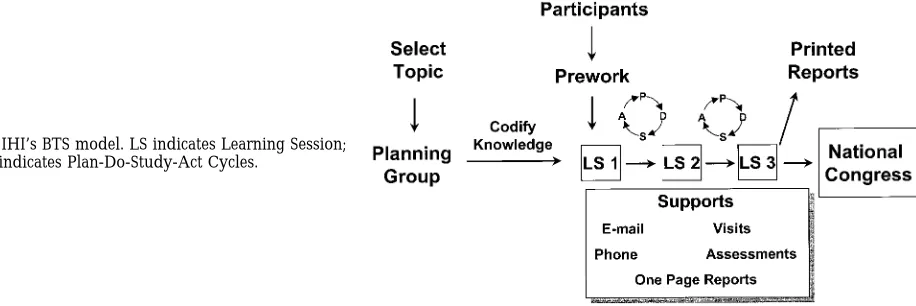
The BTS is an improvement method that relies on the spread and adaptation of existing knowledge to mul-tiple, similar sites to accomplish common aims. The BTS model is shown in Fig 1. Each BTS Collaborative consists of 20 to 40 organizations working together for approximately 6 to 12 months on a specific topic and utilizes three 2-day Learning Sessions. Thus far, more than 450 teams have participated from more than 300 organizations. Table 2 lists completed, on-going, and upcoming Collaboratives. Some topics are being repeated.
In addition to addressing the issues outlined in the previous section, the BTS seeks to: 1) find, describe, and diffuse best practices throughout Collaborative organizations; 2) improve outcomes in participating organizations by understanding their systems of care and changing them rapidly, yet safely; 3) develop health care expertise in the science of improvement within each topic area; and 4) disseminate and de-ploy knowledge gained during the Collaboratives as
broadly as possible to others in the health care com-munity.
The following is a brief description of the key components of the BTS.
1. Identifying Topics for Collaborative Improvement
“Ripe” topics for improvement are selected using four criteria: 1) sound scientific evidence suggests improved approaches compared with prevailing practices (ie, a “gap” exists between knowledge and prevailing practice); 2) at least a few systems or practitioners are performing at a higher level using this knowledge; 3) both organizations and patients would benefit from “closing the gap;” and 4) na-tional tension for improvement exists in the topic area. In a prior article, Berwick suggested several such topics.23 Using the criteria above, it is easy to
identify many more.
2. Identification and Consolidation of Relevant Knowledge
The challenge in identifying and consolidating knowledge for improvement is that is goes beyond typical knowledge found in the medical literature. Not only must you understand what to do (scientific knowledge), you must also understand how to do it (improvement knowledge). To achieve this, research-ers familiar with the topic, along with practitionresearch-ers who have achieved documented cutting-edge perfor-mance, are invited to join an expert Planning Group whose role is to clarify the nature of the gap and to consolidate the scientific and improve knowledge. For example, the Planning Group for the Collabora-tive on Reducing Cesarean Section Rates While Maintaining Maternal and Infant Outcomes included an obstetrician from Green Bay, Wisconsin, where
rates had been reduced successfully from 18% to 8% in slightly over 3 years.24
Chaired by an individual with national promi-nence in the field, each such Planning Group estab-lishes numerical goals that could be achieved if the best available science were used. They identify knowledge that is ready for wider deployment and testing. Sources of knowledge “ripe for testing” in-clude clinical trials, extensive data-based practice ex-perience, expert opinion, analysis of one’s own past performance, or solid scientific theory. Planning Groups also explore and suggest measurement sys-tems specific to the topic.
Concepts used in the Collaborative on Improving Asthma Care included, for example, “develop orga-nizational agreement on a standardized asthma assessment tool,” “increase use of inhaled antiin-flammatory agents,” and “streamline crisis manage-ment.” For BTS Collaborative on Reducing Adverse Drug Events, concepts derived from human factors engineering and related sciences included “reduce reliance on short-term memory,” “reduce handoffs,” and “standardize.”
As such concepts are identified, improvement knowledge is used to put these concepts into prac-tice. In the treatment of asthma, for example, it is necessary but not sufficient to know that the use of inhaled antiinflammatory agents should be in-creased. Improvement demands that we know how to apply this concept—how to establish systems that assure appropriate use of these agents. The Planning Group elaborates in detail on concepts like these in lectures, conference calls, written materials, and coaching sessions.
It is the synergy between scientific knowledge and improvement knowledge that enables improvement to occur at the patient level.
3. Recruitment and Preparation of Collaborative Participants
For each topic, IHI issues a national call for partic-ipants— organizations serious about making demon-strable improvements at an unprecedented rate. In-terested organizations must complete an application, show evidence of senior executive commitment to the aim, and be willing to contribute to the budgetary requirements of the Collaborative. Once an applica-tion has been accepted, IHI sends preparatory work and arranges an initial conference call. IHI works with each organization to establish specific organi-zational goals that are clearly stated, data-based, nu-merical, and grounded in the knowledge developed by the Chair and Planning Group.
Critical to success is the ability of an organization to identify the right individuals to participate in this work, and to secure the time and resources necessary to achieve the aim. Individuals should be chosen based on their knowledge of the system and interest in the aim. Teams vary in size and composition from organization to organization, but each should have representation from three different domains: system leadership, technical expertise, and day-to-day lead-ership.
A system leader is someone with enough clout in the organization to leverage resources and change
TABLE 2. IHI BTS Topics
Completed
• Reducing Delays and Waiting Times (I & II)
• Reducing Cesarean Section Rates While Maintaining Maternal and Fetal Outcomes (I & II)
• Improving Asthma Care
• Reducing Adverse Drug Events (I and II)
• Reducing Costs and Improving Outcomes in Adult Intensive Care (I)
• Reducing Costs and Improving Outcomes in Adult Cardiac Surgery
• Improving Care for Low Back Pain
• Improving Prescribing Practices
• Improving Care at the End of Life
• Reducing Waits and Delays and Improving Patient Satisfaction in the Emergency Department (I)
• Reducing Adverse Drug Events (II)
• Improving Efficiency and Access to Care in Physician Offices and Clinics
• Improving Service in Health Care (I) Ongoing
• Improving Care for Chronic Conditions—Diabetes and the Frail Elderly (I)
• Reducing Costs and Improving Outcomes in Adult Intensive Care (II)
Upcoming
• Reducing Waits and Delays and Improving Patient Satisfaction in the Emergency Department (II)
• Improving Care for Chronic Conditions—Diabetes and Congestive Heart Failure (II)
policy when necessary. When a change is suggested, this person should have the authority to get it done. When time and resources are necessary, this individ-ual should have the authority to allocate them. Ex-amples of a system leader include a vice president, chief of medical staff, or a division head.
A technical expert is a subject matter expert— someone who knows the subject intimately, is trusted by other clinicians in the organization, and understands the processes of care. This individual should be an opinion leader in the institution— someone that others respect and seek for advice. Additional technical expertise may be provided by an improvement expert who can help a team under-stand what needs to be measured, design simple, effective measures, and collect, display and interpret data. Examples of a technical expert include a highly respected intensivist if the Collaborative topic is on improving care in the critical care unit, or the head of obstetrics if the topic is reducing cesarean section rates.
A day-to-day leader is a person who works in the process on a daily basis and who will be persistent in assuring that the necessary work is completed. This individual will be the critical driving component of the team, assuring that tests of change are performed and data are collected. Examples of a day-to-day leader include a nurse manager of the labor and delivery floor if the topic is reducing cesarean section rates, or a pharmacist if the topic is reducing adverse drug events.
All teams should have at least one active physician champion. The greater this individual’s influence with other clinicians, the more effective they will be in engaging them in the process of change.
4. The Collaborative Process
For a period of up to 12 months, participants en-gage in a series of structured activities designed to advance their improvement work as rapidly as pos-sible. Participating organizations meet together at three 2-day “Learning Sessions” during this period where they learn from the Planning Group, clarify the science, plan their own tests of change, and learn from each other’s efforts. The term “Learning Ses-sion,” although now fixed in our jargon, can be de-ceptive. The participants not only learn from the experts, but work closely with them and with each other to refine the science of improvement in each topic. Jointly laboring in this process, participants grow in knowledge and understanding together, and they become bound in the act of improvement.
Between Learning Sessions, the collaborative expe-rience is sustained. Participants remain linked with each other through weekly conference calls (often involving experts on specific topics, such as anesthe-sia practices in labor, or proper analgeanesthe-sia in the in-tensive care unit [ICU]), e-mail “listserv” discussion groups, and monthly exchange of printed reports. They visit other Collaborative institutions, examin-ing firsthand differences in systems of care—an ex-tremely powerful and underutilized learning and motivating experience.
Throughout the Collaborative the focus is on
re-sults with a strong, early emphasis on establishing performance measurement systems within partici-pating institutions. Results depend on the perfor-mance of numerous planned, structured tests of change while collecting data to learn from those tests. Such tests of change are not equivalent to clin-ical trials; the changes tested are not the turf for institutional review boards. The ideas being tested are, in general, already proven in the literature, suc-cessfully used elsewhere, and supported by experts in the field.
The purpose of testing change is iterative induc-tive-deductive learning about, and change in, our systems of care to achieve documented improve-ments in outcomes. Several thorough descriptions on the topic of testing change and using the scientific method in clinical care recently have been pub-lished.16,19,25
5. The Deployment of Knowledge
Each Collaborative concludes with a public “Na-tional Congress” where participants become faculty and national experts on improvement of the topic. Others working on improvement in the field outside of the Collaborative are also invited to present. The most useful scientific and improvement knowledge, measurement methodologies, lessons, and results are also consolidated into a monograph Guide to
Improve-ment and articles are prepared for publication in
peer-reviewed journals.26 –33
Other Features of the BTS Model
Two additional features of the BTS model are worth exploring to give insight into future collabo-rative designs. First, BTS Collabocollabo-ratives are limited in time (6 to 12 months) and focused on using joint learning to foster rapid, intraorganizational improve-ment. This creates tension for change. Participants set difficult goals and must work hard to achieve them in a limited amount of time. This necessitates close interaction within and between organizations.
Second, each organization collects and maintains its own data. Because each organization can choose to work on those issues most important to them, common data collection is not performed. Our em-phasis is on building the internal capabilities of par-ticipants to collect, analyze, and display data beyond the lifetime of the Collaborative.
CASE STUDIES OF ORGANIZATIONAL IMPROVEMENT
This section will provide examples of successful improvement resulting from the BTS Collaborative process. Because any one of the following case stud-ies could have occurred outside of the Collaborative environment, what does collaboration add? Collab-oration makes it possible for subject matter and im-provement experts to understand each others’ terrain and to package knowledge so that it is actionable— allowing front-line caregivers to put the science into practice.26 –30,33 Collaboration accelerates the pace of
environ-ment where sharing is the norm. This creates tremen-dous motivation for improvement.34
Reducing Cesarean Section Rates While Maintaining or Improving Maternal and Fetal Outcomes
The cesarean section rate in the United States has escalated from,10% to 24.5% over the last 25 years with no substantial evidence of improved maternal or fetal outcomes.33 Other industrialized countries
currently achieve substantially lower rates with good outcomes.
Lawrence General Hospital (LGH), Lawrence, Massachusetts, entered the BTS Collaborative on Re-ducing Cesarean Section Rates with an aim of reduc-ing their cesarean section rate by 30% in 12 months while maintaining or improving maternal and infant outcomes. LGH helps deliver approximately 1600 babies annually. Their measurement system cap-tured data pertinent to their aim including total, primary, and repeat cesarean section rates, admis-sions for false labor, use of epidural anesthesia, fetal Apgar scores, and more. Data were summarized monthly (see Fig 2.)
The LGH team included obstetricians, anesthesiol-ogists, labor and delivery nurses, senior manage-ment, and others. The following are examples of changes tested by this team and supported by the literature.33
Hospital admission for women in false or very early labor can lead to anxiety and a feeling that something should be done to accelerate the process. When unnecessary or early admission occurs, or when labor is proceeding slowly, there is a tendency toward increasing intervention that often cannot be justified by the literature and can increase the likeli-hood of unnecessary cesarean section. Examples of such interventions include electronic fetal monitor-ing, the use of induction agents such as Pitocin, and use of epidural analgesia. Other factors that can in-crease the probability of cesarean sections include a fear of litigation, poor management of the labor pro-cess, undue patient expectations, and a false belief that vaginal delivery is contraindicated after a pre-vious cesarean section.30
After a rapid analysis of their processes and out-comes, the staff at LGH developed a policy for
re-ducing admission for false labor and for low-risk patients with,4 centimeters of cervical dilation. To improve the appropriateness in the use of Pitocin, a protocol including criteria for use was developed, tested, and instituted. They standardized the concen-tration of Pitocin, but left dosing orders up to indi-vidual physicians.
To manage expectations regarding the safety and desirability of vaginal birth after a previous cesarean section, an educational program for patients and pro-viders was developed. This program provides sup-port to women early rather than later in pregnancy. Last, provider performance data were distributed to each obstetrician allowing them to learn from their differences with their colleagues.
The use of performance feedback to lower cesar-ean section rates is discussed elsewhere in this issue.35
Reducing Costs and Improving Outcomes in Adult Cardiac Surgery
Wide disparity exists in the provision of care for cardiac surgery patients. For example, some hospi-tals maintain median postsurgical ventilator times of
,6 hours with excellent outcomes while others keep patients ventilated for over 12 to 24 hours. Although there is no scientific evidence to suggest that longer ventilation times are beneficial, there are substantial theoretical reasons to seek reduced ventilator times. Shorter ventilation times reduce the risk of nosoco-mial infections, improve postoperative ambulation, reduce the need for sedation, reduce overall ICU stays, and reduce patient anxiety and discomfort.36
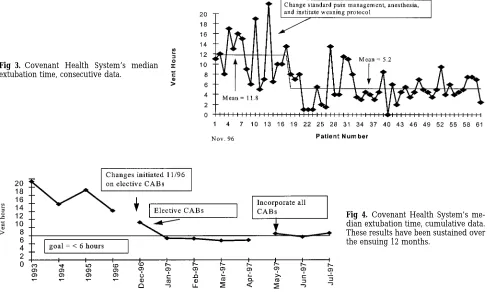
At Covenant Health System’s Parkwest Medical Center in Knoxville, Tennessee, ventilator times were successfully reduced from a median of 20 hours to 12 hours between 1993 and 1996. On entering the IHI’s BTS Collaborative on Reducing Costs and Improving Outcomes in Adult Cardiac Surgery, staff from Cov-enant quickly appreciated the advantage of reducing ventilator times more dramatically. One of their aims was to reduce median ventilation time for all coro-nary artery bypass patients to,6 hours.
Their measurement system included time from ICU admission to extubation, reintubation rates, number of arterial blood gases performed per case,
pulmonary complications, and length of stay in the ICU. Data were collected on all patients without exclusions (see Figs 3 and 4.)
After studying the procedures and data of other organizations in the Collaborative, the Covenant staff determined that three changes were central to rapid and safe postoperative extubation.37,38
1. Alterations in anesthesia can insure that patients are spontaneously ventilating and ready to extu-bate within several hours after surgery.36,39 The
traditional use of high intraoperative doses of narcotics and sedatives lead to prolonged seda-tion and is unnecessary. Likewise, neuromuscu-lar blockers can be titrated and reversed at the end of the procedure allowing for early sponta-neous ventilation.
2. Small, frequent doses of narcotics can be used to manage postoperative pain instead of traditional large doses that lead to prolonged sedation and respiratory depression. More rapid extubation it-self affords pain reduction through relief of the anxiety associated with intubation.
3. Nurses and respiratory therapists are capable of using weaning protocols to assess and move pa-tients toward extubation.40 Once sufficiently
trained, they can proceed with extubation and ongoing respiratory monitoring. The key compo-nents of an effective postoperative weaning pro-tocol include a well-trained staff and clearly de-fined weaning criteria that must be met before extubation.
Improving Prescribing Practices
Despite the value of nutrition in critically ill pa-tients, nutritional concerns often go overlooked in
busy ICUs.41– 43Poor nutrition can increase
suscepti-bility to infection and make ventilator weaning more difficult. Staff at Children’s Hospital of Wisconsin (CHW) assessed nutritional practices in their pediat-ric ICU (PICU) as a part of IHI’s BTS Collaborative on Improving Prescribing Practices and realized the gap between current knowledge and their practices. They established an aim of placing at least 75% of PICU cardiovascular patients on enteral feedings within 24 hours of meeting criteria.
To achieve this aim, CHW tested and then insti-tuted several changes. They developed an algorithm for automatic assessment and initiation of nutrition unless specific exclusion criteria were met. CHW dietitians began rounding in the PICU. They revised the nursing flow sheets to include “initiation of en-teral feedings.” And, academic detailing was con-ducted to discuss nutrition with clinicians in face-to-face meetings.44,45
Their results were shared openly and were impres-sive. The percentage of patients receiving feedings within 24 hours of meeting criteria rose from 50% to 90%, average overall days from admission to feeding in the PICU decreased from 12 to 4, and the overall incidence of infection was reduced almost 50%. (See Figs 5 and 6.)
LESSONS FOR COLLABORATIVE IMPROVEMENT EFFORTS
Limited duration, organizational ownership of data, and a focus on action and results are intentional features of the BTS. The BTS is designed as an im-provement collaborative and not a research collabo-rative in its traditional sense. Our “research” con-cerns topics such as organizational change, effective
Fig 3. Covenant Health System’s median extubation time, consecutive data.
leadership, and methods of data collection as op-posed to traditional clinical or epidemiologic re-search.
An examination of existing collaborative efforts reveals a spectrum of purpose and design worth exploring to inform future collaborative efforts. At one end of this spectrum exists the pure improve-ment collaborative and at the other end lies clinical epidemiology. By clinical epidemiology, I refer to those joint efforts where data collection and analysis are the primary activities, although improvement is the goal. This does not include clinical investigative projects such as the AIDS Clinical Trials Groups because their purpose is to perform clinical studies.46
Nor does this scheme include pure benchmarking efforts that only seek to provide comparative data analyses for similar organizations.
The BTS falls solidly on the improvement side of this spectrum with little emphasis on epidemiology while other efforts fall toward the pure epidemiology side. Still other collaborative efforts exist somewhere along the spectrum. In fact, a collaborative’s empha-sis can vary with time, depending on the needs and availability of existing knowledge as a basis for ac-tion.
The purpose of epidemiology-focused collabora-tives is investigation—leveraging increased patient and data availability from multiple organizations or sites to develop new clinical knowledge. The empha-sis is on data that is standardized across organiza-tions and often extracted by project personnel. The
intent is dissemination of newly developed knowl-edge through publication. Several problems exist with the pure epidemiology-focused efforts. Al-though they create new scientific knowledge, the details of application of this knowledge are often not established. Epidemiologic knowledge is often di-vorced from an understanding of the systems of care. Knowledge dissemination is often slow. Internal ca-pacity of participating organizations to use the knowledge to drive improvement locally may not be developed.
In contrast, collaboratives with a pure improve-ment focus generally seek action—making rapid, de-monstrable improvements in participating organiza-tions. They do so by leveraging increased application knowledge that results when multiple organizations or sites work together to understand and compare their systems of care. They then use this understand-ing together with existunderstand-ing scientific information to improve clinical outcomes. Data are collected and managed by individual organizations and are not standardized across the collaborative sites; individ-ual sites collect data pertinent to their aims. It is pragmatic science— understanding the application of existing scientific knowledge. Improvement col-laboratives build the internal capacity of participat-ing organizations to improve beyond the life of the collaborative.
Several existing collaboratives exemplify a mix of these purposes—performing epidemiology while si-multaneously seeking to improve systems of care. These intents need not exist in exclusion. At times these efforts place a stronger emphasis on improve-ment, at other times they focus on epidemiology. In fact, when properly designed, these ends inform each other.
The Northern New England Cardiovascular Dis-ease Study Group (NNE) is one such example.2,47,48
Begun in 1988, the NNE was an innovative, vision-ary, and novel approach to both epidemiology and improvement. They began on mastering data collec-tion and demonstrating variacollec-tion in care in the five participating cardiac surgery centers. This step was necessary to gain the confidence of surgeons and hospitals. Beginning in 1991, NNE organizations
Fig 5. Percentage of cardiovas-cular patients on feedings within 24 hours of meeting cri-teria, CHW, Madison, WI.
shifted their focus toward improvement with a con-certed effort to reduce cardiac surgical mortality.2,49
Since that time, the group has used its epidemiol-ogy abilities to inform essential improvement oppor-tunities. Examples include: 1) an exploration of the determinants of patients at high-risk for surgical mortality, then a concerted effort to address those determinants; and 2) an exploration of the utility of perioperative Swan Ganz catheters and the subse-quent development of a decision rule used to opti-mize their use. With common data collection, a series of structured visits to other NNE sites, three meet-ings a year, and other routine communication, the NNE has proven that such a model can flourish over time by simultaneously performing very high-qual-ity research while also achieving important improve-ment objectives.
Although the potential synergy between improve-ment and epidemiology is tremendous, a word of caution is advisable. Health care tradition is deeply rooted in our existing scientific paradigm. The sci-ence of improvement, the scisci-ence of application, is distinct from this paradigm in its intent and meth-odologies. Health care’s understanding and applica-tion of improvement sciences, while growing rap-idly, is in its infancy.
Because of our history, when an option exists, health care professionals tend to fall back into the familiar terrain of traditional science. In doing so, data collection tends to dominate the mindset and action-oriented improvement is frequently moved to the back seat. Even when a situation and available knowledge demand immediate action, our tendency remains in the direction of more study.23If
collabo-rative efforts are designed to perform both epidemi-ology and improvement, participants must clearly understand the aims of the effort, and then make sure that the unfamiliarity with improvement does not give way to a dominance of epidemiologic inves-tigation.
Although I support future efforts to combine these two, it is true that the sheer volume of existing sci-entific knowledge not only warrants an intensive focus on improvement, but also supports efforts that focus only on improvement.
CONCLUSION
The BTS is a collaborative improvement model that seeks to use existing scientific knowledge. Cli-nicians and health care leaders intent on rapid im-provements can use the basic elements of this mod-el— clear aims, repeated exchanges among teams, precise measurement systems, input from estab-lished experts, rapid tests of change, and an enabling social climate—to design widespread improvement efforts.
Collaborative improvement efforts move beyond the current insular nature of our industry and open up doors that energize health care professionals. Col-laboration liberates health care professionals to lead the improvement of systems of care instead of feeling powerless to make the changes they know are nec-essary. When we work together, we overcome the
barriers currently impeding the broad use of existing knowledge for the improvement of patient care.
REFERENCES
1. Gaba DM. Improving anesthesiologists’ performance by simulating reality. Anesthesiology. 1992;76:491– 494
2. O’Connor GT, Plume SK, Olmstead EM, et al. A regional intervention to improve the hospital mortality associated with coronary artery bypass graft surgery. JAMA. 1996;275:841– 846
3. Axelrod R. The Evolution of Cooperation. New York, NY: Basic Books; 1984
4. Plsek PE. Collaborating across organizational boundaries to improve the quality of care. Am J Infect Control. 1997;25:85–95
5. Moller JH, Powell CG, Joransen JA, Borbas C. The pediatric cardiac care consortium—revisited. Jt Comm J Qual Improv. 1994;20:661– 668 6. Donahue JG, Weiss ST, Livingston JM, Goetsch MA, Greineder DK,
Platt R. Inhaled steroids and the risk of hospitalization for asthma.
JAMA. 1997;277:887– 891
7. Calpin C, Macarthur C, Stephens D, et al. Effectiveness of prophylactic inhaled steroids in childhood asthma: a systematic review of the liter-ature. J Allergy Clin Immunol. 1997;100:452– 457
8. NIH Consensus Development Panel of the Effect of Corticosteriods for Fetal Maturation on Perinatal Outcomes. Effect of corticosteriods for fetal maturation on perinatal outcomes. JAMA. 1995;273:413– 418 9. Horbar JD. Antenatal corticosteroid treatment and neonatal outcomes
for infants 501 to 1500 gm in the Vermont-Oxford Trails Network. Am J
Obstet Gynecol. 1995;173:275–281
10. Wennberg JE, ed. The Dartmouth Atlas of Health Care in the United States. Chicago, IL: American Hospital Publishing, Inc; 1996
11. Ellerbeck EF, Jencks SF, Radford MJ, et al. Quality of care for Medicare patients with acute myocardial infarction. A four-state pilot study from the Cooperative Cardiovascular Project. JAMA. 1995;273:1509 –1514 12. Somurai SB, McLaughlin TJ, Spiegelman D, Hertzmark E, Thibault G,
Goldman L. Adverse outcomes of underuse of beta-blockers in elderly survivors of acute myocardial infarction. JAMA. 1997;277:115–121 13. Langley GJ, Nolan KM, Nolan TW, Norman CL, Provost LP. The
Im-provement Guide: A Practical Approach to Enhancing Organizational Perfor-mance. San Francisco, CA: Jossey-Bass Publishers; 1996
14. Moen RM, Nolan TW, Provost LP. Improving Quality Through Planned
Experimentation. New York, NY: McGraw-Hill; 1991
15. Wheeler DJ. Understanding Variation: The Key to Managing Chaos. Knox-ville, TN: SPC Press, Inc; 1993
16. Berwick DM. A primer on leading the improvement of systems. Br
Med J. 1996;312:619 – 622
17. Rogers EM. Diffusion of Innovations. 4th ed. New York, NY: The Free Press; 1995
18. Reinersten JL. Physicians as leaders in the improvement of health care systems. Ann Intern Med. 1998;128:833– 838
19. Berwick DM. Developing and testing changes in the delivery of care.
Ann Intern Med. 1998;128:651– 656
20. Nelson EC, Splaine ME, Batalden PB, Plume SK. Building measurement and data collection into medical practice. Ann Intern Med. 1998;128: 460 – 466
21. Nolan TW. Understanding medical systems. Ann Intern Med. 1998;128: 293–298
22. Clemmer TP, Spuhler VJ, Berwick DM, Nolan TW. Cooperation: the foundation of improvement. Ann Intern Med. 1998;128:1004 –1009 23. Berwick DM. Eleven worthy aims for clinical leadership of health
system reform. JAMA. 1994;272:797– 802
24. Sandmire HF, DeMott RK. The Green Bay cesarean section study, III: falling cesarean birth rates without a formal curtailment program. Am J
Obstet Gynecol. 1994;170:1790 –1799
25. Kilo CM, Kabcenell AI, Berwick DM. Beyond survival: toward continual improvement in health care. New Horizons. 1998;6:3–11
26. Nolan T, Schall MW, Berwick DM, Roessner J. Reducing Delays and
Waiting Times Throughout the Healthcare System. Boston, MA: Institute for
Healthcare Improvement; 1996
27. Weiss KB, Mendoza G, Schall MW, Berwick DM, Roessner J. Improving
Asthma Care in Children and Adults. Boston, MA: Institute for Healthcare
Improvement; 1997
28. Rainey TG, Kabcenell AI, Berwick DM, Roessner J. Reducing Costs and
Improving Outcomes in Adult Intensive Care. Boston, MA: Institute for
Healthcare Improvement; 1998
29. Leape LL, Kabcenell AI, Berwick DM, Roessner J. Reducing Adverse Drug
Events. Boston, MA: Institute for Healthcare Improvement; 1998
30. Flamm B, Kabcenell AI, Berwick DM, Roessner J. Reducing Cesarean
MA: Institute for Healthcare Improvement; 1998
31. Brock WA, Nolan K, Nolan TN. Pragmatic science: accelerating the improvement of critical care. New Horizons. 1998;6:61– 68
32. Kollef MH, Horst HM, Prang L, Brock WA. Reducing the duration of mechanical ventilation: three examples of change in the intensive care unit. New Horizons. 1998;6:52– 60
33. Flamm BL, Berwick DM, Kabcenell AI. Reducing cesarean section rates safely: lessons from a “Breakthrough Series” collaborative. Birth. 1998; 25:117–124
34. Czikszentmihalyi M. Creativity: Flow and the Psychology of Discovery and
Invention. New York, NY: Harper Collins; 1996
35. Main E. Reducing cesarean section rates with data-driven quality im-provement activities. Pediatrics. 1999;103(suppl):374 –383
36. Cheng DCH, Karksi J, Peniston C, et al. Early tracheal extubation after coronary artery bypass graft surgery reduces costs and improves re-source use: a prospective randomized controlled trial. Anesthesiology. 1996;85:1300 –1310
37. Higgins TL. Safety issues regarding early extubation after coronary artery bypass surgery. J Cardiothorac Vasc Anesthesia. 1995;9:24 –29 38. Brauer SD, Van Arsdell G, Bailey L. Is immediate extubation safe after
profound hypothermic circulatory arrest? Anesth Analg. 1996;82:S49. Abstract
39. Mora CT, Ducek, Torjman MC, White PF. The effects of anesthetic technique on the hemodynamic response and recovery profile in coro-nary revascularization patients. Anesth Analg. 1995;81:900 –910
40. Thalman JJ, Rinaldo-Gallo S, MacIntyre NR. Analysis of an endotra-cheal intubation service provided by respiratory care practitioners.
Respir Care. 1993;38:469 – 473
41. Cerra FB, Benitez MR, Blackburn GL, et al. Applied nutrition in ICU patients. A consensus statement of the American College of Chest Physicians. Chest. 1997;111:769 –778
42. Bower RH. Nutrition during critical illness and sepsis. New Horizons. 1993;1:348 –352
43. Schwartz DB. Enhanced enteral and parenteral nutrition practice and outcomes in an intensive care unit with a hospital-wide performance improvement process. J Am Diet Assoc. 1996;96:484 – 489
44. Avorn J, Soumerai SB. Improving drug-therapy decisions through ed-ucational outreach. A randomized controlled trail of academically based “detailing.” N Engl J Med. 1983;308:1457–1463
45. Soumerai SB, Avorn J. Principles of educational outreach (“Academic Detailing”) to improve clinical decision making. JAMA. 1990;263: 549 –556
46. Collier AC. New directions for ACTG. Lancet. 1994;344:601– 602 47. Berwick DM. Harvesting knowledge from improvement. JAMA. 1996;
275:877– 878
48. O’Connor GT, Plume SK, Wennberg JE. Regional organization for out-comes research. Ann N Y Acad Sci. 1993;703:44 –51
1999;103;384
Pediatrics
Charles M. Kilo
Improving Care Through Collaboration
Services
Updated Information &
http://pediatrics.aappublications.org/content/103/Supplement_E1/384
including high resolution figures, can be found at:
References
#BIBL
http://pediatrics.aappublications.org/content/103/Supplement_E1/384
This article cites 37 articles, 2 of which you can access for free at:
Subspecialty Collections
sub
http://www.aappublications.org/cgi/collection/fetus:newborn_infant_ Fetus/Newborn Infant
http://www.aappublications.org/cgi/collection/standard_of_care_sub Standard of Care
sub
http://www.aappublications.org/cgi/collection/quality_improvement_ Quality Improvement
_management_sub
http://www.aappublications.org/cgi/collection/administration:practice Administration/Practice Management
following collection(s):
This article, along with others on similar topics, appears in the
Permissions & Licensing
http://www.aappublications.org/site/misc/Permissions.xhtml
in its entirety can be found online at:
Information about reproducing this article in parts (figures, tables) or
Reprints
http://www.aappublications.org/site/misc/reprints.xhtml
1999;103;384
Pediatrics
Charles M. Kilo
Improving Care Through Collaboration
http://pediatrics.aappublications.org/content/103/Supplement_E1/384
located on the World Wide Web at:
The online version of this article, along with updated information and services, is
by the American Academy of Pediatrics. All rights reserved. Print ISSN: 1073-0397.