VPN STIPULATION BASED VIBRANT
DEVELOPMENT
S.M.KRISHNA GANESH1
Lecturer, Department of Computer Science and Engineering, St.Joseph College of Engineering and Technology, India
A.SILES BALASINGH2
Lecturer, Department of Computer Science and Engineering, St.Joseph College of Engineering and Technology, India
Abstract:
A virtual private network (VPN) is a private network that makes use of a public network (such as the Internet), while maintaining security and privacy through encryption and security procedures [1]. VPN's give companies an alternative to leasing an expensive, dedicated private connection from one office to another. Many businesses are using VPN on their servers to allow their employees to connect to their server from home. VPN service providers provide new services with Quality of Service (QoS) guarantees are also resilient to failures. The main objective is to find the optimal path a with scheduled routing to improve the QoS, by maintaining routing algorithm based on shortest path and scalable scheduling of packets being routed which provides a minimized bandwidth and guaranteed delay. An algorithm for optimal shortest path with scheduling is described with simulation results and compared with other algorithms
Keywords: QoS, Scalable Scheduling, optimal path, Encryption, Routing.
1. Introduction
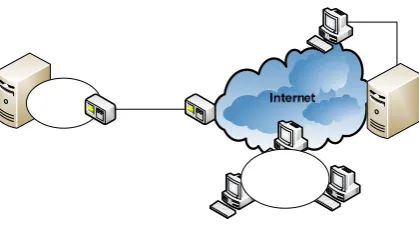
A virtual private network (VPN) is a private data network that makes use of the public Internet [2] to maintain privacy through the use of IP tunneling technology and network security protocols. VPNs can be regarded as a replacement of the expensive private leased lines. The main purpose of a VPN is to provide a company secure communication among multiple sites through the shared Internet. More detailed descriptions of VPNs can be found in [3]. To support a VPN, a service provider has to allocate predetermined paths to connect among customer sites reservation while minimizing the total bandwidth used becomes an important problem to the service provider.
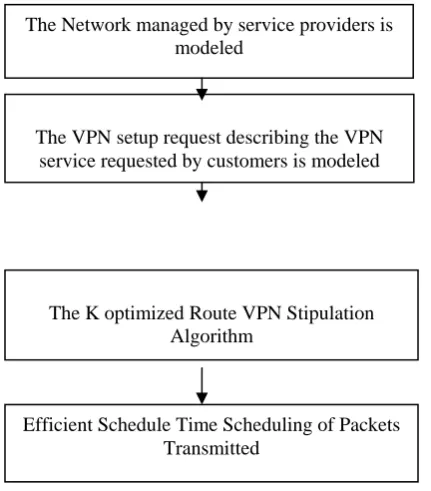
from other endpoints [4]. The egress bandwidth is the capacity required for aggregating the outgoing traffic from the endpoint into the network. The case is that for asymmetric bandwidth with synchronization. The major issue with this is to reduce the traffic among the VPN end points. The figure 2 shows the over all work flow. The proposed work describes a new VPN Stipulation algorithm called “K-Optimized Route VPN Stipulation Algorithm (KORPA)” and Efficient Schedule Time Scheduling [5] to address this issue.
Figure 2 Diagram of Algorithmic approach
2. Proposed Algorithm
2. K-Optimized Route VPN Stipulation Algorithm
2.1 Phase 1 for K-path calculation
The proposed algorithm KOPR tries to find the cost of the VPN endpoints using the asymmetric bandwidth based on the pseudo code
Pseudo code for Proposed K-optimal path algorithm 1. Vnode = ∞
2. For each V € N 3. Loop
4 Tv = KOPR (G, V) 5. Compute RS (PT, V) 6. Ed loop
7. if (Cost (V) > = optimal) 8. Reject Link PT
9. else
10 for each link compute KOPRA(G,V) 11 End if
12 End if
13 Repeat for BFS (g,v) for comparison 14 End
The Network managed by service providers is modeled
The VPN setup request describing the VPN service requested by customers is modeled
Efficient Schedule Time Scheduling of Packets Transmitted
The network backbone is modeled by an undirected graph G= (N, L), where N and L are the set of routers and the set of links, respectively. Let n and m denote the cardinality of N, respectively. Let B be the residual bandwidth of links on L and the amount of residual bandwidth on link l (lЄL) is denoted by B(l). A subset = {ar1, ar2…arp} N) is the set of VPN access routers. Each endpoint eiof a VPN gains access to VPN service by connecting to a specific VPN access router ariin AR. In other words, for each endpoint of a VPN, there is a corresponding VPN.
2.2 Phase 2 EST Development
Each VPN in the active router environment contains two types of agents on the active routers: queue agents, and control agents [6]. VPN endpoints control a delay of sessions according to the maximum and minimum delay bounds specified by the clients. Control agents control the end-to-end delay of a VPN by monitoring the delay of a session on a routing path. However the EST scheduling one such active scheduling algorithm, here proposed does not require any control at the VPN endpoints. In figure 3 we adjust the delay of the packets routed and is calculated based on the Schedule time and transmitted to meet the QoS parameters [7]
Figure 3 shows the EST scheduling frame work.
Pseudo code for efficient agenda Time 1.Let Pn be Packet transmitted
2. Transmission Time Tt > Packet Deadline Time (d)
3. Packet Deadline Time - Packet Time gives the Schedule Time 4. The Schedule time left out is added to Previous transmission Time 5. If delay(Packets) >= Threshold then packet drop
6.Then Count++
7. When the packet is dropped then retransmit the packet.
The delay of packet remitted is compute with the rejection ratio as below Number of dropped packet
Rejection ratio = * 100 Total no of packets Transmitted
Schedule time in routing. The routed are adjusted dynamically to reduce the delay. The Schedule time is added to the transmission time which could result in improved bandwidth utilization and efficiency. The delay and Schedule time determines the efficiency of routing.
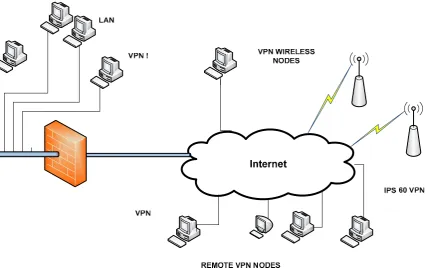
Figure 4 shows the simulated Environment model
Thus the above figure 4 is simulated environment as the VPN network and with sufficient Bandwidth and delay for efficient packet routing among the VPN Endpoints.
4. Experimental Results
4.1 Designed and developed KORPA Vs BFS and Steiner Routing
We compared the Stipulation cost (that is, the total bandwidth reserved on links of the VPN tree) and the running times of the algorithms for the symmetric as well as the asymmetric bandwidth models. In the study, we examined the effect of varying the following two parameters on Stipulation cost: 1. VPN endpoints 2. Number of VPN nodes. Most of the plots in the following subsections were generated by running each experiment five times (with different random networks) and using the average of the cost/execution times for the five repetitions as the final result.
4.2 Replication 1: (Network Size)
Graph 1 shows KORPA Vs BFS, Steiner
The table 1 shows the cost of KORPA algorithm with BFS and Steiner which shows the proposed algorithm has the lowest cost compare to others.
KOSR BFS STEINER 27 60 100 49 80 131 75 100 168 105 140 202 130 163 226 140 207 258 177 228 284 187 245 300 219 301 333 Table 1 shows the Cost of KORPA Vs BFS, Steiner
Com parision of Shortest Path Algorithm s
0
50
100
150
200
250
300
350
100
300
500
700
900
No of Nodes
Co
s
t
KOSR
BFS
STEINER
Com parative graph EST vs Static Prioirty
0
20
40
60
80
100
1 2 3 4 5 6 7 8 9
No o f Nodes
De
la
y
Static Prio
Scheduling
EST
The table 2 shows the comparative study of proposed scheduling algorithm (EST) with Static Priority Static Priority
Scheduling EST Scheduling
0 0 21 12 34 20 40 26 50 37 60 42 67 53 80 72 93 83 Table 2 shows the efficiency of EST Vs static priority
Conclusion and Future Work
We have presented a new scheduling scheme called Efficient Schedule Time scheduling. In this paper Virtual private networks consisting of VPN endpoints with their K-optimal path have been implemented in NS2. The Active VPN Endpoints reconfigure the delays of packet routed dynamically in their shortest path thus minimizing the packet loss and delay compared to the existing static algorithm. In future there are still a number of issues relating to VPN routing. For example: (1) The problem of fitting failure of lowest cost path and restoration mechanisms (2) Stipulation for the Asymmetric VPN nodes in VPN Environment.
Acknowledgments
First of all we thank the almighty for giving us the knowledge and courage to complete the research work successfully. We express our gratitude to our respected Rev.Fr.Dr.Arulraj Founder, DMI Group of institutions, East Africa and India, Dr.T.X.A.Ananth, Director(International Operations), DMI group of institutions, East Africa and India,Mr.Ignatius Herman, Director(Academic),DMI group of institutions, East Africa and India and Dr.V.KrishnanPh.D,Principal,DMI.St.Joseph College of Engg & Technology, Tanzania for allowing us to do the research work internally. Also we acknowledge the support provided by Rev.Sr.Fatima Mary, Vice Principal (Administration), DMI.St.Joseph College of Engg & Technology, Tanzania and Mr.N.Ressel Raj, Vice Principal (Academic), DMI.St.Joseph College of Engg & Technology, Tanzania. We thank our friends and collegues for their support and encouragement.
References
[1] Rocketfuel project(200), Computer Science and Engineering, Univ. of Washington. and HIST algorithm.6 April vol 12 pp.123-140 [2] H. Liang et al,(2002) “MinimalCost Design of Virtual Private Networks,” in IEEE Proceedings of the CCECE ’02, may 2002, vol.3,
pp. 1610 – 1615.
[3] T. Erlebach et al,(2004), “Optimal Bandwidth Reservation in Hose-Model VPNs with Multi-Path Routing”, INFOCOM,
vol.4,pp.2275-2282
[4] N. G. Duffield et al(1999), “A Flexible Model for Resource Management in Virtual Private Networks”, In Proc. ACM SIGCOMM, pp. 95-108.
[5] A. Gupta et al (2001), “Stipulation a Virtual Private Network: A Network Design Problem for Multicommodity Flow”, In Proc. ACM
STOC, pp. 389-398.
[6] A. Kumar et al, (2002), “Algorithms for Stipulation Virtual Private Networks in the Hose Model”, IEEE/ACM Trans. on Networking, vol.10, issue 4, pp. 565-578.
[7] A. Juttner et al(2003), “On Bandwidth Efficiency of the Hose Resource Management Model in Virtual Private Networks”, In Proc.
INFOCOM ,vol 1, pp.386-395
[8] I. Matta et al,(1999), “QDMR: An Efficient QoS Dependent Multicast Routing Algorithm”, In Journal of Communications and
Networks, Real-time Technology and Applications Symposium, pp. 213-222.
[9] P. P. Mishra, et al (2000), “Capacity Management and Routing Policies for Voice over IP Traffic”, IEEE Network, vol. 14, no. 2, pp. 20-27, pp. 20-27.
[10] B. M. Waxman (1988), “Routing of Multipoint Connection”, IEEE Journal on Selected Areas in Communications, vol. 6, issue 9, pp. 1617-1622.
[11] Zhanfeng Jia et al (2006), “Heuristic Methods for Delay Constrained Efficient Cost Routing Using K-Shortest-Paths”, IEEE
TRANSACTIONS On Automatic control, vol. 51, no. 4, pp.707-712
THE AUTHORS
Mr. S.M.Krishna Ganesh has completed Masters of Technology Degree in Computer Science and Engineering at Kalasalingam University in the year 2009, Tamil Nadu, India.He is currently working as Lecturer in St. Joseph College of Engineering and Technology,Dar Es Salaam, Tanzania, East Africa. He has 8 publications to his credit. He has guided more than 20 projects to final year B.E/B.Tech students with good industry and teaching experience. His areas of interests are Image Processing, Computer Networks, Neural networks and Bioinformatics.