
NAVIER–STOKES FLOWS
CHUONG V. TRAN AND XINWEI YU
Abstract. We study the Cauchy problem of the Navier–Stokes equations by both semi-analytic and classical energy methods. The former approach provides a physical picture of how viscous effects may or may not be able to suppress singularity development. In the latter approach, we examine the pressure term that drives the dynamics of the velocity norms||u||Lq, forq≥3. A key idea behind this investigation is due to the fact that the pressurepin this term is determined up to a function of both space and|u|, sayP(x,|u|), which may assume relatively broad forms. This allows us to usePas a pressure moderator in the evolution equation for||u||Lq, whereby optimal regularity criteria can be sought by varyingPwithin its admissible classes. New regularity criteria are derived with and without making use of the moderator. The results obtained in the absence of the moderator feature some improvement over existing criteria in the literature. Several criteria are derived in terms of the moderated (effective) pressurep+P. A simple moderation scheme and the plausibility of the present approach to the problem of Navier–Stokes regularity are discussed.
1. Introduction
We study the Cauchy problem of the Navier–Stokes system
∂u
∂t + (u· ∇)u+∇p= ∆u, (1)
∇ ·u= 0, u(x,0) =u0(x),
whereuis the fluid velocity,pis the pressure and the kinematic viscosity coefficient has been set to unity for convenience. The fluid is assumed to fill allR3with the usual condition of sufficient decay
at infinity. The initial velocity fieldu0(x) is incompressible and sufficiently regular. Given such an
initial velocity, it is well known that the solution remains regular at least up to some timet=T, which depends onu0(x). The question is whether or not regularity persists beyondT, particularly up to all t≥T (global regularity). Decades of active research on this issue since Leray’s seminal studies in the 1930s have resulted in a rich literature [1–35]. Early studies by Prodi [24], Serrin [26] and Ladyzhenskaya [22] found that regularity (up to some timet) is guaranteed provided that Rt
0||u|| 2q/(q−3)
Lq dτ < ∞, for q >3. Here ||·||Lq denotes the usual norm in the Lebesque spacesLq. Recently, Escauriaza, Seregin and Sver´ak [14] have extended this criterion to esssup(0,t)||u||L3 <∞, for the limiting caseq= 3. On the basis of these results, various criteria expressible in terms of the pressure pand its gradient∇phave been derived by a number of authors [3, 6, 8, 33]. One of the main results along this line of research is the criterion R0t||p||L2α/α(2α−3)dτ <∞, forα∈(3/2,∞), representing some moderate improvement of the Prodi–Serrin–Ladyzhenskaya result (due to the
Date: June 18, 2015.
2000Mathematics Subject Classification. 76D03,76D05.
Key words and phrases. Navier–Stokes equations, Pressure moderation, Effective pressure, Global regularity.
relation ||p||Lα ≤ c||u||
2
L2α, where c is a constant and 1 < α < ∞). This means that a loss of
regularity would require not only |u| → ∞ but also |p| → ∞. From a quite different approach, Seregin and Sver´ak [25] proved that no singularities can develop ifpis bounded from below. The theory of Navier–Stokes regularity has also been enriched by a number of criteria expressible in terms of one component of uor ∇u[5, 7, 20, 21, 32, 35], the velocity directionu/|u|[9, 23, 31] or vorticity directionω/|ω|[1, 2, 10, 17, 34].
The vast wealth of regularity criteria in the literature, together with the slow theoretical progress on the problem, appears to have given the impression that viscous effects are not adequate to regu-larise the nonlinear dynamics. This impression is strengthened by the critical nature of the criterion esssup(0,t)||u||L3 <∞, suggesting that further improvement may not be possible, at least by existing methods. On the contrary, the notion of momentum blow-up is highly counter-intuitive, even for Euler flows. This notion has been and remains foreign to a large part of the research community in fluid dynamics. Furthermore, the pressure force responsible for driving local momentum has been known to be nonlinearly depleted to some extent [29]. It has been suggested that such depletion might be adequate to ensure non-singular growth of local momentum under viscous effects [29]. Hence, it is not excessively optimistic to hold firm to the belief that Navier–Stokes flows are regular and that the problem can be fruitfully handled by classical methods.
This study extends the results of Ref. [29] in several directions, by further examining the pressure force by both semi-analytic and fully analytic methods. Semi-analytic results, though inconclusive, are derived to illustrate that viscous effects may be strong enough to regularise flows evolving from sufficiently regular initial velocity fields. Owing to the fact that the pressure pin the term that drives the dynamics of||u||Lq, forq≥3, is determined up to some function of space and velocity, we introduce an effective pressure via such a function – a pressure moderator. This facilitates the search for optimal regularity criteria from the evolution equation for ||u||Lq, by varying the moderator within its admissible classes. Rigorous regularity criteria are derived with and without making use of the moderator. The results obtained in the absence of the moderator feature some improvement over existing criteria in the literature. Several criteria are derived in terms of the effective pressure and the results are interpreted. We discuss a simple moderation scheme and the plausibility of the present approach.
2. background
This section briefly reviews some classical results on which the present study is based. These include the Calderon–Zigmund inequality relating u to p and the Prodi–Serrin–Ladyzhenskaya regularity criterion in terms of||u||Lq.
2.1. Basic estimates. By taking the divergence of the momentum equation in (1) and by virtue of∇ ·u= 0, we obtain
∆p=−∇ ·((u· ∇)u) =−
3
X
i,j=1
∂i∂j(uiuj). (2)
Taking the gradient of (2) yields
∆∇p=−
3
X
i,j=1
These results allow us to use the Calderon–Zigmund inequality to estimatepand∇pin terms ofu
and∇uby
||p||Lq ≤c||u||
2
L2q, for 1< q <∞ (4)
and
||∇p||Lq ≤c|||u|∇u||Lq, for 1< q <∞, (5)
where c is a constant. Throughout this study, constants are denoted by c, which may assume different values from one expression to another.
By H¨older’s inequality and (4) we have
p|u|
(q−2)/2
2
L2 ≤c||u||
q+2
Lq+2. (6)
By Sobolev’s inequality we have (also see Ref. [29])
||u||q/L3q2 ≤cq |u|
(q−2)/2∇|u|
L2. (7)
We will use (6) and (7) forq≥3 in this study.
The evolution of the local energy|u|2/2 is governed by
∂ ∂t
|u|2
2 +u· ∇
|u|2
2 +u· ∇p= ∆
|u|2
2 − |∇u|
2. (8)
Integrating (8) over the domain yields the equation governing the decay of the global energy
||u||2L2/2:
1 2
d dt||u||
2
L2 =− ||∇u||
2
L2 =− ||ω||
2
L2, (9)
where the integrals of the advection, pressure and Laplacian terms identically vanish. Integrating (9) over time yields the bound
Z t
0
||ω||2L2 dτ ≤
||u0||2L2
2 . (10)
The quantity on the left-hand side of (10) represents cumulative energy dissipation and is among a few quantities that are a priori controlled. As far as the problem of regularity is concerned, equation (10) is a basis for estimates of relevant dynamical quantities.
2.2. The Prodi–Serrin–Ladyzhenskaya criterion. This subsection presents a derivation of the classical criterionRt
0||u|| 2q/(q−3)
Lq dτ <∞, forq >3. The steps leading to this result are also used in the subsequent calculations.
Multiplying the momentum equation in (1) by−∆uand integrating the resulting equation over the domain yield
1 2
d dt||ω||
2
L2 ≤ Z
R3
|∆u||u||∇u|dx− ||∆u||2L2
≤ ||∆u||L2||u||Lq||∇u||Lq0− ||∆u||
2
L2, (11)
where 1/q+ 1/q0= 1/2. By using the Gagliardo–Nirenberg’s inequality (a combination of H¨older’s and Sobolev’s inequalities in the present case), we can estimate the norm||∇u||Lq0 by
||∇u||Lq0 ≤c||∇u||1−3/q L2 ||∆u||
3/q
Substituting this result into (11) yields
1 2
d dt||ω||
2
L2 ≤c||∆u||
1+3/q L2 ||ω||
1−3/q
L2 ||u||Lq− ||∆u||
2
L2
≤c||u||2Lq/q(q−3)||ω||
2
L2−c0||∆u||
2
L2, (13)
where Young’s inequality (again withq >3) has been used andc0is another constant. By applying Gronwall’s lemma to (13) we obtain
||ω||2L2+c0 Z t
0
||∆u||2L2 dτ≤ ||ω0|| 2
L2exp
c
Z t
0
||u||2Lq/q(q−3)dτ
. (14)
It follows that||ω||2L2 is finite and||∆u||
2
L2 is integrable provided that
Z t
0
||u||2Lq/q(q−3) dτ <∞. (15)
This condition turns out to be sufficient to prove finiteness of arbitrarily high order Sobolev norms of u, thereby ensuring regularity. The extension of (15) to the criterion esssup(0,t)||u||L3 < ∞ requires a different approach [14], which is beyond the scope of the present study.
3. Preliminary results
3.1. Viscous effects versus pressure force. From a physical point of view, viscous effects can be expected to adequately suppress growth of local momentum driven by the pressure gradient, at least for sufficiently regular velocity fields. The reasons can be seen from the latter of following two observations.
First, equation (8) implies that a fluid particle possessing a local maximum velocity can be accelerated only if u· ∇p <0, i.e. only if the particle moves toward lower pressure. Apparently, a blow-up of the fluid velocity would require infinite acceleration, i.e. bu· ∇p→ −∞, whereub=u/|u|. Now since regularity persists whenever||p||L∞ <∞, the only possibility forub·∇p→ −∞isp→ −∞.
This result has been deduced by Seregin and Sver´ak on the basis of a more formal analysis [25]. Second, supposeu∈Lq, whereq >3, so that the scaling of peak velocity within a ball of radius
rdoes not exceedr−3/qin the limitr→0. As suggested by (4) and (5), given the scalingr−3/qfor
|u|, the “forcing” term∇pscales asr−6/q−1. Meanwhile, the viscosity term ∆uscales asr−3/q−2.
For q > 3, the latter apparently predominates the former. This means that whenever u ∈ Lq,
where q > 3, viscous effects are stronger than the pressure gradient force at peak velocity. As a consequence,uremains in Lq and regularity is assured. The critical caseq = 3 features an exact
balance between the two forces and the present argument is inconclusive. This case corresponds to the well-known criterion esssup(0,t)||u||L3 <∞.
- - -
6 6 6 ?
?
?
> >
=
= K
Y K
[image:5.612.122.496.322.405.2]
Figure 1. A schematic description of the flows in a neighbourhood ofx0(located at the centre of the figure), where|u|peaks. The circle represents a ball centred at
x0with radiusr. The arrows represent∇|u|, which vanishes atx0, while the open curves represent streamlines.
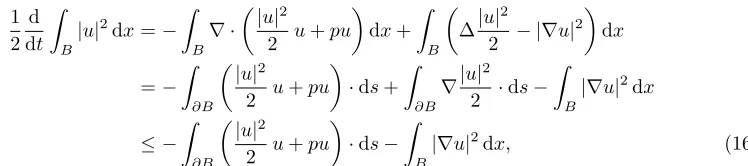
B(x0, r) yields
1 2
d dt
Z
B
|u|2dx=−
Z
B ∇ ·
|u|2
2 u+pu
dx+ Z
B
∆|u|
2
2 − |∇u|
2
dx
=−
Z
∂B
|u|2
2 u+pu
·ds+ Z
∂B ∇|u|
2
2 ·ds− Z
B
|∇u|2dx
≤ −
Z
∂B
|u|2
2 u+pu
·ds−
Z
B
|∇u|2dx, (16)
where∂Bdenotes the spherical boundary ofB. In (16), the divergence theorem has been used and the second surface integral (expected to be non-positive for some small enoughr) in the middle line has been omitted. Given u∈Lq, we have the scalings|u(x0)| ∼ r−3/q,|p| ∼ |u(x0)|2∼r−6/q and |∇u| ∼r−3/q−1. The first and second terms on the right-hand side of the final line scale asr−9/q+2
andr−6/q+1, respectively. In the limitr→0, the latter clearly predominates the former, provided that q >3. Hence,|u(x0)|decays and uremains inLq. Thus, there can be no loss of regularity.
Given a smooth u0(x), a divergence of |u(x0)| ∼ r−3/q by r → 0 without being accompanied
byq→3+ is ruled out by the regularity criterion esssup
(0,t)||u||L3 <∞. Hence a development of singularities would necessarily require|u(x0)|to (strongly) grow via both limitsr→0 andq→3+ in a concurrent fashion. The above arguments are applicable to this growth scenario. The upshot is that for smoothu0(x), highly concentrated momentum in the form|u| ∼r−, even for small >0, may not develop in the first place.
Remark 1. If|u(x0)| ∼r−3/q, forq <3, i.e. u0(x)6∈L3, then the pressure term predominates the viscosity term. The above arguments may not rule out the possibility|u(x0)| → ∞. This can be seen as an explanation for the critical nature of the criterionesssup(0,t)||u||L3 <∞. As we do not expect
Remark 2. Nonlinear depletion of the pressure force manifests itself through cancellation within the surface integral of pu in (16). Indeed, for sufficiently small r, pmay be assumed to have the same sign on ∂B. It then follows that inflow (flow into B) and outflow make contributions of opposite signs to the integral, hence cancelling each other to some extent.
3.2. Basic criteria. This subsection considers the evolution of||u||L3,||u||L4and||ω||L2, from which two regularity criteria are derived. The results feature some improvement over existing ones.
Forq≥3, the evolution of||u||Lq is governed by
||u||qL−q1 d
dt||u||Lq =−
Z
R3
|u|q−2u· ∇pdx+
Z
R3
|u|q−2
∆|u|
2
2 − |∇u|
2
dx (17)
= (q−2) Z
R3
p|u|q−2bu· ∇|u|dx−(q−2) |u|
(q−2)/2
∇|u|
2
L2− |u|
(q−2)/2
∇u
2
L2. Whenq= 3, equation (17) reduces to
d
dt||u||L3 ≤
1
||u||2L3 Z
R3
|p||u||∇|u||dx≤c||u||
3
L6||ω||L2
||u||2L3
≤ c||ω||
4
L2
||u||3L3
||u||L3, (18)
where H¨older’s inequality, (6) and Sobolev’s inequality have been used. Integrating (18) over time yields the following criterion.
Theorem 1. Let uandpsolve the Navier–Stokes equations (1). If
Z t
0
||ω||4L2
||u||3L3
dτ <∞, (19)
then
||u||Lq ≤ ||u0||Lqexp (
c
Z t
0
||ω||4L2
||u||3L3 dτ
)
<∞ (20)
and regularity follows.
This slightly improves a previous result of Ref. [29] by a factor of ||u||−L31. Interestingly, the im-provement is possible by not using the dissipation terms in the evolution equation for||u||L3.
It is beneficial to consider a combination of the evolution equations for||u||L4 and||ω||L2, for the reason to become obvious in due course. Forq= 4, equation (17) becomes
||u||3L4 d
dt||u||L4 = 2
Z
R3
p|u|2
b
u· ∇|u|dx−2|||u|∇|u|||2L2− |||u|∇u||
2
L2
≤2||pu||L2||u· ∇|u|||L2−2|||u|∇|u|||
2
L2− |||u|∇u||
2
L2
≤ 1
2||pu||
2
L2− |||u|∇u||
2
L2. (21)
Meanwhile, equation (11) can be rewritten in the form
1 2
d dt||ω||
2
L2 ≤ ||∆u||L2||(u· ∇)u||L2− ||∆u||
2
L2
≤ ||∆u||L2|||u|∇u||L2− ||∆u||
2
L2
≤ |||u|∇u||2L2− 3 4||∆u||
2
Adding (21) and (22) yields
d dt||u||
4
L4+ 2 d dt||ω||
2
L2 ≤2||pu||
2
L2−3||∆u||
2
L2 ≤c||u||
6
L6−3||∆u||
2
L2
= c||u||
6
L6
||u||4L4+ 2||ω||
2
L2
||u||4L4+ 2||ω||
2
L2
−3||∆u||2L2, (23)
where equation (6) has been used. From this estimate, we have the following theorems.
Theorem 2. Let uandpsolve the Navier–Stokes equations (1). If
Z t
0
||u||6L6
||u||4L4+ 2||ω||
2
L2
dτ <∞, (24)
then both||u||L4 and||ω||L2 remain finite and regularity follows.
Theorem 3. Let uandpsolve the Navier–Stokes equations (1). There existsc >0such that if
||u||L6 ≤c||∆u||
1/3
L2 , (25)
then either ||u||L4 or||ω||L2 (or both) decays and regularity follows.
Remark 3. While both theorems 2 and 3 make use of the dissipation term ||∆u||2L2, the latter
exploits this term more fully than the former.
Remark 4. By settingq= 6 andq0= 3in (11) and after some simple manipulation, we arrive at the conclusion that||ω||L2 decays when||u||L6 ≤c||∆u||
1/4
L2. This means that criterion (25) represents
a “gain” in optimality by a factor of ||∆u||1L/212. This gain is due to the fact that in (22), the vortex
stretching term has been estimated as a quadratic rather than a cubic.
Remark 5. Criterion (25) may be replaced by the following version
Z t
0
||u||6L6dτ ≤c Z t
0
||∆u||2L2dτ. (26)
Remark 6. Criterion (25) remains unchanged under the scalings p(x, t) 7−→ λ2p(λx, λ2t) and u(x, t)7−→λu(λx, λ2t)that render (1) invariant. Interestingly, the quantities on the left- and right-hand sides of (25) are, respectively, of large (u) and very small scales (∆u), in comparison with the small scales represented byω.
Consider the following version of the Gagliardo–Nirenberg inequality
||u||L6 ≤c||∆u||
(6−q)/(6+q)
L2 ||u||
2q/(6+q)
Lq , (27)
which is valid for 1≤q≤6. In what follows, equation (27) is used with q∈(3,6]. We have
Z t
0
||u||6L6 dτ ≤c Z t
0
||∆u||L6(62−q)/(6+q)||u||
12q/(6+q)
Lq dτ
≤c
Z t
0
||∆u||2L2dτ
3(6−q)/(6+q)Z t
0
||u||3Lq/q(q−3)dτ
4(q−3)/(6+q)
, (28)
where H¨older’s inequality has been used. It follows that equation (26) holds if
Z t
0
||u||3Lq/q(q−3)dτ≤c Z t
0
||∆u||2L2dτ. (29)
Corollary 1. Let uandpsolve the Navier–Stokes equations (1). If
Z t
0
||u||3Lq/q(q−3)dτ≤c Z t
0
||∆u||2L2dτ, (30)
then either ||u||L4 or||ω||L2 (or both) decays and regularity follows.
4. Pressure moderation and main results
The pressure pin (1) is determined up to an arbitrary function oft. This uninteresting feature is removed by the condition of decay at infinity. What is remarkable is that in (17),pis determined up to a function ofxand|u|, sayP(x,|u|), which can assume relatively broad forms. As far as the problem of optimal bounds for the pressure term in (17) are concerned, P(x,|u|) presents itself as a powerful tool. The present study considers usingP(x,|u|) to moderatepin the vicinity of peak velocity, where |p| is also expected to peak. Several regularity criteria are derived in terms of the “effective” (moderated) pressurep+P.
We first derive a simple identity concerning the form of P. The result is summarised in the following lemma.
Lemma 1. Let
P(x,|u|) =f(x)g(|u|), where
u· ∇f(x) = 0 and g(|u|)∈C1,
then
Z
R3
P |u|q−2
b
u· ∇|u|dx= 0. (31)
Proof. Let
G(s) = 1
sq−2
Z s
0
ξq−3g(ξ) dξ.
By virtue of∇ ·u= 0 and the hypothesisu· ∇f(x) = 0, we have
∇ · f(x)G(|u|)|u|q−2u
=f(x)u· ∇
Z |u|
0
ξq−3g(ξ)dξ
=f(x)g(|u|)|u|q−2
b
u· ∇|u|. (32)
Integrating (32) overR3 proves the lemma.
Remark 7. Lemma 1 applies to a bounded domain D with nonslip boundary ∂D∈C1.
Recall (17)
||u||qL−q1 d
dt||u||Lq = (q−2)
Z
R3
(p+P)|u|q−2ub· ∇|u|dx (33)
−(q−2) |u|
(q−2)/2∇|u|
2
L2− |u|
(q−2)/2∇u
2
L2,
along streamlines. This appears to be a stiff constraint on f(x), which, nonetheless represents a “degree of freedom” of the moderator. On the other hand, another degree of freedom of the moderator is provided byg(|u|), which can be flexible enough for the intended purpose as it is subject to virtually no conditions, except for decay at infinity as |u| itself. As the very term “moderator” suggests, we are mainly interested inP such that|p+P| ≤ |p|in Ω (ideally|p+P| |p|). Hence we may assume in some subsequent calculations that ||p+P||Lq ≈ ||p||Lq ≤ c||u||
2
L2q. Note that linear combinations of|u|α, for 0≤α≤2, are admissible forms forg(|u|). Of particular interest is
g(|u|) = |u|2, so thatf(x)g(|u|) = f(x)|u|2, which may partially neutralisepin the vicinity of its
minimum (negative) since|u|2 is expected to be comparable to|p|in such vicinity.
It has been widely recognised in the turbulence community that rotation (in conjunction with density stratification) has “regularising effects” on fluid turbulence, by tending to suppress the turbulence in the direction of rotation (and stratification). This phenomenon has been known as two-dimensionalisation. In the present context, regularising effects of rotation may be readily appreciated by the fact that fluid particles are deflected away from the paths of optimal acceleration under the sideways influence of the Coriolis force. Such a force is given by|u|Abu, where A is an anti-symmetric matrix. Now consider the force term |u|2∇f(x), which, when added to (1), has
similar effects as |u|Aub (in the sense that both are perpendicular tou), albeit relatively stronger due to its quadratic rather than linear dependence on |u|. The moderator f(x)|u|2 can be seen to
be attributable to the force term |u|2∇f(x). This gives some insight into the pressure term and
the present notion of pressure moderation.
In order to fully exploitP, we divide space into regions of high and low velocity. Similar to Tran and Yu [29], we consider a partition ofR3in the following manner. Forq≥3, let Ω⊂
R3 be such
that the following conditions hold.
• |u|> c q2
||u||q/βL3q−γ
||p+P||2L2||u||
qα/β L2
!1/(q−2)
, forx∈Ω;
• |u| ≤ c
q2
||u||q/βL3q−γ
||p+P||2L2||u||
qα/β L2
!1/(q−2)
, forx∈Ωc=R3\Ω.
Here γ > 0 is a parameter (to be determined shortly) and α and β are (two H¨older conjugate exponents appearing in a H¨older inequality below) given by
α= 2γ
(3q−γ)(3q−2) and β=
3q(3q−γ−2) (3q−γ)(3q−2).
Hereafter, the above partition is referred to as Pfor convenience. For q = 3 we set γ = 5. The bound for|u|inPthen becomes (constants omitted)
||u||14L4/3
||p+P||2L2||u||
5/3
L2
≥ ||u||
14/3
L4
c||u||4L4||u||
5/3
L2
= ||u||
2/3
L4
c||u||5L/23
≥ ||u||L3
c||u||2L2
.
Hence Ω consists of regions with velocity of order||u||L3. Meanwhile, forq≥4 we setγ = 6. The bound for|u|inPthen becomes (again constants omitted)
||u||L(q3q−−2)(36 q−2)/(3q−8)
||p+P||2L2||u||
4/(3q−8)
L2
!1/(q−2)
≥ ||u||
(q−2)(3q−2)/(3q−8)
L3q−6
c||u||4L4||u||
4/(3q−8)
L2
!1/(q−2)
≥ ||u||L3q−6
c||u||2L2
This ensures that Ω consists of regions with velocity of order ||u||L3q−6. Note that in the limit
q→ ∞, the bound inPtends to||u||L∞.
Remark 8. The assumption ||p+P||L2 ≤ c||u||
2
L4 is necessary for the case q = 3 to ensure that Ω consists of regions with velocity in the order of ||u||L3. When q ≥4, this assumption means Ω
consists of regions with velocity in the order of||u||L3q−6. It follows that if we just require the velocity
in Ωto be in the order of||u||Lq, then the requirement on||p+P||L2 can be a bit more relaxing.
It can be seen thatPis designed in such a way that the contribution from the region Ωc to the
pressure term in (33) can be cancelled out by the dissipation terms. Hence the contribution from Ω is solely responsible for growth of||u||Lq. Indeed, we have
Z
Ωc
(p+P)|u|q−2
b
u· ∇|u|dx≤
Z
Ωc
(p+P)2|u|q−2dx
1/2 |u|
(q−2)/2∇|u|
L2 ≤ c q
||u||q/L3q(2−βγ)
||u||qα/L2 (2β) |u|
(q−2)/2∇|u|
L2 ≤ c
q||u||
q/2 L3q |u|
(q−2)/2∇|u|
L2 ≤c |u|
(q−2)/2
∇|u|
2
L2, (34)
where the H¨older inequality
||u||L3q−γ ≤ ||u||
α L2||u||
β L3q
and (7) have been used. Substituting (34) into (33) yields
||u||qL−q1 d
dt||u||Lq ≤(q−2)
Z
Ω
(p+P)|u|q−2
b
u· ∇|u|dx−c(q−2) |u|
(q−2)/2∇|u| 2 L2 − |u|
(q−2)/2
∇u 2
L2. (35)
The integral over Ω (by itself or in conjunction with the dissipation terms) is susceptible of several different estimates, the relative optimality of which is not known a priori. In what follows, we consider two estimates, each with a reasonable “weight” on the effective pressure, banking on the possibility that this pressure can be made moderate in Ω.
The case q = 3 admits a special estimate, which deserves separate attention. Otherwise, we handle all cases q≥3 together. Forq= 3, equation (35) becomes
||u||2L3 d
dt||u||L3 ≤
Z
Ω
(p+P)|u|ub· ∇|u|dx−c
|u|
1/2∇|u|
2
L2− |u|
1/2∇u 2 L2 ≤ Z Ω
(p+P)4dx
1/4
||u||1L/22 |u|
1/2∇|u|
L2 −c |u|
1/2∇|u|
2
L2− |u|
1/2∇u
2
L2, (36)
Theorem 4. Let uandpsolve the Navier–Stokes equations (1). If
Z
Ω
(p+P)4dx≤c |u|
1/2
∇u 4
L2, (37)
whereΩis defined by partition PandP is described by lemma 1, then||u||L3 decays and regularity
follows.
Remark 9. The criterion in theorem 4 can be stated in the form
Z t
0
Z
Ω
(p+P)4dx
1/2 dτ≤c
Z t 0 |u|
1/2∇u
2
L2dτ.
We now considerq≥3, with an emphasis on the limit of largeq. This limit is appealing since Ω reduces in size, to a point if|u|peaks at a single point. Intuitively,pwill be easier to moderate in this limit. The price is the magnitude ofq, which appears in the results. This turns out to be an issue unresolved in the present study. A similar issue involving the limitq→ ∞is discussed in some detail in Ref. [29].
From (35) we have
||u||qL−q1 d
dt||u||Lq ≤(q−2)
Z
Ω
|p+P|3
|u|3 dx
1/3
||u||q/L3q2 |u|
(q−2)/2
∇u L2
−c(q−2) |u|
(q−2)/2∇|u|
2
L2− |u|
(q−2)/2∇u 2 L2
≤c0q(q−2) Z
Ω
|p+P|3
|u|3 dx
1/3 |u|
(q−2)/2∇u 2 L2
−c(q−2) |u|
(q−2)/2∇|u|
2
L2− |u|
(q−2)/2∇u
2
L2, (38)
where H¨older’s inequality and (7) have been used. This result immediately implies the following theorem.
Theorem 5. Let uandpsolve the Navier–Stokes equations (1). There isc >0such that if
Z
Ω
|q(p+P)|3
|u|3 dx≤c, (39)
where Ω is defined by partition P and P is given by lemma 1, then ||u||Lq decays and regularity
follows.
In the limit q→ ∞, Ω reduces to the point(s) of peak |u|. Hence, its measure, say |Ω|, tends to zero. An obvious moderation scheme is such that p→ −P, i.e. p+P → 0 toward peak |u|. Regularity requires this approach and|Ω| →0 to be rapid enough, so that the integral in (39) tends to zero. Now, consider a finite q≥3. In the limit ||u||Lq → ∞, we also have |Ω| →0. It follows that if|p+P| ≈ |u|5/3in Ω, then
Z
Ω
|p+P|3
|u|3 dx≈
Z
Ω
|u|2dx→0.
Therefore, equation (39) holds and regularity is secured. In other words, a moderation scheme that brings |p| from, presumably, |u|2 down to |u|5/3 is required. It is possible to reformulate theorem
The preceding result has made use of estimates that decouple all factors in the pressure term. In what follows, we keepp+P andbu· ∇|u|together, for the reason to become obvious shortly. Thus, instead of (38) we have
||u||qL−q1 d
dt||u||Lq ≤(q−2)
Z
Ω p+P
|u|2 |u|
q
b
u· ∇|u|dx
−c(q−2) |u|
(q−2)/2∇|u|
2
L2− |u|
(q−2)/2∇u
2 L2
≤(q−2) Z Ω
p+P
|u|2 bu· ∇|u|
3/2
dx
!2/3
||u||qL3q
−c(q−2) |u|
(q−2)/2∇|u|
2
L2− |u|
(q−2)/2∇u 2 L2
≤c0q2(q−2) Z Ω
p+P
|u|2 ub· ∇|u|
3/2
dx
!2/3 |u|
(q−2)/2
∇|u| 2 L2
−c(q−2) |u|
(q−2)/2∇|u|
2
L2− |u|
(q−2)/2∇u
2
L2, (40)
where H¨older’s inequality and (7) have been used. This result immediately implies the following theorem.
Theorem 6. Let uandpsolve the Navier–Stokes equations (1). There isc >0 such that if
Z Ω
q2p+P
|u|2 ub· ∇|u|
3/2
dx≤c, (41)
where Ω is defined by partition P and P is given by lemma 1, then ||u||Lq decays and regularity
follows.
In the limitq → ∞, we have ub· ∇|u| →0 and |Ω| → 0. As in the preceding case, we seek an admissibleP such thatp+P →0 toward peak|u|. We then have bothp+P →0 andbu· ∇|u| →0, together with |Ω| → 0, against q → ∞. Now, consider a finite q ≥3 and the limit ||u||Lq → ∞. Suppose that there exists a moderation scheme that results in|(p+P)bu· ∇|u|| ≈ |u|10/3in Ω. Then
Z Ω
p+P
|u|2 ub· ∇|u|
3/2
dx≈
Z
Ω
|u|2dx→0.
Therefore, equation (41) holds and regularity is secured. Note that in this case, the above scheme that p+P vanishes toward peak|u|may still work, although the focus of the present moderation is “off peak” rather than “on peak” velocity.
Finally, we modify the calculations leading to theorems 2 and 3 with a pressure moderator. By combining (22) with (35), we obtain
d dt
||u||4L4+ 2||ω||
2 L2 ≤8 Z Ω
(p+P)|u|2
b
u· ∇|u|dx−8c|||u|∇|u|||2−3||∆u||2L2
≤c
Z
Ω
(p+P)2|u|2dx− ||∆u||2
L2, (42)
Theorem 7. Let uandpsolve the Navier–Stokes equations (1). If
Z
Ω
(p+P)2|u|2dx≤c||∆u||2
L2, (43)
where Ωis defined by partition P and P is described by lemma 1, then either ||u||L4 or ||ω||L2 (or
both) decays and regularity follows.
Remark 10. The criterion in theorem 7 can be stated in the time-average sense.
We conclude this study with some remarks on a possible pressure moderation scheme. Note that an alternative notion of pressure moderation is that of pressure approximation in terms of a moderatorf g. Intuitively, detailed knowledge of the relation betweenpand|u|within Ω is crucial for the approximation process. In general, available information on such relation is provided by (2), (3), (4) and (5), where equation (2) can also be expressed in the form
∆
p+|u|
2
2
=∇ ·(u×ω). (44)
Ideally, if the Poission equation (44) can be solved and its solution can be approximated in terms off g, then we have a moderator. In unfavourable circumstances, the following scheme merits some thoughts and further investigation.
For simplicity we consider the simple moderator f(x)|u|2 and assume that|u|peaks at a single
pointx0. Consider a simple surfaceS(a plane for example) passing throughx0. For eachx∈S∩Ω,
let`xbe the portion of the streamline passing throughxand contained within Ω. Now fory∈`x,
we define
f(y) =−
R
`xp(y) d` R
`x|u(y)|
2d`.
It follows that
p(x) +f(x)|u(x)|2= 0,
forxon a surface in Ω. Note that sincef(x) is constant on`x, we haveu· ∇f(x) = 0 as required.
This makesP =f(x)|u|2a plausible moderator.
5. Concluding remarks
For Navier–Stokes flows evolving from sufficiently regular initial velocity fields, the criterion
||u||L3 <∞unambiguously implies that no loss of regularity occurs ifuremains in L3. This study aims to understand the question of whether or not the pressure force is capable of “driving” a sufficiently regular velocity field u out of L3. An almost negative answer has been deduced on the basis of semi-analytic arguments. An effective pressure has been introduced via an additive moderator to replace the genuine pressure in the term that drives the dynamics of ||u||Lq, for
q≥3. This approach allows one to vary the moderator within its admissible classes in the search for optimal bounds for that driving term. New regularity criteria have been derived by standard energy method with and without pressure moderation. In the absence of the moderator, some slight improvement on existing results has been achieved by considering the evolution of the hybrid quantity||u||4L4 + 2||ω||
2
moderator has been considered. The results appear promising, pending theoretical establishment of an effective moderation scheme.
Acknowledgments. This paper was presented at the 3rd Scottish PDE Colloquium (Strathclyde) under the title “A physicist’s approach to Navier–Stokes regularity.”
References
[1] Beirao da Veiga H and Berselli L C2002 On the regularizing effect of the vorticity direction in incompressible
viscous flowsDiff. Integral Eqns15345–356
[2] Berselli L C 2009 Some geometric constraints and the problem of global regularity for the Navier–Stokes equationsNonlinearity 222561–2581
[3] Berselli L C and Galdi G P 2002 Regularity criteria involving the pressure for the weak solutions to the Navier–Stokes equationsProc. Amer. Math. Soc.1303585–3595
[4] Caffarelli L, Kohn R and Nirenberg L1982 Partial regularity of suitable weak solutions of the Navier–Stokes equationsCommun. Pure Appl. Math.35771–831
[5] Cao C2010 Sufficient conditions for the regularity to the 3DNavier-Stokes equations Discrete Contin. Dyn. Syst.261141–1151
[6] Cao C and Titi E S2008 Regularity criteria for the three-dimensional Navier–Stokes equationsIndiana Univ. Math. J.572663–2680
[7] Cao C and Titi E S2011 Global regularity criterion for the 3D Navier–Stokes equations involving one entry of the velocity gradient tensorArch. Ration. Mech. Anal.202919–932
[8] Chae D and Lee J2001 Regularity in terms of pressure for the Navier–Stokes equationsNonlinear Anal.46
727–735
[9] Chan C H and Yoneda T2012 On possible isolated blow-up phenomena and regularity criterion of the 3D
Navier-Stokes equation along the streamlinesMethods Appl. Anal.19211–242
[10] Constantin P and Fefferman C 1993 Direction of vorticity and the problem of global regularity for the
Navier-Stokes equationsIndiana Univ. Math. J.42775–789
[11] Constantin P, Fefferman C and Majda A1996 Geometric constraints on potentially singular solutions for the 3D Euler equationsCommun. Partial Diff. Eqns21559–571
[12] Deng J, Hou T and Yu X2005 Geometric properties and nonblowup of 3D incompressible Euler flowCommun. Partial Diff. Eqns 30225–243
[13] Deng J, Hou T and Yu X2006 Improved geometric conditions for non-blowup of the 3D incompressible Euler equationCommun. Partial Diff. Eqns31293–306
[14] Escauriaza L, Seregin G A and Sver´ak V2003 L3,∞-solutions of Navier–Stokes equations and backward
uniquenessUspekhi Mat. Nauk.583–44
[15] Fan J, Jiang S, Nakaruma G and Zhou Y2011 Logarithmically improved regularity criteria for the Navier– Stokes and MHD equationsJ. Math. Fluid Mech.13557–571
[16] Giga Y1986 Solutions for semilinear parabolic equations inLpand regularity of weak solutions of the Navier– Stokes equationsJ. Diff. Eqns62186–212
[17] Gruji Z and Zhang Q S2006 Space-time localization of a class of geometric criteria for preventing blow-up in the 3D NSECommun. Math. Phys.262555–564
[18] Kato T and Ponce G1988 Commutator estimates and the Euler and Navier–Stokes equationsCommun. Pure Appl. Math.41891–907
[19] Katz N and Pavlovic N2002 A cheap Caffarelli–Kohn–Nirenberg inequality for the Navier–Stokes equation
with hyper-dissipationGeom. Funct. Anal.12355–379
[20] Kukavica I and Ziane M 2006 One component regularity for the Navier–Stokes equationsNonlinearity 19
453–469
[21] Kukavica I and Ziane M 2007 Navier-Stokes equations with regularity in one directionJ. Math. Phys.48
065203
[22] Ladyzhenskaya O A1967 On uniqueness and smoothness of generalized solutions to the Navier–Stokes equa-tionsZapiski Nauchn. Seminar POMI 5169–185
[25] Seregin G and Sver´ak V 2002 Navier–Stokes equations with lower bounds on the pressureArch. Ration. Mech. Anal.16365–86
[26] Serrin J1962 On the interior regularity of weak solutions of the Navier–Stokes equationsArch. Ration. Mech. Anal.9187–195
[27] Struwe M1988 On partial regularity results for the Navier–Stokes equationsCommun. Pure and Appl. Math.
41437–458
[28] Tao T2009 Global regularity for a logarithmically supercritical hyperdissipative Navier–Stokes equationAnal. Partial Diff. Eqns 2361–366
[29] Tran C V and Yu X2015 Depletion of nonlinearity in the pressure force driving Navier–Stokes flows Nonlin-earity281295–1306
[30] Tran C V and Yu X2016 Regularity of Navier–Stokes flows with bounds for the pressureJ. Math. Fluid Mech.
submitted
[31] Vasseur A2009 Regularity criterion for 3D Navier-Stokes equations in terms of the direction of the velocity
Appl. Math.5447–52.
[32] Zhou Y2002 A new regularity criterion for the Navier-Stokes equations in terms of the gradient of one velocity
componentMethods Appl. Anal.9563–578
[33] Zhou Y 2005 On regularity criteria in terms of pressure for the Navier–Stokes equations inR3 Proc. Amer.
Math. Soc.134149–156
[34] Zhou Y 2005 A new regularity criterion for the Navier–Stokes equations in terms of the vorticity direction
Monatsh. Math.144251–257
[35] Zhou Y and Pokorny M2010 On the regularity of the solutions of the Navier–Stokes equations via one velocity componentNonlinearity 231097–1107
Chuong V. Tran: School of Mathematics and Statistics, University of St Andrews, St Andrews KY16 9SS, United Kingdom
E-mail address:[email protected]
Xinwei Yu: Department of Mathematical and Statistical Sciences, University of Alberta, Edmonton, AB, T6G 2G1, Canada
![Bis(propan 2 yl) [(2S,3S) 2 hydroxy 3 nitrobutan 2 yl]phosphonate](data:image/gif;base64,R0lGODlhAQABAIAAAP///wAAACH5BAEAAAAALAAAAAABAAEAAAICRAEAOw==)