STATIC CONTEXT MODEL FOR
CONTEXT AWARE E-LEARNING
Minu. M. Das*
Department of Computer Science and Engineering, Pondicherry University Pondicherry, India
Dr. T. Chithralekha
Department of Banking Technology, Pondicherry University Pondicherry, India
Dr. S. SivaSathya
Department of Computer Science and Engineering, Pondicherry University Pondicherry, India
Abstract:
Context aware E-Learning systems provide learning content according to a learner’s context. In order to determine a learner’s context, the parameters that constitute the context and the values of these parameters in the current learner’s situation have to be found. There are several existing context aware E-Learning systems and each of these are taking care of some of the context parameters - like learning styles, learner preferences etc. But, a standardized static context model that helps to capture a learner’s context in its entirety is not available. This paper proposes a static context model that helps to capture a learner’s context. The static context model is developed by consolidating the various context parameters used in the existing context aware E-Learning systems and organizing them into an appropriate structure. The structure of the static context model along with the parameters that constitute the context is explained in the paper
Keywords: E-Learning; personalized E-Learning; context aware E-Learning; context models.
1. Introduction
In traditional teaching, the tutor will give information and resources such as text books to the learner and the learner should follow that particular sequence to learn the materials. But nowadays, E-Learning is becoming popular. In E-Learning a learner can study the materials according to his/her interest. Most of the E-Learning systems are not personalized. Through personalized E-Learning systems the learner can get the information according to his/ her pre knowledge, skill, interests etc. Learner’s context should be taken care for personalizing the E-Learning system.
This paper proposes a static context model which could be used to develop a context aware E-Learning system. The static context model has been developed by compiling the various parameters proposed in the existing context-aware E-Learning systems. These parameters are organized into three sub-contexts namely the Situation Context, Abstraction Contexts and Personal Context. Using this static context model, an evaluation of the context models of the existing context-aware E-Learning systems has been carried out. This evaluation helps to evince the inadequacies of the existing context models in capturing a learner’s context.
Section 2 describes the context-aware E-Learning system. Section 3 provides an overview of the existing works in context aware E-Learning systems. Section 4 explains the newly proposed static context model for context aware E-Learning system. Section 5 provides the evaluation of existing context models against the static context model described in this paper. Section 6 gives the conclusion.
2. Context Aware E-Learning Systems
This section describes about E-Learning, personalized E-Learning and context aware E-Learning.
2.1. E-Learning
By Derek (2003) E-Learning is defined as “the delivery of a learning, training or education program by electronic means. E-Learning involves the use of a computer or electronic device (e.g. a mobile phone) in some way to provide training, educational or learning material”. E-Learning can involve a greater variety of equipment than online training or education, for as the name implies, online involves using the Internet or an Intranet. CD-ROM and DVD can be used to provide learning materials. Distance education provided the base for E-Learning development. E-Learning can be on demand. It overcomes timing, attendance and travel difficulties. Plain E-Learning systems cannot adapt to a learner’s learning requirements. Hence, E-Learning systems evolved and personalized E-Learning systems which enable customized E-Learning for every learner came into existence
2.2. Personalized E-Learning
Thyagharajan & Nayak (2007) described personalized E-Learning as a unique, blended educational model that is tailored to the individual learner’s needs and interests. Personalized learning can be used for developing the individual learning programs and also engage these learners into the learning process so that learner’s learning potentials and success can be optimized. Personalized learning should not be restricted by time, place and learner’s other requirements. Personalized E-Learning is mostly focusing on learner’s preferences and current state of a learner to provide the learning content correctly. It does not focus on the learner’s situation. Hence, context- aware E-Learning systems which consider a learner’s situation also were developed. These came to be called as context-aware E-Learning systems.
2.3. Context Aware E-Learning
A context aware E-Learning system considers many parameters that contribute for a learner’s contexts. By using these context parameters, the system will give customized information to the user. The definition of context given by ubiquitous computing community as “Context is any information that can be used to characterize the situation of an entity. An entity is a person, place, or object that is considered relevant to the interaction between a user and an application, including the user and applications themselves.”
Context aware E-Learning systems select or filter the learning resources in order to make the E-Learning content more relevant and suitable for the learner in his/her situation. The selection or filtering of the E-Learning resources is done by considering the learner’s personal information, learning style preferred by him, learner’s situation, etc. These parameters constitute for the learner’s context.
There are many works done on context aware E-Learning systems and in each of them certain subset of parameters are considered for the context. In the subsequent section the context parameters used in existing context aware E-Learning systems are described.
3. Context Parameters in Existing Context-Aware E-Learning
Learner personal profile Level of Expertise Learning Style
Learner Preferences or Learner Approach Learner Intention
Learner Situation
Quality of Learning Service (QoLS) Network
Device
3.1. Learner personal profile
Learner’s personal profile contains learner’s personal details such as name, ID, Date of Birth, Knowledge of the learner etc.
3.2. Learner’s Level of Expertise
Level of expertise is used to indicate whether the person is a beginner or that learner has some pre-knowledge about a topic or the learner is an expert in that topic.
3.3. Learning Style
Learning Style corresponds to media used by the learner for learning his/her lessons. The media can be video, audio, textual, animation etc.
3.4. Learner’s Preferences
Most of the existing systems are focusing on Learner’s preferences. Learner’s preferences described in these papers correspond to the conceptual, example-oriented, case study or problem-oriented, demonstration, simulation approaches preferred by the learner for learning the e-content.
3.5. Learner’s Intention
Learner’s intention means in what intention the learner is coming for E-Learning site. The learner can come for research purpose or survey purpose or interview purpose or just to learn the concept etc.
3.6. Learner’s Situation
Learner’s situation defines the situation of the learner. The learner might be driving some vehicle or he/she might be in private place or in public place etc. The learner’s location details are also included in learner’s situation.
3.7. Quality of Learning Service (QoLS)
QoLS contains functional and non functional quality requirements. The functional requirements are network bandwidth and response time. Non- functional requirements are reliability, availability and cost.
3.8. Network
Network can be wired network or wireless network. 3.9. Device
The device used by learner can be mobile, PC, Laptop, PDA etc.
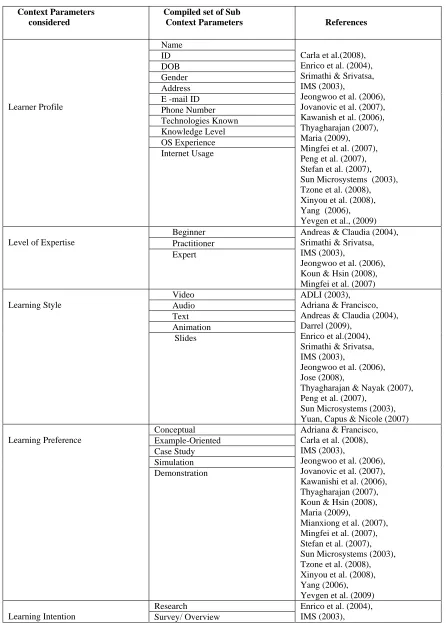
Table 1. List of context parameters.
Context Parameters considered
Compiled set of Sub
Context Parameters References
Learner Profile
Name
Carla et al.(2008), Enrico et al. (2004), Srimathi & Srivatsa, IMS (2003),
Jeongwoo et al. (2006), Jovanovic et al. (2007), Kawanish et al. (2006), Thyagharajan (2007), Maria (2009), Mingfei et al. (2007), Peng et al. (2007), Stefan et al. (2007), Sun Microsystems (2003), Tzone et al. (2008), Xinyou et al. (2008), Yang (2006), Yevgen et al., (2009) ID
DOB Gender Address E -mail ID Phone Number Technologies Known Knowledge Level OS Experience Internet Usage
Level of Expertise
Beginner Andreas & Claudia (2004),
Srimathi & Srivatsa, IMS (2003),
Jeongwoo et al. (2006), Koun & Hsin (2008), Mingfei et al. (2007) Practitioner
Expert
Learning Style
Video ADLI (2003),
Adriana & Francisco, Andreas & Claudia (2004), Darrel (2009),
Enrico et al.(2004), Srimathi & Srivatsa, IMS (2003),
Jeongwoo et al. (2006), Jose (2008),
Thyagharajan & Nayak (2007), Peng et al. (2007),
Sun Microsystems (2003), Yuan, Capus & Nicole (2007) Audio
Text Animation Slides
Learning Preference
Conceptual Adriana & Francisco,
Carla et al. (2008), IMS (2003),
Jeongwoo et al. (2006), Jovanovic et al. (2007), Kawanishi et al. (2006), Thyagharajan (2007), Koun & Hsin (2008), Maria (2009),
Mianxiong et al. (2007), Mingfei et al. (2007), Stefan et al. (2007), Sun Microsystems (2003), Tzone et al. (2008), Xinyou et al. (2008), Yang (2006), Yevgen et al. (2009) Example-Oriented
Case Study Simulation Demonstration
Learning Intention
Research Enrico et al. (2004),
Quick Reference Thyagharajan (2007), Yang (2006)
Basic Introduction Project
Assignment Seminar
Learner Situation
Private Bill et al. (1994),
Carla et al. (2008), Jovanovic et al. (2007), Kawanishi et al. (2006), Koun & Hsin (2008), Maria (2009), Mingfei et al. (2007) Public
Driving
QoLS Functional Requirement
Bill et al. (1994) Carla et al. (2008) Non- Functional
Requirement
Network
Wired Bill et al. (1994),
Carla et al. (2008), Jovanovic et al. (2007), Kawanishi et al. (2006), Mianxiong et al. (2007), Mingfei et al. (2007), Yevgen et al. (2009), Yuan et al. (2007), Zhu (2009) Wireless
Device
Mobile Bill et al. (1994),
Carla et al. (2008), Jovanovic et al. (2007), Kawanishi et al. (2006), Koun & Hsin (2008), Maria (2009),
Mianxiong et al. (2007), Mingfei et al. (2007), Yuan et al. (2007), Zhu (2009) PC
Laptop PDA
From an analytical perspective, the existing works helps to obtain a complete overview of the various aspects to be considered for providing context-aware E-Learning content to the user. But, considering from a critical perspective, the following are the limitations observed.
Static context model is not followed.
In certain works, only some of the contexts parameters are considered.
In certain works, only some of the Sub context parameters are taken into consideration.
Since a static model which encompasses the entire set of context parameters that will not change for E- Learning course session is yet to be formulated, the same has been taken up as the objective of this work. The details of the context model are described in the subsequent section.
4. Static Context Model for Context Aware E-Learning
a learner’s context comprehensively. This is achieved by consolidating the various context parameters and organizing them into appropriate sub-contexts. This process is explained below. The context parameters described in Table 1 has been segregated into the following sub-contexts
Personal Context
Abstraction Context Situation Context
4.1. Personal Context
Personal context is giving the information about the learner’s personal details, personality type and level of expertise of the learner.
4.2. Abstraction Context
Abstraction context contains the information about learning approach or preferences, learner’s intention and learning style.
4.3. Situation Context
The situation context describes the information about the learner’s situation, network and device used by the user.
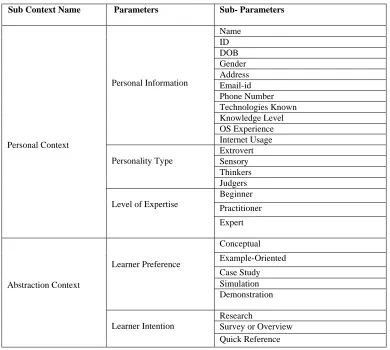
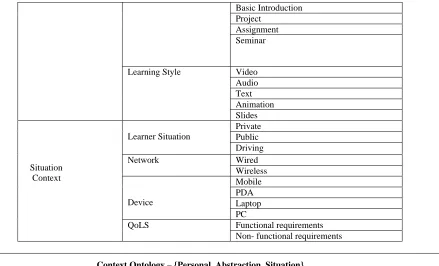
The organized set of context parameters classified under appropriate sub-contexts constitute for the static model. This is given in Table 2. The context model has been represented in a formalized manner in Figure 1 of representing the context model is given below.
Table 2. Structured set of contexts
Sub Context Name Parameters Sub- Parameters
Personal Context
Personal Information
Name ID DOB Gender Address Email-id Phone Number Technologies Known Knowledge Level OS Experience Internet Usage
Personality Type
Extrovert Sensory Thinkers Judgers
Level of Expertise
Beginner
Practitioner
Expert
Abstraction Context
Learner Preference
Conceptual
Example-Oriented
Case Study Simulation Demonstration
Learner Intention
Research
Basic Introduction Project
Assignment Seminar
Learning Style Video
Audio Text Animation Slides
Situation Context
Learner Situation
Private Public Driving
Network Wired Wireless
Device
Mobile PDA Laptop PC
QoLS Functional requirements
Non- functional requirements
Context Ontology – {Personal, Abstraction, Situation}
Personal – {Personal Information, Personality Type, Level of Expertise}
Personal Information {Name, ID, DOB, Gender, Address, Email-id, Phone Number, Technologies
Known, Knowledge Level, OS Experience, Internet Usage}
Personality Type {Extrovert, Sensory, Thinkers, Judges}
Level of Expertise {Beginner, Practitioner, Expert}
Abstraction - {Learner’s Preference, Learner’s Intension, Learning Style}
Learner’s Preference {Conceptual, Example- Oriented, Case Study, Demonstration, Simulation}
Learner’s Intension {Research, Survey, Quick Reference, Basic Introduction, Project, Assignment, Seminar}
Learning Style {Video, Audio, Text, Animation}
Situation – {Learner’s Situation, QoLS, Network, Device}
Learner’s Situation {Public, Private, Driving}
QoLS {Functional Requirements, Non-Functional Requirements}
Functional Requirements {Bandwidth, Response Time}
Non-Functional Requirements {Reliability, Availability, Cost}
Network {Wired, Wireless}
Device {Mobile, PDA, Laptop, PC}
The static context model is a standardized one helping to establish a learner’s context comprehensively. Thus, it provides a reference structure which could be used to develop context-aware E-Learning systems.
5. Evaluations
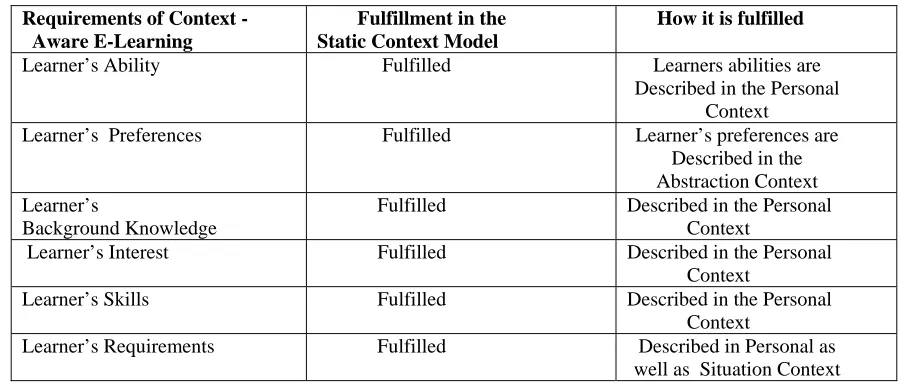
In this section, the evaluation of the static context model is performed by considering the requirements to be fulfilled by context aware E-Learning systems. This is given in Table 3.
Table 3. Fulfillment of context aware requirements by the proposed system
Requirements of Context - Aware E-Learning
Fulfillment in the Static Context Model
How it is fulfilled
Learner’s Ability Fulfilled Learners abilities are Described in the Personal
Context
Learner’s Preferences Fulfilled Learner’s preferences are Described in the Abstraction Context Learner’s
Background Knowledge
Fulfilled Described in the Personal Context
Learner’s Interest Fulfilled Described in the Personal Context
Learner’s Skills Fulfilled Described in the Personal Context
Learner’s Requirements Fulfilled Described in Personal as well as Situation Context Subsequently, an evaluation of the context models of the existing E-Learning systems against the static context model has been carried out. This is given in Table 4. Table 4. shows the whether the existing systems are satisfying the contexts parameters of the static context which is described in this paper.
Table 4: Comparison of standard context model with existing context models
Existing Systems
Personal Awareness
Abstraction Awareness
Situation Awareness
Total Score
ADLI, 2003 2
Adriana & Francisco 1
Andreas, 2007 2
Andreas, 2004 1
Bill et al., 1994 1
Carla et al., 2008 1
Darrel, 2009 2
Enrico et al.,2004 2
Srimathi & Srivatsa 2
IMS, 2003 2
Jeongwoo et al., 2006 1
Jose et al., 2008 2
Jovanovic et al., 2007 2
Kawanishi et al., 2006 2
Thyagharajan, 2007 2
Koun & Hsin, 2008 2
Lanzilotti et al., 2006 2
Maria, 2009 2
Mianxiong et al., 2007 1
Peng et al., 2007 2
Stefan et al., 2007 1
Sun icrosystems,2003 2
Tzone et al., 2008 1
Xinyou et al., 2008 2
Yang, 2006 2
Yang et al., 2006 2
Yevgen et al., 2009 2
Yuan et al., 2007 2
Zhu, 2009 2
Proposed System 3
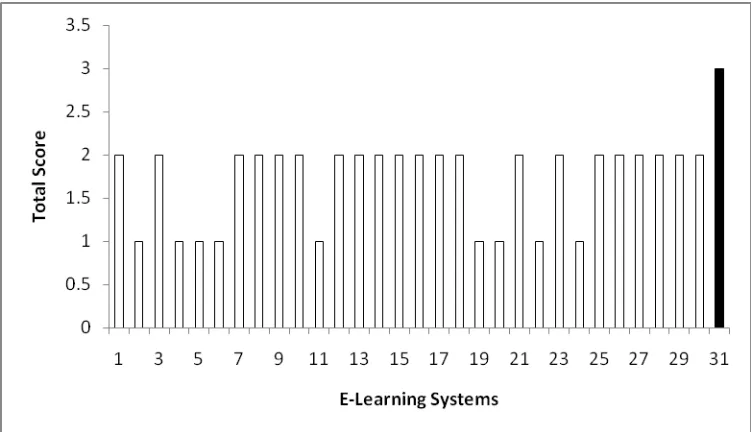
The total score is given based on the context parameters fulfilled. Figure 2 shows the graphical representation of the evaluation. The X coordinate represents the E-Learning systems and Y coordinate represents the Total value that each system obtained. Most of the existing systems are satisfying only 2 context parameters described in the proposed context model. But proposed static context model contains value 3 which is shown in black shade satisfies all the context parameters.
Fig 2. Graphical representation of evaluation of Context models in existing e-learning systems against static context model
6. Conclusion
This paper describes a static context model for context aware E-Learning systems. The context is organized into three sub-contexts namely personal context, abstraction context and situation context that will not change in the entire learning course session. In context aware E-Learning systems, the system will give highly customized content to the learner based on the context. However, this paper does not consider about the psychological aspects and user’s cognitive level and also the dynamic contexts. In future psychological aspects, user’s cognitive level details and dynamic contexts can also be included in the context model.
References
[1] ADLI. (2003): Sharable Content Object Reference Model (SCORM), Advanced Distributed Learning Initiative.
[2] Adriana, B., & Francisco J. G. Towards reusable Adaptive Rules.
[3] Andreas, S. (2007): IMPACT OF CONTEXT-AWARENESS ON THE ARCHITECTUREOF LEARNING SUPPORT SYSTEMS, Architecture solutions for E-Learning systems, Idea- Group Publishing.
[4] Andreas, S. and Claudia, W. (2004): User Context Aware Delivery of E-Learning Material: Approach and Architecture, Journal of
[5] Bill N, S, Norman, A and Roy, Want. (1994): Context-Aware Computing Applications, IEEE Workshop on Mobile Computing Systems and Applications.
[6] Carla, L., Filippo, S., Marco, T., and Giulia, V. (2008): Adaptive Learning with the LS-Plan System: a Field Evaluation, IEEE Transaction on Learning Technologies.
[7] Darrel, W. (2009): E-Learning, Semantic Web Services and Competency Ontologies, IEEE First International Workshop on Education Technology and Computer Science, pp. 233-237.
[8] Derek, S. (2003): E-Learning Definition and Explanation (Elearning, Online Training, Online Learning)
[9] Dey, and Anind, K. (2001): Understanding and Using Context, Personal Ubiquitous Computing, 5(1), pp. 4–7.
[10] Enrico, R., George, N., Giovanni, C., Eleftherios, K., and Sofia, K. (2004): Context for Simplicity: A Basis for Context-aware
Systems Based on the 3GPP Generic User Profile, International Journal of Computational Intelligence, 1(1), pp 1-12.
[11] Howe, D. (2006): Free online dictionary of computing, Imperial College Department of Computing London, UK. [12] H. Srimathi, Srivatsa, S.K. Identification of ontology based learning object using instructional design.
[13] IMS Global Learning Consortium, (2003):IMS Abstract Framework: White paper.
[14] Jeongwoo, Ko., Fumihiko, M., Teruko, M., Eric, N., Masahiko, T., and Ichiro, A. (2006): Context-Aware Dialog Strategies for Multimodal Mobile Dialog Systems, Journal on AAAI.
[15] Jose, M., Juan, A., Luis, G., and Francisco, V. (2008): Creating adaptive learning paths using Ant Colony Optimization and Bayesian Networks, IEEE International Joint Conference on Neural Networks (IJCNN 2008), pp.3834-3839.
[16] Jovanovic, J., Gasevic, D., Knight, C., and Richards, G. (2007): Ontologies for Effective Use of Context in E-Learning Settings, Educational Technology & Society, 10(3), pp. 47-59.
[17] Kawanishi, N. Jin, K.S. Si, H. Kawahara, Y. and Morikawa, H. (2006): Building Context-Aware Applications and Probe Space Infrastructure,IEEE International Symposium on Intelligent Signal Processing and Communications, pp.103-106.
[18] K.K. Thyagharajan and Ratnamanjari Nayak. (2007): Adaptive Content Creation for Personalized E-Learning Using Web Services, Journal of Applied Sciences Research, 3(9) pp. 828-836.
[19] Koun-Tem Sun, Hsin-Te Chan. (2008): The Study of Using Sure Stream to Construct Ubiquitous Learning Environment, 2008 IEEE International Conference on Sensor Networks, Ubiquitous, and Trustworthy Computing, pp.534-548.
[20] Lanzilotti, R., Ardito, C., Costabile, M. F., and De Angeli, A. (2006): eLSE Methodology: a Systematic Approach to the E-Learning Systems Evaluation, Educational Technology & Society, 9(4), pp. 42-53.
[21] Maria, Z. (2009): Using Learning Styles to Personalize Online Learning, Journal on Campus- Wide Information System, 26(3), pp.256-265.
[22] Mianxiong, D., Kaoru, O., Zixue, C., and Guojun, W. (2007): A Support Method for Improving Learner’s Learning Habit Using
Behavior Analysis in a Ubiquitous Environment, IEEE 2007 International Conference on Parallel Processing Workshops (ICPPW 2007), pp. 67-72.
[23] Mingfei, W., Linlin, C., Ping, Z., and Yongjun, X. (2007): Applying Wireless Sensor Networks to Context-Awareness in Ubiquitous Learning, IEEE Third International Conference on Natural Computation (ICNC 2007), 5, pp. 791-795.
[24] Peng, C., Anbo, M., and Chunhua, Z. (2007):Constructing Adaptive Individual Learning Environment Based on Multi- Agent System, IEEE International Conference on Computational Intelligence and Security Workshop (CISW 2007), pp.374-377.
[25] Stefan, D., Alessio, G., and John, D. (2007): Addressing Context-Awareness and Standards Interoperability in E-Learning: A Service-oriented Framework based on IRS III.
[26] Sun Microsystems, (2003): E-Learning Framework.
[27] Tzone- I,. W., Kun-Te, W., and Yueh-Min, H. (2008): Using a style-based ant colony system for adaptive learning, Elsevier Journal on Expert System with Application, 34(4), pp.2449-2464.
[28] Xinyou, Z., Fumihiko, A., Toshie, N. and Tishio, O. (2008): Personalized Adaptive Content System for Context-Aware Mobile
Learning’,IJCSNS International Journal of Computer Science and Network Security, 8(8), pp.153-161.
[29] Yang. S. J. H, (2006): Context Aware Ubiquitous Learning Environment for Peer- to- Peer Collaborative Learning, Educational Technology and Society, 9(1), pp.188-201.
[30] Yang S. J. H, and Irene Y.L. Chen, (2006): Providing Context Aware Learning Services to Learners with Portable Devices, 2006 IEEE International Conference on Advanced Learning Technologies (ICALT ‘ 06), pp.840-842.
[31] Yevgen, B., Hamidreza, B., Igor, K., and Michael, F. (2009): An adjustable personalization of search and delivery of learning objects to learners, Elsevier Journal on Expert System with Application, 36(5), pp. 9113-9120.
[32] Yuan, F. Z, Laurence, C., and Nicole, T. (2007): A Learner Model for Learning- by- Example Context, Eighth ACIS International Conference on Software Engineering, Artificial Intelligence, Networking, and Parallel/Distributed Computing, pp. 778-785.