Asian Journal of Pharmaceutical Research and Development
(An International Peer-Reviewed Journal of Pharmaceutical Research and Development)
www.ajprd.com
ISSN 2320-4850
Review Article
COMBINATORIAL CHEMISTRY: A REVIEW
Hariraj Singh*, Neha Sharma, M.P.Khinchi, Shubham Gautam
Ankit
Kumawat
Department of Pharmaceutical Chemistry, Kota College of Pharmacy, Kota, Rajasthan, India
ABSTRACT
Combinatorial chemistry represents a broad spectrum of techniques that are rapidly becoming a standard part of the medicinal chemist's tool kit. Combinatorial chemistry as a technique for the rapid synthesis of drug like compounds will continue to make a major impact on the way drug molecules are discovered. The development of combinatorial chemistry is timely and undoubtedly will contribute to the discovery of new drugs that can benefit mankind. This technique has definitely decreased the cost involved in new drug research and increased the chances of finding new lead molecules.
Combinatorial chemistry reduces the time and cost associated with producing effective and competitive new drugs. Combinatorial chemistry comprises chemical synthetic methods that make it possible to prepare a large number (tens to thousands or even millions) of compounds in a single process. These compound libraries can be made as mixtures, sets of individual compounds or chemical structures generated by computer software. Combinatorial chemistry can be used for the synthesis of small molecules and for peptides.
Key words: Combinatorial chemistry, Methods, Synthesis, Uses.
INTRODUCTION:-
he discovery of new materials played an important role in the history of mankind. Many discovered materials had effect on every day’slife. The impact of some of these materials was so definitive that they gave the name of long historical eras. So bronze gave the name for Bronze Age, for example, and iron for the Iron Age.
The life today is also largely affected by the materials we use. The standard of life could not be the same without semiconductors, insulators, adhesives, synthetic fibers, drugs, pesticides, paints etc. In order to improve our life, more and more useful materials and
compounds need to be discovered. Our
theoretical knowledge may be sufficient for designing a bridge or a skyscraper but is definitely not enough for designing a new more effective drug or designing a super conductor working at or near room temperature..
Hariraj Singh
Department of Pharmaceutical chemistry, Kota College of Pharmacy, Kota, E mail: [email protected]
The rules governing these interactions, however, are largely unknown. The rational design of drugs had some successes. The drug candidates are designed in computers
based on the already known three
dimensional structures of target proteins. Both the ligand molecule and the protein itself can take up a practically unlimited number of conformations, and that leads to difficulties. The consequence is that mostly the traditional approach is followed: series of compounds are synthesized then the useful drug candidates are identified by trial and error. In practice, thousands of compounds are needed to be prepared and tested in order to find a drug candidate.
a slightly controversial aura continues to surround combinatorial chemistry, despite its simplicity, power, and success.[1]
DEFINATION
Combinatorial chemistry is a laboratory technique in which millions of molecular constructions can be synthesized and tested for biological activity. It has generated massive numbers of targeted molecules for testing and the developing techniques of high throughput screening have automated the screening process so larger numbers of biological assays can be done. All this together has reduced the discovery-to-market time from what used to be 10-14 years. In a traditional organic synthesis lab, the chemist does the standard reaction A + B --> C. But with combinatorial chemistry A is a mixture of perhaps 5 components and B is a mixture of 10 so instead of getting one product the chemist now gets 50. This collection of molecules synthesized so rapidly is referred to as libraries.[2]
Principle of Combinatorial Chemistry
Combinatorial chemistry is a technique by which large numbers of structurally distinct
molecules. The key of combinatorial
chemistry is that a large range of analogues is
synthesised using the same reaction
conditions, the same reaction vessels. In this way, the chemist can synthesise many hundreds or thousands of compounds in one time instead of preparing only a few by simple methodology. In the past, chemists have traditionally made one compound at a time. For example compound A would have been reacted with compound B to give product AB, which would have been isolated after reaction work up and purification
through crystallisation, distillation, or
chromatography.[1][2]
In contrast to this approach, combinatorial chemistry offers the potential to make every
combination of compound A1 to An with compound B1 to Bn.
The range of combinatorial techniques is highly diverse, and these products could be made individually in a parallel or in mixtures, using either solution or solid phase techniques.
COMBINATORIAL SYNTHETIC METHOD
Synthetic Methods in Combinatorial Chemistry
Portioning mixing (PM) synthesis
Parallel Synthesis methods
The PM Method
protecting gp is removed & the above steps are repeated. After all steps are furnished the synthesized compound is cut off from the bead.[3][6]
The Biological Method
The biological method of creating peptide libraries is briefly exemplified by phase display libraries. First on oligo nucleotide library is synthesized chemically by a series of coupling with equimolar nucleotide mixtures. The formed oligonucleotides are then inserted into the DNA of phages. In the next stage the phages infect the host bacterium and their DNA replicate together
with the inserted "foreign" DNA
segment.Every page particle carries a couple of thousand identical coat protein molecules with the same peptides sequence fused to the Outer end. In this respect the pages resemble the bead in PM synthesis, with each
containing an individual compound.[3]
The Light - Directed, Spatially Addressable Parallel Chemical Synthesis
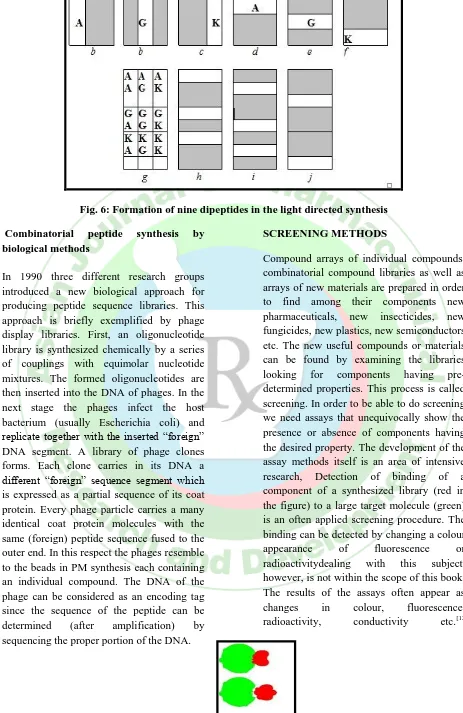
The light directed method makes it possible to prepare an array of peptides or other kinds of molecular on the surface of a glass slide. The surface of the glass is functionalized with amino alkyl gps protected by the photo- labile 6 – nitro Vera tryloxycarbonyl (NVOC) gps. The amino acid used in the synthesis are also protected by NVOC. Group.Nine dipeptides are synthesized from amino acids A, G & K. Before each coupling step one or more area of the slide is irradiated through a mask to remove the protecting g.p. then submitted to coupling with the indicated protected amino acid coupling occurs only in the irradiated area. After completing through
fcyder of irradiation & coupling, nine dipeptide sequence are found in locations.By irradiating through marks h, i, j & coupling with amino acids A, G, & K, 27 tripeptides will form. All these are individual compound which are formed is an efficient way resembling PM synthesis.
PARALLEL SYNTHETIC METHOD
Two methods can be used for parallel synthetic methods they are
The Multipin method
The Teabag method
The parallel synthesis
The principle of parallel synthesis is the same as that applied by the house wives in the kitchen and the Tibetan monks in praying. Execution of the chemical reactions takes time and during that time not only one but a series of reactions can be realized. Each synthetic reaction is started in a different reaction vessel and all the necessary operations are executed in parallel.
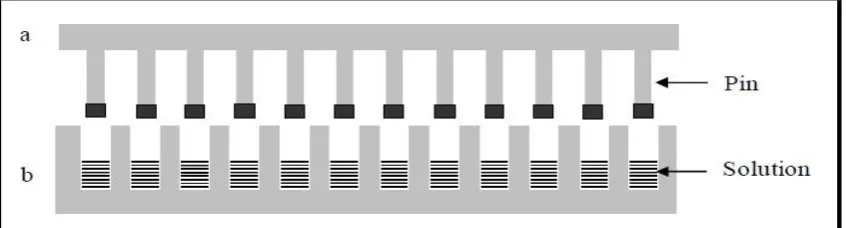
The Multipin method of Geysen
The first example of parallel synthesis was published by Geysen and his colleagues. They synthesized series of peptide epitopes in an apparatus developed for this purpose.In the multipin apparatus the authors used the microtiter plate introduced by Takátsy for reaction vessels and a cover plate with mounted polyethylene rods fitting into the wells.The amino acids used in building the peptides and the coupling reagents were dissolved and added to the wells. The coated ends of the pins were immersed into solution and kept there until the coupling reactions ended.[7]
The tea-bag synthesis
A parallel synthetic method based on the principle suggested by Frank but using a different solid support was developed by R.
A. Houghten.14 Series of peptides were
synthesized on bead form polymer support. The polymer beads were enclosed into visibly labeled permeable plastic bags.
In a coupling step the bags were grouped according to the amino acid appearing in their assigned sequence at that coupling position then placed into the same reaction vessel for coupling with the same amino acid. For example in coupling step 3 all bags in which the assigned sequence contained Ala in
position 3 were grouped and transferred into the reaction vessel where Ala was used in the elongation reaction. Before the next coupling step the bags were manually regrouped after reading their label - again according to the sequences assigned to the bags. All operations, including removal of protecting groups, couplings, washings and even the cleavages were performed on the solid supports enclosed into the same bags. This procedure has the same advantage that was pointed out at the Frank method: less number of operations is needed than in a normal parallel synthesis and the number of reaction vessels is also less than the number of the
synthesized compounds
.
Fig. 2: The tea bag method
Automatic parallel synthesizers
Automatic parallel synthesizers are
developed for both peptide and organic synthesis. The peptide synthesizers generally do not need heating or cooling. The organic syntheses, on the other hand, often need heating or cooling or special atmosphere or elevated pressure. So the organic synthesizers
are more complex than the peptide
synthesizers.[7]
The solutions of the reagents and amino acids are stored in containers closed by septum. The solvents are stored in bottles. The solvents and solutions are automatically transferred into reaction vessels by needle like probe that can penetrate through septum. The probe is fitted to an arm that can be moved in x, y and also in z direction.
The Apex 396 is available with one or two arms and also with two kinds of reactors. The
synthesized peptides can be cleaved
automatically from the resin. The quantity of the synthesized peptides may vary from 0.005 to 1 mmol.
The peptides cleaved from the resin are in dissolved form. The solvent needs to be evaporated or lyophilized. A simple module developed for this purpose is seen in Figure. It is designed to prevent liquid bumping. It
can be connected to vacuum pump equipped with cold trap. The module can also be used to evaporate or concentrate fractions after purifications.
Fig. 4: Parallel evaporation/lyophilization module
Combinatorial synthesis on bead-form resin
The split-mix synthesis
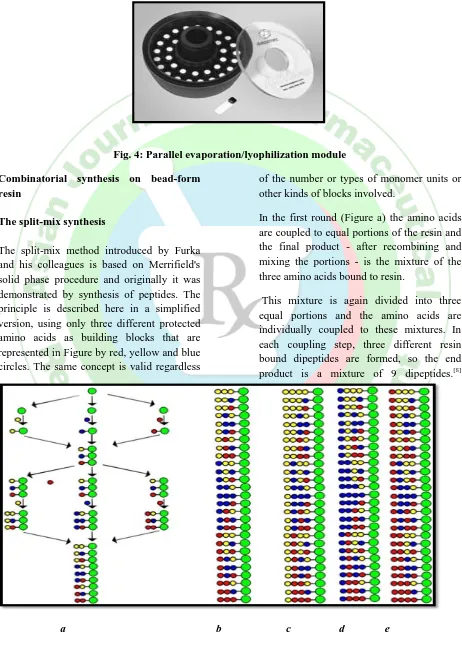
The split-mix method introduced by Furka and his colleagues is based on Merrifield's solid phase procedure and originally it was demonstrated by synthesis of peptides. The principle is described here in a simplified version, using only three different protected amino acids as building blocks that are represented in Figure by red, yellow and blue circles. The same concept is valid regardless
of the number or types of monomer units or other kinds of blocks involved.
In the first round (Figure a) the amino acids are coupled to equal portions of the resin and the final product - after recombining and mixing the portions - is the mixture of the three amino acids bound to resin.
This mixture is again divided into three equal portions and the amino acids are individually coupled to these mixtures. In each coupling step, three different resin bound dipeptides are formed, so the end
product is a mixture of 9 dipeptides.[8]
a b c d e
a: Preparation of a library of nine dipeptides on solid support. Divergent arrows: dividing
intoequal portions; vertical arrows:
coupling; convergent arrows: mixing and homogenizing, b: 27 tripeptides, c, d and e: 81tetrapeptides. Green circle represent resin, red yellow and blue circles are amino acids or other organic monomers. A third dividing , coupling and mixing step that is not demonstrated in the figure would lead to the formation of a mixture of 27 resin bound tripeptides and a fourth cycle would produce 81 tetramers .
Combinatorial synthesis using amino acid mixtures
The method is even more efficient than the split-mix procedure. In every coupling step of the synthesis only a single coupling operation is executed in a single reaction vessel in contrast with the 20 reaction vessels and 20 coupling operations needed in the split-mix procedure. In the split-mix procedure a total of 100 couplings are needed to prepare the 3.2 million pentapeptides. The amino acid mixture method needs only 5 coupling steps. There are, however, disadvantages too. It is known that the coupling rates of the amino acids differ from each other. As a consequence, formation of the peptides in 1 to 1 molar ratio cannot be assured. Some peptides form in significantly higher molar quantity then others and some peptides do not even form. Efforts have been made to compensate these differences. Rutter and Santi described in their patent17, that the differences can in part be compensated by proper adjustment of the concentrations of amino acids in the coupling mixtures.[7]
Combinatorial synthesis using soluble support
The very large majority of the classical methods developed for preparing organic
compounds work in solution phase. The advent of combinatorial methods induced a fast development in the area of solid phase synthetic procedures. Nevertheless, most organic synthetic methods that are found in the literature are still applicable only in solution phase. In addition, the solid phase reactions are significantly slower than those in solution. A dissolved reagent molecule that is outside resin beads can react with a molecule attached to the solid support inside a resin bead only after diffusion into the solvent bound within the particle. The diffusion is a slow process so the solid phase reactions take a considerable longer time than those in solution phase.
Combinatorial synthesis on solid surface
Fig. 6: Formation of nine dipeptides in the light directed synthesis
Combinatorial peptide synthesis by biological methods
In 1990 three different research groups introduced a new biological approach for producing peptide sequence libraries. This approach is briefly exemplified by phage display libraries. First, an oligonucleotide library is synthesized chemically by a series of couplings with equimolar nucleotide mixtures. The formed oligonucleotides are then inserted into the DNA of phages. In the next stage the phages infect the host bacterium (usually Escherichia coli) and replicate together with the inserted “foreign” DNA segment. A library of phage clones forms. Each clone carries in its DNA a different “foreign” sequence segment which is expressed as a partial sequence of its coat protein. Every phage particle carries a many identical coat protein molecules with the same (foreign) peptide sequence fused to the outer end. In this respect the phages resemble to the beads in PM synthesis each containing an individual compound. The DNA of the phage can be considered as an encoding tag since the sequence of the peptide can be
determined (after amplification) by
sequencing the proper portion of the DNA.
SCREENING METHODS
Compound arrays of individual compounds, combinatorial compound libraries as well as arrays of new materials are prepared in order to find among their components new pharmaceuticals, new insecticides, new fungicides, new plastics, new semiconductors etc. The new useful compounds or materials can be found by examining the libraries
looking for components having
pre-determined properties. This process is called screening. In order to be able to do screening we need assays that unequivocally show the presence or absence of components having the desired property. The development of the assay methods itself is an area of intensive
research, Detection of binding of a
component of a synthesized library (red in the figure) to a large target molecule (green) is an often applied screening procedure. The binding can be detected by changing a colour
appearance of fluorescence or
radioactivitydealing with this subject,
however, is not within the scope of this book. The results of the assays often appear as
changes in colour, fluorescence,
radioactivity, conductivity etc.[12
High throughput screening of arrays of individual compounds
The introducing by Takátsy of the parallel approach in his microbiological experiments was a very important development in the history of the analytical methods. The use of his microtiter plates made possible to carry out the analytical assays in parallel format
and exploit its advantages in improving the efficiency.Improvements in the sensitivity of the assay methods made possible to further increase productivity by replacing the 96-well plates with 384 and even 1,536-96-well ones and by applying automation.
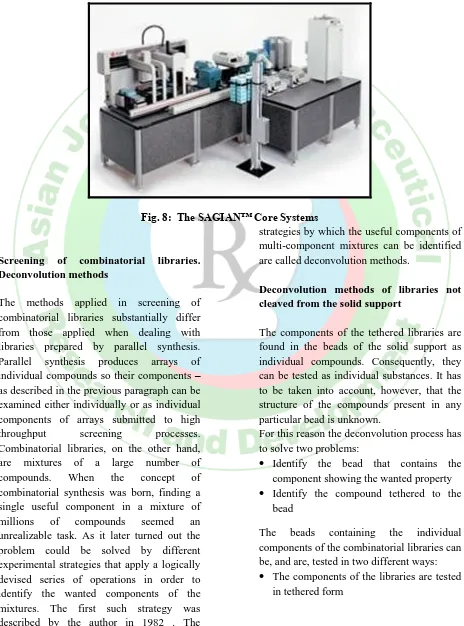
Fig. 8: The SAGIAN™ Core Systems
Screening of combinatorial libraries. Deconvolution methods
The methods applied in screening of combinatorial libraries substantially differ from those applied when dealing with libraries prepared by parallel synthesis.
Parallel synthesis produces arrays of
individual compounds so their components – as described in the previous paragraph can be examined either individually or as individual components of arrays submitted to high
throughput screening processes.
Combinatorial libraries, on the other hand, are mixtures of a large number of
compounds. When the concept of
combinatorial synthesis was born, finding a single useful component in a mixture of
millions of compounds seemed an
unrealizable task. As it later turned out the problem could be solved by different experimental strategies that apply a logically devised series of operations in order to identify the wanted components of the mixtures. The first such strategy was described by the author in 1982 . The
strategies by which the useful components of multi-component mixtures can be identified are called deconvolution methods.
Deconvolution methods of libraries not cleaved from the solid support
The components of the tethered libraries are found in the beads of the solid support as individual compounds. Consequently, they can be tested as individual substances. It has to be taken into account, however, that the structure of the compounds present in any particular bead is unknown.
For this reason the deconvolution process has to solve two problems:
Identify the bead that contains the
component showing the wanted property
Identify the compound tethered to the
bead
The beads containing the individual
components of the combinatorial libraries can be, and are, tested in two different ways:
The components of the libraries are tested
The screening tests are carried out with
compounds cleaved from individual
beads.
COMBINATORIAL METHODS IN MATERIALS AND CATALYST RESEARCH
Besides the organic compounds utilized as drugs, pesticides etc. there exists another important group of materials that have definitive effect on our every-days life. These are the solid inorganic materials and polymers. These materials substantially differ from organic compounds that have well defined molecular structure. In the inorganic solid materials the elementary composition is not always stochiometric, the proportion of the component elements may be very different. In addition a considerable part of the elements of the periodic table may occur among their constituents. The polymers also differ from the small molecular organic compounds. They usually contain a large but undefined number of building blocks. For this reason preparation and examination of this class of materials needs special methods. Nevertheless discovery of the new materials that have useful properties also require preparation and testing of a very large number of samples. In order to speed up the research, application of the combinatorial thinking and the combinatorial methods seems to be a realistic choice.
Inorganic materials
The classes of inorganic materials that can be studied by combinatorial methods include
semi- and superconductors, dielectrics,
phosphors, superalloys, magnetoresistive
materials and others. The main areas where the new inorganic materials may find application are electronic devices, displays, memory devices, photonic devices, magnetic and optical data storage.
The inorganic solid materials are best investigated in the form of thin films. A number of methods have been developed to fabricate these films. A few of these methods is outlined below.[13]
Heterogeneous catalysts
The heterogeneous catalysts belong to a very important class of materials since they are used in the manufacture of a large number (about 7000) of chemicals and for this reason they significantly contribute to the economy and to our living standards. Catalysts are used in about 60% of chemicals productions. Catalysts are complex materials. According to estimations about 50-70 elements of the periodic table can be regarded as suitable components for heterogeneous catalysts.The “multi-sample concept” proposed by Hanak and his pioneering work in the 1970s and 1980s were not followed but the advent of the combinatorial methods in the pharmaceutical area initiated very intensive research for adaptation of the combinatorial methods to the catalyst research. Today the principles of combinatorial approach are already accepted and widely applied.
Catalyst discovery is a multi-step iterative process. It starts with library design that involves data-mining from the literature and considers many variables like precursor materials and their relative concentrations,
support materials, mixing conditions,
calcination temperatures, the reactor applied in testing and analytical tools.
Polymers
Polymers are an important class of materials. Their application is so widespread that our life today could not be imagined without them. They are used as structural, packaging and coating materials, they are components of our clothes and they are applied even in microelectronics and nanotechnology. Their properties depend not only on composition but to a high degree on conditions of their processing that is effected by a large number of variables. The combinatorial methods that are introduced and used in this area help to faster determine the influence of the mentioned variables. In this respect the polymer libraries prepared in the form of continuous thin films are very important.[11]
COMPUTATIONAL ASPECTS OF LIBRARY DESIGN AND SYNTHESIS
The appearance of combinatorial and HTS methods made the synthesis and screening of millions of compounds a reality. This generated a so huge amount of data that conventional bookkeeping proved unable to handle. In order to overcome this situation new software companies were founded that produced many products to serve the need of combinatorial and HTS methods. Since application of combinatorial chemistry began in pharmaceutical research the computational tools were developed keeping in mind the needs of drug research. Some software are used in library design, others help chemistry
and again others proved helpful in data recording, analysis and data retrieval.
Drug research is a long and expensive process. The chemical part of the discovery of a drug usually begins after the therapeutic target has been identified. First a lead compound has to be discovered that shows at least a limited effect on the target. Then comes the optimization process when, by modifying the structure of the lead, a more effective compound has to be found and, at the same time, the unwanted side effects has to be reduced to a possible minimum.[9]
Software Companies
The companies listed below are engaged in developing software and commercialize such products. Beside the name of the companies the addresses of their home pages are also indicated.[14][15]
REFERENCE
1. Furka, F. Sebestyen, M. Asgedom, G. Dibo, General method for rapid synthesis of multicomponent peptide mixtures. Int. J. Peptide Protein Res., 1999.
2. Merrifield RB, 1963 J. Am. Chem. Soc. 3. J. K. Scott and G. P. Smith Science 1990.
4. S. Cwirla, E. A. Peters, R. W. Barrett and W. J. Dower Proc. Natl. Acad. Sci. USA 1990.
5. J. J. Devlin, L. C. Panganiban and P. E. Devlin Science 1990.
6. Fodor SP, Read JL, Pirrung MC, Stryer L, Lu AT, Solas D, 1991.Light-directed, spatially addressable parallel chemical synthesis.
7. H. M. Geysen, R. H. Meloen, S. J. Barteling Proc. Natl. Acad. Sci. USA 1984.
8. E. J. Moran, S. Sarshar, J. F.Cargill, M. Shahbaz, A Lio, A.M.M.Mjalli, R.W. Armstrong J. Am. Chem. Soc. 1995.
9. K. C. Nicolaou, X –Y. Xiao, Z. Parandoosh, A. Senyei, M. P. Nova Angew. Chem. Int. Ed. Engl. 1995.
10. Corbett, P. T.; Leclaire, J.; Vial, L.; West, K. R.; Wietor, J.-L.; Sanders, J. K. M.; Otto, S. (Sep 2006). "Dynamic combinatorial chemistry". 11. Lehn , J. - M. ( 2007 ) Chem. Soc. Rev .
12. H. M. Geysen, R. H. Meloen, S. BartelingProcNatlAcadSci USA 1984.