Developing and piloting a multi-channel ICT-Enabled Model to enhance University
engagement with smallholder farming communities in Uganda
D.P. MIREMBE1, B.B. OBAA2 and P. EBANYAT3
1Department of Networks, College of Computing and Information Sciences, Makerere University, Kampala, Uganda 2Department of Extension and Innovation Studies, College of Agricultural and Environmental Sciences,
Makerere University, Kampala, Uganda
3Department of Agricultural Production, College of Agricultural and Environmental Sciences, Makerere University, Kampala, Uganda
Corresponding author: [email protected] African Journal of Rural Development, Vol. 1(1): 2016: pp. 13 - 21
This article is lincenced under a Creative Commons license, Attribution 4.0 International (CC BY 4.0)
ABSTRACT
Current outreach models for universities have been shown to be weak globally. This paper looks at an alternative, less expensive approach which can reach farmers in real time. It describes the development and piloting of a Multi-Channel ICT-based Model of enhancing University engagement with smallholder farming communities in Uganda, codenamed “SUFACE”. The acronym, SUFACE was derived from the project Strengthening University Farming Communication Engagement which funded the work. Four main stages were followed in developing the model: (i) establishing requirements for developing an appropriate model and designing the model, (ii) developing the ICT platform to anchor the model, (iii) establishing knowledge and information centers (KICs), and (iv) training managers of KIC, extension workers and farmers. The model provides services in capturing farmer information needs, storage and indexing, data visualization, data search, information sharing, security and privacy. Preliminary indications are that the model has increased access to information and has fostered closer working relations between the university and farmers. Where the ICT infrastructure exists, this appears to be a financially viable approach for better linking universities with small farmers either directly or through local knowledge centres, NGOs or extension agencies. Key emerging issues include the need to develop local capacity for farmer query translation and exploring opportunities for automatic query translation and response.
Key words: Apps, ICT4Agriculture, Model, SUFACE, smallholder farmer, University engagement
RÉSUMÉ
Les modèles actuels d’assistance des universités ont été montrés globalement faibles. Ce document se penche sur une autre solution, une approche moins coûteuse qui peut atteindre les agriculteurs en temps réel. Cet article décrit le développement et l’essai d’un modèle basé sur les TIC multicanaux pour le renforcement de l’engagement de l’université avec les petites collectivités agricoles de l’Ouganda, baptisée “SURFACE”. L’acronyme SUFACE était tiré du projet de renforcement d’Engagement de la communication agricole de l’Université qui a financé les travaux. Quatre grandes étapes ont été suivies dans l’élaboration du modèle : (i) établir des exigences de développement d’un modèle approprié et concevoir le modèle, (ii) développer la plate-forme TIC pour y ancrer le modèle, (iii) établir de centres d’information et de connaissances (CCI), et (iv) former des gestionnaires de TIC, vulgarisateurs et agriculteurs. Le modèle fournit des services dans la capture de besoins d’information des agriculteurs, le stockage et l’indexation, la visualisation de données, la fouille de données, le partage de l’information, la sécurité et la vie privée. Les indications préliminaires sont que ce modèle a permis d’accroître l’accès à l’information et a favorisé des relations de travail plus étroites entre l’université et les agriculteurs. Là où l’infrastructure des TIC existe, cela semble être une approche financièrement viable pour mieux lier les universités avec les petits agriculteurs directement ou par l’intermédiaire de centres de connaissances locales, d’ONG ou d’organismes de vulgarisation. Les nouvelles questions clés comprennent la nécessité de développer des capacités locales pour les requêtes des agriculteurs et explorer les possibilités de traduction automatique des requêtes de traduction et des réponses.
Mots clés: ICT4Agriculture, modèle, SUFACE, applications, petits agriculteurs, engagement de l’université Date received: 19 January, 2016 Date accepted: 27 January, 2016
INTRODUCTION
Uganda, like many African countries, is blessed with abundant natural resources. Despite the abundance of natural resources, a number of regions in Uganda still suffer from food and nutrition insecurity. Nearly 80% of Uganda’s population depends on agriculture as the main source of livelihood of which, over 70% of these are smallholder farmers (National Planning Authority (NPA, 2013). Daudu et al. (2009) and Ebanyat (2010) argue that, Universities as part of the National Agricultural Research Systems (NARS), have a role to play in provision of advisory services by engaging with communities in development not only through creation, but also the dissemination of farming technologies and knowledge. The uptake of agricultural knowledge products by small holder farmers improves their productivity, access to financial services and markets and product innovations resulting into enhanced food and nutrition security (Okello et al., 2011).
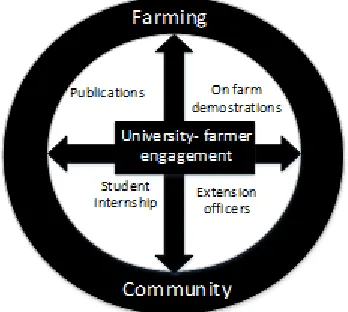
As part of NARS, Makerere University runs active outreach programs aimed at disseminating agricultural information and knowledge to farmers. The programs are mainly implemented through student internships, publications, engagement with extension officers and on-farm demonstration (Figure 1). Currently over 50% of knowledge dissemination at the university is through publications (Makerere University, 2008), yet majority of the farmers are illiterate, rendering information disseminated inaccessible to farmers who need it most. While the other approaches of knowledge dissemination (on farm demonstrations, student internship and extension officers) provide an enriched engagement with the farmers, they are expensive to conduct by the university in terms of staff time and other resources (Ebanyat et al., 2010; Makerere University, 2015). Besides, these approaches do not provide farmers with opportunities to raise specific information needs on demand (timeliness of information), as activities are preplanned to demonstrate particular technologies produced by the university.
Consequently, most of the critical information and knowledge that could help smallholder farmers make utility maximizing decisions on markets, pests, diseases, among others, has remained untapped at the university. This has made the University largely irrelevant to the smallholder farmers despite the cutting edge research outputs. This experience is not unique to Makerere, as evidence from literature on the subject indicates that it is a widespread phenomenon (Daudu et al., 2009; Babu et al., 2011). Research by Vidanapathirana (2012), shows that current outreach models implemented by universities are characterized by weak stakeholder linkages, inappropriate knowledge packaging, intricate technical language and limited interaction with end-users of information, among other constraints. Seeking for more relevance and impact, research centers, including universities across the global are exploring innovative ways of enhancing engagement between researchers and farmers (Grimshaw et al., 2011).
A number of researchers have demonstrated that appropriate application of Information Communication Technologies (ICTs) can enhance engagement between knowledge producers such as universities and smallholder farmers, resulting into increased uptake of agricultural knowledge (Okello et al., 2011). The enhancement is in terms of more timely availability of information to farmers, facilitation of collaboration and discussions, mutual learning, impact assessment of knowledge shared, among others (Aregu, 2014).
Since 2011, Makerere University with support from the Regional Universities Forum for Capacity Building in Agriculture (RUFORUM) has been implementing a Community Action Research Project (CARP), entitled, “Developing an Outreach Framework for Strengthening University-Farming community Engagement for Improved and Sustainable Livelihoods (SUFACE). The main objective of the project is to develop and operationalize partnerships between Makerere University, selected farmer communities and other critical stakeholders within the framework of action research, to enhance productivity, competitiveness, responsiveness and impact of University led research on smallholder agriculture and agricultural development in Uganda. The specific objectives of the project include:
a) To pilot an experiential learning model to strengthen quality and better graduate training and engagement of Universities with farming communities.
b) To develop and test the effectiveness of capacity development- information- based outreach model for disseminating university generated technologies and best practices to farmers and agribusiness communities.
D.P. MIREMBE et al.
c) To build entrepreneurial capacity of smallholder farmers and students by strengthening legume and rice value chains in two regions of Uganda.
d) To develop an information and communication technology mechanism to enable farmers’ to access information from a University information centre.
In the project, developing strong partnerships across the research to development continuum has been the basis for enhancing functionality of selected value chains on one hand and building the capacity of rural communities to access, utilize and intensify the use of technologies on the other hand. A critical component of the project has been the development and deployment of an ICT platform to enable farmers to access information from the University, share their experiences and to enable experts at the university to learn from farmers and to provide prompt responses to their queries. It has built on past experiences of outreach activities by piloting the use of novel approaches (ICTs and others) to strengthen functionality of multi-commodity value chains with a focus on soybeans and groundnuts. It was envisaged that through creation of knowledge and information centers, the University can proactively intensify its engagement with rural communities and make meaningful contributions to rural development. This paper describes the development of and experiences in implementing the Multi-Channel ICT enabled Model under the project (SUFACE), code named “The SUFACE Model”.
RESEARCH APPROACH
This study adopted a mixed methods strategy for collecting data, using both qualitative and quantitative approaches. Much of the information on the process of development and deployment of the multi-channel ICT model was collected through a review of the trail of documents that accompanied the process, participant observations and discussions with people involved. The information on establishing farmers’ information needs that informed the design of the model was collected through a household survey (Magoba, 2016). Using a multi-stage sampling strategy involving stratification and random selection, a total of 300 households in Apac, Lira and Bukedia were selected and interviewed (Magoba, 2016). The questions in the household questionnaire mostly focused on the level of ICT usage among farmers, type of ICTs used, types of information needed, limitations in the current ICTs, and the key characteristics in their view of an effective and efficient ICT enabled model for greater engagement with the university. In addition, Key Informant Interviews were held with eight people. Four of the informants had agricultural extension experience while the rest had ICT background. The discussions with key informants were aimed at gaining a deeper
understanding of the effectiveness of the current university outreach models and establishment of requirements for a cost-effective model of engagement. From the survey, discussions with informants and a review of scholarly literature, requirements of an ideal model of engagement between the university and farming community were synthesized and defined. Using the requirements, the SUFACE model was designed. The actual implementation of the SUFACE ICT platform followed the agile software development method to enable stakeholder participation during the implementation, testing and evaluation of the platform as suggested by Hevner et al. (2004).
RESULTS OF THE STUDY
A summary of the key findings from the household survey
The level of ICT use among farmers was high (65%) (Magoba, 2016). In general, more residents in peri-urban settings than rural areas used ICTs but the difference was not statistically significant. The main types of ICTs used were mobile phones, landline telephone, radio and internet (Figure 2). Internet was used more than the computers and television. The relatively high internet access was attributed to the use of smart phones and other mobile phones that can access internet.
Majority (60%) of the farmers used ICT to access financial services, mostly mobile money services. Fewer (10%) used ICT for consulting experts and accessing market information (5%). On the challenges farmers face when using ICTs, lack of knowledge about ICTs, costs attributed to acquiring ICTs, and lack of knowledge on how to operate ICTs were highlighted. This indicates a need to train farmers on the use of ICTs for undertaking different activities. Poor access to internet and lack of access to ICTs were some of the other challenges. The most preferred ICTs were mobile phones, computers and internet as indicated by 40.5%, 21.3% and 20.1% of the respondents, respectively. Having the mobile phones as the most appropriate is not surprising because majority of farmers had access to a phone (Figure 2).
Key requirements for developing an appropriate ICT platform for engaging farmers
basis. Any model of engagement between the university and farmers must be effective in meeting expectations of both farmers and the university. In addition, it must be efficient in order to guarantee a return on investment to both stakeholders. From our synthesis, the following were identified as key requirements for a pragmatic model of engagement between the university and farming communities:
a) Facilitate the dissemination of information and knowledge to farmers in a cost-effective manner. b) Support interaction between farmers and
researchers at the university.
c) Enable impact assessment of the knowledge and information shared.
d) Provide a framework of monitoring outbreak of pests and diseases.
e) Allow farmers express their information needs in their local languages in order to enhance the articulacy of their information need.
f) Enable access of information and knowledge over a variety of platforms including SMS, mobile apps, web, TV, among others.
g) Enable real-time response to farmers’ information requests.
h) Allow farmers to express their information need in any data format including voice, text, video and multi-media.
i) Enable third party interaction between farmers and the university.
j) Provide services of on-farm documentation for farmers.
DEVELOPING THE SUFACE MODEL
Philosopy of model design
The design of the SUFACE model of engagement was based on the understanding that no single channel of
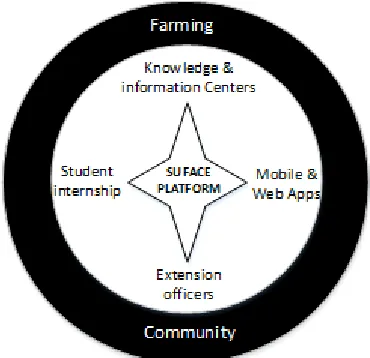
information and knowledge dissemination can be effective and efficient in enhancing engagement between the university and smallholder farmers. The underlying thinking was informed by the fact that a number of outreach channels provide complimentary services, hence providing an effective and efficient model. Therefore, the design of a multi-Channel ICT enabled model code named “SUFACE model” was adopted (Figure 3).
The model has four main elements; the ICT Platform, Community Knowledge and Information Centers, Agriculture Extension Officers and Graduate Student Interns. The model is anchored on the ICT platform which acts as a repository of information and provides tools for collaboration and interaction between farmers and researchers at the university as illustrated in Figure 4. In the SUFACE model, the researchers at the university interact with farmers primarily through the SUFACE platform over mobile and web applications. Figure 2: Type of ICT’s used by farmers
D.P. MIREMBE et al.
To enable this interaction, information from the university has to be structured and packaged in a way that it can be uploaded onto the platform databases. Farmers can then access the information directly via mobile and web applications or through intermediaries such as extension officers, student interns and information officers at community knowledge and information centers.
In the SUFACE Model, farmers engage the university through access to a pre-packaged knowledge product or via real-time request of specific information (query). When a farmer has a specific information need, the farmer can generate a query either in English or local language and submit the query to the platform via mobile or web application. Alternatively, such a farmer can request to have their queries submitted by the community knowledge and information center managers, student interns or extension officers.
When submitting a query the farmer specifies the language of submission, crop and segment of the value chain of interest (e.g. seeds, weather, diseases and markets). When the query hits SUFACE platform, it is indexed based on its characteristic like language and crop, then stored in an appropriate database. Then, an auto generated notification is sent to experts informing
them of the new query and the need to respond to the query. The notification is sent via e-mail and SUFACE mobile app which is installed on the experts’ phone. To ensure that experts respond to the query, the platform keeps reminding the experts every 6 hours until the query is responded to. The expert responds to the query via the SUFACE web portal or via the SUFACE mobile app. A farmer receives a notification on his SUFACE app when her/his query has been answered by the expert. If the expert would like to share the response with the public, s/he checks the publish button within the SUFACE web portal or mobile app. Once the response is published, the platform allows farmers and other stakeholder to comment on the response. This feature enables the university and experts to learn about the local practices but also on alternatives of handling certain situations. The default format of response is text, but experts can attach an image to enhance the expressiveness of the advice provided.
THE SUFACE PLATFORM
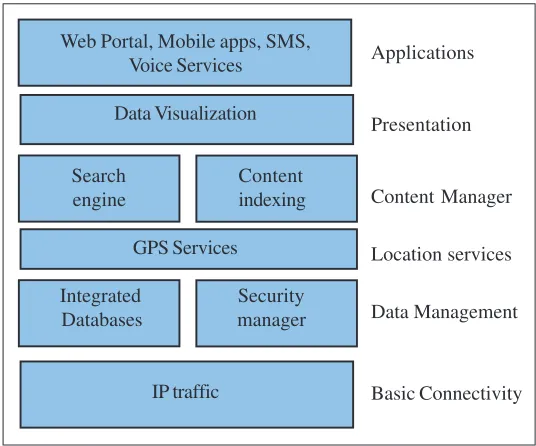
The SUFACE Platform has six modules. These are Applications, Presentation, Content Manager, Location services, Data management and Basic connectivity (Figure 5).
Figure 4: Typical interaction channels
Figure 5: SUFACE ICT Platform
Applications
Presentation
Content Manager
Location services
Data Management
Basic Connectivity Web Portal, Mobile apps, SMS,
Voice Services
Data Visualization
Search Content engine indexing
GPS Services
Integrated Security Databases manager
Applications
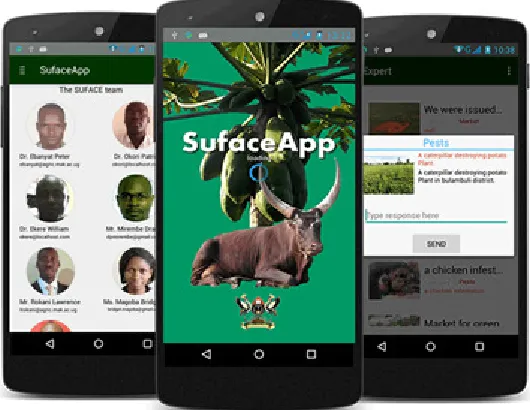
The module defines interfaces for the implementation of various mobile and web services with specific requirements without modifying the core platform architecture. Furthermore, the module provides native applications which users of the platform use to interact with the platform like the SUFACE mobile app (refer to Figure 6). Some of the applications are input and output service providers’ databases, farmer profiles, query processing engine, and weather information, among others.
Presentation Module
The module defines data visualization service like the annotated map of queries, data drill downs, charts, and basic statistics, among others. The module helps users to quickly find meaning in a sea of data on the platform. It is very useful mainly to researchers and extension officers in monitoring the outbreak of pests and diseases.
Content Manager
The Content Manager is responsible for efficient storage and retrieval of information on the platform. This module defines structures for content search primitives, such as content indexing routines. Unstructured search algorithms such as I-walks (Otto et al., 2006), are used to instantiate a content search together with file and peer searcher components. The schemes are used to locate matching pairs of query and response in the integrated databases.
Location Services
The SUFACE location services track information need sources (queries) using a Global Position Service (CPS). When a farmer initiates a query on the platform, the SUFACE application records the current GPS
coordinates of the phone and the time of the query. On submitting the query, the GPS coordinates are automatically mapped onto a defined map to indicate the source of the query. This service is critical in monitoring the outbreak of pests and diseases, in addition to monitoring activities of student interns in the field. In the current outreach models, it is difficult for a student supervisor at the university to trace the student activities in the field, but this service provides an effective and efficient solution.
The Data Management
The Data management module maintains data items on the platform. The data management module consists of two key components, integrated databases and security manager. The integrated database is made up of databases for various value chains from a number of data sources. The security manager provides services of user authentication, authorization, backup, privacy, and data integrity check. The security manager relies on standard server security protocols to deliver the services.
Basic Connectivity
The primary goal of the connectivity module is to maintain the connectivity between SUFACE platform servers and clients mainly mobile apps over the Internet Protocol (IP) infrastructure. Conceptually, the module manages the basic link operations in a typical data communication network. Given the uneven internet coverage in rural areas, the SUFACE applications uses both real-time query submission and store and forward protocols. One of key roles of the basic connectivity module is to calibrate the internet connectivity strength and define the appropriate quality of service parameters for the session before establishing a communication session.
D.P. MIREMBE et al. SUFACE MODEL INSTATIATION
In order to ascertain the usefulness and usability of the model, an instantiation was done between Makerere University and farmer groups in northern and eastern Uganda as part of the community action research project (Ebanyt, 2010). In the following sub-sections we discuss the instantiation process. The process involved mainly five tasks; SUFACE platform development, collaboration establishment, knowledge and information center establishment, farmer and KIC managers’ training, and awareness creation.
SUFACE Platform Development
The SUFACE model is centered on an ICT platform that facilitates the production of knowledge and interaction between farmers and knowledge providers. The platform development followed a systematic interactive agile software development method. From the generic user requirements of the model, functional and non-functional requirements for the platform were defined. Functional requirements are the specifics services the platform is expected to provide to users, while none-functional requirements are the specific constrains under which it is expected to operate.
The platform was built on client server architecture and designed to support thousands of concurrent database access sessions. Accordingly, My Structured Query Language (MySQL) database server was used to implement the platform database. The SUFACE web applications are designed to be easy to use and efficient in database access, accordingly, Asynchronous JavaScript extensible Mark-up Language (AJAX), PHP and Hyper Text Mark-up Language (HTML5) were used to implement the business logic. Given the wide availability of cheap and reliable android phones in Uganda, the SUFACE mobile app was built on android platform. To guarantee service availability, reliability and responsiveness, the platform was hosted in a cloud service. Before any service was deployed on the platform, the service had to be tested for code correctness and service validity. Code testing was done by experienced software developers, while service validity was achieved through pilot testing of the service with selected groups of farmers.
Knowledge and Information Center Establishment
Once the SUFACE platform core features were made available, collaborations with two Community Knowledge and Information Centers (KICs) were established. The centers are Kubere Information Centre in Apac district (WOUGNET, 2016) and P’KWI in Bukedea district (Opio, 2012). The establishment followed a process that involved site visits, vision sharing and the signing of the memorandum of understanding between the university and KIC operators. The KICs were equipped with computers,
mobile phones, smart televisions and DVC players to facilitate access to information from the platform and sharing this information with farmers.
Farmer and KIC Manager Training
In order to equip farmers and KIC managers with skills to access information from the platform, several end-user training sessions were conducted. The training followed a hands-on approach focused on optimal skills transfer. The trainings began with assessment of the level of ICT literacy among participants so as to align training content. In general, the trainings involved presentation of an overview of the SUFACE model and the platform architecture. This was followed by demonstrations on task execution, individual and group work to try out getting information from the platform. The last session usually involved assessment of skills attained by participants. To increase effectiveness, farmers were trained in smaller groups of 10. In total, 50 farmers have been trained, 30 from Kubere KIC and 20 from P’KWI. The 50 farmers were tasked to train the rest of the members in their groups. Farmers were selected based on their level of education, command of English language, access to a phone, recommendation by group members, age and on gender. About 60% of the farmers trained were women of whom 70% were youth. At each KIC, two information officers were not only trained on how to use the platform to access information, but also on how to translate farmer queries into English and to upload them on the platform. KIC managers also helped in translating or transcribing farmers’ queries from local language to English. They also translated responses to queries from experts into the local language to make it widely accessible.
Creating awareness and establishing collaboration networks
visibility of the model. The engagement is also a good avenue of getting stakeholders input on model performance and soundness of the design principles. An awareness strategy was designed in consultation with farmers who knew the appropriateness of media channels and their richness. The project team conducted over ten stakeholder engagement events including; workshops, meetings and field days. In addition, posters, banners and flyers were produced and distributed in the community. The team also ran a number of radio programmes in the project area of operation for a combined period of 6 months to create awareness.
Feedback from Piloting the SUFACE model
These are preliminary results based on informal feedback and researcher observation both in the farming communities and on the SUFACE platform. A full assessment of the effectiveness of the model is underway. So far, over 2000 queries have been submitted to the SUFACE platform in a period of two years that is an average of 3 queries per day (SUFACE, 2016). This demonstrates an increase in engagement between the university and smallholder farming communities of northern and eastern Uganda. Most information requests are about pests, diseases and markets as illustrated on a query map on the SUFACE web portal (SUFACE, 2016). Basing on the timing of query submission, we note that farmer information needs peak during crop management and harvesting time. The few queries on seeds and the whole pre-planting season could be attributed to three factors; i) some farmers were supplied with seeds as part of the CARP projects ii) government extension agencies were actively distributing free seed during the time of this project, and iii) it was also observed that farmers in communities operate an informal seed system. The informal interaction with farmers, extension workers and KIC managers in the project sites revealed an improved level of satisfaction with the quality of information from the university. Feedback from the student intern supervisors indicated an improved effectiveness of students work as, they find it easy to consult experts using the platform when in the field supporting farmers. The use of SUFACE platform, by students on field internship helped supervisors to monitor their location and minimized the risk of academic dishonesty with their reports. At the national level, the model has attracted interest from the Ministry of Agriculture, Animal Industry and Fisheries. The team leader for the ICT component of the project is now part of core team developing the National ICT strategy for agriculture 2016-2020 with support from the World Bank.
While the overall initial feedback from stakeholders is positive, farmers complained of delays in getting responses from the platform. They prefer an instantaneous response to their information requests. Secondly, they noted that sometime responses are complicated to follow, hence the need to have responses which are instructive in nature, with clearly stated step by step actions to address the observed phenomenon.
CONCLUSIONS AND AREAS FOR FURTHER RESEARCH
A number of issues have emerged from the pilot deployment of the model. It has been observed that farmers prefer to express themselves in their local languages even if they know English. This could be attributed to the complexities involved in describing pests and diseases in English, since most farmers lack the vocabulary to express themselves. It has also emerged that farmers have difficulties in texting, accordingly voice or video based services are preferred. Farmers tend to treat information requests on animal-related cases as emergencies compared to crop-based information needs. While the initial project idea was biased towards legume value chains, we noted that farmers expect an engagement model that provides a one stop-center for their information needs, given the diversity of farming enterprises most are engaged in. Thus for a model to have wider acceptance, it must provide information across a number of value chains, both crops and animals. The project team has also observed that groups that have strong structures and systems are more inclined to appreciate the engagement model with the university than individual farmers or groups that are loosely coupled. From feedback with other stakeholders, the team has noted that while the design of SUFACE model is based on the needs of the university outreach function, many business and civil society processes can use the model for such services such as reporting crime to police, disaster management, product promotion and marketing, monitoring elections, just to mention a few.
D.P. MIREMBE et al. ACKNOWLEDGMENT
We acknowledge the input of Prof. Jude Lubega of Uganda Technology and Management University who provided the initial feedback on the manuscript. Special thanks also go to the Regional Universities Forum for Capacity Building in Agriculture (RUFORUM) for financing this work under the Community Action Research Programme (CARP), Grant ID: RU 2011 CARP 03. We also acknowledge the input from Groningen University in the Netherlands for the insights in decision enhancement theories and design science approach.
STATEMENT OF NO CONFLICT OF INTEREST
We the authors of this paper hereby declare that there are no competing interests in this publication.
REFERENCES
Aregu, R. 2014. Market and price decision enhancement services for farmers in Uganda. PhD Thesis. Groningen, The Netherlands: University of Groningen.
Babu, C.S., Glendenning, C.J., Asenso-Okyere, K. and Govindarajan, S.K. 2011. Farmers’ information needs and search behaviors. Case study in Tamil Nadu, India. International Food Policy Research Institute (IFPRI).
Daudu, S., Chado, S.S. and Igbashal, A.A. 2009. Agricultural information sources utilized by farmers in Benue State, Nigeria. PAT 5(1):39-48.
Ebanyat, P., Okori, P., Isubikalu, P., Ekere, W., Oryokot, J., Asea, G. and Otim-Odoch, P. 2010. Developing an outreach framework for strengthening University-farming community engagement for improved and sustainable livelihoods (SUFACE). A project proposal submitted to the RUFORUM CARP Programme.
Hevner, A., March, S., Park, J. and Ram, S. 2004. Design science in information systems research. MIS Quarterly 8(1):75-105.
Gonzalez, R.A. and Sol, H.G. 2012. Validation and design science research in information systems. Research methodologies, innovations and philosophies in software systems engineering and tnformation systems. IGI Global. pp. 403-426.
Grimshaw, D.J. and Kala, S. (Eds.). 2011. Strengthening rural livelihoods: The impact of information and communication technologies in Asia. IDRC.
Makerere University. 2008. The Makerere University Strategic Plan 2008/09-2018/19. Makerere University Library.
Makerere University. 2015. Outreach. http://mak.ac.ug/ about-makerere/outreach, accessed on 20th January,
2015.
Magoba, B. 2016. A Content-Based Publish/Subscribe Model for improved University-farming communities engagement. Master Thesis, College of Computing and Information Science, Makerere University, Kampala, Uganda.
National Planning Authority (NPA). 2013. Uganda Vision 2040. http://npa.ug/uganda-vision-2040/. Okello, J.J., Kirui, O., Njiraini, G.W. and Gitonga, Z.
2011. Drivers of use of information and communication technologies by farm households: The case of smallholder farmers in Kenya. Journal of Agricultural Science 4(2):111.
Opio, M. A. 2012. Empowering Women in the Oilseeds Business: The Case of PKWI Women’s Cooperative. SNV Netherlands Development Organization. Otto, F. and Ouyang, S. 2006. Improving search in
unstructured P2P Systems: Intelligent Walks (I-Walks); IDEAL Sept, 2006, Burgos, Spain; LNCS 4224, pp. 1312-1319, Springer.
SUFACE, 2016. The SUFACE Portal. www.suface.org Vidanapathirana, N.P. 2012. Agricultural information systems and their applications for development of agriculture and rural community, a review study. The 35th Information Systems Research Seminar in Scandinavia – IRIS 2012.
WOUGNET. 2016. Kubere Information Centre. http:// kic.wougnet.org/new/ accessed on 20th January,