Swati Vikas Gondikar et al., J. Sci. Res. Phar. 2014, 3(3), 81-85
J
ournal of
S
cientific
R
esearch in
P
harmacy
Research Article
Available online through
ISSN: 2277-9469
www.jsrponl
ine.com
Effect of Polymers and there Combinations on Grastroretentive and Floating property of Cefpodoxime
Proxetil Matrix Tablets
Swati Vikas Gondikar1*, Y.Ganesh Kumar2, CH.Chandana2, B.Bhajanlal1
1St.Mary’s College of Pharmacy, Batasingaram, Hayathnagar, R.R.Dist, Telangana State, India. 2 Bright Labs, Cherlapally, Hyderabad, Telangana State, India.
Received on: 21-07-2014; Revised and Accepted on: 17-08-2014
ABSTRACT
T
he present study in the development of Hydro dynamically Balanced Systems (HBS) (floating nature) of Cefpodoxime Proxetil, third generation antibiotic drug which are designed to increase the gastric residence time, thus prolonging the drug release. Preformulation studies were carried out to optimize the required quantity for HPMC K4M, Sodium CMC, Carbopol-934P was used in different concentrations. Total 10 formulations were prepared. Fourier transform Infrared spectroscopy confirmed the absence of any drug/polymers/excipients interactions. The tablets were prepared by direct compression technique, using polymers such as Hydroxy Propyl Methyl Cellulose (HPMC K4M, K15M, K100M), sodium CMC, Xanthan gum, Carbopol 934P,971P& 974P in different combinations with other standard excipient like sodium bicarbonate and Magnesium Stearate used as gas generating agent, as filler and as lubricant respectively. The prepared tablets were evaluated in terms of their pre-compression parameters, physical characteristics like hardness, friability, uniformity of weight, uniformity of drug content, swelling index, invitro floating studies, invitro drug release and short term stability studies.Keywords: Cefpodoxime proxetil, Hydrodynamically Balanced Systems, Hydroxy Propyl Methyl Cellulose, Direct compression.
INTRODUCTION
O
ral drug delivery is the most desirable and preferred method of administering therapeutic agents for their systemic effects. The high level of patient compliance in taking oral dosage forms is due to the ease of administration, patient compliance, flexibility in formulation and handling of these forms. However the oral route of administration suffers with certain drawbacks mainly short residence time of the dosage form in the GI tract, unpredictable gastric emptying and degradation of the drug due to highly reactive nature of GI contents. Gastric emptying is a complex process and makes in vivo performance of the drug delivery system uncertain. Formulation of floating drug delivery systems is an useful approach to avoid this variability with increased gastric retention time of the drug delivery system. Floating systems or hydro dynamically controlled systems are low-density systems that have sufficient buoyancy to float over the gastric contents and remain buoyant in the stomach without affecting the gastric emptying rate for a prolonged period of time .While the system is floating on the gastric contents, the drug is released slowly at the desired rate from the system. After release of drug, the residual system is emptied from the stomach .This .results in an increased gastric residence time and a better control of the fluctuation in plasma drug concentration [1].MATERIALS AND METHODS
Materials:
Cefpodoxime proxetil,Hydroxy Propyl Methyl Cellulose (HPMC K4M, K15M, K100M), Sodium CMC, Xanthan gum, Carbopol 934P, 971P & 974P.
Methodology:
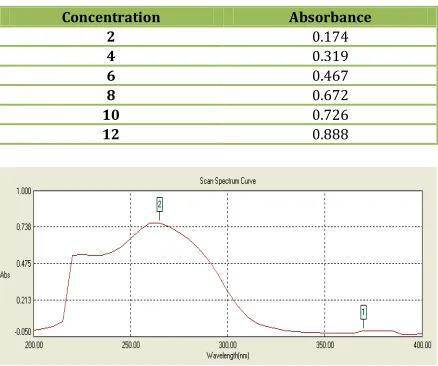
Standard curve for Cefpodoxime Proxetil pure drug: Cefpodoxime Proxetil has the λmax at 275 nm. Standard
*Corresponding author:
Swati Vikas Gondikar
St.Mary’s College of Pharmacy,
Batasingaram, Hayathnagar, R.R.Dist, Telangana State, India., Contact No.: +919490792753.
*
E-Mail: [email protected]graph of Cefpodoxime Proxetil in 0.1N HCl was plotted and a good correlation was obtained with R2 value of 0.9935.
Table No. 1: Standard graph of Cefpodoxime Proxetilin 0.1N HCl
Concentration Absorbance
2 0.174
4 0.319
6 0.467
8 0.672
10 0.726
12 0.888
Fig. 1: Cefpodoxime Proxetilfloating tablets standardization of by UV method
Swati Vikas Gondikar et al., J. Sci. Res. Phar. 2014, 3(3), 81-85
Method of Preparation:
Procedures for preparation of Floating tablet of cefpodoxime proxitel:
Floating tablets of Cefpodoxime Proxetil were prepared by direct compression method. All the ingredients were accurately
weighed .In order to mix the ingredients properly drug and polymer were blend in mortar followed by the addition of Sodium bicarbonate, microcrystalline cellulose, and Magnesium stearate, After thoroughly mixing the ingredients Tablets were compressed in rotary punching machine
Table No. 2: Composition of floating tablets of cefpodoxime proxetil.
Ingredients (mg) F1 F2 F3 F4 F5 F6 F7 F8 F9 F10
Drug 100 100 100 100 100 100 100 100 100 100
HPMC K4 M 37.5 - - 25 - - - 25
HPMC K15 M 37.5 25 37.5 - - - - 25 25 25
HPMC K100 M - 25 - - - 25 - 25 25
Xanthan gum - - 37.5 - 37.5 37.5 - - - -
Sodium CMC - - - 25 25 25 -
Carbopol- 971(p) - - - 25 - 37.5 25 25 - -
Carbopol- 974(p) - - - - 37.5 - - - -
Sodium bicarbonate 60 60 60 60 60 60 60 70 70 70 Magnesium
Stearate
3.5 3.5 3.5 3.5 3.5 3.5 3.5 3.5 3.5 3.5
Aerosil 3.5 3.5 3.5 3.5 3.5 3.5 3.5 3.5 3.5 3.5
MCC 58 83 58 83 58 58 58 48 48 48
Total Tablet Weight 300 300 300 300 300 300 300 300 300 300
Evaluation:
Angle of Repose (θ): The friction forces in a loose powder can be measured by the angle of repose. It is an indicative of the flow properties of the powder. It is defined as maximum angle possible between the surface of the pile of powder and the horizontal plane.
tan (θ) = h / r
Compressibility Index:
The Compressibility Index of the powder blend was
determined by Carr’s compressibility index. It is a simple test to evaluate the LBD and TBD of a powder and the rate at which it packed down.The Carr's index (%) and the Hausner ratio were calculated using following equations.
Carr’s index =TBD-LBD×100 TBD
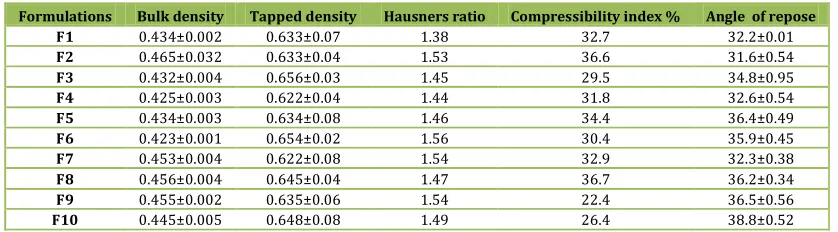
Table No. 3: Pre compression parameters
Formulations Bulkdensity Tappeddensity Hausnersratio Compressibilityindex % Angle ofrepose
F1 0.434±0.002 0.633±0.07 1.38 32.7 32.2±0.01
F2 0.465±0.032 0.633±0.04 1.53 36.6 31.6±0.54
F3 0.432±0.004 0.656±0.03 1.45 29.5 34.8±0.95
F4 0.425±0.003 0.622±0.04 1.44 31.8 32.6±0.54
F5 0.434±0.003 0.634±0.08 1.46 34.4 36.4±0.49
F6 0.423±0.001 0.654±0.02 1.56 30.4 35.9±0.45
F7 0.453±0.004 0.622±0.08 1.54 32.9 32.3±0.38
F8 0.456±0.004 0.645±0.04 1.47 36.7 36.2±0.34
F9 0.455±0.002 0.635±0.06 1.54 22.4 36.5±0.56
F10 0.445±0.005 0.648±0.08 1.49 26.4 38.8±0.52
Physical Evaluation of floating tablet of Cefpodoxime proxetil:
1) Hardness test:
The resistance of tablets to shipping or breakage, under conditions of storage, transportation and handling before usage depends on its hardness. The hardness of tablet of each formulation was measured by Monsanto hardness tester10. The hardness was measured in terms of kg/cm2.
2) Friability test:
This was determined by weighing 10 tablets after dusting, placing them in the friabilator and rotating the plastic cylinder vertically at 25 rpm for 4 min. After dusting, the total remaining weight of the tablets was recorded and the percent friability was calculated.
% loss = Initial wt. of tablets – Final wt. of tablets x 100 Initial wt. of tablets
3) Determination of swelling index:
The swelling properties of floating tablet containing drug were determined by placing the tablet matrices in the dissolution test apparatus, in 900 ml of distilled water at 37 .50C paddle rotated at 50 rpm. The tablets were removed periodically from dissolution
medium. After draining free from water by blotting paper, these were measured for weight gain. Swelling characteristics were expressed in terms of percentage water uptake (WU %) according to the equation shows relationship between swelling index and time.
WU %=Wt of swollen tablet – Initial wt of the tablet x 100 Initial weight of the tablet
4) Buoyancy determination:
Swati Vikas Gondikar et al., J. Sci. Res. Phar. 2014, 3(3), 81-85
Table No. 4: Physiochemical Properties of Cefpodoxime Floating Tablets
Batch code Weight variation (mg) Thickness (mm) Hardness (kg/cm2) Friability (%) Drug content (%)
F1 299.2± 1.42 4.15 ± 0.04 4.45 ± 0.08 0.64±0.085 102.08 ± 0.13
F2 300.4 ± 1.13 3.98 ± 0.02 4.76 ± 0.04 0.78±0.041 99.63 ± 0.12
F3 298.7± 1.72 4.05 ± 0.07 4.24 ± 0.03 0.77±0.039 102.71 ± 0.22
F4 300.6± 1.24 4.18 ± 0.02 4.16 ± 0.01 0.95±0.075 103.91 ± 0.15
F5 299.1± 1.65 4.10 ± 0.04 4.83 ± 0.07 0.71±0.044 103.47 ± 0.10
F6 298.6± 1.14 4.07 ± 0.02 4.19 ± 0.03 0.66±0.039 103.44 ± 0.12
F7 300.4± 1.79 4.20 ± 0.07 4.67 ± 0.02 0.76±0.060 96.38 ± 0.12
F8 299.9± 1.64 3.85 ± 0.07 4.28 ± 0.09 0.75±0.045 103.36 ± 0.14
F9 300.2± 1.69 3.90 ± 0.04 4.11 ± 0.01 0.76±0.054 102.73 ± 0.13
F10 298.3± 1.24 4.10 ± 0.05 4.65 ± 0.04 0.80±0.066 103.28 ± 0.10
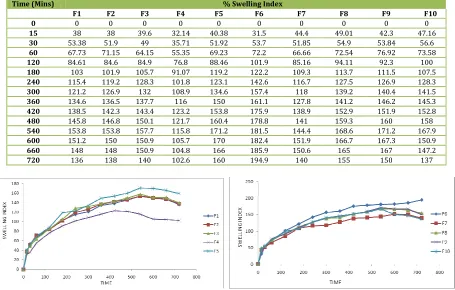
Table No. 5: Swelling index of batch F1 to F10
Time (Mins) % Swelling Index
F1 F2 F3 F4 F5 F6 F7 F8 F9 F10
0 0 0 0 0 0 0 0 0 0 0
15 38 38 39.6 32.14 40.38 31.5 44.4 49.01 42.3 47.16
30 53.38 51.9 49 35.71 51.92 53.7 51.85 54.9 53.84 56.6
60 67.73 71.15 64.15 55.35 69.23 72.2 66.66 72.54 76.92 73.58
120 84.61 84.6 84.9 76.8 88.46 101.9 85.16 94.11 92.3 100
180 103 101.9 105.7 91.07 119.2 122.2 109.3 113.7 111.5 107.5
240 115.4 119.2 128.3 101.8 123.1 142.6 116.7 127.5 126.9 128.3
300 121.2 126.9 132 108.9 134.6 157.4 118 139.2 140.4 141.5
360 134.6 136.5 137.7 116 150 161.1 127.8 141.2 146.2 145.3
420 138.5 142.3 143.4 123.2 153.8 175.9 138.9 152.9 151.9 152.8
480 145.8 146.8 150.1 121.7 160.4 178.8 141 159.3 160 158
540 153.8 153.8 157.7 115.8 171.2 181.5 144.4 168.6 171.2 167.9
600 151.2 150 150.9 105.7 170 182.4 151.9 166.7 167.3 150.9
660 148 148 150.9 104.8 166 185.9 150.6 165 167 147.2
720 136 138 140 102.6 160 194.9 140 155 150 137
Fig. 3: Relationship between swelling index and time F1 to F5 Fig. 4: Relationship between swelling index and time F6 to F10
In Vitro Release Studies:
The in vitro dissolution test was performed using USP type II dissolution test apparatus. In vitro dissolution studies of prepared drug were carried out in 900 ml of 0.1 N HCl as a medium using USP type 2 test apparatus with three replicates. The paddle rotation speed was 75 rpm, and a temperature of 37.01°C was
maintained. In all experiments, 5 ml of dissolution sample was withdrawn at 5min interval, filtered using a 0.45-mm whatman filter, and replaced with an equal volume of fresh medium to maintain a constant total volume. Samples were tested in UV/Visible spectrophotometer at 263nm [7-9].
Table No. 6: Dissolution drug release data of batch F1 to F10
% Drug Release Time F1 F2 F3 F4 F5 F6 F7 F8 F9 F10
0 0 0 0 0 0 0 0 0 0 0
30 20 24.8 21.5 23.9 23.5 33.3 21.57 24.3 22 21.7
60 28.9 31.5 27.7 32.1 28.9 42.9 38.69 32.7 32.8 35.4
120 37 39.5 37.9 37.4 34 51.6 49.58 41.8 44.1 42.2
240 43.8 46.7 44.3 46.6 44.2 57.6 56.57 46.7 50.7 50
360 49.1 55.8 53.1 57.3 50.5 65.7 64.57 54.5 58.7 55.7
480 59.3 59.9 58.09 62.1 55.5 71.2 77.58 60.7 59.8 66.7
600 73 71.8 65.9 71.7 65.9 73.3 85.39 64.9 68.1 78.7
Swati Vikas Gondikar et al., J. Sci. Res. Phar. 2014, 3(3), 81-85
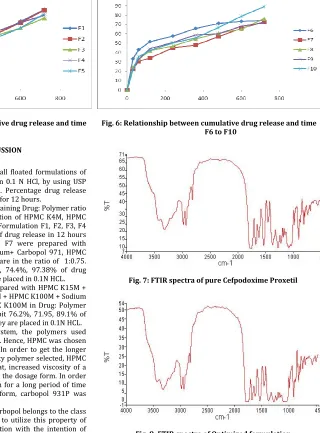
Fig. 5: Relationship between cumulative drug release and time Fig. 6: Relationship between cumulative drug release and time
F1 to F5 F6 to F10
RESULTS AND DISCUSSION
I
nvitro dissolution studies of all floated formulations of Cefpodoxime Proxetil were carried out in 0.1 N HCl, by using USP dissolution apparatus Type-II.at 50 rpm. Percentage drug release was calculated at two hour time intervals for 12 hours.Formulation F1, F2, F3, F4 containing Drug: Polymer ratio of 1: 0.75, 1:0.5 prepared with combination of HPMC K4M, HPMC K15M and HPMC K15M, HPMC K100M. Formulation F1, F2, F3, F4 exhibited 85.8%, 85.3%, 76.7%, 79.6% of drug release in 12 hours respectively. Formulations F5, F6 and F7 were prepared with Xanthan gum+ Carbopol 974, Xanthan gum+ Carbopol 971, HPMC K100M + Sodium CMC + Carbopol 971 are in the ratio of 1:0.75. These formulations exhibit only 81.2%, 74.4%, 97.38% of drug release at the end of 12th hr when they are placed in 0.1N HCL.
Formulation F8, F9, F10 is prepared with HPMC K15M + Xanthan gum + Sodium CMC, HPMC K15M + HPMC K100M + Sodium CMC, HPMC K4M + HPMC K15M + HPMC K100M in Drug: Polymer ratio of 1:0.75. These formulations exhibit 76.2%, 71.95, 89.1% of drug release at the end of 12th hr when they are placed in 0.1N HCL.
For floating drug delivery system, the polymers used must be highly swellable in shortest time. Hence, HPMC was chosen as a main swellable polymeric material. In order to get the longer duration of floating time the high viscosity polymer selected, HPMC K100M was chosen and it was found that, increased viscosity of a polymer prolongs the drug delivery from the dosage form. In order to retain the dosage form in the stomach for a long period of time and to avoid gastric emptying dosage form, carbopol 931P was included.
It was reported earlier that, Carbopol belongs to the class of swellable and adhesive polymers and to utilize this property of carbopol,it was included in the formulation with the intention of adhering the dosage form to the inner wall of the stomach and also possibly to control the release of cefpodoxime proxetil from the dosage form. Carbopol was used as a swelling agent, which also helped in gastric retention due to its adhesive properties. But carbopol affected floating properties. Physicochemical evaluation i.e. the prepared tablets were subjected to preliminary characterization such as hardness, thickness, % weight variation, friability and drug content. The evaluated parameters were within acceptable range for all the formulations.
From the overall dissolution profiles it was observed that as the concentration and of the polymers increased, there is decrease in the drug release rate, where use of less concentration could cause rapid release. From the above results formulations F7 is found to be satisfactory with dissolution profile results. Hence these formulations was said to be optimized formulations.
Drug Excipient Compatibility studies:
Fourier Transform Infrared spectroscopic studies (FTIR):
The FTIR spectra of drug, excipients, and drug loaded formulation were recorded. The characteristic peaks of the optimized formulation followed the same trajectory as that of the drug alone with minor differences. Thus there may be no drug-excipient interactions.
Fig. 7: FTIR spectra of pure Cefpodoxime Proxetil
Fig. 8: FTIR spectra of Optimized formulation
CONCLUSION
I
n the present research work gastro retentive floating matrix formulation of cefpodoxime proxetil were prepared by using various natural, synthetic polymers and their combinations. The formulation blend was subjected to various preformualation studies, flow properties and all the formulations were found to be good indicating that the powder blend has good flow properties. From the drug content and in-vitro dissolution studies of the formulations, it was concluded that the formulation F7 i.e. the formulation containing HPMC K100M + Sodium CMC + Carbopol 971(p), NaHCO3, Magnesium Stearate, MCC, Aerosil is the best formulation. F7 possessed quick buoyancy lag time of 45 sec and good total floating time of 12 hrs. The results showed that the drug release rate was decreased by increasing viscosity of the polymer combination.Swati Vikas Gondikar et al., J. Sci. Res. Phar. 2014, 3(3), 81-85
ACKNOWLEDGEMENT
T
he authors are thankful for the management of Bright Labs and Baris Pharmaceuticals Hyderabad for the gift samples of drug and polymers used in the work.REFERENCES:
1. Deshpande AA, Rhodes CT, Shah NH, et al. Controlled release
drug delivery system for prolonged gastric residence: An Review. Drug Dev. Ind. Pharm., 1996; 22: 531-539. 2. Anilkumar J Shinde. Formulation and evaluation of an oral
floating tablet of cephalexin. International Journal of Pharmaceutical Education and Research, 2010.
3. Baumgartner S, Kristl J, Vrecer F, Vodopivec P, Zorko B. Optimization of floating matrix tablets and evaluation of their gastric residence time. Int. J. Pharm., 2000; 195: 125-35.
4. USP-28/NF-23. Rockville (MD): United States
Pharmacopoeial Convention Inc; 2005; 397.
5. Singh B, Kim HN. Floating drug delivery system: an approach
to oral controlled drug via gastric retention. J. Control Rel., 2000; 63: 235-259.
6. Khatri S, Girdhani D, Pahwa R. Recent advances in floating drug delivery system. The Indian Pharmacist, 2007; 17-20. 7. Arora, S., Ali, J., Ahuja, A., Khar, R.K., Baboota, S. Floating
drug delivery systems: A review. AAPS Pharm. Sci. Technol., 2005; 6: 47.
8. Anil Kumar Chandragiri, Ganesh Kumar Y, Chandana CH,
Swetha B, Thirupathi Kaluvala. Formulation and Invitro Characterization of Gastro Retentive Drug Delivery System of Ofloxacin. Journal of Scientific Research in Pharmacy, 2014; 3(1): 19-22.
9. Kakumanua, V.K., Arora, V., Bansal, A.K. Investigation on physicochemical and biological differences of cefpodoxime proxetil enantiomers. Eur. J. Pharm. Sci., 2006; 64: 255-259.
How to cite this article:
Swati Vikas Gondikar, Y.Ganesh Kumar, CH.Chandana, B.Bhajanlal: Effect of Polymers and there Combinations on Grastroretentive and Floating property of Cefpodoxime Proxetil Matrix Tablets. J. Sci. Res. Phar, 2014; 3(3): 81-85.