267
Design And Performance Analysis Of Hybrid
Micro-Grid Power Supply System Using HOMER
Software For Rural Village In Adama Area,
Ethiopia
Wondwossen Astatike, Dr. Chandrasekar P.
Abstract: This paper is devoted to the design & performance analysis of hybrid Micro-Grid power supply system using HOMER software. The hybrid system has been designed with wind turbine generator, diesel generator and solar panel as components of local micro grid supply system. The design aimed at primarily to create an isolated micro grid system used to supply a reliable and cost effective electric power for the rural village under study. The design is done considering the present and future forecasted household AC loads as well as 2 AC pumps presently operating for agricultural irrigation purposes of the rural communities.Most rural villages in Ethiopia are not connected to the already existing electric supply network/grid. The majority of rural village homes which don’t have access to the National electric supply network usually use diesel generator set or car batteries as preferential power sources for meeting their household electric power supply demand as well as to run pumps for agricultural irrigation puropses. These power sources are not cost effective and not reliable from the point of availability of cheap diesel to the rural village to run generator and requirement of repeated charging cycle’s of batteries. Analysis indicates that Hybrid power supply system which uses two or more power sources will give better and reliable power source with high cost effectiveness.
Key Words: HOMER, Hybrid, Micro-Grid, off-grid, Power supply, Reliability.
————————————————————
1
INTRODUCTION
Though Ethiopia is increasing its electric power generation capacities from time to time, there are still huge numbers of unreached communities for electric supply access. Statistics indicates that about 80 to 85 % of Ethiopian people live in rural areas away from cities and the infrastructure for grid electric access are not realized in the present scenario. These large numbers of rural people will not be served from the national grid in the short term because of the scattered nature of individual houses. To tackle this bottleneck of power delivery problem, thinking of the untapped renewable energy resources like wind resources and solar resources that the country already gifted of will play a vital role to resolve the power delivery problem of the rural communities and improve their wellbeing. The Site selection for the hybrid micro-grid design and analysis study is decided to be the Adama City (formerly called Nazareth City) area which is 125km east direction from the capital city Addis Ababa. Adama city area is already identified and known by its high wind potential resource and high solar radiation intensity since it is found inside of the belt of the Great Rift Valley
region. In the vicinity of Adama City, there are already two wind farms which started operation in the name of Adama wind farm I and Adama wind farm II. But, both these wind farm stations will not supply their generated power to the nearby rural community. Both Adama I and II stations are supplying their generated electric power to the National electric network/National grid. Hence, the main objective of this study is to Design and conduct performance analysis of isolated hybrid Micro-Grid Power supply system using HOMER and deliver reliable and cost effective electric power to the rural village near to Adama City, Ethiopia. The hybrid system has been designed with wind turbine generator, diesel generator and solar panel as components of local micro grid supply system. In this particular design and analysis study I decided not to include battery storages or any other storage technologies of electric power in to the system. By doing this the system cost will be reduced to a significant amount. The map location of the area is indicated in Figure 1 below as found from HOMER software location search using internet.
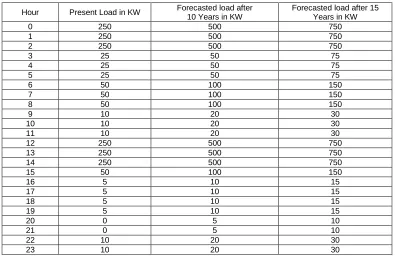
Table 1: Current and Forecasted Daily Load profile data of the rural village
Hour Present Load in KW Forecasted load after 10 Years in KW
Forecasted load after 15 Years in KW
0 250 500 750
1 250 500 750
2 250 500 750
3 25 50 75
4 25 50 75
5 25 50 75
6 50 100 150
7 50 100 150
8 50 100 150
9 10 20 30
10 10 20 30
11 10 20 30
12 250 500 750
13 250 500 750
14 250 500 750
15 50 100 150
16 5 10 15
17 5 10 15
18 5 10 15
19 5 10 15
20 0 5 10
21 0 5 10
22 10 20 30
23 10 20 30
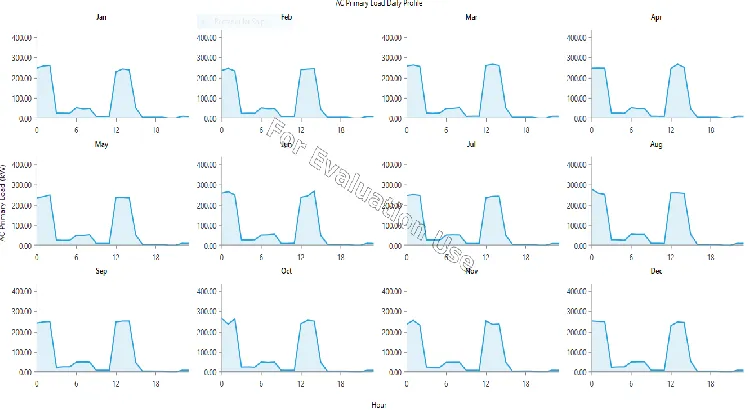
The present load data is entered to HOMER software load data for the peak month of January and the daily, seasonal and yearly profiles that are generated are depicted in Figures 2, 3 and 4 respectively below. The day-to-day random variability is set to 10% and the random variability time step is
set 20%. As a result, the scaled annual average energy required is given to be 1,845kwh/d with average power of 76.87kw.The peak power requirement is 437.35Kw with a load factor 0.18.All the loads are assumed to be AC loads.
269
Figure 3: Adama area rural village Seasonal load profile
Figure 4: Adama area rural village yearly load profile
2
LITERATURE SURVEY
The demand of electricity is increasing day by day throughout the world. Due to limited amount of fossil fuel it is important to design some new renewable energy systems that are able to decrease the energy dependence on conventional energy resources. A hybrid off-grid renewable energy system may be used to decrease dependency on the conventional energy resources. For the off grid system single technologies such as solar photovoltaic system and wind turbine are unable work reliable and effectively due to their variability of resources [1]. Hybrid Optimization Model for Electrical Renewable (HOMER), is a micro power optimization model, that simplifies the task of evaluating designs of both off-grid and grid-connected power systems for a variety of applications. The HOMER Hybrid Optimization Modelling Software is used for designing and analysing hybrid power systems, which contain a mix of conventional generators, cogeneration, wind turbines, solar photovoltaic, hydropower, batteries, fuel cells, biomass and other inputs [2]. In HOMER software we analysed cost summary including total net production cost, operational cost and levelized cost and decide on best possible Architecture [3]. Micro grid is a combination of nonconventional and conventional distributed generation resources (DGR) like solar cell arrays, wind power conversion systems, biodiesel generator sets, biomass gasifiers, micro-hydel systems, fuel cells, micro turbines
equipped with power electronic quality conditioning systems [4].
3
RESOURCES
USED
IN
THE
DESIGN
PROCESS
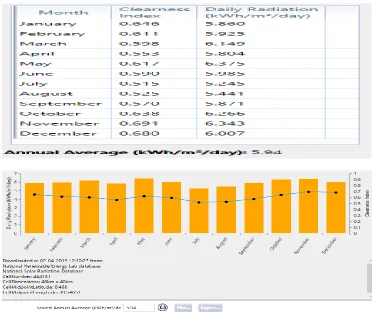
Figure 5: Monthly average solar global horizontal irradiance (GHI) data for the design area (Internet source: National renewable energy Lab database)
3.2 Temperature resource
271
Figure 6: Monthly average temperature data for the design area (Internet source: NASA surface meteorology and solar energy database)
3.3 Wind resource
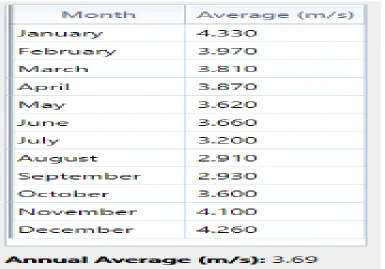
Figure 7: Monthly average wind speed data for the design area
4
MODELLING OF THE HYBRID SYSTEM IN HOMER SOFTWARE
Figure 8: Model of the hybrid system in HOMER
273
The life time of the generator, solar panel, wind turbine and PV inverter used in the model is 15,000 hours, 25 years, 20 years and 15 years respectively. Diesel price is set to 72 rupees/litre equivalent to 30 Birr/litre.
Table 5: Cost estimate in Ethiopian birr of different equipment for the designed hybrid system
S/No Equipment
Capital cost in Birr per
KW
Replacement cost in Birr
per KW
O&M in Birr per year
1 Generator 250 200 0.05
2 Solar Panel 150 100 50
3 Wind
Turbine 250 200 100
4 Inverter 100 75 50
1USD= 28.64 Ethiopian Birr = 69.05 Indian Rupees (As of April 1, 2019)
5
ANALYSIS OF SIMULATION RESULT
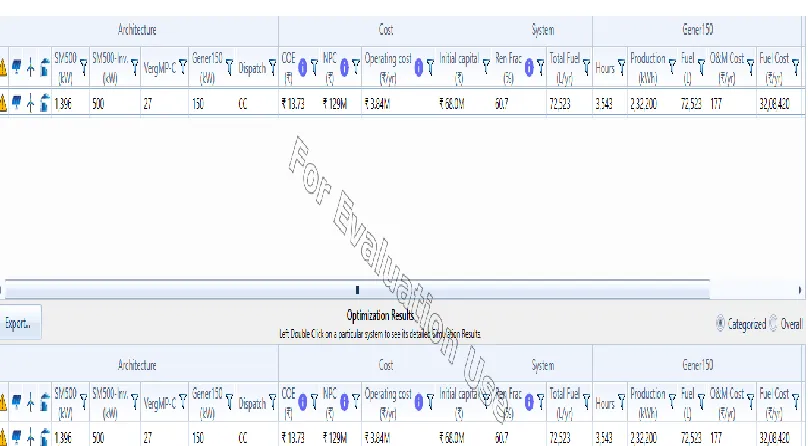
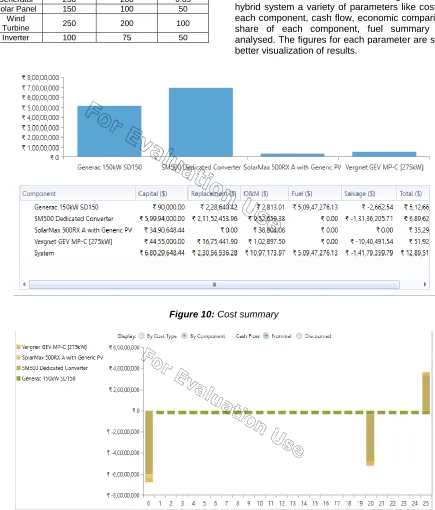
From the simulation result it can be seen that the hybrid system of wind turbine-generator set-solar PV will be the best reliable and cost effective option compared to the other hybrid combinations of solar PV-generator set, wind turbine-generator set and/or turbine-generator set operating alone to satisfy the power demand of the rural communities. From the simulation result of the wind turbine-generator set-solar PV hybrid system a variety of parameters like cost summary for each component, cash flow, economic comparison, electrical share of each component, fuel summary etc. can be analysed. The figures for each parameter are shown here for better visualization of results.
Figure 10: Cost summary
Figure 12: Economics comparison
Figure 13: Monthly average electric production
275
Figure15: AC primary load monthly averages
6
CONCLUSION AND RECOMMENDATION
From the simulation result of the designed Hybrid micro-grid system, I can conclude the fact that, the hybrid option of wind turbine, solar PV and Diesel generator is highly cost effective and reliable system than the other possible hybrid combinations of solar PV-Generator, wind turbine-generator or generator operating independently to meet the power demand of the rural communities. The excess power available in this particular design work can be used to satisfy the future power demand of the rural community for future increment of electrical loads from each resident or possible future expansion of the rural village. The forecasted power demand of the rural village after 10 and 15 years are already indicated in Table 1 above.
7
REFERENCES
[1]. R. Srivastava and V.K.Giri, Optimization of Hybrid Renewable Resources using HOMER, international journal of renewable energy research, Vol.6, No.1, 2016.
[2]. Kenneth E. Okedu, Roland Uhunmwangho, Optimization of Renewable Energy Efficiency using HOMER, Article in International Journal of Renewable Energy Research, Vol. 4, No. 2, 2014.
[3]. Kamlesh Pandey, Priya Banerjee and Devavrat Mathur, Study and Modelling of Green Energy based Micro-Grid for Rural Area, Indian Journal of Science and Technology, Vol 9(21), June 2016.
[4]. Optimization analysis of Microgrid using HOMER — a case study,Conference Paper December 2011. [5]. B. Kroposki, R. Lasseter, T. Ise, S. Morozumi, S.