The Image Processing of Morphological Changes by
Using RS &GIS (Case Study on Bago River, Myanmar)
De. Khin Mar Yee1, Dr. Mu Mu Than2, Dr. Kyi Lint3, Dr. May Myat Thu 4, Dr. Chan Mya Hmway5, Dr. Mar Lar Han6
1 Associate Professor, Geospatial Technology Center, Department of Geography, Dagon University 2 Associate Professor, Geospatial Technology Center, Department of Geography, Dagon University
3 Professor and Head, Department of Geography, Dagon University 4 Professor, Department of Geography, Dagon University
5 Assistant Lecturer, Department of Electronics, Technical University (Thanlyin)
6 Associate Professor, Geospatial Technology Center, Department of Geography, Dagon University
DOI: 10.29322/IJSRP.9.10.2019.p9403 http://dx.doi.org/10.29322/IJSRP.9.10.2019.p9403
Abstract—This research relates to a relatively understudied landform, the oxbow lake. The work utilizes oxbow lakes to ascertain the extent and nature of change in a river’s form, and to study on the man-made of the geomorphological change of Bago River. It also looks at the incidence of oxbow lakes and alluvial cutoffs across a watershed, and examines the spatial-temporal distribution of these landforms for morphological changes. The objectives of this study were to investigate the document of changes in channel planform and cross-section of the Bago River and to analayse whether the changes could have contributed to the frequent flooding or vice versa. The main data applies six satellite images (1992, 1997, 2002, 2007, 2012 and 2017) with less than 10 percent cloud cover and download from the United States of Geological Survey (USGS). The overlay of digitized image processing goes to the destination of this research work. The results show the morphological change of oxbow lakes with the aid of the Remote Sensing and Geographic Information System’ (RS & GIS) image processing. The field survey for ground check is essential for not only oxbow changes but also residents’ opinions for the accuracy of the result. Over 25 years period, agriculture developed rapidly in the catchment and flooding of the alluvial plain has become more frequent in recent times.
Index Terms— oxbow lakes, morphological changes, Bago River,
Remote Sensing, Geographic Information System
I. INTRODUCTION
Various studies in this regard have been carried out for some major rivers all over the world [1-6]. Several investigators have used remotely sensed data for ascertaining channel changes and banks to provide a base for estimating the response of the rivers to flood events [7]. Large-scale flooding is a global phenomenon that causes widespread devastation, economic damage, and loss of human lives [8].
Schumm [9] noted that most studies of river metamorphosis
channel. The oxbow lakes were changed to channel pattern by human action to reduce flooding.
II. STUDY AREA
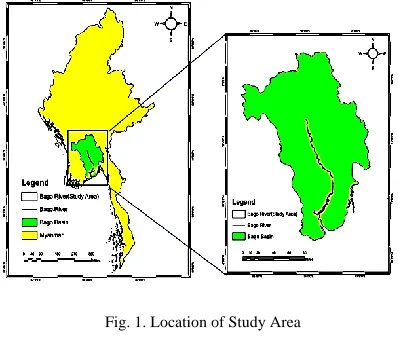
[image:2.612.317.561.61.205.2]The Absolute Location of Bago River is located two administrative regions, Bago and Yangon Region. The Bago river is located between 17° 6'21.89"N, 96°28'48.74"E and 16°46'10.54"N, 96°12'19.78"E. It is drain through Bago City and Townships of Yangon City. It is long 29.18 miles (46.96 kilometers). The location of study area can be shown by fig. 1.
Fig. 1. Location of Study Area III. OBJECTIVES
- To Study on Morphological Changes of River within five-year interval
- To retrieve the image processing by remote sensing and geographic information system
- To analyse on the morphological changes of oxbow lake areas (part of Bago River)
IV. DATA AND METHODOLOGY
Data
In this study, the main data was six Landsat images. For the processing of Landsat Thematic Mapper (Landsat 5 TM) dated February 27, 1992 (6 % cloud cover) and February 24, 1997 (1 % cloud cover), February 14, 2002 (7 % cloud cover), February 20, 2007 (0 % cloud cover), and (Landsat 7TM) dated February 26, 2012(0 % cloud cover) Landsat 8 Operational Land Imager (OLI) dated February 15, 2017 (1.08 % cloud cover) were used (Table 1).
TABLEI:ACQUISITION OF LANDSAT SATELLITE IMAGES
Methodology
The procedures of this topic consisted of three phases. The first phase was a pre field work including collection of training samples. The second phase was image processing for extraction and the third phase was the data analysis of the morphological changes.
B.1 Georeferencing and Survey and Interview
Landsat images have been georeferenced by the using Survey of Myanmar toposheet, 1696-01. Survey of Myanmar topographic maps was much helpful to prepare the base maps, and geocoding the satellite imageries in the case of digital image interpretation. Taking 4 survey samples for this paper, about 10 interviews were selected for ground checking points and local information.
B.2 Image Processing
Image enhancement is a kind of image modification that enables the capabilities omf human vision to identify and select regions of interests (Billah and Rahman, 2004 ). Landsat 5 TM and Landsat 7 TM record 7 spectral bands and Landsat 8 records 11 bands. For visual purpose any 3 bands were combined that were acting a False Colour Composite (FCC).
The next step is creation new shape file from the Arc Catalog to extract and digitize the study area of six images.
B.3 Data analysis of the morphological changes
[image:2.612.65.264.238.409.2]V. RESULTS AND DISCUSSION
Fig. 3, showed the spatio-temporal changes of Bago channel within 25 years (5-year interval). The six figures represented the pattern changes of 1992 to 2017. The detail view of black circles was the most changeable morphological meandering portion of river channel of five-year interval.
Fig.4 compared with the five-year interval changes of Bago River’ morphological patterns. The high-light rectangle can be found in detail the changes of the channel pattern within 25 years. The overlay result showed the channel changes of upper course were higher complicated meandering patterns. The channel of 1992 was longest and most meandering. Moreover, the channel of 2017 was the shortest than the other five channel patters because of human activities. Cut-offs as river training works were to be carefully planned and executed in meandering rivers. The cut-off is artificially induced with a pilot channel to divert the river from a curved flow which may be endangering valuable land or property or to straighten its approach to a work or for any other purpose. As the cut-off shortens the length of the river, it is likely to cause disturbance of regime upstream and downstream till readjustment is made. A pilot cut spreads out the period of readjustment and makes the process gradual. This processing was made by department of water resource.
Fig.3 morphological changes of Bago River (1992. 1997, 2002, 2007, 2012 and 2017)
The Bago river of 2017 was cut out the shortest path straight
line. The response of the interview, the local people made this pattern was man-made feature to control for the flood damage. The artificial man-made feature can be seen in Fig. 5. The Bago River is often faced by flooding in the Bago River Basin that natural hazard caused the irregular pattern when river flows. Cut-off process is artificial process that is need for irregular pattern of river flow and it can be protect to reduce causing flooding and the cut-off process have advantages and disadvantages.Point 1
Point 2 17°04'57.6"N 96°25'30.4"E 17°04'58.5"N 96°25'24.5"EPoint 3 Point 4
17°04'58.0"N 96°25'20.9"E 17°04'57.5"N 96°25'19.8"E
Fig.5 Manmade Morphological Changes of Bago River
(four sample sites)
VI. CONCLUSION
Bago rivers in Bago Region have swelled to their highest levels in more than five decades, according to the Department of Meteorology and Hydrology. The Bago River Basin plays an important role for agricultural production of paddy rice in Myanmar and its socioeconomic development is impacted flood and drought disasters. Recent flood events have caused major economic losses to paddy rice agriculture in the Bago River basin and flood inundation may intensify in the future climates. Therefore, this study investigates changes of floods and droughts between past and future climates in the Bago River basin using numerical model and standardized indices.
From a disaster reduction viewpoint, we believe the information derived from this study can contribute to assessments of potential flood damage for the local region, as well as other locations where data is limited, such as is generally the case in Myanmar. Such an analysis would also be helpful in formulating and directing post-event relief efforts.
REFERENCES
[1] N. Surian, “Channel Changes Due to River Regulation: The Case of the Piave River, Italy,” Earth Surface Processes and Landforms, Vol. 24, No. 12, pp. 1135- 1151, 1999.
[2] X. Yang, M. C. J. Damen and R. A. van Zuidam, “Satel- lite Remote Sensing and GIS for the Analysis of Channel Migration Changes in the Active Yellow River Delta, China,” International Journal of Applied Earth Observa- tion and Geoinformation, Vol. 1, No. 2, pp. 146- 157, 1999.
[3] M. Rinaldi, “Recent Channel Adjustments in Alluvial Rivers of Tuscany, Central Italy,” Earth Surface Processes and Landforms, Vol. 28, No. 6, pp. 587-608, 2003.
[4] I. C. Fuller, A. R. G. Large and D. J. Milan, “Quantifying Channel Development and Sediment Transfer Following Chute-Off in a Wandering Gravel-Bed River,” Geomorphology, Vol. 54, No. 3-4, pp. 307-323, 2003.
[5] L. Q. Li, X. X. Lu and Z. Chen, “River Channel Change during the Last 50 Years in the Middle Yangtze River: An Example of the Jianli Reach,” Geomorphology, Vol. 85, No. 3-4, pp. 185-196, 2007.
[6] M. Kummu, X. X. Lub, A. Rasphonec, J. Sarkkulad and J. Koponen, “Riverbank Changes along the Mekong River: Remote Sensing Detection in the Vientiane-Nong Khai Area,” Quaternary International, Vol. 186, No. 1, pp. 100-112, 2008.
[7] NRSA, “Brahmaputra Flood Mapping and River Migration Studies-Airborne Scanner Survey,” National Remote Sensing Agency, Hyderabad, 1980.
[8] A. K. Jha, R. Bloch and J. Lamond, “Cities and flooding: a guide to integrated urban flood risk management for the 21st Century,” Washington, DC: World Bank, 2012.
[9] S.A. Schumm, “River adjustment to altered hydrologic regimen— Murrumbidgee River and paleochannels”, Australia. Geol. Surv. Prof. Pap. 598, 65 pp, 1968.
[10] J.C. Knox, “Agricultural influence on landscape sensitivity in the Upper Mississippi River Valley”. Catena 42, 193–224, 2001.
[11] J.C. Knox, “Valley alluviation in southwestern Wisconsin”. Ann. Assoc. Am. Geogr. 62, 401–410, 1972.
[12] P.N. Owens, “Changes in sediment sources and floodplain deposition rates in the catchment of the River Tweed, Scotland, over the last 100 years: The impact of climate and land use change”. Earth Surface Processes and Landforms, Vol. 27, 403–423, 2002.
[13] G.R. Brooks, “Holocene lateral channel migration and incision of the Red River Manitoba, Canada”, Geomorphology 54, 197–215, 2007. [14] D. Uribelarrea, A. Perez-Gonzalez, G. Benito, “Channel changes in the
Jarama and Tagus rivers (central Spain) over the past 500 years”. Quat. Sci. Rev. 22, 2209–2221, 2003.
[15] J.R.L. Allen, “A review of the origin and characteristics of recent alluvial sediments”, Sedimentology 5, 89–191, 1965.
[16] W. Erskine, C. McFadden, P. Bishop, “Alluvial cutoffs as indicators of former channel conditions”. Earth Surf. Processes Landforms 17, 23–27, 1992.
Conference Rivers 83, Elliot CM (eds). American Society of Civil Engineers: New Orleans; 1036, 1984.
[18] M. Einsele, G. Hinderer, “Terrestrial sediment yield and the lifetimes of reservoirs, lakes and larger basins”. Int. J. Earth Sci. 86, 288–310, 1997. [19] W. Z. Win, A. Kawasaki, and S. Win, “River flood inundation mapping
in the Bago River Basin, Myanmar,” Hydrological Research Letters, Vol.9, No.4, pp. 97-102, 2015.
[20] A. Kawasaki, N. Ichihara, Y. Ochii, R. A. Acierto, A. Kodaka, and W. Z. Win, “Disaster response and river infrastructure management during the 2015 Myanmar floods: a case in the Bago River Basin,” Int. J. of Dis aster Risk Reduction, Vol.24, pp. 151-159, 2017a.