United Kingdom Vol. VI, Issue 5, May 2018
Licensed under Creative Common Page 408
http://ijecm.co.uk/
ISSN 2348 0386
THE COST MODEL OF THE MISSING LESSONS IN
THE EDUCATIONAL INSTITUTIONS
Selam Ceka
Graduate Program of Economic Faculty, Hasan Prishtina University, Prishtina, Kosovo [email protected]
Abstract
Education is an important sector for the development of the state, because students need to
have the proper education in order to have the professional skills in the workplace and by
contributing to the state and private sector. To achieve productivity at work with special
emphasis on education, an analysis of lessons in a professional school is made. The purpose of
this study is the missed lessons while only focusing on these few first minutes of teachers being
late. Respondents for the research of this paper have been deliberately selected by respondent,
respectively students in each class of a professional school. The data collection was done
through direct contact with the students. The survey was conducted among high school
students and was compiled in a way that was easily understood by the students. The simple
design of the questions gave the students the chance to answer quickly without having to put
too much time on it. A question example is: “Please, tell us how many minutes are the teachers late for a lesson (from the moment the bell rings until he/she is in the classroom)?” Study
findings show that of how much a teacher gets paid and how many lessons are lost as a result
of minutes being late will be understood here. The analysis shows the daily, weekly, monthly,
and annually missed lessons because of the minutes wasted by teachers for being late for
class, which calculated all together result in the institutional cost.
Licensed under Creative Common Page 409 INTRODUCTION
In order for the institutions to be able to efficiently reach their goals, they have to manage their
cost. This research study sheds light on the consequence that comes from the poorly managed activities. Here it becomes clear on a segment that is not easily noticed at the teacher—the
wasted minutes for each lesson. These wasted minutes do not only affect the student, they also
affect the financial expenses of a lesson. The wasted time is very small, however, when
repeated continuously, it creates hours of wasted teaching. There is a pragmatic and scientific
importance in teaching the minimization of cost. This model is designed to fit the need of school
management, the need of the Department of Education, and the Ministry of Education, Science,
and Technology. This will also serve decision-making institutions, which develop effective
policies in teaching, to find out the cause of negligence in employment. This model presents
ways on how to calculate the financial loss, both from the school and the teacher, as a result of
some wasted minutes.
RESEARCH METHODOLOGY
The present research was conducted relying on empirical data that was collected through a
survey carried out with students of the Technical High School "Pjetër Bogdani", in Ferizaj.
Through analysis, financial losses caused by teachers' delays (per lesson) at school were
found. Initially, participants in the survey were decided, which included students as primary
participants and teachers as secondary ones. Then, a questionnaire was designed as a
research tool. Through this instrument, we asked students the following question: “Please, tell
us how many minutes are the teachers late for a lesson (from the moment the bell rings until he/she is in the classroom)?” The questionnaire had a scale of answers ranging from 1minute to
5 minutes. The questionnaire was distributed to the students by the researcher himself. Data
analysis was carried out using Microsoft Excel, by the help of which conclusions were drawn
and averages of planned, realized and lost hours were calculated.
THE PRECONDITIONS OF CALCULATING WASTED CLASSES
According to the data collected from 90% of the high school‟s students, it turns out that a
teacher arrives 4.50 minutes late in each classroom. The cases for why this happens differ; they
can be objective (the school has three floors and long halls), and subjective (the psychological
state of the teacher). If the official conditions of the educational system of high schools in the
Republic of Kosovo are taken into account, for one teacher there will be this setup:
- a lesson lasts 45 min
Licensed under Creative Common Page 410 - the approximate net income for a teacher is 488.19 €
- there are 5 working days with students
- within a week, there are 32 teaching hours per class
According to the syllabus, there are 174 working days,or 35 weeks, in high school. A teacher
works 20 hours a week or approximately 4 hours daily for 5 days (20 / 5 = 4). From this, it can
be calculated the total number of hours in a year, which for a teacher is 696 teaching hours (174
days x 4 teaching hours).
THE FINDING OF THE MISSING MINUTES ACCORDING TO THE QUESTIONNAIRE
In order to find the average time of wasted minutes for a lesson, we should rely on empirical
evidence. Initially, the minute has been multiplied by the number of questionnaires for that
minute. Then, all the minutes multiplied by the corresponding questionnaires are divided by the
total number of the respondents in the classroom.
The financial analysis of lessons
The cost for one lesson can be found, starting from the monthly salary of a teacher, which is 488.19 €. Initially, the number of the average teaching hours per month must be found, then the
hourly wage is divided by the average teaching hours per month. According to the working
contract, each teacher teaches 20 hours weekly and 80 hours monthly (20 hours x 4 weeks).
Therefore, the lesson cost will be calculated as follows:
The lesson cost= Hourly wage/ lessons LC= 488.19 / 80 = 6.10 €
Since the purpose of this survey is to find the minutes wasted for each lesson, the cost of the
minutes of the lessons should be found. This is done for the analysis to be correct and
transparent. The cost of the minutes of the lessons is found like this:
The cost of the minutes of the lessons = the lesson cost/lesson minutes
CML = 6.10 / 45 = 0.14 €
After the cost of the wasted lessons is calculated, specifically the cost of the minutes of the
lessons, then it is easier to calculate the financial loss caused by being late for lessons/classes. 1a+2b+3c+...+nz
ML(x) = ———————— QNR
ML - Minutes of being late for the class (x) - The classroom
QNR - The number of
questionnaires
(of the respondents) 1,2,3,...,n - MinutesLicensed under Creative Common Page 411 The cost of missing lessons according to the number of teachers
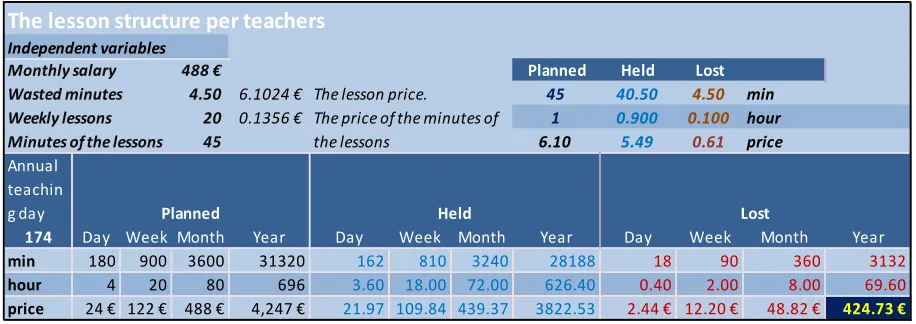
Table 1. The cost of missing lessons according to the number of teachers
A teacher that‟s 4.50 min late for lessons, in a day he/she wastes 18mins or 2.44 €, whereas, at the end of the year that teacher has wasted 424.73 €. The total number of teachers should be
multiplied by the annual financial loss of lessons for a teacher in order to find the cost of wasted lessons for the school. For a year the wasted cost of the school is 22,426 € (424.73 x 52.8).
The description of the methods of finding the financial loss for a teacher
First: the teaching hours, minutes and the planned cost for a teacher is calculated daily, monthly
and annually. All this is carried out based on the 20 weekly lessons and on the 174 teaching
days per year.
Second: the teaching hours, minutes and the realized (held lessons) cost for a teacher are
calculated daily, monthly and annually. This is achieved multiplying the planned lessons with the
held part of a lesson, whereas, the minutes of the lessons are calculated by multiplying the
planned lessons with the minutes of a held lesson. The cost of the held lessons is calculated by
multiplying the help lesson with the price of the lesson.
Third: to find out the wasted teaching hours for a teacher, the part of the wasted hour should be
found first, specifically the percentage of the wasted hour, and then it can be preceded with the
wasted time during a day, a week, a month and a year. It is presented as follows:
The part of the wasted hour=the minutes late for a lesson/ the planned minutes;
Daily wasted lessons= daily lessons x the part of the wasted lesson;
Weekly wasted lessons=weekly lessons x the part of the wasted lesson;
Monthly wasted lessons= monthly lessons x the part of the wasted lesson; The lesson structure per teachers
Independent variables
488 € Planned Held Lost
Wasted minutes 4.50 6.1024 € The lesson price. 45 40.50 4.50 min
Weekly lessons 20 0.1356 € 1 0.900 0.100 hour
Minutes of the lessons 45 6.10 5.49 0.61 price
Annual teachin g day
174 Day Week Month Year Day Week Month Year Day Week Month Year
min 180 900 3600 31320 162 810 3240 28188 18 90 360 3132
hour 4 20 80 696 3.60 18.00 72.00 626.40 0.40 2.00 8.00 69.60
price 24 € 122 € 488 € 4,247 € 21.97 109.84 439.37 3822.53 2.44 € 12.20 € 48.82 € 424.73 €
Planned Held Lost
Monthly salary
Licensed under Creative Common Page 412 Annually wasted lessons= annual lessons x the part of the wasted lesson;
Daily wasted minutes of lessons = daily lessons x the minutes of being late for class;
Weekly wasted minutes of lessons= weekly lessons x the minutes of being late for class;
Monthly wasted minutes of lessons= monthly lessons x the minutes of being late for class;
Annually wasted minutes of lessons= annul lessons x the minutes of being late for class;
The cost of the wasted lesson= the part of the wasted lesson x the lesson price;
The daily cost of the wasted lesson = the part of the daily wasted lesson x the lesson price;
The weekly cost of the wasted lesson= the part of the weekly wasted lesson x the lesson
price;
The monthly cost of the wasted lesson= the part of the monthly wasted class x the lesson
price;
The annual cost of the wasted lesson= the part of the annual wasted class x the lesson price;
The cost of missing lessons according to the number of classrooms
The structure of the missing lessons changes once the teaching hours of each classroom is
approached. So, the cost of a teacher differs from the cost of a classroom, but when the entire
school is looked at, the cost remains the same.
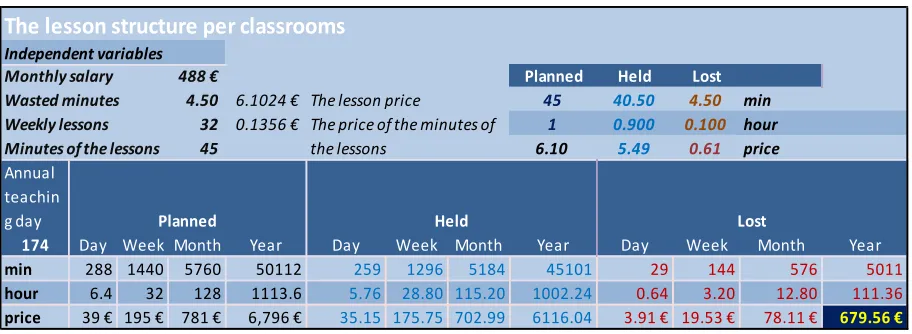
Table 2. The cost of missing lessons according to the number of classrooms
The teacher that‟s 4.50 min late for lessons, causes a waste of 12 lessons for a classroom, or 78.11 € when looked at from a financial perspective, while at the end of the year that teacher has caused a waste of 111 lessons for a classroom or 679.56 € when looked at from a financial
perspective.
The lesson structure per classrooms
Independent variables
488 € Planned Held Lost
Wasted minutes 4.50 6.1024 € The lesson price 45 40.50 4.50 min
Weekly lessons 32 0.1356 € 1 0.900 0.100 hour
Minutes of the lessons 45 6.10 5.49 0.61 price
Annual teachin g day
174 Day Week Month Year Day Week Month Year Day Week Month Year
min 288 1440 5760 50112 259 1296 5184 45101 29 144 576 5011
hour 6.4 32 128 1113.6 5.76 28.80 115.20 1002.24 0.64 3.20 12.80 111.36
price 39 € 195 € 781 € 6,796 € 35.15 175.75 702.99 6116.04 3.91 € 19.53 € 78.11 € 679.56 €
Planned Held Lost
Monthly salary
Licensed under Creative Common Page 413 The cost of annual wasted lessons in relation to the students (the classroom) is 111 lessons or
3,663 (111 x 33) in relation to the entire school. When looked at the financial indicators the
waste is 22,425 € (679.56 x 33).
Taking into account the waste that the students have suffered, it can be said that one classroom
during the entire year was 17 days (111 wasted lessons / 6.4 lessons daily). This is a disturbing
statistic considering that there are subjects scheduled once a week. The data shows that during
the year there exist three subjects that have not been held at all (111 wasted lessons/ 35
planned weeks =3). The data reveals another interesting fact. Under the supposition that the
variables of learning process of a student stay constant, the data collected from the wasting
minutes of a lesson- questionnaire reveal that 92 students have the potential of getting a high
school diploma without ever showing up in school (3,674.88 lessons/ 1,113.60 planned lessons
per classroom =3.3 classrooms; 3.3 x 28 students= 92).
From the table, it can be seen that, based on the salary and the being late element for a lesson,
the cost is the same whether the number of teachers or the number of classrooms is looked at. The table shows that this cost is 22,425.50 €.
Table 3. Classrooms‟ Table vs. Teachers‟ Table
This way, a teacher (classroom) every day teaches 6.4 (4) and if this is multiplied by the
calendric planned teaching days per year, it equals the total the planned teaching days per year.
If this is multiplied by the wasted part of the lesson, it equals the cost of the wasted lessons per
classroom. This multiplied by the number of classrooms (the number of the teachers) in the
schools, equals the cost of wasted classes within a year for the entire school.
Classrooms' Table vs. Teachers' Table
174 Working days Min hour %
488 € Monthly salary 4.50 0.100 10.00 Lost 80 Monthly lessons 40.5 0.900 90.0 Held
6.1024 € The lesson price 45 1 100 Planned
Day Week Month Year Day Week Month Year Day Week Month Year Students'
lessons 6.4 32 128 1114 0.64 3.20 12.80 111.36 5.76 28.80 115.20 1002.24
33 211.2 1056 4224 36748.8 21.12 105.60 422.40 3674.88 190.08 950.40 3801.60 33073.92
Cost per
classroom 39 € 195 € 781 € 6,796 € 3.91 € 19.53 € 78.11 € 679.56 € 35.15 € 175.75 € 702.99 € 6,116.04 €
Cost 33 1,289 € 6,444 € 25,776 € 224,255 € 128.88 € 644.41 € 2,577.64 € 22,425.50 € 1,159.94 € 5,799.70 € 23,198.79 € 201,829.46 €
Teachers'
lessons 4 20 80 696 0.400 2.000 8.000 69.600 3.60 18.00 72.00 626.40
52.8 211.2 1056 4224 36748.8 21.12 105.60 422.40 3674.88 190.08 950.40 3801.60 33073.92
Cost per
teacher 24.41 € 122.05 € 488 € 4,247.25 € 2.44 € 12.20 € 48.82 € 424.73 € 21.97 € 109.84 € 439.37 € 3,822.53 €
Cost 52,8 1,289 € 6,444 € 25,776 € 224,255 € 128.88 € 644.41 € 2,577.64 € 22,425.50 € 1,159.94 € 5,799.70 € 23,198.79 € 201,829.46 €
Licensed under Creative Common Page 414 CONCLUSION
If a teacher misses an entire lesson, that can be substituted later. However, the wasted minutes
of lessons because of being late is hard to track, therefore unlikely to the replaced. The findings
show the number of the wasted lessons because of these minutes of being late by turning them
into financial loss. Since in essence, the lesson as a whole is marked as held, this serves as
enough reason for the part of the wasted lesson to not be compensated.
To ensure the credibility of the data of this research paper, information has been gathered from school diaries about students‟ absences, teachers‟ absences, and their academic success. The
statistics show that the amount of wasted lessons is even higher when other factors are added,
such as the shortened lessons during the winter season (for technical reasons, the school shortens lessons for 5 minutes from November to March), the extra time taken in the school‟s
halls, and the absences of the teachers.
The efficiency of the education system remains alarming despite the salary increase in the past
years. When looked at in more detail, poor results have been shown at the end of the school
year: poor academic success, limited knowledge in scientific subjects, and among others, the
challenges students face when taking the national high school test. There are a lot of causes
that can affect the efficiency of the professional high schools such as: the lack in equipment, the
lack in working space, the lack of motivation concerning the working market, the foreign
education system more attractive than the national one, the absences and the late minutes of
the teachers and others alike. This model is suitable to be implemented in the education system
since it helps the decision-making institutions to develop effective policies in education and to
find the causes of employment negligence. This model can also serve the directors of schools,
municipality departments and the Ministry of Science and Technology Education. Teachers do
not only cause financial loss but also a non-financial loss, which can be even bigger since they
put the students in a position where they have to wait. This waiting period causes to lose trust in
the student-teacher relationship, therefore, students will lack sincerity towards the teacher and
the institution. Besides this, a mess is created in the school since there is space for the students
to act undisciplined in the classroom and in the corridors. There is a phenomenon called the
elasticity of the student behavior, which measures the degree of students‟ reaction in the case
of the teacher being late. If the teacher is not late for the lesson, the reaction degree is zero, but
if the teacher is late, then the degree of the students‟ reaction differs according to how late the
teacher is. Why is this important? Because with the increased number of wasted classes, there
will be a decrease in the trust towards the education system in general and the school in
particular. In these circumstances, it is recommended that teachers spend as less time as
Licensed under Creative Common Page 415 RECOMMENDATIONS
In order for the teaching system to be more efficient, and in order for the students to be more
engaged with the learning process, it is recommended:
- Lessons to be noted down in the diary at the teachers‟ office
- Lessons to be interactive
- The teacher should try to make the subject loveable for the students
- When the teacher is not liked, neither is the subject
- The teacher should show strength in teaching and not in grading - Students should all the time be appreciated
- It should be kept in mind that the grading is a result of both
REFERENCES
Besanko, D. Braeutigam, R. (2002). Microeconomics - An Integrated Approach. John Wiley & Sons. Inc. New York.
Coase, R. The Problem of Social Cost (1960), Journal of Law Economics, http://www2.econ.iastate. edu/classes/tsc220/hallam/Coase.pdf.
Hansen, D. Mowen, M. (2008) Cost management (The fifth edition in Albanian Language). Melikian Center. State University of Arizona)
Mançellar, A. (2002). (eds). Introduction to Economy. Pegi. Tirana
Qiriçi, S. (2005). The Labour Economics. Tirana
Ramosaj, B. (2002). MANAGEMENT, Third publication, University of Prishtina
The Education Calendar 2017-2018, www.masht-gov.net/kalendari për vitin shkollor 2017/2018.
The law of Education in the Municipalities of the Republic of Kosovo Nr.03/L-068
The law of Labor of the Republic of Kosovo Nr.03/L-212
The law of the Pre-university Education Nr.04/L-032.