Research article
Available online www.ijsrr.org
ISSN: 2279–0543
International Journal of Scientific Research and Reviews
Effects of Micronutrient amendment on Growth and Efficacy of
Biofertilizers
Barkodia Monika*, Batra Priyanka and LeelaWati
Department of Microbiology, CCSHAU, Hisar-125004, India [email protected],
ABSTRACT
Micronutrients play an important role in growth and efficiency of plant growth promoting rhizobia. Rhizobial growth is ceases during scarcity of micronutrient elements like iron, molybdenum, boron and zinc. Now due to depletion of soil quality the nutrient content of soil is decreasing rapidly. In nutrient deficiency biofertilizers were not working efficiently. Therefore, there is urgent need of assessment of quantity and type of micronutrient require in growth of rhizobia. In the present research investigation, effect of different concentrations of micronutrients (boron and molybdenum)on the growth of rhizobial isolate MRH 59 was evaluated. It was found that small change in micronutrient concentration leads to drastically decrease in rhizobial population.
KEYWORDS
: Maintenance, Performance Management, Optimal Maintenance*Corresponding author
Monika Barkodia
Department of Microbiology, CCSHAU, Hisar-125004, India
INTRODUCTION
Due to overexploitation of chemical fertilizers and pesticides the quality of agriculture soil is decreases continuously. Use of biofertilizers in the form of bioinoculants gained worldwide importance due to its ecofriendly nature. Rhizobia are root nodulating bacteria which reside inside the plant and help in biological nitogen fixation. Moreover, rhizobia play important role in plant growth promotion due to its diverse efficacy like hormones production, reduces biotic stress through siderophore production and hydrogen cyanide production, mitigate abiotic stress via amelioration of soil salinity1. The rhizobial inoculants markedly increased nodule number, nodule mass, shoot height and crop yield in comparison to chemically treated crops. In legume crops rhizobial inoculation enhanced crop yield to 30-47% 2.
In soil the efficacy of rhizobia is affected by number of factors like competition to native bacteria, nutrient unavailability or deficiency of nutrient in soil. In present day, Indian soil is become deficient not only on major nutrients (Nitrogen, phosphorus but also in some micronutrients like iron (Fe), molybdenum (Mo), boron (B), copper (Cu) and zinc also. Therefore, a balanced micronutrient concentration is necessary for higher crop productivity. The quantum and quality Rhizobium is very basic need to increase production of food legumes in India. Micronutrient deficiency in soil results in decrease in crop productivity as well as increased malnutrition condition on consumption 3.
MATERIAL AND METHODS
For inoculum preparation, a loopful of culture from freshly prepared slants of rhizobial isolates was transferred to YEM broth. The rhizobial isolates were grown in YEM broth for three days on shaker at 30°C.
After three days of incubation on shaker, one ml of the inoculum was transferred to the pre-sterilized yeast extract mannitol broth (YEMB) containing different concentration (0.05, 0.1, 0.5, 1.0 and 1.5 %) of micronutrients (Fe, Mo, B and Zn), flasks were incubated at 28-300C and initial population was estimated by using standard plate count technique Vincent et al 5.
RESULT AND DISCUSSION
Table I Effect of different concentrations of borax on growth of isolate MRH59
Incubation time (Days)
Log no. of cfu ml-1
Na2B4O7concentration (%)
*Control 0.05 0.5 1.0 1.5
1 2.267 3.477 3.806 2.477 2.431
2 3.298 4.869 4.690 4.623 4.301
3 5.368 6.602 7.819 5.544 5.477
4 6.431 8.457 8.587 6.480 6.602
5 8.380 9.005 9.951 8.381 7.778
6 7.260 7.832 7.812 7.707 5.301
7 7.079 7.557 7.619 6.956 4.462
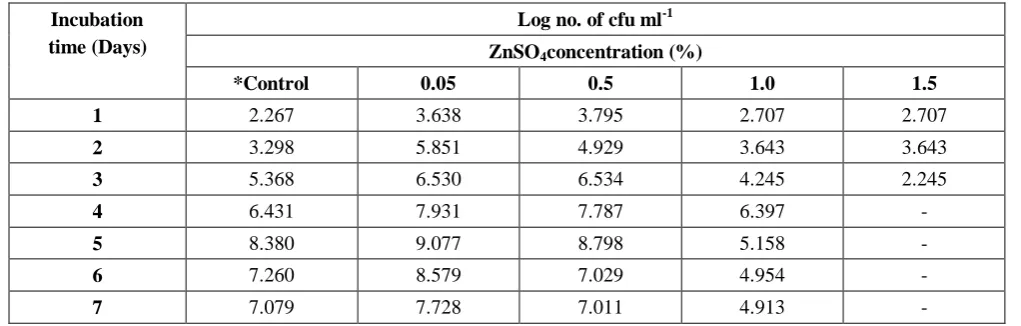
Table II Effect of different concentrations of zinc sulphate on growth of isolateMRH59
Incubation time (Days)
Log no. of cfu ml-1
ZnSO4concentration (%)
*Control 0.05 0.5 1.0 1.5
1 2.267 3.638 3.795 2.707 2.707
2 3.298 5.851 4.929 3.643 3.643
3 5.368 6.530 6.534 4.245 2.245
4 6.431 7.931 7.787 6.397 -
5 8.380 9.077 8.798 5.158 -
6 7.260 8.579 7.029 4.954 -
7 7.079 7.728 7.011 4.913 -
which was 8.3% higher than obtained in unsupplemented YEM broth. With increase in ZnSO4
concentration thereafter, there was drastic decrease in Rhizobium count (Table 2). These results agreed with the study of Gauriet al10that zinc sulphate stimulated Rhizobium growth at low concentration; at higher concentration zinc sulphate become inhibitory zinc being a metal is toxic for rhizobia at higher concentration.Bansodand Upadhaya11also reported decrease in viable count of rhizobia at higher concentration of zinc.
From the above results it was concluded that micronutrients were very essential for rhizobial growth. A small amount of micronutrient change viable count of rhizobial population. Therefore, it is very essential to check the effect of various micronutrient on rhizobial growth
REFERENCES
1. Barkodia M, KhichiS, Wati L. Biofertilizers: Potential candidate for sustainable agriculture. Int. J. Curr. Microbiol App. Sci, 2018; 7 (3): 2839-2851
2. Ndakidemi PA, Dakora, FD, Nkonya, EN, Ringo D and Mansoor, H .Yield and economics benefits of common bean (Phasculusvugaris l.) and soyabean (Glycine max l. merr) inoculation in northern Tazania. Aust J ExpAgric, 2007;46,571-577
3. Ryan J, Rashid A, Torrent J,Kwong YS, Ibrikci H, Sommer R and Bulent EE. Micronutrient constraints to crop production in the Middle East–west Asia region: significance, research, and management. AdvAgron, 2013;122,1–84
4. Paliya, S., Tikle, A. N. & Thomas, T. Efficacy of micronutrients in influencing growth behaviour of Rhizobium of pigeonpea (Cajanuscajan L. Mill sp.). Oriental Journal of Chemistry,2014;30,731736.
5. Vincent, J.M.. A Manual for the Practical Study of Root Nodule Bacteria. Blackwell, Oxford, 1970.
6. Quddus, M.A., Rashid, M. H., Hossain, M.A.&Naser, H.M. (2011) Effect of zinc and boron on yield and yield contributing characters of mungbean in low Ganges river flood plain soil at Madaripur, Bangladesh. Bangladesh. JAgric Res,2011; 36:75-85.
7. Gauri., Singh, A.K., Bhatt, R., & Pant, S. Effects of zinc on cell viability and cell surface components of Rhizobium sp isolated from root nodules of Trifoliumalexandrinum. J. Agric. Technol., 2012; 8:941-959.
9. Imtiaz, M.A., Rashid, P Khan, R.P., Memon, M.Y. &Aslam, M. The role of micronutrients in crop production and human health. Pak. J. Bot., 2010 ; 42, 2565-2578.
10.Zerpa, M., Juliana, M.J. & Jesus Méndez, J. Effects of Bradyrhizobium japonicum inoculants on soybean (Glycine max (L.) Merr.) growth and nodulation. Annual Bio. Res, 2013L;4: 193-199.