Trickle Column
Reactors
A TECHNIQUE FOR THE CONTINUOUS PERFORMANCE
OF LIQUID-PHASE CATALYSED REACTIONS
By G. J. I<.
Acres,
M.s~.,
P m .Research Laboratories, Johnson Matthey & Co Limited
Trickle column reactors combine the advantages of continuous operation at high catalyst e#ciency, inherent in gas-phase processes, with the advantages of working under mild conditions, inherent in liquid-phase processes. However, considerable attention has to be given to the design of
catalysts for use i n such reactors. Studies conducted i n the Johnson Matthey Research Laboratories have led to substantial improvements over past practice and several processes of potential industrial interest have been developed.
Catalytic reactions are conveniently divided into gas-phase reactions, where all the re- actants are gaseous, and liquid-phase reactions, where one of the reactants is in the liquid phase, either as a pure liquid or as a solution, and another is gaseous. Continuous gas-phase reactions are performed on a very large scale, and the physical criteria for their successful operation, either with fixed or fluidised beds, are well understood. Liquid-phase reactions on the other hand are conventionally performed discontinuously in batch reactors which are stirred and frequently pressurised. There is, however, a practical limit to the scale on which a batch process may be operated and there are obvious disadvantages in periodic rather than continuous production. Additionally there are two problems which are specific to liquid-phase batch processes and which are not shared by continuous gas-phase processes. First there is the necessity of separating the catalyst from the product by filtration at the end of the reaction. Second, because reaction occurs only between dissolved gas and liquid reactant at the catalyst surface, it is necessary to provide violent mechanical agitation to ensure intimate three-phase contact. If this is not adequately provided, the reaction be- comes diffusion limited and the catalyst is not
used to its full advantage (I). For these reasons where a reaction can be performed with equal facility in either the gas or the liquid phase the former is usually preferred. There are none the less a number of attractive features associated with liquid-phase reactions. They can, and indeed should, fre- quently operate under quite mild conditions of temperature and pressure, with the conse- quent promise of fewer side reactions than would be experienced at the necessarily higher temperature of a gas-phase reactor, and there is the facility to maximise the rate and selec- tivity by appropriate choice of solvent. Fre- quently of course one has to make a virtue of necessity; the gas-phase performance of many reactions, for example those involving high boiling or heat sensitive reactants, simply cannot be contemplated.
It would therefore appear most attractive to be able to carry out a liquid-phase reaction in such a manner (i) that product is formed continuously, (ii) that no filtration step is in- volved, and (iii) that diffusion limitation is not encountered. These criteria are all met in the trickle column reactor.
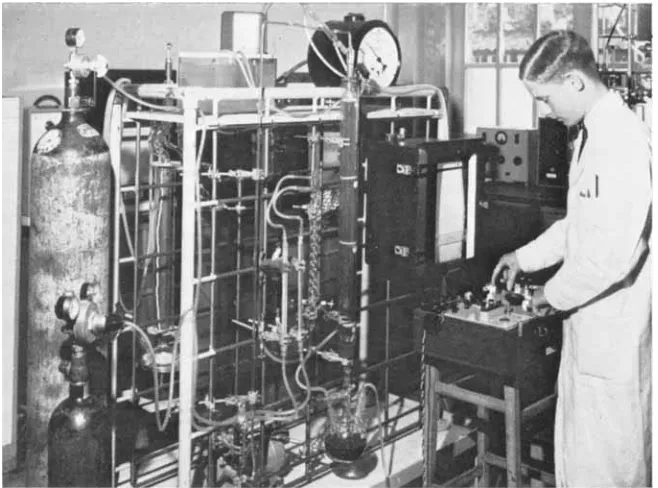
Fig. 1 The growing industrial interest i n trickle column reuctors.for continuous liquid-phase hydrogenations and oxidations necessitates laboratory work on bolh reactor and catalyst design. Reactors of the kind shown here are used in the Johnson Matthry Research Laboratories
pelleted or granular catalyst and trickles down the cat- alyst bed under gravity. A gas, usually hydrogen or oxygen, flows through the catalyst bed either con- currently or counter-cur- rently to the liquid flow. The reaction takes place between dissolved gas and liquid reactant at the catalyst surface. The pro- duct, which is formed con- tinuously, is collected at the bottom of the catalyst bed and no filtration step is involved. If this system is operated correctly, the thickness of the liquid film covering the catalyst surface is small, whereas the area of the liquid film is very large by
comparison with that in a stirred reactor. This ensures rapid diffusion of gas to the' catalyst surface and eliminates costly diffusion. phenomena even when the reactor is operated on the larger scale.
The idea of a continuous liquid phase reactor is not novel and has been investi- gated and used commercially for one or two reactions (2, 3). However, it is said that this system suffers from a major drawback, namely the deterioration in reactor perform- ance when the reactor is scaled-up (4). This is now attributed to uneven liquid distribu- tion in the reactor bed, which we have found can be overcome by better catalyst design.
Catalyst
Design
The choice of a suitable combination of metal and support for a liquid-phase reaction in a stirred reactor has been described in a previous article in this journal (5). Although the physical characteristics of catalysts for stirred reactors and trickle column reactors are quite different, the basic information there set out still applies.
We have shown that, for most liquid-phase reactions in a trickle column reactor, surface impregnated catalysts are superior to homo- geneously impregnated catalysts. Both the method of catalyst manufacture and the choice of support determine the type of catalyst obtained. By a careful choice of both these factors, effective catalysts can be made containing very low concentrations of the active metal.
Unless the liquid reactant is distributed evenly throughout the catalyst bed in a trickle column reactor, the catalyst cannot be fully utilised. In a diffusion controlled stirred reactor the catalyst is also not fully utilised and this problem is difficult if not impossible to overcome. In a trickle column reactor, however, it can be overcome by good catalyst design.
The functions of a column packing material where gases and liquids come into contact are now fairly well understood (6). The feature controlling the liquid distribution in the
column is the shape and size of the packing material, which in a trickle column reactor is
also the catalyst. There are three common forms of catalyst support, namely cylindrical pellets, solid spheres and irregular granules. In all previous recorded work with trickle column reactors metals supported on cylin- drical pellets have been used : we have found, however, that these catalysts, although satis- factory in a gas-phase reactor, make very poor trickle column catalysts. The reason appears to be that some of the cylinders pack end-to- end and cause the liquid to track through the bed, making the catalyst difficult to wet and leading to an uneven liquid distribution. Small solid spheres, although slightly better, still have a low activity because they tend to channel the liquid on to the walls of the reactor. The more common catalyst supports are, however, available as irregular granules which do not suffer from these defects and therefore perform very well in trickle column reactors.
We have found that the best way to evaluate a catalyst support for a reaction is to deter- mine the effect of catalyst bed depth on the rate. If the catalyst support is functioning correctly, the rate constant will be indepen- dent of bed depth. A typical plot is shown in Fig. 3 for the hydrogenation of a 20 per cent
solution of acetophenone in methanol using 5 per cent Pd on 8 to 14 mesh gamma alumina granules as the catalyst. Since this is a zero order reaction in a stirred reactor, the straight line plot shows that the rate constant is inde- pendent of bed depth and the catalyst is operating correctly. On this column, no liquid spreading device was used at the top of the catalyst bed. The intercept on the 'bed depth' axis at 5 cm represents the length of the catalyst bed required to spread the liquid front across the reactor.
maximum flow rate per unit area of the reactor which can be used before flooding occurs decreases with decreasing granule size. A high surface area and a high liquid flow rate are therefore not compatible in this sys- tem and a compromise is necessary. We have found that the most suitable general purpose supports are S to 14 mesh and 4 to 8 mesh granules. The approximate maximum flow rates through these supports for liquids having a viscosity and surface tension similar to that of water are 50 ml h-1 cm-a and 250 ml h-l cm-2 respectively.
Reaction Conditions
T o get the best operating conditions in a trickle column reactor it is necessary to in- vestigate the effect of reaction variables on the rate and selectivity of the reaction. In addition to the choice of catalyst and metal concentration, the flow rate, temperature, reactant concentration and pressure are important.
The maximum liquid flow rate will be determined by the activity of the catalyst and the dimensions of the reactor. Over a wide range of flow rates the rate constant will be independent of flow rate. However, as the flow rate increases and the column approaches the flooding point, diffusion effects set in and the rate constant becomes dependent on the
flow rate. One would not normally operate in this range.
Generally speaking, the rate of a catalytic reaction increases with increasing tempera- ture. In many liquid-phase reactions this does not apply and the effect of temperature on the rate is complex, as described in a previous article (I). The operating tempera-
ture of a trickle column reactor must therefore be chosen carefully.
I n a stirred reactor, solvents are often used either to dissolve a solid reactant or to act as a diluent. This is sometimes necessary in order to increase the rate of the reaction to an economic level. Solvents can also be used in a trickle column reactor but, because of the high catalyst to reactant ratio, it is sometimes possible to operate them at an economic rate with a pure liquid reactant.
Trickle column reactors should always be operated under diffusion-free conditions. With simple model reactions this condition is easy to define but there may be problems with more complex reactions. A reactor system is diffusion-free if the rate constant is independent of liquid flow rate and gas flow rate. A characteristic plot for a diffusion-free reactor is shown in Fig. 4. Since this is a zero order reaction, the straight line plot shows that the rate constant is independent of the flow rate. The reactor is therefore not
phase batch reactors are also capable of being carried out in a trickle column reactor.
diffusion controlled. A third means of testing for diffusion phenomena is to investigate the effect of pressure on the system. Usually, but not always, if the reactor is diffusion-free, the rate constant will be directly proportional to the pressure of gas in the reactor.
In most cases we would expect these reactors to be used a t atmospheric pressure, as this makes them easy and cheap to con- struct from QVF glass sections. We have, however, dcsigned and built a pressure reactor which has operated satisfactorily. For some difficult reactions, such as the hydrogenation of aliphatic aldehydes, the use of a pressurised reactor might be necessary.
Typical Liquid-phase
Reactions
T o make the best use of an atmospheric pressure trickle column reactor it is necessary to use the most active metals. For many reactions noble metal catalysts, although initially the most expensive, are in the long run the most economic. We have therefore attempted to establish by examining certain model reactions that the reactions for which these metals are commonly used in liquidAromatic nitro compounds One of the most common reactions carried out in the liquid phase is the hydrogenation of aromatic nitro compounds. We have investigated the hydro- genation of nitrobenzene and dinitrotoluene in a trickle column reactor and find both reactions possible at atmospheric pressure. Nitrobenzene can be hydro- genated with or without a solvent, but in the absence of a solvent condensation occurs between reactant and product giving a coloured product. Using equal volumes of nitrobenzene and methanol, complete conversion to aniline occurred at 25°C at a flow rate of 150 ml h-I. 300 ml of a 5 per cent Pd on 8 to 14 mesh gamma alumina catalyst were used in a column 25 cm long by 4 cm inside diameter.
The hydrogenation of dinitrotoluene in a trickle column reactor was equally successful. In a reactor 75 cm long by 4 cm inside diameter containing 900 ml of a 5 per cent Pd on 8 to 14 mesh gamma alumina catalyst, 62.5 g of dinitrotoluene were hydrogenated per hour at 5 0 T . Dioxan is a suitable solvent.
Olefinic compounds
The simplest reaction, and the one with the widest application, is the hydrogenation of an olefin to a saturated hydrocarbon. As an example, we have examined z-methylbut-3- en-2-01 which is easily hydrogenated with or without a solvent using 5 per cent Pd on 8 to 14 mesh gamma alumina as a catalyst.
cent; the other product is butanol. We have shown that a trickle column reactor is much more suitable for this reaction. Using a column 70 cm long by 4 cm inside diameter containing 900 ml of a I per cent Pd on 8 to 14 mesh alpha alumina catalyst, 300 ml of crotonaldehyde were hydrogenated per hour and the product contained less than 0.5 per cent butanol ( 7 ) .
Acetylenic compounds
In both stirred and trickle column reactors, acetylenic compounds are hydrogenated to saturated hydrocarbons using supported palladium catalysts; for example, 2-methylbut- 3-yn-2-01 is hydrogenated to amyl alcohol. It is, however, difficult in a stirred reactor to stop this reaction at the intermediate point to give 2-methylbut-3-en-2-01 unless selectively poisoned catalysts are used. However, in a trickle column reactor filled with a standard Pd/A1,0, catalyst, high yields of the inter- mediate product can be obtained by a suitable choice of reaction conditions.
Aldehydes and Ketones
The liquid-phase hydrogenation of aromatic aldehydes and ketones to the corresponding alcohols is often performed in a stirred reactor with a palladium catalyst; it is also possible to obtain the saturated hydrocarbons by hydro- genolysis. The hydrogenation of an aromatic ketone to the corresponding alcohol can also be done in a trickle column reactor. For example, acetophenone can be hydrogenated to phenyl ethanol in high yield using 5 per cent Pd on 8 to 14 mesh gamma alumina as catalyst. Using a 20 per cent solution of
acetophenone in methanol, 7 0 ml of aceto- phenone are hydrogenated per litre of catalyst per hour at 27'C.
Aromatic Compounds
The aromatic ring is not easily hydro- genated at room temperature and atmospheric pressure except with a very active metal such as rhodium. We have, however, shown that the hydrogenation of phenol to cyclohexanol
will proceed in a trickle column reactor using
5 per cent Rh on charcoal granules as catalyst. 15 g of phenol were hydrogenated per litre of catalyst per hour at 30°C.
Disproportionation reactions
Cyclic olefins such as cyclohexene will dis- proportionate in the presence of a palladium catalyst. For example, in a stirred reactor operating at 8 3 T , cyclohexene disproportion- ates into cyclohexane and benzene in the ratio of two to one. A similar reaction can be carried out in a trickle column reactor but at a much lower temperature. At 30°C, 300 ml of cyclohexene are converted per litre of catalyst per hour. If ethylene is used as a hydrogen scavenger and methanol as a solvent, however, the proportion of benzene in the product can be increased. Using a 20 per cent cyclohexene solution in methanol and ethylene as a hydrogen scavenger, 87 per cent of the product is benzene.
Simplicity and
Low
Installation Cost
The reactions discussed above are typical of those widely employed in the chemical industry, and it is likely that under suitable conditions any hydrogenation or oxidation which can be performed as a batch process can be carried out more advantageously in a trickle column reactor. The simplicity and low installation costs of the method must commend its consideration to all concerned with the design and use of industrial cata- lytic processes.
References
1 G. J. K. Acres and G. C. Bond, Platinum z B. D. Babcock, G. T. Mejdell and 0. A.
Hougen, A . I . Ch. E.J., 1957, 3, (3), 366 3 K. Denbigh, Chemical Reactor Theory, Camb.
Univ. Press, 1965
4 L. D. Ross, Chern.Eng. Prog., 1965,61, (Io), 77
5 G. C. Bond and E. J. Sercombe, Platinum
6 G. J. Jameson, Trans. Inst. Chern. Eng., 1966,
7 G. J. K. Acres and A. E. R. Budd, Johnson Matthey, British Patent Appln. 40930165 Metals Rev., 1966, 10, (4), 122
Metals Rev., 1965, 9, (31, 74
44, T198