Implementing A Risk Management And X-Ray
Cargo Scanning Document Management
Prototype
Wilson Nwankwo, Akinola S. OlayinkaAbstract: Analysis of images acquired from X-ray cargo scanning sites at the ports of discharge of consignments is central to modern risk management operations on imports. Often times the images (in their raw format) must be relayed to remote locations for analysis and risk profiling and this may constitute a heinous task owing to the unique format and signature of such multimedia documents as well as type of storage media attached directly to the high capacity X-ray cargo scanners. This paper is aimed at showcasing the design and implementation of a cost-effective solution for managing the secure transmission and processing of acquired cargo images across different locations. In this paper, the details of implementation of the prototype using open source tools are presented. The socio-technical approach is adopted while the implementation strategy follows a hybrid approach involving both structured and object-oriented methods. The application is programmed using PHP, Ajax and MySQL. The application enables a risk management and cargo scanning organization to relay large volumes of scanned cargo images in highly compressed secure formats in such a way that consistency and integrity are ensured as the files are relayed to remote sites for further image analysis, as well as their storage in relational databases such as MySQL. Access, processing, and share over the network with other stakeholders involved in the international trade facilitation cycle is ensured through encryption and digital signing.
Keywords: Trade facilitation, Imaging, Risk Management System, Document Management, Imports, Documentation
————————————————————
I. INTRODUCTION
The Internet is a great vehicle for ensuring seamless communication and information access in the enterprise [1],[2],[3],[4],[5],[6],[7]. The Internet promotes resource accessibility [8],[9] and availability [9-10] which are very vital in the activities of trade facilitation organizations [11], [12] especially those government agencies that are involved in the management of national security apparatuses and revenue collection from imports [13],[14],[15]. Another important factor in handling critical documents in the trade facilitation life cycle is confidentiality [16] and integrity [17]. The foregoing is very vital owing to the fact that any alteration of such documents may mar the possibility of arriving at a correct decision by the image analysts thereby rendering the entire campaign a failure.
1.1 The place of Electronic Document Management in Security and Port operations
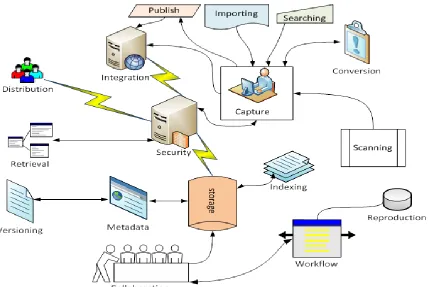
Generally, document management systems are designed to provide information indexing, storage, access, retrieval, and versioning, security, as well as metadata query capabilities [18],[19],[20],[21],[22],[23],[24],25]. The components of a typical electronic document management system is shown in Figure 1. Document management systems find applications to various business ranging from banking, insurance, manufacturing, to education, etc. In international trade, especially, imports and exports documentation, inspection, and clearance, document management is the hallmark of any policy designed to achieve any effective and efficient delivery. One critical area in the inspection process is the use of high capacity x-ray cargo scanners which are often deployed for non-intrusive inspection of cargoes in the import clearance process. Unlike other x-ray imaging systems, modern cargo scanners use X-rays in the range of 9 MeV(million electron Volts). The essence of the high energy x-ray is to ensure penetration of large cargoes so that the details of the objects in such enclosures are captured. The contrast and resolution of a cargo images are fundamental properties that fundamental to object identification during the analysis process. As sophisticated
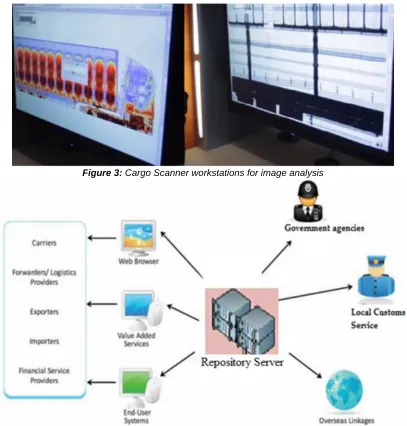
as these scanners are, they do not come with a built-in electronic document management component neither do the embedded work stations within the scanner housing permit the interfacing of the devices with external devices. Notwithstanding this gap, scanner acquired images could only contribute to the clearance process when the images are analyzed to support decision making. In most operational scenarios in developing countries, the acquired images are not analyzed at the site where they are acquired, that is, the images are often stored in a mobile storage device in such a format that is recognizable by the custom-built analysis software (that often came with the cargo scanner machine). From hands on experience with some image analysis software from Smiths Detection, Astrophysics Inc., and Westminster, scanner acquired images are easily corrupted during storage and relay to other sites hence absolute care must be taken during storage and transmission. Figure 2 shows a Smiths Detection HCV Mobile Cargo scanner in operation whereas figure 3 shows the scanner workstations used for image analysis.
1.2 Relationship between X-ray Cargo inspection, Document Management and Trade Facilitation
Centre for Trade Facilitation and Electronic Business (UN/CEFACT) has defined trade facilitation as ―the simplification, standardization and harmonization of procedures and associated information flows required to move goods from seller to buyer and to make payment‖[28]. The United Nations Conference on Trade and Development (UNCTAD) in their study had noted that a trade transaction traverses through thirty parties (brokers, banks, carriers, sureties and freight forwarders, etc. see Figure 4) with over forty documents needed in the process [29],[30],[31],[32]. Notwithstanding the way it is put by different authorities, trade facilitation revolves around four vital elements: technology, elimination of delays, increased revenue, and security. Trade transactions including
inspection and clearance at the ports are mainly conducted via documents hence document management remains central to trade facilitation. Use of high capacity X-ray cargo scanner had been around for about two decades. The essence of the cargo scanner is to eliminate all manner of human intervention in the cargo inspection process thereby eliminating human-injected delays. Document management is an integral element of every cargo scanning policy in that the acquired images often stored as part of inspection and clearance documents, are central to decision making on any cargo at the port of inspection. A specially tailored electronic document management system is required for supporting any non-intrusive inspection operation using scanners.
Fig. 1 A Secure Document Management System Environment
Figure 3: Cargo Scanner workstations for image analysis
Fig. 4. Stakeholders in the Trade facilitation chain 1.3. Statement of the Problem
Three categories of documents are identified in the domain of local risk management and scanning service organizations in Nigeria. They are: internally generated, external documents (documents received from Commercial Banks, Central Bank of Nigeria (CBN), Ministry of Finance, etc.), and legacy documents. Often times the following problems are remarkable in these organizations:
i. Poorly structured document life cycle
ii. Absence of rules and regulatory measures on document creation, manipulation, use and storage that invariably subject critical documents to abuses.
iii. Images acquired from X-ray scanners and stored on compact and digital video discs (CD/DVD) often get corrupted without notice often disrupting the times analysis of acquired images especially where the analysts do not reside on same site.
iv. Transfer and management of acquired images and multimedia documents to DVDs consumes much resources and time.
v. Acquired images unlike other multimedia documents are very prone to corruption hence storage and retrieval requires the use of a system that would ensure the integrity of the raw cargo images are preserved for analysis and future referencing.
The combined effect of these problems affect the realization of the trade facilitation policy especially with the use of X-ray scanners with few human experts who may be required to operate from remote stations.
1.4. Aim and Objectives
i. To design a system that enables the relay of multimedia documents and cargo images acquired from remote x-ray scanning sites to remote image processing terminals
ii. To implement a system that preserves the original format and specification of scanner image files while in transit from acquisition site to processing and storage locations
iii. To implement a design that would ensure availability, accessibility, and integrity of data regardless with relatively low bandwidth requirements.
iv. To incorporate into the design a scheme that protects the integrity of the acquired images from unauthorized manipulation while in transit to remote sites.
1.5 Review of Related Literature
Electronic Document Management Systems (EDMS) have been in use for many decades. One vital and common characteristics among most commercial is the ability to create, manipulate, store, and retrieve documents. Various models, approaches, and standards have been discussed and developed. Some of the notable models are: Native model, Web-based/Internet model [35], Integrated Document Model [36], [37], [38], and the Model-based approach [39], []40, 41]. With regards to storage, EDMS have been categorized as On-premises EDMS, and Cloud-based EDMS [42]. As Burtylev et al [43] had stated, the main principles underlying the development of the various EDMS models are: Monitoring and management, quality system, efficient storage, management, and access to information, logging of activities, optimization of business processes, and finally, reduction of paper documents. It is evident that in most EDMS models, more emphasis is on the traditional functions of document management system i.e. creation, storage, versioning, and retrieval. The system discussed in this paper goes beyond the traditional characteristics of electronic document management to very vital issues in cargo inspection and image analysis that borders on compression, transmission and maintenance of generated images in the very format that could be readily analysed by special image analysis software.
1.6. Relevance of the paper
Aside efficiency and effectiveness of operations, the use of X-ray scanners for the inspection of containerized and non-containerized consignments have the following advantages: (i) Reduction of hazards which may result from human-controlled physical examination of imports for infractions.
(ii) National security as concealed harmful and dangerous consignments could be easily detected and analysed
(iii) Increase in revenue generation as concealments aimed at evading taxes and duties are easily exposed.
The advantages identified above are only realized when images acquired are subjected to routine analysis. If the images are corrupted either mutilation at the point of acquisition or corruption during transmission, the purpose of the policy would be defeated. Hence, mechanisms should
be put in place to ensure the integrity of the images whether or not they are to be analysed where they are acquired. In this paper special public and private application-based encryption solutions are used to ensure consistency and integrity of the images at all times.
2. MATERIALS AND METHOD
2.1 Materials
The materials specification are divided into two parts: Design materials and Implementation materials. The materials employed during the design are:
i. A 2.5GHz Core-i5 PC with 8GB RAM and 750GB hard disk running Microsoft Windows 8.1 Operating system
ii. XAMPP Software[44]
iii. Tecno G9 tablet running android 7.1 OS iv. Paper questionnaires
The materials employed during the implementation and testing are divided into hardware and software.
Hardware
The hardware used for testing are:
a. Intel Xeon CPU 2.00 GHz with 2.00 GB RAM, 1TB hard disk.
b. Network-ready 3TB Network-attached Storage[45] c. High Resolution monitor with colour adapter
capability of 64/128-bit colour display and at least 1200*700 screen resolution.
d. NETBIOS – compatible network interface adapters (NIC).
e. Cisco 2600 (or higher) router (for connection to the internet).
f. Cisco ASA 5510 device g. Cisco 2600 Enterprise Switch
Software
a. Microsoft Windows 2008 Server (standard edition with service pack 2 installed)
b. Mozilla Firefox 3.0 or higher c. Apache Web server
2.2 Methodology
Research Design
The design of this study follows a hybrid one i.e. a mix of qualitative and system-based approaches. The qualitative component was necessary in data collection and summarization whereas the system approach involved the use SSADM and the OOADM. SSADM offers the following benefits: Clear requirements statement that everyone can understand and form a firm foundation for subsequent design and implementation; Improved project planning and control; Usability; Respond to changes in the business environment; Effective use of skills; Better quality; Improvement of productivity: Cuts costs. The process of data collection involved some field investigation on the existing system. On the other hand, the object-based approach offer simplification of the proposed system through decomposition. The various objects were easily identified and modelled. The programming was wholly done using object-oriented programming.
Population
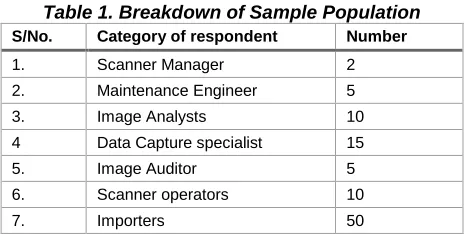
The study population was selected using quota sampling. The population comprises ninety-seven experienced operators and importers who have at one time or the other worked with Risk Management and Scanning Service Organization and/or used the Cargo scanners especially at the airports and seaports in Nigeria. The breakdown of the population is presented in Table 1.
Table 1. Breakdown of Sample Population
S/No. Category of respondent Number
1. Scanner Manager 2
2. Maintenance Engineer 5
3. Image Analysts 10
4 Data Capture specialist 15
5. Image Auditor 5
6. Scanner operators 10
7. Importers 50
Instruments
Semi-structured questionnaires were used as aid to buttress the data gathered from observation. Each questionnaire was divided into two main sections: a profile
and a survey respectively. The profile contains socio-demographic characteristics of the respondents such as age, gender, job position, qualifications, years of experience on the job, previous experience on the scanning of consignment, etc. The questions were structured to reflect the research questions using the Likert scale with four choices provided for each question. The choices represented the degree of agreement each respondent has against a given question. The instrument was validated by two former general managers who had been in the employ of two destination inspection and risk management companies.
3. RESULT AND DISCUSSION
3.1. Analysis of respondents’ opinions
Figure 5 shows the summarized data on respondents’ opinions regarding the performance of the services at the ports. From the diagram, it is shown that there is relative consistency on the opinions of the respondents as to the services provided at the ports. Majority of the respondents had agreed that the existing operational procedures are somewhat suboptimal and require enhancement.
3.2. High-level Model of the System
The architecture of the entire system using a component diagram as shown in Figure 6. The model depicts the various components that comprise the technology for conducting an efficient cargo scanning and inspection campaign.
3.3. Image acquisition and Document processing
Fig. 5: Respondents’ opinions on cargo scanning operations in the ports 3.4. System flowchart
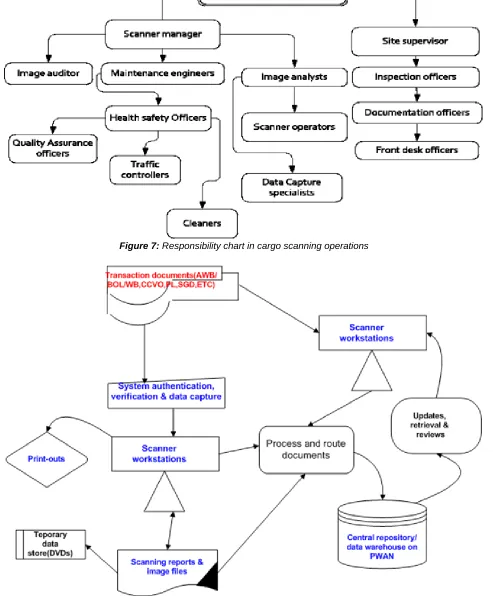
The system flowchart represents graphically the procedures for input, output and processing on the system. The input procedure starts with authentication and verification of both the user and transaction documents required for the scanning procedures. Data is entered via the scanner
workstations, validated, signed and encrypted stored in the central database over the network. Reports and other forms of output may be generated from the processed data or from the database. Figure 8 shows the system flowchart of the system.
Figure 7: Responsibility chart in cargo scanning operations
Fig. 8: System flowchart 3.5 Data modelling and Encryption Algorithm
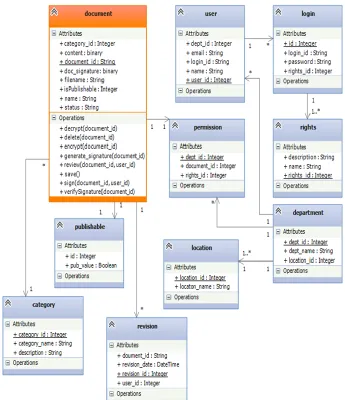
The data model is constructed using the class diagram. Figure 9 shows the class diagram. The various objects for
allowed on it. Three key methods (functions) are included: generate_signature(), sign(), verifySignature(), encrypt(), and decrypt() functions respectively. The essence of these methods during implementation are to ensure consistency and integrity of the cargo images during transmission and access.
Algorithm for securing the integrity of cargo files
Two algorithms are presented: the private and public encryption solution. In the private key encryption phase, we generate a cryptext (ciphertext) with a pseudohead (false head) that is deceptive to the hacker. The cryptext appears to use Blowfish Algorithm while in the real sense it is Rijndael. This therefore misleads the hackers [47]. For public encryption, the purpose is so that only authorized users e.g. Image analysts can access the images. The encryption doesn’t expire with time as it’s generated within the code, unlike that by certification authorities. Since the Initialization Vector (IV) is randomly generated and internally encrypted, it cannot be guessed or exposed. The algorithm for generating the public key is: Create a function for the encryption requesting user data only
b. Randomly Generate an Initialization Vector (IV) c. Invoke the Rijndael_128 Mcrypt as core d. Make the ―deciv‖ adjustments
e. Output the ―deciv‖ value as cryptext (ciphertext)
For the private encryption with user-defined Salt- Code a. Create a function requesting user data & user salt-key b. Invoke the AES crypt method as core
c. Reverse the content of user data before encryption d. Make the ―deciv‖ adjustments on the encrypted data e. Output the ―deciv‖ value
3.6 Media and Storage specifications
Input and output media
The input and output media for data and document capture include; keyboard, DVDs, document repository disks, tapes, the X-ray scanner machine, and the X-ray Scanner workstations. Sources of data for input include shipping documents (BOL/AWB/WB, CCVO, PL, MANIFEST, FORM M, RAR, SGD, etc.). Other sources of data include RFS messages, and risk information from the computerized risk management system.
Storage specification
The storage media for this system include:
High capacity storage area network arrays (2TB and higher), Compressible LTO 3 tapes, Digital video disks (DVD-RW) for temporary store.
Input – output format
The inputs and outputs take either of two forms namely:
ASCII format
This format allows the capture of only text files. This format would provide room for lightweight documents such as the scan reports, SGDs, etc.
Binary Large Objects (BLOBs)
BLOBs are used to store large scanner-generated image files in their original format, and searchable portable document format (PDF) files. The binary format readily supports high compression and easy transmissions.
3.7 Program Specification
The application follow an object oriented approach and modular designs. Each module is designed to envelop related tasks. The programs in the suite are,
a. Home module
b. Authentication module c. Document capture d. Document review e. Administration module
f. Document Management module g. Search module
h. User information management i. Reports
Some modules have sub-modules all of which are used to perform related operations.
3.8 Program Coding
The programs are written using PHP for cross-platform compatibility and could be deployed on different Operating system platforms such as: Microsoft Windows, UNIX (Linux, Solaris, AIX, etc), MacOS, etc. PHP as a compact web programming language has the following characteristic advantages:
a. Powerful user friendly design capability b. Compact code
c. Codes are easily managed, reused and expanded d. High data handing capacity
e. Excellent interconnectivity with different backends and data sources such as Oracle DBMS, Microsoft SQL SERVER, MySQL, IBM DB2, ProgresSQL SQL Lite, etc.
f. Interpreted and open source framework.
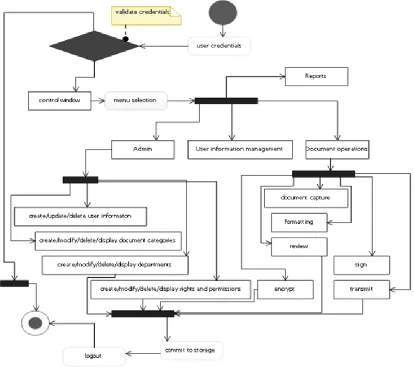
Figure 10 is an activity diagram showing the process cycle on the system.
3.9 Site preparation, Installation and migration
Fig. 9: Data model of the system
3.10 Using the system
Operating this system is very simple in that it does not require many hours or days of training. It begins with a user log in through the login window. After a successful login, the following functions may be performed on the system
(i) Administrative functions (ii) Creating/capturing documents
(iii) Authorizing/encrypting/signing documents
(iv) Reviewing document properties
(v) Transmission of documents to remote sites for image analysis
(vi) Searching and viewing documents
Fig.10: Activity diagram showing the flow of activities in the system
Fig. 11: Check-in window
Authorization, Encryption, and Review of documents
When a user creates or captures a document/file, it is made available to him/her and the administrator by default. To enable access to the document by other users, the document must be formatted, authorized and published. For
4. CONCLUSION
This paper is aimed at implementing a prototype system that aids trade facilitation through the use of an efficient and effective documentation management system. The major area of concern is the security of scanner-acquired images of cargoes during non-intrusive inspection at the ports. This is due to the fact that any inconsistency in such images during transmission would defeat the very purpose of image analysis which is often done to support decision-making during port operations. The system discussed in this paper enables the transmission, security, management, and workflow in cargo scanning and risking management organizations. The system was designed, tested and deployed to ascertain its validity as to satisfying the objectives set out prior to the design. This paper has provided valuable information regarding the implementation procedures as well as technical and operational procedures on the system. With all the details in place, it should be noted that a software does not necessarily translate to the success of a project hence the service of skilled professionals (programmers, engineers, data capture experts, etc.) and an appropriate project implementation team is required to ensure the system achieves organizational goals. This paper has demonstrated the use of open source tools to produce an enterprise-level system that can extend the functions of x-ray cargo scanners in their usage as vehicles of custom modernization and trade facilitation.
Funding
This study did not receive any external funding.
Conflict of Interest
The authors declare that they have no conflict of interest.
REFERENCES
[1]. Thomas Wells Brignall III & Thomas Van Valey (2005). The Impact of Internet Communications on Social Interaction, Sociological Spectrum, Vol. 25(3), 335-348, DOI: 10.1080/02732170590925882
[2]. Castells, M. (September 8 2014). The Impact of the Internet on Society: A Global Perspective, MIT Technology Review. Retrieved from https://www.technologyreview.com/s/530566/the- impact-of-the-internet-on-society-a-global-perspective/
[3]. Heath, D. (2017). What Are the Positive Effects of the Internet on Business? Retrieved from https://bizfluent.com/info-8236794-positive-effects-internet-business.html
[4]. Leonard, K. (2019).The Effect of the Internet on Modern Businesses & Corporations. Retrieved from https://smallbusiness.chron.com/effect-internet-modern-businesses-corporations-896.html [5]. Berisha-Shaqiri, A. (2015). Impact of Information
Technology and Internet in Businesses. Academic Journal of Business, Administration, Law and Social Sciences, 1(1), pp 73-79
[6]. Avlonitis, G.J., & Karayanni, D.A. (2000). Business Marketing Examples from American and European Companies. Industrial Marketing Management 29, pp 441–459. Elsevier
[7]. [Lagrosen, S. (2005) "Effects of the internet on the marketing communication of service companies", Journal of Services Marketing, 19(2), pp.63-69. [8]. Yebowaah, F.A. (2018).Internet Use and its Effect
on Senior High School Students in Wa Municipality of Ghana. Library Philosophy and Practice (e-journal). Retried from https://digitalcommons.unl.edu/libphilprac/1817 [9]. Nwankwo,W.(2018).Promoting Equitable Access to
University Education through Online Learning Systems, World Journal of Engineering Research and Technology,4(2). pp. 517-543
[10]. United Nations(2008). Measuring the impact of ICT use in business: the case of manufacturing in Thailand, UNCTAD,Geneva. Retrieved from https://unctad.org/en/docs/sdteecb20073_en.pdf [11]. Zaki,C.(2015). How Does Trade Facilitation Affect
International Trade?, The European Journal of Development Research, 27(1), pp.156-185. Palgrave Macmillan;European Association of Development Research and Training Institutes (EADI)
[12]. Hossain, S.S., Uttam, D. & Al Amin, M. (2009). Impact of information technology in trade facilitation on small and medium-sized enterprises in Bangladesh, Asia-Pacific Research and Training Network on Trade Working Paper Series.
Retrieved from
https://www.unescap.org/sites/default/files/AWP%2 0No.%2076.pdf
[13]. UNCTAD (2004). Use of the Internet for Efficient International Trade: Guide for SME Managers. United Nations, Geneva.
[14]. Miyahira, H.(2008). Using Information Technology to Improve Tax and Revenue Collection. THE INSTITUTE OF BRAZILIAN BUSINESS & PUBLIC MANAGEMENT ISSUES & George Washington University, Washington DC.
[15]. Gitaru, K. (2017). The Impact of System Automation on Revenue Collection in Kenya Revenue Authority (A Case Study of SIMBA). Retried from https://mpra.ub.uni-muenchen.de/80343/1/MPRA_paper_80343.pdf [16]. Olaoye, C.O. & Ayodele, K.B.(2017). Impact of
Information Technology on Tax Administration in Southwest Nigeria, Global Journal of Management and Business Research: Accounting and Auditing,17(2), pp.25-33.
[17]. Nisar,T.M.(2006). E-governance In Revenue Collection And Administration,WIT Transactions on Information and Communication Technologies,36. WITPress
[18]. Nwankwo W., Olanrewaju B. S., & Olayinka T. C. (2017). Document Interchange Framework for Tertiary Institutions, World Journal of Engineering Research and Technology,3(5), pp.144-162 [19]. Nwankwo W., Olanrewaju, B. S., & Olayinka T. C.
(2018). Document Interchange Modeling with the Zachman Framework: Nigeria’s Institutions in Perspective. World Journal of Engineering Research and Technology,4(2), pp.52-63
from
http://www.oberonplatform.com/casestudies_dm.ph p
[21]. Bychkov,D.(25 February 2013). What are the Best Document Management Systems?. Segui Technologies. Retrieved from
https://www.seguetech.com/best-document-management-systems/
[22]. Alina,A., Küng,J.,Czibulla,G.S., & Sacarea,C.(2014). Designing A General Architecture for Data Interchange, International Conference on Web Information Systems and Technologies (WEBIST)
[23]. Burtylev,I.N.,Mokhun,K.V.,Bodnya,Y.V., & Yukhnevich,D.N.(2013). Development of Electronic Document Management Systems: Advantage and Efficiency, Science and Technology, Special Issue, pp. 1-9
[24]. Mahmood, A.& Okumus, I.T.(2017). Design and Implementation of an Electronic Document Management System, MAKÜ-Uyg. Bil. Derg., 1(1). pp.9-17
[25]. Maaranen, M.(2017). An Implementation Process for a revised Document Management System, Masters Thesis, Helsinki Metropolia University of Applied Sciences. Retrieved from https://www.theseus.fi/bitstream/handle/10024/127 891/Thesis_Mika_Maaranen_Metropolia%20Maste rs%20in%20Industrial%20Management%20-%202016-2017.pdf?sequence=1&isAllowed=y [26]. World Trade Organization(2014). PROTOCOL
AMENDING THE MARRAKESH AGREEMENT ESTABLISHING THE WORLD TRADE ORGANIZATION, United Nations,Geneva
[27]. Organization for Economic Co-operation and Development(2019). "Why trade facilitation matters in today’s global economy". Available from http://www.oecd.org/trade/topics/trade-facilitation/ [28]. United Nations Economic and Social Council
-Economic Commission for Europe Executive Committee on Centre for Trade Facilitation and Electronic Business (2016) UN/CEFACT Prospective Directions, UN/CEFACT Bureau.
Available from
https://www.unece.org/fileadmin/DAM/cefact/cf_ple nary/2016_plenary/ECE_TRADE_C_CEFACT_201 6_20E_Rev_1_prospective_directions.pdf
[29]. United Nations Conference on Trade and Development(2016). TRADE FACILITATION AND DEVELOPMENT: Driving trade competitiveness,border agency effectiveness and strengthened governance, United Nations, Geneva. Available from https://unctad.org/en/PublicationsLibrary/dtltlb2016 d1_en.pdf
[30]. United Nations Conference on Trade and Developement(2006). TRADE FACILITATION HANDBOOK PART I National Facilitation Bodies: Lessons from Experience. United Nations Geneva.
Available from
https://unctad.org/en/Docs/sdtetlb20051_en.pdf
[31]. United Nations Conference on Trade and Development (2011). Trade Facilitation in Regional Trade Agreements. United Nations, Geneva. [32]. United Nations Conference on Trade and
Developement(2014). The new frontier of competitiveness in developing countries: Implementing trade facilitation . United Nations, Geneva.
[33]. Nwankwo, W.(2017). Customs Automation: The X-ray and Computerized Risk Management Systems Era,International Journal of Science and Research, 6(4), pp. 735-741
[34]. Obee, J.(29 April 2017). Choosing and Implementing an Electronic Document Management System. Barnet London Borough.
Retrieved from
https://cdn.ymaws.com/irms.org.uk/resource/collect
ion/C440C319-CE10-44AF-A0DF-BC06F876F5B2/20170428_Implementing_a_Electr onic_Document_Management_System_v2.0.pdf [35]. Nwankwo, W., Olayinka, A.S., & Benson,
B.U.(2019). X-ray Cargo Scanning and Risk Management in Trade Facilitation: Analysis & Model of an Online Imaging and Documentation Management System, International Journal of Modern Education and Computer Science,
[36]. Bjoerk B.C., Huovila P. and Hult S. (1993). Integrated construction project document management (ICPDM): In Behesti, M.; Zreik, K.(eds.). Advanced Technologies - architecture - planning - civil engineering, proceedings of the EuropIA'93 conference, June 21-24, Elsevier, Delft, Holland, 135-146.
[37]. Bjoerk B.C. (1994). The RATAS project – an example of co-operation between industry and research towards computer integrated construction, ASCE Journal of Computing in Civil Engineering, Vol. 8, No. 4, 401-419.
[38]. Turk Z., Bjoerk B,C., Johansson K. and Svensson K. (1994). Document management systems as an essential step towards CIC, CIB W78 Workshop on Computer Integrated Construction, VTT, Helsinki, Finland, August22-24, 1994.
[39]. Debras Ph., Rezgui Y., Le Ber P. and Chaplais C. (1994). Projet DOCCIME: Système logiciel pour l’intégration de l’ingénierie documentaire dans le processus de conception - Rapport final, Internal Report, CSTB, Sophia-Antipolis, France.
[40]. Rezgui, Y., Brown A., Cooper G., Aouad G., Kirkham J. and Brandon P. (1995). An integrated framework for evolving construction models, to be published in the International journal in construction Information Technology.
[41]. Rezgui, Y. (1994). Integration des systèmes d'informations techniques pour l'exploitation des ouvrages, PhD thesis, Ecole Nationale des Ponts et Chaussées, Paris, France.
[42]. Uzialko, A.C.(2019). Document Management Systems: A Buyer's Guide
Technology, Special Issue: 1-9. DOI: 10.5923/s.scit.201301.01
[44]. Apache friends(2019). XAMPP Apache + MariaDB + PHP + Perl. Retrieved from https://www.apachefriends.org/index.html
[45]. Beal, V.(2019). NAS - Network Attached Storage, Webopodia. Retrieved from https://www.webopedia.com/TERM/N/network-attached_storage.html
[46]. Duffy, K.P.(2011). Structured Systems Analysis and Design. Sogeti University. Retrieved from http://www.dphu.org/uploads/attachements/books/b ooks_5873_0.pdf