BritJ. SportsMed.- Vol. 14, Nos 2 &3, August1980,pp. 139-144
KINANTHROPOMETRY AND
PERFORMANCEOFTOPRANKING INDIAN BASKETBALL PLAYERS
H. S.SODHI,PhD
Sports Medicine ResearchLaboratory,
Netaii
SubhasNational Institute of Sports,Patiala- 147001 INDIAIt is understood that the physiological function or performance ofan athlete is an adaptationas aresult of intensive training, which in turn,hasamarked influence on his kinanthropometry i.e. thesize, shape, proportion, body composition and gross function (Cureton, 1951;
Astrand,
1956; Tanner, 1964; Hirata, 1966; Carter, 1970; Malhotra et al, 1972; Sodhi, 1976a, b; 1980 Sodhi and Sidhu, 1978). It is also evident from these studies that certain kinanthropometriccharacteristicsarenot affected by any type of physical activity. For example, the length of any bony segment ofthe body which has biomechanically a close relation with performance in many games and events, cannot be altered by any amount of training in the adult. It is,
therefore, evident that the natural endowment of such characteristics must be helpful in some biomechanical way to an athlete orsportsman duringperformancein a game. As the competition demands maximum from the body, it is essential to find a demonstration of the relationship of such bodily characteristics with respect to the requisite mechanical function in agame or event. Parnell (1951) in an anthropometric study of athletes concluded that an individual's choice ofathletic events might largely be due tocharacteristics, probably inborn.
Tanner
(1964)
examined the physique ofOlympictrack and field athletes and inferred that the athletes were both born and made. The basic structure, he stated, must be present for the possibility of beinganathleteto arise. It is, therefore, reasonable to believe that astudy of the kinanthropometry and performance can also indicate the requirements of the inbuilt characteristics and thefunctionaland mechanical fitnessof a sportsman in a game or event. The present study has, therefore, been conducted ontop-ranking Indian Basketball playersto understand the characteristics which are the result of natural endowment or either physical training.
MATERIAL ANDMETHODS
The presentstudy is based on a cross-section sample of 29 anthropometric measurements on each of the 12 National Basketball team men players and 59 normal controls. The dataofthe playerswerecollected after the final selection of players who represented India in the Commonwealth Games of 1978, held in KualaLumpur. Thedata for the controls were from students originating from different places in the country and whohad come to college or to University in Patiala. It was made sure that none of them had played any game at a senior competition level atanystageofhiscareer.
The anthropometric measurements were taken with standard techniques. The unilateral measurements were taken on the left side of the subjects. Harpenden skinfold calipers designed by Tanner & Whitehouse
(1955) were used forestimating the skinfold thickness, and somatotype ratings derived byamodification ofthe Carter(1970) and Heath-Carter (1967) method.
The corrected cross-sectional areas have been estimated by subtracting the respective skinfold thickness from thetotal circumference of the respective region, i.e. upper arm, forearm, thigh and calf. The estimate provides an index of musculo-skeletal tissue or
leantissueareain therespectivesegment.
The data of Basketballers and controls have been analysed statistically in respect of the mean, standard
deviation, test of significance, correlation coefficient and simple linear regression. (The regression of those parameters which showed non-significant correlation value has not been considered in the investigation.) The performance of the players was recorded from the official reports of the championship matches held in Kuala Lumpur. It was possible to record the individual score of field baskets, the number of rebounds defended and offended, and the average participation time of each player.
RESULTSANDDISCUSSION
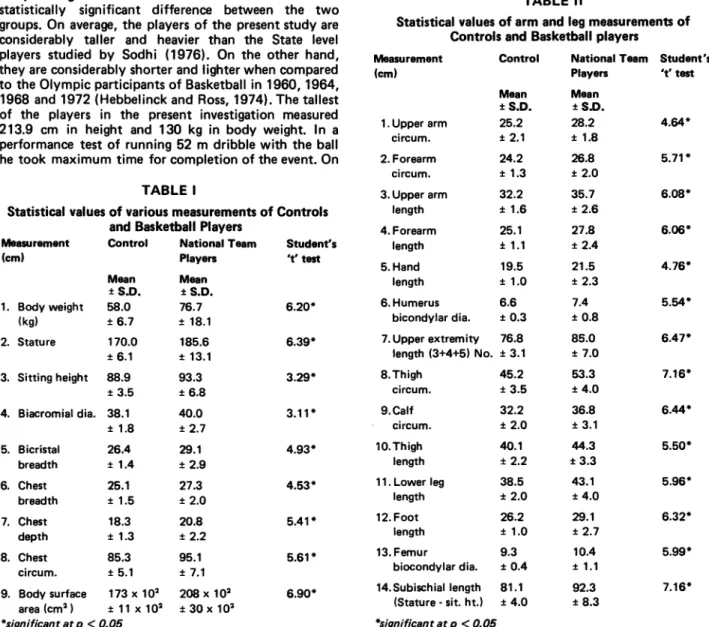
Table I indicates that on average, the National team players stand at a height of 185.6 cm with 76.7 kg of body weight. Both the measurements indicate statistically significant difference between the two groups. On average,the players of the present study are considerably taller and heavier than the State level players studied by Sodhi (1976). On the other hand, they are considerably shorter and lighter when compared totheOlympic participants of Basketball in 1960, 1964, 1968 and 1972 (Hebbelinckand Ross, 1974).The tallest of the players in the present investigation measured 213.9 cm in height and 130 kg in body weight. In a performance test of running 52 m dribble with the ball he took maximumtime for completion of the event.On
TABLE I
Statistical values of variousmeasurementsof Controls and Basketball Players
Measurement (cm) 1. Body weight (kg) 2. Stature 3. Sittingheight 88.9 ±3.5 4. Biacromialdia. 38.1 ± 1.8
Control National Team Players Mean ±S.D. 58.0 ±6.7 Mean ±S.D. 76.7 ± 18.1 170.0 185.6 ±6.1 ± 13.1 93.3 ±6.8 40.0 ±2.7 29.1 ±2.9 27.3 ±2.0 20.8 ±2.2 95.1 ± 7.1 208x102 ±30x102 26.4 ± 1.4 25.1 ± 1.5 18.3 ± 1.3 85.3 ±5.1 5. Bicristal breadth 6. Chest breadth 7. Chest depth 8. Chest circum. 9. Body surface 173x102 area (cm2) ± 11 x102 *significantat p<0.05 Student's It'test 6.20* 6.39* 3.29* 3.11* 4.93* 4.53* 5.41* 5.61* 6.90*
the other hand,the shortestparticipantwas164.2 cm in stature and 60 kg in body weight. Out of all Basket-ballers studied, four are shorter than 180 cm of height
(Table V). However, it is important to note that the tallest player in the Russian team which participated in the 1964 Olympics was 218 cm high (Hirata, 1966). It is interesting to note that like body weight and stature the values of various otherbody measurements
of the players also indicatehighly significantdifferences when compared to those of the controls (Tables I and I1); they are considerably larger than the non-playing population. However, among the players thereis avariability inheight.
TABLE 11
Statistical values ofarmandlegmeasurementsof Controls and Basketballplayers
Measurement (cm) 1.Upperarm circum. 2.Forearm circum. 3. Upperarm length 4.Forearm length 5.Hand length 6. Humerus bicondylardia. 7.Upperextremity
Control NationalTeam Players Mean Mean ±S.D. ±S.D. 25.2 28.2 ±2.1 ±1.8 24.2 26.8 ±1.3 ±2.0 32.2 i 1.6 25.1 ± 1.1 19.5 ± 1.0 6.6 ±0.3 76.8 length(3+4+5)No. ±3.1 8.Thigh circum. 9. Calf circum. 10.Thigh length 11. Lowerleg length 12. Foot length 13. Femur biocondylardia. 14.Subischial length (Stature-sit.ht.) 45.2 ±3.5 35.7 ±2.6 27.8 ± 2.4 21.5 ±2.3 7.4 ±0.8 85.0 ±7.0 53.3 ±4.0 32.2 36.8 ±2.0 ±3.1 40.1 ±2.2 44.3 ±3.3 38.5 43.1 i 2.0 ±4.0 26.2 ± 1.0 9.3 ± 0.4 81.1 ±4.0 29.1 ±2.7 10.4 ± 1.1 92.3 ±8.3 Student's 't'test 4.64* 5.71* 6.08* 6.06* 4.76* 5.54* 6.47* 7.16* 6.44* 5.50* 5.96* 6.32* 5.99* 7.16* *significantat p<0.05
The subischial:sitting height ratio and the regression of subischial length upon stature indicate proportionately significantly longer leg length in players than that of the controls (Table Ill; Fig. 1). The regression ofarm length upon staturedoes not indicate any considerable difference between the two groups (Fig. 1). However, the arm:sitting height ratio shows significantly longer arms with respect totrunklength in the case of players, evidently due to proportionately shorter trunks. The arm:subischial length also indicates significantly longer legs among the players than in the controls. The biacromial:stature andbiacromial:bicristal ratios indicate relatively narrow shoulder breadth in the players (Table 111). The regression of biacromial diameter upon stature also indicates similar results (Fig.
3). The regression of bicristal breadth upon stature does not indicate any notable characteristic in this respect.
REGRESSION
UNIS (.BUQM* PLAYERS) ... - EI EXTUYLENGTH 90 88 86 84 82 80 78 74 //I
f/ / FIG.I 160 180 20075 85 95STATURE.(Cm) UPPER EXTREMITY LENGTH(Cm) ^ 70 v 65 I. 60
%f
55
a
45 '29 40 28 1218-2631 37 ,.25 36 i~~~~24
FIG. 2 160 aSO 200 STATURE(CaI) 141 TABLE IllStatistical values ofbodyproportions ofControls andBasketball players
Measurement (Ratios) 1.Subischial/sitting height 2.Upper extremity/ subischial length 3.Upperextremity/ sitting height 4.Biacromial dia./ stature 5. Biacromial dia./ Bicristal breadth
Control National Team Student's Players 't'test Means Means ±S.D. ±S.D. 0.91 0.99 4.53* ±0.5 ±0.09 0.9 0.9 2.78* ±0.03 ±0.04 0.9 0.9 3.89* ±0.04 ±0.05 0.2 0.2 3.09* ±0.01 ±0.01 1.4 ±0.08 6.Forearm/upper arm 0.8 length ±0.03 7.Femoro/tibial ratio 8. Chest depth/ breadth 9.Stature/chest circum. 10.Reciprocal of ponderal index 1.4 ±0.09 0.8 ±0.02 0.96 0.97 ±0.03 ±0.03 0.7 0.8 ±0.06 ±0.06 2.0 1.95 ±0.13 ±0.08 44.0 43.9 ± 1.67 ± 1.5 2.57* 0.32 1.09 1.82 1.21 0.24
*significant
atp<0.05 THIGH CALF g 320 240 200 / t 160 ---44 120 FIG 4 40 60 60 UPPERAW(CM'
The average value of the reciprocal of the ponderal
index
(Ht/3
Vwt)
and the regression of body weightupon stature do not indicate significant difference in weight between the two groups (Table 111, Fig.
2).
Similarlytheregression oflowerleglength uponforearm length does not indicate any considerable difference between the two groups(Fig.
3). However, the regression of bicondylar femoral upon biocondylarhumeral widths depicts much greater relative width of thekneesinthecaseofplayers.
In somatotypes,theaverageratings of the playersand the controls do not show any significant difference
(Table IV), but it is importantto note that on average the National players are just 0.37 ± 0.26 unit more mesomorphic than the latter. In ectomorphy, however, the difference between thetwogroupsisseen tobevery narrow. The rating of the endomorphic component is found to be about halfa unit less in thecaseof players. In the somatochart, most of the players aredistributed in the meso-ecto, ecto-meso and endo-mesomorphic sectors of the triangle as compared to that of the controls who are scattered in all sectors around the middle of the triangle. The present results are not in conformity with those of Hebbelinck and Ross (1974)
who reported an ecto-mesomorphic somatotype as the prototype for Basketballers. However, it is worth mentioning here that thetop-ranking Indian Basketball players studied in the present investigation could not even qualify in the Asian Basketball Championship.The lowperformance standard of Indian Basketballersat the International level may be due to small number of ecto-mesmorphs. 4 44 42 ~40 38 c36 ,, ~34 / r$M(o 32 idowt, S*Ks* i* ----j-- l FIG.3 28 32 FOREARMLENGTH(Cm)
TABLE IV
Statistical values ofsomatypes andcorrectedcross-section Variables
I-Somatypes
1. Endomorphy 2. Mesomorphy 3. Ectomorphy
Controls Basketball Student's players 't' test Mean Mean ±S.D. ±S.D. 3.5± 1.4 3.3±0.8 3.6± 1.3 3.0±0.9 3.7±0.9 3.5± 1.1 11-CorrectedCross-sectional areas(cm2) 4. Upperarm 43±6 55±7 5. Forearm 39±4 51±8 6. Thigh 139± 19 204±35 7. Calf 72±8 97± 17 1.14 1.36 0.47 6.13* 6.72* 8.92* 7.64*
*significant
atp<0.05The average values of corrected lean tissue areas of upper arm, forearm, thigh and calf are found to be significantly greater in the players than those in the controls (Table IV). The regressions of the lean tissue area of the thigh and the calf upon that of upper arm indicate considerably greater relative development of musculo-skeletal tissue in the lower extremities of Basketballers than those of the controls (Fig. 4). The Basketballers in the Indian team showed much greater variation in the size as evident from the tallest and shortest, and three other players shorter than 180cm in stature (SD = 13.10 cm). The shortest player was selected for the National team because he proved good in distant shooting in the National competitions for more than two years. However, it is noticed that his relative performance in the Championship is very poor (Table V). His average participation time in all matches was lowest (2 min 53 s) among all players. The scoring
rate of this player is also lowest as he scored six field Baskets in the seven matches played by him. He was not fielded in the remaining two matches. Perhaps his physical disadvantages are the probable reasons for his failure.
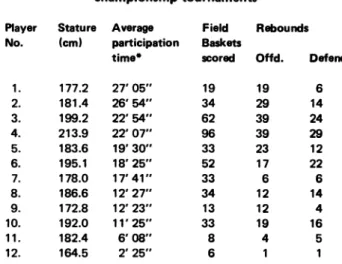
On the contrary, the tall playersseem tohave various advantages in Basketball. Thetallestpivoterat213.9cm had maximum advantage in this regard, his average participation time in all matches was 22 min 7 s and only three other players played for a greater time. However, he scored 96 field baskets which was the highest in the Indian team during this Championship. The other pivoterat 199.2 cm isalsoextremelytalland scored a total of 62 field baskets in all matches. The former offended 39and defended 29 rebounds and the latter offended 39 and defended 24 rebounds. It is, therefore, evident that tallness, especially in the case of pivoters, playsa great role inthisgame.Acorrelation of stature with scored field baskets, offended rebounds
TABLE V
The Individualperformanceofplayersduring championship tournaments
Player Stature Average No. (cm) participation time* 1. 177.2 2. 181.4 3. 199.2 4. 213.9 5. 183.6 6. 195.1 7. 178.0 8. 186.6 9. 172.8 10. 192.0 11. 182.4 12. 164.5 27'05" 26' 54" 22' 54" 22' 07" 19'30" 18' 25" 17' 41" 12' 27" 12' 23" 1 1'25" 6'08" 2' 25" Field Baskets scored Rebounds Offd. Defend. 19 19 6 34 29 14 62 39 24 96 39 29 33 23 12 52 17 22 33 6 6 34 12 14 13 12 4 33 19 16 8 4 5 6 1 1
* Participationtime istheexacttimeof play recorded by the officialtimekeepers for each player during the competition. and defended rebounds showssignificant relationships in each case (Table VI).Thecorrelation ishighest (0.92) in
the case of scored field baskets. The regression lines also show a positive relationship between stature and game performance (Fig. 5). It is, therefore, evidentthat stature has a significant role to play in this game. The shorterthe stature of a man, the lesser theperformance of the players during competition. The speed test conducted on all players showed thetwo pivoterstobe slower than other players in the team. However,asthey are atthe top in performance but slow inspeed,tallness
seems to be more important in thisrespect than speed especiallyin thepivoters.
CONCLUSIONS
It has been found that Basketball playerspossesstypical
kinanthropometric characteristics. Tallness plays an important role in the performance in this game and shortness seems to be highly disadvantageous. The results of the study indicate that of the team positions 'pivoters' must be extremely tall for building a better team. Apartfrom this, players with relatively long legs, narrow shoulders and broad knees seem to have a biomechanical advantage in this game. In other respects such as average somatotypes they are not considerably different from the controls, however, the muscular
development oftheir limbs are far better than the latter
with greatest effect in the lowerextremity than in the upper.
The Indian Basketball players, when compared with their Olympic counterparts, were found to be considerably lighter in weight and shorter in stature.
143 TABLE VI
Valuesofcorrelationcoefficientsand linearregressions between various measurements of Controls and Basketballplayers
Control National teamplayers
Corr.Coeff. Regression Equation Corr.Coeff. Regression Equation
Sri a b 'r' a b
1 Subischial length (cm) - 0.85 -12.667 0.552 0.89 -12.275 0.563
Stature(cm)
2. Upper extremity length (cm)- 0.78 9.762 0.394 0.97 -11.198 0.518
Stature (cm) 3. Biacromialdiameter(cm) - 0.72 1.883 0.213 0.73 12.147 0.150 Stature(cm) 4. Bodyweight(kg) - 0.47 -29.803 0.516 0.85 -142.757 1.182 Stature(cm) 5. Subischiallength(cm)- 0.83 -1.410 1.074 0.86 6.207 1.013
Upperextremitylength(cm)
6. Femurbicondylar(cm)- 0.56 3.790 0.832 0.88 1.818 1.166
Humerusbicondylar
7. Lean tissuethigh(cm2)- 0.72 45.654 2.183 0.94 -41.749 4.396
Leantissueupperarm(cm2)
8. Lean tissue calf(cm2)- 0.54 40.120 0.740 0.86 -11.720 1.957
Lean tissue upperarm (cm2)
9. Stature-Fieldbaskets - - - 0.92 -296.900 1.790
10. Stature-OffendedRebounds - - - 0.76 -117.130 0.730
11. Stature-DefendedRebounds - - - 0.85 -106.380 0.642
SOMATOTYPES
REGRESSION LINES
C(ASKETBALL
PLAYERS)
(BASKETBALLPLAYERS)
FELDWBASKETSSCORING FE6 FIG. 7
OFFENDEDREBOUND DEFENDEDREBOUNDS
801
/
ENDO
EMt
EFOO
Ni
EMT
70 /
CO&ARX
,WS
ETALL
PLARS
60
so- ACKNOWLEDGEMENTS
40- / The author is thankful to the
Director,
Netaji
Subhas/
-.
o National Institute of Sports, for the facilities to carry30 /
/,--
out this work, and to the Team's Chief Coach forX0
/yosupplying
the officialperformance
records of all matches played by the Indian team during the 1978 Asian Basketball Championship. Thanks are also due to The Head, Dept. of HumanBiology, Punjabi University,FIG.
S Igo 20 22 Patiala, for providing equipment to carry out thisREFERENCES
Astrand, P. 0. 1956. "HumanPhysical fitness with special referencetosexandage." Physiol. Rev.36: 308. Carter, J. E. L.1970. "The somatotypes of athletes-A Review." Human Biol. 42: 535-569.
Cureton, T. K.Jr. 1951.Physical Fitness of Champion Athletes.Universityof IllinoisPress, Urbana. Heath, B. H. andCarter, J. E. L.1967. "Amodified somatotypemethod."Am.J.Phys.Anthrop. 27: 57-74.
Hebbelinck, M. and Ross, W. D. 1974. "Kinanthropometry andbiomechanics." Biomechanics IV, 537-552;Proceedings
of 4th International Seminar on Biomechanics, University Park, Pennysylvania, Ed. R. C. Nelson & C. A. Morehouse, Macmillan Press Ltd.
Hirata. K. 1966. "Physiqueand ageofTokyoOlympic Champions."J.Sports Med.Phys.Fit. 6: 207-222.
Malhotra, M.S., Ramaswamy, S.S., Joseph, N. T. and Sen Gupta J. 1972. "Physiological assessment of Indian athletes." Ind.J.Physiol.Pharmac., 16: 55-62.
Parnell, R. W. 1951. "Some notes on physique and athletic training with special reference to heart size."Brit.Med.J., 1: 1292-1295.
Sodhi,H.S. 1976a."Effects ofphysical activity on body composition-Areview." NIS Journal 10:28-33.
Sodhi, H.S. 1976b. "The physique and body composition of Indian athletes and sportsmen of selected physical activities."Ph.D. Thesis
Punjabi
University, Patiala,
India.Sodhi, H. S., 1980. "A study of morphology and body composition of Indian Basketball players." J. Sports
Med.Phys.Fit.
In Press.Sodhi, H,S. and Sidhu, L. S. 1978. "The role of physique and body composition in volleyball." Presented in Xth International
Congress
ofAnthropological
andEthnological
Sciences,
NewDelhi,
Dec. 10-16.Tanner,J. M., 1964: The Physique of The Olympic Athlete. George Allen and Unwin, London.