1361
A Survey On Software Defined Network With 5g
Nikita Bhalani, Mayur Chavan
Abstract: The exponential growth of mobile data services because of increasing end user devices like laptops, tablets, sensors, smartphone, appliances that shaping hyper-connected network where billions of connected devices are producing a large amount of data volume. To handle the tremendous growth in communication technology that required high bit rate, low latency, high availability and high performance which can be achieved with 5G technology. In this context, Software Defined Network that separate data plane from control plane and Network Function Virtualization that divide network element into smaller network functions, these both are best candidate. In this paper, Software defined network and 5G architectural characteristics and 5G usage scenarios are discussed. SDN with 5G state of the art of research with comparative analysis of all existing solution is given within this paper. We also discuss Service based 5G network Architecture and SDN/NFV based 5G core Network.
Index Terms: 5G, Software-Defined Networking, Network Function Virtualization.
————————————————————
1 INTRODUCTION
Software Defined Network is used to simplify network management by separating network control logic from its underlying hardware by enabling network administrators to exert more control over functionality of network and providing a unified global view of network. Software Defined Networks increase scalability by separating Control and Data plane unlike traditional network system. Distributed Mobility Management is an efficient Mobility Management technique which ensures network based Mobility Management. In Centralized Mobility Management, there is single point of failure due to Local Mobility Anchor through which all data traffic will be passed. This will be overcome by using Distributed Mobility Management Scheme which is based on packet forwarding from previous router (AR) to new AR, but it establish tunnel between them may include a number of physical hops when the previous AR and the new AR are not directly connected that leads to a suboptimal path with increased processing overhead and the latency.
To overcome above limitation, we implement DMM scheme by distributing Control and Data plane for Mobility Management in 5G Network. In DMM based SDN, 1) Control Plane conduct the centralized location and handover management and provide optimal path from Correspondence node (CN) to the new AR. 2) Data Plane perform distributed packet forwarding functions that will established new path and packets are routed to new AR without any tunneling overhead.
2
SOFTWARE
DEFINED
NETWORKING
SDN can be defined as ‗‗an emerging network architecture where the network control is decoupled and separated from the forwarding mechanism and is directly programmable‖[1].
fig1.1 Applying SDN in various types of network
The SDN Architecture provides the following requirements [2] (1) SDN is independent from the characteristics of SDN controller distribution. (2) Policy and security boundaries related to information sharing and trust. (3) Based upon open SDN controller plane interfaces provide interoperability. (4) Support for management interfaces, across which resources and policy may be established. (5) Scalability and support for recursion to encompass all feasible SDN controller architectures. (6) Co-existence with existing business and operations support systems. We can apply SDN approach to any kind of network as 5G network, Wi-Fi network, LAN, WiMax network, GSM based packet delivery network and optical network as shown in fig1.1.
3 5G
Recent report [3] predicts that the global mobile data traffic expected to grow to 77 Exabyte per month by 2022, a seven-fold increase over 2017. Due to explosion of mobile traffic, existing 3G and 4G spectrum is not suitable for high data rate. 5G needed wideband spectrum for successful high data rate operation. 5G needed advanced features for optimal performances in heterogeneous environment starting from physical layers to uppermost layers that include Open Wireless Architecture (OWA) that works as physical and data link layer of the OSI stack, Network layer (divided into upper and lower network layer), Open transport layer that combined the functionality of both transport and session layer, application layer that presents data as per proper format required.
3.1 5G Usage Scenarios
Three main 5G application scenarios: enhanced Mobile ————————————————
Nikita Bhalani received her M.E. degree in Computer Engineering from Gujarat Technological University, Gujarat, India in 2017. She is currently working as Assistant Professor in Pune Institute of
Computer Technology, Pune University. E-mail:
1362 Broadband (eMBB), Massive Internet of Things (mIOT) and
Ultra-Reliable and Low Communications (URLLC) that is shown in fig. 1.2.
Fig. 1.2 5G Usage Scenarios
3.2 Architectural characteristics of 5G
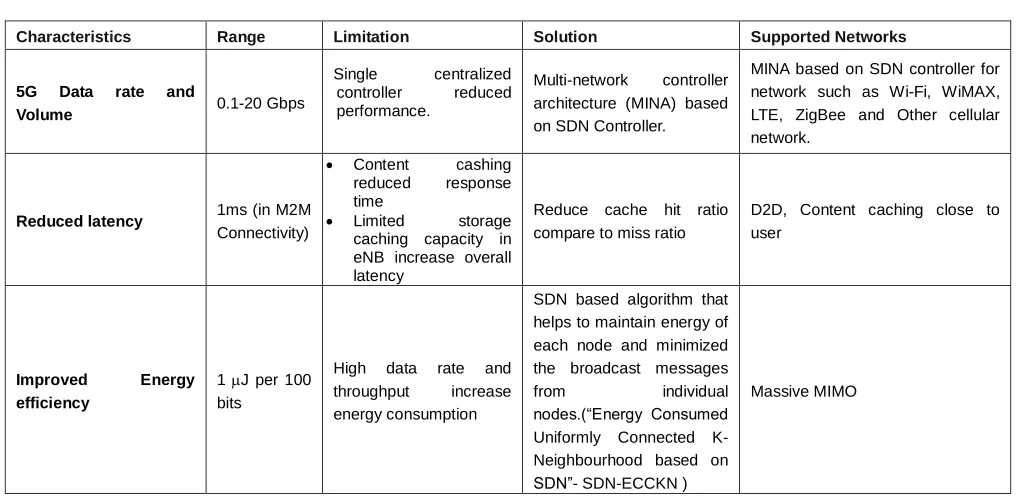
There are some several advanced characteristic of 5G for optimal performance in heterogeneous environment. TABLE 1 analyses the architectural characteristics of 5G and its proposed technologies.
TABLE1
ARCHITECTURALCHARACTERISTICSOF5G
Characteristics Range Limitation Solution Supported Networks
5G Data rate and
Volume 0.1-20 Gbps
Single centralized controller reduced performance.
Multi-network controller architecture (MINA) based on SDN Controller.
MINA based on SDN controller for network such as Wi-Fi, WiMAX, LTE, ZigBee and Other cellular network.
Reduced latency 1ms (in M2M Connectivity)
Content cashing reduced response time
Limited storage caching capacity in eNB increase overall latency
Reduce cache hit ratio compare to miss ratio
D2D, Content caching close to user
Improved Energy efficiency
1 J per 100 bits
High data rate and throughput increase energy consumption
SDN based algorithm that helps to maintain energy of each node and minimized the broadcast messages from individual nodes.(―Energy Consumed Uniformly Connected K-Neighbourhood based on SDN‖- SDN-ECCKN )
1363
4
SDN
FOR
5G:
STATE
OF
THE
ART
This section described the literature survey on state of the art for software defined network with 5G Integration.
4.1 Software Defined Networking for 5G
Reference [4] , explain the basic and fundamental concept of SDN with SDN architecture by separating the data plan and control plan from each other, that gave flexible environment to both the vender as well as network operators. To make the network control programmable and more flexible, the concept of OPENFLOW [5] introduced that provide proper interfacing between the planes.The advanced features of 5G such as high data rate, needs to dedicated wideband spectrum that is not available for existing 3G and 4G network, Energy harvesting for device to device communication, Optical Wireless Integrations for high data rate and high throughputs (in multi Gb/s) proposed in 5G that provide smooth and proper service provision, Interactions between microwave and photonics is possible through 5G hybrid nature, high speed data processing due to proposed RAN vitalization. All this advanced features are new and will to be deployed for the first time by upgrading the existing technology like SDN.It is difficult to manage all complex and advanced features of 5G by using traditional network. Using programmable components and SDN concept we can provide flexibility and Agility in 5G networks.
4.2 An SDN/NFV based framework for management and deployment of service based 5G core network
Reference [6] , defined new framework for deployment and management of Service Based 5G Core Network based on SDN and NVF. With respect to Service based architecture for 5G Core network, proposed the management architecture for service based 5G Core Network based on SDN/NVF that customized network slicing with high flexibility and high scalability with low backhaul cost compare to existing work like Softcell[7], MobileFlow[8] ,Softepc [9],Softair[10] etc.For Optimal workload allocation, develop workload allocation algorithm to minimize the system cost. Proposed framework and algorithms are more effective in terms of reducing network operation cost like flexible orchestration of network functions; provide distributed and on-demand deployment of network functions and service guaranteed network slicing as well as optical workload allocation by performing simulation with MATLAB.
4.3 An SDN-based Distributed Mobility Management for 5G
Reference [11] , proposed SDN based Distributed Mobility Management approach for packet forwarding path optimization. Existing mobility scheme such as centralized Mobility have some disadvantages like single point of failure, Signaling overhead, and In Distributed Mobility Management have tunneling overhead and non-optimal routing problem.So to overcome limitation of existing solution, applied SDN concept to distributed mobility management by separating network control from actual data transmission. SDN based Distributed Mobility Management, The Handover and location management is centralized in SDN Controller while The Data forwarding function is fully distributed at all access
router.There are two important characteristics of SDN like 1) Separation of data planes and control planes and 2) Logically Centralized Controller. By applying these two characteristics to Distributed Mobility Management, Location management and handover is handle by Centralized controller and packet forwarding is distributed and used OPENFLOW[12] southbound SDN Protocol by ONF(Open Networking Foundation).
4.4 5G Cellular Network Integration with SDN: Challenges, Issues and Beyond
S. K. Tayyaba et al. (2017) in [113] discussed various challenges and issues by integrating 5G Cellular Network with SDN. SDN provide high data transmission, spectral efficiency, resource allocation and network management Due to three layered architecture having separated data plane layer, Control Plane layer and Application layer.5G have some key characteristics like higher data rate, low latency and flexible and programmable architecture. So by integrating these two technologies, it‘s provide flexible and fully programmable architecture.Existing challenges for cellular Network like, lacks of programmability agility, security and data management due to huge amount of data traffic, and connected devices can be overcome by applying SDN concept to 5G cellular network management and make it programmable.Discussed various existing solution for cellular IOT SDN like SoftAir, SoftCell, CellSDN CROWD, Hybrid SDN and SDR, MobileFlow in terms of resource management, virtualization, decoupling of control and data planes, Network traffic. SDN can be flexible changes in Cellular network for high data transmissions rate and flexible network management.
4.5 The Challenges of Appying SDN/NFV for 5G & IoT Do Sinh et al. (2017) in [14] proposed the full SDNM architecture to handle the requirements of high bit rate and availability, low latency and high performance in heterogeneous environment of wired and wireless communication in 5G network. As SDN having programming capability for application, control and data plane for mobile network, so mobile network divided in independent network slices that can run different network protocol like SDN and NFV.Discussed significant features like throughputs and latency in 5G network that established an end-to-end channel in the full SDNM architecture in context of heterogeneous RAN including 3GPP RAN, non3GPP Ran and Muti-RAT.
4.6 Comparative analysis of all existing solutions
1364 TABLE2
PARAMETEROBSERVEINVARIOUSEXISTINGPAPER
Pape r Dat a Rat e Tran smis sion Dela y Data Proce ssing Bac kha ul Cos t Hando ver Delay Thro ughp ut Pac ket Deli ver y Cos t Sig nali ng Cos t
[1] Yes Yes Yes No No Yes No No
[3] No No No Yes No No No No
[8] No No No No Yes No Yes Yes
[10] Yes Yes Yes No Yes No Yes Yes
[11] Yes No No No Yes Yes No No
Here we have explained some of the issues. In Table 3 we have address various issues.
TABLE3
ISSUESADDRESSINVARIOUSEXISTINGPAPER
Pap er Agil ity Ene rgy Con su mpt ion Optimized resource allocation Program mable Network Compone nt Netw ork Slici ng Flex ibili ty Sca labi lity
[1] Yes Yes Yes Yes No Yes No
[3] No No Yes(Optimize
d Workload
allocation)
No Yes Yes Yes
[8] No No Yes Yes No No Yes
[10] Yes No Yes Yes No Yes No
[11] No No Yes Yes Yes Yes Yes
5 SDN
AND
5G
Due to the explosion of mobile traffic, the traditional mobile core network is not sufficient for providing low latency and extremely high reliability which are needed for vertical industries like autonomous driving and industrial automation. In traditional mobile network, function of
network elements depends on dedicated hardware which increase operational expense of network operation and also difficult to update network because need to replaces network devices. To resolve these challenges, new emerging technologies like 5G by applying concept of Software Defined Network that decouple control planes and data planes, so network functions are separated from dedicated hardware which improve data forwarding efficiency.
5.1 Service based 5G network Architecture
Service based architecture is used in software industry to improve the modularity of products, in which software products are divided into communicating services. In 5G SBA, the monolithic network elements are split into smaller network functions (NFs). Each NF is independent from each other and responsible for a single task only. Fig. 1.3 shows the 5G Service Based Architecture (SBA).
fig. 1.3 The 5G Service Based Architecture (SBA)
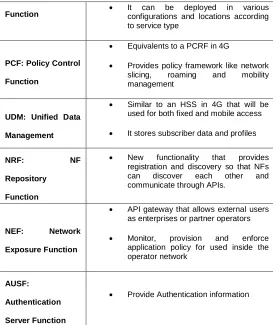
TABLE 4 listed the major components of the 5G core with their functionalities.
TABLE4
COMPONENTOF5GSERVICEBASEDARCHITECTURE
Components Functionalities
AMF: Access and
Mobility
Management
Functions
Manages access control and mobility
Includes the Network Slice Selection Function (NSSF)
SMF: Session
Management
Function
According to network policy, sets up and manages sessions
1365 Function It configurations and locations according can be deployed in various
to service type
PCF: Policy Control
Function
Equivalents to a PCRF in 4G
Provides policy framework like network slicing, roaming and mobility management
UDM: Unified Data
Management
Similar to an HSS in 4G that will be used for both fixed and mobile access
It stores subscriber data and profiles
NRF: NF
Repository
Function
New functionality that provides registration and discovery so that NFs can discover each other and communicate through APIs.
NEF: Network
Exposure Function
API gateway that allows external users as enterprises or partner operators
Monitor, provision and enforce application policy for used inside the operator network
AUSF:
Authentication
Server Function
Provide Authentication information
5.2 SDN/NFV based 5G core Network
In cellular network, all mobile data traffic goes through the core network to access services. In 5G, explosion of mobile data traffic because of usage scenarios like (1) eMBB for HD videos, virtual reality and augmented reality, (2) URLLC for latency sensitive services like autonomous driving and (3) mIoT for smart grid city and smart agriculture. To overcome these 5G challenges, we can apply NFV and SDN based architecture for 5G core network development and management that is shown in below fig. 1.4.
fig. 1. 4 SDN/NFV based 5G core network
5G Service Layer is the entrance of NFs that will provide different services to user. Service Management Layer includes various functionalities like registration, authentication, orchestration, security and Quality of Service that responsible for configuring of NF modules based on the policy made by Business Support System (BSS) and Operation Support System (OSS).The infrastructure of 5G core, including flow scheduling, Network Slicing and NF deployment are manages by Infrastructure Management Layer. There are two type of controller (1) Core SDN Controller responsible for service migration and deployment. (2) Flow SDN Controller in charge of efficient traffic dispatch in the backhaul network. Within MEC, the 5G core User Plane (UP) and some applications deployed while Control Plane (CP) deployed in cloud data center as MCC.
6
CONCLUSION
In this paper, we discussed Software Defined Network and requirements of SDN based architecture. Then, we introduced 5G Architectural characteristics and usage scenarios. Also, discussed comparatives analysis of all existing solutions for SDN based 5G network. The Service based 5G network architecture and their components functionalities are introduced. We combined SDN and NFV functionalities and provide SDN/NFV based 5G core Network that resolve tunneling overhead in existing DMM based Network.
REFERENCES
[1] Hamid Farhady, HyunYong Lee and Akihiro Nakao, ―Software-Defined Networking: A survey‖, Computer Networks, vol. 81, pp. 79–95, 2015.
[2] ONF Market Education Committee. SDN Architecture Overview. ONF White Paper, 2014.
[3] Ciscp System, Ciso Visual Networking Index: Global Data Trafic ,2017 to 2022,[Online]. Avaialble: https://www.cisco.com/c/en/us/solutions/collateral/service- provider/visual-networking-index-vni/white-paper-c11-738429.html#_Toc953327.
[4] S. K. Routray and K. P. Sharmila, "Software defined networking for 5G," 2017 4th International Conference on Advanced Computing and Communication Systems (ICACCS), Coimbatore, 2017, pp. 1-5.
[5] D. Kreutz, F. M. V. Ramos, P. Verissimo, C. E. Rothenberg, S. Azodolmolky, and S. Uhlig, ―Software Defined Networking: A Comprehensive Survey,‖ Proceedings of the IEEE, vol. 103, no. 1, pp. 1 – 63, Jan. 2014.
[6] L. Ma, X. Wen, L. Wang, Z. Lu and R. Knopp, "An SDN/NFV based framework for management and deployment of service based 5G core network," China Communications, vol. 15, no. 10, pp. 86-98, Oct. 2018. [7] L. Tao, W. Xiangming, L. Zhaoming, Z. Xing, L. Yangchun
and Z. Biao, ―SWN: An SDN based framework for carrier grade Wi-Fi networks,‖ China Communications, vol. 13, no. 3, 2016, pp. 12-26.
[8] V. Yazici, U. C. Kozat, and M. O. Sunay, ―A new control plane for 5g network architecture with a case study on unified handoff, mobility, and routing management,‖ IEEE Communications Magazine, vol. 52, no. 11, 2014, pp. 76– 85.
1366 [10]F. Z. Yousaf, J. Lessmann, P. Loureiro, and S. Schmid,
―Softepc: Dynamic instantiation of mobile core network entities for efficient resource utilization,‖ 2013 IEEE International Conference on Communications (ICC), IEEE, 2013, pp. 3602–3606.
[11]Haneul Ko, Insun Jang, Jaewook Lee, Sangheon Pack and Giwon Lee, "SDN-based distributed mobility management for 5G," 2017 IEEE International Conference on Consumer Electronics (ICCE), Las Vegas, NV, 2017, pp. 116-117.
[12]Openflow Switch Specification, Version 1.4.0, October 2013.
[13]Khan, Sahrish & Shah, Munam, ―5G cellular network integration with SDN: Challenges, issues and beyond‖, 2017 International Conference on Communication, Computing and Digital Systems (C-CODE), IEEE,2017, pp. 48-53.