Ames Laboratory Publications
Ames Laboratory
7-2006
Reply to “Comment on ‘Monotonically decreasing
size distributions for one-dimensional Ga rows on
Si(100)’ ”
Marvin Argulla Albao
Iowa State UniversityM. M. R. Evans
University of Wisconsin - Eau Claire
J. Nogami
University of TorontoDeborah Zorn
Iowa State UniversityMark S. Gordon
Iowa State University, [email protected]
See next page for additional authors
Follow this and additional works at:
http://lib.dr.iastate.edu/ameslab_pubs
Part of the
Chemistry Commons
The complete bibliographic information for this item can be found at
http://lib.dr.iastate.edu/
ameslab_pubs/333
. For information on how to cite this item, please visit
http://lib.dr.iastate.edu/
howtocite.html
.
Reply to “Comment on ‘Monotonically decreasing size distributions for
one-dimensional Ga rows on Si(100)’ ”
Abstract
In this Reply, we provide a detailed analysis of experimental data for the nucleation of metal rows or islands
during deposition of Ga on Si(100) quantifying the influence of defects. Contrasting the proposal of Kocán
et
al.
[Phys. Rev. B 74, 037401 (2006)], we find that this process is not dominated by heterogeneous nucleation
at C defects. We also argue that such heterogeneous nucleation could not in itself be responsible for the
unusual monotonically decreasing island size distributions observed in this system. In addition, we offer
possible explanations for why behavior observed by Kocán
et al.
for In deposition on Si(100) appears to differ
from that for Ga deposition.
Disciplines
Chemistry
Comments
This article is from
Physical Review B
74 (2006): 037402, doi:10.1103/PhysRevB.74.037402. Posted with
permission.
Authors
Marvin Argulla Albao, M. M. R. Evans, J. Nogami, Deborah Zorn, Mark S. Gordon, and James W. Evans
Reply to “Comment on ‘Monotonically decreasing size distributions for one-dimensional Ga rows
on Si(100)’ ”
M. A. Albao,1M. M. R. Evans,2 J. Nogami,3D. Zorn,4M. S. Gordon,4and J. W. Evans5
1Ames Laboratory-USDOE, Iowa State University, Ames, Iowa 50011, USA
2Department of Physics and Astronomy, University of Wisconsin-Eau Claire, Eau Claire, Wisconsin 54702, USA 3Department of Materials Science and Engineering, University of Toronto, Toronto, Ontario, Canada M5S 3E4
4Ames Laboratory-USDOE and Department of Chemistry, Iowa State University, Ames, Iowa 50011, USA 5Ames Laboratory-USDOE and Department of Mathematics, Iowa State University, Ames, Iowa 50011, USA
共Received 15 May 2006; published 21 July 2006兲
In this Reply, we provide a detailed analysis of experimental data for the nucleation of metal rows or islands during deposition of Ga on Si共100兲quantifying the influence of defects. Contrasting the proposal of Kocánet al.关Phys. Rev. B 74, 037401共2006兲兴, we find that this process is not dominated by heterogeneous nucleation atCdefects. We also argue that such heterogeneous nucleation could not in itself be responsible for the unusual monotonically decreasing island size distributions observed in this system. In addition, we offer possible explanations for why behavior observed by Kocánet al.for In deposition on Si共100兲appears to differ from that for Ga deposition.
DOI:10.1103/PhysRevB.74.037402 PACS number共s兲: 68.55.Ac, 68.37.Ef, 68.55.Jk, 81.15.Aa
Kocán et al.1 propose that the single-atom-wide metal rows or islands that form during deposition of Ga on Si共100兲 nucleate almost exclusively atCdefects. However, we show through additional analysis of experimental data that this is not the dominant nucleation process, contrasting the claim in Ref.1. Furthermore, we explain why the presence of such a heterogeneous nucleation pathway shouldnotplay a decisive role in producing the unusual monotonically decreasing is-land size distribution observed for this system by scanning tunneling microscopy 共STM兲.2 Instead, we argue that this unusual distribution, which was the focus of our previous study,2derives from restricted aggregation. We do, however, agree that nucleation atCdefects can be significant in the Ga on Si共100兲system, and discuss its effect on the estimation of terrace diffusion barriers.
For room temperature deposition in a single continuous dose at 10−3ML/ s for 2.5 min, our previous study reported
the slow increase in mean island size up to 具s典⬇15 atoms with increasing Ga coverage up to ⬇0.15 ML.2 This im-plies an island density of Nisl=/具s典= 0.01/site. We have noted that the defect density was always less that 0.01/site, and typically around 0.003/site, which immediately reveals that most nucleation occurs away from defects.
However, it is appropriate to provide a more definitive assessment of the issue of defect-mediated nucleation in the Ga on Si共100兲 system. Thus, we present a more detailed analysis of data from one experiment in which a series of incremental evaporations were carried out over a period of about 6 h, together within situscanning to study the nucle-ation of Ga rows. A significant buildup of C defects could occur over this prolonged period3 共in contrast to that for usual continuous dose experiments兲, so we are deliberately considering a “worst case” scenario. The illustration of Ga row nucleation reported in Ref.4 is from this run. For this particular sample, the initial defect density was substantially larger than typical. Specifically, over a 50⫻50 nm2 area 共corresponding to an area of about 8500 Si dimers兲, there were 172 triple missing dimers, 22 single missing dimers, and 52C-type defects.
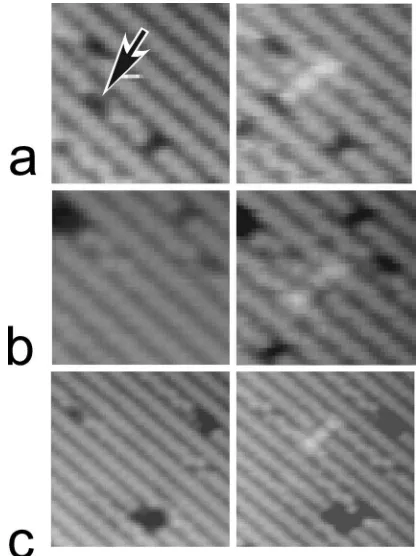
[image:3.612.331.540.370.648.2]After the first evaporation stage共data acquired within 1 h of imaging the initial clean surface兲, of 12 nucleation events, 5 were away from any defect, 4 were atC-type defects, and 3 were at non-C-type defects. Figure 1 shows three of the nucleation events, where event共a兲occurs at aC-type defect, whereas events 共b兲 and共c兲 do not, even in the presence of
FIG. 1. Filled-state STM images of nucleation of Ga atomic rows on Si共001兲. These three pairs of images show the same area of the surface before共upper panels兲and after共lower panels兲the depo-sition of a small amount of Ga. Panels共a兲 show nucleation at a
C-type defect, indicated by an arrow in the upper panel. Panels共b兲 and共c兲show nucleation away from any surface defect. Panels共a兲 and共b兲are 5⫻5 nm2. Panels共c兲are 8⫻8 nm2.
PHYSICAL REVIEW B74, 037402共2006兲
C-type defects within a few nm of the nucleation site. For a total of 63 separate nucleation events tracked during the en-tire course of incremental evaporations, 21 occurred away from any defect, 26 occurred atC-type defects, and 16 oc-curred at non-type-Cdefects. This analysis reveals unequivo-cally that nucleation atCdefects is significant, but not domi-nant, and also that nucleation at other defects can be significant.
We reiterate in the data reported in Ref. 2, five of six metal coverages were the results of single Ga depositions on bare Si共001兲, and only one coverage共0.09 ML兲was a second evaporation. Therefore, the total density ofC-type defects on the surface would be substantially less than the example given above.
It seems that behavior is different for the cited examples in Ref.1 of In共and Ag or Pb兲deposition on Si共100兲where nucleation was observed to occur almost exclusively at C defects. Why? Two possibilities might be considered. First, it is difficult to rule out tip effects. For experiments with scan-ning during deposition, the tip might enhance adatom mobil-ity, e.g., pushing homogeneously nucleated dimers to defect sites where binding is stronger, or causing their breakup 共thus allowing reformation of islands at defects兲. In fact, in our own studies of In deposition on Si共100兲 with the scan-ning direction orthogonal to the metal rows共i.e., along the Si dimer rows兲, we find evidence suggesting that In adatoms can be pushed into “forbidden” positions in between two parallel metal rows separated by the minimum distance of 2a
共a is the surface lattice constant兲.5 To avoid these potential corrupting effects, we tried to avoid repeated scanning of the same sample area wherever possible in our Ga on Si共100兲 studies. Second, we claim that intrinsically different behavior occurs for In and Ga adatoms on Si共100兲. Specifically, we present evidence to indicate that Ga-Ga adatom binding is stronger than In-In binding. This would enhance the stability of homogeneously nucleated Ga islands relative to that of In islands. Certainly, if homogeneously nucleated islands can breakup, it becomes much more likely that islands are ulti-mately formed at the stronger defect binding sites.
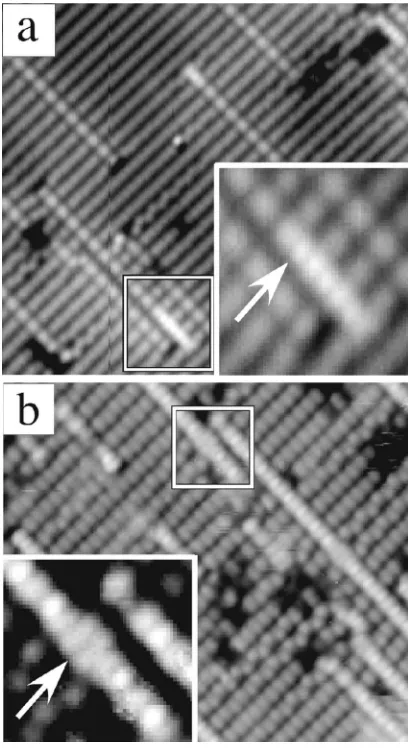
Our evidence for the difference in binding for In and Ga comes from separate two-species deposition experiments in which we first deposit one element and then the other. When Ga is deposited first, the subsequently deposited In is found only at the end of Ga rows, as observed in earlier studies.6In contrast, when In is deposited first, the subsequently depos-ited Ga is found intermixed within the interior of the rows as well as at their ends. Both cases are shown in Fig. 2 to facilitate comparison. This comparison demonstrates that Ga is bound effectively irreversibly in Ga rows, whereas In can detach from In rows due to weaker adspecies binding. A similar asymmetry in binding is seen between In and Sn, where once again, In is less stable than Sn.7 Finally, we remark that for Pb/ Si共100兲, where nucleation is proposed to occur almost exclusively atCdefects as for In/ Si共100兲, de-tachment of Pb from the ends of atomic rows is also ob-served, indicative of weaker adatom binding.8
Next, we argue that the presence of heterogeneous nucle-ation in itself should not produce a monotonically decreasing island size distribution. For pure irreversible heterogeneous nucleation at defect sites, the island size distribution reflects
the area distribution of “capture zones” for individual defects.9,10 For typical “random” distributions of defects, such area distributions are monomodal, which should thus result in a peaked monomodal island size distribution. Con-sequently, consistent with the conclusions of Ref. 2, we maintain that restricted aggregation is the primary factor leading to this monomodal distribution. From this perspec-tive, our previous simulations did incorporate the most es-sential features needed to generate this unusual distribution, the focus of our previous study.
Finally, we discuss the determination of surface diffusion barriers from modeling of STM data for island densities and distributions. Kocánet al.1correctly noted that incorporation of defect-mediated nucleation into the modeling would modify estimates of these barriers. In fact, previous DFT estimates11of diffusion barriers for Al on Si共100兲, and initial results from our ab initio quantum chemistry analysis 共
to-FIG. 2. Ga+ In co-deposition studies comparing atomic row structure.共a兲Deposition of In onto 0.09 ML Ga/ Si共100兲: aggrega-tion of In only at row ends. See Ref. 6. The image is 18.5
⫻20 nm2 with a ⬃4⫻4 nm2 inset of the outlined small square
region showing In at end of Ga row共indicated by arrow兲.共b兲 Depo-sition of Ga onto 0.07 ML In/ Si共100兲: intermixed row structures. The image is 14.5⫻16 nm2with a⬃3⫻3 nm2inset of the outlined
small square region showing a Ga dimer within a In row共indicated by arrow兲.
COMMENTS PHYSICAL REVIEW B74, 037402共2006兲
[image:4.612.334.538.56.430.2]gether with the assumption that barriers for Ga are no higher than for Al兲suggest significantly lower values than our esti-mates in Ref.2. If true, the apparent reduced effective rates for diffusion and aggregation共despite such low “bare” diffu-sion barriers兲needed to produce the observed island density could result from a number of factors.
To explore this issue, we first considered a modification of the atomistic model in Ref.2introducingC-type defects with a density of 0.003/site. In the metal on Si共100兲 systems of interest here, once a metal atom attaches adjacent to a C defect, one of the two adjacent aggregation sites is blocked and the metal row grows away from the defect in only one direction. Simulations of a corresponding model produce a somewhat increased island density relative to the case with no defects, if one keeps the same diffusion barriers of 0.4 eV 共and 0.8 eV兲 along共orthogonal to兲metal rows as in Ref. 2. This is in part due to nucleation occurring at most defects. Also restricted aggregation with islands atC defects 共since aggregation occurs only at one end兲helps to maintain a high adatom density which facilitates homogeneous nucleation. As a result, somewhat lower values of diffusion barriers are required to match the experimental island density. However, decreasing the barriers to, e.g., 0.35 eV共and 0.7 eV兲already produces a significantly lower island density than in experi-ment.
To further reduce effective diffusion and aggregation rates 共and boost the island density兲 while maintaining low bare diffusion barriers, one could also consider the role of other defects. The presence of missing dimer type defects, which do not trap metal atoms as efficiently as C defects, likely
blocks direct diffusion of Ga especially in the fast direction along the metal rows, and thus reduces the effective diffusiv-ity again facilitating island nucleation. We have also included such “inert” defects in a simple way in our modeling, but found that they do not have much effect on the island density 共for our prescription兲. Other refinements of the model should be explored to determine if experimental observations can be recovered with lower bare diffusion barriers. One could in-troduce reversible capture of adatoms at C defects, as this would reduce the fraction of such defects populated by is-lands共bringing model predictions more in line with experi-ment兲.
In summary, we show thatCdefects do not play a domi-nant role in nucleation of Ga rows or islands on Si共100兲, and that the presence of heterogeneous nucleation is not respon-sible for the unusual monotonically decreasing island size distribution. However, refined modeling incorporating de-fects is likely needed to obtain reliable estimates of diffusion barriers.
The experimental work was carried out by M.M.R and J.N. at the University of Wisconsin-Milwaukee with partial support from the Laboratory for Surface Studies. J.N. ac-knowledges support from NSERC and from NSF Grant No. DMR-0305472. M.A.A., D.Z., M.S.G., and J.W.E. were sup-ported for this work by the Division of Chemical Sciences, U.S. Department of Energy 共USDOE兲—Basic Energy Sci-ences. Their work was performed at Ames Laboratory, which is operated for the USDOE by Iowa State University under Contract No. W-7405-ENG-82.
1P. Kocán, P. Sobotík, and I. Ošt’ádal, preceding Comment, Phys.
Rev. B 74, 037401共2006兲.
2M. A. Albao, M. M. R. Evans, J. Nogami, D. Zorn, M. S. Gordon,
and J. W. Evans, Phys. Rev. B 72, 035426共2005兲.
3M. Nishizawa, T. Yasuda, S. Yamasaki, K. Miki, M. Shinohara, N.
Kamakura, Y. Kimura, and M. Niwano, Phys. Rev. B 65, 161302共R兲 共2002兲.
4J. Nogami and M. M. R. Evans, Surf. Rev. Lett. 6, 1067共1999兲. 5See EPAPS Document No. E-PRBMDO-74-081628 for a video 共QT format兲of atomic motion of In and Ga on Si共001兲, includ-ing some tip induced effects. This document can be reached via a direct link in the online article’s HTML reference section or via the EPAPS homepage 共http://www.aip.org/pubservs/ epaps.html兲.
6M. M. R. Evans and J. Nogami, Phys. Rev. B 59, 7644共1999兲.
7J. Nogami, inAtomic and Molecular Wires, edited by C. Joachim
and S. Roth共Kluwer, Dordrecht, 1997兲, pp. 11–21.
8L. Juré, L. Magaud, J.-M. Gómez-Rodríguez, P. Mallet, and J.-Y.
Veuillen, Phys. Rev. B 61, 16902共2000兲.
9P. A. Mulheran and J. A. Blackman, Philos. Mag. Lett. 72, 55 共1995兲.
10Capture zones共CZ兲are constructed by a Voronoi-type tessellation
of the surface with one zone or cell per defect. CZ shapes should reflect any anisotropy in surface diffusion. Strictly, the island size distribution is obtained by convoluting the CZ area distri-bution with a Poisson distridistri-bution to reflect fluctuations in the number of atoms deposited within each CZ, but this would pre-serve a monomodal shape.
11G. Brocks, P. J. Kelly, and R. Car, Phys. Rev. Lett. 70, 2786 共1993兲.
COMMENTS PHYSICAL REVIEW B74, 037402共2006兲