Basic Learning Movement Of Javelin Through
Games Bombardier: A Model Development
Syahruddin
Abstract: The objective of this research and development study is to produce a model of learning basic movement javelin through bombardier game for elementary school students. It also tries to obtain in-depth information about competence, characteristics, and capabilities of early primary school students in the implementation of teaching physical education, especially at the basic learning materials javelin throwing basic movement. It employs the research and development approach. The subjects are grade six elementary school students from two schools, Public Primary School of Bertingkat Mamajang I and Public Primary School of Baddoka, both are located in Makassar, Indonesia. Questionnaires were used to collect data covering four different steps, (1) analysis of needs; (2) the expert evaluation (initial product evaluation); (3) the limited trial (small group trial); and (4) the main trial (field testing). It used the test process and an assessment rubric javelin truth movement to test the effectiveness of the model. Overall, the results show: (1) Learning basic motion javelin using simple tools for students is needed by teachers of Physical Education; (2) the overall product is effectively implemented by teachers Physical Education in teaching basic motion javelin, (3) The basic motion learning model javelin for the students is effectively successful.
Index Terms: Learning Model, Basic Motion Javelin, and Games, Elementary school students.
————————————————————
1
I
NTRODUCTIONTeachers are required to be able to make the learning process to be active, creative, and fun. This is sometimes difficult because teachers to some extents do not have learning tools, are not responsible for the main task, and have minimal knowledge in terms of evaluating the students’ progress and even some have low qualifications. The result of the initial interview on the sports teacher suggests that the teaching process is generally only product-oriented, i.e., assessing student learning outcomes based on the final result after the students do the movement of the material being studied, such as how far the results of the throw or how fast to run to the finish. Teaching should be, process-oriented, i.e., assessing the process during the movement is done as in javelin learning material assessed is the process of grip, the movement of prefix, the movement of the arms and legs, and the final movement of the throw (advanced). Some elementary schools in Makassar City, Indonesia, when students follow athletic learning that most students are less interested and do not like students are anxious with the javelin is considered to be dangerous to them, the learning atmosphere is boring and saturated, and the material presented almost has no play characteristics. According to [1], at the age of 11-12 years is the most appropriate age for the development of the basics of skills needed later. The characteristics of elementary school students who love to play, love to move, enjoy working in groups and like to feel or do something directly have offered great chances to learn and master javelin throw. This is in line with the process of javelin, as practicing javelin throwing is fun and many basic movement in athletic is with in the javelin scope of activity.
The results of interviews with sports teachers in other schools suggest that the javelin learning materials are focused on lecture and demonstration methods of which 65% is completed. The percentage of graduation is far below game learning materials such as football and volition with completeness level of 85%. From the needs analysis, most of the students at elementary school are relatively unhappy with the athletic learning of javelin. This data show that it is necessary to develop basic javelin motion learning with games, which can be used as a solution to enable students to learn basic motion of javelin more effectively and efficiently. In the learning process, game is able to provide basic motion process. The Teaching Games for Understanding (TGfU) approach is a game approach in a lesson using game models aimed at increasing student participation in learning activities and students’ appreciation of the learning that teachers have delivered. The focus of TGfU, developed by Bunker and Thorpe [2], is to place students or athletes in game situations where plot tactics are within decision-making and problem solving at the same time. The terminology and variations of the TGfU approach is that the game can be modified to fit. Modifying and adapting the game is an important part of this approach. The research developed by [3] focused on an integrated approach called teachers who have the ability to create units in sports activities and game categories. Applying the constructivism theory lessons, research results show that tactical understanding and decision-making can be improved by the TGfU approach on elementary school students [4]. The TGfU approach can increase student interaction especially at solving a problem in physical education learning process [5]. Teachers need to have an understanding of the categories and have the ability to create innovative work units in learning using the TGfU game model and include other curriculum models such as Creating and Designing Games (CDG) and Sports Education. This approach requires an active teacher to gain an understanding of the game. A study determines what makes effective in these activities based on strategies or tactics, skills, rules and psychological factors [3]. By learning, teachers can lead to changes in students themselves. Changes that occur result from experience or do repetitive, meaning not because of the process of growth of maturity, and the conditional factors in individual students. The sport has been presented in a new format by utilizing the tools available ————————————————
Syahruddin, is currently a senior Lecturer at Universitas Negeri Makassar, Indonesia. He earned his PhD from Universitas Negeri Jakarta, Indonesia, Ph.+62-81342018596
807 at school and that are easily available on the market [6]. In
addition, the sport is shown to be a fun physical activity with a wide range of sports and games involving students with different levels of skills, rather making the students as the center of the activity. Sport is presented by referring to the pleasure of moving without having to feel forced and afraid. Children should not be forced to play sports. Sports should be packed into fun activities that can build skills, knowledge about the game, friendship and entertaining [1]. Play model is a way of delivering lesson material by providing various forms of play. Learning TGfU in the form of a model of play is often referred to as learning the form of tactical models. Tarigan [7] points out that teaching through tactical approaches could improve students’ playing skills, involving a combination of tactical awareness and applying basic engineering skills into their actual form. Thus, the TGfU play model (tactical approach) can enhance the students’ skills, involving a combination of tactical awareness and the application of basic engineering skills into their actual form. TGfU approach in javelin learning emphasizes the aspect of how to teach students to understand the concept of play. For example, students should be taught the concept of play and the basics of javelin, not how to teach throwing javelin as far as possible is difficult to achieve by students. TGfU approach can be done with bombardier playing model, which is expected to increase the motivation and interest of students and will improve their ability in doing javelin movement. The nature of learning in the age of elementary school through an approach is playing [8]. The world of children closer to the game situation, not a too serious activities [8]. This is because students are often quickly tired. The play model is chosen because it is based on the basic assumption that humans love to play. Playing alone is an activity that is favored by both children and adults. For children (including elementary school students), playing is a very important need in life, it can even be said that most of their time is spent for playing. Playing activities in of children are mostly done with motion activity, therefore play is very meaningful for children to train themselves and it is an absolute requirement to stimulate their growth and development. Playing is an activity that is done repeatedly and cause pleasure or satisfaction [9]. Play activities are viewed as a means of socializing where expected through play can give children a deal of exploring, discovering, expressing feelings, being creative, and learning in a fun way [9]. In addition, play activities can help children knowing about themselves, with whom he lives, and the environment in which they live. The learning model associated with javelin through the TGfU approach is a bombardier game. Bombardier is synonymous with the throw verb (throw). This game is done by throwing various objects including gym ball, cardboard, or hoop placed in the field or hanged and done individually or in groups.
2
M
ETHODSThis type of research is Research & Development. The Model has the following steps: (1) Potentials and problems, (2) Data Collection, (3) Product Design, (4) Design Validation, (5) Design Revision, (6) Product Trial, (7) Product Revision, (8) Usage Trial, (9) Product Revision, (10) Massar Production [10]. This research produces basic javelin motion learning package through TGfU approach. The subjects are the students of grade six of Inpres Mamajang I and Baddoka elementary schools of the City of Makassar, South Sulawesi, Indonesia. In total there were 30 students involved in the
study. The targets in the learning model development stage are teachers, learning experts and students assessing the learning model. The following criteria are applied: (1) the evaluator conducting the expert judgment evaluation is determined based on the expertise she possesses; and (2) the evaluator conducting the evaluation is determined based on the practitioner’s ability. This is the physical education teacher at the school to be used in research and development. The product to be developed and developed is the basic motion learning model of javelin through TGfU approach. It consists five models. It was based on bombardier games as a learning medium, with tools that are easy to obtain and relatively cheap such as rattan canes, cardboard, tennis ball, gym ball, hula-hoop and rope. The data were analyzed using quantitative descriptive analysis. They were segregated by category to sharpen judgments which were then used to draw conclusion. In the development stage, several approaches of analysis were used. These include: are of:
1. implementation and development of the design model is was described in the form of data presentation, which then be analyzed qualitatively;
2. on the limited trial, the test results of the application of the model design was analyzed quantitatively;
3. in the broader trial, qualitative descriptive analysis approach was combined with quantitative analysis technique, the t-test to examine the difference of achievement between before and after the application.
3
R
ESULTSThe study used two type of analyses, the needs analysis and the effectiveness model. Two models were employed for the need analysis, namely the initial model and the final model. The following is the description of each of analysis.
3.1Needs Analysis
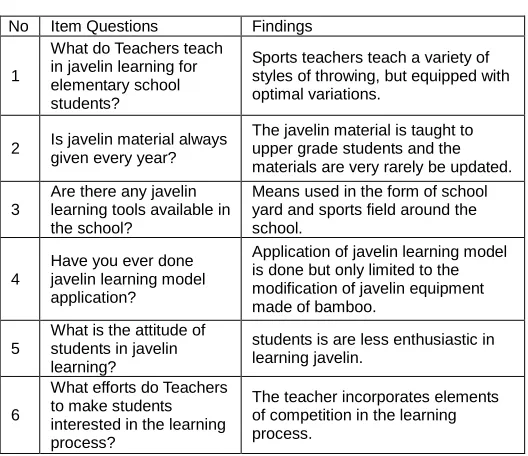
The researcher conducted a preliminary study with survey and interviews of several sports teachers about how important the proposed learning. Results of the preliminary study are shown in Table 1.
Table 1. Results of Needs Analysis and Field Findings
No Item Questions Findings
1
What do Teachers teach in javelin learning for elementary school students?
Sports teachers teach a variety of styles of throwing, but equipped with optimal variations.
2 Is javelin material always given every year?
The javelin material is taught to upper grade students and the materials are very rarely be updated.
3
Are there any javelin learning tools available in the school?
Means used in the form of school yard and sports field around the school.
4
Have you ever done javelin learning model application?
Application of javelin learning model is done but only limited to the modification of javelin equipment made of bamboo.
5
What is the attitude of students in javelin learning?
students is are less enthusiastic in learning javelin.
6
What efforts do Teachers to make students interested in the learning process?
No Item Questions Findings
7
Is the javelin learning model required by game?
Teachers desperately need a variety of learning models by incorporating game elements and relevant movements with javelin.
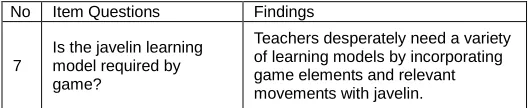
As shown in Table 1, there are many things need to improve for obtaining the best possible results in delivering and practicing the javelin sports. The main problem seems to be old fashion that teachers are using conventional way of teaching, very few of modification that could attract students to get interest in practicing the javelin sports, and bamboo is used as the materials of javelin. As a results, the students are less attractive to learn and practice the javelin sport. Knowing the problem found in the field, the researcher proposed two models of research and development study. The following is the description of the model used in the study.
a. Initial Model
In the first model, the researcher five types of game-types models. These are Cardboard throwing games with tennis ball (model 1), Game throwing ball gym with tennis ball with left hand (model 2), Game throwing ball gym dealing with tennis ball with right hand (model 3), Hula-hoop throwing game depending on the tennis ball (model 4), and Hula-hoop throwing game hanging with rattan cane (model 5). All students practiced the five-game models and they were evaluated.
b. Final Model
Following the evaluation and after being declared valid and all students have tried and practiced the initial models, additional models were advanced. So, all together there are seven models. These are Throwing Box with Tennis Ball with Right Hand (Model 1), Game throwing box with tennis ball with left hand (Model 2), Game Throwing Ball gym with tennis ball with right hand (model 3), Sports throwing ball game with tennis ball with left hand (model 4), Game throwing gym ball dealing with tennis ball (model 5), Hula-hoop throwing game hanging with tennis ball (model 6), and Hula-hoop throwing game hanging with rattan cane (model 7).
3.2Model Effectiveness
Upon completion of the initial model, the next is testing the models to seek for effectiveness of them. This is called Phase I the Testing. A javelin game model was created by researcher after being evaluated by experts (sport teachers, athletic trainers, and sport experts). Some revisions on the proposed models were made. The students were requested to practice with the revised models. The progresses were recorded and the trial phase was carried out. Based on small group experimental evaluations conducted by some experts, it can be summarized some notes. These are a) the use of simple tools, tennis balls and rattan canes, is good but should be made even more interesting, b) the model used is suitable for elementary students in javelin, c) the level of safety of the use of good and feasible tools, d) systematic model development of the introduction, core and closing, used in the development of the javelin model through bombardier games for elementary students is quite good, and needs to be equipped with Detail teaching planning RPP, e) preparation of well-structured models , from easy to more difficult ladder, and f) preparation of javelin learning model through bombardier game for elementary school students is felt to be effective in helping sports teachers achieve learning objectives. After the model was revised, the next is the field test employing small group of
10 students. The result of the assessment of the javelin learning model with the game showed an average amount of 249 out of 330 possible achievement. Thus, the effectiveness of the learning model as a whole was 75.5% (249/330). By testing the learning model product, this test step is declared complete. Following the completion of Phase I, Phase Two was executed. This phase involved a large scale of test by performing what so called the field trial (field try-out). The tests were applied to all 30 students from both elementary schools. The treatment of javelin learning models was named the bombardier game. Treatment is was given during 4 meetings with 3 to 4 models in each meeting. The test used is a process skill test of the javelin process based on the rubric of truth assessment of movement of prefix stage, throwing stage and advanced stage by scoring the movement done during throwing. The results of the model effectiveness test with the correctness assessment test of javelin movement are depicted in Table 2. As can be seen in Table 2, the initial test produces an average of 14.70 meters with a maximum length of 18.0 meters and the shortest one is 12.0 meters. The standard deviation is 1,466 meters. The average length of throwing for the final test is 20.67 meters. The longest throw is 23.00 and the shortest is 19.0 meters with a standard deviation of 1,422 meters. Thus, there is an average increase of 5.97 meters.
Table 2. Initial Test Data Description and Final Assessment of Javelin Assessment Process (n=30)
Statistics Initial Test (meters) The final test (meters)
Mean 14.70 20.67
Std. Dev 1.47 1.42
Variance 2.15 2.02
Minimum 12.00 19.00
Maximum 18.00 23.00
809 applied to schools that have adequate infrastructure facilities,
it is expected that the results could be better. In addition, the advantages of the javelin learning model through bombardier games, for which it provides flexibility of moving students, are numerous. For example, it does not need the standard equipment. That is, it can be adjusted to the conditions of existing facilities at school and may be modified). It also enable the teachers to use simple means of local or additional material as long as it can be modified for use of physical learnings. To overcome the solution in physical education on javelin number can be done with various game models such as game throwing box with tennis ball and others. These game models provide students with the opportunity to move while playing by involving all members of the student body in ways this game is modified so that it can be optimally used for learning by elementary school students. The various modifications made, namely the form of movements that is simple but activate all the arms (superior extremity); both dextran and herextra dextra and herextra parts. This means that students activate superior extremities by following the properties of muscular movements of both agonist, antagonist, horizontal and stabilizers. Game models will also bring students to work with group friends, and can improve physical fitness. This similar thing is also advocated by [11] that the benefits derived from play activities, which is throwing extra energy (surplus energy), optimize the growth of bones, muscles and organs, increase the child's appetite, children learn to control themselves, the development of various skills; increase creativity, find the meaning of the objects that are around, overcome anger, anxiety, jealousy and position, associate with other children, opportunity to be a losing or winning party, learn to follow the rules, and develop intellectual ability In line with the above, that when students perform the physical education teaching model, the movements can involve all parts of the joint (articulation) so that it can happen various movements such as flexion, extension, hyperflexion, hyperextension, abduction, adduction, rotation, and others. When performing all these movements, the main goal is to activate all the properties of the muscle so that it leads to a coordination of movement. With good coordination, the muscles of both agonists and antagonists have a good kinesthesis mechanism. In line with the findings reported in this study, a writer contends that the giving of playing approach can improve the lesson of floor gymnastics that has not been optimal and can improve the skills of front rolling gymnastics class of students [12]. Exciting play activities will affect hormones and stimulate growth [11]. Judging from the physiological aspect, playing game will give a feeling of joy. This is because the brain stimulates the master gland (pituitary gland) to secrete the hormone endorphins, which is a chemical compound that makes a person feel happy and for the body immunity. The hormone endorphins are produced by our bodies in the pituitary gland, which is when we feel happy (laughs) as well as when we have adequate rest. In fact this hormone acts like a morphine where its effect on a person's body is 200 times greater than morphine.
4
C
ONCLUSIONLearning javelin through bombardier game is needed by the teacher of Sport. In general, teachers are in dire need of a variety of javelin learning models especially with the use of simple tools. This is because the dependence of the teachers of Sport on the standard facilities and learning approaches on
the presentation of basic techniques are also standard in accordance with the established curriculum. Thus, it may cause less-varied learning patterns and tend to bore student learners. Overall this product is effectively implemented by the teacher of Sport in teaching basic motion javelin to students. Referring to the analysis of product test results, that in terms of product existence (level of urgency, usefulness and practicality) and efficiency level (time, effort and cost), and level of clarity, this product is the right solution to the problems faced by Sports teachers in teaching basic motion javelin. The results of model effectiveness test, empirically proven that the form of learning models of basic motion javelin for elementary school students have been effective learning model of basic motion javelin through bombardier game effectively to improve the process of truth of basic motion javelin without prefix. Although the results of the second stage test of the javelin development model through the bombardier game are very effective to be considered yet, this learning model still needs to be refined including the need for more detailed explanation and drawing the implementation in the class before the material is taught in the field. Thus, the effectiveness of learning time is not much wasted, schools that have limited facilities and infrastructure need to adjust, the use of tennis balls is considered light so that the continued movement centered on the togok is less involved so that the end of the movement only on the shoulders.
5
R
EFERENCES[1] Hidayatullah, M.F. (2013). Aktivitas Gerak Pada Masa Kanak-kanak. Solo: Cakra Wijaya Press.
[2] Bunker, D., & Thorpe, R. (1982). A model for the teaching of games in secondary schools. Bulletin of Physical Education, 18 (1), 5-8.
[3] Forrest, G. J., Pearson, P. J. & Webb, P. I. (2006). Teaching Games for Understanding (TGfU): A model for pre service teachers. Fusion Down-under: 1st ICHPER.SD Oceania Congress (pp. 1-10). PENZ Website: PENZ.
[4] Balakrishnan, M., Rengasamy, S., & Aman, M.S. (2011). Effect of teaching games for understanding approach on students’ cognitive learning outcome. World Academy of Science, Engineering and Technology. 5(5), 714-716.
[5] McMatch, C.R.J. (1997). Inquiring into teaching games for understanding: how models based teaching and assessment can inform practice. Master Thesis, University of Victoria.
[6] Yusakarim, Y.S. (2011). Implementasi program alternatif pendidikan olahraga (pendidikan olahraga adaptif) bagi siswa berkebutuhan Khusus (SPLB -C Cipaganti dan SPLB B Cicendo) di Bandung, Jawa Barat: Prelimanary Study. Pendidikan Jasmani dan Olahraga, 5(1), 98-103.
[7] Tarigan, B. (2000). Penjaskes Adaptif. Jakarta: Depdikbud.
[8] Djumidar. (2007). Gerak-gerak Dasar AtletikDalam Bermain. Jakarta: Rajawali.
Berbasis Kecerdasan Anak. Jakarta: PT Indeks.
[10] Gumanti, T.A., Yunidar, & Syahruddin. 2016. Metode Penelitian Pendidikan. Jakarta: Mitra Wacana Media
[11] Gusril. (2016). Perkembangan Motorik Pada Masa Anak-anak. Padang: UNP Press
[12] Muttaqin, M.A. (2012). Meningkatkan keterampilan gerak dasar senam lantai guling depan dengan pendekatan bermain untuk anak tunagrahita kelas V SDLB C di SLB Pembina Tingkat Nasional Lawang. http://library.um.ac.id/ptk/