9 | P a g e
A SECURE FRAMEWORK FOR AUDITING THE
DATA ON THE PUBLIC CLOUD
Ramavath Ramesh
1, M. Raghavendra Rao
2 1M.tech Scholar (CSE),
2Asst.Professor, Dept. of CSE, Holy Marry Institute of Technology & Sciences
(HITS), Bogaram (V), Keesara(M), R.R.(dist), Telangana,(India)
ABSTRACT
Commoditization of figuring assets has turn into a reality with distributed computing which is another
registering model. Clients are no more needed to contribute on securing figuring assets. Rather they utilize
assets gave by cloud administration suppliers in pay as you utilize style. Clients have the capacity to utilize
tremendous capacity and preparing abilities of the cloud. Be that as it may, they feel that they don't have control
over information as it is put away in a remote server. Numerous reviewing plans started to be for information
trustworthiness confirmation keeping actualized that convention utilizing Azure cloud. We have built up a model
that encourages end client to avail stockpiling and information uprightness confirmation benefits hence
guaranteeing distributed storage security. The experimental Results uncovered that the convention is effective
and profoundly secure.in mind the end goal to guarantee the capacity irregularities if any are known not clients.
Consequently they urged individuals to utilize distributed storage benefits by giving secure environment. Wang
ET al.introduced a convention detail which ensures security and execution.
I. INTRODUCTION
Ever, distributed computing has conveyed phenomenal advantages to the figuring scene. It has made it
conceivable to have an alternate figuring model that does not endure with shortage of assets. Distributed
computing empowers to share processing assets without the requirement for interest in pay as you utilize style.
Cloud administration suppliers, for example, Microsoft, Oracle, Amazon, and Google and so on have the
capacity to give colossal mists which are only processing assets that are given on interest through Internet. The
way IT framework has been utilized; is changing with the rise of distributed computing ideal model. One
essential part of distributed computing is that information is put away in a brought together server which is
connected to cloud server farm. The capacity and different administrations gave by cloud can be used by people
and associations alike without the requirement for capital venture. To associations and people cloud gives
exceptionally helpful advantages as they are diminished from capacity administration, speculation, and upkeep.
Alongside the central points, it furthermore has tests as far as sanctuary dangers. This is on the grounds that the
clients' information is put away in a remote server which is viewed as "untrusted". Clients are losing control
over their information and the storage spaces are under control of cloud administration suppliers. In this way the
rightness or respectability of the information is addressed. The cloud information stockpiling may be subjected
to interior and outer dangers. It causes security concern on some piece of cloud clients. Security issues surfaced
in distributed computing were known not world. Then again CSPs may have aims to be unjustifiable towards
10 | P a g e
framework. Out sourcing information to cloud have advantages over the long haul gave the security dangers aretended to decidedly.
So as to secure cloud information the use of cryptography to secure information is not doable as the information
is no more physically put away in the client's machine. In the meantime acquiring complete information which
has been outsourced for honesty confirmation is not perfect arrangement as it is lavish. Cloud clients ought to
have the capacity to review their information without the extravagant approach as their frameworks are asset
compelled. The information trustworthiness check ought to be done instinctively as that ought not to offer
inconvenience to end clients. The verification procedure ought to be inbuilt in cloud to empower the proprietor
of information to send honesty check solicitation to cloud server. Remembering every such thing, it is key to
have an open inspecting administration which empowers information proprietors to confirm the information
honesty effortlessly. People in general examining administration deals with periodical check of information
honesty. It helps cloud clients to be certain of their outsourced information and cloud administration suppliers
can guarantee stockpiling uprightness that makes cloud use significantly more prevalent by enhancing their
administrations.
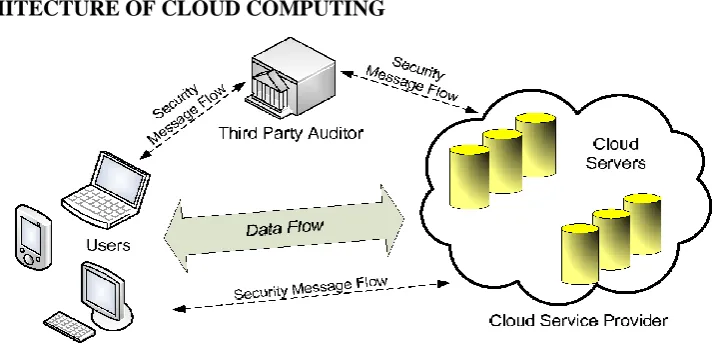
II. ARCHITECTURE OF CLOUD COMPUTING
Fig. 1: The Architecture of Cloud Cloud Data Storage Service
III. RELATED WORK
Extensive exploration was included on distributed storage security issues. In the first place of that kind is in
proposed by Ateniese ET al. which guarantees provable information parade. They performed review on
outsourced information utilizing RSA – based homomorphic authenticators. One of the plans proposed by them
gives information access to outside reviewer which may bring about security issues. Another security model was
proposed by Juels et al. They utilized the idea of blunder amending codes for confirmation of hopelessness. The
restriction of this arrangement is that the quantity of reviews is altered. In addition this works with just encoded
information. This work was later enhanced by Bowers et al. The confirmation of hopelessness is further
considered and enhanced by Dodi et al. thereafter; it is further upgraded with the use of BLS marks by Shacham
et al. On the other hand, their methodologies are not protection safeguarding. With a specific end goal to
11 | P a g e
Auditing). Towards it they encoded information first and afterward utilizing precomputed symmetric keyedhashes for evaluating purposes. Be that as it may, this plan has impediment as it works just with encoded
records. In the late writing it is found that analyst concentrates on information motion other than information
security which is put away in cloud. In the first place in part dynamic PDP (Provable Data Procession) plan was
presented by Ateniese et al. They accomplished it utilizing symmetric cryptography. Comparable sort of work
was finished by Wang etal.with some extra element known as blunder confinement. In their resulting work, they
consolidated methods, for example, MHT and HLS for supporting information flow in distributed storage. In the
meantime Erway et al. proposed a plan for provable information parade with full information motion. Straight
blend of squares was utilized to check the respectability of distributed storage. Hence and don't giving security
saving information uprightness.
In other earlier works, remote information parade convention was presented by Sebe et al. This convention has
no impediments in honesty check. Crosswise over numerous servers running in disseminated environment,
information trustworthiness checking was considered by Schwarz and Miller. In the comparative manner
Curtmola et al. made analyses on provable information parade in various server copies. Indeed they enhanced
the plan proposed to scale it to numerous server copies without the requirement for encoding every reproduction
independently along these lines giving ensured information honesty. Deletion amending codes were utilized by
Bowers etal.which is a developed model of confirmation of hopelessness. All the plans examined about give
systems to inspecting distributed storage. Then again, they don't meet the genuine necessities of the security
saving examining. In addition they don't bolster bunch inspecting. Wang et al. proposed protection safeguarding
open reviewing which backings clump inspecting as well.
In existing framework to safely present a successful outsider inspector (TPA), the accompanying two principal
prerequisites must be met: 1) TPA ought to have the capacity to effectively review the cloud information
stockpiling without requesting the neighborhood duplicate of information, and present no extra on-line weight to
the cloud client; 2) The outsider reviewing procedure ought to acquire no new vulnerabilities towards client
information protection.
In Proposed System we use people in general key based homomorphic authenticator and remarkably incorporate
it with arbitrary veil system to accomplish a protection safeguarding open evaluating framework for cloud
information stockpiling security while remembering every above necessity. To bolster productive treatment of
different examining errands, we further investigate the strategy of bilinear total mark to broaden our principle
result into a multi-client setting, where TPA can perform various reviewing assignments all the while. Broad
security and execution examination demonstrates the proposed plans are provably secure and very productive.
We likewise demonstrate to degree our primary plan to bolster clump evaluating for TPA upon designations
from multi-client
IV. ALGORITHM
A public auditing arrangementcontains of four procedures (KeyGen, SigGen, GenProof, VerifyProof).
• KeyGen: key generation procedure that is execute by the client to arrangement the system
• SigGen: used by the client to produceconfirmation metadata, which may contain of MAC, signatures or
additionalinfo used for checking
12 | P a g e
• VerifyProof: execute by the TPA to check the evidenceon or after the cloud serverV. PRIVACY-PRESERVING PUBLIC AUDITING
Homomorphic authenticators are unforgeable check metadata produced from individual information pieces,
which can be safely amassed in such an approach to guarantee an examiner that a straight mix of information
squares is effectively processed by checking just the totaled authenticator. Outline to accomplish protection
saving open examining; we propose to extraordinarily coordinate the homomorphic authenticator with irregular
cover procedure. In our convention, the direct mix of tested pieces in the server's reaction is covered with
arbitrariness created by a pseudo random function (PRF).
The proposed scheme is as follows:
Setup Phase Audit Phase
VI. FLOWCHART
VII. BATCH AUDITING
With the foundation of protection protecting open reviewing in Cloud Computing, TPA might simultaneously
handle various inspecting appointments upon diverse clients' solicitations. The individual inspecting of these
undertakings for TPA can be dull and extremely wasteful. Group examining not just permits TPA to perform the
13 | P a g e
VIII. DATA DYNAMICS
Thus, supporting information motion for security saving open danger evaluating is additionally of central
significance. Presently we demonstrate how our principle plan can be adjusted to expand upon the current work
to bolster information motion, including square level operations of change, erasure and insertion. We can
receive this strategy in our outline to accomplish protection protecting open danger reviewing with backing of
information dynamics.
IX. CONCLUSION
In this paper, we have implemented a public auditing Protocol in azure cloud which enables individuals and
organizations to store data in cloud without Security concerns. The third party auditing protocol we
implemented ensures complete storage security as it enables end users to relieve from the security Concerns of
cloud storage. Our third party auditing Protocol does not access to actual data but it is Capable of performing
audit on data and verifies the Integrity of stored data. The protocol helps in Auditing data pertaining to
concurrent sessions of Cloud users. We have built a prototype application that interacts with azure cloud and
demonstrates the Efficiency of the proposed system. The empirical Results revealed that the proposed protocol
provides High security and performance.
REFERENCES
[1] P. Mell and T. Grance, “Draft NIST working definition of cloudcomputing,” Referenced on June. 3rd,
2009.http://csrc.nist.gov/groups/SNS/cloudcomputing/ index.html.
[2] M. Armbrust, A. Fox, R. Griffith, A. D. Joseph, R. H. Katz,A. Konwinski, G. Lee, D. A. Patterson, A.
Rabkin, I. Stoica,and M. Zaharia, “Above the clouds: A Berkeley view of cloud computing,” University
of California, Berkeley, Tech. Rep. UCBEECS-2009-28, Feb 2009.
[3] Cloud Security Alliance, “Top threats to cloud computing,” 2010,http://www.cloudsecurityalliance.org.
[4] M. Arrington, “Gmail disaster: Reports of mass emaildeletions,” 2006,
http://www.techcrunch.com/2006/12/28/gmaildisasterreports- of-mass-email-deletions/.
[5] J. Kincaid, “MediaMax/TheLinkup closes its doors,”July 2008,
http://www.techcrunch.com/2008/07/10/mediamaxthelinkup-closes-its-doors/.
[6] Amazon.com, “Amazon s3 availability event:July 20, 2008,”
http://status.aws.amazon.com/s3-20080720.html, 2008.
[7] Q. Wang, C. Wang, K. Ren, W. Lou, and J. Li,“Enabling publicauditability and data dynamics forstorage
security in cloudcomputing,” IEEETransactions on Parallel and DistributedSystems,vol. 22, no. 5, pp.
847–859, 2011.
[8] G. Ateniese, R. Burns, R. Curtmola, J. Herring, L.Kissner, Z. Peterson,and D. Song, “Provable
datapossession at un-trusted stores,”inProc. of CCS’07,2007, pp. 598–609.
[9] A. Juels and J. Burton S. Kaliski, “PORs: Proofsof retrievability for large files,” in Proc. of
CCS’07,October 2007, pp. 584–597.
[10] Cloud Security Alliance, “Security guidance forcriticalareas of focus in cloud computing,”
14 | P a g e
AUTHOR DETAILS
Ramavath Ramesh pursuing M.Tech (CSE) Holy marry Institute of Technology &
Sciences (HITS), Bogaram(V), Keesara(M), R.R.(dist), Telangana, India. 501301
M.Raghavendra Rao Presently he is working as Asst. Professor in Computer Science
& Engineering, 7 years of teaching experience, Holy marry Institute of Technology &