R E S E A R C H
Open Access
Improving rare disease classification
using imperfect knowledge graph
Xuedong Li
1, Yue Wang
2, Dongwu Wang
3, Walter Yuan
3, Dezhong Peng
1and Qiaozhu Mei
4*FromThe second International Workshop on Health Natural Language Processing (HealthNLP 2019) Xi’an, China. 10 June 2019
Abstract
Background: Accurately recognizing rare diseases based on symptom description is an important task in patient triage, early risk stratification, and target therapies. However, due to the very nature of rare diseases, the lack of historical data poses a great challenge to machine learning-based approaches. On the other hand, medical
knowledge in automatically constructed knowledge graphs (KGs) has the potential to compensate the lack of labeled training examples. This work aims to develop a rare disease classification algorithm that makes effective use of a knowledge graph, even when the graph is imperfect.
Method: We develop a text classification algorithm that represents a document as a combination of a “bag of words” and a “bag of knowledge terms,” where a “knowledge term” is a term shared between the document and the
subgraph of KG relevant to the disease classification task. We use two Chinese disease diagnosis corpora to evaluate the algorithm. The first one, HaoDaiFu, contains 51,374 chief complaints categorized into 805 diseases. The second data set, ChinaRe, contains 86,663 patient descriptions categorized into 44 disease categories.
Results: On the two evaluation data sets, the proposed algorithm delivers robust performance and outperforms a wide range of baselines, including resampling, deep learning, and feature selection approaches. Both
classification-based metric (macro-averagedF1score) and ranking-based metric (mean reciprocal rank) are used in
evaluation.
Conclusion: Medical knowledge in large-scale knowledge graphs can be effectively leveraged to improve rare diseases classification models, even when the knowledge graph is incomplete.
Keywords: Rare disease diagnosis, Knowledge graph, Machine learning, Text classification, Extremely imbalanced data
Background
A disease is defined as rareif it affects fewer than 1 in 2000 people in Europe [1], or it affects fewer than 200,000 people in the United States (1 in 1500 people) [2]. China has recently released its first national list of rare diseases [3]. Across the globe, hundreds of millions of people could be affected by one of about 6000 known rare diseases [4].
Accurate diagnosis of rare diseases is an important task in patient triage, risk stratification, and targeted ther-apies. Rare disease symptoms often appear unfamiliar
*Correspondence:[email protected]
4School of Information, University of Michigan, Ann Arbor, MI, United States
Full list of author information is available at the end of the article
and atypical to a clinician, as the cases are too rare to encounter [5]. This brings significant challenge for clinicians to diagnose rare diseases timely, and calls for machine-assisted diagnosis methods.
Rare disease diagnosis is challenging to machine learn-ing approaches as well. Machine learnlearn-ing algorithms often require a significant number of training examples to achieve a good generalization performance. However, by the very nature of rare diseases, the number of relevant clinical records is bounded by the size of population. To compensate the lack of training data for rare disease diagnosis, we need to make use of domain knowledge. Recent efforts in information extraction and knowledge
engineering communities have created large-scale knowl-edge graphs [6–8], in which a large number of entities and relations are extracted from unstructured and semi-structured data, verified manually or semi-automatically, and then organized into a massive graph. Although many of these knowledge graphs are freely available as web-based services, most of them have limited coverage and accuracy. They are often built without considering down-stream machine learning tasks, therefore imperfect from a task point of view. In this paper, we are interested in lever-aging such knowledge resources in machine-assisted rare disease diagnosis.
We present a simple and effective statistical learning method that improves rare disease classification using an imperfect knowledge graph. We define a rare disease in its statistical sense, i.e. a disease that affects a small per-centage (in this paper, less than 0.1%) of the population in a large disease diagnosis corpus. The proposed method is based on the intuition that if a rare disease has a corre-sponding entity in the knowledge graph, then we can use this piece of knowledge to guide the classifier on “where to focus” when examining a clinical document. This proves to be an effective strategy in classifying rare diseases when the training documents are too few for the algorithm to learn informative features. On two disease classifica-tion corpora, the proposed method demonstrates robust improvements over strong baseline methods on rare dis-eases diagnosis.
Prior work
Machine-assisted rare disease diagnosis. Machine-assisted diagnosis approaches have attracted various lines of research recently [5]. Svenstrup et al. developed a search system that, given symptoms as a search query, returns probable rare disease diagnosis [9]. MacLeod et al. applied gradient boosted decision tree classifiers on behavioral survey data to identify potential rare diseases. Shen et al. proposed a neighborhood-based collaborative filtering algorithm, where patients with similar pheno-types receive similar diagnosis [10]. Their follow-up work further incorporated phenotype-disease associations in biomedical literature [11] and biomedical ontology [12] to improve disease recommendation results. In the current work, we approach rare disease diagnosis in a multi-class multi-classification formulation, which has been shown to deliver state-of-the-art performance in Web-scale appli-cations like ranking and recommendation [13,14].
Imbalanced data classification. From a machine learn-ing perspective, rare diseases in a patient population can be viewed as rare classes in a data set, which is a typical example of imbalanced data set. We can therefore con-sider imbalanced learning techniques in rare disease clas-sification [15]. Typical imbalanced learning techniques include resampling, cost-sensitive learning, and rare class
data synthesis [16]. However, typical machine learning research deals with class imbalance ratios between 1:4 and 1:100, and few recent works tackle imbalance ratio as extreme as 1:1,000 or lower [17,18]. In this study, we only consider resampling as one of the potential meth-ods, as its performance closely resembles that of cost-sensitive learning, and synthesizing text documents from rare classes is itself a challenging task.
Feature engineering. When training documents are too few to provide high-quality features, various feature engineering techniques can help enhance data represen-tation. Feature selection methods can be used to identify informative features for the classification task and discard irrelevant features to alleviate overfitting, especially for high-dimensional data such as text [19]. Instead of reduc-ing features, feature generation aims to add features usreduc-ing external knowledge [20]. The technique first identifies a set of knowledge concepts related to a given document, and then “appends” informative words in these concepts to the document. In between the above two strategies are feature labeling and highlighting, which originated from interactive machine learning literature [21–23]. These methods use domain knowledge to identify a subset of existing informative features, then incorporate them as certain type of informative prior in subsequent classifier training process. In this study, we evaluate various feature engineering methods for integrating domain knowledge into disease classification algorithm.
Methods
Data Description and Problem Formulation
We start by describing the two corpora and the knowledge graph used in our study, followed by our definition of rare diseases, all of which lead to our problem formulation.
Corpora: HaoDaiFu and ChinaRe. We use two Chi-nese patient diagnosis corpora. The first corpus, Hao-DaiFu, contains 51,374 patient records categorized into 805 diseases. Each document contains the symptom description submitted by a patient to Haodf.com, the largest Chinese online platform that connects patients to doctors. These patients have been previously diag-nosed by a clinician, and now come to the platform for further consultation. The second corpus, ChinaRe, contains 86,663 patient records categorized into 44 dis-ease categories. Each document contains the symptom description of a patient written by an insurance pro-fessional in ChinaRe, which is one of the largest rein-surance groups in China. The diagnoses were deter-mined by a clinician and sent to the insurance com-pany. Table 1 summarizes basic statistics of the two corpora. Jieba package was used for Chinese word segmentation [24].
Table 1Corpora statistics
HaoDaiFu ChinaRe
# of documents 51,374 86,663
# of classes (diseases) 805 44
Vocabulary size 59,879 41,087
Average # of words/doc 26.7 29.7
Average # of knowledge terms/doc 10.8 4.0
A “knowledge terms” is a term appearing in medical knowledge graph (see “Acquiring knowledge features from KG entities” section)
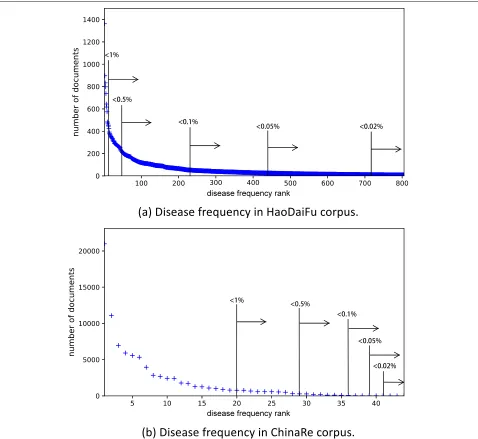
few diseases account for thousands of people, while many diseases affect a small percentage of the population.
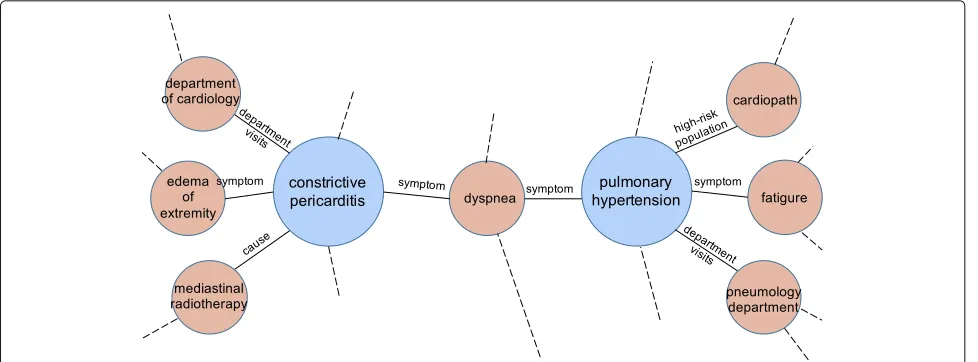
Knowledge graph: CN-DBpedia. A knowledge graph (KG), also known as an ontology, is a collection of enti-ties and relations between entienti-ties. An entity has a set of attributes, some of which may itself be an entity. Figure2 illustrates a small part of a medical KG.
In our study, it would be ideal to have a well-curated medical KG. Unfortunately there is no equivalent of English medical KG like the Unified Medical Language System (UMLS) in Chinese. As it is challenging to
Fig. 2An illustrative example of two disease entities and some of their attributes in a knowledge graph
guarantee accurate translation of an English KG to Chi-nese using machine translation, only a small fraction of UMLS concepts has Chinese translation. We leave this direction for future work. We therefore resort to a general Chinese knowledge graph, CN-DBpedia [25]. It aggre-gates knowledge from various resources and constructed in a similar manner as DBpedia. At the time of writing, it contains 16,892,423 entities and 223,137,127 relations. We use a web-based platform that provides RESTful API access to CN-DBpedia (Knowledge Works [26]). Given a textual query, the API returns matched entities. This allows us to perform entity linking relatively easily. Since CN-DBpedia is automatically constructed from Chinese equivalents of Wikipedia, it does not have perfect cover-age over all medical entities, and the crowd-contributed medical content may be inaccurate or incomplete. Not all diseases in the above two corpora have a corresponding entity in the current CN-DBpedia. We find an entity for 751 out of 805 diseases in HaoDaifu and 37 out of 44 diseases in ChinaRe.
Rare disease definition. Since different countries and regions adopt different definitions of rare diseases [1,2], and new rare diseases continue to be registered [3], there is no commonly accepted definition of rare diseases.
For the purpose of this study, we define a rare disease in its statistical sense: a disease is rare if it affects no more than a small percentage of the patient records in a large diagnosis corpus. We set the percentage to 0.1%, or 1/1,000, which is slightly higher than the 1/1,500 – 1/2,000 threshold used in the United States and Europe, since both corpora are biased samples of the entire population,i.e., missing the healthy sub-population. This definition allows us to develop and evaluate algorithms on a wide variety of statistically rare diseases observed in empirical data. In HaoDaiFu, 571 diseases have a percentage lower than
0.1% of all the records. In ChinaRe, 10 diseases have a percentage lower than 0.1% of all the records.
Problem formulation. Our goal is to build text classifi-cation algorithms that can automatically assign a disease label given the narrative description of a patient’s symp-toms. Besides a set of training documents, we also assume access to an existing knowledge graph that contains an entity for (at least a subset of ) the diseases in question. In this paper, we specifically focus on classifying rare dis-eases, or diseases accounting for no more than 0.1% of records in a corpus.
Knowledge Graph Enhanced Rare Disease Classification
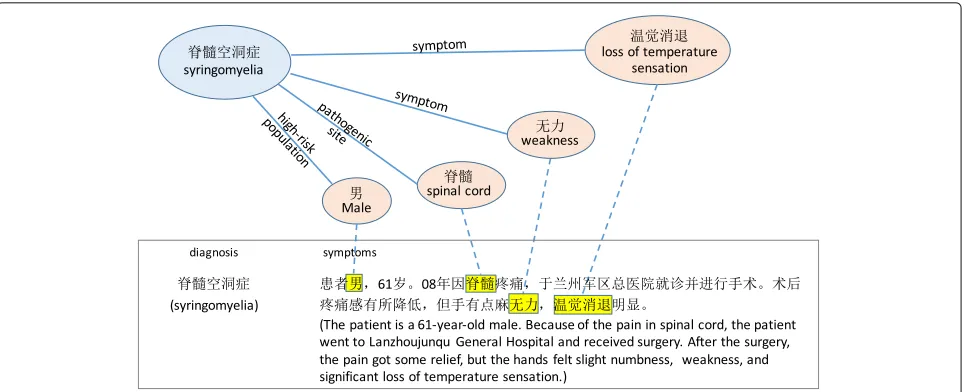
This section describes the proposed method for KG-enhanced rare disease classification. The basic idea is to use external knowledge to “emphasize” existing features in the classifier. To illustrate, let us consider a concrete example in Fig.3. Suppose we want to detect the rare dis-easesyringomyeliain text, but the training documents are extremely few (in the HaoDaifu corpus, 12 out of 41,105, or 1 out of 3425 records). A text classifier essentially aims to identify important words among many irrelevant words that indicatesyringomyelia. This is a difficult task given the very few training documents and a large vocabulary of words. How can we identify important features, assum-ing we have access to a KG? A natural strategy is to look up the entitysyringomyeliain the KG, take the attributes that describe this entity, and “inform” the classifier that words mentioned in the attributes are important features. Figure3illustrates this idea.
Fig. 3An illustrative example of using knowledge graph to “emphasize” features (words) in a document. This is an ideal case, where the highlighted features are relevant to the diagnosis. In practice, all features that appear in diagnosis-related part of KG will be highlighted
Mapping diseases to KG entities
In this step, we use the KG API to map a disease to the corresponding KG entity. The API performs entity link-ing and resolves different surface forms (or “mentions”) to the same entity, e.g. mapping “cancer” and “malig-nancy” to the cancer entity. Some disease names may have ambiguous matches. For instance,insomniamatches both a health-related entity and a song. To filter out non-medical entities, we further check the category attribute of an entity. We call it thematched entityof a disease.
As discussed before, some diseases cannot be mapped to an entity due to the incompleteness of the KG in use. We devised a fall-back strategy to handle these cases. The goal here is to identify not the exact, but the most rele-vant, entity of a disease. To do so, we evaluate the content overlap between a disease (represented by high inverse document frequency words in all documents of a dis-ease) and an entity (represented by words in its various attributes), and select the entity with the highest content overlap. We call it thesurrogate entityof a disease.
As a real example, the KG API did not find an entity for complex congenital heart disease, so we resort to a surrogate entityantiarrhythmics(a drug for heart rhythm disorders) which shares many content words with this disease.
Acquiring knowledge features from KG entities
In the following discussion, we useVto denote the native word features found in all training documents, where Chinese stop words are removed.
If a disease has a matched entity, we use words in its attributes and related entity names to form disease fea-tures. Accumulating over all diseases, we obtain a set of words K1. K1 has overlap with V but may also contain words not inV.
If a disease has a surrogate entity, we do not extract features as above because unlike a matched entity, the attributes of a surrogate entity are highly likely to be irrel-evant to the associated disease. We only extract words that appear at least once in any training document of the disease and appear in 0.01% of KG entities (to ensure specificity – similar to the idea of inverse document fre-quency). This gives us a set of wordsK2. By construction, K2⊂V.
In the above example, the surrogate entity antiarrhyth-mics and the training documents of complex congeni-tal heart disease share words such as “heart”, “atrium”, “arrhythmia”, “severe”, and “syndrome”. These antiarrhyth-mics-related words are used to detect the presence of complex congenital heart disease. They can be helpful but may also introduce errors, depending on their relevance to the actual disease.
We call the union setK = K1∪K2knowledge features, orknowledge terms.
Integrating knowledge features into text classifier
Choice of text classifier. We employed one-vs-rest sup-port vector machine (SVM) classifier with linear kernel, sparse bag-of-words (BOW) feature representation. We found that dense representation methods such as long short-term memory (LSTM) networks perform compara-bly with sparse SVM on frequent diseases but much worse on rare diseases, with or without pretrained word vec-tors. In later experiments, we still include the LSTM for comparison.
1. Construct a|V|-dimensional count vector for BOW features, then apply TF-IDF (term frequency-inverse document frequency [27]) transformation andL2 length normalization;
2. Construct a|V∩K|-dimensional count vector for knowledge features ind∩K, then apply TF-IDF transformation andL2length normalization; 3. Concatenate the above two vectors to represent the
document.
The first step constructs a feature vector for the original document. The second step constructs a feature vector for words in the document that are mentioned in KG (d∩K). Concatenating feature vectors is also calledearly fusion in multimodal learning, where different vector segments correspond to different modalities of the same data [28].
If a document contains a wordw∈ V ∩K, then it will appear twice in the feature vector: one as a BOW fea-ture, the other as a knowledge feature. Note that the two feature values will not be identical, since the two vectors will have differentL2lengths before normalization. Such a word will receive a larger feature value in the second vec-tor, since the “KG-mentioned part” (d∩K) is shorter than the original document (d). Table1shows that each doc-ument in HaoDaiFu has 26.7 words on average, in which 10.8 words are knowledge features. The ratio is lower in ChinaRe (4.0/29.7). Therefore, the second feature vector can be understood asemphasizing knowledge features in a document.
Experimental Evaluation
In this section, we evaluate the effectiveness of proposed method and a suite of baseline settings on the rare diseases in the two corpora.
Train-test split. To reduce the variance of results due to a random train-test split, we average the results of 10 runs. In each run, we randomly split the corpus into 80% for training and 20% for test. To avoid the case where some classes do not appear in training or test set, the random split is applied on a per-class basis.
Compared methods
Except for LSTM, all compared methods use one-vs-rest linear SVM classifier, sparse feature representation. We performed grid search for the hyperparameter C over {0.001, 0.01, 0.1, 1, 10, 100} on a validation set, and found that C = 1 consistently delivered the best performance to the baseline method BOW (described below). We set C=1 in all SVM classifiers.
Methods that do not make use of knowledge features:
1. BOW: only use BOW feature vector in “Integrating knowledge features into text classifier” section. 2. LSTM: the long short-term memory neural
networks, hidden state size=256, randomly
initialized word vectors (slightly higher performance on rare classes than pretrained word vectors). 3. UpSample: upsample the rare disease documents in
the training set, so that each disease has equal number of documents. This is a standard method for imbalanced classification.
4. χ2: use|V∩K1|features selected by theχ2criterion. We want to compare the efficacy of features selected by external knowledge (KG) vs. standard feature selection method (χ2).
5. BOW+χ2: concatenate the BOW andχ2feature vectors in the same manner as in “Integrating knowledge features into text classifier” section.
Methods that make use of knowledge features:
1. KG1: only useV∩K1as features; 2. KG12: only use(V∩K1)∪K2as features; 3. BOW+KGearly-fusion1 : concatenate BOW and KG1
feature vectors as in “Integrating knowledge features into text classifier” section;
4. BOW+KGearly-fusion12 : concatenate BOW and KG12
feature vectors as in “Integrating knowledge features into text classifier” section.
Other variants that also make use of both BOW features and KG1features:
1. BOW+KGlate-fusion1 : the late fusion strategy (as opposed to early fusion/concatenating features in multimodal learning [28]): we combine two SVM predictions: one trained on BOW vectors, the other trained on KG1vectors. To combine the predictions
for each document, we rank the predicted labels from most to least probable, and combine the two
predicted lists using Borda’s rank aggregation method [29].
2. BOW+KGpseudo-count1 : the pseudo count strategy [21]: concatenating KG features to BOW is equivalent to increasing the corresponding BOW feature values, which in turn is equivalent to increasing corresponding word counts. For each word in a given document that also appears in KG1,
we addk pseudo word counts to the BOW feature vector. We tunedk=1, 10, 100and setk=1as it gives the best performance.
3. BOW+KGpseudo-doc1 : the pseudo document strategy: we view the mention of a knowledge feature in a training document as annotating the rationale of the label. We then use the rationale learning strategy to generate pseudo training documents [30].
Evaluation metrics
corpus. Three bins are below 0.1% (our definition ofrare diseases):
• (0 – 0.02%]: no more than 1/5,000;
• (0.02% – 0.05%]: 1/5,000 to 1/2000;
• (0.05% – 0.1%]: 1/2,000 to 1/1,000.
For a comprehensive comparison, we also include two bins between 0.1% and 1%:
• (0.1% – 0.5%]: 1/1,000 to 1/200;
• (0.5% – 1%]: 1/200 to 1/100.
Results
Machine-assisted diagnosis can be viewed both as a clas-sification task (to assign a disease label to a document) and a ranking task (to sort disease labels by their rel-evance to a document). To evaluate the classification performance, we use macro-averagedF1score [31] as it balances precision and recall and is not biased by major-ity classes. To evaluate the retrieval performance, we use mean reciprocal rank (MRR) [32] since in both corpora, each document has only one associated disease. We report macro-averagedF1and MRR on the test data of each bin.
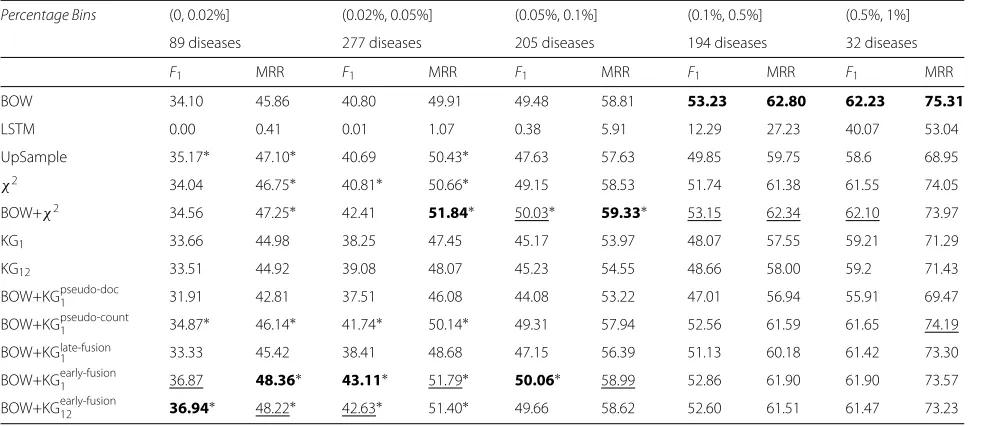
In Tables 2 and 3, we report macro-averaged F1
and MRR results in each bin across different methods. Statistical significance of these results against the BOW baseline is assessed by randomization test [33]. We set the type I error control atα=0.05.
Discussion
First, we observe that for rare diseases (three bins under 0.1%), the proposed methods BOW+KGearly-fusion1 and
BOW+KGearly-fusion12 deliver robust performance: they are almost always among the top two performers on both cor-pora. As the disease becomes less rare (two bins above 0.1%), simple BOW baseline and supervised feature selec-tion work better. This is expected as the proposed meth-ods can be viewed as doing feature selection using external knowledge. With more training data in each class, the knowledge inside training data allows us to select higher quality, more task-specific features than external knowl-edge.
In the disease-to-KG-entity mapping step (“Mapping diseases to KG entities” section), including surrogate enti-ties is sometimes beneficial to rare disease classification, but not always. The performance gain of having higher entity coverage (BOW+KG12compared to BOW+KG1) is the most salient when the disease is extremely rare (below 0.02%). This suggests that if we had a more complete KG, the rare disease classification performance could be even better.
The performance of LSTM is extremely low on rare dis-eases. Indeed, deep learning methods need a large quan-tity of training data to perform well, which are unavailable for rare classes in the long tail. Using pretrained word vec-tors did not help, since rare classes have far less training documents than frequent classes to fine-tune the relevant word vectors.
The performance of upsampling is very unstable, which agrees with previous literature [16]. It dramati-cally improves classification performance in one specific case (ChinaRe, 0.02% – 0.05%). But in most other cases, upsampling does not help or even hurts performance compared to the BOW baseline. Combining upsampling
Table 2Rare disease classification performance on HaoDaiFu corpus
Percentage Bins (0, 0.02%] (0.02%, 0.05%] (0.05%, 0.1%] (0.1%, 0.5%] (0.5%, 1%]
89 diseases 277 diseases 205 diseases 194 diseases 32 diseases
F1 MRR F1 MRR F1 MRR F1 MRR F1 MRR
BOW 34.10 45.86 40.80 49.91 49.48 58.81 53.23 62.80 62.23 75.31
LSTM 0.00 0.41 0.01 1.07 0.38 5.91 12.29 27.23 40.07 53.04
UpSample 35.17∗ 47.10∗ 40.69 50.43∗ 47.63 57.63 49.85 59.75 58.6 68.95
χ2 34.04 46.75∗ 40.81∗ 50.66∗ 49.15 58.53 51.74 61.38 61.55 74.05
BOW+χ2 34.56 47.25∗ 42.41 51.84∗ 50.03∗ 59.33∗ 53.15 62.34 62.10 73.97
KG1 33.66 44.98 38.25 47.45 45.17 53.97 48.07 57.55 59.21 71.29
KG12 33.51 44.92 39.08 48.07 45.23 54.55 48.66 58.00 59.2 71.43
BOW+KGpseudo-doc1 31.91 42.81 37.51 46.08 44.08 53.22 47.01 56.94 55.91 69.47
BOW+KGpseudo-count1 34.87∗ 46.14∗ 41.74∗ 50.14∗ 49.31 57.94 52.56 61.59 61.65 74.19
BOW+KGlate-fusion
1 33.33 45.42 38.41 48.68 47.15 56.39 51.13 60.18 61.42 73.30
BOW+KGearly-fusion1 36.87 48.36∗ 43.11∗ 51.79∗ 50.06∗ 58.99 52.86 61.90 61.90 73.57
BOW+KGearly-fusion12 36.94∗ 48.22∗ 42.63∗ 51.40∗ 49.66 58.62 52.60 61.51 61.47 73.23
Table 3Rare disease classification performance on ChinaRe corpus
Percentage Bins (0, 0.02%] (0.02%, 0.05%] (0.05%, 0.1%] (0.1%, 0.5%] (0.5%, 1%]
5 diseases 3 diseases 2 diseases 7 diseases 9 diseases
F1 MRR F1 MRR F1 MRR F1 MRR F1 MRR
BOW 91.58 93.36 29.76 53.97 90.49 93.49 88.69 92.64 92.6 95.09
LSTM 0.00 4.03 0.00 4.75 0.00 9.64 22.38 44.68 85.86 93.55
UpSample 88.36 94.81 52.22 66.54 90.11 93.06 89.36 94.27 92.62 95.76
χ2 91.38 95.83∗ 47.97 65.12 90.40 93.68 91.92 95.41 93.84 96.45
BOW+χ2 93.37∗ 97.55∗ 42.14∗ 62.80∗ 90.73 93.95 92.01 95.55 94.05 96.43
KG1 91.06 97.47∗ 22.63 43.64 48.52 48.11 80.54 86.67 74.32 77.33
KG12 92.26∗ 97.70∗ 31.20 43.91 85.61 91.42 83.71 87.96 80.05 83.18
BOW+KGpseudo-doc1 75.68 82.49 34.86 52.08 83.20 87.84 78.79 85.57 88.34 91.86
BOW+KGpseudo-count1 88.14 91.02 30.04∗ 52.62 89.02 93.61 85.54 88.64 90.8 93.34
BOW+KGlate-fusion
1 89.01 95.41∗ 29.76 48.8 68.63 70.80 86.18 89.65 86.89 86.21
BOW+KGearly-fusion1 92.30∗ 97.66∗ 54.73∗ 69.88 90.27 92.54 91.00 95.05 93.59 95.92
BOW+KGearly-fusion12 93.43∗ 97.13 47.78 62.04 91.68 95.41 90.70 94.49 93.46 95.70
See the footnote below Table2for details
with other methods (e.g.χ2or KG
1) results in even more unstable performance, which we omit. This suggests that resampling is not suitable for extremely imbalanced text classification tasks.
On rare diseases, concatenating the vectors of original BOW features and knowledge features tends to perform better than using either alone, for both χ2-selected fea-tures and KG-selected feafea-tures. We can understand this phenomenon as a type of regularization: the selected feature segment can be understood as “to put empha-sis on these features”. Or equivalently, it can be under-stood as “to reduce attention (lower the weights) on the rest of the BOW features”. To illustrate this, Table 4 shows examples of learned feature weights that for the rare diseasesyringomyelia. Conceptually, this is related to group-wise regularization: to apply different regulariza-tion strengths on two groups of features:V∩KandV\K. The problem with group-wise regularization is that for each disease, we would need a different hyperparameter to balance the strength of regularization on two feature groups. The proposed method does not have this problem.
Table 4Example feature weights of the rare disease syringomyelia
Feature BOW BOW+KGearly-fusion1
Syrinx 1.19 1.34
Temperature sensation 0.52 0.82
Numb 0.76 0.45
Tremble 0.82 0.75
Our method BOW+KGearly-fusion1 learned to place larger weights on knowledge features (“syrinx” and “temperature sensation”) and smaller weights on non-knowledge features (“numb” and “tremble”)
Among different ways of using the KG feature infor-mation, we found that early fusion performs the best. Combining classification predictions (late fusion) is chal-lenging at the global level, since the combination weights might be different for different diseases. The pseudo-count method has no significant effect, because incre-menting the count of an existing term by 1 has dimin-ishing effect after TF-IDF transformation. On the other hand, a large pseudo-count makes the document vector as if containing only selected features. Instead, allocat-ing additional dimensions for these features turns out to be more beneficial. It has been shown that text clas-sification can benefit from having many redundant but not perfectly correlated features [34]. Finally, the pseudo-example method performs poorly because it generates more examples for large classes, making small classes even smaller.
Implication
over unstructured annotations (e.g., precise and compact knowledge representation, extendable, reusable for differ-ent tasks [36]), there is always a concern that building a complete and accurate KG can be labor-intensive, if not impossible.
This work shows that a knowledge graph does not have to be perfect (in terms of coverage and accuracy) to be able to deliver desirable benefits for medical NLP tasks. Our use of a general-purpose KG also indicates that prac-titioners could start with customizing and refining an open domain KG for their tasks instead of building a medical KG from the scratch. Our results should resolve some of the concerns of building knowledge graphs in the practices of medical NLP.
Conclusion
This paper studied the problem of rare disease classifica-tion, where rare diseases are defined by their presence in a large corpus (lower than 0.1%). We developed a text classi-fication algorithm that represents a document as a combi-nation of a “bag of words” and a “bag of knowledge terms”, where a “knowledge term” is a term shared between the document and the subgraph of knowledge graph relevant to the disease classification task. On two Chinese dis-ease classification corpora, the algorithm delivers robust performance gain over feature selection methods on rare diseases.
In future work, we plan to explore a variety of meth-ods for improving document representation. First, instead of “emphasizing” all words that appear in medical-related KG, we can do so more selectively. One way is to iden-tify the most relevant KG entities to a specific document, and only emphasize words in those entities. We can use synonyms and word embedding methods to allow for fuzzy matching between KG entities and a document, to increase the coverage of knowledge features in a docu-ment. We can also consider “appending” words in relevant entities to a document, effectively performing feature gen-eration. Finally, when medical experts are interacting with a list of predicted rare diseases or most similar patients, we can explore the opportunity of learning from experts feedback and improve the diagnosis algorithm continu-ously.
Abbreviations
BOW: Bag-of-words; API: Application programming interface; KG: Knowledge graph; LSTM: Long short-term memory; UMLS: Unified medical language system
Acknowledgements
The authors would like to thank the anonymous reviewers of the HealthNLP workshop for their valuable feedback.
About this supplement
This article has been published as part ofBMC Medical Informatics and Decision Making Volume 19 Supplement 5, 2019: Selected articles from the second International Workshop on Health Natural Language Processing (HealthNLP 2019).
The full contents of the supplement are available online athttps:// bmcmedinformdecismak.biomedcentral.com/articles/supplements/volume-19-supplement-5.
Authors’ contributions
All authors read and approved the final manuscript. XL preprocessed the data, designed and implemented different algorithms, and drafted the manuscript. YW designed the evaluation methodology and edited the manuscript. DW and WY provided the data and edited the manuscript. DP edited the manuscript. QM conceptualized the project edited the manuscript.
Funding
This work and the publication cost of this article was funded in part by the National Science Foundation under grant number 1633370 and by the National Library of Medicine under grant number 2R01LM010681-05. Xuedong Li was visiting the University of Michigan under the support of the China Scholarship Council. Yue Wang was under the support of Kilgour Research Grant Award by UNC SILS.
Availability of data and materials
Not applicable.
Ethics approval and consent to participate
Not applicable.
Consent for publication
Not applicable.
Competing interests
The authors declare that they have no competing interests.
Author details
1College of Computer Science, Sichuan University, Chengdu, China.2School of
Information and Library Science, University of North Carolina at Chapel Hill, Chapel Hill, NC, United States.3MobLab Inc., Pasadena, CA, United States. 4School of Information, University of Michigan, Ann Arbor, MI, United States.
Published: 5 December 2019
References
1. European Commission. Rare Diseases.https://ec.europa.eu/health/ non_communicable_diseases/rare_diseases_en. Accessed 26 Mar 2019. 2. United States DepartmentofHealthandHumanServices. National
Organization for Rare Disorders (NORD).https://www.nidcd.nih.gov/ directory/national-organization-rare-disorders-nord. Accessed 26 Mar 2019.
3. He J, Kang Q, Hu J, Song P, Jin C. China has officially released its first national list of rare diseases. Intractable Rare Dis Res. 2018;7(2):145–7. 4. Orphanet. The portal for rare diseases and orphan drugs.https://www.
orpha.net/consor/cgi-bin/index.php. Accessed 26 Mar 2019.
5. Svenstrup D, Jørgensen HL, Winther O. Rare disease diagnosis: a review of web search, social media and large-scale data-mining approaches. Rare Dis. 2015;3(1):e1083145.
6. Bollacker K, Evans C, Paritosh P, Sturge T, Taylor J. Freebase: a collaboratively created graph database for structuring human knowledge. In: Proceedings of the 2008 ACM SIGMOD international conference on Management of data. New York: ACM; 2008. p. 1247–50. 7. Ratner A, Bach SH, Ehrenberg H, Fries J, Wu S, Ré C. Snorkel: Rapid
training data creation with weak supervision. Proc VLDB Endowment. 2017;11(3):269–82.
8. Rotmensch M, Halpern Y, Tlimat A, Horng S, Sontag D. Learning a health knowledge graph from electronic medical records. Sci Rep. 2017;7(1):5994.
9. Dragusin R, Petcu P, Lioma C, Larsen B, Jørgensen HL, Cox IJ, et al. FindZebra: a search engine for rare diseases. Int J Med Inf. 2013;82(6): 528–38.
10. Shen F, Liu S, Wang Y, Wang L, Afzal N, Liu H. Leveraging collaborative filtering to accelerate rare disease diagnosis. In: AMIA Annual Symposium Proceedings. vol. 2017. American Medical Informatics Association; 2017. p. 1554.
Rare Diseases Using Data Fusion and Collaborative Filtering Approaches. JMIR Med Inf. 2018;6(4):e11301.
12. Shen F, Liu H. Incorporating Knowledge-Driven Insights into a Collaborative Filtering Model to Facilitate the Differential Diagnosis of Rare Diseases. AMIA Annu Symp Proc. 2018;2018:1505–1514.
13. Babbar R, Schölkopf B. Dismec: Distributed sparse machines for extreme multi-label classification. In: Proceedings of the Tenth ACM International Conference on Web Search and Data Mining. New York: ACM; 2017. p. 721–9.
14. Jain H, Balasubramanian V, Chunduri B, Varma M. Slice: Scalable Linear Extreme Classifiers Trained on 100 Million Labels for Related Searches. In: Proceedings of the Twelfth ACM International Conference on Web Search and Data Mining. New York: ACM; 2019. p. 528–36.
15. He H, Garcia EA. Learning from imbalanced data. IEEE Trans Knowl Data Eng. 2008;21(9):1263–84.
16. Chawla NV, Bowyer KW, Hall LO, Kegelmeyer WP. SMOTE: synthetic minority over-sampling technique. J Artif Intell Res. 2002;16:321–57. 17. Krawczyk B. Learning from imbalanced data: open challenges and future
directions. Prog Artif Intell. 2016;5(4):221–32.
18. Dong Q, Gong S, Zhu X. Imbalanced deep learning by minority class incremental rectification. IEEE Trans Pattern Anal Mach Intell. 2018;41(6): 1367–1381.
19. Yang Y, Pedersen JO. A comparative study on feature selection in text categorization. In: Icml. vol. 97. San Francisco: Morgan Kaufmann Publishers Inc.; 1997. p. 35.
20. Gabrilovich E, Markovitch S. Feature generation for text categorization using world knowledge. In: IJCAI. vol. 5. San Francisco: Morgan Kaufmann Publishers Inc.; 2005. p. 1048–53.
21. Settles B. Closing the loop: Fast, interactive semi-supervised annotation with queries on features and instances. In: Proceedings of the conference on empirical methods in natural language processing. Association for Computational Linguistics. Stroudsburg: Association for Computational Linguistics; 2011. p. 1467–78.
22. Druck G, Mann G, McCallum A. Learning from labeled features using generalized expectation criteria. In: Proceedings of the 31st annual international ACM SIGIR conference on Research and development in information retrieval. New York: ACM; 2008. p. 595–602.
23. Raghavan H, Madani O, Jones R. Active learning with feedback on features and instances. J Mach Learn Res. 2006;7(Aug):1655–86. 24. Jieba Chinese text segmentation.https://github.com/fxsjy/jieba.
Accessed 26 Mar 2019.
25. Xu B, Xu Y, Liang J, Xie C, Liang B, Cui W, et al. CN-DBpedia: a never-ending Chinese knowledge extraction system. In: International Conference on Industrial, Engineering and Other Applications of Applied Intelligent Systems. Cham: Springer; 2017. p. 428–438.
26. Knowledge Works.http://kw.fudan.edu.cn/. Accessed 26 Mar 2019. 27. Manning C, Raghavan P, Schütze H. Term frequency and weighting. In:
Introduction to information retrieval.1st ed. New York: Cambridge university press; 2008. p. 117–9.
28. Baltrušaitis T, Ahuja C, Morency LP. Multimodal machine learning: A survey and taxonomy. IEEE Trans Pattern Anal Mach Intell. 2019;41(2): 423–43.
29. Dwork C, Kumar R, Naor M, Sivakumar D. Rank aggregation methods for the web. In: Proceedings of the 10th international conference on World Wide Web. New York: ACM; 2001. p. 613–622.
30. Zaidan OF, Eisner J, Piatko C. Machine learning with annotator rationales to reduce annotation cost. In: Proceedings of the NIPS* 2008 workshop on cost sensitive learning. Neural Information Processing Systems Foundation, Inc.; 2008. p. 260–267.
31. Wikipedia. F1 Score.https://en.wikipedia.org/wiki/F1_score. Accessed 26 Mar 2019.
32. Craswell N. Mean reciprocal rank. Encycl Database Syst. 20091703. 33. Pitman EJ. Significance tests which may be applied to samples from any
populations. Suppl J R Stat Soc. 1937;4(1):119–30.
34. Joachims T. Text categorization with support vector machines: Learning with many relevant features. In: European conference on machine learning. Berlin: Springer; 1998. p. 137–142.
35. Wang Y. Interactive Machine Learning with Applications in Health Informatics. Doctoral dissertation. Ann Arbor: University of Michigan; 2018.
36. Wilcke X, Bloem P, De Boer V. The knowledge graph as the default data model for learning on heterogeneous knowledge. Data Sci. 2017;1(1-2): 39–57.
Publisher’s Note