R E S E A R C H A R T I C L E
Open Access
Validation study of the Polish version
of the Evidence-Based Practice Profile
Questionnaire
Mariusz Panczyk
1*, Jaros
ł
awa Belowska
1, Aleksander Zarzeka
1,
Ł
ukasz Samoli
ń
ski
1,
Halina
Ż
muda-Trzebiatowska
2,3and Joanna Gotlib
1Abstract
Background:Decisions about patient care in clinical practice should be made based on proven scientific evidence of efficacy and safety (i.e., evidence-based practice [EBP]). Currently, there are no available tools in Poland for assessing the knowledge and attitudes of specialists in health sciences towards EBP. Therefore, by validating the Polish version of the original English Evidence-Based Practice Profile Questionnaire (EBP2Q), we may provide an appropriate instrument for assessing EBP.
Methods:The validation group consisted of 1,362 people, including nurses and midwives taking the specialization exam, second-degree students in nursing/midwifery, and staff of selected municipal and clinical hospitals in Warsaw, Pruszkow, and Chelm. The study was conducted from March to June 2014. The following psychometric properties of the EBP2Q were assessed: reliability (Cronbach’s alpha coefficient, and test-retest), validity (exploratory factor analysis, Spearman’s r correlation coefficient, and assessment of inter-group differences), as well as unidimensionality of domains (principal component analysis).
Results:All domains of the EBP2Q were characterized by high reliability (Cronbach’s alpha ranging from 0.800 to 0.972). The Polish version showed a strong similarity of factor structure with the original English EBP2Q, indicating that the condition for theoretical validity is fulfilled. Maintenance of the theoretical and discriminative validity and unidimensionality of five domains of the EBP2Q was confirmed.
Conclusions:The Polish version of the EBP2Q is comparable in terms of psychometry to the original English version. This questionnaire can be used to assess knowledge, attitudes, and skills concerning EBP among students and practicing professional nurses and midwives. The future validation of the EBP2Q in other groups of specialists in health sciences may increase the scope of applicability of this tool.
Keywords:Psychometrics, Questionnaires, Reproducibility of results, Health knowledge attitudes practice, Evidence-based practice, Patient safety
Background
The paradigm of Evidence-Based Practice (EBP) is based on an assumption that clinical decisions in patient care are an outcome of patients’ values, clinical circum-stances and the best research evidence [1]. It is assumed that through such medical practice patients receive the best possible care that is not largely backed by tradition
and convictions but stems from the most up-to-date re-search (the most valid and reliable scientific evidence) [1, 2]. In addition, inclusion of patients’ values in the decision-making process leads to increased acceptance of proposed treatment by the patient [3]. EBP principles, when followed by nurses, are believed to improve the quality of patient care, aid their professional develop-ment and help them accept responsibility for decisions made [3]. Further, application of EBP is likely to reduce costs of medical care by elimination of ineffective and risky medical procedures [4].
* Correspondence:[email protected]
1Division of Teaching and Outcomes of Education, Faculty of Health Science,
Medical University of Warsaw,Żwirki i Wigury 61, 02-091 Warsaw, Poland Full list of author information is available at the end of the article
As a result of the above benefits arising from applica-tion of EBP principles, there is an increased focus on formation of EBP-related attitudes and skills in under-and post-graduate education [5, 6]. In order to make de-cisions based on the paradigm of the EBP, nurses need, on the one hand, to accept such a method of medical practice (a positive attitude), and on the other, they need to have the necessary skills and expertise required for a critical analysis of available scientific evidence [7]. Although the ability to use research results is an import-ant part of the development of nurses and other related professions, there are numerous barriers to the imple-mentation of EBP. One major obstacle is the insufficient competence of nursing staff in the practical aspects of EBP [8]. According to Solomons and Spross [9], add-itional training concerning searching, evaluation, and practical use of available scientific evidence is neces-sary at all levels of nurse education. Therefore, both professional studies and postgraduate education should involve training nurses in the methodology of research, as well as teaching them the skills necessary to use EBP at work [10, 11].
Implementation of appropriate educational solutions that are tailored to the individual needs of a particular group requires a preliminary assessment of competen-cies with the use of standardized questionnaires [12]. Most tools used to assess competence in EBP focus on individual elements of knowledge and skills that are ne-cessary to implement care based on scientific evidence. In addition, questionnaires investigating the presence of potential barriers to implementation of the concept of EBP in the workplace have been developed, which evalu-ate the attitudes and behavior of individual members of the therapeutic team [13, 14]. Despite this, an overview of the Polish scientific literature concerning EBP pub-lished in 2014 indicated that there are currently no avail-able studies on the assessment of knowledge and attitudes of specialists in health sciences towards EBP [15]. In addition, there are unexplored areas, such as the level of competence in the EBP or the existing barriers in the implementation of the concept of EBP in Polish health care facilities. Indeed, no appropriate tools of proven psychometric properties have been developed in Poland that could be used to study key aspects of EBP functioning in individual groups of health sciences professionals.
Globally, a few types of questionnaires for assessing EBP are available, including: the Evidence-Based Practice Pro-file Questionnaire(EBP2
Q) [16], theEvidence-Based Prac-tice Questionnaire for Nurses[17, 18], theEvidence-Based Nursing Attitude Questionnaire [19], the Evidence-Based Practice Attitude Scale [13], the Developing Evidence-Based Practice Questionnaire[20], and theEvidence Based Practice Evaluation Competence Questionnaire [21].
Although the range of available research tools is extensive, according to Shaneyfelt et al. [22], further development, adaptation, and evaluation of new questionnaires, adapted to local conditions and specifics of work in the given country are needed. Therefore, we adapted one of the more universal questionnaires, the EBP2Q [16]. The EBP2Q was developed at the University of South Australia by a team led by Maureen McEvoy, and was validated on 526 people (consisting of students, academic teachers, and practitioners) [16]. Apart from its good psychometric parameters, an additional advantage of the EBP2Q is its application to self-assessment of EBP competences by stu-dents, lecturers, and practitioners [16]. It can also assess different aspects of EBP by selecting individual parts (do-mains) of the questionnaire [16]. The purpose of this study was to validate the psychometric properties of a Polish version of the validated English EBP2Q.
Methods
Evidence-based practice profile questionnaire
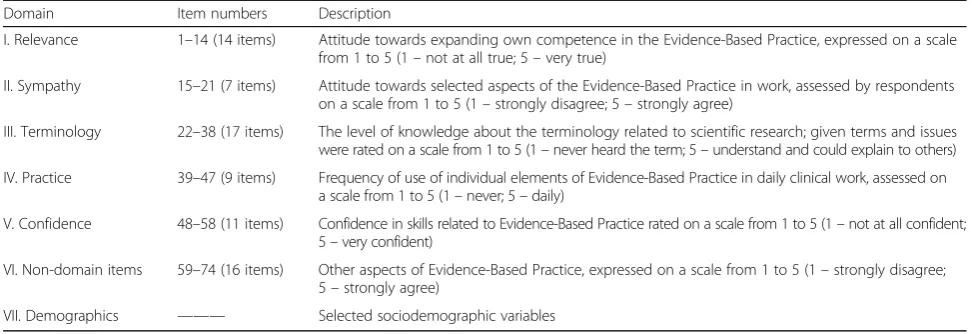
The original EBP2Q consists of 58 statements (all based on a five-point Likert scale), allowing the assessment of five domains (Relevance, Terminology, Confidence, Prac-tice, and Sympathy) by the respondent. It is supple-mented with additional questions necessary for the sociodemographic characteristics of respondents. In addition, the EBP2Q contains 16 statements, which have not been assigned to any of the five domains in the course of validation (Table 1).
The authors of the present study obtained the agree-ment of the authors of the original EBP2Q to use the tool in the studies conducted by the Medical University of Warsaw. The EBP2Q in the form proposed by McEvoy et al. [16] was translated into Polish by two in-dependent translators. Review and comparison of the two translations by the authors and a bilingual expert in nursing demonstrated their close similarity. The agreed version of the Polish translation was not subjected to re-verse translation, and therefore, the final version of the questionnaire was not tested on bilingual people. The form of the agreed Polish version of the EBP2Q is in-cluded in Additional file 1.
Data collection
the Higher Vocational School in Kalisz (N= 462); and (3) nurses working in municipal and clinical hospitals in Warsaw, Pruszkow, and Chelm (N= 304). The study was conducted from March to June 2014. Participation in the study was voluntary and anonymous. Results were collected using an auditorium questionnaire, in which respondents were gathered in a single room at the hos-pital to complete self-administered questionnaires and the completed questionnaires were subsequently pooled.
Methods of psychometric analysis
EBP2Q validation was carried out in reliance on recom-mendations proposed by Downing [23] and Sullivan [24]. To evaluate the psychometric properties of the EBP2Q, an analysis of reliability, validity, and unidimensionality of the five selected domains was performed. To assess the reli-ability of the EBP2Q, analysis of the internal consistency of the given domain was applied, using the formula proposed by Cronbach [25]. According to Nunnally’s criterion [26], a reliability threshold level with a Cronbach’s alpha greater than 0.70 was considered acceptable. To assess the intras-cale compatibility of particular statements, the correlation matrix was determined, and the value of r> 0.30 was assumed the criterion for consistency [27].
The test-retest reliability was assessed in a group of 160 students who were retested using the EBP2Q follow-ing a 2-week interval. Absolute stability was measured by calculating the weighted kappa coefficient and the intra-class correlation coefficient (ICC) that determine the level of consistency of answers given between the first and the second measurement [24]. To establish a correct test-retest analysis, the assumption of equal means in two measurements was checked using the t test [27]. The criteria for the assessment of the test-retest reliability were analogous to those used for valid-ation of the English version of the EBP2Q [16].
The validity of EBP2Q was assessed using three differ-ent analytical approaches. First, estimation of theoretical validity, also known as the internal validity, was per-formed by exploratory factor analysis. In particular, we explored whether the factor structure of the EBP2Q con-sists of five domains. Two different factor analysis cri-teria were used: (1) the Kaiser criterion, based on the number of factors with eigenvalues over one [28]; and (2) the Cattell’s criterion, based on extracting the num-ber of factors from the steep curve of the scree plot [29]. Both criteria were used as the Kaiser criterion can result in overestimating the number of factors (especially with the large number of items in the EBP2Q), while the more conservative approach based on the scree plot gives more reliable results [30]. The fulfillment of assumptions for factor analysis was evaluated, the degree of homogen-eity of variance was estimated, the determinant of the cor-relation matrix and the Kaiser-Meyer-Olkin (KMO) measure of sampling were determined, and the Bartlett’s test of sphericity was performed. Second, estimation of theoretical validity, based on the determination of the de-gree of correlation between the selected domains of the questionnaire, was assessed. To verify the above assump-tion, the Spearman’s rank correlation coefficient was cal-culated. Third, validity was estimated based on assessment of inter-group differences (discriminative validity). To do so, a comparative analysis of two groups of students was performed. One group took an e-learning EBP course (N= 119) while the control group did not participate in additional EBP classes (N= 207). A detailed training course had been previously published by Panczyk et al. [31]. Thet test was used to compare the groups and Cohen’sdwas de-termined as a measurement of the effect of differences be-tween means. The following criteria were assumed to assess the measured effect size: very strong ≥0.80, strong 0.50–0.79, average 0.49–0.20, and poor <0.2 [32].
Table 1Structure of the EBP2Q with the separate domains and contained statementsa
Domain Item numbers Description
I. Relevance 1–14 (14 items) Attitude towards expanding own competence in the Evidence-Based Practice, expressed on a scale from 1 to 5 (1–not at all true; 5–very true)
II. Sympathy 15–21 (7 items) Attitude towards selected aspects of the Evidence-Based Practice in work, assessed by respondents on a scale from 1 to 5 (1–strongly disagree; 5–strongly agree)
III. Terminology 22–38 (17 items) The level of knowledge about the terminology related to scientific research; given terms and issues were rated on a scale from 1 to 5 (1–never heard the term; 5–understand and could explain to others)
IV. Practice 39–47 (9 items) Frequency of use of individual elements of Evidence-Based Practice in daily clinical work, assessed on a scale from 1 to 5 (1–never; 5–daily)
V. Confidence 48–58 (11 items) Confidence in skills related to Evidence-Based Practice rated on a scale from 1 to 5 (1–not at all confident; 5–very confident)
VI. Non-domain items 59–74 (16 items) Other aspects of Evidence-Based Practice, expressed on a scale from 1 to 5 (1–strongly disagree; 5–strongly agree)
VII. Demographics ——— Selected sociodemographic variables a
all items based on a five-point Likert scale
The original English version of the EBP2
The analysis of unidimensionality of each EBP2Q do-main was performed using principal component analysis. A domain was considered unidimensional if it met the Kaiser criterion [28] (i.e., designated eigenvalues exceeded the value of 1 only once), and if the degree of explanation of variability (i.e., using indicator variables via the first main component) exceeded 40%.
All statistical calculations were performed using the statistical package IBM® SPSS® Statistics, version 23. For all analyses, a P-level of < 0.05 was considered statisti-cally significant.
Results
Analysis of reliability
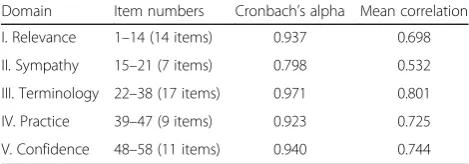
All five domains constituting the EBP2Q met Nunnally’s criterion. Moreover, the mean correlations between indi-vidual statements for the corresponding domains were higher than the recommended value of 0.30. The ana-lysis of each domain, in terms of changes in the value of Cronbach’s alpha coefficient after the removal of individ-ual statements, showed that only the elimination of one domain item (No. 15) caused a slight increase in the value of the coefficient by 0.016 (see Additional file 2, “Reliability”). Details of the results of reliability analysis are presented in Table 2.
The assessment of test-retest reliability shows a good stability of scales in individual domains of the EBP2Q. The assumption concerning the equality of the means for the repeated measurements was fulfilled, and the value ranges of weighted kappas and ICCs for the items were satisfactory (Table 3).
Analysis of theoretical validity
Before we estimated theoretical validity using factor ana-lysis, we verified the fulfillment of the assumptions for this method. No statements showed a standard deviation of zero, and we confirmed the presence of homoscedas-ticity (Levene’s test for equality of variances,P> 0.05). In addition, the value of the determinant of the correlation matrix was close to zero (1.4∙10−28
). Furthermore, the condition for sphericity was fulfilled, as it was found that a correlation coefficients matrix is not an identity matrix (Bartlett’s test of sphericity,P< 0.0001). The last condi-tion of factor analysis was evaluated by the KMO test to
assess the expected reduction rate. Adequacy of sam-pling (KMO index) was 0.949, which fulfills the assump-tions for this parameter (KMO > 0.5).
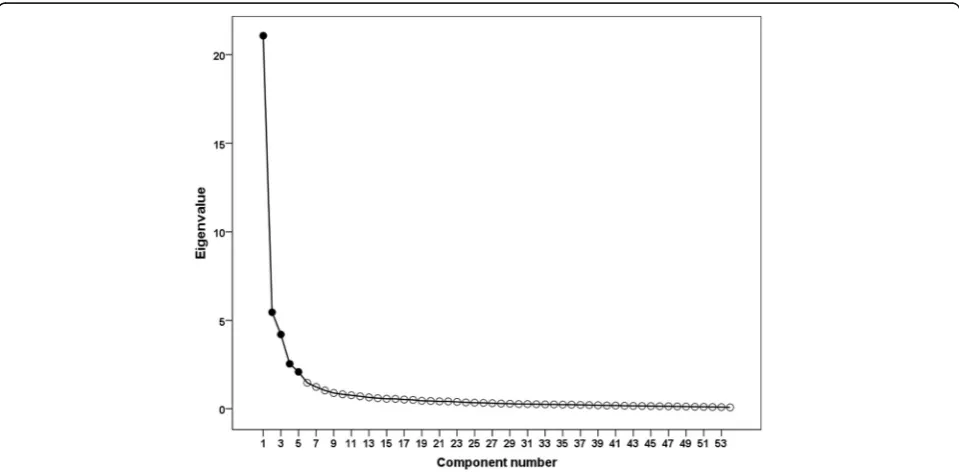
In the first attempt of exploratory factor analysis, 58 statements were distributed in accordance with the Kaiser criterion in eight domains, which was not consist-ent with the concept of the distribution of statemconsist-ents into five domains. However, interpretation of the scree plot (Cattell’s criterion) indicated five domains (Fig. 1). In the next analysis, a 5-factor solution was imposed in accordance with the theoretical assumptions. It turned out that the variables located in five factors explained more than 63% of the total variance.
To facilitate the interpretation of the obtained non-orthogonal solution, direct oblimin rotation of raw factor loadings was performed. The resulting solution largely confirmed the proposed structure of the EBP2Q. All do-mains proved to be theoretically valid. Only item No. 15 from domain II (Sympathy), did not load as expected with other statements of this domain. The result of the rotation indicates that this item belongs to domain I (Relevance) rather than domain II (Sympathy). Detailed summary of the results of the factor analysis for the direct oblimin rotation of loadings are included in Additional file 2,“Factor analysis”.
Theoretical validity of the EBP2Q was also evaluated by calculating the Spearman’s rank correlation coeffi-cients based on the sum of the scores calculated for each of the domains. For domain II (Sympathy), a weak cor-relation with domain I (Relevance, rs= 0.13) was found.
No significant positive correlation with other domains of the EBP2Q was found (Table 4). Particularly good correl-ation coefficients were observed for domain IV with do-main V and for dodo-main III with dodo-main IV. This indicates high criterion validity, which can be expressed as a positive correlation between the “Practice” and “Confidence” (rs= 0.60) and “Practice” and “
Termin-ology”(rs= 0.51).
Analysis of discriminative validity
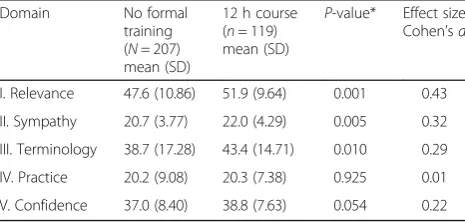
Within three domains (Relevance, Sympathy, and Ter-minology) the mean score of the students participat-ing in the EBP trainparticipat-ing was significantly higher compared with that of the control group students. EBP training had a small to medium effect size on scores within these three domains (Cohen’s d 0.29– 0.43). In the case of domain V (Confidence), however, the difference was on the border of statistical signifi-cance and the effect size was small (P= 0.054, d= 0.22). No significant effect was noted for the students’ score in domain IV (Practice, d= 0.01). The results of the validity assessment using the inter-group differ-ences method are presented in Table 5.
Table 2Reliability of the Polish version of the EBP2Q: Cronbach’s alpha coefficient
Domain Item numbers Cronbach’s alpha Mean correlation
I. Relevance 1–14 (14 items) 0.937 0.698
II. Sympathy 15–21 (7 items) 0.798 0.532
III. Terminology 22–38 (17 items) 0.971 0.801
IV. Practice 39–47 (9 items) 0.923 0.725
Assessment of unidimensionality of domains
Based on a determined structure of the EBP2Q, the uni-dimensionality of domains was evaluated. That is, we assessed whether each domain can be considered unidi-mensional. Using principal component analysis, we veri-fied the eigenvalues and the share of variance explained by the first factor (Table 6). For domains III, IV, and V only one eigenvalue was greater than 1, which, according to Kaiser criterion, demonstrated unidimensionality for each of them. For domains I and II, the second factor in-deed exceeded the limit value of criterion, but the per-centage of explained variance was above the expected threshold of 40%.
Discussion
Although the concept of EBP has been known for de-cades, this concept is not widely known in the Polish nursing and obstetric environment [15]. With the
development of nursing research, and the growing role of the results of these studies in the decision-making process, it has become necessary to implement new edu-cational programs enhancing the qualifications of the personnel. However, if the actions taken in the field of education are to be effective, accurate assessment of the competencies and knowledge of nurses and midwives is necessary. For this purpose, the authors of this study attempted to develop and validate a linguistic adaptation (Polish) of the English EBP2Q (originally developed in Australia) to assess EBP in Poland [16]. This is the first standardized questionnaire in Poland, allowing us to comprehensively assess the knowledge, attitude, and be-havior of students and health care professionals (includ-ing nurses and midwives) in terms of EBP.
As the Polish EBP2Q is intended for use in a diverse group of nurses and midwives, as well as among stu-dents in these fields, a heterogeneous validation sample Table 3Test-retest reliability of the questionnaire
Domain Range of weighted kappas
for items in each domaina Range of ICCs foritems in each domainb Domain ICCs Mean difference 0.95 CI for meandifference P-value ^
I. Relevance 0.35–0.74 0.62–0.89 0.94 0.42 −1.90–1.06 0.577
II. Sympathy 0.22–0.52 0.22–0.67 0.68 0.37 −1.24–0.50 0.405
III. Terminology 0.35–0.80 0.59–0.91 0.97 1.50 −3.28–0.28 0.099
IV. Practice 0.26–0.54 0.43–0.70 0.92 0.84 −2.04–0.36 0.169
V. Confidence 0.25–0.70 0.52–0.85 0.95 0.78 −1.77–0.22 0.125
a
Kappa values≥0.80 were taken to represent excellent agreement, 0.60–0.79 substantial agreement and 0.40–0.59 moderate agreement
b
For ICCs, values more than 0.75 indicated good reliability and less than 0.75 poor to moderate reliability ^
ttest to compare mean differences in two measurements
was chosen. We assume this provides adequate repre-sentation for evaluation of the psychometric parameters of the EBP2Q and its standardization across the various groups [33]. Our psychometric analysis confirmed the strong performance of the EBP2Q. The reliability of the individual domains clearly exceeded the recommended value (Cronbach’s alpha ranged from 0.800 to 0.972) [25, 26]. Our results are similar to those obtained during the validation of the English EBP2Q, in which Cronbach’s alpha ranged from 0.760 to 0.940 [16]. The high reliability of the Polish EBP2Q contributes to a high degree of confidence in the measurement results obtained. This is linked to the low level of random errors, which do not exceed 10–20%. Thus, random fluctuations in test re-sults described in the classical theory of psychometric tests do not reduce the value of alpha in this case [34].
The results of the test-retest reliability analysis were also similar to those obtained during the validation of the original version of the EBP2Q. Both the values of the ICCs (the Polish version: 0.68–0.97 versus the English version: 0.77–0.94) and the differences between the means (the Polish version: 0.42–1.50 versus the English version:−1.07–0.52) for the repeated measurements in individual domains of the EBP2Q were comparable to the results of the test-retest analysis published by McEvoy et al. [16]. The results for some statements making up the domains were slightly worse. Slightly lower values were observed for the lower limits of the range of weighted kappas compared with the values for
the original version of the questionnaire. However, due to the lack of detailed data from the test-retest analysis performed by McEvoy et al. [16], it is hard to assess whether the lower repeatability (weighted kappas ~0.40) for some statements in both validation tests concerned the same items. To summarize the assessment of the test-retest reliability, the Polish version of the EBP2Q ap-pears to have good parameters of absolute stability. This means that the results of the measurements in the indi-vidual domains of the EBP2Q show limited sensitivity to random changes [35].
Measurement results for the individual statements of the EBP2Q obtained during the psychometric evaluation indicate a fairly high degree of similarity in the scope of tested knowledge and attitudes among study partici-pants. We found a small degree of variation in the validation group, which indicates high uniformity in measured traits (SD ranged from 0.81 to 1.38). These re-sults are similar to those obtained by McEvoy et al. [16]. Similar results were also observed in relation to the mean score obtained by respondents for individual items of the questionnaire, and the absence of a “floor” and “ceiling” effect for the validation of the EBP2Q (extreme mean values for the English version were 1.71 and 4.09 versus 1.63 and 4.11 for the Polish version) (see Additional file 2“floor and ceiling effect”).
The assumptions for the validity assessment by fac-tor analysis were the same as those applied in the validation of the English version of the questionnaire [16]. Both the results of Bartlett’s test of sphericity (P < 0.0001) and the degree of expected reduction KMO index for the English version 0.92 versus 0.95 for the Polish version) were similar in both studies [16]. The domain structure of the Polish EBP2
Q was found to be largely consistent with the validated English ver-sion. We only observed variability in domains I and II (Relevance and Sympathy). This is probably related to a different organization of the work environment and a slightly different scope of competencies of nurses in Poland and Australia. Generally, despite some differences, the results of analysis of the theor-etical validity confirm a high degree of accordance Table 4Correlation between the results for the individual domains:
Spearman’s rank correlation coefficients
Domain
I II III IV V
I. Relevance —— 0.13 0.49 0.45 0.49
II. Sympathy 0.13 —— −0.02* −0.02* 0.05*
III. Terminology 0.49 −0.02* —— 0.51 0.47
IV. Practice 0.45 −0.02* 0.51 —— 0.60
V. Confidence 0.49 0.05* 0.47 0.60 ——
*Correlation coefficients not statistically significant (P> 0.05)
Table 5Comparison of scores obtained in EBP2Q - 12 h e-learning course group vs. control group
Domain No formal
training (N= 207) mean (SD)
12 h course (n= 119) mean (SD)
P-value* Effect size Cohen’sd
I. Relevance 47.6 (10.86) 51.9 (9.64) 0.001 0.43
II. Sympathy 20.7 (3.77) 22.0 (4.29) 0.005 0.32
III. Terminology 38.7 (17.28) 43.4 (14.71) 0.010 0.29
IV. Practice 20.2 (9.08) 20.3 (7.38) 0.925 0.01
V. Confidence 37.0 (8.40) 38.8 (7.63) 0.054 0.22
*ttest to compare mean values
Table 6The share of variance explained by first principal component analysis
Domain Kaiser criteriona The share of variance
explained by the first principal component (%)
I. Relevance 7.82; 1.91 55.84
II. Sympathy 3.26; 1.13 46.57
III. Terminology 11.63; 0.95 68.41
IV. Practice 5.61; 0.72 62.30
V. Confidence 6.95; 1.00 63.18
a
between the planned Polish and validated English EBP2Q in evaluating the knowledge and attitudes to-ward EBP.
The theoretical validity of the Polish EBP2Q also con-firms the high quality of the measurement tool. Results of respondents, calculated as the sum of the scores ob-tained for the individual domains, were positively corre-lated with each other. The exception was domain II (Sympathy), which is associated with the design of the items constituting this domain. In particular, some of the items within domain II directly overlap with those found in domain I (Relevance) and were similar to those found in all other domains. It can therefore be assumed that the individual intercorrelations for the EBP2Q com-ponents confirm the fulfillment of the condition of theor-etical validity. Therefore, some theortheor-etical assumptions related to the construction of the EBP2Q were confirmed by empirical observation, and the functioning of the Polish version is similar to the English EBP2Q.
Regarding the assessment of discriminative validity, the validation tests slightly differed across studies in how they were performed. For the original version of the EBP2Q, McEvoy et al. [16] proposed comparing the scores obtained in three different groups of respondents. The control group was compared with two groups dif-fering in duration and form of EBP training. In the pre-sented Polish validation of the EBP2Q, two groups were compared (the“no formal training”control group versus the e-learning group). For both tests, significant differ-ences between the groups concerned the results of the measurements in domains I and III (Relevance and Terminology). As expected, both tests also showed no significant training effect on the results achieved in do-main IV (Practice). The differences in the assessment of discriminative validity relating to domain V (Confidence) may be connected with different durations of EBP train-ing in the validation tests. The method of conducttrain-ing the EBP training is crucial to its effectiveness. Therefore, variations in training programs, including their duration (the Polish version: 12 h versus the English version: ≥20 h) and form (the Polish version: e-learning versus the English version: EBP course as part of university education), may have significantly contributed to the ob-served differences.
The last element of psychometric assessment of the Pol-ish EBP2
Q was evaluation of unidimensionality of individ-ual domains. As in the case of validity analysis, these results confirm the factor homogeneity of all the domains, with the exception of domains I and II. In particular, domain II was highly heterogeneous, which directly refers to the re-sults of the evaluation of criterion validity parameter. As mentioned above, this may result from potential differences between Poland and Australia in terms of working condi-tions and professional competence of nurses or midwives.
The unambiguous results of the psychometric analysis of the Polish version of the EBP2Q allow us to assume that it can be used in practice as a tool for assessing the EBP-related competence of students and practitioners in the nursing or midwifery profession. The EBP2Q is a tool for measuring the knowledge, attitudes, and behav-ior of subjects in the field of EBP. The results of this as-sessment can be used to diagnose the barriers that hinder the implementation of EBP in the workplace. Moreover, the EBP2Q can be successfully used by the participants of courses to upgrade their skills in the field of EBP, both as an element of self-assessment, as well as a tool for measuring learning outcomes. The question-naire can be also used when designing individual educa-tional programs, indicating those areas of knowledge and skills to which particular attention should be paid in the learning process. Furthermore, the modular nature of the EBP2Q is its undoubted advantage. In particular, the tool can be adjusted to the needs of an individual test by using only selected domains.
The EBP2Q, as any tool, has some drawbacks. One of them is the impossibility to assess a subject’s use of other types of evidence than scientific. Making clinical decisions on the basis of non-scientific evidence, per-sonal experience, tradition or intuition is contrary to the EBP concept. The knowledge of subjects’attitudes to the use of non-scientific evidence in medical practice could boost the measurement validity. Another important drawback of the EBP2Q pertains to domain III (Termin-ology). This domain relates to the knowledge of certain terms connected with methodology of scientific research, but it includes only the knowledge around quantitative based terms and excludes terms connected with qualita-tive research.
One of the significant limitations of the present study is the lack of convergent validity analysis, it was not possible to determine this psychometric property due to the lack of another Polish tool avail-able for evaluating similar domains to the EBP2Q. In addition, further validation studies should assess the diagnostic ability of the Polish EBP2Q, by performing research using the tool in educational situations (i.e., pre- and post-test).
Conclusions
Additional files
Additional file 1:Evidence-Based Practice Profile (EBP2) Questionnaire. Polska wersja językowa kwestionariusza. (PDF 830 kb)
Additional file 2:Data analysis. (XLSX 26 kb)
Abbreviations
EBP:Evidence-based practice; EBP2Q: Evidence-based practice profile questionnaire; ICC: Intra-class correlation coefficient; KMO: Kaiser-Meyer-Olkin
Acknowledgements
Language and editing support was provided by Proper Medical Writing Sp. z o.o. The authors want to thank Dr Barbara Kot-Doniec, the Director of the Center for Postgraduate Education of Nurses and Midwives in Warsaw, for realization of this study.
The authors want to thank all nurses that participated in this study.
Funding
There were no external funds in financing this study.
Availability of data and materials
The English version of datasets generated and/or analyzed during the current study available from the corresponding author on reasonable request. The original English version of the EBP2Q is available at: http:// www.biomedcentral.com/content/supplementary/1472-6920-11-100-s1.pdf
Authors’contributions
MP, JB, and JG contributed to the original conception and design of the survey, and final revision of the manuscript for important intellectual content. JB and AZ designed and contributed to the construction of scale and variables.ŁS, HŻT and JG contributed to the organization of the survey and data collection. MP made the psychometric analysis of the data. MP and JB contributed to interpretation of the data. MP wrote the first draft of the manuscript with revisions by JG. All authors read and approved the final manuscript.
Competing interests
The authors declare that they have no competing interests, no relationship or financial dependence to any organization or any person having a direct financial contribution in the subject of research or materials examined in this work (e.g., through employment, consultancies, stock ownership, honoraria).
Consent for publication
Not applicable.
Ethics approval and consent to participate
The authors sought advice from the Bioethics Committee of Medical University of Warsaw to conduct the presented study. As the“commission does not issue opinions on the survey, retrospective and other non-invasive scientific studies”, ap-proval was not required. Informed consent was obtained verbal from every partici-pant from whom data was collected upon completion of the questionnaire.
Author details 1
Division of Teaching and Outcomes of Education, Faculty of Health Science, Medical University of Warsaw,Żwirki i Wigury 61, 02-091 Warsaw, Poland.
2
Division of Clinical Nursing, Faculty of Health Science, Medical University of Warsaw, Erazma Ciołka 27, 01-445 Warsaw, Poland.3Centre of Postgraduate
Education for Nurses and Midwives in Warsaw, Adolfa Pawińskiego 5A, 02-106 Warsaw, Poland.
Received: 16 August 2016 Accepted: 3 February 2017
References
1. Upton D, Upton P, Scurlock-Evans L. The reach, transferability, and impact of the Evidence-Based Practice Questionnaire: a methodological and narrative literature review. Worldviews Evid Based Nurs. 2014;11(1):46–54. 2. Brown CE, Wickline MA, Ecoff L, Glaser D. Nursing practice, knowledge, attitudes
and perceived barriers to evidence-based practice at an academic medical center. J Adv Nurs. 2009;65(2):371–81.
3. Heydari A, Mazlom SR, Ranjbar H, Scurlock-Evans L. A study of Iranian nurses’and midwives’knowledge, attitudes, and implementation of evidence-based practice: the time for change has arrived. Worldviews Evid Based Nurs. 2014;11(5):325–31.
4. Melnyk BM, Fineout-Overholt E. Evidence-based practice in nursing & healthcare: A guide to best practice. London: Lippincott Williams & Wilkins; 2011. 5. McEvoy MP, Williams MT, Olds TS. Evidence based practice profiles:
differences among allied health professions. BMC Med Educ. 2010;10:69. 6. Glasziou P, Burls A, Gilbert R. Evidence based medicine and the medical
curriculum. BMJ. 2008;337:a1253.
7. Dawes M, Summerskill W, Glasziou P, Cartabellotta A, Martin J, Hopayian K, Porzsolt F, Burls A, Osborne J. Sicily statement on evidence-based practice. BMC Med Educ. 2005;5(1):1.
8. Majid S, Foo S, Luyt B, Zhang X, Theng YL, Chang YK, Mokhtar IA. Adopting evidence-based practice in clinical decision making: nurses’perceptions, knowledge, and barriers. J Med Libr Assoc. 2011;99(3):229–36.
9. Solomons NM, Spross JA. Evidence-based practice barriers and facilitators from a continuous quality improvement perspective: an integrative review. J Nurs Manag. 2011;19(1):109–20.
10. Blenkinsop C. Research: an essential skill of a graduate nurse? Nurse Educ Today. 2003;23(2):83–8.
11. Callister LC, Matsumura G, Lookinland S, Mangum S, Loucks C. Inquiry in baccalaureate nursing education: fostering evidence-based practice. J Nurs Educ. 2005;44(2):59–64.
12. Tilson JK, Kaplan SL, Harris JL, Hutchinson A, Ilic D, Niederman R, Potomkova J, Zwolsman SE. Sicily statement on classification and development of evidence-based practice learning assessment tools. BMC Med Educ. 2011;11:78. 13. Johnston JM, Leung GM, Fielding R, Tin KY, Ho LM. The development and
validation of a knowledge, attitude and behaviour questionnaire to assess undergraduate evidence-based practice teaching and learning. Med Educ. 2003;37(11):992–1000.
14. Oude Rengerink K, Thangaratinam S, Barnfield G, Suter K, Horvath AR, Walczak J, Welminska A, Weinbrenner S, Meyerrose B, Arvanitis TN, et al. How can we teach EBM in clinical practice? An analysis of barriers to implementation of on-the-job EBM teaching and learning. Med Teach. 2011;33(3):e125–30.
15. Gotlib J, Belowska J, Panczyk M, Dykowska G, Wójcik G. Evidence-based Medicine and Evidence-based Nursing Practice—a review of the Polish scientific literature. Nursing Topics. 2014;22(2):223–7.
16. McEvoy MP, Williams MT, Olds TS. Development and psychometric testing of a trans-professional evidence-based practice profile questionnaire. Med Teach. 2010;32(9):e373–80.
17. Adams S, Barron S. Development and testing of an evidence-based practice questionnaire for school nurses. J Nurs Meas. 2010;18(1):3–25.
18. Upton D, Upton P. Development of an evidence-based practice questionnaire for nurses. J Adv Nurs. 2006;53(4):454–8.
19. Ruzafa-Martinez M, Lopez-Iborra L, Madrigal-Torres M. Attitude towards Evidence-Based Nursing Questionnaire: development and psychometric testing in Spanish community nurses. J Eval Clin Pract. 2011;17(4):664–70. 20. Gerrish K, Ashworth P, Lacey A, Bailey J, Cooke J, Kendall S, McNeilly E.
Factors influencing the development of evidence-based practice: a research tool. J Adv Nurs. 2007;57(3):328–38.
21. Ruzafa-Martinez M, Lopez-Iborra L, Moreno-Casbas T, Madrigal-Torres M. Development and validation of the competence in evidence based practice questionnaire (EBP-COQ) among nursing students. BMC Med Educ. 2013;13:19. 22. Shaneyfelt T, Baum KD, Bell D, Feldstein D, Houston TK, Kaatz S, Whelan C,
Green M. Instruments for evaluating education in evidence-based practice: a systematic review. J Am Med Assoc. 2006;296(9):1116–27.
23. Downing SM. Validity: on meaningful interpretation of assessment data. Med Educ. 2003;37(9):830–7.
24. Sullivan GM. A primer on the validity of assessment instruments. J Grad Med Educ. 2011;3(2):119–20.
25. Feldt L. A test of the hypothesis that Cronbach’s alpha or Kuder-Richardson coefficent twenty is the same for two tests. Psychometrika. 1969;34(3):363–73. 26. Nunnally JC, Bernstein IH. Psychometric theory (3rd ed.), vol. 226. New York:
McGraw-Hill; 1967.
27. Jankowski K, Zajenkowski M. Methods for estimating the reliability of the measurement with the test. In: Fronczyk K, editor. Psychometrics - basics. Warszawa: Vizja Press & IT; 2009. p. 84–110.
29. Cattell RB. The Scree Test For The Number Of Factors. Multivariate Behav Res. 1966;1(2):245–76.
30. Osborne JW, Costello AB. Best practices in exploratory factor analysis: Four recommendations for getting the most from your analysis. Pan-Pacific Management Review. 2009;12:131–46.
31. Panczyk M, Belowska J, Zarzeka A, Gotlib J. Evaluation of learning outcomes at the Nursing Department in the field of Evidence-Based Medicine with the use of an e-learning Moodle™platform. Nursing Topics. 2015;23(3):306–13. 32. Cohen J. Statistical power analysis. Curr Dir Psychol Sci. 1992;1(3):98–101. 33. Bedyńska S, Cypryańska M. Advanced ways to create indicators: the use of
factor analysis and reliability analysis of the items. In: Bedyńska S, Brzezicka A, editors. Statistical signpost: Practical guide of data analysis in the social sciences. Warsaw: SWPS Academica Publishing House; 2007. p. 134–61. 34. Guilford JP. Psychometric methods. 2nd ed. New York: McGraw-Hill; 1954. 35. Weir JP. Quantifying test-retest reliability using the intraclass correlation
coefficient and the SEM. J Strength Cond Res. 2005;19(1):231–40.
• We accept pre-submission inquiries
• Our selector tool helps you to find the most relevant journal • We provide round the clock customer support
• Convenient online submission • Thorough peer review
• Inclusion in PubMed and all major indexing services • Maximum visibility for your research
Submit your manuscript at www.biomedcentral.com/submit