http://www.sciencepublishinggroup.com/j/pst doi: 10.11648/j.pst.20180202.12
ISSN: 2640-4532 (Print); ISSN: 2640-4540 (Online)
The Effect of Maternal Policy and Educational Programs on
Maternal Mortality in Ghana: A Case Study of Ho
Municipality
Dovlo Michael, Yunus Abdul Karim
Department of Statistics, University of Cape Coast, Cape Coast, Ghana
Email address:
[email protected] (M. Dovlo), [email protected] (A. K. Yunus)
To cite this article:
Dovlo Michael, Yunus Abdul Karim. The Effect of Maternal Policy and Educational Programs on Maternal Mortality in Ghana: A Case Study of Ho Municipality. Pharmaceutical Science and Technology. Vol. 2, No. 2, 2018, pp. 14-20. doi: 10.11648/j.pst.20180202.12 Received: October 5, 2018; Accepted: November 9, 2018; Published: December 17, 2018
Abstract:
This work sought to assess the impact of reducing maternal mortality through policy and educational programs in Ghana (Case study of Ho Municipality). specific objectives are assess the educational level of the maternal mother in the Ho municipality, assess the trend of maternal mortality in Ho municipality, comparing the mortality figures of the Ho municipality to that of the region, determine the factors that discourage the maternal mothers from attending antenatal care and assess whether antennal attendance depend on the awareness of maternal programs and policies. A sample of 385 maternal mothers was convenience selected for the study. Both descriptive and inferential statistics were computed. Results revealed that antenatal educational programs influence antenatal attendance among pregnant women. The study also reveals that time spend at the clinic or hospital and the attitudes of some of the health workers appears to be the major factors that discourage maternal mother from attending antenatal care whiles cost of transportation and the distance to the hospital was a problem for maternal mother coming from the rural areas. It was however recommended that health facilities should organize public education for maternal mothers that cannot read and write in the villages about pregnancy and self-medications. Public address system should be provided to the villages that do not have access to radio sets and electricity. The programs and policies should be design in different local languages apart from the English for easy and faster understanding.Keywords:
Maternal, Mortality, Educational Programs1. Introduction
1.1. Background of the Study
Maternal mortality has been a problem to the world as large as the maternal death keep increasing in some countries. Ghana as a country has made a tremendous progress after the implementation of the Millennium Development Goals set by the United Nations Agency for Health and other organizations to reduce maternal death. Although was Ghana commended for making progress, the country was not able to meet the target for Millennium Development Goals (MDG) 5, which is reducing the maternal mortality ratio (MMR) by three quarters between 1990 and 2015. [1].
According to research report, the maternal mortality rate (MMR) is the annual number of female deaths per 100,000
live births from any cause related to or aggravated by pregnancy or its management (excluding accidental or incidental causes). [2] The MMR includes deaths during pregnancy, childbirth, or within 42 days of termination of pregnancy, irrespective of the duration and site of the pregnancy, for a specified year. On January, 1 2014, CIA World Fact book ranked Ghana to be the 32nd country recording maternal death of 350 deaths/100,000 live births out of 184 countries in the world. For which South Sudan the highest death of 2054 deaths/100,000 live births whiles countries like Germany, Australia, Israel, Netherland, Spain, Japan, Italy, Austria, Greece all recorded maternal mortality below 8 deaths/100,000 live births.[2]
new report released by ‘Trends in maternal mortality: 1990 to 2013’ a Maternal Mortality Estimation Inter-Agency Group (MMEIG) of the United Nations (UN), while the country’s MMR had reduced from 760 in 1990 to 380 in 2013, there remains a substantial amount of effort to reach the MDG 5 target of 185 deaths per 100,000 live births. The report indicated that 3,100 women died from pregnancy-related complications in Ghana between January and December 2013. It however pointed that despite the high maternal deaths recorded, Ghana is considered as one of the countries in Sub-Saharan Africa ‘making progress’ towards the MDG 5 target. The Maternal Health Advisor of the MamaYe Campaign in Ghana, Dr Sylvia Deganus, expressed delight that the rate of Skilled Attendant at Birth (SAB) to delivery cases had gone up from 60.3 percent in 2010 to 63.1 percent. [3]
Understanding of these policies and programs will largely depend on the literacy rate of that country. According to CIA World Fact book literacy is age 15 and over that can read and write, as at (2015 est) Ghana’s literacy was 76.6% of the total population of 26,327,649 for which 82% were male and 71.4% for female [2]. This shows that female’s education needs to be enhanced for easy understanding of the policies and programs very well to reduce high risks implications during pregnancy within the region.
1.2. Problem Statement
Assessing the impact of reducing maternal mortality policy and educational programs in Hodespite the fact that there is policy and maternal mortality educational programs to reduce the large number of pregnant women that die every day all over the world as a result of abortion, chronic diseases, delay in attending hospital during pregnancy, shortage of health workers, malaria in pregnancy, delay by the health providers in discharging of their duties, It appears that these maternal policies and educational programs are not well interpreted to the public effectively for Ghana as member country to meet the millennium development goal 5 on maternal health by 2015 as compare to other countries, despites the free national health insurance for the pregnant women to have access to healthcare free of charge this was not achieved. According to a study preventing and treating malaria in pregnancy can be a key intervention to improve maternal, foetal and child health globally and is linked to three of the Millennium Development [4]. Although a researcher conducted a study related to the topic but focused on maternal mortality in Ghana [5]. This implies that a research gap exists.
This study therefore seeks to fill this gap by establishing the effect of maternal policy and educational programs on maternal mortality in Ghana.
1.3. Objectives of the Study
The main objective of this study is to find out the effects of the policies and educational programs in reducing maternal mortality in Ghana
Specifics objectives are
(1)Assess the educational level of the maternal mother in
the Ho municipality.
(2)Assess the trend of maternal mortality in Ho municipality.
(3)Comparing the mortality figures of the Ho municipality to that of the region.
(4)Determine the factors that discourage the maternal mothers from attending antenatal care
(5)Assess whether antennal attendance depend on the awareness of maternal programs and policies.
1.4. Significance of the Study
The study will assessed the impact of the public whether the implementation of healthcare policies and programs to reduce the maternal mortality as the millennium development goal 5 set to be achieve by 2015 is achieved by the Ho municipality. The recommendation will also enable us to find out new strategies of educating the public on implemented healthcare policies and other programs and policies for the country to meet its target.
2. Literature Review
2.1. Antenatal Attendance
This refers to expectant mothers seeking antenatal care from a health facility during the pregnancy period. The ante-natal clinic provide to expectant mother includes pregnancy test, blood pressure check, the testing of urine and blood samples, counselling vaccinations, provision iron supplements and ante-malaria prophylaxis tablets and distribution of insecticide treated net among others.
2.2. Some Causes of Maternal Mortality
Restricting treatment to symptomatic pregnant women is an inadequate strategy to reduce the morbidity and mortality associated with malaria [6]. According to a research report, Haemorrhage, Anaemia, Obstructed Labour, Abortion and Hypertensive Disorders contribute to maternal mortality [5]. Shortage of health workers in the country’s health Centre’s and this is mainly due to the migration of Ghanaian health staff [7].
2.3. Free Maternal Care Policy by the National Health Insurance Authority (NHIA)
2.4. Maternity Care Packages for the Maternal Mothers by National Health Insurance Company
(1)Antenatal care
(2)Deliveries (normal and assisted) (3)Caesarean section
(4)Post-natal care
Categories of payment by members under the health insurance scheme, the below table clearly shows that pregnant women are fully covered by the policy.
Figure 1. Categories of payment by members under the Health Insurance Scheme [8].
The main objective of the free maternal health care is to improve the quality of health care for pregnant women and the evaluation found out that quality of care – before and after – should be an area of concern [9]. The evaluation clearly showed that quality of clinical care was consistently poor and was not affected by the implementation of the exemption policy [10].
2.5. Strategies and Programs on Maternal Health in Ghana
Several initiatives within the health sector are utilized to provide health care services and other assistance to pregnant women. These include the Regenerative Lifestyle and Nutrition Program (RLNP), High Impact Rapid Delivery (HIRD), and Community-based Health Planning and Services (CHPS). RLNP focuses on non-communicable diseases such as obesity and hypertension, and maternal and child health. It identifies trains and supports change agents at the community level to communicate healthy lifestyle messages to promote services and health-seeking behaviour. The HIRD program promotes high-priority, cost-effective interventions to improve maternal and child health at the district level. This program provides specific funding for service delivery with an aim to increase focus on and funding for reproductive and child health services by DHMTs. CHPS is a strategy that aims to increase access to maternal and child health services. CHPS refers to a specific process for moving health services into underserved areas through community mobilization. Community leaders and volunteers cooperate to mobilize resources and labour to construct a simple health facility known as a Community Health Compound (CHC), consisting of space for a clinic and living quarters for a health care provider. CHCs are staffed by
Community Health Officers (CHOs), who are nurses trained specifically for this role [11].
3. Methodology
3.1. The Research Design
The study uses cross sectional design; this has been used because data on maternal mothers was taken approximately at the same time period in different locations. It is a positivistic methodology design to obtain information on variables in different context but at the same time [12].
3.2. Description of Study Area
Ho municipality lies between latitudes 60 207N and 60 55 N and longitudes 00 127 E and 00 53 E and covers an area of 2.660 sq km. The Municipality shares boundaries with the Adaklu-Anyigbe District to the south, Hohoe Municipal to the North, South-Dayi District to the West and the Republic of Togo to the East. By location, Ho Municipality can have economic co-operation with neighbouring Districts. The Ho regional Capital of Volta Region. This of course, makes it the largest urban Centre in the region.
3.3. Sampling Procedures
Data collection for this study was done using a non-probabilistic sampling technique, precisely convenience sampling.
3.4. Sample Size Determination
According to a study [13], this formula can be use when the population size is unknown or more than 10,000.
Scott formula;
_ 1
Where:
Z_score = critical value for confidence level from a normal distribution (95% confidence level = 1.96)
Sd= standard deviation (0.5). 0.5 is use because it is the most forgiving number and ensures that our sample size is large
Error margin = 0.05 and n = required sample size
. . .
. 384.16≅ 385
Based on the computation above, the appropriate sample size selected for the study was 385. However, to account for attrition, the subject was increased to 390.
3.5. Data Collection
Municipal hospital. Both primary and secondary data was used. The primary data was directly collected from maternal mothers on the field whiles the secondary data was collected from the Ho regional health Directorate.
3.6. Data Analysis
The data was captured using statistical packages for social sciences (SPSS). The data analysis was done by utilizing both quantitative and qualitative analysis techniques. The study conducted the data analysis using the application of Microsoft excel and SPSS software version 16.0. Both descriptive and inferential statistics were generated during the analysis.
4. Data Analysis
This chapter is composed of two parts; the preliminary analysis and the further analysis. The preliminary stage covers the summary statistics of the data and analysis of variance.
Table 1. Age group vrs Education Level.
Educational level
BASIC JHS SHS Tertiary Total
Age group
<18 0 0 1 0 1
18-22 2 28 25 11 66
23-27 10 32 46 52 140
28-35 6 36 37 72 151
36+ 7 10 4 6 27
Total 25 106 113 141 385
From the table 1: above, it could be observed that majority of the respondents are literate with only 6.5% having basic education. 75.6% of the majority were ages between 23 – 35 years whiles 17.1% of the maternal mothers were also between 18 – 22 years of age. This could mean that pregnant women below 18 years do not attend antenatal care because of unaware of pregnancy implications and reliance of antenatal care since at the time of the study only one pregnant woman were covered.
Table 2. Medium of delivering of message vrs Awareness.
Is there any programs/ policies to reduce maternal mortality
Yes No No idea Total
Through which medium do you normally hear these programs and policies
only on Television Count 37 0 0 37
% within 100.0% 0.0% 0.0% 100.0%
only by Radio Count 106 1 0 107
% within 99.1% 0.9% 0.0% 100.0%
Posters Count 34 0 0 34
% within 100.0% 0.0% 0.0% 100.0%
only at the Hospitals/clinic Count 61 0 0 61
% within 100.0% 0.0% 0.0% 100.0%
both Television and Radio Count 99 0 0 99
% within 100.0% 0.0% 0.0% 100.0%
Non – response Count 0 1 46 47
% within 0.0% 2.1% 97.9% 100.0%
Total Count 337 2 46 385
% within 87.5% 0.5% 11.9% 100.0%
For a country to have positive impact of maternal educational programs and policies in reducing maternal mortality, the country must largely consider the kind of medium to be used. From table 2 the study indicated that majority 87.5% of the respondents reported that they are aware there are some programs and policies to reduce the maternal death in the country whiles 12.5% of the respondents do not have any ideals about the programs and policies. The study shows that these programs and policies are largely channel through radio and televisions stations and to some extent at the hospitals/clinics, and the use of posters.
From the figure 1 the study reveals that majority 72.5% of the respondents do not engage in self medication during pregnancy but about 27.5% of the respondents still engage in self medication during pregnancy. This could means that time spent at the hospitals is too much as compare to the drug stores.
The number times a pregnant woman visit antenatal clinic guarantee the chance of having free delivery. From the figure 2 above it could be observed that about 48.1% of the pregnant women do not attend antenatal care service up to
the stipulated time by the Ghana health service. This could means that pregnant woman do not startantenatal clinic early or do not complete the antenatal clinic
Figure 2. Do you do Self Medication during Pregnancy?
Figure 4. Maternal Mortality Level for the Ho Municipal [14].
Figure 5. Maternal Mortality Level for the Region [14].
Looking at the maternal death rate for both municipal and the regional, it appears to have the same cyclical movement depicting that factors that influence rise or fall in maternal mortality in the regional does not significantly differ from of the municipal figures. It could be observed there was a downward trend in the maternal mortality rate in 2015 compared to the previous years.
From table 3, the mean values 6 and 1 maternal death for the regional and the municipality respectively differ. The two mean are equally good enough, since the standard errors are zero almost the same. The two samples appear to be coming from quite normal population, since their skewness is within the interval of -3 and 3, but having different peakness. However, the sample variance for the regional data is greater than the municipal data. Therefore, in performing the significant test, t – Test: Two – Sample Assuming Unequal Variances would be used instead of t – T: Two - Sample Assuming equal Variances.
Table 3. Descriptive Statistics for Maternal Death for the Regional and the Municipality.
Ho Municipal level Volta regional level
Mean 6 Mean 1
Standard Error 0 Standard Error 0
Median 6 Median 1
Mode 4 Mode 0
Ho Municipal level Volta regional level
Standard Deviation 3 Standard Deviation 1
Sample Variance 8 Sample Variance 2
Kurtosis 3 Kurtosis 1
Skewness 1 Skewness 1
Range 14 Range 5
Minimum 2 Minimum 0
Maximum 16 Maximum 5
Sum 221 Sum 40
Count 36 Count 36
Table 4. T-Test: Two-Sample Assuming Unequal Variances.
Ho Municipal level
Volta regional level
Mean 6 1
Variance 8 2
Observations 36 36
Hypothesized Mean Difference 0
Df 50
t Stat 10
P (T<=t) one-tail 0
t Critical one-tail 2
P (T<=t) two-tail 0
t Critical two-tail 2
the P – value, with a value, 0.00, less than the significant value of 0.05 or the alpha value. There is enough evidence that, the mean rate of maternal deaths in the municipality and in the Volta region for the past three years said to be the same is not true, and should be rejected. This is because there is a significant difference between the mean death rates of the two samples also suggesting that Ho Municipal is not the
major contributor to the higher rate of maternal mortality figures for the Volta Region.
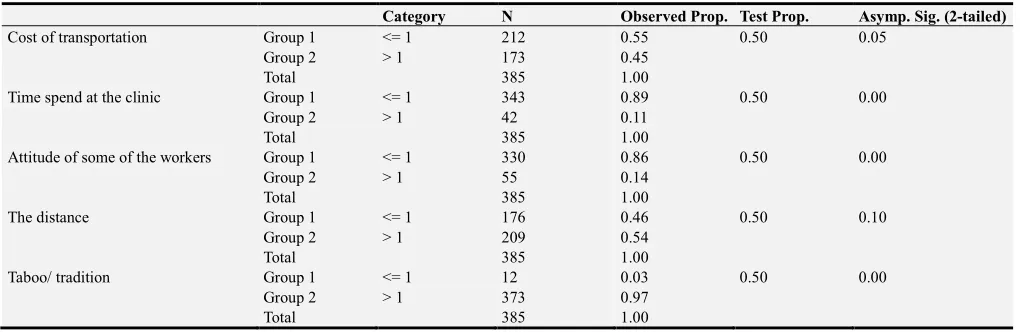
Hypothesis: the proportion of those who agree or disagree is greater or equal to other categories.
For the formulation of the groups, we put agree in group one (1) and disagree into group two (2).
Table 5. Proportion of Maternal Mothers who agree to the five Variables.
Category N Observed Prop. Test Prop. Asymp. Sig. (2-tailed)
Cost of transportation Group 1 <= 1 212 0.55 0.50 0.05
Group 2 > 1 173 0.45
Total 385 1.00
Time spend at the clinic Group 1 <= 1 343 0.89 0.50 0.00
Group 2 > 1 42 0.11
Total 385 1.00
Attitude of some of the workers Group 1 <= 1 330 0.86 0.50 0.00
Group 2 > 1 55 0.14
Total 385 1.00
The distance Group 1 <= 1 176 0.46 0.50 0.10
Group 2 > 1 209 0.54
Total 385 1.00
Taboo/ tradition Group 1 <= 1 12 0.03 0.50 0.00
Group 2 > 1 373 0.97
Total 385 1.00
At the 95% confidence level of 50% proportional value, there are no significant differences between the two categories for cost of transportation and the distance with the significant values of 0.05 and 0.10 respectively. There is no significant difference between the observed proportion and the test proportion for those who agree and disagree. There is a significant difference between the responses of the two categories for “time spend at the clinic or the hospital and “Attitudes of some of the workers indicating that those who agree that the two variables discourages them from attending antenatal care were significantly greater than those disagree
with the statements. Though there is a significant difference between the two categories at this time those who disagree are greater than agree that “Taboo/tradition” discourages them from attending antenatal care.
This could mean that, the cost of transportation and the distance to the hospital can only seem to be a problem for maternal mothers that come from the rural areas in the municipality.
Hypothesis: there is no relationship between awareness of maternal programs and policies and antennal attendance
Table 6. Chi-Square Tests for relationship between awareness of maternal programs and policies and antennal attendance.
Chi-Square Tests Value DF Asymp. Sig. (2-sided)
Pearson Chi-Square 25.175 6 0.00
N of Valid Cases 385
Symmetric Measures Value Sig.
Ordinal by Ordinal Spearman Correlation -0.07 0.16
N of Valid Cases 385
The chi- square test reveals that, at the alpha value of 0.05 as compare to the p – value of 0.00 and degree of freedom of 6, the test is significant and we therefore reject the hypothesis that there is no relationship between awareness of maternal programs and policies and antennal attendance and therefore conclude that the antennal attendance highly depend on the awareness of maternal programs and policies. The symmetric measure part of the table also reveals that, the spearman correlation between the two variables is very weak, approximately 0.1. The amount of relationship between the two variables is 16% of times hold but 84% of the times antennal attendance does not highly depends on the awareness of maternal programs and policies.
5. Findings, Conclusions and
Recommendations
This chapter includes summary of findings, conclusions and recommendations in respect of the objectives of the study.
5.1. Findings
evidence that, the average rate of maternal deaths in the Ho municipality and in the Volta region for the past three years were not the same. The study also reveals that, time spent at the clinics or hospitals and attitude of some of the health workers appears to be the major factors that discourage maternal mothers from attending antenatal care whiles cost of transportation and the distance to the hospital was a problem for maternal mothers coming from the rural areas. About 84% of the times antennal attendance highly depends on the awareness of maternal programs and policies.
5.2. Conclusions
Though there is very good responds about the awareness of reducing maternal mortality programs and policies, based on the finding above, shows that programs and policies do not yet have full positive impact on the attitudes of both maternal mother’s and the service providers.
5.3. Recommendations
The Ho Municipal Assemble should organize public education for maternal mothers that cannot read and write in the villages about pregnancy and self medications. Public address system should be provided to the villages without access to radio sets and electricity. The programs and policies should be design in different local languages apart from the English for easy and faster understanding. The study should be replicated to the other districts and municipals in the Volta region to identify the higher maternal death rate contributing districts or municipals for special attention. There should be free transport for maternal mothers who come from the rural areas in the municipality. Awareness of maternal programs and policies should be increased to increase antenatal attendance.
Limitations of the Study
(1)This study is limited to information gathered from open-ended and close ended interview questions and as such the respondents may be bias with the information provided.
(2)This study is limited to the maternal mothers who attended the antennal care clinic and may not be suitable for generalization beyond them
(3)This study is delimited to maternal mothers who start antennal before the month of April and not the entire months of the year.
Suggestions for Further Research
In order to proof the validity of the recommendations to reduced maternal mortality in the municipality, it is advisable
to evaluate the kind of life styles of the maternal mothers, treatments maternal mothers experience in individual homes and villages during pregnancy in order to find out the most suitable solutions for high rate of maternal deaths in the country, since this study only focused on the impact of programs and policies aimed at reducing maternal mortality in the country.
References
[1] World Health Organization (2008), Factsheet: Millennium Development Goal 5. World Health Organization.
[2] CIA World Fact Book
(http://www.indexmundi.com/ghana/maternal_mortality_ rate.html (Accessed 2016 March 13).
[3] Millennium Development Goals reported by Daily Guide
Ghana -May 15, 2014
http://newsghana.com.gh/author/dailyguide.com (Accessed 2016 March 13).
[4] Filippi V, Ronsmans C, Campbell O. M, Graham, W. J., Mills, A., Borghi, J., & Osrin, (2006)Maternal health in poor countries: the broader context and a call for action. Lancet. 2006 Oct 28; 368 (9546): 1535-41.
[5] Senah, K. (2003), Maternal Mortality in Ghana: The Other Side. Institute of Africa Studies: Research Review.
[6] Nosten F, McGready R, Mutabingwa T; Case management of malaria in pregnancy. Lancet Infect Dis. 2007 Feb; 7(2): 118-25.
[7] Ghana web “How is Ghana Dealing with Maternal Mortality”by Mensah T. Robert Feature Article on Ghana web Saturday, 23 April 2010 (Accessed 2016 March 13.
[8] National Health Insurance Authority (NHIA) http:/www.nhis.org (Accessed 2016 March 13).
[9] Bosu, W. K., Bell, J., Armar-Klemesu, M., & Tornui, J. (2007). “Effect of delivery care user fee exemption policy on institutional maternal deaths in the Central and Volta Regions of Ghana”. Ghana medical journal 41. 3.
[10] Ofori-Adje, D (2007). Ghana’s free delivery care policy. Ghana medical journa, 41 (3), 94.
[11] Quansah A. (2013). The Impacts of Free Maternal Delivery Policy on Maternal. Kwame Nkrumah University of Science and Technology, (Master Thesis).
[12] Collis, J. and Roger, H. (2003) Business Research, New York: p.61.
[13] Scott S. PhD, (2013). How to ensure you get the correct sample size; http://www.qualtrics.com/blog/determining sample size.
![Figure 1. Categories of payment by members under the Health Insurance Scheme [8].](https://thumb-us.123doks.com/thumbv2/123dok_us/954819.1594587/3.595.44.286.202.338/figure-categories-payment-members-health-insurance-scheme.webp)

![Figure 4. Maternal Mortality Level for the Ho Municipal [14].](https://thumb-us.123doks.com/thumbv2/123dok_us/954819.1594587/5.595.138.455.84.435/figure-maternal-mortality-level-ho-municipal.webp)