Original Research Article
A study to assess the unmet need for contraception among married
women in the urban field practice area of a medical college
Anupama M.
1, Krishna Iyengar
2*, Rajesh S. S.
2, Ashok Jayaram
3, Venkatesh P.
2INTRODUCTION
India is the second most populous country in the world. Karnataka is the eighth largest state in India in terms of Population. Ever since the family planning (FP) programme was introduced, India’s demographic and health profile has changed radically.1 In the 1965-2009 period, Contraceptive usage has more than quadrupled (from 13% of married women in 1970 to 56% in 2006), and the fertility rate has more than halved(from 5.7 in 1966 to 2.7 in 2006) but the national fertility rate is still high enough to cause long-term population growth. The United Nations estimated that world population grew at an annual rate of 1.23% during 2001-2010 whereas
India’s population grew at 1.64% per annum during 2001-2011.2
The National Population policy (NPP) 2000 states that the immediate objective is to address the unmet need for contraceptive services. The concept of unmet need for family planning points to the gap between some women’s reproductive intentions and their contraceptive behaviour.3 It includes all women who are married and presumed to be sexually active, who will not be using any method of contraception and who either did not want to have any more children or wanted to postpone their next birth for at least two more years.4
ABSTRACT
Background: The concept of unmet need for family planning points to the gap between some women’s reproductive intentions and their contraceptive behaviour. The National Population policy (NPP) 2000 states that the immediate objective is to address the unmet need for contraceptive services. Unintended pregnancy related to unmet need is a worldwide problem that affects women and their families and societies at large.
Methods: A community based cross-sectional study was conducted from November 2016 to October 2017 in Maralur and Maralur Dinne, urban localities under urban health Training Centre of Sri Siddhartha Medical College. 260 Married women (15–49 years) were interviewed by house to house survey. The questionnaire was used to collect data to assess their reproductive intentions and contraceptive behaviour.
Results: Out of 260 participants, 144 (55.4%) of them belonged to the group where their contraceptive needs were met for spacing and limiting births, 59 (22.69%) of them of did not have any need for contraceptives, 16 (6.15%) had unmet need for spacing births and 41 (15.77%) of the participants had unmet need for limiting births.
Conclusions: The unmet need for contraceptives was 21.92% in the study which is much higher compared to NFHS-4 data for urban India (12.1%). The reasons and the factors associated with the unmet need should be addressed.
Keywords: Unmet need, Married women, Reproductive age-group
Department of Community Medicine, 1Shridevi Institute of Medical Sciences and Research Hospital, Tumkur, 2Sri Siddhartha Medical College, Tumkur, 3Sri Siddhartha Institute of Medical Sciences And Research Centre, T-Begur, Karnataka, India
Received: 25 March 2019
Revised: 01 May 2019
Accepted: 02 May 2019
*Correspondence:
Dr. Krishna Iyengar,
E-mail: [email protected]
Copyright: © the author(s), publisher and licensee Medip Academy. This is an open-access article distributed under the terms of the Creative Commons Attribution Non-Commercial License, which permits unrestricted non-commercial use, distribution, and reproduction in any medium, provided the original work is properly cited.
About 80 million unintended pregnancies are estimated to occur worldwide annually and in developing countries more than one-third of all pregnancies are considered unintended and about 19% will end up in abortion, which are most often unsafe accounting for 13% of all maternal deaths globally.5,6 Two-thirds of unintended pregnancies in developing countries occur among women who are not using any method of contraception. This indicates the failure to take necessary decisions to prevent and avoid unwanted pregnancies.7 Globally, 50 million women resort to induced abortion which ultimately results in high maternal morbidity and mortality.8
Unintended pregnancy related to unmet need is a worldwide problem that affects women and their families and societies at large. The concept of unmet need has served to mediate between the concerns of governments and social scientists focused primarily on controlling population growth and those of public health professionals & human rights activists who advocate for a focus on women’s health and rights. Research indicates that addressing unmet need will both result in contraceptive prevalence rates that exceed many countries’ targets and help women achieve their own goals—and thus relieve population pressures.9
Hence the present study was undertaken to calculate the unmet needs of contraception and to study the factors associated with it.
METHODS
Study design
Community based cross-sectional study.
Study area
Maralur and Maralur Dinne, urban localities under urban health Training Centre of Sri Siddhartha Medical College, have the total population of 18,000. Among them 1856 women were in reproductive age-group.
Study population
Married women (15–49 years) living in the urban field practice area.
Inclusion criteria
Inclusion criteria were married women in the age group 15–49 years.
Exclusion criteria
Exclusion criteria were women with psychiatric morbidity; women with difficulty in hearing and speech.
Study period: From November 2015 to October 2017.
Sample size
Sample size has been estimated using the following formula
n= Z (1-α/2)2 pq/d2,
Where in, Z (1-α/2)2 value for 95% level of significance =
1.96, p = Prevalence of unmet need for contraception in urban Karnataka (18.6%), q=100-p which is 81.4, d=precision of 5%.
Substituting the above values in the above formula
n=232.65
To this 10% non-response rate is added; 233+23= 256
Thus the sample size for this study derived was 256, which was approximated to 260.
Institutional ethical clearance was obtained. Systematic random sampling was used to select the sample of 260 out of 1856 women from the list of reproductive age-group women obtained from urban health centre. The sampling interval obtained was 7. The first sampling unit between 1 and 7 was chosen at random and this was 4. The subsequent participants were selected by adding the sampling interval 7, till the required sample size was reached.
A written informed consent in the local language was taken from all participants before participating in the study.
The participants selected were interviewed with the help of pre-tested questionnaire by house to house survey after obtaining their address from the list. The questionnaire was used to collect data to assess their reproductive intentions and contraceptive behaviour. After collecting the data women were given health education regarding various contraceptive methods available and their advantages and disadvantages. The data thus collected was analysed for the purpose of this study.
Data was entered onto a Microsoft Excel 2007 spread sheet, subsequently it was analyzed using Epi info version 3.5.3 and presented in the form of tables, bar diagrams and pie diagrams. Descriptive statistics (mean and proportions) and chi square test were employed. p- Value of <0.05 was considered statistically significant.
RESULTS
Figure 1: Schematic derivation of the unmet need.
= UNMET NEED; = MET NEED ; = NO NEED
** Want now = if a woman wants to have child within 24 months. * Want child later = if a woman wants to have child and the spacing she desires is 24 months or more. Total UNMET NEED = 21.92%; UNMET NEED for spacing births = 6.15%; (5% + 1.15%); UNMET NEED for limiting births=15.77% (13.46% + 2.31%).
Figure 2: Distribution of study participants according to needs of family planning services (n=57).
Out of 260 participants, 116 (44.62%) of them belonged to the group where their contraceptive needs were met for limiting births, 28 (10.77%) of them had met their needs for spacing births, 59 (22.69%) of them of did not have any need for contraceptives, 16 (6.15%) had unmet need
for spacing births and 41 (15.77%) of the participants had unmet need for limiting births (Figure 2).
Figure 3: Distribution of study participants according to number of living children and their needs (n=57). 22.69%
6.15%
15.77%
10.77% 44.62%
Needs for family planning services
No need
unmet need for spacing unmet need for limiting
met need for spacing
met need for limiting
0.40%
10.30%
25%
19.60%
0%
3.80% 5%
13.10% 10.30%
8.50%
1.50% 2.30% 0.00%
5.00% 10.00% 15.00% 20.00% 25.00% 30.00%
nil' chidren 1' child 2' children 2 + children
Figure 4: Distribution of study participants according to the reasons for the unmet need.
*Study participants were allowed to give all possible reasons
Out of 57 participants with unmet need, 34 (13.1%) had more than two children, 13 (5%) had two children, 10 (3.8%) had one child. It is to be noted that none of the women who did not have a child had unmet need (Figure 3).
Out of 57 participants whose needs were unmet, 39 (68.4%) participants were not aware of any one of the methods of contraceptives. It was found that 19 (33.3%) of them were not using any contraceptive method because of religious beliefs or were opposed to family planning, 13 (22.8%) were not using because of health concerns, 6 (10.5%) because of non-availability or in-accessibility (Figure 4).
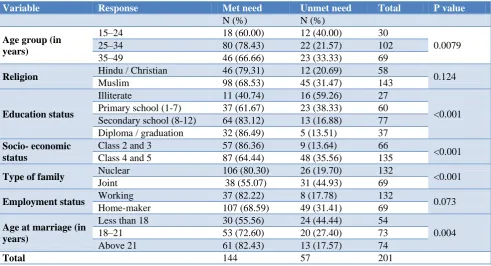
When the association between various socio- demographic factors and unmet need was studied, it was found that the association between age group, education status, socio-economic status, type of family and age at marriage of the women and the unmet need were found to be statistically significant (Table 1).
Table 1: Distribution of study participants as per met need and unmet need for contraceptives according to their socio-demographic profile (n=201).
Variable Response Met need Unmet need Total P value
N (%) N (%)
Age group (in years)
15–24 18 (60.00) 12 (40.00) 30
0.0079
25–34 80 (78.43) 22 (21.57) 102
35–49 46 (66.66) 23 (33.33) 69
Religion Hindu / Christian 46 (79.31) 12 (20.69) 58 0.124
Muslim 98 (68.53) 45 (31.47) 143
Education status
Illiterate 11 (40.74) 16 (59.26) 27
<0.001 Primary school (1-7) 37 (61.67) 23 (38.33) 60
Secondary school (8-12) 64 (83.12) 13 (16.88) 77
Diploma / graduation 32 (86.49) 5 (13.51) 37
Socio- economic status
Class 2 and 3 57 (86.36) 9 (13.64) 66
<0.001
Class 4 and 5 87 (64.44) 48 (35.56) 135
Type of family Nuclear 106 (80.30) 26 (19.70) 132 <0.001
Joint 38 (55.07) 31 (44.93) 69
Employment status Working 37 (82.22) 8 (17.78) 132 0.073
Home-maker 107 (68.59) 49 (31.41) 69
Age at marriage (in years)
Less than 18 30 (55.56) 24 (44.44) 54
0.004
18–21 53 (72.60) 20 (27.40) 73
Above 21 61 (82.43) 13 (17.57) 74
Total 144 57 201
DISCUSSION
In the study out of 260 participants 57 (21.92%) had unmet need, out of them 16 (6.15%) had unmet need for spacing births and 41 (15.77%) of the participants had unmet need for limiting births. The unmet need is quite high as compared to DLHS-4 data for Tumkur district wherein the total unmet need was 12.9% with 7.7% for spacing and 5.2% for limiting births. The reasons for this difference could be - the area we studied was inhabited by people belonging to lower socio-economic status,
lower education status, early marriage, lack of awareness and religious beliefs in the dominant population residing in the area. According to DLHS-4 for Karnataka state, overall unmet need in rural Karnataka is 15.2% and in urban Karnataka 18.6% with 11.6% for spacing births and 7% for limiting births. Our findings agree with DLHS-4 data for urban Karnataka.NFHS-4 shows unmet need of 12.9% for overall India with 5.7% for spacing and 7.2% for limiting births. NFHS-4 data for overall India is less as compared to our study. Ritu et al carried out a study in urban field practice area of JJM medical
68.42% 14.04%
22.80% 10.50%
33.30% 10.50%
14.04% 21.05%
0.00% 50.00% 100.00% lack of awareness
inconvenience health concerns / fear of side-…
post-partum / breast feeding religious beliefs / opposed to FP non-availability / in-accessibility partner disapproval infrequent sex / perceived low…
college Davangere, where the unmet need was found to be 17.2% with 7.8% unmet need for spacing and 9.4% for limiting births, the unmet need found was less as compared to our study and the difference may be due to varied socio-demographic characteristics like religion distribution as hindu participants were more in their study, also variation in socio-economic status, education status. In another study from UHTC area attached to MR Medical college in Gulbarga by Ansari et al, the total unmet need was 28.9%, which is higher than our finding; the higher unmet need in the study can be attributed to more number of illiterate participants and varied age-group and more number of women getting married at less than 18 years of age, a few participants were married at as low as 14 years of age.10,11 Rini et al conducted a study in rural areas of Davangere taluk where the unmet need was 16.7%, with 13.6% unmet need for spacing and 3.1% unmet need for limiting, the unmet need was lower compared to our study, the reason could be - because of more community participation and community need assessment by the health worker serving the rural population.12
Out of 57 participants in our study whose needs were unmet, 39 (68.4%) were not using a contraceptive because of lack of awareness, 19 (33.3%) because of religious beliefs or were opposed to family planning, 13 (22.8%) because of health concerns, 12 (21.05%) because of infrequent sex or perceived low risk of pregnancy, 8 (14.04%) because of inconvenience, 8 (14.04%) because of partner disapproval, 6 (10.5%) because they were in the post-partum period or were breast-feeding a child, 6 (10.5%) because of non-availability or in-accessibility. In the study from Ananthapuram, reasons given for unmet need were- 20 (25.0%) because of Lack of awareness, 6 (7.5%) because it was against their religion, 20 (25.0%) because of fear for side effects, 15 (18.8%) because of inconvenience to use, majority 32 (40.0%) were not using because of husband’s disapproval and 6 (7.5%) because of lack of access.13 Chakraborty et al observed in their study that out of 32 women who had unmet need, lack of information was given as the reason for unmet need by 6 (18.7%), religious and cultural factors by 7 (15.8%), fear of side effects by 11 (34.3%), opposition from husband by 8 (25.0%), irregular supply by 2 (6.2%).14 Lack of awareness and religious beliefs / opposition to family planning was found higher in our study because of overall low education level of participants, low socio-economic status and Muslim majority in our population and thus differs from the findings of Ananthapuram study as well as study by Chakraborty et al.14
CONCLUSION
The unmet need for contraceptives was 21.92% in the study which is much higher compared to NFHS-4 data for urban India (12.1%), and it has to be taken in to consideration by policy makers. The reasons for non-usage of contraceptives like partner disapproval, preference for male child, religious beliefs should be
addressed to while giving health education. Measures to improve accessibility, good services by health personnel to avoid inconvenience among women should be taken as these were important reasons for unmet need. Also the Factors associated with unmet need like age, education status, type of family they live in, the age at which a woman is getting married, socio-economic status of the family should be taken in to consideration.
ACKNOWLEDGEMENTS
We would like to thank Principal of Sri Siddhartha Medical College, Tumkur.
Funding: No funding sources Conflict of interest: None declared
Ethical approval: The study was approved by the Institutional Ethics Committee
REFERENCES
1. Pachauri S. Expanding contraceptive choice in India: Issues and evidence. J Fam Welf. 2004;50:13-25.
2. Ministry of Home Affairs. Provisional population Totals paper 1 of 2011 India, series 1. New Delhi: Office of Registrar General and Census Commissioner, Ministry of Home Affairs, Government of India, 2011. 188. Available at: http://censusindia.gov.in/2011-provresults/indiaat glance.html. Accessed on 12 November 2017. 3. Bhattacharya SK, Ram R, Goswami DN, Gupta UD,
Bhattacharyya KS, Ray S. Study of unmet need for family planning among women of reproductive age group attending immunization clinic in a medical college of Kolkata. Indian J Community Med. 2006;31(2):73-5.
4. Robey B, Ross J, Bhushan I. Meeting unmet need: new strategies. Popul Rep J. 1996;43:1-35.
5. Guttmacher Institute. The role of reproductive health providers in preventing HIV, Issues in brief; 2004.
6. Marston C, Cleland J. Relationships between contraception and abortion: a review of the evidence. Int Fam Plan Perspect. 2003;29:6–13. 7. Malwenna LI, Jayawardana PL, Balasuriya A.
Effectiveness of a community based health educational intervention in reducing unmet need for modern methods of family planning among ever married reproductive age women in the Kalutara District Siri Lanka. Int J Collabarative Res Intern Med Public Health. 2012;4:1097–114.
8. Atuahene MD, Afari EO, Adjuik M, Obed S. Health knowledge, attitudes and practices of family planning service providers and clients in Akwapim North District of Ghana. Contracept Reprod Med. 2016;1:1-8.
goals. International Family Planning Perspectives 1994;20(1):23–32.
10. Kashyap R, Vidya GS, Dhar R. A Study on Unmet Need of Contraception Among Married Women in Urban Field Practice Area of JJM Medical College, Davangere, Karnataka. Natl J Community Med 2017;8(4):203-207.
11. Ansari Mohammad, Iti L. Jannatbi, Ahmad Md, Reddy Srinivas. A Study to Assess the Factors Determining the Unmet Need for Contraceptive Usage in an Urban Area Rajapur. J Evidence Based Med Healthcare. 2015;2(35):5367-76.
12. Raveendran R, Vijayakumar B. Unmet need for family planning in South India. Int J Biomed Adv Res. 2017;8(03):82-6.
13. Kumar PVS, Pujari P. Prevalence of unmet need for contraception among reproductive age group married women in district hospital, Ananthapuramu. Int J Res Health Sci. 2014;2(1):118-25.
14. Chakraborty N, Kaviraj RS, Mandal AK. Use Of Family Planning Methods And Unmet Need Of Contraception Among Married Women In A Rural Area Of West Bengal: A Cross-Sectional Study. J Dent Med Sci. (IOSR-JDMS) 2016;15(2):24-9.