RESEARCH ARTICLE
Automatic Feedback Framework for Deriving
Educational Ontologies
J.Stanley Jesudoss
K.M.G College of arts and science,
Gudiyattam,Vellore,Tamilnadu,India
[email protected]
S.Selva Kumar
Asst.Professor(Computer Science),
Thiruvalluvar University College of arts and science,
Gajalnaickenpatti, Tirupattur.Tamilnadu, India
[email protected]
Abstract – Automatic feedback generation is an important feature of Computer Assisted Assessment (CAA) systems. Feedback can help learners to diagnose their learning status and educational knowledge. The education ontology is created in the protégé tool. Questions are generated and the examinee’s is to provide the answers for the given questions. System will generate the adaptive feedback based on the user’s response. Learner’s answer will be assessed from the ontology. And then based on the examinee’s response the adaptive feedback is generated for right and wrong answers. Adaptive Feedback can be both human readable format and machine readable format. Users learning status can be identified from the adaptive feedback. Feedback can be generated from the metadata of items. Adaptive feedback can help learner’s knowledge level and examinees can improve their knowledge level.
Index Terms – The Taxonomy of education objectives, Architecture of concept map assessment tool, Different types of CAA, Class hierarchy, Artificial Intelligence.
1. INTRODUCTION
This Automatic feedback generation has several advantages over traditional paper-and-pencil (P&P) Assessment. Also CAA (Computer Assisted Assessment) is used for assessing student learning with the help of computer. There are many types of assessments that exist. They are computer based assessment and online assessment. Assessment can be categorized [5] as either summative (for grading purposes) or formative (to give feedback to assist the learning process). Automatic generated feedback can help learners to discover their level of assimilation of certain topics [1], or learn by assessment [2]. Generally, automatic generated feedback can be divided into two categories: they are positive feedback and negative feedback they are also known as adaptive and non-adaptive feedback.
For non-adaptive feedback, hints or explanations can be embedded in items and systems can deliver them according to user’s responses. One positive aspect of this approach is that
items can be written in forms such as multiple choices, fill in blank, and so on. These forms make it feasible to share and reuse items, and further to construct item banks [3]. Item banks are collections of questions, often produced collaboratively across a subject domain that can be grouped according to difficulty, the type of skill or topic. The drawback of this approach is that the embedded feedback is intended for human reading instead of machine understanding. And therefore, it is infeasible for machines to model personal learning status to behave adaptively.
1.1. Feedback in Computer-based Instruction
Feedback is any message generated in response to a learner’s action. System-based feedback proposes a theory-based framework to assist educators, programmers, and instructional design specialists in incorporating effective feedback into educational software and programs. One of the main advantages of computer based education is the ability to provide immediate feedback on individual responses.
1.2. Feedback in Computer-based Instruction
There are many case in points of Informative being used in both pro forma education and professional backdrop in which they have establish their ability and limitations.Ancestral computer aided instruction (CAI) systems support learning by encoding sets of exercises and the combined solutions, and by providing predefined remediation actions when the students’ answers do not match the encoded solutions.
1.3. Research Problem
RESEARCH ARTICLE
2. RELATED WORK
The word ontology was taken from philosophy. Guarino and Giaretta are proposes to use the words ‘Ontology’ (with capital ‘O’) and ‘ontology’ refers to the philosophical and knowledge engineering senses respectively [10]. Gruber defined ontology as follows [7]:
“Ontology is an explicit specification of a conceptualization”
This definition became the most quoted in literature and by the ontology community. Based on Gruber’s definition, many definitions of what ontology is were proposed. Brost modified slightly Gruber’s definition as follows [8]:
“Ontologies are defined as a formal specification of a shared conceptualization “
Gruber’s and Borst’s definitions have been merged and explained by Student and colleagues as follows [9]:
“Ontology is a formal explicit specification of a shared conceptualization “
Conceptualization refers to an abstract model of some phenomenon in the world by having identified the relevant concepts of that phenomenon. Explicit means that the type of concepts used, and the constraints on their use are explicitly defined. Formal refers to the fact that the ontology should be machine-readable. Shared refers the notion that the ontology captures consensual knowledge Guarino and Giaretta collected and analyzed the following seven definitions [10]:
Ontology as a philosophical discipline.
Ontology as an informal conceptual system.
Ontology as a formal semantic account.
Ontology as a specification of conceptualization.
Ontology as presentation of a conceptual system via a logical theory
o Characterized by specific formal properties.
o Characterized only by its specific purposes.
Ontology as the vocabulary used by a logical theory.
Ontology as a specification of a logical theory. Guarino and Giaretta proposed to consider an ontology as [11]:
A Logical theory which give an explicit, partial account of a conceptualization.
For building ontologies is to reuse large ontologies like SENSUS to create domain specific ontologies and knowledge bases:
“Ontology is a hierarchically structured set of terms for describing a domain that can be used as a skeletal foundation for a knowledge base.”
According to this definition, the same ontology can be used for building several knowledge bases, which share the same skeleton or taxonomy. Extensions of the skeleton should be
possible at the low level by adding domain-specific sub concepts or at the high level by adding intermediate or upper level concepts that cover new areas.
The community calls them light weight and heavy weight ontologies respectively. Light weight ontologies include concepts, concept taxonomies, relationships between concepts, and properties that describe concepts. Heavy weight ontologies add axioms and constraints to light weight ontologies.
Ontologies are widely used for different purposes like Natural Language Processing (NLP), Knowledge Management (KM), e-Commerce, Intelligent Integration of Information (III), the semantic web etc., US hold and Jasper defined an ontology as [12]:
“Ontology may take a variety of forms, but it will necessarily include a vocabulary of terms and some specification of their meaning. This includes definitions and an indication of how concepts are inter-related which collectively impose a structure on the domain and constrain the possible interpretations of terms.”
2.1. Domain Ontology
The first step in devising an effective learning representation system, and words, is to achieve an able ontological resolution of the field. Weak analyses lead to confused learning bases. Empire ontology specifies the concepts, and the connection between ideas, in an express subject area rather than define only generic concepts. Without ontologies, or the concept that underlie learning, there cannot be a words for representing Learning. Ontological dissection clarifies the formation of Learning. Given a domain, its ontology forms the nature of any system of learning illustration for that domain.
2.2. Ontology as Taxonomy
Ontology provides the taxonomy in a machine-readable and machine processable form. However, an ontology is more than its corresponding taxonomy, it is a full specification of a domain.Each link between two nodes in taxonomy represents a “sub classification-of” relation or a “super classification-of” relationship.
2.3. Ontology as Vocabulary
Decoding the terms from one language to another, for example from English to French, does not change the ontology keep secret. But the conceptualizations that the terms in the vocabulary are intended to capture.
2.4. Ontology as Content Theory
RESEARCH ARTICLE
structure such as rule systems, frame languages, neural nets, fuzzy logic, constraint propagation, or unification. The mechanisms are proposed [12] as the secret of making intelligent machines. It cannot do much without a good content theory of the domain on which it is to work. Once a good content theory is available, many different mechanisms might be used equally well to implement effective systems, all using essentially the same content. AI researchers have made several attempts to characterize the essence of what it means to have a content theory.
2.5. Ontology as Taxonomy
An Adaptive Web Based Concept Map Assessment Tool. The architecture of an adaptive web-based concept map assessment is a tools.
The architecture of Concept Map Assessment Tool, illustrated in Figure 2.1, is comprised of five modules: (i) the Interaction Monitoring Module (IMM), which is responsible for (a) collecting data concerning the learner’s observable behaviour, (b) activating the other modules according to the learner’s actions (i.e. activation of the (DM) after the accomplishment of an activity and (AFGM) after the completion of the activity or in case the learner asks for support/help), and (c) updating the with the newly acquired information (e.g. feedback components provided, duration of the activity’s elaboration, etc.), (ii) the Diagnostic Module (DM) that supports the assessment of the learner’s concept map, based on the similarity of the map with the expert’s one, (iii) the Adaptive Feedback Generation Module (AFG), which is responsible to generate the appropriate feedback, according to the learner’s knowledge level, preferences and interaction behaviour, (iv) the Presentation Module which is responsible for the presentation of (a) the constituent parts of the concept mapping task that will be available to the learner during the accomplishment of the activity and (b) the feedback after generated by the AFGM, and (v) the Data Storage, containing the Domain Knowledge and the Learner Model.
Domain Knowledge
(DK)
Learner Model (LM) Data Storage
Adaptive Feedback Generation Module (AFGM)
Diagnostic Module (DM)
Presentation Module (PM)
Interaction Maintaining Module (IMM) Learner’s
Interaction Learner
Figure 1 The Architecture of Concept Map Assessment Tool
2.6. Assessment Activities
The design of the activities is based on the following a three-step
(i) Elicit learners’ prior knowledge.
(ii) Identify learners’ initial knowledge level as far as the new concepts are concerned.
(iii)Diagnose learners’ unknown concepts, incomplete understanding, and false beliefs, and (b) the learners to activate their existing knowledge.
2.7. Adaptive Feedback Generation in Concept Map
The architecture of Concept map Generation and its modules, focusing on the representation of the domain knowledge and the learner model, the diagnosis of the learner’s knowledge and the generation of the adaptive feedback. The discriminative characteristics of Concept map are: the conceptual structure of its domain knowledge, which is based on the notion of assessment goals that the learner can select the qualitative diagnosis process and the quantitative estimation of the learner’s knowledge level, the adoption of multiple informative and tutoring feedback components and the stepwise feedback presentation, the adoption of error-task related questions based on a categorization of learner’s common errors, the adoption of the two levels of the tutoring feedback units and the adaptation of feedback to the learner’s knowledge level, preference and interaction behaviour. An adaptive web-based concept map tool, aims to support learning through the assessment process.
2.8. Automatic Feedback and Resubmissions as Learning Aid
This work mainly focused on student’s Feedback based on automatic assessment of student’s solutions is an important aid for student’s learning process in self-study and distance learning. Learning tools that automatically assess and give feedback on learners’ performance provide valuable help for both teachers and learners. From Lauri Malmi’s [13] point of view, the main motivation is to save time and increase the amount of feedback on large courses. For learners, automatic feedback is very useful, because it supports self-study and distance learning. It is often much better to get instantly even simple feedback than to get advanced human feedback many days afterwards, or even worse to get no feedback at all.
RESEARCH ARTICLE
2.9. Intelligent System for Personalized Instruction in a Remote
In this method the lessons are dynamically generated according to learner’s knowledge level. The adaptive behaviour of the system, the functionality of the various modules and the opportunities offered to learners are presented [1].
INSPIRE is comprised of five different modules
(A) The Interaction Monitoring Module that monitors and handles learner’s responses during his/her interaction with the system.
(B) The Learner’s Diagnostic Module, which processes data recorded about the learner and decides on how to classify the learner’s knowledge,
(C) The Lesson Generation Module that generates the lesson contents according to learner’s knowledge goals and knowledge level.
(D) The Presentation Module that generates the educational material pages sent to the learner.
(E) The Data Storage, which holds the Domain knowledge and the Learner’s Model.
2.10.Review of Computer-Assisted Assessment
Computer-Based Assessment (CBA) involves a computer program marking answers that entered directly into a computer, whereas optical mark reading uses a computer to mark scripts originally composed on paper. Portfolio collection is the use of a computer to collect scripts or written work. Computer-based assessment can be subdivided into stand-alone applications that only require a single computer, applications that work on private networks and those that are designed to be delivered across public networks such as the web (online assessment).
A multiple choice item consists of four elements: the stem of the question, options, correct responses and distracters. Tests are collections of subject-specific items, possibly drawn from item banks. There are a variety of different question types (e.g. multiple choice, multiple response, hotspot, matching, ranking, drag and drop, multiple steps and open ended) and feedback mechanisms (including automatic feedback in objective testing, model answers, annotated test, or mixed mode with intervention from the teacher).
Assessment can be categorised as either summative (administered for grading purposes) or formative (to give feedback to assist the learning process).
OMR
Collecting portfolios Online
Assessment (web-based)
standalone
Networked
CBA CAA
Figure 2 Different types of CAA
2.11.Review of Computer-Assisted Assessment
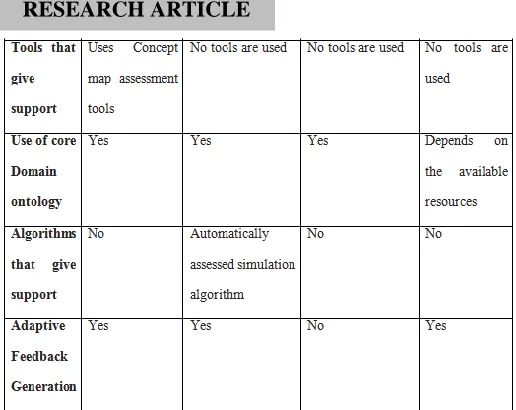
The related works are An Adaptive Web-based Concept Map Assessment Tool (COMPASS).
An Intelligent System for Personalized Instruction in a Remote Environment (INSPIRE), Automatic Feedback and Resubmission as Learning Aid, and A Review of Computer Assisted Assessment (CAA).
RESEARCH ARTICLE
Table 1 Comparative analysis of Related works
3. PORPOSED MODELLING
Items are used in standard from to produce adaptive feedback, which makes these items sharable and reusable and then the generated feedback is both human readable and machine understandable, which guarantees the interoperability of the present framework. The refined metadata schema supporting adaptive feedback generation and this schema is based on ontologies of a specific discipline and education objectives. Adaptive feedback is derived based on the examinee’s responses. Domain ontology is developed in any particular discipline.
He entire proposed modelling and architecture of the current research paper should be presented in this section. This section gives the original contribution of the authors. This section should be written in Times New Roman font with size 10. Accepted manuscripts should be written by following this template. Once the manuscript is accepted authors should transfer the copyright form to the journal editorial office. Authors should write their manuscripts without any mistakes especially spelling and grammar.
Ontologies promise “a shared and common understanding of a domain that can be communicated between people and application systems”. They attempt to formulate a thorough and rigorous representation of a domain by specifying all of its concepts, the relationships between them and the conditions and regulations of the domain. Ontologies can express hierarchical links between entities and other semantic relations.
An example of part of an ontology is provided in Figure 1, in which it is specified not only that an author is a person and that a book is a publication, but also that an author writes a book and that a book has chapters.
Figure 3 Example of a Small ontologies
3.1. Methodologies
There are different methodologies are adopted in order to achieve the above proposed problem statement. Educational ontologies are created using protégé tool by complete understanding of literature survey and a comparative analysis of the various feedback frameworks for educational ontologies.
Computer Assisted Assessment (CAA) has several advantages over traditional Paper-and-Pencil (P&P) assessment, among which is automatic feedback. Automatic generated feedback can help learners to discover their level of assimilation of certain topics [1], or learn by assessment [2]. Generally, automatic generated feedback can be divided into two categories: adaptive and non-adaptive. For non-adaptive feedback, hints or explanations can be embedded in items and systems can render them according to user’s responses. One positive aspect of this approach is that items can be written in forms such as multiple choices, fill in blank, and so on. These forms make it feasible to share and reuse items, and further to construct item banks [3]. The drawback of this approach is that the embedded feedback is intended for human reading instead of machine understanding. And therefore, it is infeasible for machines to model personal learning status to behave adaptively.
For adaptive feedback, e.g. [2], [4], the adaptive is usually represented by the idea of gradual provision of appropriate information. This approach needs special computing structures to model learners, and classifies user’s responses into several categories to produce feedback. Conformance implementations should include required metadata, and these annotations can be used beyond searching and copyright. Based on above considerations, frameworks of generating feedback from metadata of items are proposed.
3.2. Terminologies and Preliminaries
RESEARCH ARTICLE
finding items regarding a specific topic or chapter. These aspects have been reflected in the specifications published by standard organizations. In light of the fact that different disciplines have their respective knowledge map, classifications are discipline or course depended, and therefore they are not part of the standards.
Many languages are capable of representing ontology including Extensible Mark-up Language (XML). Ontology Web Language (OWL) [15] as the following language considerations.
OWL is an international recognized standard for conveying web ontology.
OWL-DL (OWL-Description Logic), a dialect of OWL, has solid logical foundations so that it can be
balance between expressive power and
computational complexity.
OWL tools, including editor and reasoned, for applications. For each concept in ontology, it has a universally unique ID Uniform Resource Identifier (URI) to represent it.3.3. Terminologies and Preliminaries
The elements in T of the dyads are concepts from the taxonomy of a discipline or a course. These conditions form a domain ontology. The relation between two concepts is rdfs: subClassOf (Resource Description Framework) another must be clarified. If concept A is rdfs: subClassOf concept B that is B is a kind of A. These relations are defined before constructing ontology using XML. There are several situations that the relation between two concepts a and is-part-of relationship. For example, “a car has an engine”. If developer adopt both relations of is-a and is-part-of, this will introduce unnecessary complexity. To solve this problem, each concept C in the taxonomy as “knowledge of C” is defined. Therefore, we can declare that the knowledge of some type of engine is a kind of the knowledge of car.
Figure 4 Taxonomy of education objectives
3.4. Diagnosis of learning status
To model learners, the first step is to evaluate their responses. The learner answer categorization schema proposed in [4] is adopted and try to classify responses into these classes. If a user submits a wrong answer, this answer does not belong to any class this is added in the wrong class and the system records the outcomes of the item. An assessment contains multiple items. With the interaction proceeds, the system records a user’s performance on different topics. And this information forms a concept map to judge the overall knowledge level of the examinee regarding an instructional unit.
3.5. Feedback generation
The feedback is divided into two classes. They are per item and per unit feedback. For item feedback, a rule-based natural language generation approach is utilized. These rules are activated by answers and annotations. For correct answers, the system will generate sentence like “answer is correct”. The verb and topic are the label of the corresponding education objective and the label of the corresponding concept regarding a certain discipline, respectively.
For wrong answers, the system generates a negative message to tell the learner what is wrong. For example, “the answer is missing”. For instructional unit, the system will provide a statistical report to examinees. These reports show the users’ abilities on different topics and types of question, e.g. answering, applying, so that they can adjust learning strategy or review certain chapters. Because these reports contain the knowledge level of users on certain topics and therefore can be used in adaptive learning systems [18] to infer which units are ready for a user to study, and which units shall not start at the current knowledge level.
4. RESULTS AND DISCUSSIONS
Metadata is crucial for reusability and interoperability of items and the issues of deriving adaptive feedback from metadata are investigated. However it also charges educators with boring fill-in operations [19], and automatically generation of metadata has been a challenge of item authoring systems [20]. The problem of whether this framework is workable must be the answer.
RESEARCH ARTICLE
that contains it. In case that the unit is exported individually, the system automatically copies up-level notes for it. These measures can reduce the burden of fill-in operations.
Automatic semantic annotation methods have been described in the literature [19]. These works provide potential solutions to this problem. Research efforts on Natural Language Processing (NLP) have produced the word ontology.
The ideas behind the Frame Net are to retrieve the meaning of a word from stereotyped patterns. And vice versa, these patterns can be used to generate sentences, including math problems [21]. Bloom’s taxonomy suggests several typical verbs for each category, and their stereotyped situations can be used to generate sentences. Therefore, in case that an educator or agent can produce questions following these patterns, the metadata of education objectives is produced immediately as a side product.
Figure 5.1 Class hierarchy
Knowledge representation and reasoning is an important area of ontology representation. Knowledge representation can easily be extended by means of meta-classes. Knowledge representation is based on frames and first order logic. In this chapter the java ontology is created using owl language. This chapter clearly describes the tools and techniques which are used to implementing the research concept to solve the defined problem in the very effective manner. For solving the problem various tools and techniques are used.
4.1. Developing Eclipse framework for interface
The Eclipse Platform uses plug-ins to provide all functionality within and on top of the runtime system.
This plug-in mechanism is a lightweight software component framework. Eclipse Platform to be extended using other programming languages such as C and Python, the plug-in framework allows the Eclipse Platform to work with typesetting languages like networking applications . The plug-in architecture supports writing any desired extension to the environment, such as for configuration management. Java support is provided in the Eclipse SDK, with support for other version control systems provided by third-party plug-ins. Examples of plug-ins include a UML plug-in for Sequence and other UML diagrams, a plug-in for DB Explorer, and many others.
5. CONCLUSION
In this Research Methodology for framework of automatic feedback generation from metadata of items are presented. A new aspect of framework is it relies on recognized standards compliant items and metadata rather than proprietary computing structures. Based on domain ontology and explicitly stated education objectives, the feedback in text form is automatically generated by using sentence templates. Therefore, educators may spend less time on writing feedback. At the same time, the information used to produce text feedback is machine understandable and human understandable and can also be used by intelligent tutoring systems to model learners, to recover related learning objects, and to suggest appropriate material for learning.
REFERENCES
[1] A review of computer-assisted assessment Gráinne Conole and Bill Warburton Vol. 13, No. 1, March 2005, pp. 17–31
[2] E.Gouli,A.Gogoulou,K.A. Papanikolaou, and M. Grigoriadou, “Compass: An adaptive web-based concept map assessment tool,” in Proceedings of the First International Conference on Concept Mapping, Pamplona, Spain, 2004.
[3] N. Sclater, E. Boyle, J. Bull, C. Church, P. Craven, R. Cross, M. Danson, L. Halliday, I. Howie, J. X. Kelly, S. Lay, M. Massey, M. McAlpine, D. McDonald, M. MacDonald, S. Rogers, and S. White, “Defining the infrastructure for a national item bank service,” in Proceedings of 9th CAA Conference, 2005.
[4] M. Grigoriadou, K. Papanikolaou, H. Kornilakis, and G. Magoulas, “Inspire: An intelligent system for personalized instruction in a remote environment,” in Proceedings of Third workshop on Adaptive Hypertext and Hypermedia, Sonthofen, Germany, 2001, pp. 13–24. [5] D. Tsovaltzi, A. Fiedler, and H. Horacek, “A multi-dimensional
taxonomy for automating hinting,” Intelligent Tutoring Systems, pp. 772–781, 2004.
[6] “Ontological engineering” by Asuncion Gomez-Perez, Mariano Fernandez-Lopez and Oscar Corcho pp.no.6
[7] “Ontological engineering” by Asuncion Gomez-Perez, Mariano Fernandez-Lopez and Oscar Corcho pp.no.6
[8] “Ontological engineering” by Asuncion Gomez-Perez, Mariano Fernandez-Lopez and Oscar Corcho pp.no.6
[9] “Ontological engineering” by Asuncion Gomez-Perez, Mariano Fernandez-Lopez and Oscar Corcho pp.no.7
[10] “Ontological engineering” by Asuncion Gomez-Perez, Mariano Fernandez-Lopez and Oscar Corcho pp.no.8
RESEARCH ARTICLE
[12] What are Ontologies and Why Do We Need Them? B. Chandrasekaran and John R. Josephson, Ohio State University V. Richard Benjamins, University of Amsterdam
[13] “Automatic Feedback and Resubmissions as Learning Aid” by Lauri Malmi and Ari Korhonen.
[14] Bloom’s taxonomy Educational Objectives: The classification Educational goals hand book, by Bloom
[15] S. Bechhofer, F. Harmelen, J. Hendler, I. Horrocks, D. McGuinness, and P. Patel-Schneider, “Owl web ontology language reference,” http://www.w3.org/TR/owl-ref/,2003.http://www.w3.org/TR/owl-ref/
[16] J. Carneson, G. Delpierre, and K. Masters, “Designing and managing multiple choice questions: Appendix c: Mcq’s and bloom’s taxonomy,” http://www.uct.ac.za/projects/cbe/mcqman/mcqappc.html, accessed on Mar. 28, 2008.http://www.uct.ac.za/projects/cbe/mcqman/mcqappc.html
[17] R. Lister, “Objectives and objective assessment in cs1,” vol. 33, no. 1, pp. 292–296., SIGCSE Bull 2001.
[18] P. D. Bra, P. Brusilovsky, and C. Houben, “Adaptive hypermedia: from systems to framework,” ACM Comput. Surv, vol. 31, 1999.
[19] P. S. Saini, M. Ronchetti, and D. Sona, “Automatic generation of metadata for learning objects,” in Proceedings of the Sixth IEEE International Conference on Advanced Learning Technologies, 2006, pp. 275–279.
[20] E. Duval and W. Hodgins, “A lom research agenda,” in Twelfth international conference on World Wide Web, Budapest, Hungary, 2003.
[21] D. Higgins, Y. Futagi, and P. Deane, “Multilingual generalization of the model creator software for math item generation,” ETS, Princeton, NJ., Tech. Rep., 2005. [Online]. Available:
http://www.ets.org/research/researcher/RR-05-02.html
Authors
Mr.J.Stanley Jesudoss received M.C.A. degree from Thiruvalluvar University, Tamil Nadu, India, in 2011 and M.Phil in Computer Science from Thiruvalluvar University 2014, Tamil Nadu, and India. He research interests in Ontology concept. His research interests include Big Data, Web Security.