Original Research Article
Evaluation of level of satisfaction among indoor patients attending in a
tertiary care hospital of Rajnandgaon (C.G.), India
Nirmal Verma
1, Nitin Kamble
2*, Dhiraj Bhawnani
2, Kiran Makade
2,
Monika Dengani
2, Tarun Kaushik
2INTRODUCTION
Patient’s satisfaction has gained increased attention over the past few years.1 It is now a day’s understood that patient’s opinion should supplement the usual indicators of quality in health care.2,3 Patient expressions is an
important source of information in screening for problems and developing an effective plan of action for quality improvement in health care organizations.4 Assessing satisfaction has been mandatory for quality control of any hospital, which has resulted in an
ABSTRACT
Background: Patient expression is an important source of information in screening for problems and developing an effective plan of action for quality improvement in health care organizations. Assessing satisfaction has been mandatory for quality control of any hospital, which has resulted in an increasing number of projects devoted to the concept of satisfaction and determinant of patient satisfaction.
Methods: The present Cross sectional Observational Hospital based study was conducted in Government Medical College Hospital, Rajnandgaon (C.G.) India during April 2016 to September 2016. A sample of 200 patients was taken who were admitted in different Indoor Patients Department of Clinical departments. Patients were selected according to inclusion and exclusion criteria. The information from the patients on various aspects of patient’s satisfaction like admission procedure, communication with staff, physical care, test and operation help availability, cleanliness, privacy related issues and overall satisfaction was obtained by interview with patients based on the semi structured questionnaire proforma.
Results: In the present study, among IPD patient Male: Female ratio was 3:2 approx. Helpfulness of person at registration desk was ranked very good by 93% subject. Wheelchair was available for most of the patients (95%) but its availability when needed was ranked very good by 76% patients only. Majority of patient were satisfied with the behavior of the lab technician (89%), availability of lab results on given time (81%).
Conclusions: This study shows that patients admitted in the various wards of hospital were satisfied with the quality of professional services by doctors, nursing and paramedical staff but problem lies with the availability of basic amenities. Overall present study shows that assessing satisfaction of patients is simple, easy and cost effective way for evaluating the hospital services.
Keywords: Hospital services, Patient satisfaction, Patient care, Quality of medical care
Department of Community Medicine, 1Pt. Jawahar Lal Nehru Memorial Medical College, Raipur, 2Govt. Medical College, Rajnandgaon, Chhattisgarh, India
Received: 16 October 2017
Revised: 16 November 2017
Accepted: 14 February 2018
*Correspondence:
Dr. Nitin Kamble,
E-mail: [email protected]
Copyright: © the author(s), publisher and licensee Medip Academy. This is an open-access article distributed under the terms of the Creative Commons Attribution Non-Commercial License, which permits unrestricted non-commercial use, distribution, and reproduction in any medium, provided the original work is properly cited.
increasing number of projects devoted to the concept of satisfaction and determinant of patient satisfaction.5-11
Patient satisfaction surveys are used by hospital managers to improve the hospital environment, patient amenities, and facilities in a consumerism context. In contrast, little has been done to determine whether patient satisfaction assessment can lead to changes in patient care at the ward or department level. The efficacy of patient-based measured feedback to improve care provider skills and practices remains controversial.12-15
Government Medical College Hospital Rajnandgaon (C.G.) provides tertiary health care services. It is 600 bedded hospitals. This hospital came in existence from 2014-15 academic years with 100 MBBS admissions per year. The populations utilizing the services are from urban, rural and tribal areas.
In-patient satisfaction has not been assessed previously in this hospital. The study was planned with the aim to assess the indoor patient department (IPD) satisfaction level among patients and their use for quality control of hospital services.
METHODS
The present study was conducted in Government Medical College Hospital, Rajnandgaon (C.G.) India. A total of 200 patients were selected from different Indoor Patients Department of Clinical departments (Medicine, Surgery, Orthopedics, Obstetrics and Gynecology). Institutional ethics committee approved this study.
Period of study
From April 2016 to September 2016
Duration of study 06 months
Type of study design
Cross sectional Observational (Descriptive) Hospital based study
Mode of data collection
Interview
Type of interview
Through questionnaire one to one
Type of questionnaire
Semi structured
Study centre
Government Medical College Hospital (a tertiary care hospital) Rajnandgaon (C.G.).
Study subjects
Admitted Patients (Indoor Patients)
Inclusion criteria
Inclusion criteria were Indoor Patients admitted in hospital for <48 hrs duration; patients aged ≥18 yrs from all departments of IPD (except in pediatrics wards, where parents/attendants accompanying the patient were included).
Exclusion criteria
Exclusion criteria were critically ill patients; not willing to participate.
Sampling method
Simple random sampling
Sample size
Purposive sample of 200
A sample of 200 patients was taken who were admitted in different departments (Medicine, Surgery, Obstetrics and Gynecology, Orthopedics and Pediatrics) of the Government Medical College Hospital Rajnandgaon (C.G.), India. Patients were selected according to inclusion and exclusion criteria. Each patient was informed & consent has been taken. The information from the patients on various aspects of patient’s satisfaction like admission procedure, communication with staff, physical care, test and operation help availability, cleanliness, privacy related issues and overall satisfaction was obtained by interview with patients based on the semi structured questionnaire proforma. To facilitate the understanding, questions were translated into local language that is Hindi and Chhattisgarhi.
The World Health Organization (WHO) has created a performance system to assess the patient responsiveness (patient satisfaction), but those measures were based on surveying public health experts (and not patients) which generally doesn’t show the exact reality. So questionnaire are prepared from previously validated set of a 12 administered question and some more elaborative questions were asked.16
RESULTS
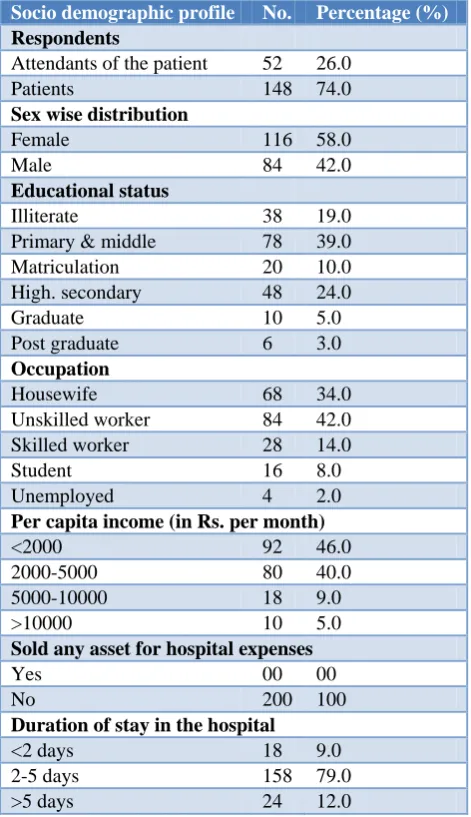
In the present study, among IPD patient male:female ratio was 3:2 approx. 19% were illiterate and 63% of subjects were educated up to higher secondary level. The maximum subjects by occupation were unskilled worker (42%) followed by housewife (34%). Most of the subjects were having per capita income up to 5000 (86%). Duration of stay in IPD ward was 2-5 days among 79% of subject (Table 1).
Table 1: Socio demographic profile of study subjects.
Socio demographic profile No. Percentage (%)
Respondents
Attendants of the patient 52 26.0
Patients 148 74.0
Sex wise distribution
Female 116 58.0
Male 84 42.0
Educational status
Illiterate 38 19.0
Primary & middle 78 39.0
Matriculation 20 10.0
High. secondary 48 24.0
Graduate 10 5.0
Post graduate 6 3.0
Occupation
Housewife 68 34.0
Unskilled worker 84 42.0
Skilled worker 28 14.0
Student 16 8.0
Unemployed 4 2.0
Per capita income (in Rs. per month)
<2000 92 46.0
2000-5000 80 40.0
5000-10000 18 9.0
>10000 10 5.0
Sold any asset for hospital expenses
Yes 00 00
No 200 100
Duration of stay in the hospital
<2 days 18 9.0
2-5 days 158 79.0
>5 days 24 12.0
Mode of admission in majority IPD patients was through emergency. Helpfulness of person at registration desk was ranked very good by 93% subject. Wheelchair was available for most of the patients (95%) but its availability when needed was ranked very good by 76% patients only. Assistance of supportive staff was found to be very good by 76% patients. Wards were easily approachable for almost all the patients and sign boards in hospital were found to be adequate and helpful. The treatment was started within 10 minutes of the admission
in the ward in more than two third of patients (69%) (Table 2).
Table 2: Services available at the time of admission.
Services available at
admission No.
Percentage (%) Mode of admission
Through emergency 174 87.0
Through outdoor 26 13.0
Helpfulness of person at registration desk
Very good 186 93.0
Good 6 3.0
Average 4 2.0
Excellent 2 1.0
Poor 2 1.0
Availability of wheel chair
Available 188 94.0
Not available 12 6.0
Availability of wheel chair when needed
Very good 152 76.0
Good 30 15.0
Average 8 4.0
Excellent 8 4.0
Poor 2 1.0
Immediate availability of support staff for assistance
Very good 152 76.0
Good 30 15.0
Average 8 4.0
Excellent 8 4.0
Poor 2 1.0
Ward locations
Approachable 200 100.0
Sign boards
Adequate and helpful 190 95.0
Inadequate 10 5.0
Time taken to start of treatment in the ward
Immediate 64 32.0
<10 minutes 74 37.0
10-30 minutes 40 20.0
>30 minutes 22 11.0
Patient satisfaction in relation to services by doctor was good in majority of patients (Table 3).
Majority of patient were satisfied with the behaviour of the lab technician (89%), Availability of lab results on given time (81%) (Table 4).
Table 3: Perception regarding quality of professional services by doctor.
Perception regarding quality of
professional services by doctor No.
Percentage (%) Time spent by the doctor with the patients
Adequate 172 86.0
Inadequate 28 14.0
Description of disease status by doctor
Satisfactory 168 84.0
Unsatisfactory 32 16.0
Communication skill of doctor
Good 110 55.0
Satisfactory 72 36.0
Unsatisfactory 18 9.0
Perception of efficiency of doctors in handling illness of patient
Good 150 75.0
Satisfactory 28 14.0
Unsatisfactory 22 11.0
Doctors discussed laboratory investigations with patients
Good 28 14.0
Satisfactory 150 75.0
Unsatisfactory 22 11.0
No. of visits of senior doctors
Adequate 174 87.0
Inadequate 26 13.0
Table 4: Perception regarding quality of lab services.
Perception regarding quality of
lab services No.
Percentage (%) Guided about location/room no. where investigations advised
Yes 196 98.0
No 4 2.0
Locations of labs
Easily approachable 184 92.0
Difficult to locate 16 8.0
Time to reach lab for investigation
<10 Minutes 172 86.0
10-30 Minutes 16 8.0
>30 Minutes 12 6.0
Behavior of lab technician
Satisfactory 178 89.0
Good 16 8.0
Unsatisfactory 6 3.0
Availability of results of investigation
Available on time 162 81.0
Delayed 38 19.0
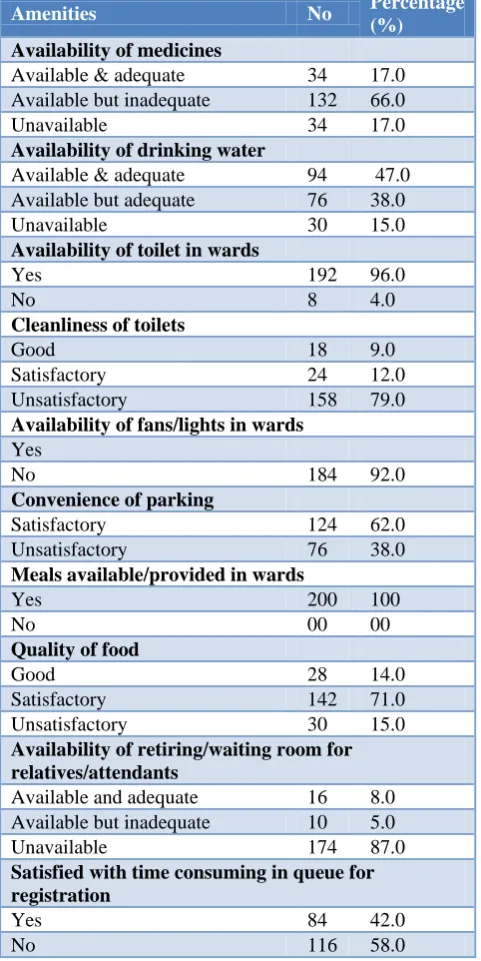
The medicines and drinking water facility was available and adequate in 17% and 47% cases respectively. Availability of toilet facility indoor ward found adequate but their cleanliness was found unsatisfactory by majority
of patients. Availability of fans/lights in ward was adequate. Facility of parking found satisfactory as perceived by the majority of subjects. Quality of food provided by hospital was found satisfactory by majority. Only 42% patients were satisfied with time consuming in queue. Majority of subjects (87%) reported that retiring /waiting room for attendants/relatives was unavailable (Table 6).
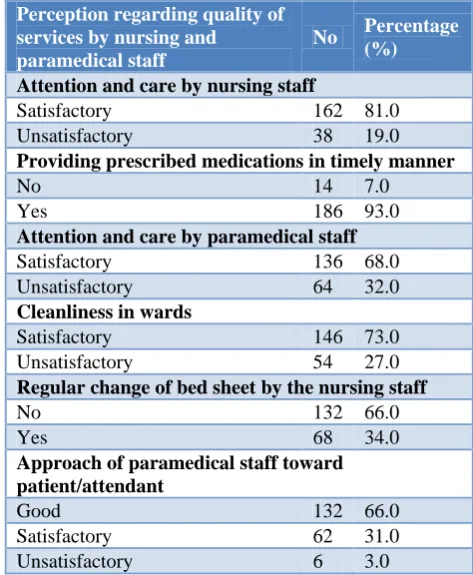
Table 5: Perception regarding quality of services by nursing and paramedical staff.
Perception regarding quality of services by nursing and
paramedical staff
No Percentage
(%) Attention and care by nursing staff
Satisfactory 162 81.0
Unsatisfactory 38 19.0
Providing prescribed medications in timely manner
No 14 7.0
Yes 186 93.0
Attention and care by paramedical staff
Satisfactory 136 68.0
Unsatisfactory 64 32.0
Cleanliness in wards
Satisfactory 146 73.0
Unsatisfactory 54 27.0
Regular change of bed sheet by the nursing staff
No 132 66.0
Yes 68 34.0
Approach of paramedical staff toward patient/attendant
Good 132 66.0
Satisfactory 62 31.0
Unsatisfactory 6 3.0
DISCUSSION
Healthcare is fast becoming consumerist industry all over the world. Today, the patients are much more aware and informed about their diseases compared to most healthcare givers. It is, therefore, vital to know exactly what our patients expect from us as healthcare providers in order to practice according to the need of the day, in addition to ethically correct medicine. 17-21
Table 6: Satisfaction regarding availability of basic amenities.
Amenities No Percentage
(%) Availability of medicines
Available & adequate 34 17.0
Available but inadequate 132 66.0
Unavailable 34 17.0
Availability of drinking water
Available & adequate 94 47.0
Available but adequate 76 38.0
Unavailable 30 15.0
Availability of toilet in wards
Yes 192 96.0
No 8 4.0
Cleanliness of toilets
Good 18 9.0
Satisfactory 24 12.0
Unsatisfactory 158 79.0
Availability of fans/lights in wards
Yes
No 184 92.0
Convenience of parking
Satisfactory 124 62.0
Unsatisfactory 76 38.0
Meals available/provided in wards
Yes 200 100
No 00 00
Quality of food
Good 28 14.0
Satisfactory 142 71.0
Unsatisfactory 30 15.0
Availability of retiring/waiting room for relatives/attendants
Available and adequate 16 8.0
Available but inadequate 10 5.0
Unavailable 174 87.0
Satisfied with time consuming in queue for registration
Yes 84 42.0
No 116 58.0
In the present study more than 57% patients were satisfied with the availability of drinking water in the premises which is nearly similar to the study done by R Kumari et al.24 In the current study 96% patients were satisfied with availability of toilet facility in the ward whereas it was 65.3% as studied by Kumari et al.24 In our study 79% patients were unsatisfied about the cleanliness of the toilet. Qureshi et al and Kulkarni et al reported that 12% & 18.96% patients respectively were dissatisfied with cleanliness in toilets.22,25 One reason may be that most of the patients using toilets were less educated and lack awareness about hygienic practices. In the study by Kumari et al it was found that the cleanliness of toilet
was (27.3%) which is higher than the finding of the present study.24
CONCLUSION
This study shows that patients admitted in the various wards of hospital were satisfied with the quality of professional services by doctors, nursing and paramedical staff but problem lies with the availability of basic amenities. Dissatisfaction was found to be more regarding cleanliness in the toilets and the wards. Availability of bed sheets, drinking water, retiring room were some of the issues needing concern in IPD. Time consumed in queue was a major factor of dissatisfaction for IPD patients. Patients of IPD were unsatisfied with the inadequate availability of medicines. Overall present study shows that assessing satisfaction of patients is simple, easy and cost effective way for evaluating the hospital services. There is a need to address these identified lacunae to improve the quality of services provided to the needy patients.
ACKNOWLEDGEMENTS
We thank the patients for the support and time provided by them. We also owe thanks to Medical Superintendent of the hospital for permitting to conduct the study amidst recent controversies regarding health care provision at hospital.
Funding: funded by STS, ICMR Conflict of interest: None declared
Ethical approval: The study was approved by the Institutional Ethics Committee
REFERENCES
1. Sitzia J, Wood N. Patient satisfaction a review of issues and concepts. Soe Sci Med. 1997;45;1829-43. 2. Donabedian A. The quality of care. How it can be
assessed? J Am Med Assoc. 1988;260;1743-8. 3. Cleary P, Me Neil B. Patient satisfaction as an
indicator of quality of care. Inquiry. 1988;25:25-36. 4. Levine AS, Plume SK, Nelson EC. Transforming patient feedback into strategic action plans. Qual Manag Health Care. 1997;5:28-40.
5. Code de la Sante Publique. Ordonnance no 96-343 du24 avril 1996 portant reforme de l’hospitalisation publique et privee. J officiel de la Republique Francaise. 1996:6324-6336.
6. Pourin C, Barbeger-Gateau P, Mitchel P. prise en comptedes patients hospitalises;aspects coceptuels et revue des travaux. J d’Economic Medicale. 1999;17:101-15.
8. Nguyen Thi PL, Briançon S, Empereur F, Guillemin F. Factors detremining inpatient satisfaction with care. Soc Sci Med. 2002;54:493-504.
9. Salomon L, Gasquet I, Mesbah M, Ravaud P. Construction of a scale measuring inpatient’s opinion on quality of care. Int J Qual Health Care. 1999;11:507-16.
10. Auquier P, Blache JL, Colavolpe C. Echellen e vecu perioperatoire de l’ anesthesia. I’construction et validation. Ann Fr Anesh Reanim. 1999;18:848-57. 11. Labarere J, Francois P, Auquier P, Robert C, Fourny
M. Development of a French in patient satisfaction questionnaire. Int J Qual Health Care. 2001;13:99-108.
12. Scott A, Smith RD. Keeping the customer satisfied; issues in the interpretation and use of patient satisfaction surveys. Int J Qual Health Care. 1994;6:353-9.
13. Tasa K, Baker GR, Murray M. Using patient feedback for quality improvement. Qual Manag Health Care. 1996;11:42-5.
14. Barlesi F, Boyer L, Duddoli C, Antoniotti S, Thomas P Acquier P. The place of patient satisfaction in quality assessment of lung cancer thoracic surgery. Chest. 2005;128:3475-81.
15. Labrere J, Founy M, Jean-Phillippe V, Marin-Pache S, Patrice F. Refinement and validation of a French in patient experience questionnaire. Int J Qual Health Assur. 2004;17:17-27.
16. World Health Organization. The World Health
Report 2000-Health Systems: Improving
Performance. Geneva: WHO, 2000.
17. Rao KD, Peters DH, Bandeen-Roche K. Towards patient-centered health services in India- a scale to measure patient perceptions of quality. Int J Qual Health Care. 2006;18:414-21.
18. Boyer L, Francois P, Doutre E, Weil G, Labarere J. Perception and use of the results of patient satisfaction surveys by care providers in a French
teaching hospital. Int J Qual Health Care 2006;18:359-64.
19. Khattak A, Alvi MI, Yousaf MA, Shah SZA, Turial D, Akhter S. Patient Satisfaction – A Comparison between Public & Private Hospitals of Peshawar. Int J Collaborative Res Internal Med Public Health. 2012;4(5):713-22.
20. Kodali RR, Ramacharyulu PS. A cross sectional study of satisfaction of in-patients in a private medical college hospital in A.P. Indian J Med Sci 2011;65:32-5.
21. Asghar S, Fatima F, Ali A, Amanat N. Assessment of Patient's Satisfaction about Dental Treatment/ Facilities Provided by Bahria Dental College Hospital, Karachi. Pakistan Oral Dental J. 2013;33(3):535-8.
22. Kulkarni MV, Dasgupta S, Deoke AR, Nayse. Study Of Satisfaction Of Patients Admitted In A Tertiary Care Hospital In Nagpur. National J Community Med. 2011;2(1):37-9.
23. Bhattacharya A, Menon P, Koushal V, Rao KLN. Study of patient satisfaction in a Tertiary referral hospital. J Acad Hospital Admin. 2003;15(1):2003-6.
24. Kumari R, Idris MZ, Bhushan V, Khanna A, Agarwal M, Singh SK. Study on patient satisfaction in the government allopathic health facilities of Lucknow district, India. IJCM. 2009;34(1):35-42. 25. Qureshi W, Khan N, Naik A. A case study on
patient satisfaction in SMHS hospital, Srinagar. JK Practitioner. 2005;12(3):154-5.