Original Research Article
Household survey on attitude and practice toward dengue infection
among rural dwellers
Nur Shafikah Hamfadi, Nur Syahmina Rasudin, Noraini Abdul Ghafar*
INTRODUCTION
Dengue fever is the most important vector-borne disease that spread rapidly and dramatically become a major public health concern in the tropical regions of the world in recent years. The disease affects millions of people every year especially in countries located within equatorial zone where high temperature and humidity are conducive for its vector transmission. Dengue fever not only spread in urban poor areas, suburbs and the countryside, but also affects the affluent neighbourhood in tropical and subtropical country.1 Aedes species, the vector carrying dengue virus, could be found easily in
natural and artificial containers which hold clear and clean water. Some of the preferred breeding sites are containers such as ant traps, flower pots, drums, coconut shells and discarded tires.2
In the absence of vaccine, the most effective prevention and control of dengue to date is by altering the transmission of the disease through the elimination of the vector. The success of dengue control depends largely on adequate knowledge and good practices of preventive measures of the targeted population. Good environmental management, favourable attitude and practices toward dengue prevention are important in controlling dengue.3,4
ABSTRACT
Background: Dengue fever is the most important mosquito-borne disease that has rapidly spread in tropical regions of the world in recent years. Due to absence of vaccine, the only method available is to prevent and control dengue is by preventing transmission of the disease. However, the control needs support, cooperation and participation from community. The objective of this study is to assess the current level of knowledge, attitude and practice toward dengue fever among the community living in rural area, beside to ascertain the association between those three domains, and to evaluate the effect of sociodemographic factors toward them.
Methods: A cross sectional survey was performed among 202 respondents dwelling in rural area, whom were selected through stratified random sampling. Knowledge, attitude, and practice toward dengue fever were assessed through a set of self-administered validated questionnaire.
Results: The community had moderate level of knowledge (64.4%), positive attitude (79.7%), and good level of practices (65.3%) on dengue fever. Television was the main source of information on dengue fever (76.2%). From the result, there were significant association between level of education with practice on dengue fever (p=0.001). The result also shown that there was significant association between knowledge and practice in the community (p=0.008).
Conclusions: More health education programmes should be organized to increase knowledge and help the translation of knowledge into practice of prevention.
Keywords: Dengue prevention, Rural setting, Community, Knowledge, Attitude, Practice
School of Health Science, Universiti Sains Malaysia, Health Campus, Kubang Kerian Kelantan, Malaysia
Received: 04 September 2019
Revised: 08 October 2019
Accepted: 15 October 2019
*Correspondence:
Dr. Noraini Abdul Ghafar, E-mail: [email protected]
Copyright: © the author(s), publisher and licensee Medip Academy. This is an open-access article distributed under the terms of the Creative Commons Attribution Non-Commercial License, which permits unrestricted non-commercial use, distribution, and reproduction in any medium, provided the original work is properly cited.
In this regard, good knowledge, attitude and practice regarding dengue fever are important especially to those exposed to this deadliest disease. knowledge, attitude and practice (KAP) are related to each other. Theoretically, good knowledge on dengue would be translated into good practice of prevention.5-8 Knowledge on vector of the disease, the mode of transmission, the symptoms of the disease, and the correct prevention method are vital to help the public act toward the disease accordingly. Good attitude and practice of dengue prevention and control should therefore be cultivated among the community. Practise of covering water, avoiding from being bitten by
Aedes mosquito, and ensuring that there are no possible breeding sites around the living area are important to be practiced. 9,10
Previously, dengue was well known as a disease encountered with those who live in the urban area. However, dengue is recently becoming endemic in rural areas as well.11 This scenario might have been contributed by the changes in environmental factors, urbanization, and inadequate vector control measures.12 Besides, close proximity of villages and urban area could bring about the risk of introduction of dengue from urban to rural area since Aedes albopictus is found in many rural areas and acts as an alternative vector for dengue.13 Despite the importance of dengue toward those residing in the area, there is relatively scarce data from this setting. It is important to collect the information regarding current level of KAP concerning dengue on rural setting because almost a quarter of dengue cases occur in the area.14,15 Hence, it is essential to acquire information regarding the current KAP on dengue in this setting. This study was therefore commenced aiming at investigating the current level of knowledge, attitude and practice toward dengue fever among the community residing in rural setting. Besides, we tried to evaluate the impact of knowledge toward practice of dengue prevention as well as the association between knowledge, attitude and practice. Findings from this study will hopefully provide important baseline information for future dengue prevention and control programs especially in rural settings. It can also help in identifying areas that can be targeted in future campaigns. Knowledge obtained from this study may also be used to monitor the effectiveness and progress of dengue prevention campaigns by the government officials for effective implementation of programs.
METHODS
Study design and study population
This was a cross-sectional study carried out in the period of six months (from June to December 2018) in rural area of Besut, Terengganu, one of the states located in the east coast of Malaysia. The information was collected from individuals through questionnaire that was distributed to the target population. Sample size required was estimated
using Raosoft Sample Size Calculation (2004). Based on total population size of 403 and response distribution of 50%, the required respondents were 217 (level of significance of 0.05, confidence interval of 95%, power of 0.80, and dropout rate of 10%).
Sampling method
The respondents involved in this study were chosen through simple random sampling. A list of houses was obtained from the head villages and only 217 of houses needed in this study by considering one person per house by using lottery method. Each house was marked with a sequential number on a piece of paper which were then mixed and put into a box and then number was drawn out of the box in a random manner. Then, the person selected in every house was chosen based inclusion criteria. Adult aged 18 years old and above was considered for the study. Respondents were approached house to house and briefed regarding the study purpose by the researcher. The participants were given 10-15 minutes to answer the questionnaire. During data collection, 202 respondents were available and agreed to participate in this study after two subsequent visits.
Research tools
Data on KAP was collected by using self-administered. This questionnaire was adopted from previous study in Kuantan Pahang after acquiring permission from the author.10 The questionnaire consists of two parts; part A on socio-demographic information including history of contracting dengue and sources of dengue information, and part B on KAP regarding dengue. Knowledge domain contained 11 items, attitude 6 items and practice domain 10 items. The questionnaire was in Malay language, the national language of Malaysia. A pilot study (n=30) was conducted to ensure the questionnaire would result in effective, efficient, reliable, and valid data.
Data analysis
The data was processed and analysed using IBM Statistical Package for the Social Sciences (SPSS) statistics version 22.0. Descriptive statistics was applied to present categorical variables in demographic background. Pearson’s Chi Square was used to test the association between sociodemographic with KAP, beside the association between knowledge, attitude and practice regarding dengue fever. Result of Fisher’s exact test was referred wherever appropriate.
Ethical consideration
RESULTS
Sociodemographic background of the respondents
A total of 202 respondents participated in this study. Majority of them were female, Malays, aged between 38 to 57 years old, finished secondary school as the highest education level, and having no history of dengue fever (Table 1).
Table 1: Sociodemographic background of the respondents.
Characteristics Categories N (%)
Gender Male 34 (16.9)
Female 168 (83.2)
Race Malay 202 (100.0)
Age (years)
18-37 57 (28.2) 38-57 89 (44.1) 58-77 56 (27.7)
Education
No education 8 (4.0) Primary school 33 (16.3) Secondary school 147 (72.8) College/university 14 (6.9)
Dengue history Yes 12 (5.9)
No 190 (93.1)
Sources of information about dengue
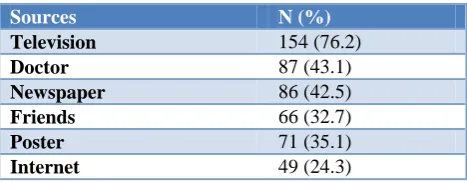
Table 2 entails the source of information about dengue. The main source of information on dengue was television (76.2%), followed by doctor (43.1%), newspaper (42.5%) and other sources.
Table 2: Source of information about dengue.
Sources N (%)
Television 154 (76.2)
Doctor 87 (43.1)
Newspaper 86 (42.5)
Friends 66 (32.7)
Poster 71 (35.1)
Internet 49 (24.3)
Knowledge toward dengue fever
Majority of the respondents have moderate level of knowledge (64.4%), and the rest were good level (25.25), and poor (10.4%). Table 3 depicted the percentage of correctly answered questions on knowledge. A total of 79.7% respondent knew that dengue was spread by bite of
Aedes. Surprisingly, only 27.2% of the respondent answered correctly for the question on secondary infection. More than half of the respondents knew that dengue is a severe flu-like illness. Approximately 66.8% of them knew that the rainy season is the dengue outbreak. Moreover, most of them knew about the symptom of dengue even not all of them answer correctly. They confused whether cough is one of the symptoms of dengue fever or not; only 54.5% of them answer correctly. More than 90% of them answered that
Aedes breed in stagnant clear water; vector of mosquitoes must be combat; killer larvae can kill mosquito larvae; water tank without lid must be cleaned every seven days. Almost 76.2% knew that dengue viruses transmitted by bite of female Aedes mosquitoes. Majority of them (70.8%) chose the right answer where insecticides can kill the adult mosquito.
Table 3: Knowledge on dengue fever.
Items Total
N (%) Dengue fever can be spread by the bite of Aedes mosquito 161 (79.7)
Human can be infected by dengue fever more than once 55 (27.2)
Dengue fever is a severe flu-like 114 (56.4)
The rainy season is the season of dengue outbreak 135 (66.8)
Symptoms:
High fever 183 (90.6)
Headache 183 (90.6)
Sore bones, muscle and joints 181 (89.6)
Pain in the back of the eye 183 (90.6)
Cough 110 (54.5)
Rashes 189 (93.6)
Vomit 172 (85.1)
Less appetite 187 (92.6)
Aedes breed in stagnant clear water 200 (99.0)
Transmitted by the bite of female Aedes 154 (76.2)
Method of controlling dengue is to combat the vector 183 (90.6)
Larvicide is beneficial in killing mosquito larvae 190 (94.1)
Attitude on dengue fever
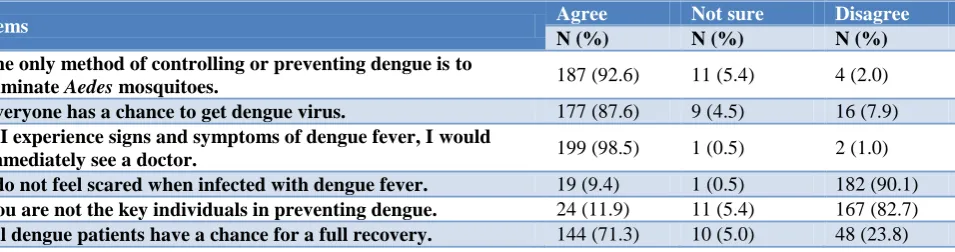
Almost three quarters of the respondents possessed good attitude (71.8%), with 7.2% having neutral attitude, and only 1% had poor attitude toward dengue fever. Table 4 shows that a total of 92.6% of respondent agreed that to control dengue cases is by eliminating the Aedes
mosquito while 87.6% of them agree that everyone have chance to get dengue virus. More than 90% of them would immediately see a doctor if they experience signs and symptoms of dengue. A total of 90.1% disagree that they are not scared when infected dengue fever while 9.4% agree that they were not scared of dengue fever. About 82.7% disagree that they were not the key individuals in preventing dengue. In addition, 71.3% of them agree that all dengue patients have a chance for a full recovery.
Practice on dengue fever
Descriptively, 65.3% of the respondents practiced good practice of dengue prevention, 25.2% with moderate, and the rest (9.4%) had poor practice. Table 5 entailed the questions on practice and the number of respondents who answered them favourably. A total of 86.1% of respondents will immediately close water container after using it. Majority of the respondents will get rid of Aedes
larvae from their water tank if there is any. About 68.3% of them changed the water in water containers in the
house every week, and 62.9% have changed the water in flower containers. Almost 70% checked mosquito larvae in a flower pot meanwhile, 95.0% of them checked the waste that blocked the flow of water around their house. A total of 84.2% were put the garbage in the trash. It was also found that almost 78.7% were already participated in dengue campaign in their area. A total of 81.2% had checked Aedes larvae in toilet tank, while 80.7 % had checked and clean the drains/gutters roofs during the rainy season.
Association between sociodemographic factors with knowledge, attitude and practice regarding dengue fever
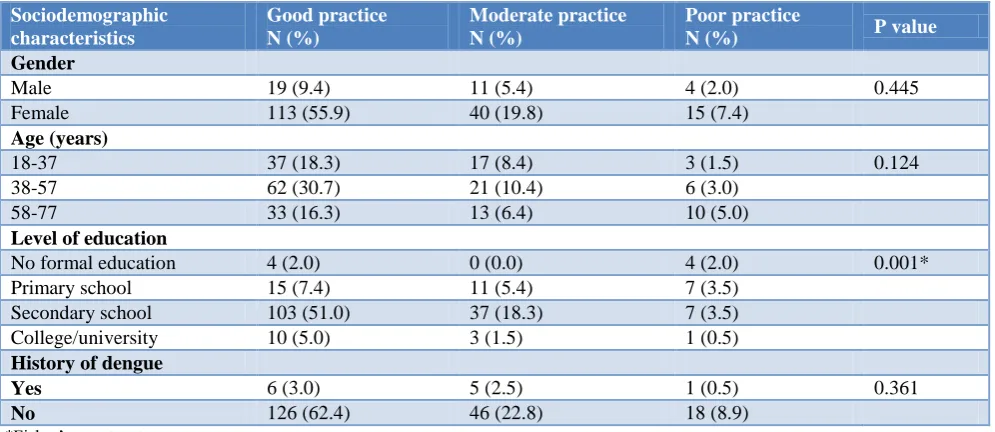
Table 6 shows the result for the association between socio-demographic factors with knowledge, attitude and practice regarding dengue fever. There is significant association between level of education with practice regarding dengue fever (p=0.001).
Association between knowledge and practice on dengue fever
Association between knowledge and attitude, attitude and practice, and knowledge and practice were tested using Pearson’s Chi square. Based on the test, knowledge was found to be associated with practice (Table 7). There was no association between knowledge and attitude, and between attitude and practice (result not shown).
Table 4: Attitude toward dengue.
Items Agree Not sure Disagree
N (%) N (%) N (%)
The only method of controlling or preventing dengue is to
eliminate Aedes mosquitoes. 187 (92.6) 11 (5.4) 4 (2.0)
Everyone has a chance to get dengue virus. 177 (87.6) 9 (4.5) 16 (7.9)
If I experience signs and symptoms of dengue fever, I would
immediately see a doctor. 199 (98.5) 1 (0.5) 2 (1.0)
I do not feel scared when infected with dengue fever. 19 (9.4) 1 (0.5) 182 (90.1)
You are not the key individuals in preventing dengue. 24 (11.9) 11 (5.4) 167 (82.7)
All dengue patients have a chance for a full recovery. 144 (71.3) 10 (5.0) 48 (23.8)
Table 5: Practice on dengue prevention and control.
Items Total
N (%) Do you immediately close the water container after using it? 174 (86.1)
If there Aedes mosquito larvae in the water tank, have you done anything to get rid of it? 193 (95.5)
Do you change the water in plant containers in the house every week? 138 (68.3)
Have you change the water in flower containers? 127 (62.9)
Have you check mosquito larvae in a flower pot? 142 (70.3)
Did you check the waste/garbage can block the flow of water around your home? 192 (95.0)
If yes, have you put it in the trash or dispose of it? 170 (84.2)
Do you participate in any dengue infection campaign in your area? Have you check the Aedes mosquito larvae in toilet tank
159 (78.7) 164 (81.2)
Table 6: Association between socio-demographic factors with practice regarding dengue fever.
Sociodemographic characteristics
Good practice N (%)
Moderate practice N (%)
Poor practice
N (%) P value
Gender
Male 19 (9.4) 11 (5.4) 4 (2.0) 0.445
Female 113 (55.9) 40 (19.8) 15 (7.4)
Age (years)
18-37 37 (18.3) 17 (8.4) 3 (1.5) 0.124
38-57 62 (30.7) 21 (10.4) 6 (3.0)
58-77 33 (16.3) 13 (6.4) 10 (5.0)
Level of education
No formal education 4 (2.0) 0 (0.0) 4 (2.0) 0.001* Primary school 15 (7.4) 11 (5.4) 7 (3.5)
Secondary school 103 (51.0) 37 (18.3) 7 (3.5) College/university 10 (5.0) 3 (1.5) 1 (0.5)
History of dengue
Yes 6 (3.0) 5 (2.5) 1 (0.5) 0.361
No 126 (62.4) 46 (22.8) 18 (8.9)
*Fisher’s exact test.
Table 7: Association between knowledge and practice regarding dengue fever.
Variable Practice, N (%) P value
Poor Moderate Good
Knowledge
Low 7 (58.3) 2 (16.7) 3 (25.0) 0.001*
Moderate 11 (11.2) 29 (29.6) 58 (59.2)
High 1 (1.1) 20 (21.7) 71 (77.2)
*Fisher’s Exact Test.
DISCUSSION
In this study, the overall findings showed that majority of the respondents had moderate level of knowledge, positive attitude and good practice on dengue fever. It was also found that there were significant associations between knowledge and practice regarding dengue fever, and between sociodemographic background (education level) and practice.
As for the source of information, the findings showed that most of the respondents get information about dengue from the television. This was similar with previous studies that identified television as a major source of public information.16,17 This showed that the mass media is very important in disseminating health information to the community. Another important source of information was from doctor. This is in line with finding in other study. The respondents may get information from health professionals when they go to the hospital to get some treatment.18
For knowledge on dengue fever, most of the respondents have moderate level of knowledge on dengue fever. Most of them have highest education at secondary school, and their knowledge was so limited. These finding was aligned to the study by Zaki et al whereby it showed
distribution of knowledge on dengue fever was more than half of the respondents had moderate knowledge.19 Majority of the respondents knew that dengue fever is spread by Aedes mosquito. This was similar with another local study whereby respondents knew that Aedes
mosquito is the vector that cause dengue fever.10 A small percentage of respondents answered that dengue fever can infect person once only. Only limited number of respondents knew regarding secondary infection. Knowledge regarding this aspect is important since secondary infection may impact in severe consequences as compared to the primary infection.20,21 Another point to be highlighted is only slightly half of the respondents answered that dengue is a severe flu-like illness. Majority of them thought that flu was not the symptom of dengue fever. Good knowledge of the symptoms of the disease is important for the rapidity of proper measures to initiate in order to prevent death of the victim. More importantly, their ability to recognize the signs and symptoms of dengue fever will aggravate them to seek early treatment.22
they would immediately see a doctor. This finding accorded the findings from other studies.23,24 This shown that although the respondents had moderate level of knowledge, they had a high level of attitude towards dengue prevention. In fact, almost all respondents knew that dengue is a serious disease and all of them felt that treatment should be sought immediately.
In regard of practice, majority of the respondents posed a good practice toward dengue fever. Majority of them were supportive of Aedes control measures. They practice some form of preventive measures against mosquito bite despite a minority still have poor practice. One of the reasons for the higher practice levels attained in this study may be that many questions on dengue practice were related to daily practices of cleanliness. Majority of the respondents will immediately close the water container after using it. This was similar to study by Aung et al.23 Moreover, majority of the respondents changed the water in plant containers in the house every week. Most of them also checked the waste or garbage that can block the flow of water around their house and put the trash into the garbage bin that has been provided in their area. They have good practice whereby they did not dispose the garbage by open burning. This finding was similar with the findings in a study in Vientiane.25
Association between socio-demographic and KAP regarding dengue fever was analysed by using Pearson’s Chi Square test. High education level was significantly associated with good practice of prevention towards dengue infection. This finding was aligned with a study in Pahang which showed there were also significant differences in the practice of dengue between primary and tertiary educational levels and between secondary and tertiary educational levels.10 This is further supported by a study in Perak which found a similar pattern.26
Pearson’s Chi square was applied to test the association between knowledge, attitude and practices among the community. There was a significant association between knowledge and practice among the respondents. This result was in accordance with a few studies.5-8,10 However, there were no significant association found between knowledge and attitude, and between attitude and practices.
CONCLUSION
This study managed to identify level of knowledge, attitude and practice regarding dengue fever among community in two rural settings. Generally, it can be concluded that the community in both places, had moderate knowledge, positive attitude and good practices. From the result, there was a significant association between level of education and practices regarding dengue fever. Besides, it was also found that there was an association between knowledge regarding dengue fever and practice of dengue prevention.
Therefore, there were some aspects regarding the control of dengue vector that need to be scaled up to improve the knowledge and behaviour of the residents towards prevention of dengue. This could be achieved by utilizing mass media in spreading the information of dengue control and prevention to the residents. Next, dengue prevention campaigns should focus on the risk of contracting dengue and education to increase knowledge about dengue, especially on the symptoms and secondary infection since these aspects is still not clearly understood by the community.
Study limitation
Our findings must be interpreted in the light of several potential limitations. Firstly, cross sectional design which does not allow causation. However, we carefully use the word association. Next, small sample size may have limited the ability to detect associations that were small and moderate in magnitude.
ACKNOWLEDGEMENTS
Authors would like to acknowledge the Universiti Sains Malaysia for supporting this study. We would also like to acknowledge all the professionals, health personnel, and all the respondents participated in this study.
Funding: This work was financially supported by the Universiti Sains Malaysia
Conflict of interest: None declared
Ethical approval: The study protocol was approved by the Human Research Ethical Committee (HREC) of Universiti Sains Malaysia
REFERENCES
1. Velayudhan R. A Toolkit for national dengue burden estimation. WHO/Department of Control of Neglected Tropical Diseases 2018: 2-15.
2. Madzlan F, Dom NC, Tiong CS, Zakaria N. Breeding Characteristics of Aedes Mosquitoes in Dengue Risk Area. Procedia Social Behav Sci. 2016;234:164-72.
3. Ooi EE, Goh KT, Gubler DJ. Dengue Prevention and 35 Years of Vector Control in Singapore. Emer Inf Dis. 2006;12(6):887-93.
4. Krishnamoorthy Y, Chandar D, Jayaseelan V, Vijayakumar K, Sivaranjini K, Vijayageetha M. Household survey on public awareness and attitudes toward dengue infection in rural Tamil Nadu, South India. J Edu Health Promo. 2018;7:171-6.
5. Dhimal M, Aryal KK, Dhimal ML, Gautam I, Singh SP, Bhusal CL, et al. Knowledge, attitude and practice regarding dengue fever among the healthy population of highland and lowland communities in central Nepal. PLoS One. 2014;9(7):1-15.
urban, semi-urban and rural communities in Malaysia. Sea J of Trop Med Pub Health. 2013;44(1):37-49.
7. Cho N, Wong YR, Chan YM, Koh PF, Chua Q, Choo NN, Clarice WS. Awareness of dengue and practice of dengue control among the semi-urban community: a cross sectional survey. J Comm Health. 2011;36:1044-9.
8. Hafeez F, Akram W, Suhail A, Arshad M. Knowledge and attitude of the public towards dengue control in urban and rural areas of Punjab. Pakistan J Zoology. 2012;44(1):15-21.
9. Amanah MA, Abdullah H, Ghafar N A. Knowledge attitude and practice on dengue among university students. Int J Comm Med and Pub Health. 2018;5(11):4720-4.
10. Hanim AA, Razman MR, Jamalludin AR, Nasreen EH, Htike MP, Swe Swe L, et al. Knowledge, Attitude and Practice on Dengue among Adult Population in Felda Sungai Pancing Timur, Kuantan, Pahang. Int Med J Malaysia. 2017;16(2):3-9.
11. Singru S, Debnath D, Bhosale SB, Pandve H, Fernandez K. Study of knowledge, attitude and practices regarding dengue in the urban and rural field practice area of a tertiary care teaching hospital in Pune, India. Med J DY Patil Vidyapeeth. 2013;6:374-7.
12. Stanaway JD, Shepard DS, Undurraga EA, Halasa YA, Coffeng LE, Brady OJ. The global burden of dengue: An analysis from the global burden of disease study. Lancet Inf Dis. 2013;16:712–23. 13. Hairi F, Ong CHS, Suhaimi A, Tsung TW, Bin Anis
Ahmad MA, Sundaraj C, et al. A Knowledge, Attitude and Practices (KAP) Study on Dengue among Selected Rural Communities in the Kuala Kangsar District. Asia-Pacific J Pub Health. 2003;15(1):37-43.
14. Ministry of Health. Annual Report 2008. Ministry of Health, Malaysia; 2010: 5-18.
15. Leong TK. Knowledge, Attitude and Practice on Dengue among Rural Communities in Rembau and Bukit Pelanduk, Negeri Sembilan, Malaysia. Int J Trop Dis Health. 2014;4(7):841-8.
16. Al-Dubai SA, Ganasegeran K, Mohanad Rahman A, Alshagga MA., Saif-Ali R. Factors affecting dengue fever knowledge, attitudes and practices among selected urban, semi-urban and rural communities in Malaysia. Southeast Asian J Trop Med Public Health. 2013;44(1):37-49.
17. Malhotra, G, Yadav A, Dudeja P. Knowledge, Awareness and Practices Regarding Dengue among Rural and Slum Communities in North Indian city,
India. Int J Medical Sci Pub Health. 2014;3(3):295-9.
18. Dhimal M, Aryal KK, Dhimal ML, Gautam I, Singh SP, Bhusal CL, Kuch U. Knowledge, attitude and practice regarding dengue fever among the healthy population of highland and lowland communities in Central Nepal. PLoS One. 2014;9(7):1-15.
19. Zaki R, Roffeei SN, Yien LH, Yahya A, Mahesh A, Said MA. Public perception and attitude towards dengue prevention activity and response to dengue early warning in Malaysia. PLoS One. 2019;14(2):1-22.
20. Changal KH, Raina AH, Raina A, Raina M, Bashir R, Latief M, et al. Differentiating secondary from primary dengue using IgG to IgM ratio in early dengue: an observational hospital based clinico-serological study from North India. BMC Infect Dis. 2016;16:715-21.
21. Mandavdhare HS, Sharma V. Differentiating primary and secondary dengue infections: Why and how? Med J DY Patil Univ. 2016;9(5):594-5. 22. Gyawali N, Bradbury RS, Taylor-Robinson AW.
Knowledge, attitude and recommendations for practice regarding dengue among the resident population of Queensland, Australia. Asian Pacific J Trop Biomed. 2016;6(4):360-6.
23. Aung MMT, Hassan A, Kadarman N, Hussin TMA, Barman A, Ismail S, et al. Knowledge, Attitude, Practices Related to Dengue Fever Among Rural Population in Terengganu, Malaysia. Malaysian J Pub Health Med. 2016;16(2):15-23.
24. Kamel M, Adli MN, Beulah DG. The KAP Study on Dengue among Community in Taman Salak Baiduri. Int J Sc Healthcare Res. 2017;2(3):319-25.
25. Sayavong C, Chompikul J, Wongsawass S, Rattanapan C. Knowledge , attitudes and preventive behaviors related to dengue vector breeding control measures among adults in communities of Vientiane, capital of the Lao PDR. J Infec Pub Health. 2014;8(5):466-73.
26. Firdous J, Mohamed A, Al Amin M, Ihsan M, Faris Imadi M, Hakim MK et al. Knowledge, attitude and practice regarding dengue infection among Ipoh community, Malaysia. J App Pharma Sci. 2017;7(8):99-103.
Cite this article as: Hamfadi NS, Rasudin NS, Ghafar NA. Household survey on attitude and practice toward dengue infection among rural dwellers. Int J