Received December 20, 2007
YI Zhihong
School of Business, Renmin University of China, Beijing 100872, China E-mail: [email protected]
Gu Dazhao
China Shenhua Energy Company Limited, Beijing 100011, China E-mail: [email protected]
SONG Hua (), YU Kangkang
School of Business, Renmin University of China, Beijing 100872, China E-mail: [email protected]
RESEARCH ARTICLE
YI Zhihong, GU Dazhao, SONG Hua, YU Kangkang
A technological innovation model based on
resource integration
—
A case study of Shenhua
© Higher Education Press and Springer-Verlag 2008
Abstract This paper proposes a model of network innovation based on resource integration drawing upon relevant literature on technology innovation. Through a case study of China Shenhua Energy Company Limited (Shenhua), it finds that in a high-velocity environment, technological innovation in enterprises becomes more external-oriented and network-oriented. The innovation patterns used in Shenhua mainly include hub and spoke innovation, chain innovation, and aggregation innovation. The adoption of these innovation patterns greatly enhances Shenhua’s innovation performance under the moderation of management mechanism of integrating internal and external resources.
Keywords resource integration, technological innovation, Shenhua
摘要 通过综述国内外与技术创新相关的理论,构建了基于资源整合的技术创新模
关键词 资源整合,技术创新,神华集团
1
Introduction
Under the environment of intensive competition and diverse customer demands, sustainable innovation has become a perpetual driving force for enterprise development. This requires not only efforts on partial technological innovation, but also on comprehensive, systematic and sustainable innovation. Through technological innovation, enterprises can obtain new kinds of resources to form core competence and sustainable competitive advantages. In order to enhance technological innovation capabilities, it is necessary to integrate and make good use of both internal and external resources and abilities. Fortunately, the existing literature on strategy, innovation (Tsai and Wang, 2005), and the new literature on dynamic capabilities (Teece, 2007) have provided certain theoretical foundations for resource integration. However, it is still lack of empirical studies. While case study is an empirical inquiry that investigates a contemporary phenomenon within a real-life context where the boundaries between phenomenon and context are not clearly evident, and in which multiple sources of evidence are used (Yin, 2003).
This paper aims at discovering a new trend of technological innovation, the technological innovation model based on resource integration, by using the method of single case study, and providing enlightenments for enterprises striving for enhancing technological innovation ability and maintaining sustainable competitiveness. In order to realize this purpose, the paper is divided into four parts. The first section is the review and conclusion about literatures in the field of technological innovation and then a new technological innovation model is established. The second section is description of the case study and the subject investigated. The following part is single case study that inspects and verifies key components of the theoretical framework. From both theoretical and practical perspectives, the paper finally draws conclusion about network innovation and enlightenment for future research.
2
Literature review and theoretical framework
“new combination” includes the following contents: (1) bringing in new products; (2) bringing in new technologies; (3) starting new markets; (4) controlling supplement of resources; (5) realizing new industrial organizations (Schumpeter, 1990). Followed Schumpeter, innovation theories began to develop along two orientations: one is the school of technological innovation represented by Mansfield and Schwartz, who conducted thorough research on the relationship between technological innovation and imitation, promotion and transfer; the other one is the school of institutional innovation represented by North, who combined innovation with institution, focusing on the relationship among institutions, technological innovation and economic benefits and emphasizing the importance of institutional environment on economy development (Ding, 2002).
Schumpeter originally defined innovation not only as technological innovation but also as marketing and organizational innovation. With the development of theories and practices, some scholars have proposed some new thoughts and theories which focus on technological innovation, innovation process, innovation system and so on (Dodgson, Gann and Salter, 2002). Five generations of technological innovation from 1950s to 1990s (Table 1) portray the development process of enterprise technological innovation from different perspectives. As shown in Table 1, most researchers have given up the idea that innovation means only the technology innovation. Innovation has been gradually recognized as a complex, multi-dimensional, nonlinear, networked, and interactive system and process.
Table1 Evolution of technological innovation process model
Model Data Features Contents
Technology as a driving force
1950s-1960s Simple, linear, and pushed by technology (Jesaph Schumpeter, 1912 )
Technological innovation is linear and spontaneous transformation guided by technology. Markets only receive technological achievements passively. Demand as a
driving force
1960s-1970s Simple, linear, and pulled by demand (Kamien and Schwartz, 1975)
Markets are sources of innovation conception. Demands offer opportunities for products and technical innovation and play a critical role in innovation. Interaction
between technology and market
1970s-1980s Based on interaction (Rothwell and Zegveld, 1985; Steinmueller, 2000)
Innovation process is brought by interaction between technology and demands. Push of technology and pull of demands have different effects on different stages of product life cycle and innovation process.
(Continued )
Model Data Features Contents
Integrated technological innovation
1980s-1990s Based on chain link network (Kline and Rosenberg, 1986)
Integrated R&D and manufacture are emphasized and close cooperation of enterprises, suppliers and customers.
Systematic network of technological innovation
1990s- System integration and network (Dodgson, Gann and Salter, 2002)
The innovation process is defined as a complex network of communication across internal and external organizations, which focuses on both function linkage and the strategic coordination across companies. Source: Study on the Capability of Total Innovation Management in Chinese Firms (doctor dissertation), Mao Wuxin, Zhejiang University, 2006.
How can technological innovation capability bring competitive advantages to enterprises? Two yardsticks can be used to measure the innovation capabilities: “technical” fitness and “evolutionary” fitness (Helfat et al., 2007). Technical fitness is defined by how effectively a capability performs its function, regardless of how well the capability enables a firm to make a living. On the contrary, evolutionary or external fitness refers to the environment chosen. Since dynamic capabilities are useful in obtaining evolutionary adaption, which can be used to shape the environment to a certain degree. Dynamic capabilities theory proposed by Teece (2007) shows that in high-velocity markets, there are simple, highly experiential and fragile processes with unpredictable outcomes. Companies can achieve sustainable competitiveness not only by difficult-to-duplicate assets (e.g. knowledge) but also by unique dynamic capabilities. These capabilities can be used to continuously create, extend, upgrade, protect, and keep new resource configurations. Meanwhile, they are also required to adapt to changing customer and technological opportunities and to upgrade the enterprise’s capacity to shape the ecosystem it occupies.
relevant search. In a fast-paced environment, with a large number of new products coming from external sources, search/exploration activity should not just be local. Enterprises must search the core as well as to the periphery of their business ecosystem. Search must embrace potential collaborators—customers, suppliers, complementors—who are active in innovative activity (Teece, 2007). This paper defines this pattern as a “hub and spoke” model (with technological innovation as the hub), which interconnected neighboring actors such as enterprises, universities, research institutes, government, financial institutions together as spokes. In such an innovation community, each one should have its “eco-niche”. If innovators want to jump to a higher level, they should exchange more information and communicate with the external environment.
In 1997, Iansiti proposed the conception of technology integration and considered that by applying technology integration management, firms are able to innovate more continuously in technologies. Thoughts and creation of new products come not only from different departments in a company, but also from its partners and customers. This new integrated mechanism makes it more likely to realize breakthroughs in innovation. It not only involves investment in research activities, investigation of customer needs, analysis of technological possibilities, but also involves understanding of latent demands, the structural evolution of industries and markets, and the likely responses of suppliers and competitors. In doing so, enterprises will have more opportunities to capture customer needs and smoothly commercialize its products to market (March and Simon, 1958; Nelson and Winter, 1982). Empirical study has shown that successful commercialization of innovation is closely related to the innovators’ understanding of customer demands (Freeman, 1974). Sometimes, customers may even be the first one to realize the potential functions of a new technology. Therefore, if a new technology does not have a good understanding of customer demands, the ultimate products will not be popular in the market. Besides, suppliers also work as the driving forces behind ultimate products. With rapid innovation in component market, competition among downstream suppliers can also affect upstream enterprises’ obtaining of leading innovation capabilities (Teece, 2007). Based on the above literature review, we define “chain innovation” as a pattern emphasizing an integrated way of innovation, which combines all participants along the value chain, including suppliers, upstream and downstream firms, and customers.
(Freeman, 1991; Eisenhardt and Martin, 2000; Fleming and Sorenson, 2003) and so on. Prahalad and Hamel also proposed that innovation capability is a system and must be established at the industrial level. Industrial innovation system is rooted in a series of close interrelated innovation sources. These sources will, by means of dynamic technology transfer and effective feedback mechanism, boost more innovations in relevant fields. As a result, the innovation capability of the whole industry will be raised to a higher level Teece (2007) considered that this type of complementary innovation is very important, especially in industries where innovation is characterized by accumulation or innovation platform. This complementation brings not only expansion of an industry in both scale and scope but also a state of co-specialization among different industrial segments. Therefore, we defined “aggregation innovation” as a network innovation process among closely interrelated but different segments within an industry.
Fig.1 Technological innovation model based on resource integration
3
Research method and sample selection
This study used the embedded single-case method, in which researchers firstly select a typical firm in a certain industry and then investigate a few sub-analytical units in the firm. After that, researchers establish and verify their theoretical model. Although numerous scholars have proposed that multi-case study is more reliable than single-case study, single-case study is still a useful approach in challenging and expanding theories. It is especially effective for studying unique or even extreme cases. Besides, when studying a single firm, single-case study can, in comparison with multi-case study method, analyze all kinds of complex conditions easier and construe the practical operating conditions of that firm deeper. Hence single case study is commonly used to in theory developing.
The background of this study is the coal industry in China and the selected firm under study is Shenhua Energy Company Limited. Shenhua is a comprehensive energy enterprise, the biggest domestic coal producer, seller and the second listed Coal Company in the world. It has the largest reserves of high quality coal in China. The primary businesses of Shenhua include coal production, selling, power supply, and railway transportation and harbor services (Fig. 2). By June 2007, the operating revenue and profits of Shenhua have increased respectively by 29.8% to 38.331 billion yuan and by 25% to 16.452 billion yuan on an annual basis.
Hub and Spoke Innovation
Integration Innovation Chain Innovation
Performance Internal
resources Hub and spoke Externalresources
innovation
Innovation
Integration innovation Chain innovation
Power segment , 16,628, 26%
Coal segment, 45,948, 71%
Others, 479, 1%
Transportation segment, 1,185,
2%
Fig. 2 Operating revenue structure of Shenhua in 2006 (Unit: million yuan) Source: Shenhua’s financial report (2006).
Three types of data-collection methods were used in this case study: The first type involves in-depth interviews and field investigation, which lasted from July to October, in 2007. The interviewees included corporate executives, managers from technology departments, and managers of subsidiaries. The second were financial report and annual reports of Shenhua, and the third, other types of data and information released by Shenhua.
4
Technological innovation based on resource integration in
Shenhua
Shenhua is an integrated energy enterprise that operates in a series of important industries, such as coal, power, oil, and transportation. These industries vary greatly in technology, entrance thresholds and in other aspects. However, Shenhua is different from any other large state-owned companies because it has few R&D institutes. At present, there are only three technological research centers in Shenhua, namely, coal, power and chemistry industries respectively. Altogether, these research centers have only about two hundreds researchers. Therefore, if Shenhua only relied upon the R&D capabilities of its own, Shenhua could hardly promote the technological innovation effectively. Under such circumstances, it is necessary for Shenhua to find an effective way to utilize external resources.
4.1 Hub and spoke innovation
technological innovation ecosystem. During the process of technological innovation, Shenhua makes a good use of external technological resources and establishes a technological innovation system by making technology management department as hinge, industrial segment technology center as support, professional technology talents as core and post-doctoral workstation as platform. On the prerequisite of mastering key process and core technologies (systematic innovative technology integration and management), Shenhua uses social innovation resources, unites external research centers, forms strategic alliances, and integrates universities, institutions, and other companies by combining internal and external resources together. In doing so, Shenhua allies different enterprises, institutions and universities to enhance performance of the innovation community by setting up industrial standards, sharing technologies and resources, organizing and coordinating relationships among different modes (Fig. 3).
Fig. 3 Hub and spoke model of Shenhua
Among the different relationships existing in an innovation community, the principal (the hub company) plays a central role in the network. In the case of Shenhua, although a lot of external resources and capabilities are integrated in the network, the core technologies and key processes are still in the hand of Shenhua. In an interview, the general manager of technology department of Shenhua emphasized that:
Research
institutes Colleges &
universities
Cooperate enterprises
Competitive enterprises
Government departments Finance
insititutions Shen Hua Group
We should use social resources under the premise of “two holdings”. That is, to hold the key processes of technological innovation, and to hold the core technology.
For example, during the process of developing coal liquefaction techniques in collaboration with outside research institutions, Shenhua succeeded in developing new and patented catalyst and techniques of coal liquefaction. In addition, Shenhua built a pilot test plant in Shanghai which can handle six tons coal per day. However, the development and perfection of techniques of coal liquefaction is a lengthy and difficult process which requires good cooperation of researchers from various fields, like coal, oil, chemistry, machinery, material and so on. Owing to lack of professional experts in so many fields, Shenhua retains experts on techniques of coal liquefaction from relevant institutions and petrochemical corporations at home and abroad, while the core technology is still held by Shenhua’s own experts.
To those peripheral partners of the hub and spoke, Shenhua outsources all kinds of research activities to them by means of development consignment, joint development, consignment auditing. The general manager of technology department of Shehua listed a few important cooperative projects in an interview:
Shenhua has formed strategic alliances with China Aerospace Science and Technology Corporation, Shanghai Academy of Spaceflight Technology as well. Shenhua also cooperates closely with a number of external enterprises, including 15 big stage-owned enterprises, by means of establishing experimental plants with them. There is also a strategic alliance of technological innovation constituted of China Iron & Steel Research Institute Group, China Academy of Machinery Science & Technology, China National Chemical Engineering Group Corporation, and Shenhua. Therefore, making full use of external research resources through formal channels, we achieved a win-win situation.
coordination committee of Co-operation among Industries, Universities and Research Institutes (formed by the Ministry of Science and Technology, Ministry of Finance, Ministry of Education, State-owned Assets Supervision and Administration Commission, All China Federation of Trade Unions and China Development Bank) to establish a “Strategic Alliance of Technological Innovation in Clean and Efficient Coal Exploitation, Liquefaction and Prolificacy” to supply technology and services for corresponding coal, power, oil and transportation departments in Shenhua; (3) alliance with other enterprises in the same industry. This kind of cooperation can promote information sharing and technology and knowledge communication in the network. In the project of coal liquefaction, cooperating with international enterprises in the same industry, Shenhua integrated advanced technologies from Japan, US and Germany. Based on these imported technologies, Shenhua renovated and improve the technologies of it own; (4) alliance with other partners. During the process of developing high-strength hydraulic support structure, Shenhua signed special contract and collaborated closely with domestic hydraulic support structure manufacturers to invent support structures with length ranging from 2.4m to 6.3m. Most of Shenhua’s previous scientific research achievements were applied in manufacturing of these two kinds of equipments; (5) alliance with financial institutions. This kind of cooperation helped Shenhua get more financial support and shared its risks of technological innovation. Shenhua established long-term strategic cooperative relationships with many banks such as the Industrial and Commercial Bank of China, Pudong Development Bank, China Merchants Bank and so on in order to reduce financial risks.
4.2 Chain innovation
management, buyer-supplier relationship management, and complex capacity management, capital management and so on.
In the survey, we found that the research and manufacturing of key equipments in Shenhua is characterized by chained innovation. Coal industry relies heavily on equipment manufacturing. The technical level and market competitiveness of a coal enterprise depends, to a large extent, on the advancement of its equipments. For a long time, Shenhua was the biggest buyer of high-level excavating equipments, but most of its equipments were imported from manufacturers in developed countries. In the early 2004, Shenhua decided to develop hydraulic support facility independently to achieve the localization of excavating equipment manufacturing. In doing so, Shenhua firstly carried out in-depth studies on the design, virtues, and defects of imported facilities. Then Shenhua renovated the design and manufacturing techniques of these equipments. Shenhua also conducted research on high-intensity steel plate welding procedure independently. Also, Shenhua depended on domestic partners to develop some of the much needed equipment, For example, Shenhua signed a consignation contract with China Aerospace Science and Technology Corporation to develop an electric-hydraulic control system together. In developing the above mentioned high-strength hydraulic support structures, Shenhua required its manufacturers to implement high standard quality system and strict superintendence system when designing and manufacturing these equipments. During the process of approving and initiating a project, the performance is ensured by the following measures, as mentioned by a manager in the interview:
One is perfecting internal management mechanisms, including establishing technical center and committee, experts consulting committee and research institutes, and training talents with post-doctoral workstation. Complete procedure management system is also set up to supervise the whole process of a project from project initiating, approving, evaluating, inspecting, accepting, and to reevaluating. The other is improving external management mechanism, including the way of selecting project undertakers, forming strategic cooperative relationships, ways of bid invitation and business negotiation.
development will be borne by the manufacturer; (2) Provide corresponding technical support and other necessary support. Shenhua joined the manufacturer’s research and manufacture of hydraulic support structures, helped solve critical technical problems, and assisted manufactures in speeding up their R&D process. As a result, the hydraulic support structures (4.5m and 5.5m) developed by Zhengzhou Mining Machinery Group and Beijing Mining Machinery factory all have good qualities. Even when these domestically made equipments are compared side by side with imported equipments of the same type, the result is still quite satisfactory. (3) During the course of equipment manufacturing localization, Shenhua provides capital, technology and marketing support and other necessary support to its manufacturers to jointly achieve the localization process. For example, in cooperation with China Aerospace Science and Technology Corporation after the sample machine passed trail test, experiment, Shenhua took the initiative to pay the R&D expenses for 30 hydraulic support structures. This mechanism of risks sharing with its partners in capital, technology and marketing has greatly sped up Shenhua’s process of equipment localization.
4.3 Aggregation innovation
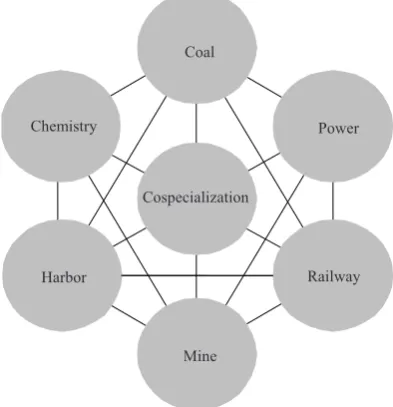
Shenhua integrated lots of coal-industry-related chains and formed a network (as shown in Fig. 4) which combines together the industries of coal, power, road, harbor and oil and connects tightly production, transportation and marketing. Besides, Shenhua’s innovation does not only locate at each nod in the network, but also focuses on realizing a synergy among different specialized partners, eliminating possible conflicts among different industries, and achieving the aggregation effects among industrial chains so as to enhance the innovation performance of the whole network.
Chemistry Power
Railway Harbor
Mine Coal
Chemistry Power
Railway Harbor
Cospecialization
Mine Coal
Fig. 4 Aggregation innovations in Shenhua
for itself. Meanwhile, it can also guarantee constant fuel supply for its power plants. Hence a joint research and development on coal, power and oil industries bring in valuable synergies to Shenhua; (2) Synergies of transportation, harbor services, and coal production. The privately-owned railways of Shenhua makes centralized dispatching possible. Point-to-point transportation system adopted by Shenhua can excavate, transport and wash coal one-offly and simultaneously, which guarantees a prompt completion of Shenhua’s transport schedule. Shenhua’s closed-loop transportation system consisted of mine, railroad and harbor reduces efficiently disturbance from external environment, decreases uncertainties of products marketing and helps keep a balance of supply; (3) synergies of coal, power, road, harbor and mine. The Coal mines of Shenhua provide raw materials for power plants, and power plants in turn support coal production and operation. In addition, Shenhua’s coal is transported via harbors, and these harbors are also turned into power plants owing to the abundant coal supply. Depending on its unequalled coal-supply and transportation capabilities, Shenhua obtained more and more opportunities of investing in high profit power businesses in the coastal areas, gaining great advantages in terms of cost and price over its rivals.
4.4 Performance of the innovation network
innovation has greatly promoted the R&D procedure of Shenhua. In an interview, the general manager of technological department of Shenhua listed the direct and indirect benefits brought in by application of many technological innovations:
Project of Shendong Mining Site created profits of more than 10 billion yuan. Project of Shuohuang Railway changed the model of operating railways. Back-silting Project of Huanghua Port creates 5 billion yuan benefit per year. Excavating Project of Shenhua succeeded in realizing the localization of equipment manufacturing. Purification Technology of Wood Coal converted coal of low quality into high-quality coal. Saving Water to Generate Electricity Project of Shenhua solved the water shortage to some extent.
After applying the technological innovation achievements to practices, Shenhua greatly promotes the production and marketing of its main business segments, such as coal and power (as shown in Fig. 5 and Fig. 6, respectively), As measured by financial performances (Fig.7), the operating revenues, EBITDA, respective operating revenue of coal segment and power segment also increase dramatically.
(Million ton)
0 20 40 60 80 100 120
2004 2005 2006 2007
Commercial coal production Coal sales
Fig. 5 Coal business of Shenhua from 2004-2007
(MW) (100 million kWh)
0 1000 2000 3000 4000 5000 6000 7000 8000 9000
2004 2005 2006 2007 0
50 100 150 200 250 300 350 400
Installed capacity Total power output dispatch
Fig. 6 Power business of Shenhua from 2004-2007
Sources: Date from the financial reports (2005, 2006) and the interim report (2007) of Shenhua.
(Million yuan)
0 5,000 10,000 15,000 20,000 25,000 30,000 35,000 40,000 45,000
2004 2005 2006 2007
Total operating revenue EBITDA
Profit from operations of coal segment Profit from operations of power segment
CAGR=31.5% CAGR=28.7%
CAGR=69.4% CAGR=28.7%
Fig. 7 Financial conditions of Shenhua from 2004-2007
Sources: Data from the financial reports (2005, 2006) and the interim report (2007) of Shenhua.
downstream enterprises. As below, the above general manager concluded the technological innovations achieved by Shenhua. He also talked about the social benefits brought in by the independent technological innovation of Shenhua:
Technological innovation of Shenhua enhanced the technical level of the whole industry. For example, model of efficiency-energy in Shendong has been widely copied. Shenhua’s safety control system of mines has been adopted by other mines in the whole country. Besides, our model of strategic alliances will continue to be promoted because the model invites cooperators according to the market demands. It is thus considered to be a more competitive approach. Technological innovation of Shenhua has also solved the safety problem and the energy and structural problem of coal industry. This prompted technological innovation in the whole industry. Also, our technologies such as coal transformation and seawater desalination brought notable benefits.
In the innovation network of Shenhua, cooperation with other research institutes can create new knowledge and technology, prompt spread of knowledge, information and technology, and optimize resources allocation by horizontal cooperation (competitive enterprises in the same industry) and vertical cooperation (upstream and downstream enterprises). This includes three levels which are innovation enterprises, fundamental industries and supportive network. These levels are not independent but connected with each other on the basis of transaction, industry correlation and knowledge sharing.
5
Conclusion and future opportunities
The case study of Shenhua verified the model of network innovation based on resources integration, that is, to integrate both independent technological innovation and boundary-crossing innovations to form a steady reciprocal innovation network, which utilizes an enterprise’s internal and external resources by means of hub and spoke, chain, and aggregation types of innovations. This can help enterprises realize synergy among different industries, complete dynamic process of knowledge sharing and resources activating, and then help them achieve the final goal of enhancing capability of independent technological innovation and keeping sustainable competitive advantages. Main conclusions are as follows:
of distributing and using resources to enhance the capability of independent innovation. Thus we argue that an enterprise’s resources include all the items that can enhance the value of the enterprise potentially and practically, including not only resources owned or controlled by the enterprise but also those resources unable or uneasy to be obtained by the enterprise. The integration of resources is to merge, aggregate and combine all these dispersed resource into a more efficient system in accordance with specific demands and situations. By converging both the internal and external resources into a network, enterprise are able to obtain more benefits and efficiency than that of dispersed resources can bring in. The purpose of resources integration is not for one single industry, but for establishing an ecosystem, which includes organizational communities, institutions, customers, suppliers, and other stakeholders. As a large state-owned enterprise, Shenhua is able to integrate resources across different industries and departments. On the one hand, Shenhua succeeded in integrating national, regional and industrial resources at the macro level. On the other hand, Shenhua also combined resources from different internal departments and upstream and downstream partners at the micro level. Therefore, technological innovation of Shenhua is a system coordinating both internal and external resources under an efficient management system. This is in accordance with the empirical conclusion drawn by Tsai and Wang (2005), who stated that simply obtaining external technologies from outside can not enhance an enterprise’s performance. However, the internal integration capacity of R&D will affect positively the external technologies’ contribution to enterprise performance.
the premise of mastering core technology and key processes; second, establish vertical cooperative alliances with upstream and downstream enterprises. It is chain innovation that prompts upstream and downstream technological innovation by sharing risks, profits and innovation fruits; third, co-specialization among relative segments to adapt to external environment with diversified demands and dynamic changes. That is an aggregation innovation which enhances performance of innovation network constructed by several industrial chains. Therefore, entrepreneurs and managers can create special values by merging properties of co-specialization (Teece, 2007).
In conclusion, this paper exploits a new innovation trend by the case study of Shenhua—a technological innovation model based on resources integration, and provides suggestions for similar companies on how to engage in effective innovation. However, this conclusion is only based on a single case study. Hence in the future, large sample approach is recommended to further test our conclusion.
References
Capon N, Glazer R(1987). Marketing and technology: A strategic coalignment. Journal of Marketing, 51(3): 1–14
Chatterji D(1996). Accessing external sources of technology. Research Technology Management, 39(2), 48–56
Cohen W M, Levin R C(1990). Absorptive capability: A new perspective on learning and innovation. Administration Science Quarterly, 35(1): 128–152
Council of Supply Chain Management Professional(2006). Supply Chain Management / Logistics Management Definitions. http://www.cscmp.org/Website/AboutCSCMP/Definitions/ Definitions.asp
David J T(2007). Explicating dynamic capabilities: The nature and microfoundations of (sustainable) enterprise performance. Strategic Management Journal, 28: 1319–1350 De la Mothe J, Paquet G(1998). Local and Regional System of Innovation. Norwell. MA:
Kluwer Academic Publishers
Ding Juan(2002). Evolution of innovation theory. Modern Economy Investigation, (6): 27–29 (in Chinese)
Dodgson M, Gann D M, Salter A J(2002). The intensification of innovation. International Journal of Innovation Management, 6(1): 53–83
Duysters G, Hagedoorn J(2000). Core competencies and company performance in the worldwide computer industry. Journal of High Technology Management Research, 11(1): 75–91
Dyer W G Jr, Wilkens A L(1991). Better stories, not better constructs, to generate better theory: A rejoinder to Eisenhardt. Academy of Management Review, 16(3): 613–619
Edquist C(1997). Systems of Innovation. London: Printer
Eisenhardt K E, Martin J A(2000). Dynamic capabilities: What are they? Strategic Management Journal, 21: 1105–1121
Review, 14(4): 532–550
Fleming L, Sorenson O(2003). Navigating the technology landscape of innovation. MIT Sloan Management Review, 44(2): 15–23
Freeman C(1974). The Economics of Industrial Innovation. Harmondsworth, UK: Penguin Books
Freeman C(1991). Networks of innovators: A synthesis of research issues. Research Policy, 20: 499–514
Granstrand O, Bohlin E, Oskarsson C(1992). External technology acquisition in large multi-technology corporations. R&D Management, 22(2): 111–133
Halfat C, Finkelstein S, Mitchell W, Peteraf M A, Singh H, Teece D J(2007). Dynamic Capabilities: Understanding Strategic Change in Organizations. Oxford, UK: Blackwell, Winter SG
Huang Rucheng(2004). Innovation community and its characteristics. Scientific Management Investigation, (8): 4–6 (in Chinese)
Huber G P(1991). Organizational learning: The contributing processes and a review of literatures. Organization Science, 2(1): 88–117
Iansiti M, West J(1997). Technology integration: Turning great research into great products. Harvard Business Review, 75(3): 69–80
Janszen, F(2002). Innovation: Successful Model in Network Era (Translated by Lei Hua and Ma Lewei). Kunming: Yunan University Press (in Chinese)
Jonash R(1996). Strategic technology leveraging: Making outsourcing for you. Research Technology Management, 39(2): 19–25
Kamien M, Schwartz N(1975). Market structure and innovation. Journal of Economic Literature. 23(1): 1–37
Kline S, Rosenberg N(1986). An overview of innovation. In: The Positive Sum Strategy, Landau, R. & Rosenberg, N. (eds.). Washington: National Academy Press
March J G, Simon H A(1958). Organizations. Wiley: New York
Nelson R R(1982). An Evolutionary Theory of Economic Change. Cambridge, MA.: Harvard University Press, Winter SG
Nelson R(1993). National Innovation Systems: A Comparative Analysis. New York: Oxford University Press
Noori H(1990). Managing the Dynamics of New Technology. New Jersey: Prentice Hall Robert K Y(2003). Case Study Research: Design and Methods. Thousand Oaks, CA: Sage
Publications
Rothwell R, Zegveld W(1985). Reindustrialization and Technology. London: Longman Schumpeter J A(1990). The Theory of Economic Development. Beijing: Commercial Press,
73–74 (in Chinese)
Steinmueller W E(2000). Will new information and communication technologies improve the “codification” of knowledge? Industrial and Corporate Change, (9): 361–376