Original Research Article
A study of prevalence of goiter among school children in Kolar
Varsha R. Mokhasi
1*, Muninarayana C.
1, Shashidhar K. N.
2INTRODUCTION
Iodine is an essential micronutrient required at 100-150 micrograms daily for normal human growth and development.1 Iodine deficiency leads to a much wider spectrum of disorders commencing with the intrauterine life and extending through childhood into adult life with serious health and social problems. Majority of consequences of iodine deficiency disorders (IDD) are invisible and irreversible but at the same time preventable.2 School-age children of 6 to 12 years are considered as an important target group for surveillance of IDD because they are highly vulnerable, easy to access, and also their applicability in a variety of surveillance activities.3
Nearly 266 million school-aged children worldwide have insufficient iodine intake. IDD was a public health problem in 47 countries. Sample surveys in India revealed that out of 324 districts surveyed so far, 263 districts are IDD endemic (prevalence 10%).5 India has made considerable progress toward IDD elimination by implementing National Iodine Deficiency Disorders Control Programme (NIDDCP) in the year 1992.6 Kolar, being a drought prone area with semi-arid climate, mainly dependent on ground water for drinking has also been home for fluorosis. As there are no recent studies on the prevalence of goiter in this area, a cross sectional study was conducted.
ABSTRACT
Background: Iodine deficiency disorders (IDD) constitute the single largest cause of preventable brain damage worldwide leading to learning disabilities and psychomotor impairment. Nearly 266 million school children worldwide have insufficient iodine intake. IDD was found to be a public health problem in 47 countries. Since the information on current prevalence of goiter in Kolar was not available, the present study was undertaken.
Methods: A cross-sectional study was conducted among school children aged 6-12 years in Kolar taluk. A total of 650 children (325 urban and 325 rural) were selected for goiter examination by multistage random cluster sampling technique. A total of 150 children were tested for the median urinary concentration and 150 salt samples were tested from the households of the study population.
Results: The total goiter rate was 6.6% among primary school children aged 6-12 years with a significant difference between ages. As the age increased the goiter prevalence also increased. The median urinary iodine excretion level was found to be 137 µg/l and 92.7% salt samples had >15 ppm iodine content.
Conclusions: Present study shows mild goiter prevalence in primary school children in Kolar and an adequate iodine content of salt and urine.
Keywords: Goiter, Prevalence, IDD, Urinary iodine
1Department of Community Medicine, 2Department of Biochemistry, Sri Devaraj Urs Medical College, Tamaka,
Kolar, Karnataka, India
Received: 15 October 2019
Revised: 07 November 2019
Accepted: 08 November 2019
*Correspondence:
Dr. Varsha R. Mokhasi,
E-mail: [email protected]
Copyright: © the author(s), publisher and licensee Medip Academy. This is an open-access article distributed under the terms of the Creative Commons Attribution Non-Commercial License, which permits unrestricted non-commercial use, distribution, and reproduction in any medium, provided the original work is properly cited.
METHODS
The present study was a cross-sectional descriptive study, undertaken in schools of Kolar taluk, including the students from both rural and urban areas. The children aged between 6-12 years were included from lower and higher primary schools in rural and urban areas of Kolar. The study was conducted from 1st November 2014 to 31st October 2015 (one year). A total of 650 students were selected, 325 each from the urban and rural schools. Multistage cluster random sampling technique was used to select study sample.
The sample size was calculated by considering the prevalence of goiter among the school children as 30% from a previous study conducted in Belgaum by Kamath et al.6 The absolute error for the sample size calculation was considered as (d=5%), at 95% confidence interval and α error of 5%. Since multistage cluster random sampling technique was used, a design effect of 2 was multiplied to get the final sample size. The total sample size calculated was 644 which were rounded upto 650. The assessment for prevalence of goiter among school children was done using a pre-tested semi structured and pre-validated questionnaire. Urine iodine was measured by Sandall Kolthoff method and salt iodine by a semi-quantitative test kit.3
The collected data was entered into Microsoft Excel spread sheet. The data was summarized and presented as frequencies, proportion, mean and standard deviation, depending on the quantitative or qualitative variables. Analysis was performed using SPSS 22 version. Chi-square was the test of significance for qualitative data. Independent t-test or Z-test was the test of significance for quantitative data between two groups, p value less than 0.05 was considered as statistically significant.
RESULTS
The following table provides the grade wise distribution of goiter. The overall prevalence of goiter among the school children aged 6-12 years was found to be 6.6%, in which 4.8% had Grade 2 goiter and 1.8% had Grade 3 goiter. The prevalence of goiter was found to be high in rural area (11.07%) when compared to urban area (2.15%) (Table 1).
Table 1: Distribution of study subjects according to grade of goiter.
Grade of goiter
Rural Urban Total
N (%) N (%) N (%)
Grade 1 289 (88.92) 301 (92.61) 607 (93.4)
Grade 2 26 (8) 5 (1.53) 31 (4.8)
Grade 3 10 (3.07) 2 (0.61) 12 (1.8)
Total 325 325 650
χ2=20.945, df=2, p=0.001.
The study also revealed that among the 43 children having goiter, most of the children of 10-12 years were found to have goiter (81.39%), and followed by 8-9 years (13.95%). There was increase in prevalence of goiter with increase in age, this was found to be statistically significant (p=0.001) (Table 2).
Table 2: Age wise distribution of children according to grades of goiter.
Age (years)
Grade 1 Grade 2
and 3 Total
N (%) N (%) N (%)
6-7 200 (32.94) 2 (4.65) 202 (31.07)
8-9 195 (32.12) 6 (13.95) 201 (30.92)
10-12 212 (34.92) 35 (81.39) 247 (38)
Total 607 43 650
χ2=37.45, df=2, p=0.001.
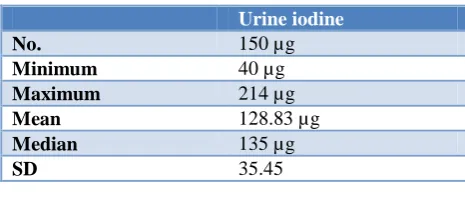
The Table 3 shows that the median urine iodine excretion (UIE) among children was 135 μg/l. Among the 150 urine samples tested for iodine levels in urine, only 12% of the children were found to have inadequate UIE, whereas 88% of the children had adequate UIE (Table 4).
Table 3: Mean urine iodine level among the study subjects.
Urine iodine
No. 150 µg
Minimum 40µg
Maximum 214 µg
Mean 128.83 µg
Median 135 µg
SD 35.45
Table 4: Distribution of UIE levels among the study subjects.
UIE Frequency %
Inadequate 18 12
Adequate 132 88
Total 150 100
Table 5 shows that among the 150 salt samples collected, 18 (12%) had inadequate iodine (<15 ppm) whereas 132 (88%) of the samples were found to have adequate iodine.
Table 5: Distribution of salt iodine levels among study subjects.
Salt iodine Frequency %
Inadequate iodine 18 12
Adequate iodine 132 88
DISCUSSION
The present study was conducted 24 years after the implementation of universal iodization of edible salt. This study was conducted to find the current status of goiter prevalence in Kolar taluk among school children aged 6-12 years.
Prevalence of goiter
The total prevalence of goiter (i.e., the palpable and visible goiter) in the present study was found to be 6.6%. According to the WHO criteria for severity of goiter, this rate of goiter prevalence falls under the category of being a mild public health problem as it falls in the range of 5.0-19.9%. This indicates that Kolar is in a transition phase from iodine deficient to being iodine sufficient.7 There is a wide variation of prevalence of goiter across the country, as observed in various studies ranging from 0.125-50.1%.8,9 Severe endemicity of goiter was reported by Joshi et al in a rural area of Meerut with an overall prevalence of goiter of 50.1%, and Sayed et al (34.6%). Persistence of severe goiter was attributed to environmental iodine deficiency and also diets high in certain foods which interfere with iodine utilization by the body.9,10
Kapil reported IDD to be of mild degree in Bharatpur, Rajasthan and Champaran district, Bihar with an overall goiter prevalence of 7.2% and 11.6% respectively.11,12 Similar findings were made by Sareen et al in Uttarakhand (TGR=13.2%) and by Lohiya et al in Faridabad, Haryana (TGR=17%).13,14
This wide variation could be due to geographical disparity in the country with respect to the environmental factors influencing the prevalence of goiter.15 This could also be due to variation in the methodology adopted in terms of sample size and age groups included in various studies.
Grades of goiter
The present study showed that among the grades of goiter, Grade 2 (4.8%) was found to be more prevalent than grade 3 (1.8%). Chandra et al, also observed in Imphal, Manipur and Sundarban delta of West Bengal, that most of the goiter was found to be Grade 2 (24.73% and 30.4% respectively) and the prevalence of Grade 3 was only 5.29% and 2.7% respectively.16,17 Similarly other studies in Churachanpur District of Manipur by Singh et al and Kulgam district of Jammu and Kashmir by Khan et al, the prevalence of Grade 2 goiter was found to be higher than Grade 3 goiter.18,19
Age and prevalence of goiter
The prevalence of goiter was found to increase with age in the present study, with highest prevalence among
10-observations made by Chaudhary et al in Ambala district of Haryana, the goiter rate was higher (1.7%) in 9 to 12 years age group as compared to 6 to 8 years (1.45%).20 Similar observations of increase in the goiter prevalence with age was observed in other studies by Makwana et al in Jamnagar and by Amin et al in Amreli, Gujarat with a highest prevalence among 11-12 years of age.21,22 Biswas et al in Birbhum, West-Bengal found that the prevalence was found to increase with age except for children aged 10 years (12.9%), with a goiter rate of 11.9% and 13% among 8 and 9 year old children respectively.23
UIE
The median urine iodine in the present study was found to be 135 μg/l, 12% of them had inadequate UIE, whereas 88% of the children had adequate urine UIE iodine excretion which was similar to recent study by Kapil U et that 86% of the districts in India had adequate UIE (100 μg/l).24 Similarly in Sundarbans, West-Bengal, it was
found that median urinary iodine level was 225 mg/l, 76.7% of the children had adequate UIE whereas 23.3% had UIE below 100 µg/l.25 Whereas Jagirdar et al in Kolhapur district of Maharashtra, observed that only 19.8% of the samples had adequate UIE and 80.2% samples had inadequate UIE.17
Salt iodine
The salt iodine content was found to be adequate (>15 ppm) in 88% of the samples. The 12% of the samples which had inadequate iodine content can be explained due to improper methods of storing the iodized salt at the household level.
Das et al in Chandigarh observed that majority (98.1%) of the samples had adequate iodine content (>15 ppm).25 Whereas in the basin of the river Ganga and the Bay of Bengal in the Howrah and Purba districts showed that 66.4% of households were consuming salt with adequate iodine.26
In Jodhpur, Rajasthan, it was observed that majority of children consumed inadequately iodized salt which indicates that the consumption of iodized salt in desert area is extremely low in spite of the national programs in operation.23
CONCLUSION
regular basis. IDD control activities should be strengthened and surveys should be done every 3-5 years to monitor the progress in eliminating IDD. Therefore, sustainment of and proper monitoring of the universal salt iodisation program can lead to elimination of IDD in the area, in near future.
ACKNOWLEDGEMENTS
We would like to acknowledge Mr. Sumanth, PhD scholar, Department of Biochemistry, Sri Devaraj Urs Medical College.
Funding: No funding sources Conflict of interest: None declared
Ethical approval: The study was approved by the Institutional Ethics Committee
REFERENCES
1. Directorate General of Health Services Ministry of Health and Family Welfare, Government of India; 2006. National Rural Health Mission IDD and Nutrition Cell. Revised Policy Guidelines On National Iodine Deficiency Disorders Control Programme. Available at: http://www.whoindia.org /LinkFiles/Nutrition_Revised_Policy_Guidelines_O n_NIDDCP.pdf. Accessed on 1 July 2019.
2. Pandav CS, Yadav K, Srivastava R, Pandav R, Karmarkar MG. Iodine deficiency disorders (IDD) control in India. Indian J Med Res. 2013;138:418-33.
3. ICCIDD, UNICEF, WHO. Assessment of iodine deficiency disorders and monitoring their elimination: a guide for programme managers. Geneva: World Health Organization; 2007.
4. Status Report on National Iodine Deficiency Disorders Control Programme in Southern States. Available at: http://www.iddindia.20m.com/status NIDDCPSouthernstates2. Accessed on 1 July 2019. 5. UNICEF. Sustainable Elimination of Iodine Deficiency-Progress since the 1990 World Summit for Children. New York: Nutrition Section, Programme Division. United Nations Plaza; 2008. 6. Kamath R, Bhat V, Rao RSP, Acharya D, Kapil U,
Kotian MS, et al. Prevalence of Goitre among School Children in Belgaum District. Indian J Pediatr. 2009;76:825-8.
7. Status Report on National Iodine Deficiency Disorders Control Programme in Southern States. Available at: http://www.iddindia.20m.com/status NIDDCPSouthernstates2. htm). Accessed on 30 September 2019.
8. Sridhar PV, Kamala CS. Status and Prevalence of Goitre in School Going Children in Rural Area.J Clin Diagn Res. 2014;8(8):15-7.
9. Joshi DC, Mishra VN, Bhatnagar M, Singh RB, Garg SK, Chopra H. Socioeconomic factors and prevalence of endemic goiter. Indian J Public Health. 1993;37:48-53.
10. El-Sayed NA, Mahfouz AA, Nofal L, Ismail HM, Gad A, Zeid HA. Iodine deficiency disorders among school children in upper Egypt: an epidemiologic study. J Trop Pediatr. 1998;44:270-4.
11. Dodd NS, Samuel AM. Iodine deficiency in adolescents from Bombay slums. Natl Med J India. 1993;6(3):110-3.
12. Kapil U, Singh J, Prakash R, Sundaresan S, Ramachandra S, Tandon M. Assessment of iodine deficiency in selected blocks of east and west Champaran districts of Bihar. Indian Pediatr. 1997;34:1087-91.
13. Sareen N, Kapil U, Nambiar V, Pandey RM, Khenduja P. Iodine nutritional status in Uttarakhand State, India. Indian J Endocrinol Metab. 2016;20(2):171-6.
14. Lohiya A, Yadav K, Kant S, Kumar R, Pandav C. Prevalence of iodine deficiency among adult population residing in Rural Ballabgarh, district Faridabad, Haryana. Indian J Public Health. 2015;59(4):314.
15. Karmarkar MG, Deo MG, Kochupillai N, Ramalingaswami V. Pathophysiology of Himalayan endemic goiter. Am J Clin Nutr. 1974;27:96-103. 16. Chandra AK, Singh LH, Debnath A, Tripathy S,
Khanam J. Dietary supplies of iodine and thiocyanate in the aetiology of endemic goitre in Imphal East district of Manipur, North East India. Indian J Med Res. 2008;128:601-5.
17. Chandra AK, Tripathy S, Ghosh D, Debnath A, Mukhopadhyay S. Iodine nutritional status and prevalence of goitre in Sundarban delta of South 24-Parganas, West Bengal. Indian J Med Res. 2005;122:419-24.
18. Singh LH, Haobam, Arke L, Chandra AK. Prevalence of Endemic Goiter in School Children during Post Salt Iodization Period in Churachanpur District, Manipur, India. Int J Med Health Sci. 2015;4:20-3.
19. Khan SMS, Mahjabeen R, Masoodi MA, Kauser J, Nabi S. Prevalence of goiter among Primary school children of Kulgam district, Jammu and Kashmir, India. Acad Med J India. 2014;2:18-21.
20. Chaudhary C, Pathak R, Ahluwalia SK, Goel RKD, Devgan S. Iodine deficiency disorder in children aged 6-12 years of Ambala, Haryana. Indian Pediatr. 2013;50(6):587-9.
21. Shah H, Shah V, Makwana N, Unadkat S, Yadav S. Goiter prevalence and current iodine deficiency status among school age children years after the universal salt iodization in Jamnagar district, India. Thyroid Res. 2012;9(2):40.
22. Amin D, Rathod S, Doshi V, Singh MP. Changing Prevalence of Iodine Deficiency Disorders in Amreli District, Gujarat, India. Natl J Integr Res Med. 2011;2(3):77-80.
24. Kapil U. Successful efforts toward elimination iodine deficiency disorders in India. Indian J Community Med. 2010;35:455-68.
25. Singh MB, Marwal R, Lakshminarayana J. Assessment of iodine deficiency disorders in school aged children in Jodhpur dictrict of Rajasthan. J Hum Ecol. 2010;32(2):79-83.
26. Girma K, Nibret E, Gedefaw M. The status of iodine nutrition and iodine deficiency disorders among
school children in Metekel Zone, northwest Ethiopia. Ethiop J Health Sci. 2014;24(2):109-16.