Original Research Article
Swine flu awareness in general population
Pankaj Kumar
1, Jayshree J. Upadhye
2*
INTRODUCTION
A deadly disease flu occurs when a new influenza virus emerges for which people have little or no immunity and for which there is no vaccine. The disease spreads easily from a person-to-person, and can cause serious illness. It can spread out across the country and even worldwide in a very short span of time.1
Swine flu is caused by novel H1N1 virus. It lead to the major pandemic in 2009. World Health Organization declared it phase 6 level of pandemic. Worldwide more than 214 countries and overseas communities reported
laboratory-confirmed cases of pandemic influenza H1N1 2009 till 1 August 2010. This included over 18449 deaths.2
The transmission of the virus is from person-to-person. It is like seasonal influenza spread. The incubation period for influenza is 1 to 4 days. The symptoms of Swine flu include sore throat, chills, severe headache, cough, weakness and general discomfort like influenza. Some individuals may have serious respiratory illness, including pneumonia or respiratory failure leading to death.3
ABSTRACT
Background: By simple hygiene and sanitation measures for cough, swine flu transmission can be effectively prevented. The purpose of this study was to know whether the people had enough knowledge about swine flu (H1N1) and to assess their knowledge about possible preventive measures to be taken including vaccination against swine flu epidemics.
Methods: A cross-sectional study was conducted during November to December 2018. 200 residents were surveyed.
Results: In our study, 196 (98%) of respondents were aware of swine flu infection, 170 (85%) of respondents knew that swine flu is due to viral infection while 130 (65%) of respondents were aware that swine flu infection spreads through air while sneezing and coughing. 192 (96%) of respondents knew fever as symptom of swine flu, 166 (83%) of respondents knew cough and cold as symptoms while 128 (64%) of respondents knew headache and body ache as symptoms. 188 (94%) of respondents were aware that vaccination against Swine flu can prevent swine flu infection. 160 (80%) of respondents knew that covering mouth and nose while coughing and sneezing can prevent spread of Swine flu infection while 104 (52%) of respondents knew that frequent hand washing helps in preventing spread of Swine flu infection.
Conclusions: The present review concluded that majority of the respondents had substantial knowledge regarding swine flu, yet there were notable deficiencies regarding the transmission, preventive measures and availability of vaccine. There is need for appropriate training regarding infectious diseases and continuous education programs.
Keywords: Swine flu, Infection, Knowledge, Prevention
1
Department of Community Medicine, Governent Medical College, Bettiah, West Champaran, Bihar, India
2
Department of Obstetrics and Gynaecology, Narayment Medical College and Hospital, Jamuhar, Bihar, India
Received: 25 December 2018
Accepted: 11 January 2019
*Correspondence:
Dr. Jayshree J. Upadhye,
E-mail: [email protected]
Copyright: © the author(s), publisher and licensee Medip Academy. This is an open-access article distributed under the terms of the Creative Commons Attribution Non-Commercial License, which permits unrestricted non-commercial use, distribution, and reproduction in any medium, provided the original work is properly cited.
Clinical symptoms of infection with the influenza virus do not differ from those of seasonal human influenza. So there is a continued need for sub typing and laboratory confirmation.4
Symptoms of the H1N1 flu include fever, chills, nausea, vomiting, body aches, lethargy and fatigue. These symptoms usually appear in rapid succession. People at high risk include children, pregnant women and those with certain medical conditions. The most common cause of death from the virus is respiratory failure. Other causes of mortality include sepsis, dehydration and electrolyte imbalance.5
The illness is generally mild except in people in high risk groups as pregnant women and people with medical conditions like infection with other influenza viruses.6
Misconceptions and worries have led to inappropriate behavior by the public like refusal to take precautionary measures, including wearing a mask or getting a vaccination; avoidance of certain activities like visiting the hospital due to fear of healthcare facilities for fear of acquiring the infection.7
Swine flu is emerging disease and spreads very fast. Simple preventive measures at an early stage will be useful in prevention of the disease. It could only be achieved by raising the level of awareness.8
To educate the public about the precautions that individuals can take to reduce the risk of transmission is important. These include using tissues when sneezing, washing hands regularly with soap and water.9
Adequate amount of vaccine and antiviral are unlikely to be available early in a pandemic. Later, the vaccine could become ineffective because of resistance. So focus on the use of non-pharmaceutical public health interventions to inhibit human to human transmission is important.10
Aims and objectives
To know whether the people had enough knowledge about swine flu (H1N1).
To assess their knowledge about possible preventive measures to be taken by the people including vaccination against swine flu epidemics.
METHODS
A cross-sectional study assessing the knowledge, attitudes and practices regarding Swine flu was performed among patients visiting the rural health centers of Majhauliya, Lauriya, Chanpatiya and Barbat Sena. All these rural health centers are primary health centers which are run by Government Medical College, Bettiah, West Champaran, Bihar.
People visiting these primary health centers were selected by random selection process.
People aged 25 years or above during the period November to December 2018, formed the sample population. Using convenience sampling, 200 study participants were approached and verbal consent for a face-to-face interview was sought.
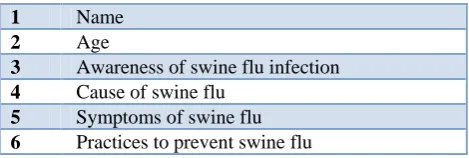
Questions were asked about the awareness of Swine flu infection, cause and symptoms of Swine Flu and Practices to prevent swine flu infection.
At the end of interview, patients were given all above information about swine flu. Training was given to prevent swine flu infection. Counseling was done to take vaccine against swine flu infection. Also, information was given that as strain of swine flu virus is different every year, the swine flu vaccine should be taken every year when the new one comes and that too at the start of the season around the month of May or June.
Inclusion criteria
Inclusion criteria were people aged >25 years and <60 years; people willing to participate in the study.
Exclusion criteria
Exclusion criteria were people <25 years and >60 years of age; people who failed to respond to all questions or who left before completing the interview.
Face-to-face interview was based on a pretested questionnaire
It included three essential questions: 1) mode of spread of swine flu 2) common symptoms of, and 3) preventive measures against the swine flu.
Table 1: Questionnaire.
1 Name
2 Age
3 Awareness of swine flu infection
4 Cause of swine flu
5 Symptoms of swine flu
6 Practices to prevent swine flu
Data was collected in Microsoft excel sheet and analyzed. Statistical analysis was done in percentages.
RESULTS
Table 2: Age and sex distribution.
No. of respondents
Percentage (%) Age (years)
25-40 140 70
41-50 40 20
51-60 20 10
Sex
Males 110 55
Females 90 45
In our study, there were 110 (55%) of males while there were 90 (45%) females (Table 2). So, majority of respondents were in the age group of 25-40 years. Majority of respondents were males.
Table 3:Awareness of swine flu and its transmission.
Awareness of swine flu and its
transmission
No. of respondents
Percentage (%)
Awareness of Swine
flu 196 98
Viral infection is the
cause 170 85
Spread by coughing and sneezing through air
130 65
In our study, 196 (98%) of respondents were aware of swine flu infection, 170 (85%) of respondents knew that swine flu is due to viral infection while 130 (65%) of respondents were aware that swine flu infection spreads through air while sneezing and coughing (Table 3). So, most respondents had heard about swine flu infection. Many respondents knew that it is a viral infection.
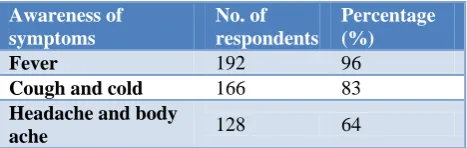
Table 4: Awareness of symptoms.
Awareness of symptoms
No. of respondents
Percentage (%)
Fever 192 96
Cough and cold 166 83
Headache and body
ache 128 64
In our study, 192 (96%) of respondents knew fever as symptom of Swine flu, 166 (83%) of respondents knew cough and cold as symptoms while 128 (64%) of respondents knew headache and body ache as symptoms (Table 4). So, majority of respondents were aware of the symptoms of swine flu infection.
In our study, 188 (94%) of respondents were aware that vaccination against Swine flu can prevent swine flu infection. 160 (80%) of respondents knew that covering mouth and nose while coughing and sneezing can prevent spread of Swine flu infection while 104 (52%) of
respondents knew that frequent hand washing helps in preventing spread of swine flu infection (Table 5). So, awareness about vaccine against Swine Flu infection was very good.
Table 5: Awareness of prevention of swine flu.
Awareness of prevention of swine flu
No. of respondents
Percentage (%)
Vaccine 188 94
Covering mouth and nose while coughing and sneezing
160 80
Frequent hand
washing 104 52
DISCUSSION
In our study, 140 (70%) of respondents were from 25-40 years, 40 (20%) respondents were from 41-50 years while 20 (10%) of respondents were from 51-60 years of age.
In our study, there were 110 (55%) of males while there were 90 (45%) females (Table 2). Contrary to our study, Hanan et al found that out of 1,548 interviews, there were 828 males and 720 females. Most of the participants were in the age groups of 18-24 years (53.2%) and 25-39 years (32.8%).11
In our study, 196 (98%) of respondents were aware of Swine flu infection, 170 (85%) of respondents knew that Swine flu is due to viral infection while 130 (65%) of respondents were aware that Swine flu infection spreads through air while sneezing and coughing (Table 3).
Similar to our study, Hanan et al found that the majority of the participants (95.4%) were aware that the disease was a viral illness. Many also mistakenly believed that the disease was an immunodeficiency disease (27.6%). Most had accurate information about the mode of transmission, but 43% stated that sexual contact was a mode of transmission.11
Contrary to our study, Baria et al reported that 86% science and 63.18% commerce students correctly knew the causative agent for swine flu. 84.5% (science) and 54% (commerce) students knew the other name of swine flu (H1N1). 61% (commerce) and 56% (science) students knew about the availability of swine flu vaccine at government hospitals. 57% (science) and 40.30% (commerce) knew about availability of free treatment of swine flu at government hospitals.12
Contrary to our study, Baria et al reported that 64.6% (science) and 69.3% (commerce) knew cough/sneezing as one of the modes of transmission. 10.6% and 11% (science) and 14% and 5.2% (commerce) students had the misconception that it is transmitted by food and water and by eating pigs meat respectively.12
Similar to our study, Shilpa et al found that fever as symptom was known to 82.6% while cough and cold was known to 72.3% and 55.4% of the respondents as a symptom respectively 2.7% of them had myth regarding spread of swine flu by eating pork, while 56.0% of the respondents said it was by inhalation and close contact with the infected. 50.5% of the participants knew there was treatment available for swine flu, while only 10.3% of them had heard about the drug Tamiflu.13
In our study, 188 (94%) of respondents were aware that vaccination against swine flu can prevent swine flu infection. 160 (80%) of respondents knew that covering mouth and nose while coughing and sneezing can prevent spread of Swine flu infection while 104 (52%) of respondents knew that frequent hand washing helps in preventing spread of Swine flu infection (Table 5).
Similar to our study, Shilpa et al found that 50.5% were aware of free treatment and testing facilities by Government. Use of mask/handkerchief as a preventive measure against swine flu was known to 81.5%. 37.0% said it could be prevented by maintaining personal hygiene avoiding crowded places 32.1%.13
Contrary to our study, Shilpa et al found that 15.8% of them were aware of swine flu vaccine and 16.3% among them were willing to take it. 63.0% were scared of the disease.13
Similar to our study, Rajoura et al found that 75% of the health care providers were aware about the symptoms of swine flu. Most of them were aware that it is transmitted through droplet infection. Correct knowledge of the incubation period of swine flu was known to 80% of the doctors and 69% of the nurses. Knowledge about high-risk persons like contacts, travelers, health care providers was in 88% of the doctors and 78.8% of the nurses. Wearing mask during duty hours was observed in 82.6% of doctors and 85% of nurses.14
Contrary to our study, Kakade found that 18 (20%) students are had poor knowledge, the majority 31 (62%) had average knowledge and 9 (18%) had good knowledge regarding swine flu and its protective measures.15
CONCLUSION
The present review concluded that majority of the subjects had substantial knowledge regarding swine flu, yet there were notable deficiencies regarding the transmission, preventive measures and availability of vaccine.
Understanding the role of specific perceptions in motivating people to engage in precautionary behavior may help health communicators to improve their messages about outbreaks of swine flu.
Funding: No funding sources Conflict of interest: None declared
Ethical approval: The study was approved by the Institutional Ethics Committee
REFERENCES
1. An Introduction to swine flu. 2009. Available at: http://www.110words.com. Accessed on 3 October 2018.
2. Pandemic influenza A (H1N1), Donor report 1st March 2011. Weekly Update Pandemic (H1N1) 2009. 5 August 2010.World Health organization, 2009: 2.
3. Fotedar S, Sharma KR, Bhardwaj V, Fotedar V. Precautions in dentistry against swine flu. SRM J Res Dent Sci. 2013;4:161–3.
4. Cutler J, Schleihauf E, Hatchette TF, Billard B, Watson-Creed G, Davidson R, Investigation of the first cases of human-to-human infection with the new swine-origin influenza A (H1N1) virus in Canada. CMAJ. 2009;181:159–63.
5. Ball K. The enigma of the H1N1 flu: Are you ready? AORN J. 2009;90:852–66.
6. Centre for Disease Control and Prevention (CDC). Available at: http://www.cdc.gov/flu/swineflu/h3n2 outbreak.html. Accessed on 3 October 2018. 7. Rubin GJ, Amlot R, Page L, Wessely S. Public
perceptions, anxiety, and behavior change in relation to the swine flu outbreak: cross sectional telephone survey. BMJ. 2009;339:b2651.
8. Nath B, Midha T, Kumari R, Gupta S. Knowledge, Attitude and Practice regarding Influenza A (H1N1) among senior secondary school students of Kanpur city in north India. Indian J Community Health. 2014;26(3):303-7.
9. Rubin GJ, Amlôt R, Page L, Wessely S. Public perceptions, anxiety, and behavior change in relation to the swine flu outbreak: Cross sectional telephone survey. BMJ. 2009;339:b2651.
10. Kaliyaperumal K. Diabetic Retinopathy Project. Guidelines for conducting a knowledge, attitude and practice study. Community Ophthalmol. 2004;4:8. 11. Hanan HB, Abolfotouh M, Hathlool RH,
Al-Jumah MA. Awareness, attitude and practices related to the swine influenza pandemic among the Saudi public, BMC Infect Dis. 2010;10:42.
12. Baria HG, Solanky P, Shah H, Patel R. A study on swine flu (H1N1) awareness among college students of Valsad city. Int J Community Med Public Health. 2017;4:3668-72.
14. Rajoura OP, Roy R, Agarwal P, Kannan AT. A Study of the Swine Flu (H1N1) Epidemic Among Health Care Providers of a Medical College Hospital of Delhi. Indian J Community Med. 2011;36(3):187–90.
15. Kakade NR, Kakade SV. A study to Assess the Effectiveness of the Structured Teaching Programme, on Knowledge Regarding Swine Flu Among Secondary School Going Children in
Selected School at Karad. Int J Sci Res. 2014;3(8):834-7.