Original Research Article
An epidemiological study on knowledge, attitude and practice of
injection safety among health care personnel in a tertiary
care hospital of Tripura
Anjan Datta, Kaushik Nag*, Nabarun Karmakar, Tamal Chakraborty
INTRODUCTION
Safe Injection Global Network (SIGN) defines a safe injection as, “the injection that does no harm to the recipient, does not expose the health worker to any risk and does not result in waste that is dangerous for the community”.1
Based on definition the above mentioned were identified as three criteria for safe injection. It is well known that injection is one of the key health care procedures used globally for administration of medicines. Even though so much of advancement in clinical
medicine, unsafe and over-use of injections are not uncommon in developing countries.2
Breaks in safe injection practices coupled with overuse of injections may expose the recipients, health care workers, or the community to several troubles including life menacing infections. Common infectious agents are- HBV, HIV, HCV, some bacterial infection, which create a major problem related to unsafe injection practice.3 Worldwide unsafe medical injections lead to 40% cases of hepatitis C, 32% hepatitis B, and 5% human
ABSTRACT
Background: Injection is considered as one of the key procedures of drug delivery all over the world. Unsafe injection practices are very common in countries like India. This study was aimed to assess knowledge, attitude and practice of injection safety in a tertiary care hospital of Tripura.
Methods: A cross-sectional study was conducted among 300 participants including staff nurses, operation theater (OT) assistants and laboratory technicians of Tripura Medical College and Dr. BRAM Teaching Hospital, Hapania; who were primarily involved in routine injection practices related to patient care from January 15th to February 14th 2018. Data was collected using a self-administered questionnaire and analyzed using SPSS version 16.0.
Results: Majority (77%) of the participants in this study belonged to 18 to 25 years age group and were females (71.3%); mostly were nurses (88%), followed by OT assistants (6.3%) and laboratory technicians (5.7%) respectively. Good injection safety practices were reported by majority of the participants (67.3%). Higher mean age with knowledge of injection safety, nurses as compared to others and probational work experience than permanent were found to have significant association with safe injection practices of the participants.
Conclusions: Even though study findings showed good practice related to injection safety among the health care personnel like similar other studies in this country, still improvement is required to fulfil the gap in knowledge and attitude of the health care providers to keep unsafe injection to the minimum level.
Keywords: Hospital, Injection, Nurses, Safe, Tripura
Department ofCommunity Medicine, Tripura Medical College and Dr. BRAM Teaching Hospital, Hapania, Agartala, Tripura, India
Received: 27 June 2018
Accepted: 31 July 2018
*Correspondence:
Dr. Kaushik Nag,
E-mail: [email protected]
Copyright: © the author(s), publisher and licensee Medip Academy. This is an open-access article distributed under the terms of the Creative Commons Attribution Non-Commercial License, which permits unrestricted non-commercial use, distribution, and reproduction in any medium, provided the original work is properly cited.
immunodeficiency virus (HIV) infections each year.4 Unsafe injection practices are also prevalent in India.5,6 Recently, Epidemiology Network in India has estimated that of the total 3-6 billion injections used each year, two-thirds were unsafe and had the potential to transmit blood-borne infections.7
In a study done in a tertiary hospital of West Bengal on nursing staff showed that, 60% of the nursing personnel maintained correct procedure during giving injection; while sterile gloves are used by only 3.7% nurses.8 While opening glass ampoules, injuries to injection providers can occur which may cause infections.7 In a study conducted in Kashi district, Nepal, almost half of the injection providers observed used only cotton/gauge while breaking an ampoule to protect their finger.9 Proper disposal of waste that generated after injection is another important issue. According to Biomedical Waste (Management and Handling) Rules 1998, needles, syringes should disposed by disinfection (chemical treatment/ autoclaving/ microwaving and mutilation/ shredding).10 Government of India has made a provision for treating biomedical waste at outside the health facilities through Common Bio-medical Waste Treatment & Disposal Facility (CBMWTDF) with the collaboration of private sector.11
The present study was aimed to assess the knowledge, attitude and practice of injection safety and factors associated, among health care personnel in a tertiary care hospital of Tripura. A high prevalence of needle stick injury in the same setting found in a previous study further demanded the present study with an overall aim to find out the lacunae in the current practices.12
METHODS
An institutional based cross sectional study was conducted among the health care personnel {nursing staffs, operation theater (OT) assistants and laboratory technicians, who are mainly involved in injection practices routinely excluding doctors} of Tripura Medical College & DR. BRAM Teaching Hospital, Hapania, West Tripura. Study was conducted for a period of one month, January 15th to February14th 2018.
Sample size
A total sample size of 300 was calculated using the formula, N=4pq/l2 (N=minimum required sample size, p=prevalence, q=1–p, l=precision). Here p was considered as 60% and l=10% absolute precision and additional 10% was taken as non-response rate.8
Inclusion criteria
Inclusion criteria were study subjects who gave their consent to participate in the study; study subjects who were available during survey.
Exclusion criteria
Doctors, medical students, interns and nursing students posted in different departments during the time of survey were excluded from the study.
Sampling procedure
Samples were selected randomly from all departments concerned among those who were available on the days of data collection until the required sample size was achieved.
Study tool
A predesigned, pretested, semi structured self- administered questionnaire was used to collect the required information. The questionnaire consisted of two parts, first part having questions related to socio-demographic variables of the participants and second part consisted of questions related to knowledge, attitude and practices of injection safety.
Data analysis
The collected data was entered in Statistical package for the Social Sciences (SPSS Inc. SPSS for Windows, Version 16.0. Chicago) and represented in percentages with appropriate tables. Chi square test was done to find out factors affecting knowledge, attitude and practice of injection safety of the participants (p <0.05 was considered as significant). Individuals scoring more than mean were considered having good knowledge, attitude and practice respectively.
Informed consent
A well explained written consent was collected from all the participants before commencement of the study.
RESULTS
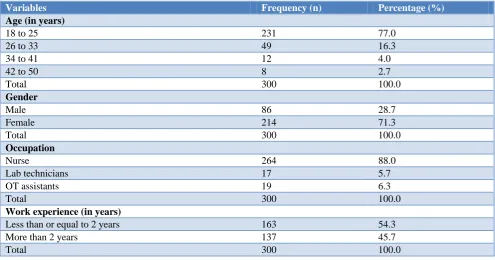
Table 1 reveals majority (77%) of the participants belonged to 18 to 25 years age group and females were (71.3%). Among the healthcare personnel the present study included mostly the Nurses (88%), followed by OT assistants (6.3%) and laboratory technicians (5.7%) respectively. Almost similar proportion of the staffs were probational (≤2 years) and permanent (>2 years) in job experience in this study.
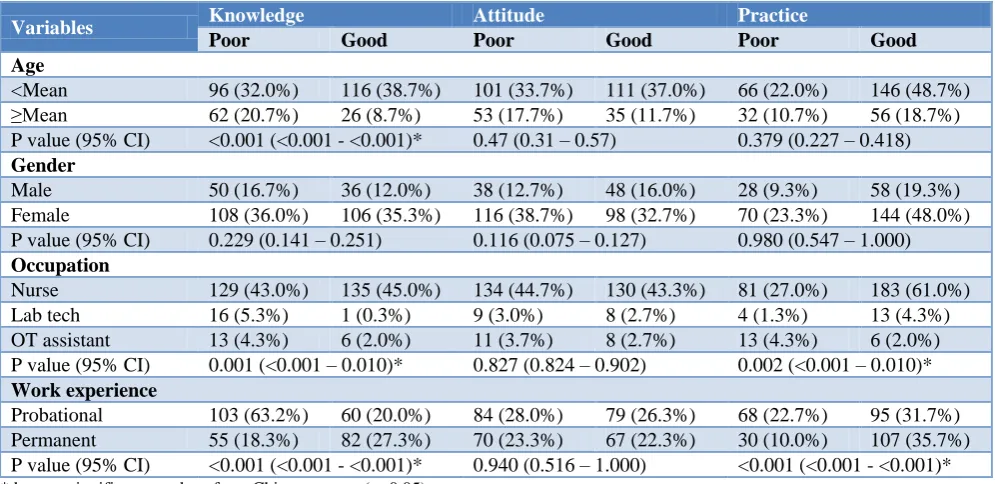
Table 6 shows significant association of knowledge with mean age of respondents (p<0.001). Similarly occupation and work experience were also found to have significant
association with knowledge and practice of injection safety in the present study.
Table 1: Background information of the study participants (n=300).
Variables Frequency (n) Percentage (%)
Age (in years)
18 to 25 231 77.0
26 to 33 49 16.3
34 to 41 12 4.0
42 to 50 8 2.7
Total 300 100.0
Gender
Male 86 28.7
Female 214 71.3
Total 300 100.0
Occupation
Nurse 264 88.0
Lab technicians 17 5.7
OT assistants 19 6.3
Total 300 100.0
Work experience (in years)
Less than or equal to 2 years 163 54.3
More than 2 years 137 45.7
Total 300 100.0
Table 2: Frequency distribution on knowledge of injection safety (n=300).
Items Frequency (n) Percentage (%)
Heard about three criteria for safe injection
No 53 17.7
Yes 247 82.3
Total 300 100.0
Not true about safe injection
Injection that does not harm the recipient 76 25.3 Does not expose the provider with any avoidable risk 27 9.0 Result in dangerous waste for the community 29 9.7
Injection can be reused 105 35.0
None of the above 63 21.0
Total 300 100.0
Awareness of the complications of unsafe injection
Yes 258 86.0
No 42 14.0
Total 300 100.0
Commonest complication of unsafe injection (n=258)
HIV 144 55.8
Hepatitis 82 31.8
Syphilis 4 1.5
Others 28 10.9
Total 258 100.0
Knowledge of post-exposure prophylaxis following unsafe injection
Yes 244 81.3
No 56 18.7
Total 300 100.0
Items Frequency (n) Percentage (%)
Not a route of injection
IM 3 1.0
IV 5 1.7
Subcutaneous 3 1.0
Oral 272 90.7
Do not know 17 5.7
Total 300 100.0
The angle of intramuscular injection
45º 27 9.0
90º 259 86.3
15º 0 0
180º 0 0
Do not know 14 4.7
Total 300 100.0
The angle of intradermal injection
45º 103 34.3
90º 14 4.7
15º 162 54.0
180º 7 2.3
Do not know 14 4.7
Total 300 100.0
The angle of subcutaneous injection
45º 140 46.7
90º 31 10.3
15º 115 38.3
180º 2 0.7
Do not know 12 4.0
Total 300 100.0
Table 3: Frequency distribution on attitude of injection safety (n=300).
Items Frequency (n) Percentage (%)
Recommendation of needle to be kept on top of the vial to withdraw additional dose
Yes 166 55.3
No 64 21.3
No response 70 23.3
Total 300 100.0
Recommendation of use of syringe taken from unopened packet always
Agree 182 60.7
Disagree 99 33.0
No response 19 6.3
Total 300 100.0
Injection safety measures are protective
Agree 271 90.3
Disagree 2 0.7
No response 27 9.0
Total 300 100.0
Safe injection technique should be used in our hospital
Agree 269 89.7
Disagree 13 4.3
No response 18 6.0
Total 300 100.0
Items Frequency (n) Percentage (%)
We should dispose sharp waste in a puncture proof container
Agree 254 84.7
Disagree 9 3.0
No response 37 12.3
Total 300 100.0
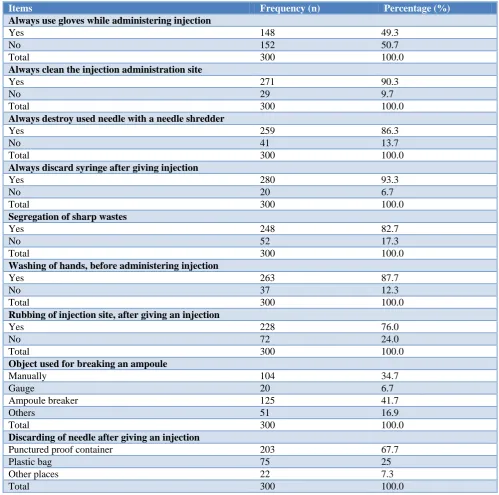
Table 4: Frequency distribution on practices of injection safety (n=300).
Items Frequency (n) Percentage (%)
Always use gloves while administering injection
Yes 148 49.3
No 152 50.7
Total 300 100.0
Always clean the injection administration site
Yes 271 90.3
No 29 9.7
Total 300 100.0
Always destroy used needle with a needle shredder
Yes 259 86.3
No 41 13.7
Total 300 100.0
Always discard syringe after giving injection
Yes 280 93.3
No 20 6.7
Total 300 100.0
Segregation of sharp wastes
Yes 248 82.7
No 52 17.3
Total 300 100.0
Washing of hands, before administering injection
Yes 263 87.7
No 37 12.3
Total 300 100.0
Rubbing of injection site, after giving an injection
Yes 228 76.0
No 72 24.0
Total 300 100.0
Object used for breaking an ampoule
Manually 104 34.7
Gauge 20 6.7
Ampoule breaker 125 41.7
Others 51 16.9
Total 300 100.0
Discarding of needle after giving an injection
Punctured proof container 203 67.7
Plastic bag 75 25
Other places 22 7.3
Total 300 100.0
Table 5: Frequency distribution table of qualitative distribution of knowledge, attitude and practice of the participants (n=300).
Characteristics Poor (≤ mean score) Good (> mean score)
Knowledge 158 (52.7%) 142 (47.3%)
Attitude 154 (51.3%) 146 (48.7%)
Table 6: Association of socio-demographic variables with knowledge, attitude and practice of the respondents.
Variables Knowledge Attitude Practice
Poor Good Poor Good Poor Good
Age
<Mean 96 (32.0%) 116 (38.7%) 101 (33.7%) 111 (37.0%) 66 (22.0%) 146 (48.7%) ≥Mean 62 (20.7%) 26 (8.7%) 53 (17.7%) 35 (11.7%) 32 (10.7%) 56 (18.7%) P value (95% CI) <0.001 (<0.001 - <0.001)* 0.47 (0.31 – 0.57) 0.379 (0.227 – 0.418)
Gender
Male 50 (16.7%) 36 (12.0%) 38 (12.7%) 48 (16.0%) 28 (9.3%) 58 (19.3%) Female 108 (36.0%) 106 (35.3%) 116 (38.7%) 98 (32.7%) 70 (23.3%) 144 (48.0%) P value (95% CI) 0.229 (0.141 – 0.251) 0.116 (0.075 – 0.127) 0.980 (0.547 – 1.000)
Occupation
Nurse 129 (43.0%) 135 (45.0%) 134 (44.7%) 130 (43.3%) 81 (27.0%) 183 (61.0%) Lab tech 16 (5.3%) 1 (0.3%) 9 (3.0%) 8 (2.7%) 4 (1.3%) 13 (4.3%) OT assistant 13 (4.3%) 6 (2.0%) 11 (3.7%) 8 (2.7%) 13 (4.3%) 6 (2.0%) P value (95% CI) 0.001 (<0.001 – 0.010)* 0.827 (0.824 – 0.902) 0.002 (<0.001 – 0.010)*
Work experience
Probational 103 (63.2%) 60 (20.0%) 84 (28.0%) 79 (26.3%) 68 (22.7%) 95 (31.7%) Permanent 55 (18.3%) 82 (27.3%) 70 (23.3%) 67 (22.3%) 30 (10.0%) 107 (35.7%) P value (95% CI) <0.001 (<0.001 - <0.001)* 0.940 (0.516 – 1.000) <0.001 (<0.001 - <0.001)*
*denotes significant p values from Chi square test (p<0.05).
DISCUSSION
This present study was done on 300 healthcare personnel working in Tripura Medical College & Dr. BRAM Teaching Hospital, where mean age of participants was 24.18±5.799 years and majority were females (71.3%). By occupation most of them were Nurses (88%), followed by OT assistants (6.3%) and laboratory technicians (5.7%). Almost similar proportion of the staffs were probational (≤2 years) and permanent (>2 years) in their work experience. Similar studies were conducted by Sahu D et al.13 in Chhattisgarh in 2015 among 62 nurses and Chaudhury et alin Darjeeling in 2016.15
In the current study, majority of the participants were aware of the three criteria of safe injection and of the complications of unsafe injection as well (86%). Majority (81.3%) also had knowledge about the post exposure prophylaxis in case of accidental exposure. These findings correlate to the study conducted in Andhra Pradesh in 2010, where about 84% of the participants had the aforesaid knowledge.16 Similar results were also found in the study conducted by Rehan et al in a tertiary care hospital of New Delhi and the study by Ashish Naik et al.17,18 among health care workers in urban health centres of Surat city. Although, study conducted by Karthik et al among nursing students of a tertiary care hospital of Chennai, Tamil Nadu, showed only 56% had knowledge of injection safety among the participants.19 This study showed good practices regarding injection safety among majority (67.3%) of the health care personnel whereas their knowledge and attitude in this regard were equivocal. This should be an area of serious
concern even though practices related to appropriate disposal of injection materials was very poor (27.7%) in various other studies.16 Where almost half of our study participants used gloves while giving injections a similar study at Darjeelingrevealed no similar practices.15 The present study also showed higher mean age (p value <0.001), occupation as nurse (p value 0.001) in comparison with OT assistants and laboratory technicians and probational work (≤2 years of experience) (p value <0.001) were significant predictors of good knowledge and latter two variables also as predictors of good practice (p value 0.002 and <0.001 respectively) of injection safety among the participants. No previous study results were found in this context. Further qualitative research would be helpful for in depth knowledge of the predictors of knowledge and practice of injection safety for future benefits.
From the above discussion it can be concluded that even though practices regarding injection safety was good among the study population, there was ample scope for improvement in the knowledge and attitude of the staffs in this regard. Moreover, OT assistants and Laboratory technicians were significantly lacking on their knowledge and practice with comparison to nursing staffs regarding injection safety and there should be plan for further sensitization and training of them especially on open vial policy.
Funding: No funding sources Conflict of interest: None declared
REFERENCES
1. Safe Injection Global Network (SIGN): Advocacy booklet. Geneva. 2011. Available at: http://who.int/injection_safety/sign/
advocacy_booklet/en/index.html. Accessed on 2 March 2018.
2. Gyawali S, Rathore DS, Shankar PR, Vikash KC. Strategies and challenges for safe injection practice in developing countries: a review. J Pharmacol Pharmco. 2013;4:8-12.
3. World Health Organization (WHO). Injection Safety Fact Sheet. Fact sheet no.231. Revised May 2016. Available at: http://www.who.int/infection-prevention/publications/is_fact-sheet.pdf. Accessed on 23 March 2018.
4. Hauri AM, Armstrong GL, Hutin YJ. The global burden of disease attributable to contaminated injections given in health care settings. Int J STD AIDS. 2004;15(1):7-16.
5. Anand K, Pandav CS, Kapoor SK, Undergraduate Study Team. Injection use in a village in north India. Natl Med J India. 2001;14:224.
6. Kotwal A, Priya R, Thakur R, Gupta V, Kotwal J, Seth T. Injection practices in metropolis of North India: perceptions, determents and issues of safety. Indian J Med Sci. 2004;58:334-44.
7. Hutin Y, Hauri A, Chiarello L, Catlin M, Stilwell B, Ghebrehiwet T, et al. Best infection control practices for intradermal, subcutaneous, and intramuscular needle injections. Bull World Health Organ. 2003;81(7):491-500.
8. Paul B, Roy S, Chattopadhyay D, Bisoi S, Misra R, Bhattacharya N, et al. A study on safe injection practices on nursing personnel in a tertiary care hospital of Kolkata, West Bengal, India. TAF Prev Med Bull. 2011;10(6):681-6.
9. Gyawali S, Rathore DS, Ravi Shankar P, Vikash Kumar Kc, Jha N, Sharma D. Knowledge and Practice on Injection Safety among Primary Health Care Workers in Kaski District, Western Nepal. Malays J Med Sci. 2016;23(1):44-55.
10. Ministry of Environment & Forests. Notification. New Delhi. 1998 July 20. Available at: http://envfor.nic.in/legis/hsm/biomed.html.
Accessed on 5 May 2018.
11. West Bengal Pollution Control Board. Waste inventory (MSW & BMW) in West Bengal. Available at: http://www.wbpcb.gov.in/html/
downloads/sw_inventory.pdf. Accessed on 5 May 2018.
12. Sharma A, Tripura K, Acharjee A. A cross sectional study on prevalence of needle stick injury and management practices among health workers working in a teaching hospital, Tripura. IOSR J Dental Med Sci. 2018;17(1):5-7.
13. Sahu D, Gandhi N. Assessment of Safe Injection Practices in a Tertiary Care Hospital: A Cross-Sectional Study from Chhattisgarh. Ntl J Community Med. 2015;6(4):500-3.
14. Yvan JF Hutin. Injection Practices in Albania: Rapid Assessment and Proposed Action Plan. Department of Blood Safety and Clinical Technology, World Health Organization. Available at: https://www.healthcare-waste.org/fileadmin/ user_upload/resources/ALB_SIGN_report2000_1.p df. Accessed on 5 May 2018.
15. Sudip CB, Kuntala R. Safe Injection Practices in Primary Health Care Settings of Naxalbari Block, Darjeeling District, West Bengal. J Clinical Diagnostic Res. 2016;10(1):21-4.
16. Garapati S, Peethala S. Assessment of knowledge and practices on injection safety among service providers in east Godavari district of Andhra Pradesh. Ind J Comm Health. 2014;26(3):259-63. 17. Rehan HS, Deepti C, Ravinder SK, Tanuj C, Arpit
A, Sharma KG. Injection practices of healthcare professionals in a Tertiary Care Hospital of Lady Hardinge Medical College and Associated Hospitals, New Delhi. J Infection Public Health. 2012;5:177-81.
18. Ashish N, Vaibhav G, Bansal KR. An assessment of injection practices in urban health centres of Surat city: are the health care workers safe? National J Community Med. 2012;3(1):125-8.
19. Karthik RC, Uma Devi R, Gopalakrishnan S, Raja S, Rama R. A Study On Knowledge And Practices Related To Safe Injection Practices Among Nursing Students In A Tertiary Care Hospital, Chennai, Tamil Nadu, India. Res J Pharmaceutical, Biological Chemical Sci. 2015;6(5):857-62.