Original Research Article
Evaluation of awareness of job responsibilities and incentives of
accredited social health activist in the delivery of health care services
Mayadhar Panda, Sikata Nanda*
INTRODUCTION
The Govt. of India launched “National Rural Health Mission” (NRHM) on 12th
April 2005 for an initial period of 7 years (2005-2012) and then extended with naming as NHM now. The main aim is to improve rural health care delivery system besides strengthening the urban health care. It became operational in the whole country with special focus on 8 Empowered Action Group states, out of which Odisha in one.1
The main aim of NRHM is to provide accessible, affordable accountable, effective and reliable primary health care and bridging the gap in rural health care
through creation of cadre of Accredited Social Health Activist (ASHA).2 Now the urban and rural areas are integrated and under the flagship of NHM (National Health Mission) the major initiative of ASHA’s in every village / ward is represented to serve the population in a better way.3
ASHA worker must be a resident of the village and a woman (married / widow / divorced) preferably in age group of 25 to 45 yrs with formal education up to eight class, having leadership qualities and communication skills to address the public. For selection the general norm followed is 1 ASHA per 1000 population. However, this could be relaxed in hilly & tribal areas as per the habitation.4
ABSTRACT
Background: Accredited social health activist (ASHA) workers are the female health volunteers of the community who takes steps to generate awareness and provide information to the community on determinants of health such as nutrition, hygiene practices and basic sanitation, healthy living condition. Our aim was to evaluate the level of awareness of job responsibilities of ASHA workers, to assess about their awareness about the different incentives in the delivery of health care services and to recommend for improvement on the functioning of the ASHA workers.
Methods: A cross sectional study was conducted in Khordha district of Odisha from March 2018 to July 2018. 3 blocks were selected purposively i.e. Bhubaneswar under urban block, Bolagarh under rural block and Banapur a tribal block. Working in the 3 selected blocks, 331 ASHA’s participated in the study.
Results: 37% were between 34-39 years and 30% were in the age group of 34-39 years in the rural block and about 40% ASHA workers belonged to 25-29 years of age. For full immunization in the 1st year of life per beneficiary an amount of Rs. 100 is given to an ASHA worker. However, 67 (68.4%) in urban block, 79 (63.2%) in rural block and 83 (76.8%) ASHAs in tribal block were aware about this incentive.
Conclusions: The role of ASHAs should be well defined and accordingly with supportive supervision, the ASHAs should be monitored to efficiently & effectively play their roles and discharge duties.
Keywords: ASHA, Worker, Responsibilities, Incentives
Department ofCommunity Medicine, SCBMCH, Cuttack, Odisha, India
Received: 14 October 2018
Revised: 17 November 2018
Accepted: 19 November 2018
*Correspondence:
Dr. Sikata Nanda,
E-mail: [email protected]
Copyright: © the author(s), publisher and licensee Medip Academy. This is an open-access article distributed under the terms of the Creative Commons Attribution Non-Commercial License, which permits unrestricted non-commercial use, distribution, and reproduction in any medium, provided the original work is properly cited.
ASHA will be a health activist in the community who will create awareness on health. ASHA is to take steps to generate awareness and provide information to the community on determinants of health such as nutrition, hygiene practices and basic sanitation, healthy living condition. She is to provide information on existing health services, timely utilization of health and family welfare services.
She is to counsel women on birth preparedness, highlights on safe delivery, importance of exclusive breast feeding, complementary feeding, immunization, contraception and prevention of common infections including RTI/STI and care of the young children. She is also to mobilize the community and facilitate them to access health and health related services.
She is required to work with the village health and sanitation committee of the GP (Gram Panchayat) to develop a comprehensive village health plan. As part of their responsibility they are to escort pregnant women & children requiring referral to the nearest health care facility.
Objectives
To evaluate the level of awareness of job responsibilities of ASHA workers.
To assess their awareness about different incentives in the delivery of health care services.
To recommend for improvement of the functioning of the ASHA workers.
METHODS
Type of study
Cross sectional
Place of the study
Khordha district of Odisha.
Period of study
March 2018 to July 2018.
Out of 10 blocks in Khordha district in eastern Odisha 3 blocks were selected purposively i.e. Bhubaneswar under urban block, Bolgarh under rural block and Banapur a tribal block. The ASHAs working under these 3 blocks were enrolled in the study and a predesigned, pretested questionnaire validated earlier by the experts of Community Medicine was implemented after taking their written consent. Urban block was designated as block1, rural block as block 2 and tribal block as block 3. Out of total 99 no. of ASHA’s in urban block, 98 were enrolled in the study. Similarly in block 2 (rural block) out of 128 ASHAs, 125 agreed to give their opinion and views in the study. Out of total 111 ASHAs in block 3 (tribal block)
108 decided to participate in on study. So, out of total 338, ASHA’s working in the 3 selected blocks, 331 ASHA’s participated in the study.
The level of awareness of the ASHAs residing in the 3 blocks, was assessed regarding the incentives and their job responsibilities and accordingly a comparative analysis was done.
Thereafter the collected data was analyzed in SPSS 21 and interpreted after appropriate statistical tools were applied.
RESULTS
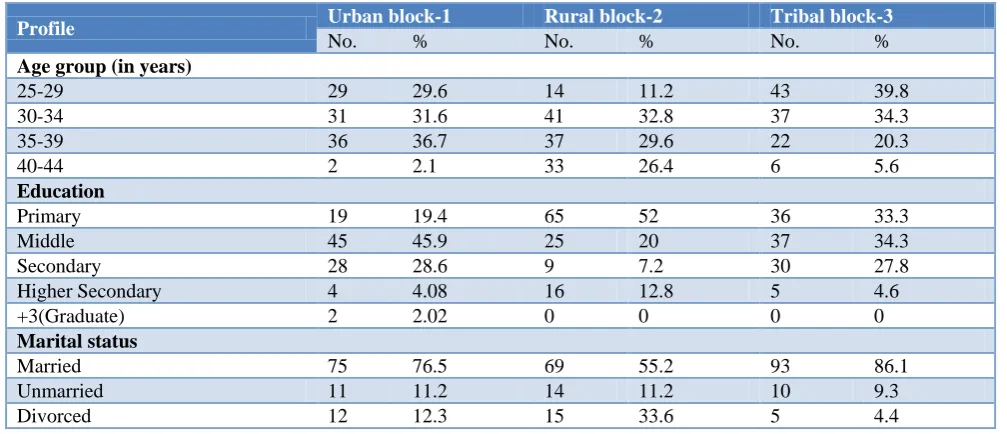
Table 1 depicts the profile of ASHA worker in the 3 sample blocks. A comparative analysis was done between the 3 blocks which showed that out of 98 ASHA workers in urban block, 37% were between 34-39 years and 30% were in the age group of 34-39 years in the rural block and about 40% ASHA workers belonged to 25-29 years of age. Regarding educational qualification 45 (45.9%) ASHA’s were educated till middle class in urban block and in rural block 65 (52%) and in tribal blocks 37 (34%) were educated till primary level. Majority of the ASHA worker were married in all the 3 blocks.
Table 2 reveals the population covered by ASHA workers. 50(51%) of ASHA workers covered <1000 population in urban block and 58 (46.4%) in rural block. In the tribal block 39(36.1%) ASHA workers covered 1000 to 1500 population.
Table 3 shows the ASHA workers’ knowledge across 3 blocks regarding incentives given for immunization. According to this table based on the block wise analysis of ASHA workers awareness on the different incentives for different job responsibilities, it was found that in urban area out of 98 ASHAs about 78 (79.6%) whereas about 98 (78.4%) in rural area and 101 (93.5%) in tribal area were aware about the incentives given for mobilization of children.
Table 4 projects the ASHA workers knowledge regarding incentive on reproductive health.
motivation of females for sterilization of females in hospitals. In the urban block 83 (84.7%), in rural block 110 (88%) and in tribal block 99 (91.7%) ASHA’s are
aware regarding motivation for female sterilization for which they are paid an incentive of Rs. 200.
Table 1: Profile of ASHA’s in the sample blocks.
Profile Urban block-1 Rural block-2 Tribal block-3
No. % No. % No. %
Age group (in years)
25-29 29 29.6 14 11.2 43 39.8
30-34 31 31.6 41 32.8 37 34.3
35-39 36 36.7 37 29.6 22 20.3
40-44 2 2.1 33 26.4 6 5.6
Education
Primary 19 19.4 65 52 36 33.3
Middle 45 45.9 25 20 37 34.3
Secondary 28 28.6 9 7.2 30 27.8
Higher Secondary 4 4.08 16 12.8 5 4.6
+3(Graduate) 2 2.02 0 0 0 0
Marital status
Married 75 76.5 69 55.2 93 86.1
Unmarried 11 11.2 14 11.2 10 9.3
Divorced 12 12.3 15 33.6 5 4.4
Table 2: Population covered by ASHA’s in the 3 blocks.
Population Urban block-1 Rural block-2 Tribal block-3
No. % No. % No. %
<1000 50 51 58 46.4 34 31.5
1001 to 1500 19 20.4 43 34.4 39 36.1
>1500 29 29.6 24 19.2 35 32.4
Table 3: Comparison of ASHA workers’ knowledge across 3 blocks regarding incentives for immunization.
Incentives for different job responsibilities
Block wise ASHA worker awareness
Block-1 Block-2 Block-3
No % No % No %
Mobilization of children through ASHA (per session
Rs.150/-) 78 79.6 98 78.4 101 93.5
For full immunization in 1st year of life (per beneficiary
Rs. 100/-) 67 68.4 79 63.2 83 76.8
For complete immunization up to 2nd year of age
Pulse polio immunization / day Rs. 75/- as volunteer 56 57.1 63 50.4 68 62.9 *Multiple responses.
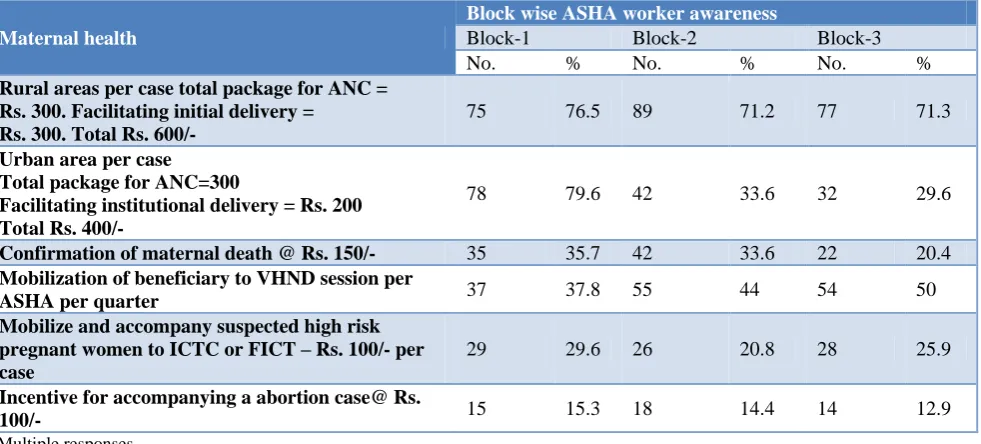
Table 5 shows a comparative analysis of ASHA workers knowledge regarding the incentives for maternal health. The different activities undertaken is as follows like Rs. 300/- for ANC package in rural areas, facilitating institutional delivery is Rs. 300/- in rural areas. However in urban areas per antenatal case, the total package for ANC is Rs. 200/- so, a total of Rs. 400/- is the dedicated incentive for urban area ANC. For confirmation of maternal death the AHSA’s are given Rs. 150/- per case. Table 6 shows a comparative analysis of ASHA workers’ knowledge regarding incentives for child health. As per the block wise analysis of ASHA workers, regarding the
incentive for home based newborn care programme, for which ASHA worker gets Rs. 250/- per newborn, in urban block out of 98 only 52(53.1%) of ASHA workers, in rural block out of 125 only 67 (53.6%) and in tribal block 44(40.7%) were aware about it. Lack of proper training, capacity building and reorientation, in service training at frequent intervals for up gradation of their level of knowledge that already exists.
ASHA workers. In the urban block out of 98, 43(43.9%) of ASHA workers, in rural block, out of 125 ASHA workers 65 (52%) and in tribal block 35 (32.4%) were aware of it. Similarly, as a community DOT provider, for providing treatment support to Category II TB patients
the ASHA’s are provided @ Rs. 1500/-. In urban block, out of 98 ASHA workers 45 (45.9%), in rural block out of 125 ASHA workers 66 (52.8%) and in tribal block out of 108, 40(37%) ASHA workers had appropriate knowledge.
Table 4: Comparison of ASHA worker knowledge across 3 blocks regarding incentives for reproductive health.
Incentives based on job responsibilities
Block wise ASHA workers awareness
Block-1 (n=98) Block-2 (n=125) Block-3 (n=108)
No. % No. % No. %
Incentive for accompanying the client for PPIUCD
insertion Rs. 150/- 88 89.7 98 78.4 100 92.6
Under ESB scheme for promoting spacing of births
@ Rs. 500/- 83 84.7 97 77.6 90 83.3
Promoting adoption of limiting methods up to 2
children @ Rs. 1000/- 85 86.7 98 78.4 89 82.4
Motivation of male sterilization at hospitals @Rs.
300/- 82 83.7 102 81.6 90 83.3
Motivation for female sterilization @ Rs. 200 83 84.7 110 88 99 91.7
Table 5: Comparative Analysis of ASHA workers knowledge regarding incentive for maternal health.
Maternal health
Block wise ASHA worker awareness
Block-1 Block-2 Block-3
No. % No. % No. %
Rural areas per case total package for ANC = Rs. 300. Facilitating initial delivery =
Rs. 300. Total Rs. 600/-
75 76.5 89 71.2 77 71.3
Urban area per case Total package for ANC=300
Facilitating institutional delivery = Rs. 200 Total Rs. 400/-
78 79.6 42 33.6 32 29.6
Confirmation of maternal death @ Rs. 150/- 35 35.7 42 33.6 22 20.4
Mobilization of beneficiary to VHND session per
ASHA per quarter 37 37.8 55 44 54 50
Mobilize and accompany suspected high risk pregnant women to ICTC or FICT – Rs. 100/- per case
29 29.6 26 20.8 28 25.9
Incentive for accompanying a abortion case@ Rs.
100/- 15 15.3 18 14.4 14 12.9
*Multiple responses.
Table 6: Comparative analysis of ASHA worker knowledge regarding incentives for child health.
Job responsibilities
Block wise ASHA worker awareness
Block-1 Block-2 Block-3
No. % No. % No. %
Incentive for home based newborn care programme
Rs. 250/- per newborn 52 53.1 67 53.6 44 40.7
Incentive for follow up of LBW babies
Rs. 50/month/case 42 42.9 55 44 41 37.6
Incentive to ASHA for follow up of SNCU discharge
babies Rs. 50/case / month 43 43.8 52 41.6 37 34.2
Incentive of ASH for IDCF Rs. 200
Mobilizing children 6 months to 60 months Rs. 3/child/qtr
Table 7: Comparison of ASHA worker knowledge regarding incentive for RNTCP.
Sl. No. Incentive based on responsibilities
Block wise ASHA worker Awareness
Block – 1 Block -2 Block – 3 No. % No. % No. %
1. As community DOT provider providing treatment support to
category I TB patient @ Rs. 1000 43 43.9 65 52 35 32.4
2. As a community DOT provider providing treatment support
to category II TB patients @ Rs. 1500 42 45.9 66 52.8 40 37
3. As a community DOT provider providing treatment support
to drug resistant TB patients @ Rs. 5000 46 46.9 72 57.6 34 31.5
4. For sputum sample transport in tribal and difficult areas @
Rs. 25/- sample 42 42.9 75 60 50 46.3
5. Injection prick @ Rs. 25/- injection 45 45.9 70 56 42 38.9
*Multiple responses.
Table 8: Comparison of ASHA worker across 3 blocks regarding knowledge on job responsibilities & incentives in various disease control programme.
Sl. No. Job responsibilities
Block wise ASHA worker Awareness
Block – 1 Block -2 Block – 3 No. % No. % No. %
1. Blood sample collection, report and treatment in NVBDCP @
Rs. 15/- for & Rs. 75/- for complete treatment. 55 56.1 75 60 50 46.3
2. Line listing of lymphoedema and hydrocele cases @ Rs. 200/- 54 55.1 65 52 43 39.8
3. Incentive to ASHA NLEP PB=400
MB=600 65 66.3 70 56 60 55.6
4. Identification regaining motivating and transporting the case
for cataract operation @ Rs.250/- case 60 61.2 68 54.4 47 43.5
5. Under NIDDCP salt testing @Rs. 25/- per 50 tests 45 45.9 46 36.8 26 24.1
Table 9: Comparison of ASHA worker across 3 blocks knowledge regarding other job responsibilities and incentives.
Sl. No. Job responsibilities
Block wise ASHA worker awareness
Block – 1 Block -2 Block – 3 No. % No. % No. %
1. Organizing GKS meeting (monthly) @ Rs. 1500/- month 89 90.8 10 80 86 79.6
2. Attending monthly sector meeting @ Rs. 150/-meeting 90 91.8 112 89.6 85 78.7
3. To support ANM in updating RCH register per quarter / 300 85 86.7 80 64 78 72.2
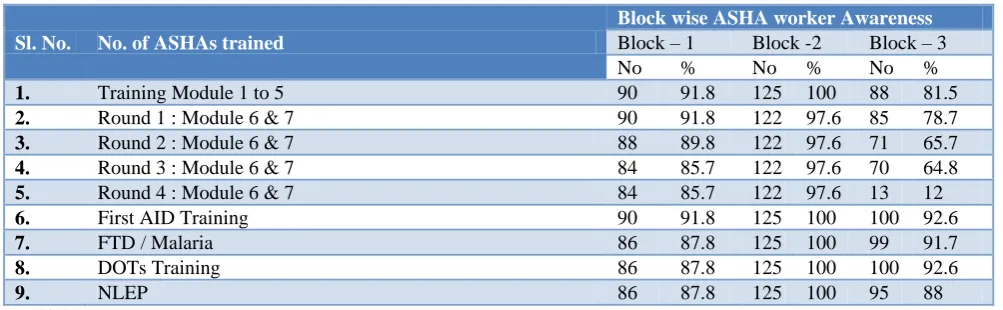
Table 10: Comparative Analysis of Block wise on Information on Training of ASHA workers.
Sl. No. No. of ASHAs trained
Block wise ASHA worker Awareness
Block – 1 Block -2 Block – 3 No % No % No %
1. Training Module 1 to 5 90 91.8 125 100 88 81.5
2. Round 1 : Module 6 & 7 90 91.8 122 97.6 85 78.7
3. Round 2 : Module 6 & 7 88 89.8 122 97.6 71 65.7
4. Round 3 : Module 6 & 7 84 85.7 122 97.6 70 64.8
5. Round 4 : Module 6 & 7 84 85.7 122 97.6 13 12
6. First AID Training 90 91.8 125 100 100 92.6
7. FTD / Malaria 86 87.8 125 100 99 91.7
8. DOTs Training 86 87.8 125 100 100 92.6
9. NLEP 86 87.8 125 100 95 88
Table 8 shows the comparison of ASHA workers knowledge on job responsibilities & incentives in various disease control programmes across 3 blocks. Certain job responsibilities are as follows like blood sample collection, report and treatment in NVBDCP @ Rs. 15 for testing and Rs. 75/- for complete treatment. Out of 98 ASHA workers in urban area 55 (56.1%) were aware about it in urban block, whereas in rural block 75 (60%) and in tribal block 50 (46.3%) were aware about it. Table 9 shows the ASHA workers knowledge on other job responsibilities & incentives like organizing GKS meeting (monthly) i.e., Gaon Kalyan Samiti for which they are given Rs. 150/- per month. It was concluded that 89 (90.8%) ASHA’s in urban area, 100 (80%) in rural area, 86 (79.6%) in tribal area were aware about GKS meeting and the incentive regarding it. A good number of ASHAs’ involvement was there in making the GKS meeting successful. Monthly sector meeting @ Rs. 150/- (for which they were given incentive) was attended regularly by 90 (91.8%) of ASHA’s in urban area, 112 (89.6%) of ASHA’s in rural area and 85 (78.7%) of ASHA’s working in tribal area
Table 10 shows the comparative analysis among ASHA workers in the 3 blocks. The training module (1 to 5) for ASHAs was undertaken by 90 (91.8%) in urban block, 125 (100%) in rural block & 88 (81.5%) in tribal block. Regarding 6&7, Round 1 training 90 (91.8%) of ASHA’s in urban block, 122 (97.6%) in rural and 85 (78.7%) in tribal block had under gone training. Module 6&7, Round 2 training was undertaken by 88 (89.8%) ASHA’s in urban block, 122(97.6%) in rural block and 71 (65.7%) in tribal block.
DISCUSSION
In a study conducted by Gopalan SS et al revealed that majority of ASHA’s were in age group of (31-35) years and (2-5) years was the year of experience in 82.90% of ASHA worker.6 In the same study the no. of trainings the ASHA workers had undergone was <5 in 232 (73.06%).5 Desai et al in a study amongst ASHAs in Kolhapur district, Maharashtra for improvement of health status of villages showed that 49(46%) of ASHA’s were in (26 to 30) yrs of age. In the same study regarding work done by ASHAs 40 (37.4%) ASHAs rendered help for institutional delivery. In the same area it was observed that 100% malnutrition was decreased and immunization was done. Majority of the ASHAs conducted meetings and programmes for villages and only24 respondents told that they had no idea about the subject but participated in the meeting passively. For full immunization in the 1st year of life per beneficiary an amount of Rs. 100 is to be given to ASHA worker. However, 67 (68.4%) in urban block, 79 (63.2%) in rural block and 83 (76.8%) in tribal block were aware about this incentive. For complete immunization up to 2nd year of life and Pulse Polio Immunization incentive of Rs. 75/-day, 56 (57.1%) in urban block, 63 (50.4%) and 68 (62.96%) in rural block
ASHAs their still exists lacunas in the level of knowledge on morbidity patterns on child health.12
CONCLUSION
The role of ASHA as conceived by NHM must be acknowledged by other stake holders like ANM, AWW, village Mukhya /panchayat. The relationship between the ASHAs and the community need to be strengthened by payment to be done through Panchayat / VHSC (village health & sanitation committee). Educating ASHA’s about their role vis-à-vis other health workers and increased cooperation & training between them would serve their community health needs especially in regard to their service.
Funding: No funding sources Conflict of interest: None declared
Ethical approval: The study was approved by the Institutional Ethics Committee
REFERENCES
1. Park K, Park’s textbook of Preventive and Social Medicine; Bhanot Publication; 2018: 469-472. 2. Govt. of India Press release, Ministry of Health and
Family Welfare, New Delhi, Achievements under the National Rural Health Mission; 2015: 12-15. 3. Govt. of India, National Urban Health Mission,
Framework for implementation, Ministry of Health and Family welfare, New Delhi; 2013: 55-56. 4. Govt. of India. National Rural Health Mission,
Accredited Social Health Activist (ASHA), Guideline, Ministry of Health and Family Welfare, New Delhi; 2005: 19-21.
5. Gopalan S, Mohanty S. Assessing community health workers' performance motivation: a mixed-methods approach on India's Accredited Social Health
Activists (ASHA) programme. BMJ open. 2012;2(5)pii:e001557.
6. Desai PB. Role of Accredited Social Health Activist (ASHA) in the improvement of health status of villages under NRHM in Kolhapur district, Maharashtra. J Community Med Health Edu. 2016;6(2):1-11.
7. Alex E. Incentives, women and children: How the ASHA programme can reduce child mortality in rural India and how it might fail. Brown Univ Effective Intervention; 2009: 8-10.
8. Deoki N. Assessment of the functioning of ASHA’s under NRHM in Uttar Pradesh: NIHFW; 2007: 16-17.
9. Kanlt V, Cherian A, Jameela G. The contribution of ASHA under (NRHM) National Rural Health Mission in the implementation of comprehensive primary health care in East Champaran district, Bihar (State), India: Global Health Equity. 2005;6:5–7.
10. Wang H, Jugal RK, Miner SA, Fishers E. Performance based payment system for ASHA’s in India: what does international experience tell us? Technical report: Intra Health. 2012;3:8-10.
11. Mony P, Raju M. Evaluation of ASHA programme in Karnataka under the National Rural health Mission. BMC Proc. 2012;6:12-6.
12. Shrivastava SR, Shrivastava PS. Evaluation of trained accredited social health activist (ASHA) workers regarding their knowledge, attitude and practices about child health: Rural Remote Health. 2012;12:2099-103.