The Effects of Temperature and Additives on
the Microstructure of Al
2
TiO
5
Melih Özçatal1,M.SerhatBaşpınar1
Department of Metallurgical and Materials Engineering, AfyonKocatepe University, Afyonkarahisar, Turkey1
ABSTRACT: Aluminumtitanate (Al2TiO5) ceramics has superior high temperature properties such as high melting
point, low thermal conductivity, and high thermal shock resistance. This study discusses the effects of temperature and doping on the microstructure of Al2TiO5 produced by powder metallurgy techniques. In order to determine the effects
of additives 10 wt. % SiO2 or Fe2O3 was used in the experiments. Samples without and with additives were sintered at
1450 and 1600 °C. The microstructural properties were characterized with scanning electron microscope (SEM). X-ray diffraction (XRD) was performed for phase identification of the samples. The study results showed that increasing sintering temperature eliminated pores and decreased the unreacted phases of rutile and corundum. Furthermore, it was observed that both additives inhibited the grain growth of Al2TiO5 and decreased the number of cracks.
KEYWORDS: Aluminumtitanate, Microstructure, Additives, Sintering.
I. INTRODUCTION
Aluminum Titanate (AT) is a synthetic ceramic material has a great potential on high temperature applications due to its high melting point (1860°C), low thermal conductivity (∼1.5 Wm−1K−1) and high thermal shock resistance [1-2].
There are two drawbacks limits the industrial use of this material.
The first problem is low mechanical strength due to high micro-crack formation. The reason of micro-crack formation is high anisotropy of thermal expansion coefficients, which are -3.0, +11.8, and +21.8×10⁻⁶/K in each of its three crystallographic axes. AT has a pseudobrookite type crystal structure with a theoretical density of 3.70 g/cm3. Reaction (1) shows the formation of AT. The densities of starting materials are 3.99 and 4.25 g/cm3. Thus, formation of AT accompanied by an 11% volume increase [3].
The second problem is the instability of AT phase. AT tends to decompose into Al2O3 and TiO2 between
750-1300 °C while heating and cooling. This decomposition occurs when adjacent Al3+ (0.54 Å) and Ti4+ (0.67 Å) octahedra collapse because the lattice sites occupied by the Al3+ ions are too large. The thermal energy available from this collapse allows Al3+ to migrate, resulting in structural dissolution to rutile and corundum [4].
Various stabilizers have previously been studied from the perspective of thermodynamic and kinetic stabilization. Thermodynamic thermal stability can be increased by additions of MgO, Fe2O3 or TiO2, which have pseudobrookite
structures [5-6]. Thermodynamic stabilization is related to the material’s decreased decomposition temperature during cooling. AT can also be kinetically stabilized with limiting its grain growth with SiO2, which do not form a solid
solution with AT but rather restrain the tendency of toward decomposition [7]. AT can also be stabilized with addition mullite, ZrO2, or ZrTiO4 as a kinetic stabilization [8-10].
In this study 2 types of stabilizers were used: AT with the addition of only Fe2O3 and only SiO2. Samples were
sintered sintered at 1450 and 1600°C. The effect of additives and sintering temperature on the phase formation and microstructure are discussed.
5 2 2
3
2
O
TiO
Al
TiO
Al
II. MATERIALS AND METHODS
A. Sample Preparation
Commercially available α-Al2O3 (corundum), TiO2 (rutile), Fe2O3 (hematite) and SiO2 (quartz) powders were used as starting materials. For the mixtures investigated α-Al2O3:TiO2 rutile was stoichiometric, and the quantity of both
additive materials was 10% by mass. Powders were mixed in porcelain jar and balls using water, and then slurries were dried in an oven at 105 °C for 24 hours. Then powders were again put in jar and dry mixed for 1 hour to break agglomerates. The mixed powders were formed into pellets (diameter of 30 mm and 10 mm thickness) by uniaxial semi-automatic press with 50 bars hydraulic pressure. Subsequently, the green pellets were sintered at 1450 and 1600 °C for 3 hours in air to obtain dense samples.
B. Characterization
A powder diffractometer with Cu Kα radiation (λ=1.5418 Å) and a secondary graphite monochromator were used
for the mineralogical analysis. XRD spectra were obtained by scanning from 5° to 80° angles (2θ), with a goniometer
speed of 1.25°/min, 40 kV acceleration voltage and 30 mA current.
The samples were mounted with the vacuum impregnation method and polished to have flat surfaces prior to SEM investigation. Then, they were coated with carbon and examined with SEM attached with an energy dispersive X-ray spectrometer under 20kV with 20 mm working distance (WD).
III.RESULTS AND DISCUSSION
A. XRD Analysis
Figure 1 shows the XRD spectra of the starting powders. It can be understood that powders are not containing impurities more than 5 wt. %.
Fig.1.XRD patterns of the starting powders
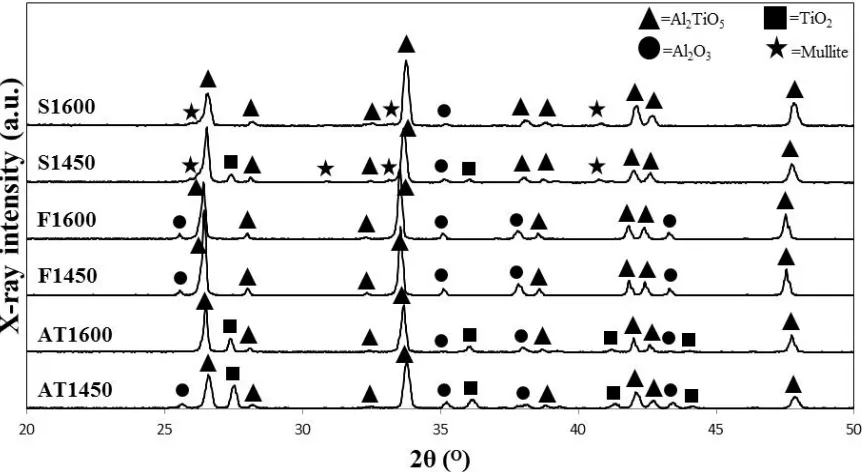
In order to understand the effect of sintering temperature and the effect of Fe2O3 and SiO2 additions, the samples
were prepared with 10 wt.% additive and sintered 1450 and 1600°C. Specimens with additives and sintering
temperatures such as Fe2O3, SiO2,1450°C, 1600°C, which are denoted as AT1450, AT1600, F1450, F1600, S1450 and
but not always necessary. Fe3+ with a radius of 0.64 Å, readily forms solid solutions with Al3+ in AT, which has a Radius of 0.54 Å [11].
Fig. 2.XRD patterns of the sintered samples
With formation of Fe2TiO5-AT solid solution, Al2O3 and TiO2 become unreacted. This explains minor phases of
Al2O3 and TiO2 present at the XRD spectra of samples F1450 and F1600. Rezaie et al. [5] observed that additions of
Fe2O3 decreased the formation temperature and increased the grain growth of AT. Samples with 10 wt. % SiO2 are
mainly composed of AT with small amount of mullite and trace amount of Al2O3. Sample S1450 has also minor phase
of TiO2. Mullite presence was also observed with the SEM-EDX analysis.
B. Microstrucrure
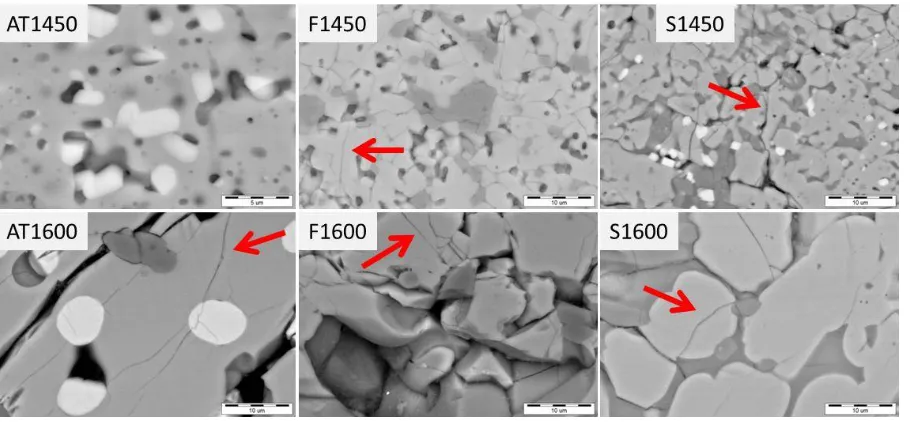
Figure 3 shows the general microstructure of the sintered samples. Pores and cracks are present at all samples. The samples AT1450 and AT1600 have very large cracks and pores. Abnormal grain growth is observed due to the high sintering temperatures. Also many unreacted grains are present at the microstructure. White inclusions are rutile, darker ones are corundum and the grey matrix is AT. Unreacted phases of rutile and corundum peaks are observed with XRD analysis as well. Because of the large grain size of the starting powders, with the formation of the AT, closest grains to each other are depleted and the unreacted phases are become separated. Thus, diffusion path of the ions and atoms blocked. More efficient mixing and milling could be effective to have a full formation of AT.
Samples containing 10 wt.% hematite (F1450 and F1600) have very less amount of unreacted phases. TiO2 and
Fe2O3 phases are not observed both with XRD and SEM analysis but unreacted Al2O3 is observable at the
microstructure (dark grains). AT grains are abnormally grown and become more elongated.
At the microstructure of S1450, unreacted grains of Al2O3 and TiO2 present and mullite (3Al2O32SiO2) is seen as
Fig.3.SEM-BSE images of the samples sintered at 1450 °C (upper) and 1600 °C (lower)
Figure 4 represents the more detailed microstructure of the sintered samples. Sample AT1450 has many unreacted grains and pores. AT-matrix is seen grey and there are no micro-cracks. Sample F1450 have unreacted Al2O3 grains
due to the formation ofFe2TiO5 phase. Intergranular and transgranular micro-cracks are observed.
IV. CONCLUSIONS
Aluminum Titanate (AT) ceramics has been produced with addition 10 wt. % SiO2 or Fe2O3. Samples are sintered
without and with additives at two different temperatures; 1450 and 1600°C.
Microstructure and XRD phase studies showed that unreacted Al2O3 and TiO2 are remained at the samples without
additives. All TiO2 is depleted at the samples containing Fe2O3 due to the formation of solid solutions by diffusion of
the Fe3+ ions to the AT crystals. Mullite and glassy phase are formed in the grain boundaries of the samples containing SiO2. Intergranular and transgranular micro-cracks are formed because of the high anisotropy of thermal expansion
coefficients of the AT crystals during sintering or cooling. With increasing sintering temperature from 1450 to 1600°C grains become coarser and elongated.
ACKNOWLEDGMENT
The authors would like to thank Metamin A.Ş. for supporting the raw materialsin this study.
This paper was presented at icetas2016Afyonkarahisar/Turkey.
REFERENCES
[1] G. Bayer, “Thermal expansion characteristics and stability of pseudobrookite-type compounds, Me3O5,” Journal of the Less Common Metals,
vol. 24, no. 2, pp. 129-138, 1971.
[2] M. Ishitsuka, T. Sato, T. Endo, and M. Shimada, “Synthesis and thermal stability of aluminum titanate solid solutions,” Journal of the American Ceramic Society, vol. 70, no. 2, pp. 69-71, 1987.
[3] B. Freudenberg, and A. Mocellin, “Aluminum Titanate Formation by Solid-State Reaction of Fine Al2O3 and TiO2 Powders,” Journal of the American Ceramic Society, vol. 70, no. 1, pp. 33-38, 1987.
[4] F. J. Parker, “Al2TiO5-ZrTiO4-ZrO2 Composites: A New Family of Low-Thermal-Expansion Ceramics,” Journal of the American Ceramic Society, vol. 73, no. 4, pp. 929-932, 1990.
[5] H. Rezaie, R. Naghizadeh, N. Farrokhnia, and S. Arabi, “The effect of Fe2O3 addition on tialite formation,” Ceramics international, vol. 35, no.
2, pp. 679-684, 2009.
[6] T. Korim, “Effect of Mg2+and Fe3+ions on formation mechanism of aluminiumtitanate,” Ceramics International, vol. 35, no. 4, pp. 1671-1675,
2009.
[7] H.-C. Kim, D.-J. Lee, O.-S. Kweon, and I.-J. Kim, “Thermal Durability of Al2TiO5-Mullite Composites and Its Correlation with
Microstructure,” Journal of the Korean Ceramic Society, vol. 42, no. 8, pp. 532-536, 2005.
[8] M. Nagano, S. Nagashima, H. Maeda, and A. Kato, “Sintering behavior of Al2TiO5 base ceramics and their thermal properties,” Ceramics international, vol. 25, no. 8, pp. 681-687, 1999.
[9] I. J. Kim, and G. Cao, “Low thermal expansion behavior and thermal durability of ZrTiO4-Al2TiO5-Fe2O3 ceramics between 750 and 1400 C,” Journal of the European Ceramic Society, vol. 22, no. 14, pp. 2627-2632, 2002.
[10] P. Oikonomou, C. Dedeloudis, C. Stournaras, and C. Ftikos, “Stabilized tialite–mullite composites with low thermal expansion and high strength for catalytic converters,” Journal of the European Ceramic Society, vol. 27, no. 12, pp. 3475-3482, 2007.
[11] I. Kim, and L. Gauckler, “Formation, decomposition and thermal stability of Al2TiO5 ceramics,” Journal of Ceramic Science and Technology,