Original Research Article
A prevalence study on hypertension among practising
advocates in Madurai
P. Praveena
1*, Shanthi Edward
2INTRODUCTION
Hypertension is a major global public health issue. World Health Organisation (WHO) states hypertension as “Silent Killer”, because the disease does not cause any harm by itself but predisposes to other cardiovascular, cerebrovascular and chronic renal diseases.1 WHO data indicates that by 2025, the global burden of hypertension will increase by 60% to be 1.56 billion adults with hypertension worldwide.2 Hypertension is reported to be the fourth contributor to premature death in developed
countries and seventh in developing countries.3 Hypertension has a multifactorial etiogenesis, amongst that occupational factor plays a vital role. In modern society, job strain results from a combination of high workload and decision making in the workplace. In recent years, the practice of law is demanding and exceedingly stressful occupation. Main factors concerned are, being overloaded with work, unsupported, lack of appreciation, long hours, unattainable targets, work placed structures, cultures and aspects of legal education. It causes a great impact on health and wellbeing. Even
ABSTRACT
Background: In recent years, the practice of law is demanding and exceedingly stressful occupation. Main factors concerned are, being overloaded with work, unsupported, lack of appreciation, long hours, unattainable targets. Even the most balanced and well-adjusted advocates at some point eventually succumbs to the pressures of working in the legal field. It causes hypertension and a great impact on ones‟well being. Hence the main objective of the study is to find out the prevalence of hypertension among practising advocates, thereby effective measures can be taken to prevent and control hypertension and its complications.
Methods:: A cross-sectional study was conducted in a sample of 300 practising advocates at Madurai district court for a period of 1 year by simple random sampling method.
Results: The overall prevalence of hypertension among the practising advocates was found to be 41% (123). Among the 123 hypertensives, 56 (18.7%) were known hypertensives and 67 (22.3%) were newly detected hypertensives.
Conclusions: The cause for hypertension among the advocates may be due to hectic work pressure. Advocates being professionals are well educated and informative. Regular adoption of basic life style modification practices, short vacations, arrangement of health camps in court premises with guidance of bar council association, recruitment of health counsellor in Bar Council Association for health educating and counselling the advocates, regular monitoring of health status by self-care management can control and prevent hypentension.
Keywords: Hypertension, Advocates, Life style modifications 1
Assistant Professor, Department of Community Medicine, Velammal Medical College Hospital and Research Institute, Madurai, Tamil Nadu, India
2
Professor, Department of Community Medicine, Sree Balaji Medical College and Hospital, Chennai, Tamil Nadu, India
Received: 01 November 2018
Accepted: 04 December 2018
*Correspondence:
Dr. P. Praveena,
E-mail: [email protected]
Copyright: © the author(s), publisher and licensee Medip Academy. This is an open-access article distributed under the terms of the Creative Commons Attribution Non-Commercial License, which permits unrestricted non-commercial use, distribution, and reproduction in any medium, provided the original work is properly cited.
the most balanced and well-adjusted advocates at some point eventually succumbs to the pressures of working in the legal field. In view of above issues, present study intends to generate information on prevalence of hypertension among practising advocates, thereby effective measures can be taken to prevent and control hypertension.
METHODS
Study design:Cross sectional study
Place of study:Bar association and law chamber, District court, Madurai.
Period of study:From September 2015 to August 2016. Study population: Advocates in the age group of 30 years and above practicing in Madurai city.
Inclusion criteria
Inclusion criteria were advocates in age group of 30 and above; regularly practicing advocates (attending court at least thrice a week); advocates practicing for a period of more than 5 years.
Sample size
According to available studies, relating to prevalence of hypertention among advocates, the prevalence was 36%, considering it as „p‟ with limit of accuracy as 16% of prevalence and with 10% attrition the sample size is calculated4
N = Za2×P×Q/ L2 =1.96 × 1.96 ×36 ×64/ 5.76×5.76 = 266.72.
With 10% attrition i.e. 26.6, minimum sample size calculated
(266+26.6) =293.32 rounded off to 300 Hence sample size for this study will be 300 Sampling method
Simple random sampling.
From Madurai Bar Association (M.B.A) Advocates voters‟ affidavit list, 600 advocates were selected by simple random sampling technique using computerized random numbers. Out of that a sample of 300 advocates who satisfy the inclusion criteria are selected by enquiry through phone dialing. Permission from Madurai Bar Association Secretary was obtained prior to the data collection.
Data collection tool
Structured and pretested interview schedule (modified after pilot) and sphygmomanometer (mechanical type with a dial).
Data was collected using the final proforma. Data on background characteristics were obtained from all participants. Three blood pressure readings as per JNC VII were measured in all study subjects at an interval of 3 hours in sitting position and the average was calculated. The participants were advised to refrain use of tobacco in any form or ingestion of caffeine during the 30 minutes preceeding measurement. Newly detected hypertensives were examined again after 2 days in the same manner to confirm that hypertension was constant. Apart from the known hypertensives, based on the blood pressure measurements, the remaining study subjects were classified according to JNC VII criteria.
Statistical analysis
The Data was entered and analysed using SPSS version 16.0. Descriptive statistical analysis done by calculating percentages and 95% CI were computed.
RESULTS
Prevalence of hypertension
Out of 300 advocates participated in the study, 123 (41%) were found to be hypertensives. Among the 123 hypertensives, 56 (18.7%) were known hypertensives and 67 (22.3%) were newly detected hypertensives. The 95% of Confidence interval for prevalence of hypertension is ranging between 35.4-46.8. Prevalence of hypertension among the study subjects is shown in Table 1.
Classification of hypertensives as per type of hypertension
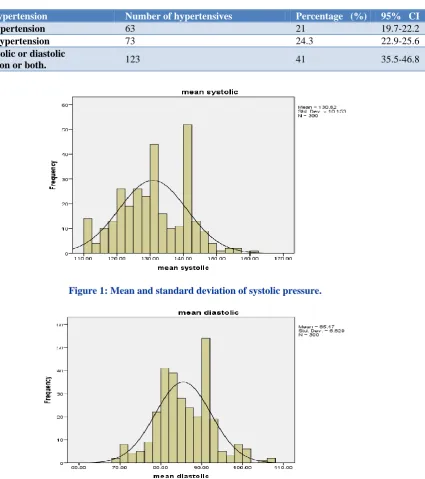
The prevalence of systolic and diastolic hypertension was found to be 63(21%) and 73(24.3%) respectively. The 95% of CI for prevalence of systolic and diastolic hypertension is ranging between 19.7-22.2 and 22.9-25.6 respectively. The overall prevalence of both systolic and diastolic hypertension was found to be 123(41%) and 95% Confidence Interval for hypertensives is 35.4-46.8. Distribution of hypertensives as per systolic and diastolic blood pressure measurements is shown in Table 2. It has been found that mean and standard deviation of systolic pressure among 300 study participants was found to be 130.7 and 10.7 respectively. The mean and standard deviation of diastolic pressure was found to be 85.4 and 6.8 respectively, shown in Figure 1 and 2.
Criteria. Among the 56 known hypertensive advocates 7 (12.5%) were having normal blood pressure during the examination. It has been observed from the table 3, that among the 244 study participants, 105 (43.03%) study participants were in pre hypertensive status, 55 (22.54%) and 12 (4.91%) study participants were in stage I and stage II hypertension respectively. Around 72(29.5%) study participants were found to be normotensives. Hence
67 (27.45%) study participants were newly detected hypertensives according to JNC VII criteria. For further description the data was dichotomized in to two groups, Hypertensives (Including stage I, stage II and known
hypertensives)
Normotensives (Including pre-hypertensives)
Table 1: Prevalence of hypertension in study subjects.
Prevalence of hypertension Number of study subjects (n=300) Percentage (%) 95% CI
Newly detected hypertensives 67 22.3 17.6 -27.1
Known hypertensives 56 18.7 14.3-23.1
Total hypertensives 123 41.0 35.4-46.8
Table 2: Distribution of hypertensive cases as per type of hypertension.
Type of hypertension Number of hypertensives Percentage (%) 95% CI
Systolic hypertension 63 21 19.7-22.2
Diastolic hypertension 73 24.3 22.9-25.6
Either systolic or diastolic
hypertension or both. 123 41 35.5-46.8
Figure 1: Mean and standard deviation of systolic pressure.
Table 3: Distribution of hypertensives and normotensives based on JNC VII classification (other than 56 known hypertensives).
Classification based on JNC VII Number of study subjects
(n=244) Percentage (%) 95% CI
Normotensives 72 29.5 23.7-35.2
Pre hypertensives 105 43.03 36.8-49.2
Stage I hypertensives 55 22.54 17.3-27.7
Stage II hypertensives 12 4.91 2.1-7.6
Table 4: Distribution of hypertensive subjects and their background characteristics.
Background characteristics Hypertensives (including stage
I, II, known hypertensives) Percentage (%) Total P value Age ( in years)
30-40 34 29.5 115
0.006
41-50 41 48.2 85
51-60 46 46.9 98
>60 02 100 2
Sex
Male 122 43.3 282
0.001
Female 1 5.5 18
Marital status
Unmarried 10 47.6 21
0.391
Married 112 40.2 178
Divorced 1 100 1
Type of case practice
Civil 37 26.0 142
0.000
Criminal 13 38.2 34
Both 73 58.8 124
Working hours
<8 hours per day 6 4.1 143
0.000
≥8 hours per day 117 74.5 157
History of diabetes mellitus
Present 29 76.3 38
0.000
Absent 94 35.8 262
Total 123 41 300
Therefore the total normotensives and total hypertensives were taken as 177 (59%) and 123 (41%) respectively for further analysis.
Out of 300 advocates, 115(38.3%), 85(28.3%), 98(32.7%) and 2(0.7%) were in the age group of 30 to 40 years, 41 to 50 years, 51 to 60 years and more than 60 years respectively. Among the study subjects 282 (94%) were male and 18 (6%) were female. Twenty one (7%), 278 (92.7%) and 1 (0.3%) were unmarried, married and divorced respectively. Among the 300 advocates 142 (47.3%), 34 (11.3%), 124 (41.3%) were practising civil cases only, criminal cases only, both civil and criminal type of cases. One hundred and fifty seven (52.4%) of 300 advocates were working equal to or more than 8 hours per day, 38 (12.7%) had history of diabetes mellitus, 114 (38%) had a family history of hypertension.
DISCUSSION
Prevalence of hypertension
Hypertension and age distribution
It has been found that as age increases there is increase in blood pressure. In the present study the age wise increase in prevalence of hypertension was found to be 29.56% in the age group 30-40 years and 48.23% in the age group of 41-50 years. The above observation was statistically significant indicating that the increase in trend of hypertension is observed as age increases. This confirmatory evidence was proved by Yadav et al among affluent North Indian population reported, the overall prevalence of hypertension in the age group 30-39 years was 13.7% and increased to a peak of 64 per cent in the age group 60-69 years.8 Similarly a study done by Ranasinghe et al, the distribution of hypertension showed a significant rise with increase in age.9 The above study denotes that there is significant rise of blood pressure which was common more than 50 years of age group. It is found that the current study finding is similar to Vasan et al finding which reported that there is significant association of hypertension with age.10 This may be due to the fact that structural changes in the arteries (especially with large artery stiffness) occurs as age increases.
Hypertension and sex
In the current study, the distribution of hypertensive cases were found to be more among males compared to females. Out of 300 study participants, a majority of 282 (94%) were males and remaining 18 (6%) were females. Among the total males, 122 (43.26%) were found to be hypertensives and out of the total females 1 (5.55%) was hypertensive. Similar findings were observed in following studies. A study done by American Heart Association in 2014, the prevalence of hypertension was more in men than women until the age of 45 years.11 A study done by Sirajahmad at urban area of north India revealed that males had a higher prevalence (15.8%) of hypertension than females 12.8%.12 Hence the distribution of hypertensive cases has been found more in males compared to females in various group of population.
On contrary to the current study finding, a study done by Dangroo et al in rural Indian population states that prevalence in males and females were 13.8% and 15.3% respectively.13 It denotes a higher prevalence of hypertension among females compared to males in rural areas. This could be due to the oppression of females in the male dominating rural society in India.
Hypertension and marital status
In the present study, among the married participants 112 (40.28%) and among the unmarried participants 10 (47.61%) were found to be hypertensives. One participant who was a divorcee had hypertension. The findings were similar to Lipowicz et al study which was done globally to evaluate the relationship between marital status and blood pressure and risk of developing hypertension.14 It
was found that never married men had on average higher systolic blood pressure and diastolic blood pressure than married men. It denotes that unmarried, separated or widowed individuals have a higher risk of developing hypertension compared to married individuals. The reason could be that happy married life with support from spouse helps to deal with stressful situations and reduces the risk of developing hypertension.
Hypertension and occupation
The present study was carried out among advocates who are considered as professionals. The prevalence of hypertension among advocates in the present study (41%) was similar to the study conducted among lawyers by Maulana Azad Medical college researchers which showed 36% of prevalence of hypertension. But the prevalence of hypertension in the present study (41%) was found to be higher when compared with prevalence in professional group (22.05%) stated by Kannan et al.15 On comparing with done by Ghosh et al conducted in doctors community prevalence of hypertension was 14.8%, the prevalence among advocates was found to be higher (41%) in the current study.16 The prevalence of hypertension in the present study was similar to a study by Babu et al conducted among software professionals stating 45% of hypertension prevalence.17 The above findings that advocates are more prone for hypertension than other professionals may be due to hectic nature of work (attending arguments in court for hours together, rushing from one court to another during calling period, referring law journals which needs more concentration and involvement).
Hypertension and working hours
In the present study, it has been observed that around 117 (74.52%) study participants who were working equal to or more than 8 hours per day were found to be hypertensives and only 6 (4.19%) study participants who were working less than 8 hours per day were found to be hypertensives. The above observation was statistically significant indicating that long working hours per day has influenced on hypertension. The observations in articles reported in Forbes and Medical Daily published in the American Journal of Epidemiology based on Meta-analysis of Observational Studies reveal that a combination of stress, raised blood pressure, unhealthy diets and toiling long working hours may be the cause of thousands of worker‟s serious health problems.18,19 Working more than 8 Hours a day raises the blood pressure and increases the risk of heart disease by 80%. Lack of fixed work schedule and long working hours among advocates may be cause for development of hypertension.
Hypertension and case practice
73(58.87%) compared to participants practising only civil cases 37(26.05%) and only criminal cases 13 (38.23%). Advocates practising criminal cases were more prone for stress and hypertension than practising civil cases, which was similar to the finding of a study conducted among lawyers by Maulana Azad medical college researchers, published in Indian Express by reporter Kanusarda at Delhi.4 It states that criminal lawyers experience more stress than others perhaps because of the responsibilities involved in their specialisation. The nature of work, responsibilities, number of intricacies and above all the fact that lives of individuals are at stake in criminal cases increase the degree of pressure which ultimately results in stress.
Hypertension and diabetes mellitus
Around 29 (76.31%) with history of diabetes, were found to be hypertensives and 94 (35.87%) study participants with no history of diabetes were hypertensives. The above observation was found to be statistically significant indicating that diabetes may be a co-morbid condition for prevalence of hypertension. A study done by Dhobi et al reported, prevalence of diabetes among hypertensives were 42% and even though the prevalence of diabetes among hypertensives is less compared to current study, still there was association between diabetes and hypertension.20
CONCLUSION
In conclusion, the overall prevalence rate of hypertension among advocates above the age group of 30 was found to be 41%. It has been found that as age increases there is increase in blood pressure. The age wise increase in prevalence of hypertension was found to be 29.56% in the age group 30-40 years and 48.23% in the age group of 41-50 years. The prevalence is high, 41% among advocates compared to doctors in other study, 14.8%. Advocates who are practising both civil and criminal cases contribute to higher prevalence of hypertension (58.87%). Advocates working equal to or more than 8 hours a day, 74.5% were found to be hypertensives. The cause for hypertension among them may be due to hectic work pressure like attending arguments for hours together, rushing from one court to another during calling period, long extensive working hours, unattainable targets. Therefore occupation has a major influence on hypertension.
Hypertension is preventable and treatable by making healthy choices. Advocates being professionals are well educated and informative. Therefore by regular adoption of basic life style modification practices, the prevalence of hypertension may be reduced among the advocate community. Hence life style modifications should be adopted to overcome strain and stressful life. Dietary Approaches to Stop Hypertension (DASH) eating plan can be followed. Combinations of two (or more) lifestyle modifications can achieve even better results. Short
vacations can be planned and entertained with friends and family, arrangement of health camps in court premises with guidance of bar council association, health counsellor can be recruited in Bar Council Association for health educating and counselling the advocates. Yoga classes can be recommended. Regular monitoring of health status by self-care management is needed. Work schedules can be pre-planned, prioritized and executed.
Funding: No funding sources Conflict of interest: None declared
Ethical approval: The study was approved by the
Institutional Ethics Committee of SRMC &RI (SRU),
Chennai (IEC Ref: CSP-MED/15/AUG/24/37)
REFERENCES
1. World Health Organization. A global brief on hypertension Silent killer, global public health crisis www.who.int/cardiovascular_diseases/publications/ global_brief_hypertension/en/. Accessed on 10 September 2018.
2. Kearney PM, Whelton M, Reynolds K, Muntner P, Whelton PK, He J. Global burden of hypertension: analysis of worldwide data. Lancet. 2005;365(9455):217-23.
3. Deepa R, Shanthirani CS, Pradeepa R, Mohan V. Is the „rule of halves‟ in hypertension still valid?--Evidence from the Chennai Urban Population Study. J Assoc Physicians India. 2003;51:153-7. 4. Sarda K. The New Indian Express Donning lawyers
robes, with no law to protect from stress, 2014. 5. Madhumitha M, Naraintran S, Manohar C, Revathi
S, Biradar MK, Patil RS. Hypertension – prevalence and risk factors among urban population in north Karnataka. Int J Cur Res Rev. 2014;6(7):39-45. 6. Anchala R, Kannuri NK, Pant H, Khan H, Franco
OH, Di Angelantonio E, et al. Hypertension in India: a systematic review and meta-analysis of prevalence, awareness, and control of hypertension. J hypertension. 2014;32(6):1170-7.
7. Gani P, Priya KJ, Paramasivam S. Prevalence of hypertension in an urban area: a community-based survey in Trichy, Tamilnadu, India. Int J Community Med Public Health. 2016;3:2325-9. 8. Yadav S, Boddula R, Genitta G, Bhatia V, Bansal B,
Kongara S, et al. Prevalence & risk factors of pre-hypertension & pre-hypertension in an affluent north Indian population. Indian J Med Res. 2008;128(6):712-20.
9. Ranasinghe P, Cooray DN. The influence of family history of Hypertension on disease prevalence and associated metabolic risk factors among Sri Lankan adults. BMC Public Health. 2015;15:576.
11. American Heart Association World-wide report 2014.
12. Ahmad S. Prevalence and risk factors of hypertension, among adults residing in an urban area of north India. Int J Pure App Biosci. 2015;3(2):338-44.
13. Dangroo S, Hamid S, Rafiq M, Ashfaq. The Role of Gender and Their Marital Status in the Prevalance of Hypertension in Kashmiri Population; Scholars Journal of Applied Medical Sciences (SJAMS) Sch. J App Med Sci. 2013;1(6):975-80.
14. Lipowicz A. Lopuszanska M Marital differences in blood pressure and risk of hypertension among polish men. Eur J epidemiol. 2005:20(5);421-7. 15. Kannan SL. An epidemiological study of
hypertension in a rural household community. Sri Ramachandra J Med. 2009;II(2):9-13.
16. Ghosh A, Mukhopadhyay K, Bera R, Dasgupta R. Prevalence of hypertension and prehypertension among doctors of different specialties in a tertiary-care teaching hospital in Eastern India and its correlation with body mass index. Int J Med Sci Public Health. 2016;5:709-13.
17. Babu GR, Mahapatra T, Detels R. Job stress and hypertension in younger software professionals in
India. Indian J Occup Environ Med. 2013;17(3):101–7.
18. DiSalvo D.why working more than 8 hours a day can kill you. Available at: http://www.forbes.com/ sites/ daviddisalvo/ 2012/09/12. Accessed on 10 September 2018.
19. Christine HsuUS/WORLD. Working More Than 8 Hours a Day Raises the Risk of Heart Disease by 80%. Sep 11, 2012 07:02 PM; Available at: http://www.medicaldaily.com/working-more-8-hours-day-raises-risk-heart-disease-80-242464. Accessed on 10 September 2018.
20. Dhobi GN, Majid A, Masoodi SR, Bashir MI, Wani AI, Zargar AH. Prevalence of Hypertension in patient with new onset type 2 diabetes mellitus. J Indian Med Assoc. 2008;106:92-8.