www.pharmascholars.com
121
Original Article
CODEN: IJPNL6
ESTIMATION AND VALIDATION OF SOFOSBUVIR IN BULK AND TABLET
DOSAGE FORM BY RP-HPLC
Ravikumar Vejendla
1, *C.V.S. Subramanyam
2, G. Veerabhadram
31
Sri Indu Institute of Pharmacy, Sheriguda, Ibrahimpatnam, Hyderabad, India
2Gokarajurangaraju, Kukatpally, Hyderabad, India
3
Osmania University, Department of Chemistry, Hyderabad, India
*Corresponding author e-mail:
[email protected]
Received on: 25-01-2016; Revised on: 21-03-2016; Accepted on: 28-03-2016
ABSTRACT
A simple, sensitive, precise, and accurate isocratic reverse phase high pressure liquid chromatographic method has been developed and validated for the estimation of sofosbuvir in bulk and tablet dosage form. To optimize, a column Phenomenex prodigy ODS-3V (150 mm x 4.6 mm, 5 µm), mobile phase mixture of methanol and (0.1%) tri-fluro acetic acid as buffer having pH of 3.2 in the ratio of (30:70 v/v) found to be an efficient system for elution of drug with good peak shape as well as retention time 2.990 min., flow rate 1.0 ml/min. at UV wavelength of 260nm. Quantitative linearity was obeyed in the concentration range of 100 to 600 µg/ml, the regression equations of concentration over their peak areas were found to be Y = 18864x + 58306 R² = 0.996, where Y is the peak area and X is the concentration of drug. The number of theoretical plates obtained was 2604.352 which indicate the efficient performance of the column. The limit of detection was 0.01 µg/ml and limit of quantification was 0.03 µg/ml, which indicates the sensitivity of the method the high percentage recovery indicates that the proposed method is highly accurate. No interfering peaks were found in the chromatogram indicating that excipients used in tablet formulation did not interfere with the estimation of the drug by the proposed RP-HPLC method.
Key words: Sofosbuvir, RP-HPLC, Methanol, Buffer as tri-fluro acetic acid.
INTRODUCTION
Sofosbuvir, IUPAC Name is Isopropyl (2S )-2-[[[(2R,3R,4R,5R )-5-(2,4-dioxopyrimidin-1-yl)-4- fluoro-3-hydroxy-4-methyl-tetrahydrofuran-2-yl]methoxy-phenoxy-phosphoryl]amino] propanoate, molecular formula and weight was C22H29FN3O9P &
529.453g/mol.
Fig. 1: Chemical structure of sofosbuvir.
Sofosbuvir1 is a nucleotide analog used in
combination with other drugs for the treatment of
hepatitis C virus (HCV) infection. Compared to previous treatments, Sofosbuvir-based regimens provide a higher cure rate, fewer side effects, and a two- to four-fold reduced duration of therapy2.
Sofosbuvir allows most patients to be treated successfully without the use of peginterferon3, an
inject able drug with severe side effects4 that is a key
component of older drug combinations for the treatment of HCV. Sofosbuvir inhibits the RNA polymerase that the hepatitis C virus uses to replicate its RNA. In 2013, the FDA approved sofosbuvir in combination with ribavirin (RBV) for oral dual therapy of HCV genotypes 2 & 3, and for triple therapy with injected pegylated interferon (peg.IFN) and RBV for treatment-naive patients with HCV genotypes 1 and 4. 5In 2014, a combination of
sofosbuvir with the viral NS5A inhibitor ledipasvir
International Journal of Pharmacy
www.pharmascholars.com
122
was approved. 6This latter combination provides highcure rates in people infected with genotype 1 (most common in US, Japan & much of Europe) without the use of interferon, irrespective of prior treatment failure or the presence of cirrhosis7. Sofosbuvir is
also used in Hepatitis –C virus patients with an HIV confection. The treatment is based on a number of clinical trials, for example, the ELECTRON trial which showed that a dual interferon-free regimen of sofosbuvir plus ribavirin produced a 24-week post-treatment sustained virological response rate of 100% for previously untreated patients with Hepatitis-C virus genotype 2 or 38.
Sofosbuvir is a pro-drug using the Pro-tide biotechnology strategy. It is metabolized to the active anti-viral agent, 2’-deoxy-2’- α -fluoro-β-methyl-uridine-5’-tri-phosphate. The tri-phosphate serves as a defective substrate for the NS5B protein, which is the viral RNA polymerase, thus acts as an inhibitor of viral RNA synthesis9. Prior to the discovery of
sofosbuvir, a variety of nucleoside analogs had been examined as anti-hepatitis-C treatments, but these exhibited relatively low potency. This low potency arises in part because the enzymatic addition of the first of the three phosphate groups of the tri-phosphate is slow. The design of the sofosbuvir, based on the protide approach, avoids this slow step by building the first phosphate group into the structure of the drug during synthesis. Additional groups attached to the phosphorus temporarily mask the two negative charges of the phosphate group, thereby facilitating entry of the drug into the infected cell10. FDA approved sofosbuvir for the treatment of
chronic Hepatitis-C11. In October 10th 2014, FDA
approved the product combination of ledipasvir 90 mg / sofosbuvir 400 mg Brand –Harvoni12.
The present work reports the HPLC method for the analysis of sofosbuvir bulk, formulations and also in dissolutions, there was no HPLC method was reported. Some reported methods are 13development
of a sensitive UPLC-ESI MS/MS method for quantification of sofosbuvir and its metabolites in human plasma. 14Simultaneous determination of
lidipasvir, sofosbuvir and its metabolites in rate plasma by UPLC-MS/MS, and 15Evaluation of a
rapid method for the simultaneous quantification of ribavirin, sofobuvir and its metabolites in rat plasma by UPLC-MS/MS method.
EXPERIMENTAL METHODOLOGY
Instrumentation: Waters Alliance 2695 separation module (Waters Corporation, Milford, USA) equipped with 2998 UV detector with Empower-2 software was used for the analysis. The HPLC system
was equipped with a column compartment with temperature control and an on-line degasser. Data acquisition, analysis, and reporting were performed by Empower-2 chromatography software. Phenomenex Prodigy ODS-3V (150 mm x 4.6 mm I.D; 5 µm) was used as stationary phase. Solubility of the compound was enhanced by sonication. All the weights in the experiments were done with Essea model: AJ220 Digital Electronic Balance.
Chemicals and Reagents: The reference samples of sofosbuvir were obtained from Natco Pharma Ltd., Hyderabad. Purified water was prepared by using Milli-Q water purification system. HPLC grade methanol (Merck, Mumbai), which was used for preparing dilutions and mobile phase. Analytical grade tri-fluro acetic acid (buffer) was obtained from Rankem Fine Chemicals Ltd., New-Delhi. Sovaldi, a formulation containing Sofosbuvir-500 mg was purchased from local market.
Preparation of standard solution: The standard solution was prepared by dissolving the suitable quantity of sofosbuvir of 500 mg in standard volumetric flask, and dilute up to the volume with diluent (water: methanol 60:40), from the above solution pipette out 5 ml into 50 ml standard volumetric flask and dissolve with diluent (500 µg/ml). This prepared standard (20 µl) was injected and chromate-graphed.
Preparation of standard solution: Twenty tablets were finely powdered and an accurately weighed sample equivalent to 500 mg (Avg. wt is 814mg) of sovaldi formulation into a 100 ml standard volumetric flask, dissolve and dilute to volume with diluent, Pipette out 5 ml into 50 ml standard volumetric flask dissolve with diluent (500 µg/ml), this prepared sample (20 µl) was injected and chromate-graphed and the results from assay are summarized.
METHOD DEVELOPMENT:
www.pharmascholars.com
123
chromatography software found to be an efficientsystem for elution of drug with good peak shape as well as retention time 2.990 min., flow rate 1.0 ml/min.
METHOD VALIDATION:
As per (ICH) International Conference on Harmonization guidelines, the method validation parameters such as specificity, linearity, precision, accuracy, LOD, LOQ and robustness were optimized16.
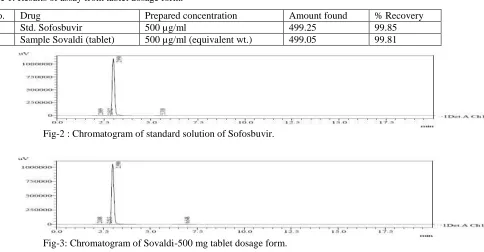
a) Specificity: Specificity is the extension to which the procedure applies to analyte of interest and is checked by examining the formulation sample for any interfering peaks. The specificity of the method was evaluated with regard to interference due to presence of excipients. The excipients used in the formulation did not interfere with the drug peak and thus the method is specific. The HPLC chromatogram recorded for the drug matrix (mixture of the drug and excipients) showed almost no interfering peaks within retention time ranges. Fig. 2 & 3 showed the representative chromatograms for standard and the dosage form. The figure describes that the selected drug was clearly separated and the proposed HPLC method is selective.
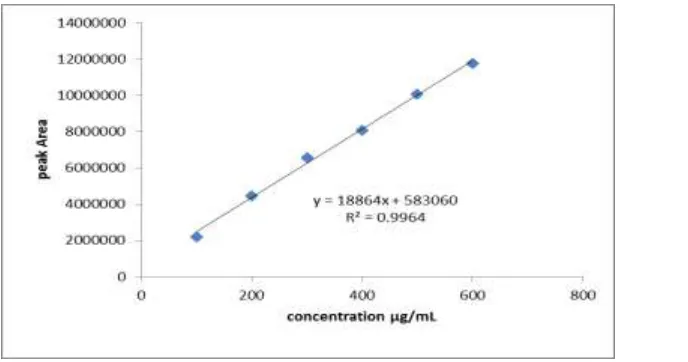
b) Linearity: To establish linearity, the stock solutions were prepared as 1000 µg/ml using mobile phase, from the stock solution further dilutions were prepared in the concentration range of 600 - 100 µg/ml, elution’s are made on HPLC by injecting 20 µg/ml of each concentration repeat it for two times. The coefficient of determination and regression coefficient (R2) was
obtained and shown in the table 2 and fig. 4.
c) Precision: The intraday and inter-day precision was determined by analyzing sofosbuvir standard (500 µg/ml) for six times on same day (intra-day) and repeated on the second day (inter-day) studies were given the table 3 & 4.
d) Accuracy: The accuracy of the method shall be demonstrated through determination on samples in three concentrations from 120% (600 µg/ml), 100% (500 µg/ml) and 80% (400 µg/ml), three replicates of each of the theoretical concentrations employed as per the usual procedure and the results are summarized in Table 5.
e) Limit of detection (LOD) and limit of quantification (LOQ):
A series of 12 replicate concentrations were analyzed and quantified. Set up the described chromatographic conditions and allow the system to equilibrate. Starting with concentration 10%, 5%, 2%, 1%, 0.5%, 0.2%, 0.1%, 0.05%, 0.02%, 0.01% and 0.005% peak area values were given in the Table 6. From this LOD is 0.01% and LOQ was found to be 0.03%.
f) Robustness: The robustness of the method was determined as per USP guidelines, under different conditions including change in flow rate, different column, pH of buffer, and buffer concentration. The results obtained by deliberately variation in method parameters and data are summarized in table-7.
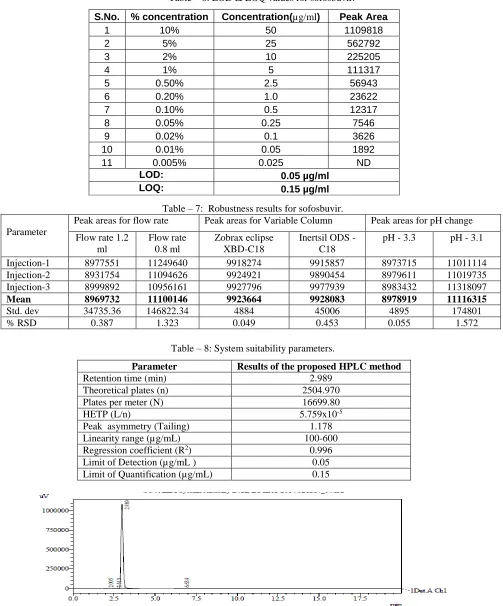
g) System suitability: For system suitability, six replicates of the working standard samples were injected and the parameters like – plate number (N), retention time (Rt), and peak asymmetry of samples were calculated and given in table-8.
RESULTS AND DISCUSSION
The aim of the present study was to develop a simple, sensitive, precise, and accurate RP-HPLC method for the analysis of sofosbuvir in bulk, formulation and disolution. To optimize the mobile phase, various combinations of buffer, methanol and acetonitrile solvents were studied, on a column Phenomenex prodigy ODS-3V (150 mm x 4.6 mm, 5 µ). Finally by using mixture of methanol and (0.1%) tri-fluro acetic acid with pH 3.2 as buffer in the ratio of (30:70 v/v) found to be an efficient system for elution of drug with good peak shape as well as retention time 2.990 min., flow rate 1.0 mL/min. at UV wavelength of 260 nm. Quantitative linearity was obeyed in the concentration range of 100 to 600 µg/ml, the regression equations of concentration over their peak areas were found to be Y= 18864 X + 58306, R2=0.996, where Y is the peak area and X is the
www.pharmascholars.com
124
CONCLUSIONIn conclusion a new isocratic RP-HPLC method was developed and validated for the estimation of sofosbuvir in bulk and tablet dosage form. The developed method is simple, precise and accurate and satisfactory results were obtained through the method validation data. The present method can be easily applicable for routine drug analysis in laboratories and pharmaceutical industry.
ACKNOWLEDGEMENT
Authors thank to M/s Natco Pharma Ltd., Hyderabad, for providing the gift sample of standard sofosbuvir for carrying the research work. The authors are also thankful to Director & Head of Sri Indu Institute of Pharmacy, Gokarajurangaraju Pharmacy College, and Osmania University, Hyderabad, for providing equipment for the present work.
Table 1: Results of assay from tablet dosage form.
S.No. Drug Prepared concentration Amount found % Recovery
1 Std. Sofosbuvir 500 µg/ml 499.25 99.85
2 Sample Sovaldi (tablet) 500 µg/ml (equivalent wt.) 499.05 99.81
Fig-2 : Chromatogram of standard solution of Sofosbuvir.
Fig-3: Chromatogram of Sovaldi-500 mg tablet dosage form.
Table – 2: Linearity results for sofosbuvir.
Concentration of
drug (µg/mL)
Retention
time (min.)
Peak Area
100 2.963 2205366
200 2.985 4450760
300 2.987 6584010
400 3.044 8065447
500 2.968 10058134
www.pharmascholars.com
125
Fig.- 4: Calibration curve of Sofosbuvir.Table – 3: Inter-day precision Table – 4: Intra-day precision
Table- 5:
Accuracy results for Sofosbuvir.
S.No
Recovery at 80% dilution Level Peak areas
Recovery at 100% dilution Level Peak areas
Recovery at 120% dilution Level Peak areas Standard Spiked (10%) Standard Spiked (10%) Standard Spiked (10%)
1 8191294 8922484 9948703 10784935 11742762 12321031
2 8273988 8863628 9963923 10719931 11765161 12269195
3 8061684 8545883 9966516 10798878 11735631 12299054
Mean 8175655 8777332 9959714 10767915 11747851 122964427
Std.Dev 107012 202589 9624 42136 15409 26018
%RSD 1.309 2.308 0.097 0.391 0.131 0.212
% Recovery 98.4 100.29 99.38
Average %
Recovery 99.35
Inj. Retention
time (min) Peak Area
1 2.982 9931517
2 2.978 9927713
3 2.980 9929188
4 2.974 9926435
5 2.972 9925327
6 2.974 9906283
Mean 2.977 9924410.5
Std.Dev 0.131 9140.88
%RSD 0.004 0.092
Inj. Retention
time (min) Peak Area
1 2.991 9982586
2 2.978 9933753
3 3.074 9962273
4 2.971 9954863
5 2.971 9952183
6 2.988 9913721
Mean 2.996 9949896.5
Std.Dev 1.313 23753
www.pharmascholars.com
126
Table – 6: LOD & LOQ values for sofosbuvir.S.No. % concentration Concentration(µg/ml) Peak Area
1 10% 50 1109818
2 5% 25 562792
3 2% 10 225205
4 1% 5 111317
5 0.50% 2.5 56943
6 0.20% 1.0 23622
7 0.10% 0.5 12317
8 0.05% 0.25 7546
9 0.02% 0.1 3626
10 0.01% 0.05 1892
11 0.005% 0.025 ND
LOD: 0.05 µg/ml
LOQ: 0.15 µg/ml
Table – 7: Robustness results for sofosbuvir.
Parameter
Peak areas for flow rate Peak areas for Variable Column Peak areas for pH change
Flow rate 1.2 ml
Flow rate 0.8 ml
Zobrax eclipse XBD-C18
Inertsil ODS - C18
pH - 3.3 pH - 3.1
Injection-1 8977551 11249640 9918274 9915857 8973715 11011114
Injection-2 8931754 11094626 9924921 9890454 8979611 11019735
Injection-3 8999892 10956161 9927796 9977939 8983432 11318097
Mean 8969732 11100146 9923664 9928083 8978919 11116315
Std. dev 34735.36 146822.34 4884 45006 4895 174801
% RSD 0.387 1.323 0.049 0.453 0.055 1.572
Table – 8: System suitability parameters.
Parameter Results of the proposed HPLC method
Retention time (min) 2.989
Theoretical plates (n) 2504.970
Plates per meter (N) 16699.80
HETP (L/n) 5.759x10⁻⁵
Peak asymmetry (Tailing) 1.178
Linearity range (µg/mL) 100-600
Regression coefficient (R2) 0.996
Limit of Detection (µg/mL ) 0.05
Limit of Quantification (µg/mL) 0.15
www.pharmascholars.com
127
REFERENCES1. Berden FA, Kievit W, Baak LC, et al. “Dutch guidance for the treatment of chronic hepaptitis-C virus infection in a new therapeutic era”. Neth J Med October 2014; 72(8): 388-400,.
2. Cholongistas E, Papatheodoridis GV, “Sofosbuvir: anovel oral agent for chronic hepatitis-C” Ann Gastroenterology 2014; 27 (4): 331-337.
3. Tran TT, “A review of standard and newer treatment strategies in hepatitis-C”. Am J Manag Care December 2012; 18 (14) Supplementary, S340-9,.
4. Yau AH, Yoshida EM. “Hepatitis-C drugs: The end of the pegylated interferon era and the emergence of all-oral interferon-free antiviral regimens: a concise review”. Can J Gastroenterol Hepatol September 2014; 28 (8): 445-51.
5. Calvaruso V, Mazza M, Almasio PL. “Pegylated-interferon-α(2a) in clinical practice: How to manage patients suffering from side effects”. Expert Opin Drug Saf May 2011; 10(3): 429-35.
6. Turker M. “FDA Approves ‘Game Changer’ Hepatitis-C Drug Sofosbuvir”. Medscape. 6th December 2013.
7. “New drug Sovaldi heralds the end of Hepatitis-C in Britain”. Daily Mail. 1st February 2014.
8. Gane EJ, Stadman CA, etal., “Nucleotide polymerase inhibitor Sofosbuvir plus Ribavirin for Hepatitis-C” N.Engl. J. Med. January 2013; 368(1): 34-44..
9. Sofosbuvir Full Prescribing Information”. www.Gilead.com. Retrieved 28 October 2014.
10. Chae HB, Park SM, Youn SJ. “Direct acting antivirals for the treatment of chronic hepatitis C: open issues and future perspectives”. Scientific world journal 2013.
11. FDA apporoves Sovaldi for chronic hepatitis-C”. FDA New Release. US Food and Drug Administration. 2013-12-06.
12. “New drug Sovaldi heralds the end of Hepatitis-C in Britain”. Daily Mail. 1st February 2014.
13. ICH, Q2B-Validation of analytical procedures; methodology, International Conference on Harmonization, Nov. 1996.
14. Rezek MR, Basalious EB, Karim IA. “Development of a sensitive UPLC-ESI MS/MS method for quantification of sofosbuvir and its metabolites in human plasma”. J Pharm Biomed Anal. 2015 Oct.10 page 97-104.
15. Chenwei Pan etal., “Simultaneous determination of lidipasvir, sofosbuvir and its metabolites in rate plasma by UPLC-MS/MS”. Journal of Chromatography B 1 Jan.2016; Volume 1008, , pages 255-259.
16. Shi X, Zhu D, Lou J, Gan D, “Evaluation of a rapid method for the simultaneous quantification of ribavirin, sofobuvir and its metabolites in rat plasma by UPLC-MS/MS method”. J Chromatography B Analyt Technol Biomed Life Science. 1 Oct. 2015; volume 1002, page 353-357.