DEVELOPMENT AND VALIDATION OF ESOMEPRAZOLE AND
NAPROXEN IN BULK AND TABLET DOSAGE FORM BY RP-HPLC
METHOD
DESHPANDE S. V.*, MAHAPARALE S. P., SHINDE S. S., FUNNE S.M.
Padmashree Dr. D. Y. Patil College of Pharmacy, Akurdi, Pune-411 044, Maharashtra, India.
Date Received:
24thApr2014
Date of Accepted:
3rdMay2014
Date Published:
12thMay2014
Abstract:
A simple, rapid, reproducible, accurate and precise Reverse Phase HPLC method was developed for the quantitative simultaneous estimation of Esomeprazole and Naproxen in combined tablet dosage form. Esomeprazole is used as antiulcerative and Naproxen has non steroidal anti-inflammatory activity. The chromatographic separation of both drugs was achieved with 250 x 4.6 mm, i.d 5 μm C-18 column using acetonitrile:0.01 M potassium dihydrogen phosphate buffer (60:40 v/v) at the flow rate of 1.0 ml/min at 244.0 nm. The linearity range was found to be 2-30 μg/ml for Esomeprazole and 5-100 μg/ml for Naproxen. The coefficient of correlation for Esomeprazole and Naproxen was found to be 0.9993 and 0.9989 respectively. The percent recoveries obtained for Esomeprazole and Naproxen were found to be 99.86 and 99.72 respectively. The method was validated for linearity, range, precision, accuracy, specificity, selectivity, intermediate precision, ruggedness, robustness, stability and suitability.
Keywords:
Esomeprazole (ESO); Naproxen (NAP); Method validation; ICH guideline and RP-HPLC method.
Introduction
Esomeprazole magnesium trihydrate (esomeprazole) is used as antiulcerative in treatment of zollinger- Ellison syndrome. Chemically, Esomeprazole (ESO) is bis(5-
methoxy-2-[(S)-[(4-methoxy-3,5-dimethyl-2- pyridinyl)methyl]sulfinyl]-1-H-benzimidazole-1-yl)magnesium trihydrate, a compound that inhibits gastric acid secretion. Esomeprazole is the isomer of omeprazole, the first single optical isomer proton pump inhibitor. It is cost effective in the treatment of gastric oesophageal reflux diseases. Naproxen (NAP) has nonsteroidal anti-inflammatory activity. Chemically it is d-2-(6-methoxy-2-napthyl) propionic acid. Esomeprazole (ESO) and Naproxen (NAP) are available in tablet dosage form in the ratio1:25. Esomeprazole is official in The Merck Index1,
450
MATERIALS AND METHOD:Instrument:
Agilent HPLC 1120 series containing degasser, binary gradient pump and UV detector is used.
Chemicals and reagents:
Standard gift samples of Esomeprazole and Naproxen were procured from Emcure Pharma Ltd., Pune respectively. Methanol (HPLC grade) and Acetonitrile (HPLC grade) was obtained from Merck Laboratories Pvt. Ltd., Mumbai.
Chromatographic conditions:
The HPLC system consists of an Agilent 1120 series, which comprised binary gradient pump and UV detector. The system was controlled through Ezchrome software using Chromasil C18 (4.6 x 250 mm, 5 μm) column maintained at 30°C temperature and at flow rate 1.0 ml/min. The measurements were done with UV detection at 244.0 nm. The mobile phase was composed of Acetonitrile: 0.01 M Potassium dihydrogen phosphate buffer (60:40 v/v). The mobile phase was kept in ultrasonicator for 30 min. and filtered through a 0.45-μm nylon membrane filter.
Standard stock solutions:
The stock solution (100 μg/ml) of ESO and NAP were prepared separately by dissolving accurately about 10 mg of each drug in 100 ml methanol HPLC grade in 100 ml volumetric flask.
Calibration curves of ESO and NAP:
Appropriate aliquots of standard stock solutions of ESO and NAP were diluted with mobile phase to obtain concentrations in the range of 2, 4, 6, 8, 10, 12, 14, 18, 20, 24, 28 and 30 μg/ml of ESO and 5, 10, 20, 30, 40, 50, 60, 70, 80, 90 and 100 μg/ml of NAP respectively. The linearity of ESO and NAP was found to be in the concentration ranges of 2-30 μg/ml and 5-100 μg/ml, respectively (Table 1). The coefficients of correlation were found to be 0.9993 for ESO and 0.9989 for NAP (Table 1). The mixed standard solution containing 2
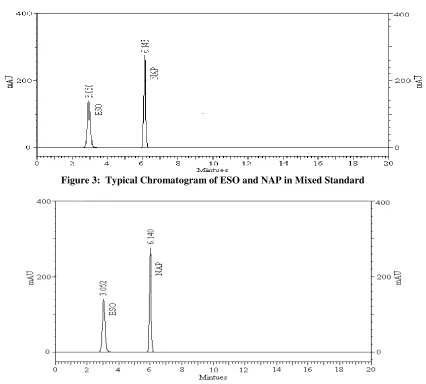
μg/ml of ESO and 50 μg/ml of NAP was prepared from standard stock solution and injected into HPLC system ( Fig. 3).
Analysis of tablet formulation:
Each tablet strength (brand name Vimovo) contains 20 mg of ESO and 500 mg of NAP. Twenty tablets were weighed and crushed into the glass mortar to obtain fine powder. The powder sample equivalent to 2 mg of ESO and 50 mg of NAP was weighed and transferred into a 100 ml volumetric flask and dissolved in 50 ml methanol HPLC grade. The flask was kept in an ultrasonic bath for 20 min. The volume was adjusted to 100 ml with methanol HPLC grade. The solution was filtered through
0.2 μ nylon membrane filter. From this stock solution, 1 ml solution was pipetted out and transferred to 10 ml volumetric flask and made volume up to the mark with mobile phase to get the concentration 2 μg/ml of ESO and 50 μg/ml of NAP. The solution was injected into HPLC system (Fig.4.). The results of the assay of tablet formulation and its statistical validation data are given in Table 2.
RESULTS AND DISCUSSION:
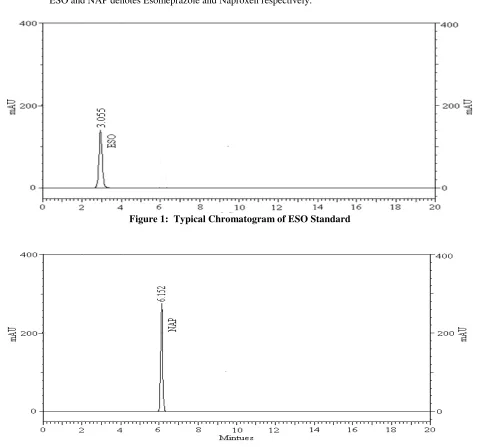
ESO and NAP were well resolved using mobile phase composition of Acetonitrile: 0.01 M Potassium dihydrogen phosphate buffer (60:40 v/v) at flow rate of 1 ml/min, UV detection wavelength 244.0 nm and injection volume 20 μl. The retention time for Esomeprzole and Naproxen were found to be 3.052 min and 6.140 min, respectively. The resolution between two peaks was found to be 9.55.
Method Validation:
Specificity: The specificity of the method is used to evaluate the homogeneity of drug peak.
Linearity: Linearity for ESO and NAP was selected at 2-30 μg/ml and 5-100 μg/ml. The results are shown Table 1.
Precision (repeatability): The results of the precision study indicate that the method is reliable (% RSD < 2).
Accuracy (recovery test): Accuracy of the method was performed at three levels, 80 %, 100 %, and 120 % of the label claim of the tablet (2 mg of ESO and 500 mg of NAP). The results are shown in Table 3.
Robustness: The robustness of a method is the ability of method to remain unaffected by small changes in parameters like mobile phase composition, flow rate, pH of mobile phase and temperature etc.
CONCLUSION:
Table 1: System Suitability Parameters
*Average of six readings
ESO and NAP denotes Esomeprazole and Naproxen respectively.
Figure 1: Typical Chromatogram of ESO Standard
Figure 2: Typical Chromatogram of NAP Standard
Parameter ESO NAP
Linearity range* (µg/ml) 2-30 5-100 Correlation coefficient* 0.9990 0.9987 Limit of detection (µg/ml) 0.012 0.051 Limit of quantitation (µg/ml) 0.070 0.095 Retention time* (min) 3.050 6.143 Resolution factor* - 9.55
452
Figure 3: Typical Chromatogram of ESO and NAP in Mixed StandardFigure 4: Typical Chromatogram of ESO and NAP in Tablet Formulation
Table 2: Analysis of tablet formulation
*Average of six readings
Tablet sample
Label claim (mg/tablet)
Amount found (mg/tablet)
% Label claim found*
± ±±
± Standard
deviation
Standard error
ESO 20 19.95 99.75 0.5404 0.2206
NAP 500 499.05 99.81 0.1091 0.0445
Table 3: Recovery studies
Drug Level of %
recovery % Mean*
Standard
deviation % RSD
Standard error
ESO 80 99.77 0.6765 0.6720 0.2762 NAP 80 99.87 0.1181 0.1182 0.0482 ESO 100 99.86 0.6274 0.6282 0.2561 NAP 100 99.72 0.0416 0.0417 0.0170 ESO 120 99.62 0.7125 0.7152 0.2909 NAP 120 99.76 0.0821 0.0829 0.0335
ACKNOWLEDGMENT:
The authors are thankful to BCUD, University of Pune for funding the research work, Padmashree Dr. D. Y. Patil College of Pharmacy, Akurdi Pune for providing excellent research facilities and Emcure Pharmaceuticals Ltd., Pune for providing the gift sample of Esomeprazole and Naproxen.
REFERENCES
1. Budhwari S., The Merck Index, 13th Ed., Merck Research Laboratories, Whitehouse Station, New Jersey, 2001, 6913, 6443.
2. Sweetmann S. C. Eds., Martindale, The extra pharmacopoeia, The complete drug reference. 36th Edn., Vol. I, The Pharmaceutical Press, London, 2009, 92, 1729.
3. Indian Pharmacopoeia, Vol. III, Govt. India Ministry of Health and Family Welfare, The Controller of Publication, New Delhi, 2007, 1473.
4. British Pharmacopoeia, 4th Ed., Vol. II, Her Majesty’s Stationary Office, London, 2004, 1357. 5. The United State Pharmacopoeia, 31st Ed., Vol. III,
United States Pharmacopoeial Convention Inc. Washington DC, 2008, 2760.
6. D, Moreno MA, Torrado S, Lastres JL. Comparison of derivative spectrophotometric and liquid chromatographic methods for the determination of omeprazole in aqueous solution during stability studies. J Pharm Biomed Anal. 1999;21:291–298. 7. Ozaltin N, Kocer A. Determination of omeprazole in
pharmaceuticals by derivative spectroscopy. J Pharm Biomed Anal. 1997;16:337–342.
8. Dogrukol AK, Tunalier Z, Tuncel M. TLC densitometric determination of omeprazole in pharmaceutical preparations. Pharmazie. 1998;53:272–273.
9. Petersen KU, Schmutzler W. Proton pump inhibitors release of active substance from various preparation. Detsche Apotheker Zeitung. 1999;139:68–69. 10. Sluggett GW, Stong JD, Adams JH, Zhao Z.
Omeprazole determination using HPLC with coulometric detection. J Pharm Biomed Anal. 2001;25:357–361.
11. Mathew M, Gupta VD, Bailery RE. Stability of omeprazole solutions at various pH values as determined by high performance liquid chromatography. Drug Develop Ind Pharm. 1998;21:965–971.
12. Ding L, Yang J, Yan HL, Zhang ZX, An DK.
Determination of omeprazole and its pharmacokinetic in human plasma by an improved HPLC method. Chinese J Pharm Anal. 1999;17:458–461.
13. Shim SH, Bok SJ, Kwon KI. Determination of omeprazole in rat plasma by HPLC with column switching. Arch Pharm Res. 1994;17:458–461.
14. Zhi XJ, Hunang J, Zhang JH, Wang HT, Zhang LL. Determination of omeprazole and its metabolites in plasma by RP-HPLC. Chinese J Pharm. 1999; 30:166–168.
15. Motevalian M, Saeedi G, Keyhanfar F, Tayebi L, Mahmoudian M. Simultaneous determination of omeprazole and its metabolites in human plasma by HPLC using solid phase extraction. Pharm Pharmacol Commun. 1999;5:265–268.
16. Yeung PK, Little R, Jiang YQ, Buckley SJ, Veldhuyzen SJ, Zanten VN. Simple high performance liquid chromatography assay for simultaneous determination of omeprazole and metronidazole in human plasma and gastric fluid. J Pharm Biomed Anal. 1998;17:1393–1398.
17. Kobayashi K, Chiba KO, Sohn DR, Kato Y, Ishizaki T. Simultaneous determination of omeprazole and its metabolites in plasma and urine by reversed phase high performance liquid chromatography with an alkaline resistant polymer coated C18 column. J Chromatogr B. 1992;117:299–305.
18. Amantea MA, Narang PK. Improved procedure for quantization of omeprazole and metabolites using reversed phase high performance liquid chromatography. J Chromatogr A. 1988;426:216– 222.
19. Hassan-Alin M, Andersson T, Bredberg E, Rohss K. Pharmacokinetics of esomeprazole after oral and intravenous administration of single and repeated doses to healthy subjects. Eur J Clin Pharmacol. 2000;56-1:665–670.
20. Johnson DA, Roach AC, Carlsson AS, Karlsson AA, Behr DE. Stability of esomeprazole capsule contents after in vitro suspension in common soft foods and beverages. Pharmacotherapy. 2003; 23:731–734. 21. Harry GB. Analytical profiles of drug substances
and excipients. Vol. 21. Elsevier, a division of Reed Elsevier India Pvt. Ltd., 2005; 345-373.
22. Toshi H., Shozo M., Ikea K. Simultaneous analysis of naproxen in human urine by high-performance liquid chromatography with normal solid-phase extraction. J Chromatogr. B: Biomed Sci Appl. 1997;692 (2, 9): 375-388.
23. Lotfi M., Frida D. Simultaneous determination of naproxen and related compounds by HPLC using porous graphitic carbon column. J Pharm Biomed Anal. 2003; 32(4): 1087-1092.
24. Mouiay H., Nadia A., Hocine C. Assay of Naproxen in Rat Serum by High- Performance Thin-Layer Chromatography. J Association of Analytical Chemists International. 2000; 83(6): 1489-1492. 25. Chan C. C. Analytical Method Validation and
Instrument Performance Verification, Wiley Interscience. 2004, 16-22.