e-ISSN: 2348-6465
Original Article
Isolation and characterisation of mosquitolarvicidal compound from
Gliricidia sepium
Jacq.Jiji Thomas
1,*,Shonima Govindan M
1, Muraleedhara Kurup G
21
School of Biosciences, Mahatma Gandhi University, Kottayam, Kerala, India.
2
Dept. of Biochemistry, Kariavattom, Kerala University, Trivandrum, Kerala, India.
A R T I C L E I N F O
A B S T R A C T_____________________________________________________________________________________
1.
Corresponding author *
Jiji Thomas, School of Biosciences, Mahatma Gandhi University,
Kottayam, Kerala, India.
1. INTRODUCTION
The Mosquitoes, commonly called “flying syringes”,
as they are sanguivorous vectors, cause more sufferings
to the humans than any other organism. It is not time to
forget the recent rampage of Chikungunya and Dengue
fever all over the state, pushing the people into death or
International Journal of Pharma Research and Health Sciences
Available online at
www.pharmahealthsciences.net
Received: 01 Apr 2014 Accepted: 20 Apr 2014
Objective: Isolation and identification of larvicidal phytochemical from the plant
Gliricidia sepium, which is commonly used for smouldering to repel mosquitoes.
Methods: Larvicidal activity of petroleum ether, hexane, acetone, methanol and water extracts of Gliricidia sepium leaves were assayed for toxicity against 4th instar larvae of
Culex quinquefasciatus. The larval mortality was observed after 24 h exposure. The crude
petroleum ether extract was further purified by column chromatography and eluates were tested for larvicidal activity. Selected one was identified by spectral analysis. Result: In the present study, bioassay- guided fractionation of G.sepium leaf extract led to the separation and identification of 8,11,14- eicosatrienoic acid as a potential new mosquitolarvicidal compound with LC50 value 0.011 mg/ml and LC90 as 0.060 mg/ml
against 4th instar larvae of Culex quinquefasciatus. GC-MS, FTIR, 1H NMR and 13C NMR spectral analysis confirmed the identification of active compound. Conclusion: This work could grab success in extricating ourselves by emanating a safe eco friendly solution from the plant Gliricidia sepium. As the source plant is ubiquitous in Kerala zone and the method of extraction is not any way cumbrous it may be easily manufactured and launched into the market for the effective application.
Thomas et al. Volume 2 (2), 2014, Page-173-178
at least to permanent ill health. Due to inadequate
management of land and water resources, and failure to
solve problems of waste management, more productive
habitats for mosquito continue to grow and, cause
diseases and intolerable annoyance. Culex mosquitoes
are vectors for Japanese Encephalitis, Lymphatic
Filariasis, West Nile Fever, St. Louis Encephalitis,
Avian Malaria etc. They are painful and persistent
biters and also attack in dusk and dark. An obvious
method for the control of mosquito borne diseases is
the use of insecticides, and many synthetic agents have
been developed and employed in the field with
considerable success .The botanicals might be used as
an alternative to other insecticides for the control of
mosquito and thus mosquito borne diseases, and hence,
such studies would be helpful in developing
plant-based anti-mosquito agents. 1 The use of botanicals for
mosquito management is gaining importance in the
recent years in view of their selective properties of low
cost and safety to ecosystem.
Gliricidia, belonging to the legume family Fabaceae, is
a medium sized tree known in different vernacular
names, Cacao in Honduras, Kakawate in Philippines,
Konnai in South India and Seemakonnai in Kerala.
Gliricidia is well known as a small semi deciduous
tree, in the tropics as well as sub tropics, where the
climate is seasonally dry and the soil is deep and well
drained. Planters grow this plant for affording shade, to
shade-loving crops like Coffee, Cacao and also as
hedge plants or fence posts along the boundaries. It
prefers vegetative propagation by stem cuttings to the
sexual reproduction by seeds.
2. MATERIALS AND METHODS
2.1 Culturing and maintenance of mosquito
Culex quinquefasciatus mosquitoes collected from
field were used for raising the colony. After
oviposition, eggs were collected in filter paper and kept
separately at 27±2 °C. The adult mosquitoes were
provided with water soaked raisins and cotton swabs
dipped in 5 % glucose solution. The female mosquitoes
were fed on blood meal. Plastic cups of 6 cm height
and 8 cm diameter lined with filter paper and half filled
with water were introduced into the cages for
oviposition. After the eggs were laid, the ovitraps were
taken out of the cages and fresh ones were placed in
the cages for subsequent ovipositions. After hatching,
the first instar larvae were transferred to an enamel tray
of 30×25×5 cm3 containing well water. The larvae
were fed on a diet of finely powdered biscuits and
yeast in the ratio 3:1. The water in the tray was
changed every day and dead larvae were removed.2
2.2 Collection and extraction of Plant materials
Leaves of Gliricidia sepium were collected from
Vagamon, located 1100 m above sea level at Idukki
district, in Kerala state. Fresh mature and healthy
leaves were chopped into small pieces, spread out and
dried under shade until they could be broken easily by
hand. Dried leaves were ground in an electric mixer,
and were used for soxhlet extraction using petroleum
ether, hexane, acetone, methanol and water as solvents.
The petroleum ether leaf extract which exhibited high
larvicidal activity 3, was extracted with various solvents
like chloroform, diethyl ether, acetonitrile, acetone and
methanol. Since acetonitrile fraction of the crude
extract showed maximum larvicidal activity, it was
selected for column chromatographic purification.
2.3 Purification of larvicidal compound by column chromatography
For the extraction, glass column of 1 cm diameter and
20 cm length was used. 300 mg of Silica gel 230-400
mesh size was taken in a beaker and prepared slurry by
pouring, 3 ml of chloroform. This mixture was
carefully transferred into the column. 10 mg extract
mixed with 1 ml chloroform was applied on the
column. 10 ml of chloroform was added and eluate was
ml/min and marked as ‘A’. After draining the first
solvent in the column, 15 ml of acetone: methanol (9:1)
was added and the eluates were collected in a rate not
more than 0.5 ml / min. It was named as ‘B’. After
draining the second solvent, 10 ml methanol was added
and collected the extract, which was named as ‘C’. The
three fractions were evaporated, dissolved in a small
volume of chloroform: methanol (2:1), and were stored
in refrigerator for further experiments.
The compound ‘B’ which shows maximum larvicidal
activity was selected for further studies. Isolation and
separation of the active ingredient in ‘B’, was done by
column chromatography using silica gel column and
acetone: methanol (9:1) solvents as described above.
Compounds, separated based on colour and named as
AM 1 to AM7, were subjected for larvicidal assay.
2.4 Spectral analysis
The GC-MS analysis of the phytochemical was carried
out by using a Shimadzu GC-17A with QP5050 with
the following specifications. An apolar 30 m DB-5
column (0.25 mm i.d.and 0.25 µm film thicknesses)
and helium as carrier gas were used (Agilent
techniques, USA). Injector temperature was 250 °C;
interface heating was 300 °C; ion source heating: 200
°C, EI mode; scan range was 40-600 amu. For
compound identifications NIST library spectra as well
as reference MS –spectra were used. FTIR
spectrometer, Shimadzu FTIR- 8400S was used to
investigate the functional group molecules and polar
bonds.1H NMR, 13C NMR spectra of phytochemical
was recorded using Bruker DRX-500 NMR
spectrometer.
2.5 Bioassay on larvae and pupae
For bioassay tests of all the crude extracts, larvae were
taken in four batches of twenty five and experimented
with 1000 ppm solution. After 24 h, number of dead
larvae was counted. The experimental media, in which
100 % mortality of larvae occurs, alone were selected
for isolation and purification of larvicidal compound.
The compound AM7 was subjected to dose response
bioassay to determine lethal concentrations at which
larvae and pupae showed 50 % (LC50) and 90 % (LC90)
mortality level by following the procedure of WHO [4]
with slight modification. 5The larvicidal phytochemical
extracted from G.sepium, was prepared in
concentrations ranging from 0.01 to 0.10 mg/ml using
0.1 % of Tween 20 as emulsifier. Sample in each
concentration was in replicates of four and, a control
containing only Tween 20 (0.1 %) was run for
comparison. 6 Twenty five numbers of 4th instar larvae
were used for the experiments. The larvae were fed dry
yeast powder. 7 The number of dead larvae at the end of
24 h was recorded and percentage of mortality was
calculated.
2.6 Statistical analysis
The larval mortality data were subjected to probit
analysis for calculating LC50, LC90, at 95 % confidence
limits.
3. RESULTS
The acetonitrile fraction of petroleum ether extract of
Gliricidia sepium leaf powder showed highest
larvicidal activity among all other fractions. In column
chromatographic separation, as the compound ‘B’
exhibited high mortality rate against larvae, it was
further purified. Among the seven compounds
obtained, spectral analysis of AM7 was carried out,
since the compound exhibited high larvicidal activity
among all the effluents. The yield of AM7 was found to
be 0.58 g /100g of leaf powder. GC-MS spectrum
indicated that the compound AM7 shows the structure
of 8, 11, 14-eicosatrienoic acid
(Dihomo-gamma-linolenic acid). It is with molecular formula C20H34O2
and molecular weight 306.48 g/mol. It is a
20-carbon-chain omega-6 fatty acid, unsaturated at positions 8,
Thomas et al. Volume 2 (2), 2014, Page-173-178
identity of the compound 8, 11, 14-eicosatrienoic acid.
In 13C NMR spectrum, the signals from 127.63-130.43
ppm revealed the presence of C=O. Signals appeared in
76.68-77.32 showed the presence of C=C carbons and
the signals of alkane carbon atoms were appeared in
the region of -0.02-31.52. Spectrum clearly exhibits the
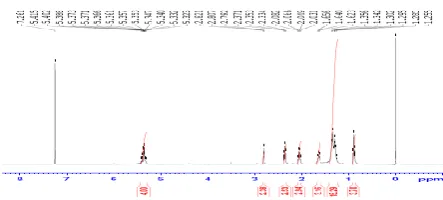
picture of 8, 11, 14-eicosatrienoic acid. 1H NMR
spectrum exhibits peaks due to H nuclei at different
environments. Peak at 2.3 ppm is due to proton at C2,
where the electron withdrawing _COOH group
decreases the electron density around the protons.
Ethylenic protons at C8, C9, C11, C12, C14 and C15
absorbs at higher ppm value (5.4) due to anisotropic
deshielding. Peak at 2.1 ppm is attributed to allylic
protons at C7 and C16. Protons at C10 and C13 absorb at
still higher ppm values (2.8). End –CH3 protons (at
C20) resonate at lower frequencies (0.97 ppm). Peaks at
1.3 ppm and 1.7 ppm are due to _CH2 groups at C3,
C4, C5, C6, C17, C18 and C19. In FTIR spectrum the
signal at 3011.51 cm-1 is due to OH stretching
vibration. Signal at 2927.01-1 is due to stretching
vibration of C-H and 1709.19-1 is due to stretching
vibration of C=O. Other bands assigned at 1267.89,
1458.10 and1046.49 correspond to the vibrations of
C-C, C=C and C-O groups. Studies using GC-MS, 13C
NMR ,1H NMR and FTIR spectra clearly showed that
compound AM7 isolated from G.sepium is
8,11,14-eicosatrienoic acid.
In bioassay test it was found that the compound Am7
(8,11,14-eicosatrienoic acid) was highly effective
against the 4th instar larvae of C.quinquefasciatus with
LC50, 11 ppm (0.010 LL-0.013 UL) and LC90, 60
ppm(0.327 LL-0.017 UL) at 95 % confidence limits.
Tween 20 did not exert any toxic effect as the control
showed no mortality.
4. DISCUSSION
Pipercide, a constituent of Piper nigrum have LC50
value 0.004 mg/l against C. Pipiens larvae. 8 The oil
resins from the Copaifera reticulate showed LC50 value
for the 4th instar larvae of C. quinquefasciatus as 80
ppm. 9 The combination of Neem and Karanja oil
exhibited an LC50 of 0.06, 0.038 and 0.048 % against
the larvae of Culex quinquefasciatus, Aedes aegypti
and Anopheles stephensi respectively. 10
8, 11, 14-eicosatrienoic acid is a fatty acid which is an
intermediary in the synthesis of prostaglandin. Though
prostaglandins are present in plants 11, no report seems
to be available regarding the toxic activity of
prostaglandins against mosquitoes. Similarly, though
many fatty acids were reported to have the
mosquitocidal activity 12, this is the first report
establishing the toxicity of 8, 11, 14-eicosatrienoic
acid.
Fig 1: GC-spectrum of compound AM7
Fig 2: MS spectrum of the compound AM7
Fig 3: 13C NMR spectrum of AM7 isolated from G.sepium
50.0 75.0 100.0 125.0 150.0 175.0 200.0 225.0 250.0 275.0 0.0
25.0 50.0 75.0 100.0 %
41 67 79
55
95 93
108 121 135
Fig 4: 1H NMR spectrum of AM7 isolated from G.sepium
4000.0 3600 3200 2800 2400 2000 1800 1600 1400 1200 1000 800 600 400.0
86.7 88 89 90 91 92 93 94 95 96 97 98 99 100 101 102 103 103.8 cm-1 %T 3011.51 2927.01 2856.48 1709.19 1458.10 1267.89 1046.49 879.61 714.24 1086.59 927.20
Fig 5: FTIR spectrum of AM7
5. CONCLUSION
In the present paper we report the larvicidal activity of
the compound 8, 11, 14-eicosatrienoic acid extracted
from leaves of Gliricidia sepium against Culex
quinquefasciatus. The results of the present study
would be useful in promoting research aiming at the
development of new agent for mosquito control based
on bioactive compounds from indigenous plant source.
There is no report of 8, 11, 14- eicosatrienoic acid in
the genus Gliricidia and, their larvicidal activity is
being evaluated for the first time. Results of this study
show that the petroleum ether extract of G. sepium may
be considered as a potent source and 8, 11, 14-
eicosatrienoic acid as a new natural mosquitocidal
agent.
6. ACKNOWLEDGEMENTS
Author1 is thankful to University Grants Commission,
New Delhi (UGC Letter no: F.FIP/KLMG068TF01
dated on 21-01-2009) India for providing financial
support.
7. REFERENCES
1. Mandal S. Mosquito vector management with
botanicals- the most effective weapons in
controlling mosquito-borne diseases. Asian Pacific
J Trop Biomedicine 2012; 336-336.
2. Gerber FJ, Barnard DR, Ward RA. Manual for
mosquito rearing and experimental techniques.
Am Mosq Centr Assoc Bull 1994; 5, 1-98.
3. Thomas J, Govindan SM, Muraleedharakurup G.
Larvicidal activity of Gliricidia sepium against
Culex quinquefasciatus. Int J Pharma and Biosci
2012; 3(3)614-618.
4. World Health Organization. Report of the WHO
informal consultation on the evaluation and testing
of insecticides CTD/WHO PES/IC.Geneva,
Switzerland, 1996; p.69.
5. Rahumann AA, Gopalakrishnan G, Ghouse BS,
Arumugam S, Himalayanm B. Effect of Feronia
limonia on mosquito larvae. Fitoterapia 2000; 71,
553-555.
6. Sathishkumar M, Maneemegalai S. Evaluation of
Larvicidal effect of Lantana camara Linn against
mosquito species Aedes aegypti and Culex
quinquefasciatus. Advan Biol Res 2008; 2(3-4),
39-43.
7. Senthilnathan S. The use of Eucalyptus
tereticorinis SM (Myrtaceae) oil (leaf extract) as a
natural larvicidal agent against the malaria vector
Anopheles stephensi Liston (Diptera culicidae).
Bioresource Tech 2007; 98, 1856-1860.
8. Park IK, Lee SG, Shin SC, Park JD, Ahn YJ.
Larvicidal Activity of isobutyl amides identified in
Piper nigrum fruits against three mosquito species.
J Agric Food Chem 2002; 50, 1866−1870.
9. Silva IG, Zanon VOM, SilvaHHG. Larvicidal
activity of Copaifera reticulate Ducke oil-resin
against Culex quinquefasciatus Say (Diptera:
Culicidae). Neotropical Entomol 2003;
32,729-732.
10. Shanmugasundaram RT, Jeyalakshmi T, Sunil Dutt
M, Balakrishna Murthy P. Larvicidal activity of
Neem and Karanja oil cakes against mosquito
Thomas et al. Volume 2 (2), 2014, Page-173-178
aegypti (L.) and Anopheles stephensi (L.). J
Environmental Bio 2008; 29(1), 43-45.
11. Groenewald E G, Westhuizen A J. Prostaglandins
and related substances in plants. The Botanical
Review 1997; 63(3), 199-220.
12. Kishore N, MishraB B, Tiwari V K, TripathiV. A
review on natural products with mosquitocidal
potentials. Opportunity, challenge and scope of
natural products in medicinal chemistry, 2011;
335-365.
Conflict of interest statement