The Journal of Public Space 2017 | Vol. 2 n. 1
https://www.journalpublicspace.org
Piano at the ground level
Laura Camargo, Gabriela Tenorio
University of Brasília, Campus Universitário Darcy Ribeiro, Brazil Faculty of Architecture and Urbanism
[email protected] | [email protected]
Abstract
From observing the current dynamics of cities and the development of contemporary architecture, great criticism arises in response to the creation of iconic buildings as formal experiments that do not contribute to the local experience. Motivated by this criticism, this paper aims to analyse and understand the importance and the participation of architecture in the construction of a better public realm. The analytical method seeks to understand,
evaluate and manipulate the main attributes of a public space based on the features that make it a platform for public life. The analysis focuses on the public realm in three areas of study- the space resulting of the interaction between the buildings, the interstitial space and the constructed spaces. The projects chosen to analyse consisted on iconic buildings by the architect Renzo Piano, due to his international recognition - a body of work shaped by the contexts in which they operate. The projects are situated in global cities and propose new configurations of public space: Centre Georges Pompidou, Paris; Potsdamer Platz, Berlin; and Saint Giles Court, London. The analysis seeks the features that make architecture successful in the sense that it aggregates people and creates interesting spaces that favour human permanence; the paper evaluates whether the projects of Renzo Piano display these features. Each project has its own particularities. Starting with the dimensions, each project contributes to the public space at a different scale. Nevertheless, the variables analysed were the same for each context, and the effects were considered regarding the proportions and the
programmatic possibilities offered by each. After understanding the site and its history, the study of the public life and its local attributes, this paper highlights the strengths and
weaknesses of each building and how they contribute to the specific place. The interpretation of the results took into account not only the present, but also the lifetime of each project, raising some potential problems or successes for the future. It is possible to conclude that the three projects contribute positively to the public space, stimulating urban improvements and constitute good-practice examples, each at a different intensity.
Keywords: architecture; public space; pedestrian; insertion; Renzo Piano.
THE JOURNA
L OF PUBLIC SPACE
To cite this article:
Camargo L., Tenorio G. (2017). Piano at the ground level, The Journal of Public Space, 2(1), 57-68, DOI: 10.5204/jps.v2i1.50
This article has been peer-reviewed and accepted for publication in The Journal of Public Space. Please see the Editorial Policies under the ‘About’ section of the journal website for further information.
Piano at the ground level
Introduction
From observing the dynamics of the city, some criticism arose with regard to the creation of iconic buildings as isolated forms that render little contributions to people’s experience of a certain site. Since the architecture of the streets, urban blocks, squares and its
relationship with the pedestrians can influence public spaces the present research intends to evaluate emblematic contemporary projects in terms of their participation and
importance for building a better public space. In order to do that, we look for the
features that make such projects successful, by aggregating people and creating interesting spaces that favour permanence.
A growing concern with the presence of architecture in the urban context can be
observed nowadays amongst scholars. Constantly analysing the resulting spaces in the city and seeking to make the cities attractive to their inhabitants, they say that the architects should try to create places that are not only visually attractive, but also respond efficiently to the needs and aspirations of the people who use those spaces.
Holanda (2010: 28) defines architecture as an independent variable: a “place enjoyed as a means to satisfy functional, bioclimatic, economic, sociologic, topologic, affective, symbolic and aesthetic expectations, based on values which can be universal, or pertaining to a group, or individual”. By identifying the aspects that characterise architecture and the many kinds of performance before social expectations, it is possible to analyse the quality of the resulting spaces.
This raises a very important question: what makes a building belong to the site where it is? What can the architect provide to the society in order to construct cities for people? In the present paper, the focus is the city’s configuration, its performance and how it affects the pedestrians in particular. Thus, being properly placed at the ground level and responding to the flow and needs of people that use the space are strategies that make architecture better fit the urban context.
In order to analyse the architecture within the framework suggested by Holanda (2010), the paper considers functional aspects (related to activities) and sociologic aspects (related to the presence of people in public spaces).
Method
The present paper applies the method developed by Tenorio (2012). The aim is to analyse how new buildings can influence public life in the resulting urban spaces. A brief description of the method and its phases of application are presented below.
A. Information about the object of study
In order to gather information about the project and the surrounding area, data for understanding the history of the neighbourhood and the changes the project brought to the region is collected. In addition, information about the architect’s expectation when conceiving his projects allows us to evaluate whether these expectations came to life. How does the architect suggest that the dialogue between building and public space take place?
B. Survey and evaluation of public life: subjects and activities
Laura Camargo and Gabriela Tenorio
the presence of people. The definition of ‘success’ in this particular case refers to the number and variety of people and activities present.
Unlike what it is proposed by Tenorio (2012), for whom the characteristics should be measured in loco, the present paper analyses public life based on the memories of people who have been to the site, according to Lynch (2010). The population sample available for an interview was outsiders, a group of Brazilian tourists, from both genders, who were asked to register their memories about who used and how they used the public spaces they visited.
C. Evaluation of public space: Configurational elements/Local Attributes
Regardless of the results obtained for public life, it is necessary to analyse the variables of configurational elements that influence the maintenance of public live, positively or negatively.
The items analysed refer to local attributes, since the focus of this work is on
performance of the building within the public space immediately surrounding it. These items are: (1) Location: the place must be a passage to another site, being positioned at, or close to, well connected lines within the city’s street system. (2) Limits and
dimensions: the space must have clear limits, and dimensions in consonance with its characteristics. Alexander et el. (1977: 518) claims that a positive outdoor space – “the one that has a distinct and definite shape, as definite as the shape of a room” – makes people feel comfortable and, therefore, use them. (3) Types of buildings: the surrounding buildings must be of different types, have different characteristics and display a variety of people and activities. (4) Doors and windows: the limits of the place must have several doors and windows facing it, which according to Jacobs (2009) provide informal surveillance and increase the sensation of security. In addition, according to Tenorio (2012), the limits must have mild borders - or soft edges, as mentioned by Gehl (2006) - elements that favour the transition and interaction between public/private, preferably at the same level, keeping people at the public space. (5) Level: the site must be at ground level, following the topography, thus allowing accessibility and favouring the visualization of activities. Whyte (2009: 58) stresses that plazas that are sunk or higher than a foot must be avoid because they tend to be dead places. (6) Access and circulation: the place must be accessible for public and non-motorized transport, offer good conditions of access and circulation for pedestrians. (7) Activities on the limits and surroundings: they must be varied and well distributed, spatially and temporally.
The analysis was carried out by filling out the tables proposed by Tenorio (2012), and each item was answered by using a colour scale, going from red to green, indicating the worst situation and the best performance respectively. The justifications necessary were taken from studies of the graphic material and literature available about the site; from
Google Street View for surveying the field and pictures, videos and maps available online;
from axial maps of global integration; map of convex spaces including the openings to public space (doors). These last two maps are resources from the Space Syntax (Hillier & Hanson, 2003).
Piano at the ground level
Case study
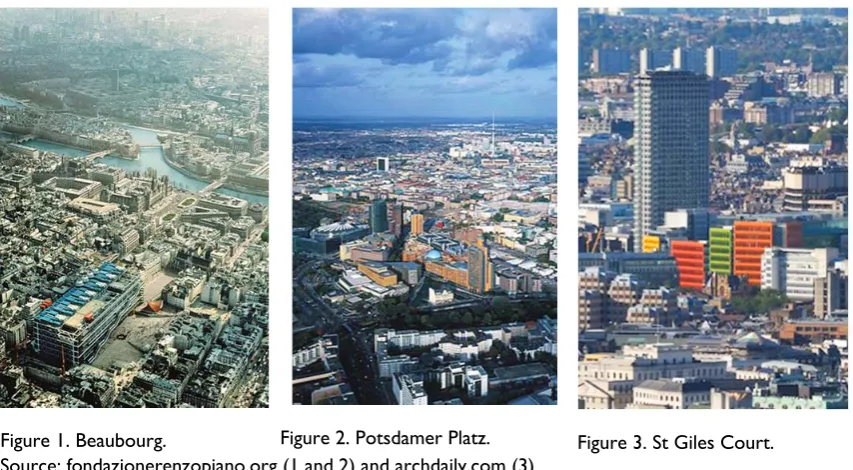
The study examines three works: Centre Georges Pompidou, Paris; Potsdamer Platz, Berlin; and St Giles Court, London. Each Project has its particularities and contributes to public life in a different scale. Centre Georges Pompidou, as a single building, St Giles Court, as a set of buildings and Potsdamer Platz, as a set of blocks. The variables analysed were the same and the effects were considered within the proportions and possibilities of each site.
Figure 1. Beaubourg.
Figure 2. Potsdamer Platz. Figure 3. St Giles Court. Source: fondazionerenzopiano.org (1 and 2) and archdaily.com (3)
The three works are located in centres of global cities, and they are a symbol of a proposal for a new configuration of the public space. The Italian architect Renzo Piano, chosen due to his vast architectonic production, extensive available bibliography about his work and international recognition, designed the three selected projects.
According to Buchanan (1993), Piano produces an architecture shaped by the site where it is located, by the program that it serves and by the historical moment when it is built, in terms of the technology available. Moreover, the author states that his architecture does not impose on the site, but rather responds to it, adopting some local characteristics and intensifying others, by complement or contrast. For Piano, it is important that the
architecture does not fragment the city, and this is the reason why he tries to make it intensely integrating, making it a part of that period of time and that site, participating of the social life and the surrounding nature in many ways.
Therefore, we intend to verify if the buildings are well placed in the urban context and understand how architecture influences the public space, looking for the characteristics that make his projects successful or not.
Centre Georges Pompidou | Paris, France | 1971-1977
A. Information about the object of study
Georges Pompidou Centre, also known as Beaubourg, is located in Marais, 4th
arroundissement of Paris, a privileged area for art lovers, with numerous art galleries and
Laura Camargo and Gabriela Tenorio
after a contest, whose aim was to bring culture to a more popular level (not being
restricted to the elites), and today the region is home to the second greatest collection of modern art in the world. The museum was named after the then president of France, who sought to make art more popular. The wining proposal was expected to be a building not only capable of offering leisure and cultural activities, but also a space to produce culture. The intention was to create a building, which was an extension of the public space, represented mainly by the square in front of it. In addition to the expressive-symbolic meaning, Beaubourg was a great addition to the region, and became an active instrument of urban and social functions.
B. Survey and evaluation of public life: subjects and activities
Out of the questionnaires handed out, 20 were answered between 2006 and 2012, 7 of which were pertaining to visits made on summer time, and 13 in winter.
Most of the people interviewed considered the place very active, with a well-balanced gender presence. They indicated the predominance of groups formed by young white students and tourists, middle-class or upper middle-class people. However, the groups present did not intimidate other groups; hence, their presence did not interfere negatively with the quality of public life.
Pompidou and its surroundings can be considered a place of passing and permanence according to most of the people interviewed, which also identified that a number of people remained there for a reasonable amount of time. Most of the people interviewed identified passive and active activities on the borders of the site. They remembered cultural activities, concerts, people interacting and showing affection and joy.
C. Evaluation of public space: Configurational elements/Local Attributes
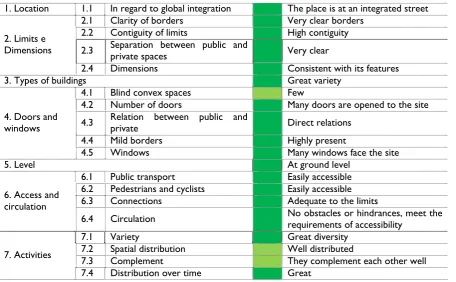
Table 1. A Summary of the evaluation of configurational elements for Centre Georges Pompidou. Source: adapted from Tenorio, 2012.
1. Location 1.1 In regard to global integration The place is at an integrated street
2. Limits e Dimensions
2.1 Clarity of borders Very clear borders 2.2 Contiguity of limits High contiguity 2.3 Separation between public and private spaces Very clear
2.4 Dimensions Consistent with its features
3. Types of buildings Great variety
4. Doors and windows
4.1 Blind convex spaces Few
4.2 Number of doors Many doors are opened to the site 4.3 Relation between public and private Direct relations
4.4 Mild borders Highly present
4.5 Windows Many windows face the site
5. Level At ground level
6. Access and circulation
6.1 Public transport Easily accessible 6.2 Pedestrians and cyclists Easily accessible
6.3 Connections Adequate to the limits
6.4 Circulation No obstacles or hindrances, meet the requirements of accessibility
7. Activities
7.1 Variety Great diversity
7.2 Spatial distribution Well distributed
7.3 Complement They complement each other well
Piano at the ground level
(1) Pompidou is in the central region of Paris, very close to the biggest and busiest subway station of the city. We can say the building is centralised, well connected and integrated to the urban context. Analysing the traffic demand in the surroundings, it is possible to observe that, even in days with less traffic, the street du Renard/Beaubourg is intensely used, being considered a place of daily passing.
(2) Beaubourg square, in front of Pompidou, is represented by a minimum of convex spaces, consistent with the in loco perception. A sequence of traditional Parisian facades, clear, tridimensional and contiguous elements configure the square. The separation of public and private space is clear. The dimension of the square is of a large area (more than 8000m2): one comes from small convex spaces, the narrow streets of the old
Parisian neighbourhood, and arrives at a large square, created to receive visitors and make the transition of scale between different buildings. This square is part of the
architecture of the building, since it is responsible for its connection with the city and the pedestrians.
(3) Amidst traditional typological solutions, Pompidou broke paradigms with its innovative concept, and contributed to a variety of types of building in the region. The building is placed in a neighbourhood predominantly occupied by 18th century mansions; however, different buildings are also present: Atelier Brancusi, IRCAM, Saint-Merri Church and a Sports Centre. The plots of land vary in size, but the blocks are regular, with diversified internal patios, enabling different occupations and values.
(4) Although the surroundings have many openings, such as doors and windows facing the public space, the building itself has very few doors and this does not positively contribute for the public space. The panoramic escalators are the representation of Pompidou’s windows to the public space. The visitor has their attention caught when making his way up; his eyes are taken from the local to the urban scale. The public/private transition is clear, and it happens in the balconies of restaurants or doors and with well-established limits, when it comes to a non-commercial activity. The borders are mild and present several elements that encourage the permanence of people and make the transition from public to private space.
(5) The difference in level between the local streets and the square that gives access to the building can be considered well planned, since its presence does not make the space inaccessible. The transition is gradual, so both the access to surrounding buildings and to the Beaubourg is at ground level, with no hindrances. The result of this level difference is a set of step forming a grandstand, a place intensely used for several activities.
(6) The access to public transport is varied and efficient. The main access streets all have segregated cycle facilities. In addition, there is a bicycle renting station in Beaubourg Square and other five stations close by. The access of pedestrians is easy due to the variety of transportation available, and it is a priority in the region: Beaubourg square and some other surrounding streets are exclusive pedestrian zones. The connections are direct, at ground level, and meet the accessibility requirements.
(7) The limits and surroundings of the place feature a great variety of activities. It is visible, however, a decline in the activities of commerce in Rue Renard, facing the blind facade of the Pompidou. The activities and the movement of people predominate in Beaubourg Square, in front of the main façade. On this side, the activities are well
Laura Camargo and Gabriela Tenorio
In conclusion, the building is part of the city, the pedestrian values and promotes the maintenance of public life, with proper physical structure to develop several social, cultural and artistic activities. It is possible, therefore, to consider the project a positive contribution to its urban context.
Potsdamer Platz | Berlin, Germany | 1992-2000
A. Information about the object of study
During the twentieth century, Berlin underwent two possible extreme scenarios for the development of a city. It had been the center of European cultural and social life but it was also a city destroyed by war. The Potsdamer Platz had played an important role in history, being the center of cultural life in Berlin before the World War II devastated the city and the Wall divided it.
After German reunification in 1992, the German company Daimler-Benz organised an international competition for the general planning of the Potsdamer Platz. The challenge was to rebuild a part of Berlin in 5 years. Reconstruction would be symbol of the consolidation and reunification of the city. The winning design by Renzo Piano was the one that included the construction of a new square, Marlene Dietrich Platz. Considering the square a key element in the development of the dynamics of urban social life, this element constitutes the cornerstone of the project.
B. Survey and evaluation of public life: subjects and activities
Of the questionnaires distributed, 13 were answered based on visits that occurred between 2007 and 2013, out of which 8 were in the summer and 5 in winter.
Most people consider the place very active, with well-balanced of gender and age range presence. The indicated groups were: young and old, tourists and locals going to work, of both genders. Thus, the predominant groups do not intimidate to the presence of other groups, without any restrictions and contributing to the variety of people on the site. The Potsdamer Platz can be considered a place of passing and permanence, according to the interviews. As for duration, the responses were balanced in the 3 options featuring longer periods of time. More than half of respondents viewed and remembered passive and active activities taking place on the site and its borders. Most respondents believe that the activities were motivated by the presence of people on the site and they remembered people observing, interacting and even showing affection and joy.
C. Evaluation of public space: Configurational elements/Local Attributes
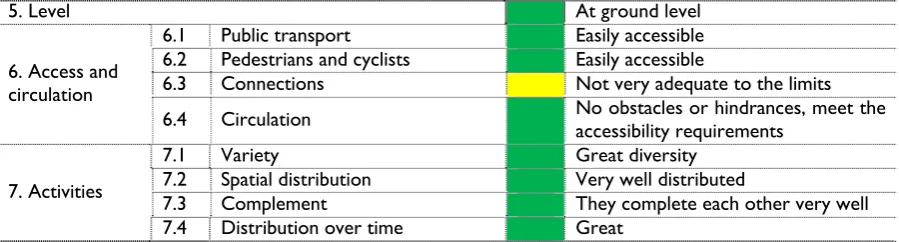
1. Location 1.1 In regard to global integration The place is at an integrated street
2. Limits e Dimensions
2.1 Clarity of borders Very clear borders 2.2 Contiguity of limits High contiguity 2.3 Separation between public and private spaces Very clear
2.4 Dimensions Consistent with its features
3. Types of buildings Great variety
4. Doors and windows
4.1 Blind convex spaces Few
4.2 Number of doors Some doors are open to the site 4.3 Relation between public and private All direct relations
4.4 Mild borders Present
Piano at the ground level
5. Level At ground level
6. Access and circulation
6.1 Public transport Easily accessible 6.2 Pedestrians and cyclists Easily accessible
6.3 Connections Not very adequate to the limits
6.4 Circulation No obstacles or hindrances, meet the accessibility requirements
7. Activities
7.1 Variety Great diversity
7.2 Spatial distribution Very well distributed
7.3 Complement They complete each other very well
7.4 Distribution over time Great
Table 2. A Summary of the evaluation of configurational elements for Potsdamer Platz. Source: adapted from Tenorio, 2012.
(1) The Potsdamer Platz is located in central Berlin, where well-connected streets predominate. Even on days with less movement, the access roads to the site are
considered very busy. Thus, it can be considered well integrated into the urban context and a place of daily passing.
(2) It is represented by minimum convex spaces consistent with the perception in loco. The Platz is composed of small local streets and a larger main street. The limiting elements are clear, three-dimensional, and continuous and follow a well-defined design. The configuration of the street is clear, and the facades of buildings create a linear, continuous and dynamic scenario. The public / private separation is clear and straightforward, consisting of well-defined limits.
(3) Renzo Piano made the master plan and developed 8 buildings. The others were works of other architects within the parameters established. The variety of types occurs due to the shape of the plots and the difference in the land use established, since these variables lead to a different program of needs and different solutions for each.
(4) The Alte Potsdamer Strasse has no blind convex spaces, and you can see that the buildings designed by Renzo Piano have a greater number of doors to the public space than the others. The transition from public to private is clear; the limits are
tri-dimensional and well defined. The path offers a series of distractions to pedestrians, with mild borders for the public / private transitions. The borders can be restricted to the pub tables, but the place features lots of windows and storefronts. This fact contributes positively to the quality of public space as a whole and distracts pedestrians, keeping them in the public space.
(5) The buildings designed by Piano take into account a direct connection with the public space, with access at ground level, without hindrances or obstacles. It is also possible to observe how the passers-by use the level difference in the Marlene Dietrich Square, which becomes the same level of the surrounding buildings. Besides of working the level differences as an element to increase accessibility and free circulation, the result is intensively use by the visitors, as an open bleacher.
Laura Camargo and Gabriela Tenorio
the connections of the place with its limits are frequent and occur safely, and they meet all accessibility requirements.
(7) The limits and the surroundings of Potsdamer Platz feature wide variety of activities: commerce, restaurants, cafes, hotel, residences, offices, and cultural facilities. These activities are well distributed throughout the complex, complement each other well, and keep the place busy both during the day and at night.
It is possible to attest that the complex is accessible to pedestrians, well located, offers varied public transport, it is safe and presents a wide range of activities in its surroundings during the day. Therefore, we can conclude that the project proposed by Piano for the city contributes positively to the urban context.
St Giles Court | London, England | 2002-2010
A. Information about the object of study
The mixed-use complex Saint Giles Court is part of a complex urban network, composed of medieval streets, modern buildings and traditional blocks. It is located at Camden, an area famous for having been one of the worst slums in London. In the early 50s, a corporate building with the same name was constructed there. At first, its presence did not contribute to the development of the area.
In 2002, however, St. Giles was indicated as an area of recovery under the Strategic Plan of London for the development of the city, and Renzo Piano was called in to create a new project. The challenge was to conceive a building that could increase the number of activities and foster public life in the region. Thus, the original intention primed with the mixture of land uses and diverse activities. The project is made up of complex volumes, similar to the surrounding buildings. Piano decided to place the buildings around a central patio, composed of activities for the general public, such as stores and restaurants. The central square is composed of many openings that aim at inviting the pedestrians to come by, creating a new route in an already consolidated urban context.
B. Survey and evaluation of public life: subjects and activities
Out of the 18 questionnaires applied, only 5 were actually answered, referring to visits made during the period of 2011 and 2012. Thus, 13 people visited the city after the building was inaugurated (05/2010), but they did not recognise it, which shows that the place has not yet been consolidated as a tourist attraction or a route between two other touristic sites. Amongst the answers obtained, 1 person visited the place in summer and 3 in winter, and the fifth person visited the place several times, since she lived in London. According to the answers obtained, the place is busy, with a balance in gender presence; however, there is little variety in age range and social class. In spite of this apparent unbalance shown by the answers, most of the people interviewed believe there was not a prevalence of certain groups at the site. The prevailing groups were: adult males, possibly entrepreneurs, which can be positive for the public space in workdays, but can be
Piano at the ground level
C. Evaluation of public space: Configurational elements/Local Attributes
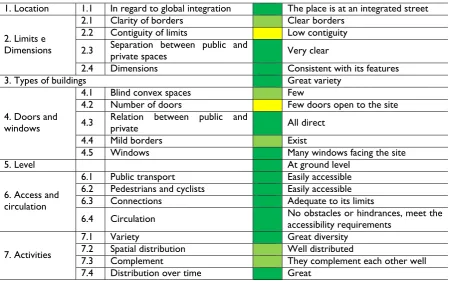
1. Location 1.1 In regard to global integration The place is at an integrated street
2. Limits e Dimensions
2.1 Clarity of borders Clear borders 2.2 Contiguity of limits Low contiguity 2.3 Separation between public and private spaces Very clear
2.4 Dimensions Consistent with its features
3. Types of buildings Great variety
4. Doors and windows
4.1 Blind convex spaces Few
4.2 Number of doors Few doors open to the site 4.3 Relation between public and private All direct
4.4 Mild borders Exist
4.5 Windows Many windows facing the site
5. Level At ground level
6. Access and circulation
6.1 Public transport Easily accessible 6.2 Pedestrians and cyclists Easily accessible
6.3 Connections Adequate to its limits
6.4 Circulation No obstacles or hindrances, meet the accessibility requirements
7. Activities
7.1 Variety Great diversity
7.2 Spatial distribution Well distributed
7.3 Complement They complement each other well
7.4 Distribution over time Great
Table 3. A Summary of the evaluation of configurational elements for St Giles Court. Source: adapted from Tenorio, 2012.
(1) St Giles Court is located in central London, where well-connected streets prevail. Through the analysis of local traffic, it is possible to conclude that the area is well integrated to the urban context and is a place for daily passing.
(2) The place is represented by convex spaces, consistent to the perception in loco, according to its function and hierarchy in the urban context. The limits and surroundings are clear, tri-dimensional and continuous. The separation between public and private spaces is clear, however, the facades make a non-linear and fragmented scenario. There is variety in size and the complex characteristics of urban fabric in that region provide a non-linear and fragmented configuration, hindering the definition of a prevailing route. (3) The pre-existing buildings present varied typologies and it is possible to see the presence of new and different constructions. St Giles Court encompasses a set of standard buildings that stand out from the other surrounding buildings. The shape and content it houses are different from the surroundings, which is a positive factor for the region.
Laura Camargo and Gabriela Tenorio
(5) All the area under the marquise and the internal side of the atrium is for the
pedestrian. The sidewalk and the access are with no hindrances of level differences, at the level of the square and the access to the building.
(6) The access to public transportation is varied and efficient. Cyclists have cycle lanes in the main access roads and there is a bicycle rental station in the complex, and two others nearby, in a 300m radius. The access to pedestrians is easy thanks to the variety of public transport available and to the treatment; the level has received, with no hindrances or obstacles. The access is direct, and the connections are at ground level, meeting the accessibility requirements.
(7) The limits and surroundings of St. Giles present great variety of activities, but not a great number. The presence of residences, restaurants, cafes and offices in the building itself, and its proximity to commercial streets, tourist equipment and cultural facilities increases the dynamic characteristic of the region, keeping the place active most of the day. The activities are not well distributed spatially, since the access to them in not always facing the region under analysis. In addition, the activities offered at St Giles Court could be more diverse, since solely restaurants and cafes occupy the ground floor. It would be interesting to add other types of activities in order to increase the variety of people using the space, and for a longer period.
Taking into consideration that the surroundings by the time of the analysis had
unfavourable conditions for the public life, St Giles Court complex is an important vector for the improvement of quality of public life in the public space at this area.
Conclusion
The analysis of public space near great, emblematic projects is a useful and accurate tool to evaluate contributions of these interventions in their respective urban contexts, and how architects proposes the transition of the building they project and the public realm. It would be interesting to make an analysis prior to the urban development and later re-do it at a fixed time intervals, in order to check whether the building has brought the improvements the architects had anticipated.
It is possible to conclude that the three projects studied contributed positively for the urban space. The extent of their contribution, however, does not depend exclusively on their physical attributes, but also on the quality of public life present in the context where they were placed, which can be a negative factor. Moreover, the time lapse since the construction of the building must be taken into account. The passing of time is necessary for a building to put down roots and truly become a part of the place. An example is St Giles Court, which presented the worst performance in the study.
It is the most recent building of the sample (inaugurated in May 2010), and the fact that very few people visited it in their recent trips to the city may be a sign that it has not yet been entirely embraced by the urban fabric, or it has not yet become part of an
interesting path. The place is characterised more as an area of passing than permanence. The project is bold and it is what the region needed, something to make social life more dynamic, however it has not yet reached the highest point of its potential contribution to urban life.
Piano at the ground level
the region, being intensely used by both local inhabitants and tourists, living up to the aspirations of Piano when drafting the Master plan.
Center Georges Pompidou, the project that received the best evaluation and best quality of urban presence, is also the oldest in the sample (1977), and it is completely integrated to the city. However, roots are not enough for a project to foster a good quality public space. The vitality of the region shows that it is important that the site continues to offer various activities and that it is constantly renewed, paying attention to the quality and maintenance of the physical space.
Piano believes that the work of an architect is unfinished, because human relations and the cities where they take place are in constant evolution. The architect plants something new, but its future cannot be foretold. Thus, the architect must choose a solid starting point for his project when stating values and ethics or consolidating intentions. Based on the analysis carried out, we can confirm that the starting point chosen by Renzo Piano for the conception of each of his three projects is solid. The three of them positively
influence the surroundings and add something to the region. We can say that his work materialises his discourse.
“
As an architect, I think that places influence every perception,every emotion, every human activity”.
Renzo Piano, 1997
References
Alexander, C.; Ishikawa, S.; Silverstein, M. (1977), A Pattern Language: Towns, buildings, construction.
New York: Oxford University Press.
Buchanan, P. (1993). Renzo Piano Building Workshop: complete works. (Vol. 1). London: Phaidon.
Buchanan, P. (1995). Renzo Piano Building Workshop: complete works. (Vol. 2). London: Phaidon.
Buchanan, P. (1997). Renzo Piano Building Workshop: complete works. (Vol. 3). London: Phaidon.
Buchanan, P. (2000). Renzo Piano Building Workshop: complete works. (Vol. 4). London: Phaidon.
Buchanan, P. (2008). Renzo Piano Building Workshop: complete works. (Vol. 5). London: Phaidon.
Gehl, J. (1987) Life between buildings: Using public space. Washington - Covelo - London: Island
Press.
Hillier, B.; Hanson, J. (2003) The social logic of space. Cambridge: Cambridge University Press.
Holanda, F. (2010) Brasília: Cidade moderna, cidade eterna. Brasília: FAU UnB.
Jacobs, J. (2009). Morte e vida de grandes cidades. São Paulo: Martins Fontes.
Jodidio, P. (2008). Piano: Renzo Piano Building Workshop 1966 to today. Cologne: Taschen.
Lynch, K. (2010). A imagem da cidade. 2 ed. São Paulo: Martins Fontes.
Piano, R. (1997). Carnet du travail. Paris: Seuil.
Rodrigues, F de M (1986). Desenho urbano: cabeça, campo e prancheta. São Paulo: Projeto.
Tenorio, G. (2012). Ao desocupado em cima da ponte: Brasília, arquitetura e vida pública. Brasília: FAU
UnB.